Friday, 24 March 2017

One Rank One Pension Scheme


One Rank One Pension Scheme

One Rank One Pension Scheme OROP


Around 3200 representations for addressing the anomalies on One Rank One Pension (OROP) were received from individuals / Associations which were examined and issues referred to the Judicial Committee on OROP for its recommendations. The Committee has submitted its report on 26.10.2016.

Pension Grievances Cell in the Department is receiving grievances of the pensioners / family pensioners regarding non-payment of OROP benefits and taking up the matter with the concerned offices e.g. Controller General of defence Accounts (CGDA), Principal Controller of Defence Accounts (Pension) and Pension Disbursing Agencies (Banks) for redressal of their grievances in a time-bound manner. Service Headquarters and CGDA also have dedicated grievances Directorates / Cells for redressal of the grievances of Ex-Servicemen. Disposal of the grievance is monitored at the highest level in the Government.
Annual Financial implication on account of grant of OROP is estimated at Rs. 7,488.70 Crore and Rs. 10,925.11 Crore towards arrears for the period of 01.07.2014 to 31.12.2015.

The status of payment to the Defence Forces Pensioners / Family Pensioners on account of implementation of OROP order, as on 27.02.2017 are as under:-

No. of cases paid (1st instalment and lump sum payments)Amount disbursed
(Rs. in crore)
No. of cases paid 2nd instalmentAmount disbursed
(Rs. in crore)
19,93,8154,076.9515,57,9502,298.21

As per Government order dated 07.11.2015 on OROP, the pension would be re-fixed every 5 years.
Personnel who opt to get discharged after 07.11.2015 on their own request under Rule 13(3)1(i)(b), 13(3)1(iv) or Rule 16B of the Army Rule 1954 or equivalent Navy or Air Force Rules will not be entitled to the benefits of OROP.

This information was given by Minister of State for Defence Dr. Subhash Bhamre in a written reply to Shri Mullappally Ramachandran and others in Lok Sabha today.

PIB

Ordnance Factory Board


Ordnance Factory Board

Ordnance Factory Board (OFB) was established in 1979. It is a departmentally run production organization functioning under the Department of Defence Production, Ministry of Defence and manufactures Arms, Ammunitions, Artillery Guns, Tanks, Combat Vehicles, Troop Comfort items and other equipment required by the Armed Forces. It serves as a dedicated production base for military hardware needs of the Armed Forces, with a view to achieve self-reliance in defence preparedness of the country.

Performance of OFB in terms of value of issue during the last three years and current year is as below:
(Rs. in Crore)
2013-142014-152015- 162016-17
(till February 2017)
11,12311,36413,04712,426


This information was given by Minister of State for Defence Dr. Subhash Bhamre in a written reply to Shri Laxmi Narayan Yadav in Lok Sabha today.

PIB

Decision on 7th CPC allowances : Deep sense of frustration among employees

Decision on 7th CPC allowances : Deep sense of frustration among employees
Delaying 7th CPC allowances announcement will cause deep sense of frustration among Central Government employees.

"Reports indicate that the Government might take more time to announce its decisions regarding the Ashok Lavasa Committee's report on allowances that were prescribed by the Seventh Pay Commission"
The Committee on Allowances was formed under the leadership of Ashok Lavasa in July 2016 to review the recommendations on allowances by the 7th CPC. The committee was initially given 4 months period to submit its report to Finance Ministry.

Later, citing the stagnation that resulted due to demonetization, the Finance Ministry extended the period for submitting the report to 22nd Feb 2017.

Replying to a question in the Parliament, Central Minister Arjun Ram Meghwal said, on March 10, that the Allowance Committee has not yet submitted its report and that the government will immediately announce its decisions on the report as soon as it is received. He added that the committee is in the last leg of preparing its reports and that it would be submitted to the government very soon.

Previously, it was said that the government will announce its decision as soon as the assembly elections in the five states concluded. Announcements were expected in Arun Jaitley’s budget speech in the Parliament. BJP’s win in the elections is now believed to be the reason behind a dramatic change in the situation.
As far as the Central Government employees are concerned, those living in the accommodations provided by the government are not bothered by the House Rent Allowance because the government doesn’t pay them any House Rent Allowance. Moreover, most higher officials stay in government accommodations.
Decisions on allowances offered to the armed forces are of special significance.

More than 50 lakh employees are hoping that the Centre will implement the revised allowances from April 1 onwards.

Why 7th Pay Commission's 'miserly' hike is understandable

Why 7th Pay Commission's 'miserly' hike is understandable
The central government is well aware of the fiscal trap pay hike largesse portends.


The 33 lakh-strong central government employees are peeved with what they perceive to be a niggardly increase granted by the 7th Pay Commission vis-à-vis the earlier pay commissions and accepted with alacrity by the central government.

The government though has averred that it is “not appropriate” to compare the increase in minimum pay suggested by the 7th Central Pay Commission with that of the previous commissions. According to the 7th Pay Commission, the real increase given in 1996 and 2006 in minimum pay was 31 per cent and 51 per cent.
As compared to that, the commission recommended an increase of 14.29 per cent. In concrete terms, the minimum salary has been hiked from Rs 7,000 per month to Rs 18,000 per month. The central government employees want it to be fixed at Rs 26,000 per month (Source: India.com).

The central government is well aware of the fiscal trap pay hike largesse portends, given the real and grim possibility of state government employees making a clamour for parity with central government salaries.
A Hindu report, however, takes a more charitable view of things when it says that data compiled from multiple sources, including a 2008 official survey, Right to Information applications, media reports and the 2011 Census shows that India has 1,622.8 government servants for every 1,00,000 residents. In stark contrast, the US has 7,681. The central government, with 3.1 million employees, thus has 257 serving every 1,00,000 population, against the US federal government's 840.

But then comparisons are proverbially odious. The US outdoes India in most government norms including judge-to-population ratio. While it is desirable to emulate the US, practical considerations including the size of the Indian population and the absolute number of employees make it veer towards caution.

Any egregious hike by the central government would have a precipitous impact not only on its finances but also on states, many of which are BJP ruled.

The central government is only following the template it laid down for itself when it boldly addressed the festering problem of the armed forces. While agreeing to one-rank-one-pension (OROP) norm in principle, it stood its ground and remained firm on ensuring this parity only every five years as against the unreasonable demand of every year.

At Rs 93,231 (Economic Survey report) for 2015-16, India’s per capita income for a month translates into an abysmal Rs 7,769 as opposed to what the central government employees have been offered - Rs 18,000. Mind you, the national average hides an inherent skew - the unorganised sector workers intuitively must be getting only half of the national average.

The point is the central government cannot be gung-ho about pay increases for employees coming under its jurisdiction given its ripple effect, in so far as similar demands from state government employees as well as the justified heart-burn it would cause among other employees especially in the unorganised sector.

Time was when public sector bank (PSB) employees got considerably more than central government employees. But successive pay commissions appointed by the central government have upset the PSB employees’ applecart. The sad truth is the central government pays out of the seemingly bottomless coffers of the consolidated fund of India whereas banks have to pay from their revenue and are answerable to their shareholders.

In any case, when the base is already large, further increases necessarily will have to taper down and be incremental. The 2006 increase of 51 per cent was indeed egregious. An encore of it in 2016 was just not possible.

As an aside, it must be pointed out that the central government job is no longer a cushy one, what with a demanding Prime Minister snapping at their heels. They are for the first time feeling the heat of the private sector motto - work hard, party hard.

Thursday, 23 March 2017

7th CPC Allowance Committee Report - Minister once again replied in Parliament on 22.3.2017


7th CPC Allowance Committee Report - Minister once again replied in Parliament on 22.3.2017

DoPT Minister replied in Lok Sabha on 22nd March 2017 regarding the status of the Committee on Allowances.

Minister of State in the Ministry of Personnel, Public Grievances and Pensions and Minister of State in the Prime Minister's Office Shri DR. JITENDRA SINGH said in a written reply to various questions regarding the report of allowance committee in Parliament on 22.3.2017 as follows:

“Several representations have been received from various employees’ associations on allowances by the Committee on Allowances. Joint Consultative Machinery (JCM) has also requested to resolve the pending issues including allowances as soon as possible.

To examine the recommendations of the 7th Central Pay Commission on Allowances (other than Dearness Allowance), a Committee of Secretaries under the Chairmanship of Finance Secretary and Secretary, Expenditure has been set up by the Ministry of Finance, Department of Expenditure on 22.07.2016.
In the 13 meetings held so far, the Committee has interacted with National Council (Staff Side), Joint Consultative Machinery (JCM) and the representatives of All India Railwaymen Federation (AIRF), National Federation of Indian Railwaymen (NFIR), All India Train Controllers Association (AITCA), All India Guards Council (AIGC), Federation of National Postal Organization, National Federation of Postal Employees, Bhartiya Postal Employees Federation, Bhartiya Postal Employees Association (Group-C), Joint Action Council of Service Doctors Organization (JACSDO), All India GDMO Association (AIGDMOA), Delhi Administration Doctors Welfare Association (DADWA), Faculty Association (Maulana Azad Medical College and associated hospitals), Faculty Welfare Association (Lady Hardinge Medical College), Safdarjung Hospital Medical Officers Association, All India Government Nurses Federation (AIGNF), Railway Nurses of India, All India ESIC Nurses Federation, PGI Nurses Welfare Association, Trained Nurses Association of India (TNAI), National Federation of Atomic Energy (NFAEE).

The Committee has not yet submitted its report to the Government. Decisions on implementing the Report will be taken after the Report is submitted by the Committee.

Authority: Lok Sabha

More than 9.5 lakhs women avail benefit under the Maternity Benefit Programme during 2014-15 and 2015-16


More than 9.5 lakhs women avail benefit under the Maternity Benefit Programme during 2014-15 and 2015- 16

Scheme to be implemented on a Pan India basis w.e.f. 01.01.2017

The Maternity Benefit Programme is a Centrally Sponsored Scheme being implemented through the State Governments/UT Administrations. The Ministry issues guidelines for implementation of the Programme, releases funds in the prescribed cost sharing ratio and monitors implementation of the scheme. Whenever, any incident of non-payment of benefits under the Programme is brought to the notice of the Ministry, the concerned State Government/UT Administration is requested to take necessary action in this regard.
Adequate fund have been placed at the disposal of States/UTs for providing maternity benefit to the eligible beneficiaries.

Earlier this scheme was implemented in selected 53 districts of the country, the Government has approved pan- India Implementation of Maternity Benefit Programme to cover all the districts of the country with effect from 01.01.2017. Year-wise details of funds allotted to the scheme are as under:

Year2011-122012-132013-142014-152015-162016-17
Allocations
(Rupees in Crore)
BE- 520.00
RE-403.00
BE-520.00
RE-93.87
BE-500.00
RE- 300.00
BE-400.00
RE-358.00
BE-438.00
RE-233.50
BE-400.00
RE-617.00*
* For implementation of Maternity Benefit Programme.

Details of funds released under the Maternity Benefit Programme during 2011-12 to 2016-17 (Up to 06.03.2017) and number of beneficiaries across the country is as follows:

Year2011- 122012- 132013- 142014- 152015-16
Funds Released (Rs. In Crores) 293.8382.57232.05343.13233.46
Beneficiaries309749644167588971616420336910
No. Of States not reported data of beneficiaries4038 10

This information was given by Minister of State for Women & Child Development, Smt Krishna Raj in reply to a question in Rajya Sabha today.

PIB

Implementation of creamy layer criteria


Implementation of creamy layer criteria

In case of recommendation of name of a candidate by Union Public Service Commission (UPSC) for service allocation, the candidate is considered for allocation to one of those services by the Government for which he has indicated his preference subject to fulfilment of other conditions like Medical fitness, eligibility for availing reservation as per Civil Services Examination Rules and extant instructions on the subject. Further, vacancies reserved for Other Backward Classes (OBC) candidates are filled by the candidates eligible for availing OBC (Non Creamy Layer) reservation.

The Supreme Court of India in the Indra Sawhney judgement referred to 'creamy' layer as those sections or identified groups among the backward classes who are excluded from the purview of reservation. Further, the criterion for determining creamy layer amongst OBCs is provided in the Schedule to the OM dated 08.09.1993. For Category VI of the aforesaid Schedule, wherein Income/Wealth Test for determination of creamy layer has been prescribed, the income ceiling is revised from time to time. The current income ceiling for that purpose is Rs 6 Lakh per annum, as stipulated in DoPT OM dated 27.05.2013.

This was stated by the Minister of State in the Ministry of Personnel, Public Grievances and Pensions and Minister of State in the Prime Minister's Office, Dr. Jitendra Singh in a written reply to a question by Shri Devender Goud T. in the Rajya Sabha today.

PIB

Change in nomenclature of Nursing Staff in CGHS


Change in nomenclature of Nursing Staff in CGHS

F.No.A.60011/13/2017-CGHS.II
Government Of India
Ministry Of Health & Family Welfare
C.G.H.S. -II Section
Nirman Bhawan, New Delhi
Dated the 8th March 2017.
ORDER

Subject: Change in nomenclature of Nursing Staff in CGHS - regarding.

In pursuance to Nursing Division's Order No.Z.28015/41/2014-N, dated 09.09.2016, the nomenclature of following Nursing Staff in CGHS have been changed as mentioned against each, with immediate effect:

SL.No.Existing Nomenclature of the PostNew Nomenclature
1Staff NurseNursing Officer
2Nursing SisterSenior Nursing Officer

2. The change in nomenclature as mentioned above doesn’t involve change in duties and responsibilities and any additional financial benefits.

3. This issues with the approval of Competent Authority.
(Dharminder Singh)
Under Secretary to the Govt. Of India

Signed Copy

Fixed Minimum Wages for Workers


Fixed Minimum Wages for Workers

The Minimum Wages Act, 1948 provides for both the Central and State Governments as the appropriate Governments to fix, review and revise the minimum wages of the workers employed in the scheduled employments under their respective jurisdictions. Presently, there are 45 scheduled employments in the Central Sphere while in the State Sphere the number of such employments is 1709.

The Minimum Wages Act, 1948 is implemented by the Centre as well as the States in respect of their respective jurisdiction. In the Central Sphere, the enforcement is secured through the Inspecting Officers of the Chief Labour Commissioner (Central) commonly designated as Central Industrial Relations Machinery (CIRM), the compliance in the State sphere is ensured through the State Enforcement Machinery. They conduct regular inspections and in the event of detection of any case of non-payment or under-payment of minimum wages, they advise the employers to make payment of the shortfall of wages. In case of non-compliance, penal provisions against the defaulting employers are invoked. Details of enforcement of Minimum Wages Act, 1948 during 2014-15, 2015-2016 and 2016-2017 (upto December, 2016) are given below.

S .No.Particulars2014- 152015-162016-17
(upto Dec., 2016)
1No. of Inspections Conducted658298035732
2No. of Irregularities detected687477593839837
3No. Irregularities Rectified878094646740541
4No. of Prosecutions Launched377415491636
5No. of Convictions278214761386

Claim cases under Minimum Wages Act
YEARCLAIMSAMOUNT AWARDED (in Rs.)
B/FFILEDDECIDEDAWARDEDRECOVERERDPAID TO WORKES
1234567
2013-143855300028381230300725079411533439937
2014-1539802167248598568813589224430526714
2015-1636727431796666544174412803634879425
2016-17
(upto Dec., 2016)
2610719827749370484124193438196925

This information was given by Shri Bandaru Dattatreya, the Minister of State (IC) for Labour and Employment, in written reply to a question in Rajya Sabha today.

Source : PIB

Government may table 4 GST bills in Parliament today: Minister


Government may table 4 GST bills in Parliament today: Minister

New Delhi: The government may table four GST supplementary legislations in Parliament today, a union minister said.

We can do it today as well. A meeting on GST will be chaired by Finance Minister Arun Jaitley today, Minister of State for Finance Arjun Ram Meghwal said when asked about tabling of the four GST bills in the Lok Sabha.

He was speaking to reporters on the sidelines of an infrastructure event here.

The Cabinet on Monday cleared the four GST related bills to enable roll out of the Goods and Services Tax from July 1.

The four bills are: the Central Goods and Services Tax Bill 2017, the Integrated Goods and Services Tax Bill 2017, the Union Territory Goods and Services Tax Bill 2017 and the Goods and Services Tax (Compensation to the States) Bill 2017.

A source had told that the bills would be introduced as money bills in Parliament this week.

Yesterday, Finance Minister Arun Jaitley said that he was hopeful of rolling out GST from July 1 which will create one of the world's biggest single markets and make commodities cheaper and tax evasion difficult.

Jaitley said India has "hugely" a non-tax compliant society and the government banned higher denomination notes to curb the tendency of people to deal in cash that lead to tax evasion as well as terror financing.

PTI

Flash News

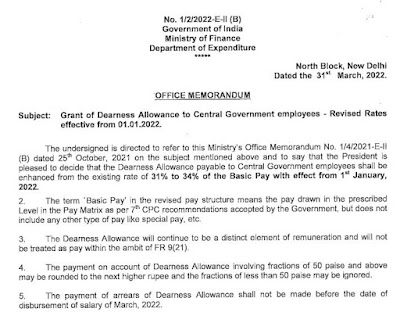
DA Jan 2022 - Grant of Dearness Allowance to Central Government employees - Revised Rates effective from 01.01.2022

 3% DA Hike - Revised Rates effective from 01.01.2022: DoE OM dated 31.03.2022 No. 1/2/2022-E-II (B) Government of India Ministry of Finance...