Monday, 19 September 2016

Air Travel: Accounting and Payment by PAO

Air Travel Accounting and Payment by PAO

Government of India
Controller General of Defence Accounts
Ulan Batar Road, Delhi cantt  110066
(Defence Travel System, E Ticketing Project)
Phone No.: 011-26108268/26163404 /Fax No.: 011 26163403

No. Mech/EDP/861/E-T /Air

Dated: 15/09/2016
To,
The PCsDA/CsDA,

Subject: Air Travel Accounting and Payment by PAO

Reference: HQrs Office letter no. Mech/EDP/861/E-Ticketing/Phase-III dated-21-12-2015.

It is intimated that under the e-Ticketing system- wherein Rail Tickets are being booked in lieu of warrants, an Air travel module has also been launched in collaboration with Balmer Lawrie to cover all types of moves like Temporary Duty, Permanent Transfer, LTC All India and LTC Home Town. Air tickets are being booked through DTS since 11 September 2015 by various units across Services under different PAOs. The payment procedure as agreed between CGDA and Balmer & Lawrie is post payment.

2. All PCsDA/CsDA/PCA{Fys) along with this HQrs office has been issued two set of tokens/login-id for this purpose.

(a) One set of Token /Login-Id for DAD Employee:  For booking of Air Tickets i.e. Master Booker Tokens and Competent Authority Approval Tokens for booking of Air Tickets for entitled DAD officers (already issued during training in the Jan, 2016).

(b) PAO tokens for generating and downloading of system generated booking details /Bills and invoices of air tickets booked for DAD entitled officers for payment. Such Tokens (Issued recently) cannot be used for booking of Air Tickets.

3. Process of Booking of Air Tickets: As mentioned in para 2(a) above, one set of Token/Login Id has already been issued for DAD Employee for profile creation of all officer/staffs entitled to travel by Air and booking of Air Tickets.

Air Tickets. Initially, profiles of all the officers/staffs working under jurisdiction of each PCsDA/CsDA and PCA(Fys) need to be created for booking of Air Tickets. The creation of profile is a onetime process and need not be done again. When an officer/staffs will be transferred from one PCsDA/CsDA to another, in such case his profile need to be “Transferred out” by the old office and accordingly his new office will perform the activity of “Transfer in” of such officers/staffs. All such activities like profile creation, editing of profile, Air Travel Booking request and cancellation request are performed by master booker /Booker token. At the same time, Approval/Approving token is used for approval of all such request as forwarded by the master booker token through DTS system. Accordingly, once travel request is approved by Competent Authority/Approving Authority, Master Booker/Booker Token can book the Air Ticket as per Travel Regulation and Movement Sanction.


4. Process of Payment of Air Tickets to Balmer Lawrie & Co.:  As mentioned above, the booking of Air Tickets has been launched in collaboration with Balmer Lawrie, the payment procedure as agreed between CGDA and Balmer & Lawrie is post payment. Following steps are involved in processing of payment of Air Tickets to Balmer Lawrie & Co.

(a) Online Accounting and Payment Module for Air Travel:  As mentioned in para 2(b) above, Air Ticket booking details and voucher for Air Ticket booked during a particular period can be generated by logging in to the PAO Module for further processing of payment to Balmer & Lawrie Co.

(b) Preparation of Punching Medium:  After generation of the voucher by logging-in to the PAO Module, PCsDA/CsDA will prepare Punching Medium to compile under respective code head as per classification hand book.

(c) Payment Through NEFT:  After preparation of Punching Medium and Daily Payment Sheet, PCsDA/CsDA will make payment of the due amount through NEFT or through any other process is being followed in their offices.

(d) Voucher Settlement:  After payment PCsDA/CsDA will log-in to the PAO Module and will mark against each invoices as payment done.

(e) Voucher Acknowledgement:  All payment will be acknowledged by Balmer & Lawrie through System and PCsDA /CsDA will be able to download Receipt voucher of payment from the system.

4. Claim Submission:  As the Air Ticket booked through system is given to the officer is as good as advance to the officer/staff serving in the PCsDA/CsDA offices, traveler will submit his final claim within one month after completion of the journey along with original boarding pass and a copy of the Air Ticket booked through DTS

5. In this regard it is intimated that PCsDA/CsDA who are not having PKI tokens (One set of Booking Token with two tokens (One for Master Booker/Booker Token and another for Approval Token)) for booking of Air Tickets through DTS and one PKI token (PAO Token) for generation of voucher and processing payment are requested to intimate to this HQrs office for issuing of the same. PCsDA/CsDA/PCA(Fys) offices in possession of one set of PKI token (One for Master Booker/Booker token, another for Approval token) are requested to start booking of Air Tickets through DTS immediately.

Jt. CGDA (IT&S) has seen.


Sd/-
Deepak Kumar
Sr.ACGDA(IT & S)
Source : cgda.nic.in

New Pension System Features released recently for NPS Subscribers

New Pension System - Features released recently for NPS Subscribers

New Pension System (NPS) and its-implementation
GOVERNMENT OF INDIA
MINISTRY OF RAILWAYS
(RAILWAY BOARD)
RBA No. :54/2016
New Delhi, dated: . 16.08.2016
No.2016/AC-II/21/7
General Managers, FA&CAOS and CPOs,
All Indian Railways. and PUs

Sub: New Pension System (NPS) and its-implementation.

Please find enclosed PFRDA’S letter no. PFRDA/19/CG/1/39 dated 01.08.2016 on the above subject. In this regard, the “following has been desired:

i. Distribution of comprehensive brochure prepared by PFRDA for government Sector subscribers.
ii. Updation of contact details of all the underlying offices in the records of CRA for better communication flow.
iii Setting up of dedicated NPS Cell
iv. Displaying related information on the website of in the Ministry and incorporating the same link in the ‘Employee’s corner’.

As regards (iv.) above, all, the important instructions issued by Accounts Dte are available on the Indian Railway’s website as under:
www.indianrailways.gov.in

About Indian Railways

Railway Board Directorates

Accounts

Instructions on NPS

Kindly ensure circulation of these instructions so that the subscribers and nodal. offices are aware of initiatives taken for their benefit.

DA: As above
sd/-
(Amitesh Kumar Sinha)
Director Finance/CCA
Railway Board

PENSION FUND REGULATORY AND DEVELOPMENT AUTHORITY
b-14/A, First Floor, Chhatrapati Shivaji Bhawan,
Qutab Institutional Area, Katwaria Sarai, New Delhi-110016
R.V. Verma
Member
FILE NO. PFRDA/19/CG/1/39
01st August, 2016
Subject: National Pension System (NPS) and its implementation.

I am writing in the context of the National Pension System (NPS) and its implementation in the Central Government sector - Ministries & departments including the Central Autonomous Bodies under their jurisdiction. I would like to highlight the important measures taken by PFRDA in strengthening the systems, in the interest of the ultimate beneficiary- the subscriber and other stakeholders.

2. After the passage of PFRDA Act, 2013, various regulations have been framed by PFRDA under the ambit of the Act. The basic purpose of framing regulations is to ensure protection of subscriber interest. Prominent ones among the regulations are PFRDA (Redressal of Subscriber Grievance) Regulations, 2015 and PFRDA (Exits Withdrawals under the NPS) Regulations, 2015. You will appreciate that PFRDA (Redressal of Subscriber Grievance) Regulations, 2015, had laid down clear guidelines with respect to redressal of subscriber grievances. Further, Exit Regulations of PFRDA have specified the provisions and process relating to exit and withdrawal in detail.

3. It has been PFRDA’S endeavour to take various initiatives from time to time in order to simplify and improve the operational issues in National Pension System (NPS) for ease of transaction for subscribers. Towards this end, we have introduced a number of new functionalities under NPS architecture such as simplification of account opening, withdrawal, grievance management etc. In this regard, recently many new functionalities have been released by the Central Recordkeeping Agency (CRA) to ease operations for the benefit of subscribers and nodal offices. The details of the functionalities released recently for the nodal offices under Govt. Sector are enclosed as Annexure A.

4. As our main focus is on the subscriber, around whom the entire system revolves, we have also provided several facilities to them for easing the process and making them more user friendly. The following are the important initiatives taken in this direction:
(i) SMS and email alerts,
(ii) Centralized Grievance Management System (CGMS) with a pre-determined turnaround time for resolution of grievances related to different services.
(iii) Call Centre facility.
(iv) Periodic consolidated SoT (Statement of Transactions)
(v) Web based access to all subscribers to view SoTs and facility to modify certain data like mobile number & email id on their own.
(vi) Subscriber awareness programs at various locations and centers.
In addition to the above, several new functionalities have also been introduced in the CRA system for the benefit of the subscribers. The details of the same are enclosed as Annexure B.

5. We would very much appreciate if the Central Government ministries departments may undertake the following measures to enhance the effectiveness of the system:
(a) Distribution of comprehensive brochure prepared by PFRDA for government sector subscribers (copy enclosed).
(b) Updation of contact details of all the underlying offices in the records of CRA for better communication flow.
(c) Setting up of a dedicated NPS Cell
(d).Displaying NPS related information on the website of your Ministry and incorporating the same in link like ‘ Employee’s corner’.
6. We feel that there is urgent need to disseminate more information among the dealing officials -Pay & Accounts Offices(PAOs) Drawing & Disbursing officers (DDOs) of the CG Ministries & Departments for resolving the concerns and covering the gaps. We have recently engaged Crux Management Services Pvt. Ltd. as a training agency for imparting training to the nodal officers of CG Ministries/ Departments. We request you to nominate maximum number of DDOs from your Ministry to the training programmes which PFRDA is coordinating. Besides, workshops may be organized by CG Ministries & Department for their respective nodal offices also in order to increase

subscriber awareness and for imparting operational knowledge to PrAOs/PAOs/DDOs, wherein PF RDA and CRA officials may also participate.

We are confident that the implementation of NPS and streamlining .of the process is receiving your due attention. You may like to convene regular meetings to review the implementation of NPS and the new fun’ctionalities which wrll go a long way in ensuring smooth implementation of NPS. PFRDA will be glad to provide all necessary support and cooperation. Should your office need further clarifications, they are welcome to contact Sh. Ashish Kumar, General Manager at ashish.kumar@pfrda org.in.
With Regards,
Yours sincerely
sd/-
(R.V.Verma)
Mr. S. Mookerjee,
Financial Commissioner
Ministry of Railways,
Room No.232, Rail Bhavan,
New Delhi - 110001.
Encl.: A/a
Annexure A

Functionality for nodal offices on Tier-II
operations and voluntary contribution processing under Tier-I

The Govt. Sector Nodal Offices have now been provided with utility for activating the Tier II account and its operation for all Government employees. The Government subscribers (mandatorily covered under NPS) can also approach their “associated Nodal Office for making additional investment (Voluntary Contributions) in their PRAN - Tier I account in order to claim tax benefits.
Upload of unequal contribution for Govt.
employees
In, case of Govt. sector employees, the Nodal Office is required to prepare and upload the contribution file wherein the Employee and Employer Contribution are equal for each subscriber. This functionality will now allow the Nodal Offices to prepare and upload contribution files where Employer and Employee contribution amount are not. same due to various exceptional reasons.
Insertion of QR Code facility on backside of PRAN
For new PRAN cards, a Quick Response (QR) code will be inserted, which when scanned on a smart phone will enable easy access to CRA website for any information on NPS.
Grievance resolution by monitoring office in CRA
system
In case of Govt. Sector Nodal offices, only the PAOs/DTOs can provide resolution remarks for the grievances raised against them by ‘ their associated subscribers in Central Grievance Management System (CG-MS) module. However, the mapped Pr.AOs/DTAs can only monitor the status of the grievances (using ‘Token No’) raised against underlying PAOs/DTOs. Now, with the new facility made available in the CRA system, the Pr.AOs/DTAs can verify whether the PAO/DTO has resolved the grievance.
Pop-Up window for resolution of pending grievance
in CRA system
To aid the Nodal Offices, a pop-up alert is displayed on the home page immediately after the User logs in to CRA website (www.cra-nsdl.com). The pop-up displays the count of grievances pending (if any) for more than 30 days. The User has two options i.e., either to resolve the grievances immediately by selecting the option ‘Resolve Now’ (which will guide the user to ‘grievance resolution’ screen) or to select ‘Resolve Later’ to continue with regular operations and provide resolutions to the grievances later, The pop-up window is a reminder to all the Nodal Offices which have any grievance pending for resolution beyond 30 days in Central
Grievance Management system (CGMS) module.
Functionality for capturing bank details and contact details of the nodal offices  ‘A facility has been provided to Nodal Offices of Central Government to enter the contact details of their Nodal Officer (along with details of alternate Nodal Officer) and the Bank account details of respective Nodal Office in CRA system. This will help Trustee Bank and CRA to identify the nodal offices for better coordination.
Login facility for, DDOs in CRA system
The DDOs can login the CRA system using User ID & I-PIN (password). The DDOs can generate their l-PIN by capturing a request through instant reset option in the CRA system (www.cra-nsdl.com) and getting it authorized by their associated Nodal Office (PAOs/DTOs). This facility has been granted to the DDOs to enable them to view various reports, which is quite helpful in day to day functioning.
Annexure B
Features released recently for NPS Subscribers

1. Mobile App
Mobile App for NPS’ is nowavailable to the Subscriber’s in ’Google Play Store’ as NPS by NSDL e-Gov’ for installation and use. The following features are available to the Subscribers in Mobile App:
a) Transaction Statement: Using this feature, Subscriber will be able to raise the request for Transaction Statement for a. particular financial year. The statement will be sent to the Subscriber’s registered mail ID at end of the day.
b) Account details view: Subscriber can view his / her NPS account details.
c) Statement of Holding view: Details of scheme Wise units alongwith latest NAV and the total value of the schemes (as on date) is available.
d) View of last 5 contributions: Details of the last five contributions credited will be available i.e.,‘ credit date, tier type, amount and. contribution remarks.
e) Change in contact details (Telephone/ Mobile no./ email ID): At present, Subscriber can change his/ her contact details in CRA system using login credential. The same feature has been extended in Mobile App.
f) Change password/ Security Question: Subscriber can add / modify his her password and set security question (for password reset) through Mobile App. Subscriber will also be able to reset his/ her password by answering secret questions.
g) Notifications: Notifications, if any, from CRA will be available to the Subscriber. Short messages will be displayed here.

2. Change of address using Aadhaar authentication
The Subscribers can now update/modify their address on their own using Aadhaar based authentication. After logging in CRA, Subscriber will use the menu Update Address”. After clicking on the menu ”Update Address”, Subscriber will prevode the Aadhaar No and “click on the ’submit’ button. ‘On clicking on submit button, ‘ an OTP will be sent to Subscriber’s mobile. Once the Subscriber authenticates by submitting the OTP, address details from Aadhaar system will be fetched and updated in the CRA system. In this process, Subscriber will be able to update permanent as well as correspondence address. At present, this feature has been made available to All Citizens of India and Corporate sector. It will be extended to Government Subscriber Shortly.

3. Scheme Preference change facility
The NPS Subscribers associated to All Citizens of India (UoS), Corporate sector and Government sector (for Tier‘SII-only) can now change their Scheme Preference after logging in. An OTP will be sent to the Subscriber (on their registered mobile number) once Subscriber topts to change his / her Scheme Preference. After authentication is done with OTP, the Subscriber can change their PFM, Asset Class, Allocation ratio, Scheme Options.

4. Tier II activation through eNPS
Any subscriber having Tier I account in NPS can now activate Tier II account online through eNPS. To initiate the Tier‘II activation, Subscriber has to enter his/her PRAN, DOB and PAN. An OTP will be generated and will be sent to the registered mobile number. Subscriber has to enter the OTP and proceed for Tier II activation under

5. KYC re-verification using Aadhaar authentication
A Subscriber whose Bank has not confirmed (rejected) his / her KYC verification request can now update the address details and confirm KYC using Aadhaar based authentication. The Subscriber need to simply go to eNPS site, click on Update details and proceed.

6. Facility to contribute Online
Subscribers are contributing through online mode using eNPS portal of. NPS Trust. Now, a facility has been made available to contribute online by Subscribers using IPIN credentials in CRA system. Subscriber can login into the CRA system and click to ”Contribution” menu. On submission, the Subscriber will be redirected to eNPS contribution page from Where he / she can contribute as per existing process of eNPS.

7. Withdrawal from Tier II account
At present, for Withdrawal from Tier II account, the NPS subscribers are required to visit the branch of the’ Point of Presence (POPS) or Nodal Office which is mapped to him / her. Now, the NPS Subscribers have a facility to initiate Withdrawal request from Tier II account using their login credentials and OTP authentication on registered mobile number.

8. Online IPIN generation
The eNPS Subscribers can now access the CRA system immediately after registering without waiting for physical I-PIN to be despatched. Facility is now available where the Subscriber will generate I-PIN instantly and access his/her NPS account.

Minimum Pay & Multiple factor after 7th CPC Memorandum submitted by IRTSA

Minimum Pay & Multiple factor after 7th CPC - Memorandum submitted by IRTSA

INDIAN RAILWAYS TECHNICAL SUPERVISORS ASSOCIATION
(Estd. 1965, Regd. No.1329, Website http://www.irtsa.net)

M.Shanmugam,
Central President, IRTSA
#4, Sixth Street, TVS Nagar, Padi,
Chennai-600050
Email-cpirtsa@yahoo.com
Mob: 09443140817

Harchandan Singh
General Secretary, IRTSA,
C.Haq.32, Phase 6, Mohali,
Chandigarh -160055,
Email-gsirtsa@yahoo.com
(Ph:0172-2228306, 9316131598)

No:IRTSA/CHQ/Memo CPC MF/2016-16
Date: 14-9-2016

Additional Secretary (Expenditure),
Government Of India
North Block
New Delhi - 110 001


For kind consideration of the Committee of Secretaries - On Minimum Pay & Fitment Facotr of 7th CPC
Subject: Minimum Pay & Multiple factor after 7th CPC
Reference: i) Para 10.1.67 Of Report of 7th Pay Commission

ii) Para 3 & 4 of Resolution No.1-2/2016-IC dated 25-07-2016 of Govt of India on 7th CPC Report

We have to make the following submissions for the kind consideration of the Committee for regarding Minimum Pay and Fitment/Multiplication Factor:

1. MODIFICATIONS ACCEPTED BY SUPREME COURT & PRESENT DAY REQUIREMENTS IGNORED BY 7TH CPC FOR DECIDING MINIMUM PAY BY Dr.W.AYKROYED FORMULA

a) The Minimum Pay Fixed at Rs.18000 by the 7th CPC is very much unjust and meager and ignores the accepted norms in this regard.

b) The Minimum wage of Rs.18000 proposed by 7th Pay Commission is based on Dr Aykroyed formula for Minimum Need Based Wage which was adopted by 15th Indian Labour Conference held in 1957. This needed to be updated as per present day requirements. As per law of natural justice and as per directions of the Supreme Court of India issued as long back as in 1991 in the case of Reputekos Brett & Co. Vs Workers & others.

c) Prescribed provision of 25% to cover education, recreation, festivals & medical expenses has been reduced to 15% by 7th CPC. Similarly provision for housing has been reduced from prescribed 7.5% to 3% which are totally inadequate, unjust and unrealistic.

d) In para 4.2.8, Step-1, 7th CPC indicated that a family is comprising of three consumption units, as per norms set by 15th Indian Labour Conference (ILC) in 1957.

e) Computing husband as one unit, wife as 0.8 unit and two children each below the age of 14 as 0.6 unit is very much inadequate and 15th ILC had not considered maintenance of aged parents.

f) Maintenance and Welfare of Parents and Senior Citizens Act, 2007 make it a legal obligation for children and heirs to provide maintenance to senior citizens and parents, by monthly allowance.

g) It is therefore, necessary that while calculating cost for maintenance household the aged parents should also be considered as 2 Units besdes the husband, wife, two Children as consumption units per family and the same should be taken at least as four (if not five) instead of three.

h) Dr. W. Aykroyd formula on food & other requirements and associated requirements specified by 15th ILC shall be applied for 4 consumptio units per family.

i) Minimum Pay works out to be Rs.24,000 (instead of Rs.18000 recommended by the 7th CPC) and the multiple factor 3.43 (instead of 2.57 recommended by the 7th CPC)

j) Table-1 of 7th CPC for calculation of minimum pay needs to be redrawn as under by keeping 4 consumption unit per family:

IRTSA-Memo-1


2. MINIMUM PLUS DA WITH 40% FIXATION BENEFIT

a) 40% fixation benefit was given over 4th CPC scale to 5th CPC scale in general to all the scales.

b) 40% of maximum of 5th CPC scale was given over 5th CPC scale as fixation benefit in general in 6th CPC scales.

c) But, only 14.29% (i.e even less than 15%) of basic pay has been given as fixation benefit is after the 7th CPC over 6th CPC pay, which is grievously inadequate.

d) Table-2 given below gives the comparison on fixation benefit given after 6th CPC & after 7th CPC.

IRTSA-Memo-2


e) The Multiple Factor of 2.57 proposed by the Pay Commission for Pay Fixation is totally unjust, inadequate and arbitrary especially keeping in view the high inflation (in real terms and wage rise in the organized sector including the PSUs after two revisions in PSUs since the Sixth CPC. The Fixation Benefit needs to be at least 40% - as after the last two Pay Commissions and the Common Multiple Factor may please be fixed at least (Pay+DA) + 40% of Pay + DA, ie. 3.15 times of 6th CPC basic pay.

Table -3 showing calculation of new pay which will be equal to Pay + Pay fixation benefit equal to 40% of 6th CPC Pay + DA

IRTSA-Memo-3


k) Minimum Pay works out to be Rs.22,100 (instead of Rs.18000 recommended by the 7th CPC) and the multiple factor 3.15 (instead of 2.57 recommended by the 7th CPC)

3. MINIMUM PAY BY MERGER OF DA EVERY TIME THE DA RISES BY 50%

a) Merger of DA with Pay & Pension was always done every time the DA crossed 50%, except after the Sixth Pay Commission and that norm justifiably needs to be restored.

b) Minimum Pay as on 1-1-2016 would be Rs.19,687 if DA was merged with Pay when the DA crossed 50% (from 1-1-2011) and when it crossed 100% even without any relief or fixation benefit of 7th CPC and the Minimum Pay would bebRs. 22,483 or say 22,500 with 14.29% of total emoluments Fixation benefit given by the 7th CPC (which itself was the lowest ever after any CPC) - as per detailed calculations submitted below:

4. a) Minimum Pay after DA Merger at 50% & 100% and with 14.29% rise.

7000×1.5 = 10500 x 1.5 = 15750×1.25 = Rs.19687×1.1429 = 22500.272 or say Rs.22000

b) Fitment Factor after DA Merger at 50% & 100% and with 14.29% rise

= 22500 / 7000 = 3.21 times of BP

c) Even if the Merger of DA was done only once after it crossed 50% (on 1-1-2011), Minimum Pay as on 1-1-2016 would have been Rs.18375 (without any relief or fixation benefit of CPC) and Rs.20984 or say Rs.21000 with 14.2% Fixation benefit given by the 7th CPC as per details below:

d) Minimum Pay after DA Merger at 50% & 100% and 14.2% rise:

= 7000 x 1.5 = 10500 x 1.75 = 18375 x 1.1429 = Rs.21000.7875 or say Rs.21000.

e) Fitment Factor after DA Merger at 50% and 14.2% rise

21000 / 7000 = 3 times of BP

f) All the foregoing calculations of Minimum Pay and Fitment Factor are linked to only 14.2% rise of wages as inherent in the recommendations of 7th CPC - which is the lowest ever rise after a Pay Commission in recent years.

g) The minimum Pay may please be fixed as Rs.22500 and the multiple factor for revision of Pay and Pension may please be fixed as 3.21.

4. It is, therefore, requested that, in view of above submissions:

a) Minimum Pay may please be fixed as Rs.24,000 and the multiple factor 3.43, by modifying Dr. W.Aykroyed Formula & 15th ILC norms by duly taking into account Maintenance and Welfare of Parents and Senior Citizens Act, 2007. (or)

b) Minimum Pay be fixed as Rs.22,100 and the multiple factor 3.15 by giving 40% fixation benefit for the 6th CPC Pay & DA. (or)

c) Minimum Pay may please be fixed as Rs.22500 and the multiple factor for revision of Pay and Pension may please be fixed as 3.21, by merging the DA with Pay whenever it crossed 50% with fixation benefit of 14.2% equitant to the rise recommended by 7th CPC.

Thanking you in anticipation,


Yours faithfully,
sd/-
Harchandan Singh
General Secretary, IRTSA


Source: IRTSA

Implementation of the recommendations of 7th CPC Fitment Factor and Pay Fixation for Running Staff

Implementation of the recommendations of 7th CPC Fitment Factor and Pay Fixation for Running Staff

GOVERNMENT OF INDIA
MINISTRY OF RAILWAYS
RAILWAY BOARD)

No.E(P&A)II-2015/RS-25
New Delhi, dated 14.9.2016.

The General Secretary,
AIRF,
4,State Entry Road,
New Delhi 110055.

The General Secretary,
NFIR,
3, Chelmsford Road,
New Delhi 110055.

Sub : Implementation of the recommendations of 7th CPC Fitment Factor and Pay Fixation for Running Staff.

The undersigned is directed to refer to the above mentioned subject and to the letter dt. 05.08.2016 of GS/AIRF and letters dt. 04.08.2016 & 23.08.2016 of GS/NFIR.

2. In this connection, it is stated that unlike during the Sixth CPC where there were separate fitment tables for pay fixation, in the Seventh CPC only a single multiplication factor of 2.57 and a single Pay Matrix table has been recommended and accepted. Paragraph 2 of the Resolution dt. 25.07.2016 refers. Therefore, no other multiplication factor or Pay Matrix/ Fitment table can be used for pay fixation for any category of staff.

3. Further, as brought out in para 12 of the Resolution dt. 25.07.2016 pay fixation of running staff (who draw Running Allowance) has been clubbed with fixation pay of Doctors (who draw NPA). The methodology and illustration for computing revised basic pay in the case of Doctors have been clearly brought out in para 7 (B) (ii) of the Notification dt. 25.07.2016 of Ministry of Finance. It may be observed that the rate of increase. in the illustration in the case of Doctors is also not exactly 14.29%. in fact, para 12 of the Resolution mentioned that actual raise in pay at the time of initial fixation is to be ensured at about 14.29%. The figur therefore is not an absolute percentage of raise which has to be ensured, A similar methodology of pay fixation for running staff (keeping the basic multiplication factor at 2.57) has been applied in consultation with and approval of Ministry of Finance.

4. lt may also be seen that while fixing the pay after revision in the appropriate cell of the applicable level in the Pay Matrix the actual increase in pay works out practically to around three times the pre-revised basic pay of the running staff.

5. Therefore, pay revision for Running Staff has been done in terms of approved formulation and no separate fitment table can be issued in this connection, as brought out above.

Yours faithfully,
sd/-
For Secretary / Railway Board
Source: NFIR

Grant of ad-hoc bonus for 30 days to the Group C & D RPF/RPSF personnel for the financial year 2014-2015

Ad-hoc bonus for 30 days to the Group C & D RPF/RPSF personnel for the financial year 2014-2015

GOVERNMENT OF INDIA
MINISTRY OF RAILWAYS
(RAILWAY BOARD)
RBE No. 108/2016
New Delhi, dated 15.09.2016
No.E(P &A )11-2015/Bonus 1
The General Managers/CAOs (R),
All Indian Railways &
Production Units.

Sub.: Grant of ad-hoc bonus for 30 days to the Group 'C' & 'D' RPF/RPSF personnel for the financial year 2014-2015.

Ad-hoc bonus for 30 days without any ceiling on wages for eligibility to all eligible Group 'C' & 'D' RPF/RPSF personnel for the financial year 2014-15 was sanctioned vide Board's letter of even no. dt. 02.11.2015 with the wage calculation ceiling of Rs. 3500 p.m

2. The President has now decided that the calculation ceiling of monthly emoluments for the purpose of payment of ad-hoc bonus shall be revised to Rs. 7000/- w.e.f. 01.04.2014 i.e. for the accounting year 2014-15. Therefore, payment of ad-hoc bonus for the financial year 2014-15 to all eligible Group 'C' & 'D' RPF/RPSF personnel would be based on the wage calculation ceiling of’ Rs. 7000  per month.

3. Accordingly, ad-hoc bonus to eligible Group 'C' & 'D' RPF/RPSF personnel for the financial year 2014-15 may be re-worked and the difference may be paid on priority in the same mode as payment of salary. All the other terms and conditions under which the payment was made shall remain unchanged.

4. This issues with the concurrence of Finance Directorate of the Ministry of Railways
sd
(S.Balachandra Iyer)
Director/Pay Commission,
Railway Board.
Authority: http://www.indianrailways.gov.in/

Friday, 16 September 2016

Payment of Productivity Linked Bonus to all eligible non-gazetted Railway employees for the financial year 2014-2015

GOVERNMENT OF INDIA
MINISTRY OF RAILWAYS
( RAILWAY BOARD)
RBE No. 109/2016
No. E(P&A)II-2015/PLB-4
New Delhi, dated: 15.09.2016.
The General Managers/CAOs,
All Indian Railways & Production Units etc.

Sub : Payment of Productivity Linked Bonus to all eligible non-gazetted Railway employees for the financial year 2014-2015.

Productivity Linked Bonus (PLB) equivalent to 78 (Seventy Eight) days wages without any ceiling on wages for eligibility for the financial year 2014-15 to all eligible non-gazetted Railway employees (excluding all RPF/RPSF personnel) was sanctioned vide Board’s letter of even no. dt. 07.10.2015 with the condition that where wages exceed Rs. 3500/- per month. Productivity Linked Bonus will be calculated as if ‘wages’ are Rs. 3500/- p.m.

2. The President has now decided that the calculation ceiling of monthly emoluments for the purpose of payment of PLB shall be revised to Rs. 7000 w.e.f: 01.04.2014 i.e. for the accounting year 2014-15. Therefore, payment of PLB for the financial year 2014-15 to all eligible non-gazetted Railway employees (excluding all RPF/RPSF personnel) would be based on the wage calculation ceiling of Rs. 7000/- per month i.e. where wages exceed Rs. 7000/- per month, Productivity Linked Bonus will be calculated as if ’wages’ are Rs. 7000/- p.m.

3. Therefore, in the case of eligible railway employees mentioned in Board’s letter of even no. dt. 07. 10.2015 who were not placed under suspension, or had not quit service/retired/expired during the financial year 2014-15 or were on leave where leave salary admissible is not less than that admissible on leave on average pay. the amount due towards Productivity Linked Bonus for the financial year 2014-15 becomes Rs. 17,951/- instead of Rs. 8,975/-.

4. Accordingly, the PLB amount to eligible non-gazetted Railway employees (excluding all RPF /RPSF personnel) for the financial year 2014-15 may be re-worked and the difference paid on priority in the same mode as payment of salary. All the other terms and conditions under which the payment was made shall remain unchanged.

5. This issues with the concurrence of Finance Directorate of the Ministry of Railways.
Sd/-
( S. Balachandra Iyer)
Director/ Pay Commission,
Railway Board.
Source : http://www.nrmu.net/

GRANT OF BONUS TO GDS WITH REVISED CEILING RS.7000 FROM 2014-15 : NFPE

GRANT OF BONUS TO GDS WITH REVISED CEILING @ RS.7000/- FROM 2014-15 : NFPE

National Federation of Postal Employees
1st Floor North Avenue Post Office Building, New Delhi-110 001
Phone: 011.23092771
e-mail: nfpehq@gmail.com
Mob: 9868819295/9810853981
website: http://www.nfpe.blogspot.com

No.P-16(g)/2016
Dated : 14th September, 2016
To
The Secretary
Department of Posts
Dak Bhawan
New Delhi – 110 001

SUB:  GRANT OF BONUS TO GDS WITH REVISED CEILING @ RS.7000 - FROM 2014-15 REQ - REG.

Respected Sir

The Government of India, Ministry of Finance issued order on revised ceiling limit of PLB from Rs.3500- to Rs.7000- from the year 2014-15 (OM No. 7/4/2014-E-III A dated 29-08-2016) to all Central Govt. Employees. It is apparent to note that the calculation of Productivity Linked Bonus for the year 2014-15 with revised ceiling limit @ Rs.7000-to regular departmental employees in the Department of Posts has been granted vide letter No. .26-01/2015-PAP dated 02-09-2016 and the arrears have also been drawn in favour of the regular employees.

The case of 3 lakh GDS employees regarding applicability of revised ceiling limit @Rs.7000- is yet to be finalized by the Department.

Therefore, it is requested to kindly expedite the grant of Bonus to 3 lakh Gramin Dak Sevaks at the revised ceiling @ Rs.7000- from 2014-15 prospectively.

Early action is highly solicited.
Yours faithfully,
(R.N. Parashar)
Secretary General
Source : http://aipeup3bbsr.blogspot.in/

Memorandum Reg Minimum Pay & Multiplying Factor of 7th CPC - submitted by IRTSA

Memorandum Reg Minimum Pay & Multiplying Factor of 7th CPC - submitted by IRTSA

INDIAN RAILWAYS TECHNICAL SUPERVISORS ASSOCIATION
(Estd. 1965, Regd. No.1329, Website http://www.irtsa.net )
M. Shanmugam,
Central President, IRTSA
# 4, Sixth Street, TVS Nagar, Padi, Chennai - 600050.
Email- cpirtsa@yahoo.com
Mob: 09443140817
Harchandan Singh,
General Secretary, IRTSA,
C.Hq. 32, Phase 6, Mohali, Chandigarh-160055.
Email-gsirtsa@yahoo.com
(Ph:0172-2228306, 9316131598)
No:IRTSA/CHQ / Memo CPC MF / 2016-16
Date: 14-9-2016

Additional Secretary (Expenditure),
Government of India,
North Block,
New Delhi-110001

For kind consideration of the Committee of Secretaries - On Minimum Pay & Fitment Factor of 7th CPC

Subject: MINIMUM PAY & MULTIPLE FACTOR AFTER 7TH CPC
Reference: i) Para 10.1.67 of Report of 7th Pay Commission
ii) Para 3 & 4 of Resolution No. 1-2/2016-IC dated 25-7-2016 of Govt of India on 7th CPC Report
We have to make the following submissions for the kind consideration of the Committee for regarding Minimum Pay and Fitment / Multiplication Factor:

1. MODIFICATIONS ACCEPTED BY SUPREME COURT & PRESENT DAY REQUIREMENTS IGNORED BY 7TH CPC FOR DECIDING MINIMUM PAY BY Dr. W. AYKROYED FORMULA

a) The Minimum Pay Fixed at Rs.18000 by the 7th CPC is very much unjust and meager and ignores the accepted norms in this regard.

b) The Minimum wage of Rs.18000 proposed by 7th Pay Commission is based on Dr Aykroyed
formula for Minimum Need Based Wage which was adopted by 15th Indian Labour Conference held in 1957. This needed to be updated as per present day requirements. As per law of natural justice and as per directions of the Supreme Court of India issued as long back as in 1991 in the case of Reputekos Brett & Co. Vs  Workers & others.

c) Prescribed provision of 25% to cover education, recreation, festivals & medical expenses has been reduced to 15% by 7th CPC. Similarly provision for housing has been reduced from prescribed 7.5% to 3% which are totally inadequate, unjust and unrealistic..

d) In para 4.2.8, Step-1, 7th CPC indicated that a family is comprising of three consumption units, as per norms set by 15th Indian Labour Conference (ILC) in 1957.

e) Computing husband as one unit, wife as 0.8 unit and two children each below the age of 14 as 0.6 unit is very much inadequate and 15th ILC had not considered maintenance of aged parents.

f) Maintenance and Welfare of Parents and Senior Citizens Act, 2007 make it a legal obligation for children and heirs to provide maintenance to senior citizens and parents, by monthly allowance.

g) It is therefore, necessary that while calculating cost for maintenance household the aged parents should also be considered as 2 Units besdes the husband, wife,  two Children as consumption units per family and the same should be taken at least as four (if not five) instead of three.

h) Dr. W. Aykroyd formula on food & other requirements and associated requirements specified by 15th ILC shall be applied for 4 consumptio units per family.

i) Minimum Pay works out to be Rs.24,000 (instead of Rs.18000 recommended by the 7th CPC) and the multiple factor 3.43 (instead of 2.57 recommended by the 7th CPC)

j) Table-1 of 7th CPC for calculation of minimum pay needs to be redrawn as under by keeping 4 consumption unit per family:
Calculation of Minimum Pay as on 01.01.2016 for four consumption unit per family
Per dayPCUUnitPer month4 PCUUnitPrice/ UnitRs.ExpensesRs.
1Rice/Wheat475gm57.00kg25.931478.01
2Dal (Toor/Urad/Moong)80gm9.60kg97.84939.26
3Raw Vegetables100gm12.00kg58.48701.76
4Green Vegetables125gm15.00kg38.12571.80
5Other Vegetables75gm9.00kg32.80295.20
6Fruits120gm14.40kg64.16923.90
7Milk200ml24.00litre37.74905.76
8Sugar/Jaggery56gm6.72kg37.40251.33
9Edible Oil40gm4.80kg114.02547.30
10Fish3.33kg268.38894.60
11Meat6.67kg400.902672.67
12Egg120no.4.27512.40
13Detergents etcRs/month388.41388.41
14Clothing7.33meter164.881208.57
15Total (1-14)12290.97
16Fuel, Electricity, Water Charges3072.74
17Total-(15) divided by 0.815363.71
18Marriage, Recreation, Festivals, etc.2711.24
19Total-(17) divided by 0.8518074.95
20Provide for Skill by adding 25% to (19)4518.74
21Sum (19+20)22593.69
22Housing @698.77
23Total-Divide no.21 by 0.9723292.47
24Step up of 3% on No.23 as DA is projected at 125% on 01.01.2016698.77
25Final Minimum Pay as on 01.01.2016 (23+24)23991.24
26Rounding off24000
2. MINIMUM PLUS DA WITH 40% FIXATION BENEFIT

a) 40% fixation benefit was given over 4th CPC scale to 5th CPC scale in general to all the scales.

b) 40% of maximum of 5th CPC scale was given over 5th CPC scale as fixation benefit in general in 6th CPC scales.

c) But, only 14.29% (i.e even less than 15%) of basic pay has been given as fixation benefit is after the 7th CPC over 6th CPC pay, which is grievously inadequate.

d) Table-2 given below gives the comparison on fixation benefit given after 6th CPC & after 7th CPC.

Table-2
5th CPC6th CPC%increase from 5th CPC Pay+ DA to
6th CPC Pay
6th CPC Pay +125% DA7th CPC Pay% increase from 6th CPC Pay+ DA to7th CPC
5th CPC Pay5th CPC Pay + DA86%PBGP6th CPC Basic Pay
27505115PB-11800700036.85%1800014.29%
30505673PB-11900773036.26%220501990013.68%
32005952PB-12000846042.14%245072170019.66%
40007440PB-12400991033.20%253892550015.18%
45008370PB-128001136035.72%309962920016.18%
50009300PB-242001350045.16%351863540016.54%
745013857PB-246001714023.69%425254490022.50%
750013950PB-248001815030.11%513144760012.83%
800014880PB-254002100041.13%590635310016.37%
800014880PB-354002100041.13%638825610018.73%
1032519205PB-366002535032.00%661506770016.58%
1200022320PB-376002950032.17%813027880017.05%
1430026598PB-487004610073.32%9424811850014.24%
1540028644PB-489004910071.41%14521513110019.91%
1430026598PB-4100005300099.26%15305914420035.21%

e) The Multiple Factor of 2.57 proposed by the Pay Commission for Pay Fixation is totally unjust, inadequate and arbitrary especially keeping in view the high  inflation (in real terms and wage rise in the organized sector including the PSUs after two revisions in PSUs since the Sixth CPC. The Fixation Benefit needs to  be at least 40% - as after the last two Pay Commissions and the Common Multiple Factor may please be fixed at least (Pay+DA) + 40% of Pay + DA, ie. 3.15  times of 6th CPC basic pay.
Table -3 showing calculation of new pay which will be equal to Pay + Pay fixation benefit equal to 40% of 6th CPC Pay + DA

1Minimum Pay (6th CPC)7000
2DA @ 125%8750
3Pay + DA15750
4Fixation benefit (40% of Pay + DA) & Proposed increase in real wage6300
5New Pay (3+4)22050
6Increase in basic pay (in Rs.) (5 - 1)15050
7No. of times increase in basic pay3.15
8Real wage no. of times increase1.40
k) Minimum Pay works out to be Rs.22,100 (instead of Rs.18000 recommended by the 7th CPC) and the multiple factor 3.15 (instead of 2.57 recommended by the 7th CPC)

3. MINIMUM PAY BY MERGER OF DA EVERY TIME THE DA RISES BY 50%

a) Merger of DA with Pay & Pension was always done every time the DA crossed 50%, except after the Sixth Pay Commission and that norm justifiably needs to be
restored.

b) Minimum Pay as on 1-1-2016 would be Rs.19,687 if DA was merged with Pay when the DA crossed 50% (from 1-1-2011) and when it crossed 100% even without any relief  or fixation benefit of 7th CPC and the Minimum Pay would bebRs. 22,483 or say 22,500 with 14.29% of total emoluments Fixation benefit given by the 7th CPC (which  itself was the lowest ever after any CPC) - as per detailed calculations submitted below:

4. a) Minimum Pay after DA Merger at 50% & 100% and with 14.29% rise.

7000×1.5 = 10500 x 1.5 = 15750×1.25 = Rs.19687×1.1429 = 22500.272 or say Rs.22000

b) Fitment Factor after DA Merger at 50% & 100% and with 14.29% rise

= 22500 / 7000 = 3.21 times of BP
c) Even if the Merger of DA was done only once after it crossed 50% (on 1-1-2011), Minimum Pay as on 1-1-2016 would have been Rs.18375 (without any relief or
fixation benefit of CPC) and Rs.20984 or say Rs.21000 with 14.2% Fixation benefit given by the 7th CPC as per details below:

d) Minimum Pay after DA Merger at 50% & 100% and 14.2% rise:

= 7000 x 1.5 = 10500 x 1.75 = 18375 x 1.1429 = Rs.21000.7875 or say Rs.21000.
e) Fitment Factor after DA Merger at 50% and 14.2% rise
21000 / 7000 = 3 times of BP

f) All the foregoing calculations of Minimum Pay and Fitment Factor are linked to only 14.2% rise of wages as inherent in the recommendations of 7th CPC - which is  the lowest ever rise after a Pay Commission in recent years.

g) The minimum Pay may please be fixed as Rs.22500 and the multiple factor for revision of Pay and Pension may please be fixed as 3.21.

4. It is, therefore, requested that, in view of above submissions:

a) Minimum Pay may please be fixed as Rs.24,000 and the multiple factor 3.43, by modifying Dr.W.Aykroyed Formula & 15th ILC norms by duly taking into account Maintenance and Welfare of Parents and Senior Citizens Act, 2007. (or)

b) Minimum Pay be fixed as Rs.22,100 and the multiple factor 3.15 by giving 40% fixation benefit for the 6th CPC Pay & DA. (or)

c) Minimum Pay may please be fixed as Rs.22500 and the multiple factor for revision of Pay and Pension may please be fixed as 3.21, by merging the DA with Pay whenever it crossed 50% with fixation benefit of 14.2% equitant to the rise recommended by 7th CPC.

Thanking you in anticipation,
Yours faithfully,
sd/-
Harchandan Singh,
General Secretary, IRTSA
Source : IRTSA
========================= CPC, Income Declaration Scheme, PIB, central government employee news
Government reiterates that information contained in a valid declaration under the Income Declaration Scheme, 2016 is confidential and shall not be shared with any authority.

The Income Declaration Scheme, 2016 (the Scheme) provides an opportunity to persons who have not paid full taxes in the past to come forward and declare their undisclosed income and assets. The Scheme is open for declarations up to 30.9.2016.

As regards, concerns regarding confidentiality of the information filed under the Scheme, it is reiterated that information contained in a valid declaration is confidential and shall not be shared. In respect of declarations filed with the Commissioner of Income-tax, Centralised Processing Centre, Bengaluru [CIT (CPC)], the declaration shall not be shared even with the jurisdictional Principal Commissioner / Commissioner and payments made under the Scheme shall not be visible to the jurisdictional officers. Form-2 and Form-4 required to be issued in such cases shall be system generated by the CPC.

Similarly, the declaration filed with jurisdictional Principal Commissioner/Commissioner shall not be shared with any authority within or outside the department including the jurisdictional Assessing Officer. Further, the payments under the Scheme shall neither be reflected in 26AS statement nor can be viewed by the Assessing Officer in the Online Tax Accounting System (OLTAS) of the Department in the interest of confidentiality.

PIB
========================= 7th CPC, 7th Pay Commission, Air Chief Marshal, Armed Forces, CoSC, Defence Minister, Manohar Parrikar, Parrikar, Pay Commission, central government employee news
Satisfied with Parrikar’s response on pay commission: Air Chief Marshal Arup Raha

New Delhi: The armed forces today said they have raised “anomalies” in the 7th Pay Commission with Defence Minister Manohar Parrikar and were satisfied with his response that the issue will be resolved at the earliest.

The statement by the Chairman of the Chiefs of Staff Committee (CoSC) Air Chief Marshal Arup Raha comes just days after the three services issued letters to their formations, saying they have asked the government to hold “in abeyance” the implementation of the CPC in view of the “unresolved anomalies”.
The forces argue that the anomalies lower the status and pay parity of forces vis-a-vis their counterparts in the police and civilian administration.

Raha and Navy Admiral Sunil Lanba had also met with Parrikar on Monday over the issue.
The 7th Pay Commission anomalies in respect of the armed forces were discussed with the Defence Minister in detail by the Service Chiefs and the members of the Armed Forces Pay Commission Cell, a statement by Raha’s office said.

The Defence Ministry is “seized of all the issues and has assured to resolve them at the earliest. The Services are satisfied with the response,” it said.

The statement came amid reports that the forces were not happy with Parrikar’s reply.

PTI

INDIAN RAILWAYS TECHNICAL SUPERVISORS ASSOCIATION

INDIAN RAILWAYS TECHNICAL SUPERVISORS ASSOCIATION
(Estd. 1965, Regd. No.1329, Website http://www.irtsa.net )

M. Shanmugam,
Central President, IRTSA
# 4, Sixth Street, TVS Nagar, Padi, Chennai  600050.
Email: cpirtsa@yahoo.com
Mob: 09443140817
Harchandan Singh,
General Secretary, IRTSA,
C.Hq. 32, Phase 6, Mohali, Chandigarh-160055.
Email-gsirtsa@yahoo.com
(Ph:0172-2228306, 9316131598)
No: IRTSA/CHQ/Memo/CPC-All-2016-15
Date: 12-09-2016

1. Finance Secretary & Secretary (Expenditure), North Block, New Delhi- 110001. Email: secy-exp@nic.in
2. Secretaries of Home Affairs, North Block, New Delhi - 110001 Email: hshso@nic.in
3. Secretary Defence, 101 South Block, New Delhi - 110001 Email: defsecy@nic.in
4. Secretary Post, Deptt. of Post, Sanchar Bhawan, Sansad Marg, New Delhi 110001 Email: secy-posts@nic.in
5. Secretary Health & Family Welfare, Nirman Bhawan, New Delhi - 110001 Email: secyhfw@gmail.com
6. Secretary Personnel & Training, North Block, New Delhi - 110001 Email: secy_mop@nic.in
7. Chairman, Railway Board, Rail Bhawan, New Delhi - 110001. Email: crb@rb.rail.net.gov.in

For kind consideration of the Committee of Secretaries on Allowances

Respected Sir,

Subject: 7th CPC Report - Reg. Allowances

Reference: Para 7 of Resolution of MOF GOI Notification No. 1-2/2016-IC Dated 25-7-2016
We have to submit as under for the kind consideration of the Committee on Allowances:

1. Seventh CPC in its report has categorized 196 allowances under 15 categories. Common allowances viz., Dearness Allowance, House Rent Allowance, Transport Allowance, Tour Travelling Allowance and Children Education Allowance, which fall under 3 categories i.e. Common Allowances, Department Specific Allowances and Category Specific Allowances.

Allowances are administered in broadly four ways
i. Indexed fully DA
ii. Indexed partially DA
iii. No DA indexation
iv. Percentage of Basic Pay

2. UNJUST AND ARBITRARY RECOMMENDATIONS:

a) It is regretted that none of the Allowances were dealt in detail and the Commission had recommended for abolition of 52 allowances without even going into the merit or justification of either of them.

b) Recommendations made by 7th CPC on allowances were not based on a just approach and there is need to review & revise the recommendations of 7th CPC on all allowances.

3. None of the previous Pay Commissions had ever dealt with the issue in such a ruthless, arbitrary and unjust manner, without even applying its mind to such a vital issue which affected lakhs of employees. All these Allowances had been granted as per statutory provisions of law and specific justifications and on the recommendations of the previous Pay Commissions or High Powered Committees on the specific issues.

As such, no allowances should be abolished and it should be left to the respective departments for the continuance of allowances as per nature of duties & job requirements.

4. CLASSIFICATION OF EXISTING ALLOWANCES:

As mentioned by the Pay Commission, the existing Allowances can be broadly classified as under:
SlNo.CategoryNumber of Allowances
1Allowances payable for Additional/Extra Duty14
2Allowances related to Knowledge Updates3
3Allowances related to Deputation3
4Allowances related to Working on Holidays3
5Allowances related to Housing7
6Allowances related to Good Service4
7Qualification Allowances15
8Allowances related to Risk and Hardship51
9Allowances for Running Staff of Indian Railways13
10Allowances related to Sports2
11Sumptuary Allowances5
12Allowances related to Training2
13Allowances related to Travel13
14Allowances related to Uniform9
15Other Allowances52
Total196

5. UNJUST FACTOR OF 2 ADOPTED BY 7TH CPC TO CALCULATE ALLOWANCES IN 7TH CPC SCALE (Para 4 of Chapter 8.2.5)

a. 7th CPC has used unjust factors to arrive at quantum of allowances in new pay.
b. Multiple Factor (of 2.57 recommended by 7th CPC - as may be revised by the Govt.) for revision of pay by 7th CPC be used for revision of allowances paid in fixed amount.
c. Factor of 80% of MF be used for allowances that are indexed partially with DA.
d. Factor of 40% of MF be used for allowances that are indexed fully with DA.
e. Factor of 1 be used for allowances that are paid on percentage of Basic Pay.

SNNature of AllowanceFactor recommended by 7th   CPCFactor proposed   *
1Allowances that are paid in fixed amount not indexed with DA2.252.57
2Allowances that are paid in fixed amount indexed partially with DA1.52
3Allowances that are paid in fixed amount indexed fully with DANo change1.4
4Allowances that are paid in percentage of Basic Pay0.81
* Multiple factor recommended by 7th CPC (or) as may be revised by the Govt.

6. ALLOWANCES APPLICABLE TO RAILWAYS

1. Sub: PCO ALLOWANCE (para 8.17.101) - Reduction recommended by 7th CPC is unjust and should not be implemented:

a. Incentive system followed in Indian Railways is unique for its system & within Railway Budget. The system is cost effective since it improved the productivity by better utilization of men, machine & infrastructure. By introducing incentive system in the Production Units & Workshops, Indian Railways improved its efficiency.

b. Technicians, Junior Engineers, Senior Section Engineers & helpers working in shop / section are included in the incentive system. Direct Incentive (at piece rate) is being paid to Technicians working in four grades. Average incentive based on the performance of individual shop / section is being paid to helpers & Junior Engineers. Technicians, helpers and Junior Engineers are paid at hourly rates as per RBE No.194/2009. Senior Section Engineers working in shop floor are paid 15% of their basic pay as incentive.

c. Junior Engineers & Technicians who are posted in production control organization on tenure basis in the same grade are eligible for PCO allowance in lieu of incentive at the rate of 15% of their basic pay. Likewise Senior Section Engineers who are posted in production control organization on tenure basis are eligible for PCO allowance in lieu of incentive at the rate of 7.5% of their basic pay.

d. Revision of incentive rates along with productivity improvement by reducing allowed time is being done in Railways after the implementation of every Pay Commission recommendations in a holistic manner.

e. In the year 1999 while revising the incentive rates 12.5% fatigue & contingency allowances were reduced from the allowed time. In the year 2009 while revising the incentive rates 5% allowed time had been reduced across the board. Effectively 17.5% of additional man power and corresponding additional infrastructure were made available to improve the productivity.

f. Incentive rates & PCO allowance are integral part of Incentive system being followed in Railways. Revision of incentive rates & PCO allowance have to done at same time by taking all factors including productivity improvement into consideration.

g. Hence 7th CPC’s recommendations on PCO Allowance may please be ignored and the same be continued to be paid at the existing rates of 15% & 7.5% of new basic pay respectively.

2. BREAKDOWN ALLOWANCE (para 8.10.8 & 8.10.80) Recommended for abolition needs to be continued:

a. 7th CPC has recommended for abolition of Breakdown allowance stating that it is part of Government employees’ duty to respond to emergencies.

b. Breakdown Allowance is being paid to the employees who constitute breakdown squad. Work down during breakdown is not of routine nature and it requires special skill to restore railway operation in case of emergency.

c. It also fixes responsibility to breakdown squad to respond immediately to any emergencies as per laid down procedures.

d. It is therefore requested to continue Breakdown allowance atleast equal to one day basic pay rounded off to next hundreds as per the table given below.

Proposed Rates of Break Down Allowance:
S.No.CategoryRevised Pay StructureAmount of Break down Allowance/monthProposed
BD Allowance
Pay
Band
Grade
Pay
1Helper & Gr ‘D’ staffPB-11800Rs.80 p.m.Rs.600
2.Technician Gr.IIIPB-11900Rs.120 p.m.Rs.700
3Technician Gr.II Technician Gr.IPB-1PB-12400 & 2800Rs.160 p.m.Rs.900
4.Sr. Technicians  Junior Engineers and Senior Section EngineersPB-24200 & 4600Rs.200 p.m.Rs.1200

3. NATIONAL HOLIDAY ALLOWANCE (para 8.6.11):

a. National Holiday Allowance (NHA) is paid to the Group ‘C’ Staff - when they are required to work on National Holiday. Rate of NHA is already very marginal, 7th CPC has further reduced it in terms of percentage to entry basic pay.

b. It is requested that
i. National Holiday Allowance be paid at least equal to one day wage including DA (or)
ii. Percentage to entry basic pay applied in 6th CPC shall be applied for 7th CPC basic pay as given in the table. It should be paid for working on holidays including Sundays if the employees are not given compensatory rest, and NDA may please be raised further by 25% each time DA increases by 50%.
Desg
6th CPC7th CPC
Proposed
Entry BPNH% to BPPay LevelEntry  BPNH
Recommended
by 7th CPC
%to BPApplying 6th CPC%One Day
Pay 7th CPC
BP+DA
Helper70002563.7L1180003842.1658600+DA
TechGr
-III
77302563.3L2199003841.9659663+DA
TechGr
-II
99103183.2L4255004771.9818850+DA
TechGr
-I
113604203.7L5262004771.8969873+DA
Sr.Tech135004203.1L6354006301.811011180+DA
JE135004203.1L6354006301.811011180+DA
SSE171404202.5L7449006301.411001497+DA

4. TEACHING ALLOWANCE - be paid 30% of Basic pay (para 8.14.8 & 8.14.9):

a. Given to all non-permanent faculty members joining training institutions on deputation.

b. In 1986 when this allowance was introduced 30% of total emoluments were granted. Fourth CPC reduced it to 30% of basic pay. In the year 1991-92 due to the resource crunch, the allowance was reduced to 15 % of basic pay.

c. Training allowance is granted to non-faculty members, to attract more intelligent and knowledgeable persons to the training institutes. Due the availability of incentive schemes and other benefits the present rate of Training allowance does not motivate intelligent and knowledgeable persons to join Training institutions.

d. Even though Sixth Pay Commission had not recommended for any change in % of basic pay paid as Training Allowance, Railways / Government have made principle decision to increase the Training Allowance from 15% to 30% keeping in view the necessity to attract more talent & expertise faculty to the Training Institutions, but still the decision has not been implemented.

e. But, 7th CPC has proposed to reduce the teaching allowance for existing 15% to 12% for non permanent training faculties’ working in various training institutes for non Gazteed staff.

f. In the present fast technological improvement scenario to attract intelligent and knowledgeable persons to the training institutions, the Training allowance should be restored to 30 % of basic pay and Eligibility for maximum period of five years recommended by 7th CPC should be ignored since many of Railway training institutes are having eight year tenure for teaching faculties.

5. RISK & HARDSHIP ALLOWANCE (para 8.10.64):

Recommendations on Risk Allowance by previous Pay Commission a narration
SecondCPCRecommended Rs.3 to unskilled staff working in Defense and Railways whose work was exceptionally heavy or whose normal duty involved special risks such as those of chemical process or those who handled explosives. Also extended to sweepers working in underground sewers.
Third CPCRecommended Rs.10. Included semi skilled workers worked in boiler plants and cold storage plants.
Committee on Risk allowanceClassified   the   beneficiaries   into   four   categories,   namely,   Semi-skilled,   skilled, supervisors and Certain gazetted and non-gazetted officers. The rate ranged from Rs.15 to Rs.100 per month.
Fourth CPCRecommended 100% increase in the existing rates.
Fifth CPCa)   Contingent Risk Relate to one-time events where the event is uncertain.b)   Continuous  Risk  Situation  where  the  risk  is  inherent  and  continuous  in  the occupational itself with adverse effects on health.
c)   Fifth  CPC  recommended  Risk  allowance  for  those  categories  which  fall  under sl.no.2.
d)   It also de-notified some of categories.
e)   Recommended Risk allowance ranged from Rs.40 to Rs.300.
Sixth CPC6th  CPC opinioned that risk factors in any job should be removed instead of making  allowance for them and all other conditions of work should be taken care in the pay scale itself.
But Sixth CPC didn’t followed its own recommendations and granted common pay scales for all non technical, technical and staff who works in open to sky areas.
a. On the Railways, especially in open line depots and yards, exposure to hot sun, heavy rain, cold climate and unhygienic open to sky work areas particularly, presence of human excreta are having continues inherent health risks as part of their occupation itself, that cannot be eliminated.

b. There are other areas which are having continuous inherent risk in their occupation - for example:

i. In Welding shops, Paint shops, Forge & Smith shop, Electroplating shops in Workshops and Production Units of Indian Railways having adverse effects of health.

ii. In Diesel Shed exposure to high noise to the decibel level of 180, working temperature around 50 degree centigrade and air pollution beyond permissible levels.

iii. In Track maintenance exposure to hot sun, heavy rain, cold climate and unhygienic open to sky working, presence of human excreta and other non-biodegradable wastes having inherent health risks.

iv. C&M Staff exposed to radiations like X-ray and many Chemicals.

c. It is therefore requested to extend Risk & hardship allowance to sheds & depots and open line Technical staff &Technical Supervisors as per medium & low risk factors of Risk & hardship Matrix recommended by 7th CPC.

6. Internet Allowance, Mobile Phone Allowance (para 8.17.61):

a. 7th CPC left it to individual departments / ministries to deal with internet, mobile & newspaper allowance. Indian Most Railways employees are using their individual mobile and / or internet to perform the official duty.

b. It is therefore requested that all the non-supervisory employees may please be granted with Rs.500 and Technical Supervisors may please be granted Rs.1000 as communication allowance. Or all supervisors may please be provided with CUG connections with free talk time of Rs.1000 per month.

7. Night Duty Allowance (para 8.17.77):

a. 7th CPC recommended for continuing the present formulation of weightage of 10 minutes for every hour of duty performed between the hours of 22.00 and 06.00. Hourly rate of equal to (BP+DA)/200 also continued.

b. It is requested that Formulation of weightage of 10 minutes for every hour of duty performed between 22.00 and 6.00 hours may please be changed to 20 minutes for every hour of duty performed between 18.00 and 6.00 hours in view of hazards of work during Night Shift.

7. GENERAL ALLOWANCES APPLICABLE TO ALL CENTRAL GOVERNMENT EMPLOYEES

1. DEARNESS ALLOWANCE (para 8.17.37)

a. The existing formula for DA is weighed heavily against the employees in view of following reasons:

b. All India Consumer Price Index (Industrial Workers) on which the presently based, is itself defective in so far as the weightage give to various items is arbitrary and not based on present day requirement.

c. By changing the base year to 2016 whatever advantage that had emerge out of the 7th Pay commission will be neutralized. for example the DA as on 1-7-2016 works out to be 7% on previous base year which would have been Rs.490 on the old Basic Pay of Rs. 7000 but it would now be only Rs. 360 i.e. 2% of new Basic Pay of Rs.18000.

d. Most importantly, the fraction of %age rise is totally ignored while declaring the revised DA. This considerably erodes the real wage every time the DA is revised. (For example the %age rise of Price Index from 1-1-2016 works out to be 2.92 but the DA as per existing system would be only 2% thus resulting in 0.92% erosion of Pay & Pension in the very first year of 7th CPC)
e. This is against the Law of Averages which lays down the principle that for rounding off the fraction below half may be ignored and the fraction more than half should be rounded off to the next higher point.

f. In any case, the fraction ignored in previous half year should be added in the next half year (for example the Average Price Index was 125.83 at the end of December, 2016. But the fraction of 0.83 was ignored and Pay rise was given only on 125%. The balance of 0.83% should be added to 2.92 for calculation the DA from July, 2016 thus DA @ 3% instead of 2% fro 1-7-2016).
It is, therefore, requested as under)

a) Weight-age given to various items in the All India Consumer Price Index, may please be modified as per present day requirements.

2. HOUSE RENT ALLOWANCE (para 8.7.3 to 8.7.16)

House rent allowance recommended by 7th CPC is inadequate
Sl.No.Classof
City
Existing
Population criteria
Existing rates as percentage of BPProposed
Population criteria
Proposed
Ratesof H.R.A.
a“x” Class50 Lakhs & above30%“A1” 25 Lakhs &
above
40%ofPay
+D.A.
b‘y” Class50 -5 Lakhs20%“A” 5 to 25 Lakhs30%ofPay+
D.A.
c“Z”ClassBelow 5 lakhs10%“C” & UnclassifiedBelow 5 Lakhs20%ofPay
+D.A.

3. TRANSPORT ALLOWANCE (8.15.44 to 8.15.54)

10% of Pay + DA be granted as Transport Allowance uniformly for all cities in India since the cost of fuel is almost equal in all cities and other areas.
Transport Allowance may please be revised as under:
Pay LevelHigher TPTA CitiesOther PlacesProposed Rate  of Transport
Allowance per month
9 and above7200 + DA3600 + DA10%ofPay+DA
3 to 83600 + DA1800 + DA
1 and 21350 + DA900 + DA

4. CHILDREN EDUCATION ALLOWANCE SCHEME & HOSTEL SUBSIDY (para 8.17.11 to 8.17.17)

Grant of Children Education Assistance and Reimbursement of actual Tuition Fee or 2.57 times of existing rates & Extension of the scheme.

a. Under the Scheme of Children Education Allowance reimbursement is granted to Government Servants upto a maximum of two children and for children from classes nursery to twelve, including classes eleventh and twelfth held by junior colleges or schools affiliated to Universities or Boards of Education. Annual ceiling of Rs.12,000 per child has been increased to Rs.18,000 per child when the DA crossed 100% in 6th CPC scale.

b. Limiting the scheme only upto 12th standard is also graciously inadequate, since expenses for higher education & professional education are (even in Government institutions) very high and getting out of reach of salaried people.

c. It therefore requested that
i. Actual expenses incurred towards Children Education shall be reimbursed or the existing CEA Rs.18000 shall be indexed by 2.57 to Rs.46,260.
ii. The scheme may please be extended to college education also.
iii. Children Education Allowance & Hostel Subsidy shall be allowed to avail concurrently.

5. Fixed Medical Allowance (para 8.17.52):

Considering the high cost of medical treatment in old age FMA should be raised from the present level of Rs.500 to Rs.2000 and it should be paid to all the retired employees without any restriction.

6. Family Planning Allowance (para 8.17.50 ) Recommended for abolition needs to be continued

a. Family planning allowance initially granted the amount equal to one increment of the pay scale the employee belongs, but subsequently it has been reduced considerably and the rate granted after Sixth Pay Commission is very meagre as given below,

b. It requested to grant Family Planning Allowance at least equal to one increment in the revised scale, or it should be indexed by the factor of 2.57 and rounded off to next hundred as given in table below.

Sl.
No.
NameofPay
Band/Scale
PayBandsGrade
Pay
Existing rates of family planning allowanceProposed rate of family planning allowance
1-1S4440-74401300210600
2-1S4440-74401400
3-1S4440-74401600
4-1S4440-74401650
5PB-15200-202001800
6PB-15200-202001900
7PB-15200-202002000
8PB-15200-202002400
9PB-15200-202002800250700
10PB-29300-3480042004001100
11PB-29300-348004200
12PB-29300-348004200
13PB-29300-348004200
14PB-29300-348004200
15PB-29300-3480046004501200
16PB-29300-3480048005001300
17PB-29300-3480054005501500
18PB-315600-391005400
19PB-315600-391005400
20PB-315600-391005400
21PB-315600-3910066006501700
22PB-315600-391006600
23PB-315600-391006600
24PB-315600-3910076007502000
25PB-315600-391007600
26PB-315600-391007600
27PB-437400-6700087008002100
28PB-437400-670008700
29PB-437400-6700089009002400
30PB-437400-670008900
31PB-437400-670001000010002600
32PB-437400-6700010000

IV. ALLOWANCES WHICH ARE NOT CONSIDERED BY 7TH CPC.

1. Sub: Grant of PCO Allowance / Incentive Bonus to Technical Staff Supporting Shops / Sections (including  CMT / (C & M Lab), Drawing / Design, IT Power Supply & Stores etc)  in Railway Workshops & Production Units  Treating them as part of Inspection, Planning & Progress wings of PCO.

a. Technical Staff in Drawing / Design Office, CMT/ (M & C Lab), IT, Stores, Maintenance & Power Supply etc., in Railway Workshops & Production Units play important roles in improving the production & productivity through upkeep & maintenance of machinery, plants & equipments; improved Tools, Templates, Jigs & Fixtures & designing of components & prototypes of Rolling Stocks; ensuring uninterrupted supply of Power and requisite Stores; and effective quality control through intensive inspection & Testing (including 100% Testing in many areas of in house production) to ensure correct chemical composition & metallurgical qualities as per specifications etc.

b. But all these staffs are not paid either any Incentive Bonus or the PCO Allowance like the other Technical Supervisors & Staff in the PCO (Production Control Organisation). Thus they get less take home pay than the rest of the technical staff in the Workshops & Production Units, inspite of substantial contribution & technological inputs to the productivity. This is against the principle of “equal work equal pay” and discriminatory.

c. It is, therefore, requested that the Technical Staff in Supporting Shops / Sections (including CMT / (C & M Lab), Drawing / Design, IT, Maintenance, Power Supply & Stores etc) - in Workshops & Production Units be treated as part of Inspection Planning & Progress wings of PCO & paid either the PCO Allowance or Incentive Bonus as EIW Staff - at par with their counterparts working in PCO / Shop floor.

2. DESIGN ALLOWANCE

a. Fifth Pay Commission ( vide Para 50.19 ) had recommended for grant of Design Allowance of Rs.300 for Junior Engineers and Rs.600 for Assistant Engineers and the Recommendation was accepted by the Government and implemented in the CPWD ( vide their letter No. 15/4/98-DW(S&D)547-1000 dated 9.6.2000), but the same was not implemented by the Railways although the JEs & SSEs in the Drawing & Design Offices on the Railways do a lot of designing work as mentioned in details in annexure of this report. This is very unjust and discriminatory.
b. It is therefore requested to kindly recommend for grant of Design Allowance to the JEs & SSEs in the Drawing & Design Office on the Railways - at par with their counterparts in the CPWD.

3. GRANT OF SPECIAL PAY or IT ALLOWANCE

a. To get the maximum advantage from the latest Information Technology the Railways had to induct talented IT Engineers who are in possession of not only the domain knowledge of the functioning of the day to day working of the Zone, Division & workshop; but also additionally the skill and aptitude for and possessing I.T Skills for manning and administering the Computer Centres started in different Workshops and Divisions.

b. The different Zonal Railway Administrations have formed IT Centres by inducting good number of Technical Supervisors / Supervising Engineers and other Technical Personnel (in addition to staff from other categories) from the Workshops / Divisions - (preferably) possessing higher qualifications like B.E. / AMIE etc. Computer Aptitude Test and gave them specialized training in various computer aspects for efficient maintenance of EDP Centres as well as different M.I.S Application Packages. There is also element of Direct Recruit in the Grade Of Junior Engineer/IT & Senior Engineer/IT.

c. These IT Engineers have been performing the sophisticated jobs without any Special Pay which is in vogue for other categories of staff for performing special types of jobs like imparting training in the Training Organisation on Railways.
d. It is therefore requested that to grant Special Pay or IT Allowance to Junior Engineers/IT & Senior Engineer/IT to attract and retain talented personnel in this new horizon of Information Technology.

4. CCA - CITY COMPENSATORY ALLOWANCE

a. CCA - City Compensatory Allowance should be restored to meet the peculiar needs especially of the big cities and Metros, towards payment of Professional Taxes to the Local Governments/Local Authorities, Miscellaneous expenses, higher expenses of children for attending to distant schools and colleges, etc

b. CCA be linked to the Consumer Price Index or D.A. The rates of CCA be automatically increase by 25% whenever the Dearness Allowance goes up by 25%.
PROPOSED RATES OF C.C.A.

Sl.No.Class of CityProposed Rates of  C.C.A.
a“x” Class15%ofPay+D.A
b“y” Class10%ofPay+D.A
c“Z” Class8%ofPay+D.A
Thanking You
Yours faithfully,
sd/-
Harchandan Singh,
General Secretary, IRTSA
Source : IRTSA

Flash News

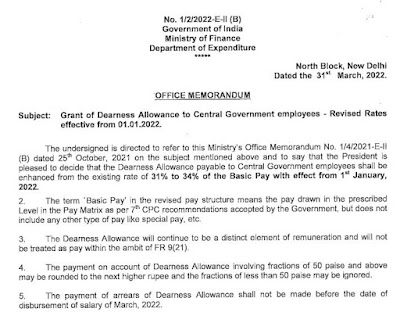
DA Jan 2022 - Grant of Dearness Allowance to Central Government employees - Revised Rates effective from 01.01.2022

 3% DA Hike - Revised Rates effective from 01.01.2022: DoE OM dated 31.03.2022 No. 1/2/2022-E-II (B) Government of India Ministry of Finance...