Wednesday, 17 February 2016

Meeting on Charter of Demands with Convener Implementation Cell 7th CPC

Meeting on Charter of Demands with Convener Implementation Cell 7th CPC

convenor-implementation-7th-CPC

NJCA
National Joint Council of Action
4, State Entry Road, New Delhi
No. NJCA/2016
Dated: 15.02.2016
Dear Comrades,

Sub : MTG with Convener Implementation Cell 7th CPC

I met today sh. R.K. Chaturvedi Jt. Secretary (Convener 7th CPC Implementation cell) and informally told him about anguish of central government employees about retro grade recommendation of 7th CPC.

Convener Implementation Cell has fixed a meeting on 19th February, 2016 at 11.00 hrs. in the FRESCO MTG Room (168-D), North Block. Before this meeting we would like to hold an Internal Meeting at 5.00 pm on 18th February, 2016 in JCM Office, 13-C Ferozshah Road New Delhi to decide about common issues as well as Departmental issues.

Hope all of you will make it convenient to attend above.

With fraternal greetings,
Comradely Yours,
sd/-
(Shiv Gopal Mishra)
Convener
7th CPC recommendations and Charter of Demands of NJCA – Revision in the date of meeting -Reg.
F.No. 30-3/2016-IC
Government of India
Ministry of Finance
Department of Expenditure
Implementation Cell
R No.217, Hotel Ashok, New Delhi
Dated : 15th February, 2016
To
Shri Shiva Gopal Mishra,
Convener,
National Joint Council of Action,
4, State Entry Road,
New Delhi – 110055

Subject : 7th CPC recommendations and Charter of Demands of NJCA-Revision in the date of meeting -Reg.

Sir,
In partial modification of this Office letter of even number dated 12.02.2016 on the above subject it is intimated that the said meeting with the representative of the National Joint Council of Action (NJCA) which was earlier scheduled on 17th February, 2016 at 3.00 P.M. will now be held on 19th February, 2016 at 11.00 AM in the FRESCO Meeting Room (168-D), Ministry of Finance, North Block, New Delhi.

2. You are again requested to invite all the constituents/representative of NJCA, including the representatives of all major Ministries/Departments in this meeting.
Thanking you
Yours faithfully,
(Ram Gopal)
Under Secretary (IC-I)
Tel: 261 16647

Charter of Demands

Settle the issues raised by the NJCA on the recommendations of the 7 CPC sent to Cabinet Secretary vide letter dated 10th December 2015.

Remove the injustice done in the assignment of pay scales to technical/safety categories etc. in Railways& Defence, different categories in other Central Govt establishments by the 7 CPC.
Scrap the PFRDA Act and NPS and grant Pension/family Pension to all CG employees under CCS (Pension) Rules, 1972 & Railways Pension Rules, 1993.
i) No privatization/outsourcing/contractorisation of governmental functions.
ii) Treat GDS as Civil Servants and extend proportional benefit on pension and allowances to the GDS.
No FDI in Railways & Defence; No corporatization of Defence Production Units and Postal Department.

Fill up all vacant posts in the government departments, lift the ban on creation of posts; regularize the casual/contract workers.

Remove ceiling on compassionate ground appointments.

Extend the benefit of Bonus Act,1965 amendment on enhancement of payment ceiling to the adhoc Bonus/PLB of Central Government employees with effect from the Financial year 2014-15.

Source : www.ncjcmstaffside.com

Big Boost to the Railway Sector: CCEA approves construction of additional Railway lines

Big Boost to the Railway Sector: CCEA approves construction of additional Railway lines

The Cabinet Committee of Economic Affairs, chaired by the Prime Minister Shri Narendra Modi, has approved construction of six Railway Lines and a Railway bridge to cater to both increased passenger and freight needs in various areas of the country. The proposals will cost over Rs.10,700 crore and most part of the expenditure will be met through extra budgetary resources (Institutional Financing). Details of the six approved projects are as follows:

1) Doubling of Hubli-Chickajur railway line

Doubling of 190 km long Hubli-Chickajur broad gauge single railway line has been approved. The total estimated expenditure will be Rs.1294.13 crore. The project is likely to be completed in 4¼ years during 13th Plan period and will cover the areas of Chitradurga, Davangere, Haveri and Dharwad.

Entire route from Pune-Miraj-Hubli-Bengalore has been identified for doubling which will not only improve smooth flow of traffic but also boost overall development of the region.

This stretch is part of an important rail link of passenger trains between Mumbai and Bangalore and goods trains to the ports at Mangalore. On this route, doubling between Bangalore-Tumkur and Arsikere-Chickajur have already been completed. On balance portion, doubling work between Hubli-Londa part of Hubli-Londa-Vasco-da-Gama, is also in progress.

2) Construction of Wardha (Sewagram) – Ballarshah 3rd railway line

Construction of Wardha (Sewagram) – Ballarshah 3rd railway line of 132 km will be taken up at an estimated completion cost of Rs.1443.32 crore. The project is likely to be completed in five years during 13th Plan period and will be located in Wardha and Chandrapur districts.

The line capacity utilization of the section is saturated and running of additional Mail/Express and Goods traffic over the section cause detention to the trains. Wardha (Sewagram) – Ballarshah section is very important from goods originating point of view of Nagpur Division where many collieries and many sidings are proposed on the section.

3) Doubling of Ramna-Singrauli railway line

Doubling of 160 km long Ramna – Singarauli railway line has been approved at a cost Rs.2675.64 crore and is likely to be completed by 2019-20. The project will cover the districts of Garhwa in Jharkhand, Singrauli in Madhya Pradesh and Sonbhadra in Uttar Pradesh.

The Ramna-Singrauli section falls in Dhanbad Division of East Central Railway. At present traffic utilization of the section is 105%, resulting in detention of trains and loss of revenue. In order to attain the desired fluidity and increase in the sectional capacity, doubling of this single line section is very essential from operational point of view. The project will serve the freight and passenger traffic needs in the jurisdiction of Northern Coal Fields and series of power plants and associated small scale industries in and around Anpara and Shaktinagar, namely Anpara Super Thermal Power Plant, Rihand Super Thermal Power Plant, Renusagar Hydro Power Plant,Singrauli Super Thermal Power Plant, Vidhyachal Super Thermal Power Plant.

4) Construction of 3rd railway line between Anuppur-Katni

Construction of 165 km long 3rd railway line between Anuppur-Katni in Madhya Pradesh has also been apporved at a cost of Rs.1595.76 crore. The project is likely to be completed in 5 ¼ years spanning over 12th and 13th plan period.

The project would cover the districts of Anuppur, Shahdol, Umaria and Katni districts of Madhya Pradesh.
There has been tremendous surge in coal and one mining which has been geared up in the recent past and ambitious plans for an enormous leap forward in the ensuing years to tap these resources lying hitherto untapped. As a result of the rapid industrialization, number of industrial townships have also grown up along the project line. These developments have resulted in large demand for additional coaching services on the section. With this anticipated increase of freight traffic, the capacity utilization will reach upto 175%. Apart from this substantial additional coal traffic from IB valley, Korba area, East Corridor and Gevra Road – Pendra Road Project would be channelized through this route to the respective destinations. In order to meet the growth in the freight and passenger traffic, tripling of 3rd line between Anuppur-Katni is essential.

5) Doubling of Katni-Singrauli railway line

Construction of doubling of 261 km long Katni – Singarauli railway at a cost of Rs.2084.90 crore has been approved. The project will be completed in 5 ¼ years. The project would cover the districts of Katni, Shahdol, Sidhi and Singrauli in Madhya Pradesh.

Katni-Singrauli is a critical and busy section carrying coal from Northern Coal Fields towards Western and Northern thermal power plants. This section intersects Allahabad-Mumbai route at Katni. Provision of doubling between Katni-Singrauli section would provide the necessary line capacity for introduction of additional mail/express and passenger trains to serve the people of the area and transportation of coal from collieries. This will also boost overall development of the region.

6) Construction of additional Bridge and doubling project of Rampur Dumra-Tal-Rajendrapul

Construction of additional Bridge and doubling project of Rampur Dumra-Tal-Rajendrapul sector in Bihar at a cost of Rs.1700.24 crore has also got CCEA’s approval today.

The project is likely to be completed by 2019-20. The project is located in Begusarai and Patna districts of Bihar.

The existing rail-cum-road bridge at Hathidah has single line track and doubling is not possible. Present traffic utilization of the section is 123.5%. At present this is the only railway bridge connecting both North and South Bihar. Existing single line has resulted in heavy detention of goods and passenger traffic.
In order to streamline the operation of traffic in this single line section, it is very essential that one additional bridge and doubling of this section is undertaken. By providing this facility, there will be ample fluidity in maintaining train operations as well as introduction of more passenger/goods trains in the section and it will augment line capacity too. This will also facilitate in minimizing the running time of trains between Kiul-Barauni and Mokama-Barauni section and will ease out the existing operational constraints in this section.

PIB

7CPC: Government Nurses to go on mass casual leave on Feb 26 protesting the 7th Pay Commission Report

7CPC: Government Nurses to go on mass casual leave on Feb 26 protesting the 7th Pay Commission Report
G.K.Khurana-protesting-7th-pay-commission
Secretary General of All India Government Nurses Federation G K Khurana (right) addressing a press conference.

Members of All India Government Nurses Federation will go on mass casual leave on February 26 as part of their ongoing agitation protesting the 7th Pay Commission Report.

The Federation has warned the government that work would be halted at every public hospital from March 15 onwards if their demands are not met.

AIIMS nurses’ union has also extended support to the strike and 50 nurses from the institute participated in the protest held at Jantar Mantar today.

“We have extended support to the strike called by All India Government Nurses Federation and on February 26, all of us will be on mass casual leave,” Biju Kesri, President of AIIMS nurses’ Union, said.
Federation members said they wanted to discuss the issue with the government but were not being given an appointment.

“We have been trying to get appointment with the Health Minister but are not being given time. Also, they themselves have never tried to contact us over the issue,” Federation’s Secretary General G K Khurana said.
“We are protesting against the retrograde recommendations of the 7th Pay Commission. We are demanding that the entry pay grade for staff nurses should be enhanced to Rs 5,400 from the existing Rs 4,600. Also the nursing allowance should be enhanced by Rs 7,800. Risk allowance and night duty allowances should be given to all nurses as it is given to all other government employees.

“We deal with the deadly infections daily but we are not provided enough risk allowance. If the demands are not met, we will go on an indefinite strike from March 15,” Khurana said.

Nurses across the country are already on a relay hunger strike since 12 till February 27 over the issue.
Inputs with PTI

Tuesday, 16 February 2016

EPFO offers 8.8% interest for 2015-16, unions protest

EPFO offers 8.8% interest for 2015-16, unions protest

epfo-8.8-interest

The financial, investment and audit committee of the EPFO board had proposed 8.95 per cent rate of return as “feasible” in its meeting held in January 2016.

The central board of trustees of the Employees’ Provident Fund Organisation (EPFO) on Tuesday recommended 8.80 per cent rate of return on retirement savings under its watch for 2015-16.

Although this is a notch higher than the 8.75 per cent offered by the EPFO to its subscribers at present, the announcement has left the trade unions disappointed as they complain that the financial and investment panel of the EPFO board had earlier recommended interest rate of 8.95 per cent.

“We have strongly protested the move to declare rate of interest at 8.80 per cent in the CBT meeting today. At 8.95 per cent, the rate declared by the financial and investment panel of the EPFO, it is left with a surplus of 91 crore. We have not agreed to it,” said Prabhakar Banasure, a member of financial, investment and audit committee of the EPFO who was present in the meeting held in Chennai.

Mr. Banasure said Union Labour Minister Bandaru Dattatreya, who chaired the Central Borad of Trustees meeting, said 8.80 per cent is an “interim” interest rate. “We demanded the Minister to wait for the audit of the 2015-16 balance sheet before declaring the interest rates. However, he didn’t agree,” he added.
The FIAC of the EPFO board had proposed 8.95 per cent rate of return as “feasible” in its meeting held last month.

The EPFO has estimated Rs. 34,844 crore as its income meant for distribution of interest to its 8.7 crore subscribers for 2015-16. This includes a surplus of Rs. 1,604 crore which accrued in 2015 to the EPFO’s income beyond the fund’s original estimates.

The FIAC had discussed that with increase in the interest rate to 8.95 per cent, the surplus available with the retirement body would come out to be Rs. 91.40 crore. At 8.80 per cent and 8.85 per cent, the surplus would be Rs. 673.85 crore and Rs. 479.70 crore, respectively, the FIAC had said.

Earlier, the labour ministry had proposed 8.90 per cent as rate of interest to the union labour ministry for taking in-principle approval of the finance ministry. However, sources said the finance ministry, which is looking to moderate the returns on small savings instruments, wanted the EPFO’s returns to fall in line.

Finance Ministry invites NJCA to discuss over 7th Pay commission recommendations on 19.2.2016

Finance Ministry invites NJCA to discuss over 7th Pay commission recommendations on 19.2.2016

The Official Sources Close to the Finance Ministry told that a Meeting with National Joint Council of Action to be held on 19th February 2016 on the issues of 7th Pay Commission and Charter of Demands of NJCA.

It is informed that Convener, 7th Pay Commission Implementation Cell has fixed Meeting with NJCA on 19th February 2016 at North Block to discuss about the matters pertaining to 7th CPC recommendations and Charter of Demands of NJCA. The timing of the meeting scheduled itself has reveals its importance.

It is expected that, since the Meeting is scheduled before the Budget Session, some news about implementation of 7th pay commission may be announced in Budget or at least we are able to know the latest development about 7th cpc implementation after the Meeting.

An internal meeting of NJCA will also be held on 18.2.2015 before they attend the meeting with Finance Ministry.

7th Pay Commission report total rubbish, say employees leaders

7th Pay Commission report ‘total rubbish’, say employees’ leaders

7thPayCommissionreport
Central government employees’ leaders have trashed the 7th Pay Commission report on pay and allowances hike of central government employees and officers, saying it was ‘total rubbish’ and ‘not worth the paper it was printed on’.

A Trade Union leader said he finds it hard to believe that the 900-page report had failed to find any government employees’ welfare motive behind the issuance of such type of pay hike recommendations, which has given nothing, not even proper minimum pay hike.

“Who in the domain of central government employees and officers believes was there any welfare motive behind the recommendations of the 7th Pay Commission for government employees?” he asked.
“who of them believes that no government agencies were involved in the issuance of such type pay commission? The pay commission report reveals that it was made on the direction of the government.”

“Yes, government can say that the 7th Pay Commission report gave a message of cheer of senior officials as commission was comprised three bureaucratic members excluding Justice A K Mathur, who led the committee. The bureaucratic members gave their vote in favor of their fraternity.

“The pay panel was constituted with no leader of the trade unions and the employees associations as representative of employees. So, the panel took a different view for lower grade employees.

IPS, IRS and other services officers have also suffered as there was not any member as their representative in the panel,” the leader of the CPI-affiliated All India Trade Union Congress (AITUC) said in here on Monday.

AITUC General Secretary Gurudas Dasgupta had already said, “It is totally disappointing… least hike (proposed) in the last 30 years. Considering the inflation, it is unsatisfactory.”

CPI-M linked Centre of Indian Trade Unions’s (CITU) President A K Padmanabhan had said these recommendations are an “injustice” to workers. The minimum pay is not in sync with today’s inflation and prices.

RSS affiliate Bhartiya Mazdoor Sangh’s General Secretary Viresh Upadhyay had said, “It is disappointing and we oppose it strongly. There is just 16 per cent hike in net pay against projected 23.55 per cent. Besides, there is now a huge gap between the minimum and maximum pay. This gap should not be more than 1:10, but it is way above.”

Confederation of Central Government Employees and Workers President K K N Kutty had said it was “totally disappointing and beats logic. It is the only commission, which has reduced the allowances and due to which the growth in net income is only 14.28%.”

The leading associations of Central government employees like central secretariat, railwaymen, nurses, employees of CBEC and CBDT, postal employees and other departments have opposed the the 7th Pay Commission report and have sought “rectification” to its.

Accordingly, the have submitted their representations to Implementation Cell (IC) in the Finance Ministry which works under the Empowered Committee of Secretaries (CoS) headed by Cabinet Secretary P K Sinha.

A 13-member Empowered Committee of Secretaries (CoS) was set up on January 27 for processing the report of the 7th Central Pay Commission before cabinet nod.

The report of the 7th Pay Commission was presented to Finance Minister Arun Jaitley in November with a recommendation for raising minimum pay to Rs 18,000 per month from current Rs 7,000 while the maximum pay, drawn by the Cabinet Secretary, has been fixed at Rs 2.5 lakh per month from current Rs 90,000, which will be effective from January 1, 2016.

The panel recommended a 14.27 per cent increase in basic pay. The overall increase in salary, allowances and pensions is 23.55%. The increase in allowances will be higher by 63% while pensions will rise 24%.

Instructions/Guidelines relating to filling up the Integrity Column of Annual Performance Assessment Reports-regarding.

No.21011/27/2015-Estt. (A-II)
Government of India
Ministry of Personnel, P.G. and Pensions
Department of Personnel & Training
North Block, New Delhi-110001
Dated: 11th February, 2016
Office Memorandum
Subject: Instructions/Guidelines relating to filling up the Integrity Column of Annual Performance Assessment Reports-regarding.

The undersigned is directed to refer the existing instructions/ guidelines of this Department on filling up the column relating to integrity in ACRs (now APARs).

It has been brought to the notice that many a time Reporting Officers do not make clear and categorical mention about the integrity of the officer reported upon.

Further, it has also been seen that in case of doubt of integrity of the officer reported upon, the procedures prescribed for filling up the integrity column in APARs are not being followed appropriately.

2. Now, it has been decided to reiterate the followings instructions/guidelines contained in para 5.2 of this Department OM No. 51/5/72-Ests. (A) dated 20 th May, 1972 on procedures prescribed for filling up the column relating to integrity in APARs:
(a) Supervisory officers should maintain a confidential diary in which instances which create suspicion about the integrity of a subordinate should be noted from time to time and action to verify the truth of such suspicions should be taken expeditiously by making confidential enquiries departmentally or by referring the matter to the Special Police Establishment. At the time of  recording the annual confidential report, this diary should be consulted and the material in it utilised for filling the column about integrity. If the column is not filled on account of the unconfirmed nature of  the suspicions, further action should be taken in accordance with the following sub paragraphs.
(b) The column pertaining to integrity in the character roll should be left blank and a separate secret note about the doubts and suspicions regarding the officer’s integrity should be recorded simultaneously and followed up.
(c) A copy of the secret note should be sent together with the character roll to the next superior officers who should ensure that the follow-up action is taken with due expedition.
(d) If, as a result of the follow-up action, an officer is exonerated, his integrity should be certified and an entry made in the character roll. If suspicions regarding his integrity are confirmed, this fact can also be recorded and duly communicated to the officer concerned.
(e) There are occasions when a reporting officer cannot in fairness to himself and to the officer reported upon, either certify integrity or make an adverse entry, or even be in possession of any information which would enable him to make a secret report to the Head of the Deptt. Such instances can occur when an officer is serving in a remote station and the reporting officer has not had occasion to watch his work closely or when an officer has worked under the reporting officer only for a brief period or has been on long leave, etc. In all such cases, the reporting officer should make an entry in the integrity column to the effect that he has not watched the officer’s work for sufficient time to be able to make any definite remark or that he has heard nothing against the officer’s integrity as the case may be. This would be a factual statement to which there can be no objection. But it is necessary that a superior officer should make every effort to form a definite judgement about the integrity of those working under him, as early as possible, so that he may be able to make a positive statement.
(f) There may be cases in which after a secret report/note has been recorded expressing suspicion about an officer’s integrity, the inquiries that follow do  not disclose sufficient material to remove the suspicion or to confirm it. In such a case the officer’s conduct should be watched for a further period, and, in the meantime, he should, as far as practicable, be kept away from positions in which there are opportunities for indulging in corrupt practices.
3. It is further conveyed that the remarks against the integrity column of APARs of the officer reported upon shall be made by the Reporting Officer in one of three options mentioned below:
(a) Beyond doubt.
(b) Since the integrity of the officer is doubtful, a secret note is attached.
(c) Not watched the officer’s work for sufficient time to form a definite judgement but nothing adverse has been reported to me about the officer.
4. All Ministries/Departments are requested to bring it to the notice of all concerned for strict compliance.

(Devesh haturvedi)
Joint Secretary to the Govt. of India
Ph. 23094398
Source: ccis.nic.in

Implementation of 7th Pay Commission to impact govt's fiscal math: Deutsche Bank

Implementation of 7th Pay Commission to impact govt's fiscal math: Deutsche Bank

New Delhi: Implementation of the Seventh Pay Commission recommendations is likely to exert pressure on the government's fiscal finances and inflation trajectory going forward, says a Deutsche Bank report.

According to the global financial services firm, the government is likely to meet its fiscal deficit target for the fiscal but may settle for a higher fiscal deficit target of 3.8 percent for 2016-17.

"It will be difficult for the government to absorb the likely 0.5 percent of GDP worth incremental increase in wage bill and also attempt to bring the fiscal deficit down to 3.5 percent of GDP in FY17, as per the revised medium-term fiscal consolidation plan," Deutsche Bank said in a research note.

According to the global brokerage firm, the government is expected to settle for a higher fiscal deficit target of 3.8 percent of GDP in FY17, lower than the 3.9 percent likely out-turn in fiscal year 2015-16.
Moreover, the 7th Pay Commission would boost consumption but not "materially".
However, Pay Commission would boost household savings in the next couple of years, which will help to support domestic investment needs, without having to rely excessively on foreign savings (or current account deficit).

On inflation, the report said the inflation trajectory will likely get affected by 30-50 bps, due to the Pay Commission impact, which should still leave room for the central bank to cut the policy rate by at least 25 bps.

Reserve Bank Governor Raghuram Rajan on February 2 left key interest rate unchanged citing inflation risks and growth concerns, while pegging further easing of monetary policy on government's budget proposals.
Rajan said RBI "continues to be accommodative" but would look forward to the government's budget proposals on February 29 as also the inflation trend.

According to Deutsche Bank, beyond the 25 bps rate cut, scope of further easing would be strictly data dependent and would hinge on the likelihood of RBI's meeting the 5 percent CPI target by early next year.

Source : zeenews.india.com

Postal Department Has Overtaken SBI on Digital Connectivity: Ravi Shankar Prasad

Postal Department Has Overtaken SBI on Digital Connectivity: Ravi Shankar Prasad

MUMBAI: The postal department has surpassed the country's largest lender, SBI, in terms of digital connectivity even before its payments bank launch, Union IT and Communications Minister Ravi Shankar Prasad today said.

"The core banking solution (CBS) or digital connectivity of the postal department has surpassed the State Bank of India's digital connectivity," Prasad said at a special session on the third day of the ongoing Make in India week here.

There are over 1.50 lakh post offices across the country, of which 1.25 lakh are in rural areas, and the department had embarked on CBS connectivity a few years ago.

The department is all set to launch a payments bank by March 2017.

SBI Chairman Arundhati Bhattacharya had in the past expressed reservations about the entry of payments banks.

The postal department has got in-principle nod to start a payments bank, along with 10 other players, including corporate houses like the Mahindras, the Birlas, Reliance Industries and telecom firms with a deeper distribution network such as Bharti Airtel.

The successful applicants have been given 18 months to start operations. They are required to present a final plan of operation to the Reserve Bank of India before final nod.

Speaking at the special session on IT and electronics, Prasad appealed all to invest more in the country, saying India will be a USD 1 trillion opportunity for digital companies in five years.

He elaborated that electronics will be a USD 350 billion industry while IT, IT-enabled services and e-commerce would bring in USD 350 billion and USD 250 billion for the communication sector.

The minister said electronics and IT manufacturing are also crucial for the success of flagship programmes such as Start-up India and Digital India.

He listed consumer, defence, automobile and medical electronics as the sub-sectors full with opportunities.

Prasad sees the target of having 500 million Internet users advancing by one year to 2016-end instead of 2017.

In the same vein, the minister said he is sensitive to the demand on the skilling front and added that over 1,200 doctoral candidates in 80 select universities will be benefiting under a special scheme.

Source: newindianexpress.com

Jaitley Launches Portal to Collect Rs 2 Lakh cr non-tax Receipt

Jaitley Launches Portal to Collect Rs 2 Lakh cr non-tax Receipt

Jaitley Launches Portal to Collect Rs 2 Lakh cr non-tax Receipt – State-owned NTPC remitted an interim dividend of Rs 989 crore to government through the electronic mode today.

Finance Minister Arun Jaitley today launched a portal to electronically collect over Rs 2 lakh crore annually in non-tax receipts from sources such as dividends by state-owned firms, RBI and spectrum fee.

“This (portal) has its own advantages and it will reduce a lot of manual work now,” Jaitley said while inaugurating the Non-Tax Receipt Portal (NTRP) which was developed by the Controller General of Accounts (CGA).

State-owned NTPC remitted an interim dividend of Rs 989 crore to government through the electronic mode today.

The annual collection of non-tax receipts amounts to over Rs 2 lakh crore. It mainly includes dividends, interest receipts, spectrum charges, royalty, licence fee, sale of forms and RTI application fees.

As per the Budget, the government aims to collect over Rs 2.21 lakh crore as non-tax receipts during 2015-16.

Earlier in the day, the Finance Ministry tweeted: “Annual collection of non tax receipts is over Rs 2 lakh crore. Biggest share flows from dividends paid by Public Sector Undertakings, RBI.”

Arun Jaitley further said that it is “an important occasion when the office of the CGA has now started using technology and created a receipts portal for all the payments into the Consolidated Fund of India”.

NTRP provides a one-stop platform to citizens or corporates or other users to make online payment of non-tax receipts to Government of India.

While taxes are largely collected using the e-payment mode, non tax revenues flow mainly through physical instruments such as bank draft or cheque or cash.

“The online electronic payment will help common users/citizens from the hassle of visiting bank premises for issue of drafts, and later to Government offices to deposit the instrument for availing services.

“It also helps avoidable delays and remittance of these instruments into Government account as well as eliminate undesirable practices in the delayed deposit of these instruments into bank accounts,” a finance ministry statement said.

The online payments can be made by using either a credit card, a debit card or through net banking.

For 2015-16 fiscal, Rs 1,00,651 crore has been budgeted from dividends. Of this Rs 36,174 crore is estimated to come from CPSEs and Rs 64,477 crore from banks, financial institutions and RBI.

The ministry has already received a dividend of Rs 65,896 crore from RBI.

Source: Financial Express

Flash News

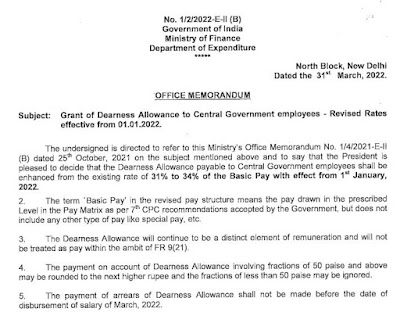
DA Jan 2022 - Grant of Dearness Allowance to Central Government employees - Revised Rates effective from 01.01.2022

 3% DA Hike - Revised Rates effective from 01.01.2022: DoE OM dated 31.03.2022 No. 1/2/2022-E-II (B) Government of India Ministry of Finance...