Monday, 25 January 2016

AIRF to conduct secret ballot proposing Indefinite Strike against 7th CPC report

AIRF to conduct secret ballot proposing Indefinite Strike against 7th CPC report

AIRF will conduct a secret ballot on February 11 and 12 to decide the date and future course of action (on strike) – Shiv Gopal Mishra, AIRF General Secretary

All-India Railwaymen’s Federation (AIRF) threatened to go ‘Indefinite Strike’ against the Seventh Pay Commission report.

“We will conduct a secret ballot on February 11 and 12 to decide the date and future course of action (on strike),” AIRF General Secretary Shiv Gopal Mishra said here today.

He said if railway employees will cast their votes in favour of launching indefinite strike then we will go for it and accordingly a date would be announced.

Mishra said their demands also include review of new pension scheme and filling up of large number of vacant posts in the railways.

Mishra differed with the Seventh Pay Commission reports and said “the minimum wage should be increased from Rs 18,000 per month to Rs 26,000.”

According to the Seventh Pay Commission recommendations, there would be an additional burden of Rs 32,000 crore on railways and Railway Minister Suresh Prabhu has described it as “unbearable”.

Mishra also said, there were about 2.5 lakh posts including those of loco pilots, assistant station masters and track men lying vacant in railways.

On new pension scheme, he said, “it should be reviewed as there are many anomalies in it. We want the guaranteed pension scheme should be implemented.”

In order to make the proposed agitation a success, Mishra said a sustained awareness campaign will be launched from January 25 to February 10.

Source : AIRF

Reserve Bank of India has issued a circular on Payment of Agency Commission on pension accounts

Reserve Bank of India has issued a circular on Payment of Agency Commission on pension accounts

RBI has clarified that agency banks are being compensated at Rs. 65 per transaction for handling pension computation, payment and related services on behalf of Central and State Governments up to 14 transactions per year. So, splitting up transaction for earning more commission by banks is not permitted.

Reserve Bank circular on Payment of Agency Commission on pension accounts – Transaction in pension more than allowed numbers would not fetch agency commission

RESERVE BANK OF INDIA
RBI/2015-16/294
DGBA.GAD.No. 2278/31.12.010/2015-16
January 21, 2016
The Chairman & Managing Director/
The Chief Executive Officer
All Agency Banks

Dear Sir/Madam
Payment of Agency Commission on pension accounts

As you may be aware, agency banks are being compensated at Rs. 65 per transaction for handling pension computation, payment and related services on behalf of Central and State Governments. As per the norms followed by the Government, a pensioner’s account should not have more than 14 credit transactions in a calendar year attributable to pension and related arrear payments, if any.

2. It has however come to our notice that certain banks are apportioning payment of arrears on account of Dearness Relief (DR) and/or delay in start of pension monthwise, thus, resulting in inflated agency commission claims. It is reiterated that number of commisionable transactions for payment of agency commission on account of pension in a year should not exceed 14. This includes one monthly credit for payment of net pension and a maximum of two per year for payment of arrears on account of increase in DR, if applicable.

3. It is also reiterated that cases involving payment of arrears on account of late start/restart of pension qualifies as a single transaction for claiming of agency commission. In other words, any payment of arrears on account of late start/restart of pension should be effected in a single credit transaction instead of separate monthly credits.

4. Some of the Central Government Departments and State Governments prefer to compute the pension figures on their own and pass them on to banks for payment. Such transactions may be included under non-pension payments, on which agency commission is payable on a turnover basis as per the existing norms (currently at 5.5 paise per Rs. 100/-).
Yours faithfully
(Manish Parashar)
Deputy General Manager

Download RBI Circular RBI/2015-16/294 DGBA.GAD.No. 2278/31.12.010/2015-16 dated 21.01.2016

BSNL Clarification regarding Employees Pension Scheme

BSNL Clarification regarding Employees Pension Scheme

BHARAT SANCHAR NIGAM LIMITED
(A Govt. of India Enterprise)
NO.500-85/CA-II/BSNL/EPF/2011/Vol.VI
Dated 19.01.2016
To,
The IFAs,
All Circles
BSNL

Sub.: Various Gazette Notifications issued by EPFO from Time to Time

This office has been receiving queries regarding Employees Pension Scheme.

In this regard, it is informed that EPFO vide its letter no. Actuarial / 18(2)2008/ Vol.III/7738 dated 29.08.2014 (copy enclosed) has already clarified that henceforth, EPS will apply only to EPF members whose pay at the time of becoming PF member is not more than Rs.15000/- per month on or after 01.09.2014. The entire employer and employee contribution shall remain in the Provident Fund and no diversion to EPS shall be made for all new PF members on or after 01.09.2014 having salary more than Rs. 15000/- at the time of joining.

In this connection, it is mentioned that this office has already issued instructions to act in accordance with the Gazette Notifications issued by EPFO, from time to time, without waiting for endorsement from the Corporate Office as the non compliance of the EPF guidelines attract penal provisions.

It is further mentioned that suitable action may be taken by the circles for rectification of any erroneous deduction made and deposited with EPFO under the EPS head for the employees covered under the above mentioned letter of EPFO dated 29.08.2014.

All BSNL units are hereby requested to kindly take necessary action in accordance with the instructions issued by EPFO.

Encl: As above
(V.M.Gupta)
Dy. General Manager (CA-III)

EMPLOYEES PROVIDENT FUND ORGANISATION
(Ministry of Labour & Employment, Govt. of India)
Head Office

Bhavishya Nidhi Bhawan, 14, Bhikaiji Came Place, New Delhi – 110 066.

No. Actuarial/18(2)2008/Vol.III/7738
Dated: 29.08.2014
To
All Addl. Central P.F. Commissioners (Zones)
All Regional P.F.Commissioners (In-Charge of Region)

Sub: Gazette Notification providing for increase in wage ceiling under EPS 1995 from Rs. 6500 to Rs.10000/- which shall come into force on and from the 1st day of Sept 2014.

Sir.
This is in continuation of this office circular No Actuary/l 8(2)2008/ Vol.111/5905 dated 23.07.2014 wherein it was informed that the Employees’ Pension Scheme 1995 is being amended to increase the wage ceiling from Rs.6500/- per month to Rs. 15,000/- per month in the Employees’ Pension Scheme, 1995.

2. The proposed amendments have since been noti red vide Gazette Notification No. GSR 609 (E) which shall come into force on and from the 1st day of September, 2014 (Copy of notification enclosed).

3. Accordingly, with effect from the 1st day of September, 2014, the pensionable salary for all cases of exit/death on or after 01.09.2014, for calculating pension shall be the average monthly pay drawn during the contributory period of service in the span of 60 months preceding the date of death/exit from the membership of the Employees” Pension Fund. The pensionable salary shall be calculated on pro-rata basis separately for the period up to 31.08.2014 up to wage ceiling of R.6,500/- per month and for the subsequent period upto the wage ceiling of Rs.15,000 per month. Similarly. the Withdrawal Benefit shall be based on the weighted wages at different wage ceilings. As already informed necessary amendments in the applicable on software are being carried out and the necessary software shall be released by I.S. Division at the earliest.

4. Accordingly, requisite steps may be taken so hat full details of wages for 60 months are available to settle the pension claims in accordance with the proposed modification. In this regard, Form 10-C & Form 10 D are also being redesigned to incorporate the above changes and shall be circulated soon. However in the meantime wage details be obtained by attaching additional sheet or giving details of 60 months of wages along with Form 10-D in respect of all members having date of exit from EPS 1995.

5. The members having date of exit from EPS, 1995 on account of superannuation/option date for commencement of early pension etc. prior to 01.09.2014 shall get Pensionary benefits on the basis of the existing pensionable salary calculations ie by taking 12 months average.

6. Further, with effect from 01.09.2014, wherever employer & employees have opted to contribute on salary exceeding Rs.6,500/- per month such employer & employees will have to exercise a fresh option to contribute on salary exceeding Rs.15,000/- per month subject to the condition that such member would have to contribute the Government’s share of contribution @ 1.16% on the salary exceeding Rs.15,000/- per month from his/her share of contribution. The fresh Option is to be exercised within a period of 6 months. It is essential to know with certainty the employee who are currently permitted to contribute to EPS on higher wages, so that fresh options can be called for. Accordingly, you may immediately flag all such cases of contribution on salary exceeding Rs.6,500/- per month and obtain fresh options in a time bound manner. It may be made known to the existing optees that if the fresh option is not exercised it shall be deemed that the employee has not Opted in allowing contribution over age ceiling and the contributions to Employees Pension Fund made above the wage ceiling in respect of the member shall be diverted to the Provident Fund account of the memer along with interest as declared under the Employees’ Provident Fund Scheme from time to time.

7. Furthermore, with effect from 01.09.2014 the provisions for contribution on higher salary has been deleted and as such no new options can be allowed to any member of EPS, 1995 on and after 01.09.2014.
8. As EPS will henceforth apply only to EPF members whose pay at the time of becoming PF member is not more than Rs. l5,000/- per month on or after 01.09.2014 the entire employer and employee contribution shall remain in the Provident Fund and no diversion to EPS shall be made for all new PF members on or after 01.09.2014 having salary more than 15,000/- at the time of joining. This must be ensured as any negligence on this issue may lead to unwarranted litigations.

9. The above actions may be taken without any deviation and officer in charge shall be responsible for compliance of above directions under his jurisdiction.

(This issues with the approval of CPFC)
Yours faithfully,
sd/-
(CHANDRAMAULI CHAKRABORTY)
REGIONAL E.F.COMMISSIONER-I (Pensions)
Click to view the Copy of the BSNL Clarification

Facilitation Fee levied by authorized travel agents on air tickets book on Government account

PCA (Fys) Kolkata Circular on Facilitation Fee levied by authorized travel agents for air tickets booked on Government account.
air-ticket-ltc


Office of the PCA (Fys) Kolkata, has issued an important Circular on Facilitation Fee levied by authorized travel agents on air tickets book on Government account

Important Circular

Office of the PCA (Fys) Kolkata,
10A, S. K. Bose Road,
Kolkata -700001

NO.2078/AN-VIII/TA/LTC/BL

Dated: 20/1/2016

Sub: Facilitation Fee levied by authorized travel agents on air tickets book on Government account

A copy of GOI, MoF, DoE, OM no. 19024/1/2012-E-IV, dated 5/9/2014 on the above subject along with M/s Balmer Lawrie Co. Ltd. Letter dated 3/11/2015 is forwarded herewith for your information and guidance, please.

Nabarun Dhar
Jt. C of A.(Fys)

No.19024/1/2012-E-lV
Government of India
Ministry of Finance
Department of Expenditure
North Block, New Delhi.

 Dated the 5th September, 2014.


OFFICE MEMORANDUM

Subject- ‘Facilitation Fee’ levied by authorised travel agents on air tickets booked on Government account – Withdrawal regarding.

    Attention is invited to this Department’s O.M of even number dated 10th October 2013 wherein the authorized travel agents namely M/s Balmer Lawrie & Company Limited (BLCL) M/s ,Ashok Travels & Tours (ATT) and Indian Railways Catering and Tourism Corporation Ltd. (IRCTC) were allowed to levy ‘Facilitation Fee’ @ Rs.100/- per ticket for domestic sector and Rs.300/- per ticket for international sector for air travel. Wherein Government of India bears the cost of air passage.

    2. The issue has been re-examined in consolation with the Ministry of Civil Aviation and Department of Legal Affairs in the light of provisions of the Air craft’s Rules,1937, as amended from time to time and it has been decided to Withdraw this Department’s O.M of even number dated 10th October 2013 with immediate effect. Consequently, no service charges (by whatever nomenclature), which are not included in the tariff charged by Air India / Airlines, are required to be paid to the authorized travel agents.

    3. payment to the authorized travel agents for the Bills raised by them for air tickets produced/ purchased till date in respect of air travel already undertaken or due to be undertaken would be regulated as per O.M of even number dated 10.10.2013. it is reiterated that as far as possible air tickets on Government account may be obtained directly from Air India/ Airlines (booking counter/offices/website) and if obtaining tickets directly from Air India/ Airlines is not possible should the services of authorized travel agents be availed of.

    4. All Ministries/Departments are advised to bring these instructions to the notice of all concerned from compliance.


(Subhash Chand)
Director

Balmer Lawrie
TOURS & TRAVEL


Date: November 03, 2015

To
Principal Controller of Accounts (FYS)
10A, S K Bose Road
Kolkata – 700001

Kind attention: Mr. Nabarun Dhar, JT. Controller of Accounts (AN)

Dear Sir,

Kindly refer to your letter ref. no. 2078/ AN-VIII/TA-DA/BL dated 16/10/15, please note that in accordance with GOI, MoF, DoE OM no. 19024/1/2012-E.IV, dated 5/09/2014, we are not charging any Service Charge/Facilitation Fee/ Processing Fee etc. in our bill.

But SERVICE TAX, EDU. Cess, & High Edu. Cess, are Govt. Statutory Taxes which are chargeable if you purchase any ticket from an agency and we are regularly depositing this Service Taxes to the service tax authority vide service tax registration no. AABCB0984EST047, which is already mentioned in our bill.

Hence you are kindly requested to make payment of service taxes accordingly.


Thanking you.
Yours faithfully,
for Balmer Lawrie & Co. Ltd.,
(S. Nath)
Sr. Branch Manager (Travel & Vacations).


Download PCA (Fys) Circular NO.2078/AN-VIII/TA/LTC/BL dated 20.01.2016

Department of Personnel and Training has issued an OM regarding Admissibility of Travelling Allowance (TA).

DoPT clarifies that no Travelling Allowance may be allowed to the probationers for the onward journey for joining the training institute and while they are taken to outstation for training activity

DoPT OM on Admissibility of Travelling Allowance (TA) and other expenditure incurred while on training by the Government Servants on probation

travelling-allowance-TA


Department of Personnel and Training has issued an OM regarding Admissibility of Travelling Allowance (TA).

No.T-25014/1/2016-TRG(ISTM Section)

Government of India
Ministry Of Personnel, Public Grievances and Pensions
Department of Personnel and Training
(Training Division)
 Old JNU Campus, Block IV,
New Mehrauli Road, New Delhi – 110 067
Dated: 21st January, 2016


OFFICE MEMORANDUM

Subject: Admissibility of Travelling Allowance (TA) and other expenditure incurred while on training by the Government Servants on probation.

Institute of Secretariat Training and Management (ISTM) is conducting Foundation Training Course of newly recruited Assistant Section Officers (DR) and Stenographers (DR). ISTM has received number of references from various Ministries and Departments, requesting for clarification, whether the expenditure incurred by trainee Assistants, now re-designated as Assistant Section Officers, for their boarding, lodging etc. while undergoing Foundation Training, under the aegis of ISTM can be reimbursed to them. Representations have also been received from Assistant Section Officers, through their administrative Ministries in this regard.

2. The matter has been examined in consultation with the IFD(MHA) with reference to the Supplementary Rules 164 and instructions issued by the Government from time to time under the aforesaid Rules, which govern claims of Travelling Allowances while on training by probationers. The rule position is clarified as under:-

    (i) No Travelling Allowance may be allowed for the onward journey for joining the training institute;

    (ii) No Travelling Allowance may be allowed to the probationers while they are taken for outstation for training activity;

    (iii) Probationers have to pay boarding /lodging /transport charges, if any, from their pocket.

    (iv) No daily allowance may be admissible.

    (v) One side TA may be allowed to the participants while reporting for duty in the allocated Ministry/Department on completion of the Training Programme from an outstation Institute, which are located at Hyderabad, Kolkata, Chandigarh, Shimla and Jaipur, where such training is being conducted by ISTM at present, or any other State Training Institute, which may be identified later, outside NCR.

3. All Ministries/Departments of Government of India are, therefore, advised to decide the claims made by Assistant Section Offices in respect of reimbursement of expenditure by them for boarding/lodging and other transport charges during the period of their Foundation Training conducted by ISTM, in accordance with the provisions contained at para (2) of this O.M. In case, any reimbursement has already been made, the same may be recovered immediately.

4. This issues with the concurrence with the IFD(MHA), vide their Dy. No. 299/Fin.II/15, dated 31.12.2015.


(O.P.Chawla)
Under Secretary to the Government of India


Download DoPT OM No.T-25014/1/2016-TRG(ISTM Section) dated 21.01.2016

7th Pay Commission – Hike the Basic Minimum pay by 44% – Review the Salaries after every 5 years – Unions

7th Pay Commission – Hike the Basic Minimum pay by 44% – Review the Salaries after every 5 years – Unions

The brewing discontent amongst the central government employees is threatening to create a storm and disrupt the implementation process. The unions are asking around 44% hike on the basic minimum pay and review the salaries every 5 years.

7th Pay Commission – Hike the Basic Minimum pay by 44% – The unions had staged a 3-day agitation earlier in January, and even threatened to strike work for longer period.

Implementing the recommendations of the 7th Central Pay Commission (7th CPC) is not going to be a cakewalk for the government.

The brewing discontent amongst the central government employees is threatening to create a storm and disrupt the implementation process. The unions are asking around 44 percent hike on the basic minimum pay suggested by the 7th Central Pay Commission.

The 7thCPC had recommended the minimum pay at Rs 18,000 and the maximum pay at Rs 250,000, but the employee unions wants the minimum pay to be hikes from Rs 18,000 per month to Rs 26,000–a rise of around 44.4 percent.

The unions also said that the pay panel has recommended the lowest hike in basic pay since independence.

The unions argue that pay scales vary from states to states. They also want the minimum pay to be applied across all the states in the country.

The Central government employees’ unions have not only demanded to increase the minimum pay of central government employees, but also want government to review the salaries of central government employees after every 5 years instead of the current 10 years.

The previous 6th Central Pay Commission had recommended a 20 percent hike, which the government had doubled while implementing it in 2008. However, the present government is on the look out for a way to somehow influence negatively, the already employee negative 7th cpc recommendations.

The unions have upped the ante on salary hike since the government set up empowered committee of secretaries headed by Cabinet Secretary earlier in January to process the recommendations of the 7th CPC.

The unions had staged a 3-day agitation earlier in January, and even threatened to strike work for longer period.

Source: Zee News

Sunday, 24 January 2016

IESM LETTER TO RM ON OROP ANOMALIES

IESM LETTER TO RM ON OROP ANOMALIES


21st January 2016


The Raksha Mantri
South Block, Ministry of Defence
New Delhi

Urgent Need to Rectify Anomalies in OROP
in Govt notification dated 7 Nov 15


Dear Shri Manohar Parrikar ji

Please refer to Govt executive letter dated 26 Feb 14, press release dated 5 Sep 15, Govt notification dated 7 Nov 15 and 14 Dec 15. Please also refer to the statement made by MOS Defense Sh Rao Inderjit Singh in Parliament on 2 Dec in reply to question asked by Sh Rajeev Chandrashekhar regarding implementation of OROP. (All attached)

One Rank One Pension was approved by UPA Govt in budget dated 17 Feb 14 and then by NDA Govt in their budget dated 10 Jun 14. UPA Government issued an executive order dated 26 Feb 14 for the implementation of OROP dues to veterans at the earliest. This was never implemented by the MOD nor a demand note was ever raised. The approved definition of OROP by two Governments is given below.

    "One Rank One Pension (OROP) implies that uniform pension be paid to the Armed Forces Personnel retiring in the same rankwith the same length of service irrespective of their date of retirement and any future enhancement in the rates of pension to beautomatically passed on to the past pensioners. This implies bridging the gap between the rate of pension of the current pensioners and the past pensioners, and also future enhancements in the rate of pension to be automatically passed on to the past pensioners."

OROP implies that a senior rank soldier should never draw pension less than his junior rank soldier. This cardinal principle is the soul of OROP and must never be violated.

Government issued a notification on 7 Nov 15 for implementing OROP. Government reiterated above-mentioned definition of OROP in the letter but introduced some conditions in the notification that completely destroy the definition approved by two parliaments. These conditions have created four anomalies which completely violates the definition and thereby, the soul of OROP. These anomalies are discussed in detail in succeeding paragraphs.

    1) Fixation of Pension on calendar year of 2013 instead of FY of 2014: Fixation of pension as per calendar year 2013 would result in past retirees getting less pension of one increment than the soldier retiring today. This will result in past retirees drawing lesser pensions than present retirees. This will completely destroy definition of OROP approved by two Parliaments and will also result in loss of one increment across the board for past pensioners in perpetuity.

    2) Fixation of pension as mean of Min and Max pension: Fixing pension as mean of Min and Max pension of 2013 would result in more anomalies wherein same ranks with same length of service will draw two or more different pensions thus violating the very principle of OROP. This issue was discussed with RM in various meetings and after due deliberations it was decided that accepting highest pension of each rank in the year would meet the requirement as base of pension.

    3) Payment wef 1st Jul 14 instead of 1st Apr 14: OROP has been approved in budget of 2014-15 by two parliaments. As per norms of Government, all proposals approved in budget are applicable from 1st April of that FY. In the case of OROP, the Govt had issued specific orders to its applicability wef 1st April 14. Hence implementation date for OROP from 1st July will be against the Parliament approval. Changing the date would result in loss of 3 months emoluments for OROP across the board. However, if OROP implementation date is to be kept as 1st July, then the base pension should also be accepted as per the PPOs of July 2014.

    4) Pension Equalisation every five year: Pension equalisation every five year will result in a senior rank soldier drawing lesser pension than a junior rank soldier for five years thus OROP definition will be violated for five years. This will also result in permanent violation of definition as fresh cases will come up every year.

These anomalies will result in lesser pensions to widows, soldiers, NCOs and JCOs than what will be due to them on approval of OROP. This will result in veterans not getting OROP as per approved definition and will create large discontentment across all ranks.

There is a need to have a relook at the pensions of Hon Nb Subedars, Majors and Lt Cols.

    a) Some Havildars are granted rank of Hon Naib Subedar in view of their exemplary service. These soldiers are not granted pension of Naib Subedar thus making the Hon rank just ceremonial. It is requested that Hon Naib Subedars should get pension of a Naib Subedar rather than that of a Havildar. Similarly, this must be accepted as a principle and it should be applicable to all Hon ranks in case of NCOs and JCOs.

    b) There are only a few Majors as veterans. Moreover no officer is retiring in Major rank now. In the past, officers were promoted to Major rank after completing 13 yrs of service whereas present officers are getting promotion of Lt Col in 13 yrs. It will be justified to grant all pensioners of the rank of Major, minimum pension of Lt Col as they cannot be compared to present retirees as officers are not retiring as Majors any more. Number of such affected officers is not more than 800 and will not cause heavy burden to Govt.

    c) Similarly, all pre-2004 retiree Lt Cols should get the minimum pension of full Col. Presently all officers retire in the rank of Colonel hence all Lt Col equivalents should be granted min pension of Colonels.

In view of above you are requested to rectify these anomalies and issue addendum to notification issued on 7 Nov 15 for implementation of OROP. We strongly believe that there will be no requirement of judicial committee for attending to anomalies creeping up in implementation of OROP. Grant of increase in pension in case of honorary ranks and Majors and Lt Col must also be approved as a good will gesture.

This letter is being signed by three major organizations with the approval of more than 200 organizations. List of such organizations is attached.

sd/-
Lt Gen Balbir Singh
Chairman IESL Advisor UFESM
sd/-
Col Inderjit Singh
Chairman AIEWA Chairman IESM
sd/-
Maj Gen Satbir Singh
Chairman UFESM Advisor UFESM

Copy to:

  1  Mr Arun Jaitley, Finance Minister, North Block, Finance Ministry, Government of India
  2 Mr Jayant Sinha, MoS, Finance, North Block, Finance Ministry, Government of India
  3  General Dalbir Singh, PVSM, UYSM, AVSM, VSM, ADC, Chief of Army Staff
  4 Air Chief Marshal Arup Raha, PVSM, AVSM, VM, ADC, Chief of the Air Staff & Chairman Chiefs of Staffs Committee (CoSC)
  5  Admiral RK Dhowan, PVSM, AVSM, YSM, ADC, Chief of Naval Staff

Source: http://ex-servicemenwelfare.blogspot.in/

EPFO may pay 9% interest on PF deposits for 2015-16

EPFO may pay 9% interest on PF deposits for 2015-16

Retirement fund body EPFO may provide 9 per cent interest on PF deposits for this fiscal, which is higher compared to 8.75 per cent provided in previous two fiscals to its over five crore subscribers.

The Employees Provident Fund Organisation’s (EPFO) finance panel has recommended raising the interest rate on statutory savings of over 5 crore subscribers from 8.75% to 8.95% during the current fiscal.

“The income projection of Rs 34,844.42 crore for the current fiscal is expected to be revised upward. Thus the body can provide 9 per cent rate of interest on PF deposits for 2015-16,” an EPFO trustee and Bharatiya Mazdoor Sangh Secretary P J Banasure told PTI.

The Employees Provident Fund Organisation’s (EPFO) Finance Audit and Investment committee (FAIC) recommended 8.95 per cent interest on PF deposits for the current fiscal in its meeting earlier this week.

Banasure, who is also a member of FAIC said:”If the EPFO provides 8.95 per cent interest rate on PF deposits for 2015-16, it will leave a surplus of Rs 91 crore as per income projections worked out in September last year. But the FAIC will meet again later this month to vet the latest income estimate which is likely to be revised upward.”

According to EPFO income projections worked out in September, providing 9 per cent interest on PF will result in a deficit of Rs 100 crore. “We are expecting that there will be a surplus of Rs 100 crore on providing 9 per cent rate of interest on PF deposits when EPFO will work out the latest estimates. FAIC can change its recommendation in the next meeting and suggest 9 per cent interest rate for 2015-16,” he said.

The proposal has to be endorsed by the Central Board of Trustees (CBT) before the Finance Ministry notifies it.

However, there has been indications from the Finance Ministry that it will slash interest rate on small savings like public provident fund in view of the rate cut by Reserve Bank of India.

The EPFO provides rate of interest from the earning on investments of formal sector workers’ funds without any assistance from the government.

Source: EOT

Age relaxation to the residents of the State of J&K in Railways

Age relaxation to the residents of the State of J&K in Railways


GOVERNMENT OF INDIA
MINISTRY OF RAILWAYS
(RAILWAY BOARD)


RBE No.1/2016


No.E(NG)-II/95/RR-1/26

New Delhi, dt.: 6/01/2016


The General Manager (P),
All Zonal Railways/Production Units, CORE/Allahabad,
MTP/Kolkata, Chennai, Mumbai,
CAO (R), DMW/Patiala, COFMOW/New Delhi,
Director General, RDSO/Lucknow, RSC/Vadodra,
Director, IRISE/Secundrabad, IRICEN/Pune, IRIEEN/Nasik & IRIM&EE/Jamalpur, Chairmen, RRBs/RRCs.


Sub: Age relaxation to the residents of the State of Jammu & Kashmir.

Kindly refer to this Ministry’s letter of even number dated 08.6.2012 (RBE No.70/2012) forwarding therewith a copy of the notification No. 15012/6/2011-Estt.(D) dated 30.12.2011 issued by Ministry of Personnel, Public Grievances & Pensions (Department of Personnel & Training) extending the currency of relaxation of age limit limit in favour of the residents of State of Jammu & Kashmir for appointment to Central Civil Services and posts, recruitment to which are made to UPSC/SSC or otherwise by the Central Government up to 31/12/2013.

Department of Personnel & Training have issued a further notifications No. 15012/1/2014-Estt(D) dated 30/9/2014 and 23/10/2015 and accordingly the relaxation of age limit in favour of the residents of the State of Jammu & Kashmir for appointment to Central Civil Services and posts, recruitment to which are made through UPSC or SSC or otherwise by the Central Government stands extended up to 31/12/2017.

Please acknowledge receipt.
(Neeril Kumar)
Director Estt.(N)-II
Railway Board.


Authority : www.indianrailways.gov.in

7th Pay Commission – Government to Factor in Payout of 7th CPC in Deficit Targets

7th Pay Commission – Government to Factor in Payout of 7th CPC in Deficit Targets

“The government will not be generous in the pay out this time as they already are facing pressures from various fronts like disinvestment and poor direct tax collections,” said Dharmakirti Joshi, currently the chief economist at CRISIL.

7th Pay Commission – Government to Factor in Payout of 7th CPC in Deficit Targets – It is expected that the government, while putting a final seal on the recommendations, will keep in mind the tight fiscal position of the country.
The payout of the seventh pay commission recommendations will make finance minister Arun Jaitley walk a tight rope when he announces the fiscal deficit targets for 2016-17.

Expected to incur an additional expenditure of Rs 1.02 lakh crore to pay higher salaries and pensions recommended by the commission, Rs 28,000 crore alone will go for salary hikes of railway employees. In total, the implementation will impact the fiscal deficit by 0.65% of the GDP.

Experts feel that deficit figures shared in the medium-term fiscal policy statement had stated that the fiscal deficit target for FY17 and FY18 is 3.5% and 3.0%, respectively will have a significant impact from the pay commission pay out, leaving the government with higher deficit numbers.

“Achieving these targets in view of the likely acceptance and implementation of the recommendations of the Seventh Central Pay Commission will be difficult. We expect that the fiscal deficit of FY17 to come in at 3.9% of GDP. This will push the attainment of the fiscal deficit target of 3% of GDP to FY19, a year later than envisaged in the fiscal policy statement. In the past also, pay revisions have pushed fiscal consolidation targets. Accordingly, the fiscal deficit targets are likely to be 3.9%, 3.5% and 3.0% in 2016-17, 2017-18 and 2018-19 respectively,” said Sunil Kumar Sinha, principal economist, India Ratings & Research.

However, the pay commission revisions are yet to be accepted by the high-powered panel headed by cabinet secretary PK Sinha. The recommendations have a bearing on the remuneration of 47 lakh central government employees and 52 lakh pensioners.

An empowered committee of secretaries was being decided to screen the recommendations with regard to all relevant factors of the Commission in an expeditious detailed and holistic fashion.
Though senior finance ministry officials feel that the pay-out which is likely to come only in the middle of 2016, might not be a big burden as the arrears would not be accounting to be much, unlike the past instances.

But, it is expected that the government, while putting a final seal on the recommendations, will keep in mind the tight fiscal position of the country.

“The government will not be generous in the pay out this time as they already are facing pressures from various fronts like disinvestment and poor direct tax collections,” said Dharmakirti Joshi, currently the chief economist at CRISIL.

Finance ministry till now has maintained a stand that it will be able to meet its target despite additional outgo on account of higher pay. But, finance minister Jaitley recently admitted that the impact of implementing the recommendations would last for two to three years.

The seventh pay commission had recommended an average 23.55% increase in salaries, allowances and pension, a move that will benefit 4.8 million staffers and 5.5 million pensioners. The hike will be effective from January 1, 2016.

A minimum pay of Rs 18,000 per month and a maximum of Rs 2.5 lakh has been recommended by the commission, headed by Justice (retired) AK Mathur, that presented its 900-page report to finance minister Arun Jaitley.

Source: Hindustan Times

Flash News

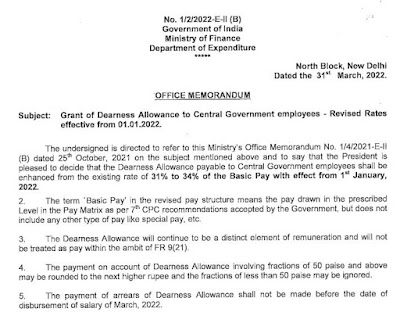
DA Jan 2022 - Grant of Dearness Allowance to Central Government employees - Revised Rates effective from 01.01.2022

 3% DA Hike - Revised Rates effective from 01.01.2022: DoE OM dated 31.03.2022 No. 1/2/2022-E-II (B) Government of India Ministry of Finance...