Tuesday, 21 July 2015

Preparation of list of Government servants due to retire along with their Aadhaar numbers and incorporation of Aadhaar number in PPO Booklet: CPAO's OM

Preparation of list of Government servants due to retire along with their Aadhaar numbers and incorporation of Aadhaar number in PPO Booklet: CPAO's OM

GOVERNMENT OF INDIA
MINISTRY OF FINANCE
DEPARTMENT OF EXPENDITURE
CENTRAL PENSION ACCOUNTING OFFICE
TRIKOOT-II, BHIKAJI CAMA PLACE,
NEW DELHI-110066
PHONES : 26174596, 26174456, 26174438
CPAO/Tech/Jeevan Pramaan/2015-16/515 to 662.
10.07.2015

Office Memorandum
Subject:- Preparation of list of Government servants due to retire along with their Aadhaar numbers and incorporation of Aadhaar number in PPO Booklet.

1. As a part of Digital India initiatives, Digital Life Certification (DLC) of the pensioner has been made an option for submission of life certificate by the pensioner in the month of November each year. As the role of Aadhaar has become vital, a column for Aadhaar has already been provided in the Pension Payment Order booklet. Accordingly, all Heads of Offices have to ensure that wherever available same is provided to their Pay & Accounts Offices alongwith pension papers of the retiring government servants. In this regard, a provision has also been made in CAM-52 (PPO Booklet) by adding the following columns after existing column no.5.

6. Permanent Account Number for Income Tax (PAN)
7. Aadhaar No. (if Available)
8. Mobile No. (if Available)
9. E-Mail ID (if Available)
 
2. The seeding of Aadhaar with pensioners’ PPO number and their bank accounts is being closely monitored by Prime Minister Office. While this information is being regularly collected by CPAO from banks, the processing of fresh pension cases alongwith Aadhaar number is a very important requirement for expediting seeding of Aadhaar number by banks with PPO number & bank account and smooth implementation of submission of DLCs by pensioners in the month of November.

3. Further, attention is invited to Rule 56 of CCS (Pension) Rules which provides that:-

“(1) Every Head of Department shall have a list prepared every three months, that is, on the 1st January, 1st April, 1st July and 1st October each year, of all Government servants who are due to retire within the next twelve to fifteen months of that date.
 
(2) A copy of every such list shall be supplied to the Accounts Officer concerned not later than 31st January, 30th April, 31st July or 31st October, as the case may be, of that year.”
 
4. To avoid any delay in finalizing the pension cases all Heads of Offices should have first-hand information of the Aadhaar number while preparing the list of retiring government officials as per the provision of Rule 56 of CCS (Pension) Rules and should provide the same to the Accounts Officer concerned not later than 31st January, 30th April, 31st July or 31st October of that year.
 
5. In has been observed that during the month of June, 2015; out of 3101fresh PPOs (Pension Payment Orders), only in 220 cases Aadhaar numbers have been indicated. All Pr. CCAs/CCAs/ AGs are once again requested to ensure that all fresh PPOs are sent to CPAO with Aadhaar numbers wherever available and quarterly list of would be retirees as mentioned in para 3 & 4 above also mention Aadhaar numbers wherever available.

(Subhash Chandra)
Controller of Accounts
Source: http://cpao.nic.in/pdf/cpao_tech_jeevan_praman_2015-16.pdf

7th Pay Commission Rumours – Discarding Grade Pay system – Will it be beneficial ?

7th Pay Commission Rumours – Discarding Grade Pay system – Will it be beneficial ?
A study on difference in Fitment benefit for 7th Pay Commission Pay Fixation in the case of principles of 5th CPC Pay fixation is adopted in lieu of Fitment Benefit in the form of Grade Pay System evolved by 6th CPC

Fitment benefit in the form of Grade Pay provided by 6th CPC was computed based on highest pre-revised pay in each of the pre-revised Pay Scale – Fitment benefit advocated by previous pay commisions were reckoned with Pre-revised basic Pay drawn on the effective date of CPC

While Central Government Employees keep their fingers crossed after 7th Pay Commission finished all the interaction sessions with the Employees Federations and started finalising its report to be submitted to Govt, many surmises and speculations have already started filling the air through Internet and through word of mouth about possible 7th CPC pay fixation methods.

Some of those 7th Pay Commission rumours are as follows
  • There will be no running Pay band and Grade Pay System
  • The Minimum Pay will be Rs. 21000
  • The uniform multiplication factor for arriving revised pay will be 2.86
  • The Criteria for retirement age will be either completion of 33 Years of service or at the age of 60 Years whichever is earlier.
Interestingly, these rumours are spread out this time carry the tags as “inside information provided by Employees federations which participated in the 7th Pay Commission meetings”. The very character of a rumour is, it may be true or false. God only knows.

Among these, the unconfirmed news that 7th Pay Commission is to discard Pay Band – Grade Pay System may be affecting the Pay Structure of Central Government Employees very much if it is true.
In fact this is an off-shoot of proposal moot out by Confederation of Central Government Employees and
Workers in its reply to 7th Pay Commission Questionnaire

In this background, we made an analysis as to whether discarding of Grade Pay System would be beneficial to Central Government Employees.

As per the proposal of Confederation, the Pay Band and Grade Pay system evolved by the 6th CPC brought about innumerable anomalies and the same has to be replaced by the Pay scale structure, which was in vogue prior to the implementation of the 6th CPC.

What was Pay Scale Structure prior to 6th CPC ?  How fixation pay was made in that pay scale ?

Obviously, Pay Scale Structure contemplated by Confederation is 5th Pay Commission Pay Structure which is the Pay Structure prior to 6th CPC pay Structure.
Now, let us have a look at the 5th CPC Pay Structure and how pre-revised 4th CPC Pay was revised and fit into the same.

5th Pay Commission Pay fixation Method :

As per Central Civil Services (Revised Pay) Rules 1997 which was notified by Ministry of Finance for implementation of 5th Pay Commission Report, Revised Pay Scales against 4th CPC pay scales are as follows

4th CPC Pay scales5th CPC pay scales
750-12-870-14-940S-12550-55-2660-60-3200
775-12-871-12-1025S-22610-60-3150-65-3540
775-12871-14-955-15-1030-20-1150S-2A2610-60-2910-65-3300-70-4000
800-15-1010-20-1150S-32650-65-3300-70-4000
825-15-900-20-1200S-42750-70-3800-75-4400
950-20-1150-25-1400/950-20-1150-25-1500/1150-25-1500S-53050-75-3950-80-4590
975-25-1150-30-1540/975-25-1150-30-1660S-63200-85-4900
1200-30-1440-30-1800/1200-30-1560-40-2040/1320-30-1560-40-2040S-74000-100-6000
1350-30-1440-40-1800-50-2200/1400-40-1800-50-2300S-84500-125-7000
1400-40-1600-50-2300-60-2600/1600-50-2300-60-2660S-95000-150-8000
1640-60-2600-75-2900S-105500-175-9000
2000-60-2120S-116500-200-6900
2000-60-2300-75-3200/2000-60-2300-75-3200-3500S-126500-200-10500
2375-75-3200-100-3500 / 2375-75-3200-100-3500-125-3750S-137450-225-11500
2500-4000S-147500-250-12000
2200-75-2800-100-4000/2300-100-2800S-158000-275-13500
2200-75-2800-100-4000NEW SCALE8000-275-13500(Group A Entry)
2630/- FIXEDS-169000
2630-75-2780S-179000-275-9550
3150-100-3350S-1810325-325-10975
3000-125-3625/3000-100-3500-125-4500/ 3000-100-3500-125-5000S-1910000-325-15200
3200-100-3700-125-4700S-2010650-325-15850
3700-150-4450/3700-125-4700-150-5000S-2112000-375-16500
3950-125-4700-150-5000S-2212750-375-16500
3700-125-4950-150-5700S-2312000-375-18000
4100-125-4850-150-5300/4500-150-5700S-2414300-400-18300
4800-150-5700S-2515100-400-18300
5100-150-5700/5100-150-6150/5100-150-5700-200-6300S-2616400-450-20000
5100-150-6300-200-6700S-2716400-450-20900
4500-150-5700-200-7300S-2814300-450-22400
5900-200-6700/5900-200-7300S-2918400-500-22400
7300-100-7600S-3022400-525-24500
7300-200-7500-250-8000S-3122400-600-26000
7600/-FIXED /7600-100-8000S-3224050-650-26000
8000/- FIXEDS-3326000(FIXED)
9000/- FIXEDS-3430000(FIXED)

Further, 5th CPC revised pay of Central Government Employees was worked out by adding DA as on 01.01.1996, two installments of Interim Relief (IR-1 and IR-2) and 40% of pre-revised basic pay with Pre-Revised Basic pay drawn as on 01.01.1996. Then resultant revised basic pay was stepped up to nearest incremented pay in the revised 5th CPC pay scale against the existing 4th CPC pay scale in which the pay was drawn. The following illustration would provide clear cut idea about 5th Pay Commission Pay fixation method

Illustration for 5th Pay Commission Pay fixation

Existing 4th CPC pay scaleRs. 1640-60-2600-75-2900
Revised 5th CPC pay scaleRs. 5500-175-9000
Pre-Revised Basic PayRs. 2360
D.A as on 01.01.1996 @ 148%Rs. 3493
IR-1Rs. 100
IR-2Rs. 236
Add 40% of pre-revised B.PRs. 944
TotalRs. 7133
Nearest incremented pay in revised 5th CPC pay scale —-ARs, 7250
If one increment is ensured in the revised pay scale for every three increments in the pre-revised pay scale, the revised basic will be —- BRs. 6250
5th CPC revised Basic Pay as on 01.01.1996 (A or B whichever is higher)Rs. 7250

From the above it could be found that fitment benefit of 40% is calculated using the pre-revised basic pay received by an employee as on 01.01.1997. On the contrary, in the case of fitment benefit allowed by 6th Pay Commission in the form of Grade Pay, it has been calculated at 40% of highest Pay in each of 5th CPC Pre-Revised pay scale.

6th Pay Commission Pay Band and Grade Pay hierarchy

5th CPC Pay Scales6th CPC Pay Band and Grade Pay
GRADESCALEPay BandGrade Pay
S-12550-55-2660-60-3200-1S4440-74401300
S-22610-60-3150-65-3540-1S4440-74401400
S-2A2610-60-2910-65-3300-70-4000-1S4440-74401600
S-32650-65-3300-70-4000-1S4440-74401650
S-42750-70-3800-75-4400PB-15200-202001800
S-53050-75-3950-80-4590PB-15200-202001900
S-63200-85-4900PB-15200-202002000
S-74000-100-6000PB-15200-202002400
S-84500-125-7000PB-15200-202002800
S-95000-150-8000PB-29300-348004200
S-105500-175-9000PB-29300-348004200
S-116500-200-6900PB-29300-348004200
S-126500-200-10500PB-29300-348004200
S-137450-225-11500PB-29300-348004600
S-147500-250-12000PB-29300-348004800
S-158000-275-13500PB-29300-348005400
NEW SCALE8000-275-13500(Group A Entry)PB-315600-391005400
S-169000PB-315600-391005400
S-179000-275-9550PB-315600-391005400
S-1810325-325-10975PB-315600-391006600
S-1910000-325-15200PB-315600-391006600
S-2010650-325-15850PB-315600-391006600
S-2112000-375-16500PB-315600-391007600
S-2212750-375-16500PB-315600-391007600
S-2312000-375-18000PB-315600-391007600
S-2414300-400-18300PB-437400-670008700
S-2515100-400-18300PB-437400-670008700
S-2616400-450-20000PB-437400-670008900
S-2716400-450-20900PB-437400-670008900
S-2814300-450-22400PB-437400-6700010000
S-2918400-500-22400PB-437400-6700010000
S-3022400-525-24500PB-437400-6700012000
S-3122400-600-26000HAG+SCALE75500-80000NIL
S-3224050-650-26000HAG+SCALE75500-80000NIL
S-3326000(FIXED)APEX SCALE80000(FIXED)NIL
S-3430000(FIXED)CAB. SEC.90000(FIXED)NIL

We are of the view that if the 7th CPC fitment benefit is calculated on the basis of existing pre-revised pay as in the case of 5th CPC then revised 7th CPC pay would be lesser than the revised 7th CPC Pay calculated by adopting the methods 6th CPC, in which grade pay (fitment benefit) has been arrived at on the basis of highest pay in the pre-revised pay Scale.

At the same time it may not be viable to arrive 7th CPC fitment benefit on the basis of highest Pay in each of Pay Band as 6th CPC Pay Band Structure has been designed in such a way that each of the Pay band accommodates many 5th CPC Pre-Revised Pay Scales

However, even after discarding Grade pay System, if the fitment benefit for 7th Pay Commission Pay revision is provided on the basis of highest pay in the fitment table provided vide O.M 1/1/2008-IC dated 30.08.2008 for the each of the 5th CPC Pre-Revised Pay Scale, then it would be Pay wise beneficial to Central Government Employees.

We invite valuable opinion of readers in the form of comments to this article so that pay fixation method beneficial to CG Employees community can be highlighted

Source: gconnect

7CPC: Maruti Suzuki to get boost from Seventh Pay Commission’s recommendations

7CPC: Maruti Suzuki to get boost from Seventh Pay Commission’s recommendations


MUMBAI: Investors expect Maruti Suzuki to get a boost from the Seventh Pay Commission's recommendations later this year that will lead to salaries of government employees rising. The Pay Commission is expected to submit its report by October and this is likely to be implemented from July 2016, likely adding to an expected double-digit growth in passenger car sales in FY17. Maruti Suzuki is expected to be the main beneficiary, analysts said. The last Pay Commission report had resulted in car sales rising 18 per cent annually between FY09 and FY11.
"The Sixth Pay Commission, which was implemented in August 2008, resulted in almost 10 times increase in Maruti's sales to government employees from FY08 to FY12," Jatin Chawla and Akshay Saxena, research analysts at Credit Suisse, wrote in a July 15 report.

The market value of Tata Motors surged past Maruti Suzuki in 2010, after the Indian company turned JLR around following its acquisition from Ford in 2008. JLR more than made up for Tata Motors' poor domestic performance over the past few years. The Chinese decline has forced many carmakers to scale down targets.
JLR said June sales were flat because strong growth in Europe and North America was offset by a dramatic slowdown in China.
German luxury carmaker Audi has abandoned a target to sell 600,000 cars this year in China, its biggest market, as the country's stock market rout sapped demand for luxury cars, Bloomberg reported on Thursday. Audi's Chinese sales rose 1.9 per cent to 273,853 cars in the first half. Credit Suisse reckons that a salary increase could boost demand for cars in India by 10 per cent. It upgraded the expectation for volume growth at Maruti Suzuki for FY17 to 23 per cent from 17 per cent on account of the expected pay commission boost. It also increased the stock's target price to Rs 5,100 at the end of 2017 fromRs 4,370 previously. Maruti expects there will be a repeat this time around.
"We have sold almost 200,000 vehicles to government employees in FY15," said Randhir Singh Kalsi, executive director, sales, Maruti Suzuki. "We certainly believe we can get more incremental volumes after implementation of the Seventh Pay Commission." Maruti saw a pickup mostly in the Rs 2.5-5 lakh price bracket last time around.
Others also expect a bounce. "An increase in disposable income certainly will help potential buyers to purchase high quality products. So, definitely a salary hike of government employee will propel the industry growth," said Rakesh Srivastava, president, sales, Hyundai India. Growth was seen across segments and geographies after the last pay increase, he said.
There are about 30 lakh central government employees while state government workers number about three times that. About a fourth of them are paidRs 30,000-50,000 per month and nearly 10 per cent may buy cars, Credit Suisse estimates, adding up to an additional volume of about 300,000 units.
Among those who get a pay increase, those who have set aside enough for children's education and own a home will be the ones most likely to buy a new car, said Maruti's Kalsi, pointing out that brands will need to target the entire family, not just breadwinners.
"Importantly, car buying is no longer a prerogative of the parents and their teenage children now play an important role in choosing a car," he said.
Changing consumer preferences also indicate that it won't be just entry-level cars that are likely to rise; some may look to upgrade.
"We are (expecting) incremental demand from employees for compact as well as sedan cars," said Srivastava of Hyundai. Apart from the additional pay, arrears will also play a role. The Sixth Pay Commission award saw employees getting arrears for 32 months in two installments in FY09 and FY10. This means that any delays in payment enhance the ability of an employee to buy a car. Carmakers offer special discounts for government employees and it's easier for them to get loans from public sector banks as well.

Via Economic Times

7CPC: Seventh Central Pay Commission to submit report by October 31

7CPC: Seventh Central Pay Commission to submit report by October 31

New Delhi: The eyes of the central government employees will be firmly glued on the forthcoming seventh central pay commission reports which is likely to be be submitted by October 31 for implementation from April 2016.

The pay panel is likely to finalise and submit its report on salary and allowance hike by October 31, sources said. The members and officials of the panel had made several field tours and collected valuable suggestions, which are all going to be trashed as the Commission winds up its office within three month.

After getting recommendations, the central government may announce to accept it in the budget 2015-16 to implement it from April 2016.

It is expected that seventh pay panel to suggest hiking the tripled salaries of central government employees.
The salaries of central government employees were roughly tripled with retrospective effect from 1996 and tripled once again with retrospective effect from 2006 by the fifth pay panel and sixth pay panel respectively. This shows the salaries of central government employees have tripled every decade.

According to media report says that investors are expecting car bazar to get a boost from the seventh central pay commission’s recommendations from mid-next year on account of getting arrears of rising salaries of central government employees.

The last Pay Commission report had resulted in car sales rising 18 per cent annually between financial year 2009-10 and financial year 2010-11.

The last pay commission was implemented in August 2008 with retrospective effect from January 2006 which resulted in getting huge salary arrears to central government employees to enable them to purchase car from their arrears on loan basis.

They paid margin amount from arrears and installments from salaries but this pay panel will be implemented from January 2016, hence no such huge arrears will be paid to central government employees this time to pay margin amount for car loan. So car bazar will not get a boost from the seventh central pay commission’s recommendations.

TST

Monday, 20 July 2015

India Working Class Unitedly Demands Change of Policy – Confederation

India Working Class Unitedly Demands Change of Policy – Confederation

2015 SEPTEMBER 2nd ONE DAY STRIKE
INDIA WORKING CLASS UNITEDLY DEMANDS CHANGE OF POLICY

On 26th May, The day Modi Government at the Centre completed one year in office, Workers National Assembly at the Mavlankar Auditorium in the National Capital, New Delhi, in one voice condemned BJP-led NDA Government’s anti worker, anti-peasants, anti-people and pro-corporate, pro-MNC one year’s rule and declared country wide united protests and resistance through General Strike on 2nd September 2015 against these policies and to pursue 12 points charter of demands.

The unanimous declaration of the National Convention, organized by All the eleven Central Trade Unions and National Federations of Employees of all sectors and services condemned the Modi Government for bringing sweeping changes in the Land Acquisition Act permitting forcible acquisition of land from the farmers and drastically curbing farmer’s justify to land and agricultural worker’s justify to livelihood, bringing sweeping changes in the labour laws in favour of the employers, attack on the existing social securities like EPF, ESI benefits, cutting budgetary allocations to scheme which benefit the poor like MNREGA, dismantling of the Public Distribution System, disinvesting profit making public sector undertakings, Not implementing tripartite decisions of the successive Indian Labour Conferences (ILCs), Ignoring the 10 point demands submitted earlier by the Central Trade Union pending since UPA Government etc.

The Central Government Employees are the worst sufferers due to the policy offensives of the Government. No DA Merger, No Interim Relief, No retrospective date of effect to 7th CPC from 01.01.2014 as demanded by JCM Staff Side, refusal to include Gramin Dak Sewaks under 7th CPC, denial of revision of wages and regularization of casual labourers, non implementation of Cadre Restructuring agreement signed by Postal department and Postal federations, 5% condition on Compassionate appointment, non revision of bonus ceiling, non implementation of arbitration awards, non convening of JCM National Council are the one year balance sheet of the Modi Government in the Central Government employees sector. Over and above this, policy offensives like Task Force Committee Report on Postal Corporatisation, Bibek Debroy Committee Report on Railway privatisation, corporatisation of the 41 Ordinance factories in the defence sector, move to close down printing, stationery and publication department and Medical store depots, non filling up of vacancies, downsizing, outsourcing, contractrisation, privatisation, are also being implemented in an aggressive manner.

The atrocious attack on the working people of the country including Central Government employees should be combated resolutely. The anti worker character of the neo liberal policies and the capitalist class interest behind these policies must be thoroughly exposed. It is to resist and repulse these attacks on the working class that the united trade union movement gave a call for a country wide general strike on 2nd September 2015.

From 1991 onwards, when the Congress government started implementing these policies, Confederation of Central Government Employees & Workers has been opposing it and had joined the main stream of the working class in resisting the onslaught of imperialist globalization policies. Confederation National Executive had decided to join the one day strike on 2nd September 2015.

This strike must act as a strong warning to the BJP-led Government that the working class of the country, which has a great history of struggles and sacrifices, is not going to let these attacks pass. We call upon the entire Central Government employees to join the strike en-masse and make it a grand success.

Source: Confederation

Joint Action Programme (AIDEF/INDWF/BPMS) in Defence Establishments – BPMS

Joint Action Programme (AIDEF/INDWF/BPMS) in Defence Establishments – BPMS

(AN ALL INDIA FEDERATION OF DEFENCE WORKERS)
(AN INDUSTRIAL UNIT OF B.M.S.)
(RECOGNISED BY MINISTRY OF DEFENCE, GOVT. OF INDIA)
CENTRAL OFFICE: 2-A, NAVEEN MARKET, KANPUR – 208001, PH & FAX : (0512) 2332222
MOBILE: 09415733686, 09235729390, 09335621629, WEB : www.bpms.org.in

No. BPMS/11/CIR/2015
Dated: 17.07.2015
To,
The Office Bearers, CEC Members,
President / Secretary of the unions
Affiliated to BPMS

Subject: – Joint Action Programme (AIDEF/INDWF/BPMS) in Defence Establishments.

Dear Brothers & Sisters,
Sadar Namaskar

It is apprised that 03 Federations of Defence Civilian employees(AIDEF, INDWF & BPMS) have considered the declaration adopted in the National convention of Workers organized by the Central Trade Unions on 26.05.2015 and unanimously resolved to endorse the decision taken in the convention to observe one day Token Strike on 02nd Sept. 2015 against the Pro-Corporate and anti-labour policy of the Govt of India. The federations also noted with deep concern about the Govt. Policies in allowing 49% FDI in Govt. and entering into Joint Ventures with private industries for Defence Production and also revision of DPP which will force Ordnance Factories to compete with Private Sector. The federations also noted with concern about the undue delay in settlement of the pending 20 demands of the Defence Civilian Employees inspite of repeated representation by the federations.

Therefore, the 03 federations have unanimously decided the following:-

1. The Joint action Committee of the 03 federations will monitor the preparation of the proposed Strike.

2. The Defence Civilian Employees will observe One day Strike on 02nd Sept. 2015 in support of the demands submitted to the Govt by the Central Trade Unions and the 20 demands of the Defence Civilian employees.

3. The Strike Ballot will be taken by AIDEF on 04th August, INDWF on 05th August and BPMS on 06th August, 2015 and the Strike Notice will be served on 17.08.2015.

4. Joint Action Committee may be formed at Regional, State,Area and Unit level and various preparatory and mobilization programmes may be organized by the affiliated unions of the 03 federations. Unions which are not affiliated to the 03 recognized federations may also be involved in the Joint Action Committee along with various Service Associations. A copy of this declaration may also be forwarded to the CDRA seeking their support.

Demands:
1. Withdraw FDI in Defence, Privatization of Defence Production, the decision to make OFB a Departmental Commercial Undertaking, to impose excise duty on OFB products and reduction of activities of DGQA.

2. The existing procedure of allotting workload to OFB on nomination basis and as assured by the MOD in the past, OFB should be given first priority for manufacturing Defence Equipments.

3. Withdrawal of New Pension Scheme and extension of the defined pension to the employees recruited on or after 01.01.2004 by exempting them from NPS at par with the Armed Forces Personnel

4. Stop all type of outsourcing, contract, casualization and regularize all workers deployed on contract and casual basis as permanent employees.

5. Issue of Government orders for revising the NDA rates in the 5th / 6th CPC pay scales w.e.f. 01.01.1996 and 01.01.2006 respectively instead of April, 2007

6. Grant of ACP/MACP benefits to the labourers who have completed 30 years of service.

7. Grant of MACP benefits to those employees who were placed in the HS Hrade-I during the implementation of 04 Grade structure by treating the movement from HS Grade to HS Grade-I as placement as per the judgements of Hon’ble CAT Principal Bench, New Delhi, Kolkata & Mumbai.

8. Revision of Risk Allowance in 6th CPC pay scales and extension of risk allowance to left out organizations, left out categories and also for newly introduced hazardous and risky operations.

9. Grant of MACP benefits in the promotional hierarchy of the employees like LDC, Skilled workers, Storekeepers etc. should be granted 1st MACP in the GP Rs. 2400/- instead of Rs. 2000/- by implementing the decision of the Hon’ble Supreme Court.

10.Implementation of the revised hourly rates of the industrial employees deployed on piece work system and incentive w.e.f. 01.01.2006.

11.Grant of Time Wages / DOT to the industrial employees deployed on piece work system in Ordnance Factories w.e.f. 01.04.2006.

12.For early settlement of long pending demands of DRDO employees like Cadre Review, 20% PRIS, DRTC Review etc.

13.Recruitment of Ex-Trade Apprentices based on Batch Wise seniority as provided under Section 22 of the amended Apprentice Act, 1961.

14.Recruitment of Group ‘C’ posts through Employment Exchange.

15.Grant of incentive to Examiners and other left out categories of Ordnance Factories.

16.Immediate settlement and issue of Government orders on all the Cadre Review proposal of Non-Industrial employees of all the Defence Establishments.

17.Grant of trade union justifys to employees working in Hospitals and Training Establishments under Min of Defence.

18.Grant of compassionate appointment in the Defence Establishments without any ceiling limit at par with Railways.

19.Extension of CSD Canteen facilities to the retired Defence Civilian Employees.

20.Implementation of the judgements on service matters of various courts to all the similarly placed employees to avoid multiplicity of the litigations.
We hope for full support and cooperation to give a great success to this programme.
With regards,
Brotherly Yours
sd/-
(M. P. SINGH)
General Secretary
Source: BPMS

Steps for conducting inquiry in case of allegation of Sexual Harassment – DoPT Orders

Steps for conducting inquiry in case of allegation of Sexual Harassment – DoPT Orders

G.I., Dept. of Per. & Trg. No.F.No.11013/2/2014-Estt (A-III), dated 16.7.2015

Subject: Steps for conducting inquiry in case of allegation of Sexual Harassment
Undersigned is directed to say that during the meeting of the Chairpersons of Complaints Committees with Secretary (Personnel) on the 16 th April, 2015 it was suggested that the Department of Personnel and Training may prepare a step guide for conduct of inquiry in complaint cases of sexual harassment. Rule 14(2) of the Central Civil Services (Classification, Control and Appeal) Rules, 1965 lays down that the Complaints Committee established in each Ministry or Department for inquiring into complaints of sexual harassment shall hold such inquiry as far as practicable in accordance with the procedure lain down in these Rules.

2. The annexed guide on “Steps for Conduct of Inquiry in complaints of Sexual Harassment” is intended to give the procedure as prescribed in the rules/instructions. This is, however, not intended as a substitute for reference to the Rules and instructions. Members of the Complaints Committees and others who are required to deal with such inquiries should acquaint themselves with Central Civil Services (Classification, Control and Appeal) Rules, 1965, and instructions issued thereunder.
sd/-
(Mukesh Chaturvedi)
Director(E)
No.F.No.11013/2/2014-Estt (A-III), dated 16.07.2015

Steps for Conduct of Inquiry in Complaints of Sexual Harassment

Complaints Committees
l. Complaints Committees have been set up in all Ministries/Department and organisations under them in pursuance to the judgement of the Hon’ble Supreme Court in the Vishakha case. As per Section 4(1) of the Sexual Harassment of Women at Workplace (Prevention, Prohibition and Redressal) Act, 2013(“the Act”), the Internal Complaints Committee (referred to as “Complaints Committee” hereafter) is to be set up at every workplace. As per Section 4(2), this will be headed by a woman and at least half of its members should be women. In case a woman officer of sufficiently senior level is not available in a particular office, an officer from another office may be so appointed. To prevent the possibility of any undue pressure or influence from senior levels, such Complaints Committees should involve a third party, either an NGO or some other body which is familiar with the issue of sexual harassment.

What is Sexual Harassment?
2. “sexual harassment” includes any one or more of the following acts or behaviour, (whether directly or by implication), namely:-
(i) physical contact and advances; or
(ii) demand or request for sexual favours; or
(iii) sexually coloured remarks; or
(iv) showing any pornography; or
(v) any other unwelcome physical, verbal, non-verbal conduct of a sexual nature.

3. The following circumstances, among other circumstances, in relation to or connected with any act or behavior of sexual harassment may amount to sexual harassment:
(i) implied or explicit promise of preferential treatment in employment; or
(ii) implied or explicit threat of detrimental treatment in employment ; or
(iii) implied or explicit threat about her present or future employment status; or
(iv) interference with her work or creating an intimidating or offensive or hostile work environment for her; or
(v) humiliating treatment likely to affect her health or safety.
Workplace defined:
4. As per Section 2(0) ofthe Act, the following places are included within the ambit of the expression “workplace”:
(i) any department, organisation, undertaking, establishment, enterprise, institution, office, etc. -established, owned, controlled or wholly or substantially financed by funds provided directly or indirectly by the Central Government;
(ii)hospitals or nursing homes;
(iii) any sports institute, stadium, etc., used for training, sports or other activities relating thereto;
(iv)any place visited by the employee arising out of or during the course of employment -including transportation provided by the employer for undertaking such journey;

Initial relief
5. The Committee will also have the powers to recommend:-
(a) to transfer the aggrieved woman or the charged officer to any other workplace; or
(b) to grant leave to the aggrieved woman up to a period of three months.
(The leave will not be deducted from her leave account.)

Complaints Committee to be Inquiring Authority
6. As per Proviso to Rule 14(2) of CCS (CCA) Rules, 1965, in case of complaints of sexual harassment, the Complaints Committee set up in each Ministry or Department etc. for inquiring into such complaints shall be deemed to be the Inquiring Authority appointed by the Disciplinary Authority for the purpose of these rules. Complaints Committee, unless a separate procedure has been prescribed, shall hold the inquiry as far as practicable in accordance with the procedure laid down in the Rule l4.

Need for investigation
7. The Complaints Committees may act on complaints of sexual harassment when they receive them directly or through administrative authorities etc, or when they take cognizance of the same suo-moto. As per Section 9(1) of the Act, the aggrieved woman or complainant is required to make a complaint within three months of the incident and in case there has been a series of incidents, three months of the last incident. The Complaints Committee may however extend the time limit for reasons to be recorded in writing, if it is satisfied that the circumstances were such which prevented the complainant from filing a complaint within the stipulated period.

8. As mentioned above, the complaints of sexual harassment are required to be handled by Complaints Committee. On receipt of a complaint, facts of the allegation are required to be verified. This is called preliminary enquiry/fact finding enquiry or investigation. The Complaints Committee conducts the investigation. They may then try to ascertain the truth of the allegations by collecting the documentary evidence as well as recording statements of any possible witnesses including the complainant. If it becomes necessary to issue a Charge Sheet, disciplinary authority relies on the investigation for drafting the imputations, as well as for evidence by which the charges are to be proved. Therefore this is a very important part of the investigation.

Dual Role
9. in the light of the Proviso to the Rule 14 (2) mentioned above, the Complaints Committee would normally be involved at two stages. The first stage is investigation already discussed in the preceding para. The second stage is when they act as Inquiring Authority. It is necessary that the two roles are clearly understood and the inquiry is conducted as far as practicable as per Rule 14 of CCS (CCA) Rules, 1965. Failure to observe the procedure may result in the inquiry getting vitiated

10. As the Complaints Committees also act as Inquiring Authority in terms of Rule 14(2) mentioned above, care has to be taken that at the investigation stage that impartiality is maintained. Any failure on this account may invite allegations of bias when conducting the inquiry and may result in the inquiry getting vitiated. As per the instructions, when allegations of bias are received against an Inquiring Authority, such Inquiring Authority is required to stay the inquiry till the Disciplinary Authority takes a decision on the allegations of bias. Further, if allegations of bias are established against one member of the Committee on this basis, that Committee may not be allowed to conduct the inquiry.

11. In view of the above, the Complaints Committee when investigating the allegations should make recommendations on whether there is a prima facie substance in the allegations which calls for conducting a formal inquiry. They should avoid making any judgmental recommendations or expressing views which may be construed to have prejudiced their views while conducting such inquiry.

Decision to issue Charge sheet, and conducting Inquiry
12. On receipt of the Investigation Report, the Disciplinary Authority should examine the report with a view to see as to whether a formal Charge Sheet needs to be issued to the Charged Officer. As per Rule 14(3), Charge Sheet is to be drawn by or on behalf of the Disciplinary Authority. In case the Disciplinary Authority decides on that course, the Charged Officer should be given an opportunity of replying to the Charge sheet. As per Rule 14(5), a decision on conducting the inquiry has to be taken after consideration of the reply of the charged officer.

13. If the Charged Officer admits the charges clearly and unconditionally, there will be no need for a formal inquiry against him and further action may be taken as per Rule 15 of the CCS (CCA) Rules.

The Inquiry-stages
14. In case the Charged Officer denies the charges and his reply is not convincing, the Charge sheet along with his reply may be sent to the Complaints Committee for formal inquiry, and documents mentioned in Rule l4 (6) will be forwarded to the Complaints Committee. As per Section 1 1(3) of the Act, for the purpose of making an inquiry, the Complaints Committee shall have the same powers as are vested in a civil court under the Code of Civil Procedure, 1908 when trying a suit in respect of the following matters, namely:-
(a) summoning and enforcing the attendance of any person and examining him on oath;
(b) requiring the discovery and production of documents; and
(c) any other matter which may be prescribed.
The Section 11(4) of the Act requires that the inquiry shall be completed within a period of ninety days.

15. The Disciplinary Authority shall also in terms of Rule 14(5) (0) appoint a Government servant as a Presenting Officer to present evidence on behalf of prosecution before the Complaints Committee/ Inquiring Authority. The listed documents are to be sent to the Presenting Officer. The Complaints Committee would, thereafter, summon the Presenting Officer and the Charged Officer. As a first step, the charged officer would be formally asked as to whether he admits the charges. As mentioned above, in case of any clear and unconditional admission of any Article of Charge, no inquiry would be held in respect of that Article and the admission of the Charged Officer would be taken on record. The inquiry would be held, thereafter, in respect of those charges which have not been admitted by the Charged Officer. The Charged Officer is also entitled to engage a Defence Assistant. The provisions relating to Defence Assistant are given in Rule 14(8).

16. The Inquiring Authority is, thereafter, required to ask the Presenting Officer to have the prosecution documents, listed in the Charge Sheet inspected by the Charged Officer. Copies of such documents, if not only given to the Charged Officer, would be handed over to him. The Charged Officer would, therefore, be required to submit a list of documents and witnesses which he wants to produce in support of his defense. The Inquiring Authority would consider allowing such documents or witnesses on the basis of their relevance. Normally, any document or witness which reasonably appears to be relevant and helpful in defense may be allowed. Once the documents have been allowed, the Inquiring Authority would send a requisition for these documents to the custodian of such documents.

I7. When the regular hearing commences, the Inquiring Authority would ask the Presenting Officer to produce the documentary evidence. Such documents as are disputed by the Charged Officer have to be proved by the witnesses before they are taken on record. The undisputed documents would be taken on record and marked as exhibits.

Examination of Witnesses
18. Summons would. thereafter, be sent to the witnesses listed in the Charge sheet. The Presenting Officer may choose to produce them in any order he finds appropriate. These witnesses would be examined in the inquiry in the following manner. The examination in chief would be done by the Presenting Officer where the Presenting Officer may ask questions of the witness to ascertain the facts. The witness would, thereafter, be cross-examined by the Defense. After the cross-examination, the Presenting Officer would be given an opportunity to re-examine the witness. In the examination in chief, leading questions are not allowed. These are however allowed in the cross examination.

19. The procedure of Inquiry requires Opportunity to the Charged Officer to cross-examine all the witnesses that appear on behalf of the Prosecution. Failure to do so may be construed as a denial of reasonable opportunity to the charged officer, resulting in vitiation of the Inquiry. If the complainant appears as a witness, she would also be examined and cross-examined. The Inquiry Officer may however disallow any questions which are offensive, indecent or annoying to the witnesses, including the complainant.
20. If Inquiring Authority wishes to ascertain some facts for clarity, he may pose questions to the witnesses. This should however, be done in such a manner as to not show any bias for or against the Charged Officer. This has to be done in the presence of the Presenting Officer and the Charged Officer/Defence Assistant. No inquiry should be conducted behind the back of the charged officer. The witnesses will be examined one by one, and the other witness who are either yet to be examined, or have been examined are not allowed to be present during the examination of a witness.

Daily Order Sheet
21. The Inquiring Authority would also maintain a document called Daily Order Sheet in which all the main events of the inquiry and including requests/representations by the Charged Officer or the Presenting Officer, and decisions thereon would be recorded. For example (i) if the Charged Officer refuses to cross-examine the witnesses, this should be recorded in the Daily Order Sheet (ii) the Daily Order Sheet should record that the Charged Officer had been advised that he has the justify to engage a Defense Assistant (iii) it should also be clearly mentioned that the Charged Officer was aIso informed as to who are eIigible to assist him as Defense Assistant. (iv) the Daily Order Sheet should also record in case request of the Charged Officer for engaging a particular person as Defense Assistant is disallowed in the light of the existing instructions. Daily Order Sheet should be signed by the Inquiring Authority, Presenting Officer and the Charged Officer/Defence Assistant.

Defence Evidence
22. After the prosecution evidence is over, the Charged Officer is required to submit his statement of defense. In this statement, the Charged Officer is required to briefly indicate his line of defense. After this. the Defense evidence will be taken. The evidence will be produced in the same order as the prosecution evidence. First, the documents allowed by the Inquiry Authority would be taken on record and then the witnesses called and their examination, cross-examination and re-examination done. The onIy difference here would be that the Examination in Chief would be done by defense while the cross-examination would be done by the prosecution. The defense would then have the Opportunity of re-examining the witness.

General Examination of the Charged Officer
23. After the Defense evidence is over, the Inquiring Authority shall ask Charged Officer as to whether he wishes to appear as his own witness. In case he does so, he will be examined like any other defense witness. In case however, he declines to do so, the Inquiring Authority is required to generally question him. At this stage due care is required to be exercised that as per Rule I408) the purpose of this stage is to apprise Charged Officer of the circumstances which appear to be against him. This is to enable the Charged Officer to explain them to the Inquiring Authority. Presenting Officer and the Defence Assistant do not take any part in the General Examination. Charged Officer may not be compelled to answer questions during examination by the Inquiring Authority.

Brief
24. After this, the Presenting Officer would be asked to submit his brief. A copy of this brief would be given to the Charged Officer. Both the Presenting Officer and the Charged Officer may be allowed reasonable time for submission of their brief.
25. The Inquiring Authority then writes the Inquiry Report in which the evidence in support of the charges and against them will be examined. The Report should be a speaking one clearly bringing out as to the evidence on the basis of which any particular conclusion has been reached. Based on this analysis, the Inquiring Authority will give its findings on the Articles as proved or not proved. In case any Article of charge is proved only partially, then the Inquiring Authority should record the extent to which that Article has been proved.

Powers of the Committee to make recommendations
26. Normally, the Inquiry Officer is not allowed to make any recommendations in his report. Here the function of the Complaints Committee acting as the Inquiring Authority differs. The Complaints Committee may however, make recommendations including what has been mentioned in para 2 above:
(c) to grant such other relief to the aggrieved woman as may be prescribed; or
(d)to deduct from the salary or wages of the charged officer such sum as it may consider appropriate to be paid to the aggrieved woman or to her legal heirs.

Any amount outstanding at the time of cessation of the services of the charged officer due to retirement, death or otherwise may be recovered from the terminal benefits payable to the officer or his heirs.
Such compensation will not amount to penalty under Rule 11 of CCS (CCA) Rules in terms of the Explanation (ix) to Rule 11 inserted vide Notification of even Number dated 19-11-2014.
Committee may recommend action to be taken against complainant, if the allegation is malicious, or the complainant knows it to be false, or has produced any forged or misleading document.
The Committee may also recommend action against any witness if such witness has given false evidence or produced any forged or misleading document.

27. The Complaints Committee should also remember that as per the Section 16 of the Act, notwithstanding the RTI Act, 2005, information as regards identity and addresses of the aggrieved woman, respondent and witnesses, Inquiry proceedings, Recommendations of the Committee, shall not be published or communicated or made known to public, press or media in any manner. Provided that information may be disseminated regarding the justice secured to any victim of sexual harassment under Act without disclosing the name, address, identity or any other particulars calculated to lead to the identification ofthe aggrieved woman and witnesses.

28. With the above stage, the inquiry would be formally over. The Inquiring Authority should prepare separate folders containing the documents mentioned in Rule l4(23(ii).

Suspension
29. A Government servant may also be placed under suspension before or after issue of a Charge Sheet where his continuance in office will prejudice the investigation, for example if there is an apprehension that he may tamper with witnesses or documents. Suspension may also be resorted to where continuance of the Government servant in office will be against wider public interest such as there is a public scandal and it is necessary to place the Government servant under suspension to demonstrate the policy of the Government to deal strictly with officers involved in such scandals. It may be desirable to resort to suspension in case of misdemeanor involving acts of moral turpitude.

Special provisions to deal with threats or intimidation
30. Disciplinary Authority may also diSpense with inquiry under Rule l9(ii), and action may be taken without the inquiry when the Disciplinary Authority concludes that it is not reasonably practicable to hold such an inquiry. The circumstances leading to such a conclusion may exist either before the inquiry is commenced or may develop in the course of the inquiry. Such situation would be deemed to have arisen:
(i) where the Government servant, through or together with his associates terrorizes, threatens or intimidates witnesses who are likely to give evidence against him with fear of reprisal in order to prevent them from doing so; or
iii) where the Government servant himself or with or through others threatens, intimidates and terrorizes the Disciplinary Authority, Members of the Committee, the Presenting Officer or members of their family.
Disciplinary Authority is not expected to dispense with the inquiry lightly, arbitrarily or with ulterior motive or merely because the case against the Government servant is weak.

Authority : www.persmin.nic.in

Saturday, 18 July 2015

7th Pay Commission Recommendations has begun to emerge!

(7CPC) 7th Pay Commission Recommendations has begun to emerge!
“It doesn’t come as a surprise that even bits and morsels of information about the recommendations, which is being eagerly expected by nearly 50 lakh employees and pensioners, make headlines.”
The recommendations of the 7th Pay Commission have slowly started to make their way to the media in the form of unconfirmed news. The information that was being extensively discussed by all for more than a week now has finally made it to the websites yesterday.

It has now been confirmed that the 7th Pay Commission will submit is report to the Government next month. With the report being given a final shape, certain pieces of information have already started to hit the media. Some of the workable recommendations of the commission are out.

In 2006, a number of such unconfirmed reports surfaced, when the 6th Pay Commission report was being prepared, because the report was not submitted to the government on time. Due to the delay, there was tremendous curiosity to find out what the report contained. This led to a lot of rumors. Since the internet didn’t become that popular in those days, those rumors were hard to believe. Most of them were circulated by word of mouth.

Now, despite the fact that there are plenty of news sources, since it has become possible to trace the point of origin of the information, such rumors have reduced. This time around, the information was given by the leaders of Federations. Yet, one can neither completely accept them as true, nor dismiss them as entirely false.

Since the government and the major employees federations have their own websites, it has become possible for the information to spread to the corners of the world within minutes. Also, retracts and denials too have become equally fast, thus killing the rumours immediately. With a number of other individual websites and blogs too covering the news about Central Government employees, the readers are now able to differentiate between news and rumours.

There is nothing surprising or shocking in the news reports that have now surfaced. A minimum basic pay of Rs.21,000 is an expected one. The recently released Kerala Pay Commission too has recommended the minimum wage at Rs.17,000 (from 01.01.2014 onwards). The National Council has demanded that it be Rs.26,000 per month.

It is a well known fact that the Grade Pay System had been a source of constant irritation. The dual Hierarchy System (Promotional hierarchy and Grade Pay hierarchy) will come to an end. There will not be any more confusion about the promotions that come through MACP.

The Multiplication Factor of 2.86 does sound very low. NC JCM had pressurized the Pay Commission to fix it at 3.7. The 6th Pay Commission had fixed it at 1.86, and also given Grade Pay. Since the DA now stands at 125% (including July 2015 and January 2016), this could end up being substantial.

Information about retirement is unexpected. Unconfirmed reports claim that the 7th Pay Commission is planning to recommend 33 years in service or the age of 60 (whichever comes early) as the criteria for superannuation. Since the recommendations will be implemented from 01.01.2016 onwards, many are likely to get affected.

And also some key messages revolving about the recommendations are…

There will be no running Pay band and Grade Pay System. The Pay scales will be open ended to avoid stagnation in the scales. The CCA will be separated into two components as it was in the 5th Pay Commission. CGEGIS Insurance Coverage and Monthly premium will be increased. Classification of Posts will be Modified and the 7th Pay Commission recommendation will be implemented with effects from 1.1.2016.

Source: 7thpaycommissionnews.in

Indian Railways starts collecting feedback about basic amenities through phones using IVRS based system

Indian Railways starts collecting feedback about basic amenities through phones using IVRS based system
Ministry of Railways
Press Information Bureau,
Government of India.
17-July, 2015
Railway PSU IRCTC entrusted with this task of collecting feedback

With a view to improve passenger amenities in running trains and stations, Indian Railways has started collecting feedback from the public about the basic amenities from this month. Collecting this kind of feedback is in line with the emphasis given by Minister of Railways Shri Suresh Prabhakar Prabhu on the best connect between railway administration and railway users.

The job of collecting this significant feedback has been entrusted to its own PSU namely “Indian Railway Catering and Tourism Corporation (IRCTC)”. The feedback is being collected by IRCTC through Interactive Voice Response System (IVRS) with the number +91-139. Under this system, travelling passengers are being contacted randomly on their mobile phones to gather their feedback about the facilities provided by the Railways in six areas, namely, cleanliness of station/platform/train, quality of catering, level of cooling of AC, quality of food, punctuality of train and quality of bedrolls.

Out of the six facilities, a passenger is asked to send his/her feedback on only two facilities. They are given three options of pressing on mobile – 2 (Two) for Good, 1(one) for Satisfactory and 0(Zero) for unsatisfactory/Bad – with regard to a particular amenity.

On an average 60-70 calls per day per train are being made and efforts are done to make approximately one lakh successful calls per day to passengers of mail / express trains.

The feedback will help improve passenger amenities and also help fix accountability of service providers.

PIB

Sports coaching to Children/Dependents of Central Government Employees

Sports coaching to Children/Dependents of Central Government Employees.

Central Civil Services Cultural & Sports Board
Department of Personnel and Training
Ministry of Personnel,
Public Grievances and Pensions
GOVERNMENT OF INDIA
(Registration No. 2621 )
361, B-Wing, 3rd Floor
Lok Nayak Bhawan
New Delhi- 110003
No.42/2/2014-15-CCSCSB
Dated 17.07.2015

The Central Civil Services Cultural & Sports Board is imparting Coaching to Children /Dependents (both Boys and Girls) of Central Government Employees on regular basis as per details given below:

S.No Game Venue Time & Days Age of Trainee Fee
1. Cricket Vinay Marg Sports Complex, New Delhi Thursday & Saturday(3pm to 6 pm) Sunday(9 am to 12 pm) 8-16 years 500/-* 1000/-**
2. Lawn Tennis (i) Sector 13, R.K. Puram, New Delhi (ii) Vinay Marg Sports Complex, New Delhi
(iii)Bharti Nagar, New Delhi
Tuesday to Sunday (3 pm to 6 pm) 6-16 years 600/-* 1000/-**
3. Football Vinay Marg Sports Complex, New Delhi
(starting w.e.f.01.10.2015)
Wednesday & Saturday (5pm to 7 pm)
Sunday (7 am to 9 am)
8-16 years 500/-
4. Basketball Vinay Marg Sports Complex, New Delhi
(starting w.e.f.01.10.2015)
Wednesday & Saturday (5pm to 7 pm)
Sunday (7 am to 9 am)
8-16 years 300/-
* For Children/Dependents of Central Government Employees.
** For other than Central Government Employees.

2. Those interested may submit their application in prescribed form which is available at http://www.persmin.nic.in/DOPT_wings_ATA_Welfare _ccscasb_Index.asp. Dully filled application form along with fee will have to be submitted at the office of CCSCSB.
(Abhay Jain)
Secretary (CCSCSB)
To
1. The Welfare Officers of All Ministries/Departments.
2. Area Welfare Officers, All Government Colonies.
3. Secretaries of RWA as recognized by DOPT

Source: Persmin

Flash News

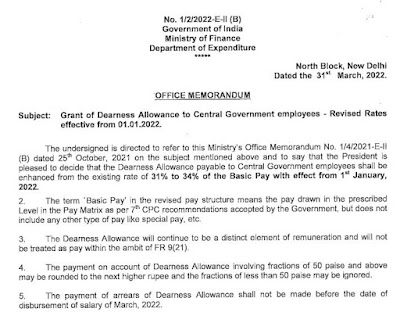
DA Jan 2022 - Grant of Dearness Allowance to Central Government employees - Revised Rates effective from 01.01.2022

 3% DA Hike - Revised Rates effective from 01.01.2022: DoE OM dated 31.03.2022 No. 1/2/2022-E-II (B) Government of India Ministry of Finance...