Tuesday, 7 April 2015

Proposal of upgradation, stepping up, merger of Grade Pay for which MoF & DoPT not agreed: NFIR to discuss with 7th CPC

Issues relating to improvement of Grade Pay etc., – Proposals of the Railway Ministry to the Ministry of Finance and DoP&T but not agreed-reg.

NFIR
National Federation of Indian Railwaymen
CHELMSFORD ROAD, NEW DELHI – 110 055 I

No. IV/NFIR/7th CPC/2013/Part. V (0.13.)
Dated: 06/04/2015
The Secretary (E),
Railway Board.
New Delhi
Kind attention: Executive Director/PC-II

Dear Sir,

Sub: Issues relating to improvement of Grade Pay etc., – Proposals of the Railway Ministry to the Ministry of Finance and DoP&T but not agreed-reg.

As Railway Board are aware. the NFIR has been given slots on 13th and 14th April, 2015 by the 7th Central Pay Commission, to deliberate and discuss the cases of Railway employees of all categories (serving/retired) relating to the pay and allowances/perks.

In this connection, the Federation would place its points on the issues (as per list enclosed) where Railway Ministry had agreed in principle and sent proposals to the MoF/DoP&T who however did not agree. To enable the Federation to have meaningful discussion on these subjects with the Pay Commission, Federation requires copies of replies received from the MoF/DOP&T.

NFIR therefore, requests the Railway Board to kindly arrange to provide copies of the replies given by MoF/DOP&T in the case of issues mentioned in the enclosed list at the a earliest.

Yours faithfully,
DA/As above
(Dr. M. Raghavaiah)
General Secretary

Annexure
S. No. Letter No. & Date Subject Comments
1. PC-VI/2008/lC/20 dt: 19/11/2012 Allotment of Grade Pay of Rs 5400 for Group ‘B’ Gazetted Officers in Railways who were in the pre-revised of Rs 7500-12000. Not Agreed
2. PC-VI/2008/IC/21 dt: 06/01/2012 Allotment of Grade pay of Rs 4800 in PB-2 for Supervisor in the Railway who were in the pre-revised scale of Rs 6500-10500 & 74500-1 1500. Not Agreed
3. PC-VI/2011/I/RSRP/4 dt: 9/07/2012 Grant of annual increment due on 01/07/2006 to Sr. Assistant who got stepping up of their pay equal to the stage of their junior w.e.f. 05/01/2006. Not Agreed
4. PC-VI/2009/1/RSRP/9(Pt) dt: 30/11/2011 Fixation of pay in the cases wherein employee has been promoted during period 01/01/2006 and 31/08/2008 and opted revised pay structure from the date of promotion. Not Agreed
5. PC-VI/2012/I/6/2 dt: 20/11/2012 Fixation of pay in the cases wherein employees were promoted during 01/01/2006 and 31/08/2008 and opted revised pay structure from the dated of promotion. Not Agreed
6. PC-V/2009/ACP/2/Pt.I dt: 27/12/2012 Stepping up of pay of seniors at par with their junior drawing higher Grade Pay under MACPS. Not Agreed
7. PC-VI/2009/DAC/1(P1.2)B dt: 11/06/2010, 21/01/2013 & 28/02/2014 Grade Pay Rs. 4200 as entry grade pay to Station Masters, Not Agreed
8. PC-VI/2012/RU/NFIR/3 dt: 12/02/2014 Placement of JAG officer in PB-4. Not Agreed
9. PC-VI/2010/IR/A/3 dt: 06/08/2012 Parity to Stenographers working in subordinate offices with stenographers in Secretariat services. Not Agreed

Source: NFIR
[https://drive.google.com/file/d/0B40Q65NF2_7UdzQ5NmdsUWg3c0lNYnlfQ0JDYXUxenQyRkUw/view]

Release pending dearness allowance, central employees appeal to government

Release pending dearness allowance, central employees appeal to government

Finance Minister Arun Jaitley

New Delhi: The central government employees appealed to the Finance Minister Arun Jaitley to release the pending installment of dearness allowance (DA) to them as new financial year 2015-16 has also been started.

The central government employees’ bodies said 6 percent DA is due from January but the government has still not declared the hike of the dearness allowance (DA).

The biggest concern facing the central government employees is raising prices.

Inflation hits government employees badly as prices keep rising. The government employees end up spending more money for things that they could buy for les earlier. As prices rise, the purchasing power of money goes down too.

Inflation hits government employees with fixed incomes very badly. Accordingly, they demanded to hike dearness allowance for the little makeup of their financial situation.

The employees’ bodies are also pressing hard to merger of 50 percent DA with basic pay but it has not been given heed by the seventh Pay Commission as well as the government.

The merger of 50 percent DA was discontinued in the Sixth Pay Commission but the Fifth Pay Commission had recommended that if the DA crosses more than 50 percent then it should be clubbed with the basic pay.
The previous UPA government had always announced DA increasing with effect from January 1, in the month of March but the BJP led NDA government has not declared DA hike till date.

Source: http://www.centralgovernmentnews.com/

Monday, 6 April 2015

Releasing of due installment of Dearness Allowance

Releasing of due installment of Dearness Allowance

Releasing of installment of dearness allowance as dearness allowance to central government employees has yet not been released which is due since 01.01.2015. Com. Shiva Gopal Mishra Secretary/NC JCM staff side has written to cabinet secretary in this regard. Please read the full text in pdf format given below:-

Shiva gopal mishra
Secretary
Ph.: 23382286
National Council (Staff Side)
joint consultaitve Machinery
for central government employees
13-C, Ferozshah Road, New Delhi — 110001
E Mail : nc.jcm.np@gmail.com
No.NC/JCM/2015
Dated: April 4, 2015

The Cabinet Secretary, Cabinet Secretariat, (Government of India) Rashtrapati Bhawan, New Delhi-110 004

Dear Sir,

Sub: Releasing of due installment of Dearness Allowance

It is an astonishing fact that the Dearness Allowance, due from 01.01.2015, to the Central Government employees, has not yet been declared by the Government of India, resulting in lots of frustration and agitation in the mind of the Central Government Employees as well as their families.

It is worthwhile to mention here that, normally Dearness Allowance used to be declared in the month of March.

We do hope, you will agree that in these days, due to escalation of prices of all the essential commodities, it has become very difficult to manage household budget.

We further hope that, to give relief to some extent to the Central Government Employees and their families, due installment of the Dearness Allowance will be released immediately.
Yours faithfully
sd/-
(Siva Gopal Mishra)
Secretary, NC/JCM(Staff Side)
Source: http://ncjcmstaffside.com/2015/releasing-of-installment-of-dearness-allowance/

7th Pay Commission is likely to seek extension, delay in report is expected

7th pay commission is running behind schedule and it is likely seek extension from Government of India, Please read this news paper report:-

7th Pay Commission
7th Pay Commission is likely to seek extension, delay in report is expected
New Delhi: The Seventh Pay Commission drafted in to make a new pay structure for the 30 lakh Central government employees would not be able to submit its report in August this year, the Commission is likely to seek extension till October.

The reports of Seventh Pay Commission will be implicated from April next year as Finance Minister Arun Jaitley said in the Parliament on February 27, “The 7th Pay Commission impact may have to be absorbed in 2016-17.”

Finance Minister Arun Jaitley said above statement in his pre-budget speech. His statement indicates that the government may implement Seventh Pay Commission report from April 2016. The UPA government formed the Seventh Pay Commission on 28 February 2014 under chairman justice Ashok Kumar Mathur with a timeline of 18 months to make its recommendations. According to present position, the commission will take at least 20-24 months. However, the Sixth Pay Commission had submitted its report within 18 months.

As a result of the recommendations of the Sixth Pay Commission, pay and allowances of the central government employees more than doubled as per Fourteenth Finance Commission estimates. As such, the central government employees are expected to get 100 percent salary hike under the recommendations of the Seventh Pay Commission.

Issues like inflation, the government’s financial position and salary structure of government employees in other countries would also be considered as parts of pay panel recommendations.
The Fourteenth Finance Commission asked the pay panel to link the pay with productivity, which will be the biggest hurdle for central government employees to be got over to get salary hike.

It is interesting to note that the earlier governments never accepted to link the pay with productivity. Meanwhile the Pondicherry State Government Employees Central Federation has urged the Central government to expedite the process of finalising the recommendations of the Seventh Pay Commission and also to announce interim relief and merger of 50 per cent of Dearness Allowance with basic pay.

The Seventh Pay Commission, set up on January 1, 2014 by the United Progressive Alliance (UPA) government, will take at least 18 to 24 months to submit the final recommendations.

Speaking to mediapersons during a demonstration on Monday to press for the demands, president of the federation, Lakshshumanasamy, accused the territorial government of ignoring the welfare of employees. Lakshshumanasamy alleged that the government was misusing the GPF contribution of employees and diverting it for other purposes.

Take-home salaries of government employees to rise

Take-home salaries of government employees to rise

NEW DELHI: Take-home salaries of millions of workers could rise with the government moving to free employees from compulsory coverage in a state-run healthcare programme that costs them 6.5% on a cost to company basis, and give them the choice to buy a health insurance product from an insurance firm instead.
The government has called a meeting of the Employees' State Insurance Corporation (ESIC) on Tuesday to approve amendments to this effect in the ESI Act of 1948, India's first social security legislation. If ratified, the change could throw up a major opportunity for the country's $2 billion health insurance business. Finance minister Arun Jaitley had declared the government's intent to allow employees to exercise their individual choice in health insurance in his Budget speech.

"We intend to bring amending legislation in this regard, after stakeholder consultation," he had said. "We have proposed adding two new sections to the law that gives employees a one-time option to opt for a health insurance product regulated by the IRDA. Employers would have to submit proof of such alternate coverage," said a senior government official, adding that workers would be allowed to return to the ESI fold if they are not satisfied with the health insurance coverage. "However, such aswitch-back to the scheme would be allowed only once.

We are also putting in a safeguard, so that employers can't force workers to opt for either the ESI or a health insurance product as a pre-condition for employment," he added. About 60% of India's organised sector workforce or 1.74 crore employees are covered by the ESIC, which offers medical care to them and their dependents along with unemployment benefits in case of disablement or occupational accidents, including fatal ones. The law mandates employers to contribute 4.75% of an employees' gross salary (up to Rs.15,000 per month) with a 1.75% matching premium payment from employees. In return, members get access to ESIC's 151 hospitals and 1,380 dispensaries around the country.

Trade unions are annoyed with the haste in which the corporation meeting has been scheduled. "We got a notice about the meeting on April 2, after which there have been a slew of government holidays. Moreover, any amendments to the law are usually debated by our board first. This is the first time that the government is bringing amendments to the table," said the general secretary of a major trade union, who is on the ESIC board.

Source: http://economictimes.indiatimes.com

Sunday, 5 April 2015

Mass Demonstration at New Delhi on 28.04.2015 – Protest to settle 10 Point Charter of Demands

Mass Demonstration at New Delhi on 28.04.2015: National Joint Council of Action – Protest to settle 10 Point Charter of Demands


You are all aware that the constituents of the National Council (JCM) representing the employees in Railways, Defence, Postal, Income Tax, Audit Departments etc., have jointly conducted a convention at New Delhi on 11.12.2014 and adopted a joint declaration demanding the central government to settle the Ten Point Charter of demands also against the anti workers policies.
Subsequently, National Joint Council of Action (NJCA) was formed at National level and Railway Federations have taken the responsibilities of forming Joint Council of Action at State level and District levels. Accordingly the employees were organised and conducted protest meetings demanding the Government of India to consider to settle the demands.


1. Effect wage revision of Central Government Employees from 01.01.2014 accepting the memorandum of the Staff Side JCM: ensure 5 year wage revision in future: grant Interim Relief and Merger of 100% of DA. Ensure submission of the 7th CPC report with the stipulated time frame of 18 months; include Gramin Dak Sevaks within the ambit of the 7th CPC. Settle all anomalies of the 6th CPC.
2. No Privatisation, PPP or FDI in Railways and Defence Establishments and no corporatisation of Defence Ordnance Factories and Posta Services.
3. No Ban on recruitment / creating of posts.
4. Scrap PFRDA Act and re-introduce the defined benefit statutory pension scheme.
5. No outsourcing; Contractorisation, Privatisation of government functions; withdraw the proposed move to close down the Printing presses; the publication, form store and stationery departments and Medical Stores Depots; regularise the existing daily rated/casual and contract workers and absorption of trained apprentices;
6. Revive the JCM Functioning at all levels as an effective negotiating forum for settlement of the demands of the Central Government Employees.
7. Remove the arbitrary ceiling on compassionate appointments.
8. No labour reforms which are inimical to the interest of the workers.
9. Remove the Bonus Ceiling.
10. Ensure five promotions in the service career.
Since, no response was reviewed from the Government of India to settle the demands, it was decided by the NJCA decided in its meeting to conduct a Mass Demonstration at New Delhi on 28.04.2015 at 09.00 Hrs by organising the Central Government Employees to participation in large numbers.

Source: INDWF
[http://indwf.blogspot.in/2015/04/mass-demonstration-at-new-delhi.html]

Fake Dearness Allowance Order Surfaces Online

Fake Dearness Allowance Order Surfaces Online

Announcements that have appeared on social media, proclaiming a hike in Dearness Allowance for Central Government employees, have been declared false and misleading. Also, claims that an announcement was made by the Finance Ministry on March 30 have also been stated as false.

Central Government employees are given a deadness allowance hike in Jan and July of each year. The announcement of DA as declared by the Cabinet Ministry in March and September. So, the enhanced payment of DA will be given in the March and September salary itself. And also the arrears will be given for two months.

Confirmation of the 6% DA hike for 01.01.2015 will be issued by the Ministry of Finance after getting the Cabinet’s approval only. With no approval being given until March 30, some social media carried reports on April 1 that a hike was announced by the Finance Ministry.

Although it was obvious that the order was a fake one, it did create a sense of shock. Since it was April 1, many sensed that it was an April Fool’s Day prank. But the Finance Ministry issued a clarification on the same day claiming that the announcement was fake.

The fake order said that the order will have retrospective effect, from January 1, 2015 onwards. It also said that a DA hike of 115, instead of 107% will be provided to the employees this time.

In the statement issued by Subhash Chand, of the Department of Expenditure, Ministry of Finance, said, “The announcement that was supposedly made on March 30 is false. No such announcement was made by the Department of Expenditure, Ministry of Finance. Therefore, do not act upon the announcement.” The message was issued to all the ministries, departments and offices of the Central Government.

Pay Commission be designated as ‘Pay and Productivity Commission': 14th Finance Commission

Pay Commission be designated as ‘Pay and Productivity Commission': 14th Finance Commission

“We recommend the linking of pay with productivity, with a simultaneous focus on technology, skill and incentives. We recommend that Pay Commissions be designated as ‘Pay and Productivity Commissions’, with a clear mandate to recommend measures to improve ‘productivity of an employee’, in conjunction with pay revisions.We urge that, in future, additional remuneration be linked to increase in productivity.” – 14th Finance Commission

14th Finance Commission’s recommendations related to Pay Commission, Salary, Pension:- Recommendations

x. We reiterate the views of the FC-XI for a consultative mechanism between the Union and States, through a forum such as the Inter-State Council, to evolve a national policy for salaries and emoluments. (para 17.28)

xi. We recommend the linking of pay with productivity, with a simultaneous focus on technology, skill and incentives. We recommend that Pay Commissions be designated as ‘Pay and Productivity Commissions’, with a clear mandate to recommend measures to improve ‘productivity of an employee’, in conjunction with pay revisions.We urge that, in future, additional remuneration be linked to increase in productivity. (para 17.29)

xii. We urge States which have not adopted the New Pension Scheme so far to immediately consider doing so for their new recruits in order to reduce their future burden. (para 17.30)

Recommendations – Public Expenditure Management

118. We reiterate the views of the FC-XI for a consultative mechanism between the Union and States, through a forum such as the Inter-State Council, to evolve a national policy for salaries and emoluments.

119. We recommend the linking of pay with productivity, with a simultaneous focus on technology, skill and incentives. We recommend that Pay Commissions be designated as ‘Pay and Productivity Commissions’, with a clear mandate to recommend measures to improve ‘productivity of an employee’, in conjunction with pay revisions. We urge that, in future, additional remuneration be linked to increase in productivity. (para 17.29)

120. We urge States which have not adopted the New Pension Scheme so far to immediately consider doing so for their new recruits in order to reduce their future burden. (para 17.30)

14th Finance Commission’s detail report related to Pay Commission, Salary, Pension:- Fiscal Deficit

3.4 The fiscal deficit of the Union Government relative to GDP declined steadily from 6.1 per cent in 2001-02 to 4.5 per cent in 2003-04. The FRBM Act mandated reducing the fiscal deficit to 3 per cent by 2008-09. The Union Government achieved this target in 2007-08, with the fiscal deficit declining to 2.5 per cent of GDP. However, in 2008-09 the Union Government undertook several fiscal expansionary measures such as revision of pay scales based on the recommendations of the Sixth Pay Commission, waiver of farm loans and the expansion of the Mahatma Gandhi National Rural Employment Guarantee Act (MGNREGA) to all districts from the 200 districts it was originally slated to cover. In addition, oil prices escalated sharply, leading to a rise in subsidy. As a consequence of all this as well as the global crisis, the fiscal deficit of Union Government increased to 6 per cent in 2008-09 and 6.5 per cent in 2009-10.

3.38 The share of capital expenditure in the total expenditure of the Union Government declined from 22.8 per cent in 2004-05 to 10.2 per cent in 2008-09 and has remained in the range of 11 per cent to 13 per cent since then. Correspondingly, the revenue expenditure increased to 89.8 per cent in 2008-09, and thereafter declined only marginally, despite expenditure tightening measures. As a ratio of GDP, the revenue expenditure of the Union Government increased from 11.9 per cent in 2004-05 to 14.1 per cent in 2009-10 and is estimated at 12.2 per cent in 2014-15 (BE). The major components of revenue expenditure comprising subsidies, interest payments, defence expenditure, pay and allowances and pensions are briefly analysed in the following paragraphs.

 Major Subsidies : Pay and Allowances and Pensions

3.46 Pay and allowances of Union Government employees more than doubled between 2007-08 and 2011-12, from Rs.74, 647 crore to Rs.166, 792 crore due to the implementation of the Sixth Central Pay Commission recommendations( Including Defence Services). As a ratio of GDP, it jumped from a little over 0.9 per cent in 2007-08 to 1.2 per cent in 2008-09 and about 1.4 per cent in 2009-10 on account of both pay revision and payment of arrears. However, it moderated to a little over 1 per cent in 2012-13.
3.47 As in the case of salaries, expenditure of the Union Government on pensions, which had declined to less than 0.5 per cent of GDP in 2007-08, increased to about 0.9 per cent of GDP in 2009-10 due to the impact of revision in pensions. Subsequently, it came down to 0.7 per cent in 2010-11 and is estimated at 0.6 per cent in 2014-15 (BE).

3.48 Expenditure on salary, pensions and interest payments together accounted for 5.67 per cent of GDP in 2004-05 but declined marginally to 5.56 per cent of GDP in 2009-10, with the rise in expenditure on salaries and pensions being more than compensated by the decline in interest expenditure. These expenditures declined further to 4.9 per cent of GDP in 2012-13.

Revenue Expenditure : Pensions

6.34 Pensions are another committed liability which has been fully provided for in our assessment. The assessment of pensions is based on the growth rate of pension expenditure obtained from past data. The year-on-year growth of pension expenditure has shown volatility, with growth declining to a low of 0.42 per cent in 2002-03 and increasing to a high of 70.46 per cent in 2009-10. Given these fluctuations, it is not appropriate for us to take a long-run trend growth rate for this expenditure as a norm for assessment. It would be more appropriate to use the observed growth in the recent past. However, a potential fiscal liability may arise in the future with the introduction of the ‘one rank one pension scheme’ for Defence Services. The Budget 2014-15 has also made an additional allocation for this scheme, which is reflected in the increase in the growth of pension expenditure to10.67 per cent over the 2013-14 (revised estimates) growth of 6.62 per cent. While the Ministry of Finance projects an increase in pension payments by 8.7 per cent in 2015-16, a 30 per cent increase is expected in 2016-17 on account of the impact of the Seventh Pay Commission, followed by an annual growth rate of 8 per cent in subsequent years. Pension expenditures between 2011-12 and 2014-15 have grown on a year-on-year basis at the rate of 9.35 per cent per annum. We are of the view that annual revisions in the Dearness Allowance and annual accretions in the number of pensioners and the corresponding pension obligations can be covered by this growth in pension expenditure during our assessment period.

Defence Revenue Expenditure

6.35 Revenue expenditure on defence has grown at an annual rate of 11.21 per cent between 2001-02 and 2012-13 and at the rate of 10.1 per cent between 2008-09 and 2012-13. In its submission to the Commission, the Ministry of Defence argued that there has been a decline in the defence expenditure-GDP ratio over the years and defence expenditure allocation in the Union budget needs to be increased to expand the acquisition of arms and improve defence preparedness. The Ministry pointed out that it has not been able to make necessary procurements because of the constraint of funds and large amounts of committed expenditure. The Ministry also mentioned that a substantial part of the defence capital budget went into meeting committed expenditures. The Ministry of Finance has also highlighted the need to increase defence outlays in order to modernise and maintain defence assets and to finance defence acquisitions. Accordingly, its projections have provided for an increase in defence revenue expenditure (including salaries) of 30 per cent in 2016-17 which will incorporate the Pay Commission impact, with a stable growth rate of 20 per cent per annum in the remaining years.

Fiscal Consolidation: Assessment and Issues

14.48 Our review shows that, at an aggregate level, States made significant improvements in complying with the FRBM targets prescribed by the FC-XII and FC-XIII. In the pre-crisis period, fiscal consolidation at the State level was aided by a number of factors, including implementation of state-level fiscal responsibility acts, debt waiver and restructuring recommended by Finance Commissions, and improvement in revenues on account of buoyancy of Central taxes and introduction of value-added tax (VAT) at the state level. Despite States experiencing pressure on their fiscal balances in the post-crisis period due to lower buoyancy of Central taxes and increased expenditure commitment due to the implementation of the recommendations of Pay Commissions, they largely continued to comply with the FRBM targets.

Pay and Productivity

17.23 Wages and salaries constitute a significant portion of the committed liabilities of both the Union and States. Periodic revisions based on the recommendations of the Pay Commissions of the Union, with States following suit, have contributed to rising revenue expenditure. For States in particular, the fiscal impact of a pay revision is severe, as the share of salary expenditure in their total revenue expenditure is substantially larger than in the case of the Union. Arrears in pay and bi-annual releases of Dearness Allowance compound the burden.

17.24 Technically, the recommendations of a Central Pay Commission are only for Central Government employees and States are not bound to follow suit. Indeed, up to the 1980s, States constituted their own Pay Commissions and prescribed their own pay scales, based upon their fiscal capacity. However, since the Fifth Central Pay Commission, salaries and allowances in States have tended to converge with those in the Union Government and since the Sixth Central Pay Commission, almost all States have adopted the Union pattern of pay scales, albeit with modifications.

17.25 An internal study by the Commission brought out the fact that the Union Government’s expenditure on pay and allowances (including expenditure for the Union Territories) [2 Excluding productivity linked bonus/ad-hoc bonus, honorarium and encashment of earned leave, and travel allowances] more than doubled for the period 2007-08 to 2012-13, from Rs. 46,230 crore to Rs. 1,08,071 crore [If salary of defence services is included, the corresponding figures will be Rs. 73,073 crore and Rs. 1, 84,711 crore].
This increase can be largely attributed to the implementation of the Sixth Central Pay Commission recommendations, evident from the per employee annual salary (excluding defence salary) increasing from Rs. 1,45,722 to Rs. 3,25,820 over this period. Moreover, the share of expenditure on pay and allowances in revenue expenditure (net of interest payment, pensions and grants-inaid) increased from 11.8 per cent in 2007-08 to 13.1 per cent in 2012-13. The incidence of salary expenditure is much higher in the States than in the Union. In 2012-13, the share of expenditure on pays and allowances of all employees in the revenue expenditure (net of interest payments and pensions) among the States ranged from 28.9 per cent to 79.1 per cent. Per employee (for regular employees) salary in 2012-13 across States ranged between Rs. 2,12,854 and Rs. 5,49,345. Thus, the impact of revisions in pay scales on fiscal positions is uniformly significant, though it varies widely across States.

17.26 Given the variations across States and the lack of knowledge about the probable design and quantum of award of the Seventh Central Pay Commission, we believe that it is neither feasible, nor practicable, to arrive at any reasonable forecast of the impact of the pay revision on the Union Government or the States. Further, any attempt to fix a number in this regard, within the ambit of our recommendations, carries the unavoidable risk of raising undue expectations.

17.27 Our concern is the likely impact on overall budgetary resources, particularly of the States, once the recommendations of the Seventh Central Pay Commission are announced and adopted by the Union Government. All States have asked us to provide a cushion for the pay revision likely during our award period. The Union Government’s memorandum has built, in its forecast, the implications of a pay increase from 2016-17 onwards. The recommendations of the Seventh Central Pay Commission are likely to be made only by August 2015, and unlike the previous Finance Commissions, we would not have the benefit of having any material to base our assessments and projections and to specifically take the impact into account. We have, therefore, adopted the principle of overall sustainability based on past trends, which should realistically capture the overall fiscal needs of the States.

17.28 In our view, on matters that impact the finances of both the Union and States, policies ought to evolve through consultations between the States and the Union. This is especially relevant in the determination of pay and allowances, where a part of the government itself, in the form of the employees, is a stakeholder and influential in policy making. A national view, arrived at through this process, will open avenues for the Union and States to make collective efforts to raise the extra resources required by their commitment to a pay revision. More importantly, it would enable the Union and States to ensure that there is a viable and justifiable relationship between the demands on fiscal resources on account of salaries and contributions to output by employees commensurate with expenditure incurred. In this regard, we reiterate the views of the FC-XI for a consultative mechanism between the Union and States, through a forum such as the Inter-State Council, to evolve a national policy for salaries and emoluments.

17.29 Further,we would like to draw attention to the importance of increasing the productivity of government employees as a part of improving outputs, outcomes and overall quality of services relatable to public expenditures. The Seventh Central Pay Commission, has, inter alia, been tasked with making recommendations on this aspect. Earlier Pay Commissions had also made several recommendations to enhance productivity and improve public administration. Productivity per employee can be raised through the application of technology in public service delivery and in public assets created. Raising the skills of employees through training and capacity building also has a positive impact on productivity. The use of appropriate technology and associated skill development require incentives for employees to raise their individual productivities. A Pay Commission’s first task, therefore, would be to identify the justify mix of technology and skills for different categories of employees. The next step would be to design suitable financial incentives linked to measurable performance. We recommend the linking of pay with productivity, with a simultaneous focus on technology, skills and incentives. Further, we recommend that Pay Commissions be designated as ‘Pay and Productivity Commissions’,with a clear mandate to recommend measures to improve ‘productivity of an employee’, in conjunction with pay revisions. We urge that, in future, additional remuneration be linked to increase in productivity.

Pensions

17.30 Pensions have been growing steadily, and the liability for pension payments is likely to cast a very heavy burden on budgets in the coming years. Some of the factors contributing to this growth are: (i) the rise in pensions recommended by successive Pay Commissions; (ii) removal of the distinction between people retiring at different points of time, so that all pensioners are treated alike in their pension justifys; (iii) taking over the liability for pensions of retired employees of aided institutions and local bodies; and (iv) increasing longevity. The New Pension Scheme (NPS), a contribution-based scheme introduced by the Union Government in 2004 for all new recruits after the cut-off date, has now been adopted by all States, with the exception of West Bengal and Tripura. This scheme has the merit of transferring future liabilities to the New Pension Fund and factoring the current liability on a State’s contribution from its current revenues. We urge States which have not adopted the New Pension Scheme so far to immediately consider doing so for their new recruits in order to reduce their future burden.

Conclusion: – The recommendations of 14th Finance Commission are important for 7th Pay Commission. As the recommendations of 14th FC is applicable with effect from 01.04.2015 the impact of above mentioned recommendations will be the part of 7th CPC. Need not to say that 7th CPC has the challenge to prepare the report in stipulated time including the views of 14th FC.

Source Document: http://finmin.nic.in/14fincomm/14fcreng.pdf

Source : karnmk.blogspot.in

Saturday, 4 April 2015

Delay in Announcement of DA Hike from January 2015

Delay in Announcement of DA Hike from January 2015

Since the implementation of the recommendations of the 4th central pay commission in 1986, the announcement of approval and the order for granting Dearness Allowance to government employees were issued in March and September itself until it was violated once under UPA regime. In 2013, the approval for granting DA hike due from January 2013 was delayed inordinately. All the central government employees had waited patiently up to 31st March 2013. Even 1st and 2nd week of April 2013, there was no signs announcing the DA hike by the Central government. Then, the federations like AIRF and Confederation of central government employees and workers have raised objection over the inordinate delay of announcing DA. And they wrote letters to the Central Government to declare the Dearness Allowance immediately to avoid the confrontation.

While briefing the situation, the Confederation of central government employees and workers has mentioned in the editorial of their blog on 17th April 2013 that ‘This naturally is quiet disturbing, especially in the time of galloping price line. The employees have, in the past, fought bitterly for grant of DA and the 3rd CPC gave a definite formula for DA in the aftermath of the one day strike on 19th September 1968. We cannot allow the hard won DA to be tampered with.’
The next day, ie on 18th April 2013 the union cabinet approved the DA hike which is due from January 2013.

This time the NDA Government started repeating the same story in its first year itself. As we mentioned earlier the DA hike from July 2014 has been announced un expectedly on 4th September 2014. So there was huge expectation this time that the present government would not make any delay in announcing the Payment dearness allowance from January 2015. But it seems that the government finds no time to take any decision over the issue of 50 Lakh Central government employees and Pensioners. Whether the central government expects the federations to plead for announcing DA hike? Or it really has no time to decide on this issue?

However, yesterday the Ministry of Finance issued a clarification dated 1st March 2015, in which it has been clarified that a fake order for payment of Dearness Allowance was being circulated in Government Departments/offices and all Ministries/Departments and Central Government offices were advised not to take cognisance of these fake instructions being circulated in Government offices.

To avoid confusion and frustration among central government employees, it is expected that the central government should announce its approval for Payment of Dearness Allowance from January 2015 immediately.

Source: www.gservants.com

Second Round of Tripartite Consultations on EPF & MP Act Amendments Held

Second Round of Tripartite Consultations on EPF & MP Act Amendments Held

Bandaru Dattatreya Chairs Tripartite Consultations

The Second Round of Tripartite Consultations on Employees Provident Fund and Miscellaneous Provisions Act,1952 (EPF &MP Act) Amendments was held here yesterday. Shri Bandaru Dattatreya, the Minister of State, Labour & Employment (I/C) chaired the second round of tripartite consultations on EPF & MP Act Amendments. The consultations gain greater importance in view of the new amendments proposed in the backdrop of the Union budget proposals impacting the functioning of EPFO.

Inaugurating the consultations, Shri Dattatreya briefly dwelt upon the major changes being mulled in the proposals. They include bringing down the minimum no. of employees required for coverage under the Act from the existing 20 to 10, doing away with the Schedule Head for coverage and bringing in a negative list instead, special provisions for encouraging the functioning of small-scale units, provisions for setting up of multiple Appellate Authorities under the Act, removing ambiguities in the implementation of the Act, ensuring greater clarity in the definitions under the Act, especially with regard to wages which qualify for deduction for the purposes of the Act, introducing greater transparency and accountability in the enforcement of the Act by having an objective inspection scheme, introducing a scheme for unorganized workers and providing a choice to the worker by giving an option to join NPS / EPFO, which is in tune with the proposals mentioned in the Union Budget.

Taking part in the discussions, the representatives of the employers’ associations and federations generally welcomed the various proposals contained in the amendments under consideration. They generally voiced the opinion that the introduction of NPS would mean greater choice for the worker. However, there were also views that NPS cannot match the benefits offered by EPFO and therefore, are not comparable. It was also felt that the amendments would help in sharpening the competitiveness of Indian Industry and would enable India to become a manufacturing hub. However, there was a need to further encourage the concessions granted to the small-scale industries. Increase of coverage also received wide acceptance, both from employers’ and employees’ side.

Opposing certain amendments proposed, representatives of the Trade Unions expressed reservations especially to the move to introduce NPS as a substitute to EPFO. They also expressed reservations regarding the inspection scheme which they argued brought about centralization in the decision making process which is contrary to the prevailing wisdom which favours decentralization.

Summing up the discussions, Shri Shankar Aggarwal, Secretary, MOL&E assured that the concerns of all stakeholders will be addressed when giving final touches to the legislative amendments. Further, the objective behind bringing in the changes is to further strengthen the delivery of social security benefits.

In his concluding remarks, Shri Dattatreya stressed upon the need to focus on the unorganized sector of the workforce which constitutes 93% of the total workforce. He said that the need of the hour is to include more segments of the workforce like Anganwadi works into the ambit of social security legislations. He also informed that the Ministry is contemplating issue of smart cards to the labour workforce so that social security benefits reach each intended beneficiary. He also assured that the Act would be amended taking into account the sensitivities of all concerned.

Shri Sharad Patil, EFI (Employers Federation of India), Shri S.S. Patil, AIMA (All India Manufacturers Association), Shri Bhardwaj, Laghu Udhyog Bharati, Shri Sushant Singh, CII (Confederation of Indian Industries), Shri A.K. Padmanabhan, CITU, Shri A.D. Nagpal, HMS, Shri B.L Sachdeva, AITUC, Shri Ashok Singh, INTUC were some of the notable representatives of employers’ associations and employees’ associations (trade unions) who took part in the deliberations in addition to the representatives of various state governments.

Source: PIB News

Flash News

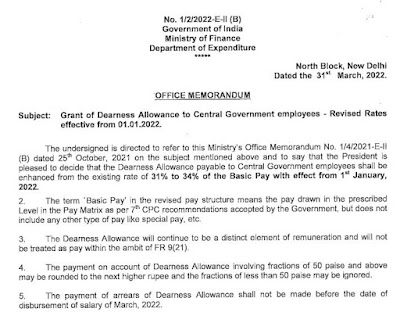
DA Jan 2022 - Grant of Dearness Allowance to Central Government employees - Revised Rates effective from 01.01.2022

 3% DA Hike - Revised Rates effective from 01.01.2022: DoE OM dated 31.03.2022 No. 1/2/2022-E-II (B) Government of India Ministry of Finance...