Tuesday, 29 October 2019

DoPT Notification regarding RTI Rules 2019

Notification regarding RTI Rules 2019

DoPT Orders 2019

DoPT Orders 2019 - RTI Rules 2019

MINISTRY OF PERSONNEL, PUBLIC GRIEVANCES AND PENSIONS
(Department of Personnel and Training)

NOTIFICATION

New Delhi, the 24th October, 2019

G.S.R. 810(E).- In exercise of the powers conferred by clauses (ca) and (cb) of sub-section (2) of section 27 of Right to Information Act, 2005 (22 of 2005), the Central Government hereby makes the following rules, namely:-
CHAPTER I
PRELIMINARY

Short title and commencement.- (1) These rules may be called The Right to Information (Term of Office, Salaries, Allowances and Other Terms and Conditions of Service of Chief Information Commissioner,Information Commissioners in the Central Information Commission, State Chief Information Commissioner and State Information Commissioners in the State Information Commission) Rules, 2019.

(2) They shall come into force on the date of their publication in the Official Gazette.
Get More: Latest DoPT Orders 2019
CHAPTER II

2. Definitions.- (1) In these rules, unless the context otherwise requires, -

(a) “Act” means the Right to Information Act, 2005 (22 of 2005);
(b) “Central Information Commission” shall have the same meaning assigned to it under clause (b) of section 2 of the Act ;
(c) “Chief Information Commissioner” and “Information Commissioner” shall have the same meaning assigned to it under clause (d) of section 2 of the Act;
(d) “State Chief Information Commissioner” and “State Information Commissioner” shall have the same meaning assigned to it under clause (l) of section 2 of the Act;
(e) “State Information Commission” shall have the same meaning assigned to it under clause (k) of section 2 of the Act.
(2) The words and expressions used and not defined under these rules, but defined in the Act shall have the same meaning as respectively assigned to them in the Act.

CHAPTER III

TERM OF OFFICE, SALARIES, ALLOWANCES AND OTHER TERMS AND CONDITIONS OF SERVICE OF THE CHIEF INFORMATION COMMISSIONER AND INFORMATION COMMISSIONER IN THE CENTRAL INFORMATION COMMISSION

3. Term of office.- The Chief Information Commissioner, or Information Commissioners, as the case may be, shall hold office for a period of three years from the date on which he enters upon his office.

4. Retirement from parent service on appointment.- The Chief Information Commissioner or Information Commissioners, as the case may be, who on the date of his appointment to the Commission, was in the service of the Central or a State Government, shall be deemed to have retired from such service with effect from the date of his appointment as Chief Information Commissioner or an Information Commissioner in the Central Information Commission.

5. Pay.- (1) The Chief Information Commissioner shall receive a pay of Rs. 2,50,000 (Rupees two lakh and fifty thousand)(fixed) per mensem.
(2) An Information Commissioner shall receive a pay of Rs. 2,25,000 (Rupees two lakh and twenty five thousand) (fixed) per mensem.
(3) In case the Chief Information Commissioner or Information Commissioners, as the case may be, at the time of his appointment is, in receipt of any pension, the pay of such Chief Information Commissioner or Information Commissioners, as the case may be, shall be reduced by the amount of that pension including any portion of pension which was commuted and pension equivalent of other forms of retirement benefits excluding pension equivalent of retirement gratuity;

(4) In case the Chief Information Commissioner or Information Commissioners, as the case may be, at the time of his appointment, is in receipt of retirement benefits in respect of any previous service rendered in Corporation established by or under any Central Act or State Act or a Government company owned or controlled by the Central Government or the State Government, his pay in respect of the service as the Chief Information Commissioner or Information Commissioners, as the case may be, shall be reduced by the amount of pension equivalent to the retirement benefits.

6. Dearness Allowance. - The Chief Information Commissioner or Information Commissioners, as the case may be, shall be entitled to draw dearness allowance at the rate admissible to an officer holding a post carrying the same pay in the Central Government, as revised from time to time.

7. Leave.- (1) The Chief Information Commissioner or Information Commissioners, as the case may be, shall be entitled to rights of leave as per admissibility to an officer holding a post carrying the same pay in the Central Government, as revised from time to time.

(2) In case the Chief Information Commissioner, the competent authority to sanction the leave shall be the President of India and in case of the Information Commissioners, the Chief Information Commissioner shall be the competent authority.

8. Cash Payment in lieu of unutilised Earned Leave.- The Chief Information Commissioner or Information Commissioners, as the case may be, shall be entitled to encashment of fifty per cent. of earned leave to his credit at the time of completion of tenure:

Provided that for a Chief Information Commissioner or an Information Commissioner, as the case may be, who had retired from the service of the Central or a State Government prior to appointment as a Chief Information Commissioner and Information Commissioner, as the case may be, the aggregate period for which the encashment of unutilised earned leave shall be entitled shall be subject to a maximum period as per admissibility to an officer holding a post carrying the same pay in the Central Government or the State Government, as the case may be, as revised from time to time.

9. Medical Facilities.- The Chief Information Commissioner and Information Commissioners, as the case may be, shall be entitled to medical treatment and Hospital facilities as provided in the Central Government Health Scheme and at places where the Central Government Health Scheme is not in operation, the Chief Information Commissioner and Information Commissioner shall be entitled to medical facilities as provided in the Central Service (Medical Attendance) Rules, 1944.

10. Accommodation.- (1) The Chief Information Commissioner or Information Commissioners, as the case may be, shall be eligible subject to availability, to the use of official residence from the general pool accommodation of the type as admissible to an officer holding a post carrying the same pay in the Central Government on the payment of the license fee at the rates prescribed by Central Government from time to time.

(2) Where Chief Information Commissioner or an Information Commissioner is not provided with or does not avail himself of the general pool accommodation referred to in sub-rule (1), he may be paid House Rent Allowance at the rate admissible to an officer holding a post carrying the same pay in the Central Government.

11. Leave Travel Concession, Travelling Allowance, Daily Allowance.- The Chief Information Commissioner or Information Commissioners, as the case may be, shall be entitled to leave travel concession, travelling allowance and daily allowance as admissible to an officer holding a post carrying the same pay in the Central Government as far as may be, apply to the Chief Information Commissioner and Information Commissioner, as the case may be.

Source: DoPT

Monday, 28 October 2019

Provision for granting Special Casual Leave for the Women employees working in the Central Government Organizations


Provision for granting Special Casual Leave for the Women employees working in the Central Government Organizations

Central-Government-Women-Employees-Special-Casual-Leave

NFIR

No.II/10/Part I
Dated: 24/10/2019
The Cabinet Secretary,
Rashtrapati Bhawan,
New Delhi - 110004

Dear Sir,

Sub: Provision for granting Special Casual Leave for the Woman employees (45 years of age and above) working in the Central Government Organizations - reg.

The Government of India is aware that with the increased efficiency levels among women in every walk of life, more importantly in the Government sector, a good number of female candidates has been joining services in various organizations of the Central Government in different capacities at all levels ranging from Group 'C' to Group 'A'. While many of them have been performing duties efficiently, their physiological condition changes when they reach certain age which is a natural phenomenon. Federation desires to bring to your kind notice that there is need to consider granting Special Casual Leave for the Women employees of 45 years age and above working in the Central Government services due to the reason that they face hormonal imbalances at the menopause stage which hampers the physical and mental health of women. Therefore provision for granting Special Casual Leave for those Woman employees of 45 years age and above including those who undergo Hysterectomy Operation needs to be considered.

Also check: 7th Pay Commission Leave Rules

NFIR, therefore, requests the Cabinet Secretary to kindly intervene and get the matter examined for making provision for granting Special Casual Leave to the Woman employees of Central Government services in the above mentioned situations.

Also read: TYPES OF LEAVE ADMISSIBLE: Leave Rules - CCS (Leave) Rules, 1972

Yours faithfully,
(Dr. M. Raghavaiah)
General Secretary / NFIR &
Leader JCM (Staff Side)
Copy to the General Secretaries of affiliated Unions of NFIR.
Media Centre / NFIR .

View the order

7CPC latest clarification on MACP Scheme - 7th CPC MACP Rules and Regulations - Latest Dopt order


7CPC latest clarification on MACP Scheme - 7th CPC MACP Rules and Regulations - Latest Dopt order

7th-CPC-latest-clarification-MACP-Scheme-DoPT-order

New Promotion Rules for Central Government Employees - Modified Assured Career Progression Scheme (MACP)

Central Government accepted the new 7th pay commission promotion rules and implemented for all groups of Central Government employees

Originally adopted by the 5th Pay Commission in 1996 and subsequently by the sixth pay commission, the system for the guaranteed promotion has adjusted the 12 and 24 year requirements to 10, 20 and 30 years.

Also check: MACP FOR THE CENTRAL GOVERNMENT CIVILIAN EMPLOYEES - DOPT CONSOLIDATED GUIDELINES

If a worker is not promoted for a period of 10 years, he or she moves to the next tier of the pay hierarchy under the MACP rule.

Now the DoPT has now given a significant order in detail regarding the promised promotional structure.

The OM recommends that the 7th Pay Commission should continue to administer the MACP Scheme 10, 20 and 30 years earlier.

The employees move into the next level of the hierarchy in the new pay matrix. As recommended, all positions, including Group A posts, whether individually or not, will be able to benefit from the Scheme.

However, the services of the organized group "A" are not covered by the scheme. MACPS may proceed in this manner, except for representatives of Organized Group's' A' Programs, to extend to all workers up to HAG level.

The Government has considered and approved the recommendations of MACPS's Seventh Central Pay Commission. At the age of 10, 20 and 30 the MACPS will continue to be administered. The worker must transfer to the next pay level in the current pay matrix system directly under the program.

The specified Benchmark shall be' Very Good' for the granting of financial improvement under the MACP Scheme for all rates.

No increase in the pay level for junior employees would be admissible as a result of pay fixation under the MACP scheme, more than for seniors.

Applicability of Rule 31 of Railway Service Rules 1993 for counting service period paid from contingencies for calculation of pension, gratuity on retirement


Applicability of Rule 31 of Railway Service (Pension) Rules 1993 for counting service period paid from contingencies for calculation of pension, gratuity on retirement

Railway Rule 31


No. 11/35/2018
Dated: 23/10/2019
The Secretary (E)
Railway Board,
New Delhi

Dear Sir,
Sub: Applicability of Rule 31 of Railway Service (Pension) Rules 1993 for counting of service period paid from contingencies for calculation of pension, gratuity on retirement - reg.

Ref: (i) NFIR’s PNM Item No: 27/2011.
(ii) Railway Board’s letter No. 2016/ E(LR)I/NM1-12 dated 14/12/2016.
(iii) NFIR’s letter No. II/35 Part XIII dated 19/12/2016.
(iv) Railway Board’s letter No. E(NG)II/2014/ CL/RWF/6 PNM - NFIR dated 17/05/2017 .
(v) NFIR’s letter No. 11/35/2018 dated 09/06/2018 &.06/11/2018.
(vi) Railway Board’s letter No. E(NG)II/2014 /RWF/CL/6 PNM-NFIR dated 21/12/ 2018.
(vii) PCPO / RWF’s letter No. RWF/ G0-26/566 dated 08th March, 2019 to Secretary (E), Railway Board.
(viii) Railway Board’s letter No E(NG)II/ 2017/ER/CL/4 dated 15/05/2019 addressed to GM(P) RWF.

Kind attention is invited to the Federation’s demand to consider applicability of Rule No. 31 of Railway Service (Pension) Rules 1993 for counting of service period paid from contingencies for calculation of retirement gratuity in favour of former casual labour who were paid wages for contingency and absorbed subsequently in Rail Wheel Factory, Yelahanka vide NFIR’s Agenda Item No. 27/2011. Federation takes note that though the Railway board vide letter dated 15/05/2019 issued half-baked clarification to RWF Authorities with reference to PCPO, RWF’s letter dated 08th March,2019 without mentioning NFIR PNM Agenda Item pending since the last about eight years since the year 2011.

Read More: Indian railway news for railway employee

In this connection, NFIR re-iterates that the Apex Court in its Judgement / Order in Civil Appeal No. 3938 of 2017 [ arising out SLP (C) No. 23723 of 2015 dated 24th March, 2017] gave following directions (in para 55) for compliance:-
  1. the casual worker after obtaining temporary status is entitled to reckon 50% of his services till he is regularized on a iegular/temporary post for the purposes of calculation of Pension.
  2. the casual worker before obtaining the temporary status is also entitled to reckon 50% of casual service for purposes of pension.
  3. Those casual workers who are appointed to any post either substantively or in officiating or in temporary capacity are entiled to reckon the entire period from date of taking charge to such post as per Rule 20 of Rules, 1993.
Federation feels disappointed that the clarification dated 15/05/2019 is inadequate due to the fact that instructions covering above points have not been incorporated for taking action by all Zones/ PUs to settle similarly placed cases including those of RWF, Yelahanka.

NFIR, therefore, requests the Railway Board to consider and issue modified instructions to the General Managers of Zones / PUs & RWF citing NFIR’s PNM meeting discussions.

A copy of the instructions may be endorsed to the Federation.
Yours faithfully,
(Dr.M. Raghavaiah)
General Secretary
Source: NFIR

6th CPC DA Rate Revised from 154% to 164% effective from July 2019 - Finmin issued Orders


6th CPC DA Rate Revised from 154% to 164% effective from July 2019 - Finmin issued Orders
 
DA Rate as per 6th CPC from July 2019

DA Rate as per 6th CPC from July 2019


6th Pay Commission DA Rate Revised from 154% to 164% effective from July 2019 - Finmin issued Orders
No. 1/3(1)/2008-E.II(B)
Government of India
Ministry of Finance
Department of Expenditure

North Block, New Delhi
Dated the 25th October, 2019.
OFFICE MEMORANDUM

Subject:- Rate of Dearness Allowance applicable w.e.f. 01.07.2019 to the employees of Central Government and Central Autonomous Bodies continuing to draw their pay in the pre revised pay scale / Grade Pay as per 6th Central Pay Commission

The undersigned is directed to refer to this Department’s O.M. o. 1/3(1)/2008-E.II(B) dated 8th March, 2019 revising the rate of Dearness Allowance (DA) w.e.f. 01.01.2019 in respect of employees of Central Government and Central Autonomous Bodies continuing to draw their pay in the pre-revised pay scale/Grade Pay as per 6th Central Pay Commission.

2. The rate of DA admissible to above categories of employees of Central Government and Central Autonomous Bodies shall be enhanced from the existing 154% to 164% w.e.f. 01.07.2019.

Also check: 6th CPC Entry Pay Structure for Direct Recruits

3. The provisions contained in paras 3, 4 and 5 of this Ministry’s O.M.No.1(3)/2008-E.ll(B) dated 29th August, 2008 shall continue to be applicable while regulating Dearness Allowance under these orders.

4. The contents of this Office Memorandum may also be brought to the notice of all organisations under the administrative control of the Ministries / Departments which have adopted the Central Government scales of pay.
Sd/-
(Nirmala Dev)
Deputy Secretary to the Government of India
To
All Ministries / Departments of the Government of India (as per standard distribution list).
Copy to: C&AG, UPSC, etc.(as per standard endorsement list).

Check the order

5th CPC pre-revised pay scale for Central Government Employees DA Order w.e.f 01.07.2019


5th CPC pre-revised pay scale for Central Government Employees DA Order w.e.f 01.07.2019
5th CPC DA Rate Revised from 295% to 312% from July 2019
5th CPC DA Rate Revised from July 2019


No. 1/3(2)/2008-E, II(B)
Government of India
Ministry of Finance
Department of Expenditure
North Block,
New Delhi
Dated the 25th October,2019.
OFFICE MEMORANDUM

Subject: Rate of Dearness Allowance applicable w.e.f. 01.07.2019 to the employees of Central Government and Central Autonomous Bodies continuing to draw their pay in the pre-revised pay scales as per 5th Central Pay Commission 

The undersigned is directed to refer to this Department’s O.M. No. 1/3(2)/2008-E.II(B) dated 8th March, 2019 revising the rate of Dearness Allowance (DA) w.e.f. 01,01.2019 in respect of employees of Central Government and Central Autonomous Bodies continuing to draw their pay in the pre-revised pay scales as per 5th Central Pay Commission.

2. The rate of DA admissible to above categories of employees of Central Government and Central, Autonomous Bodies shall be enhanced from the existing 295% to 312% w.e.f. 01.07.2019.

Also check: DA Order from July 2019 in 7th pay commission

3. The provisions contained in paras 3, 4 and 5 of this Ministry’s O.M.No.1(13)/97-E.II(B) dated 3rd October, 1997 shall continue to be applicable while regulating Dearness Allowance under these orders.

4. The contents of this Office Memorandum may also be brought to the notice of all organisations under the administrative control of the Ministries / Departments which have adopted the Central Government scales of pay.

Download the Order

Thursday, 24 October 2019

Payment of Gramin Dak Sevaks (GDS) Dearness allowance effective from 1st July 2019

Payment of Gramin Dak Sevaks (GDS) Dearness allowance effective from 1st July 2019

GDS Employees Dearness Allowance 2019

Payment of Gramin Dak Sevaks (GDS) Dearness allowance effective from 1st July 2019

F.No. 14-312016-PAP
Government of India
Ministry of Communication
Department of Posts
(Establishment Drvision)/ P.A.P. Section

Dak Bhawan, Sansad Marg,
New Delhi – 110 001.
Dated : 24th October, 2019

To,
AIl Chief Postmasters General Postmasters General
Chief General Manager, BD Directorate/Parcel Directorate/ PLI Directorate
Director RAKNPA/ GM CEPT/ Directors of AII PTCs,
AddI. Director General, Army Postal Service, R.K. Puram, New Delhi
AII General Managers (Finance)/ DAP/ DDAP

Sub: Payment of Dearness Allowance to Gramin Dak Sevaks (GDS) effective from 01.07.2019 onwards -reg.

Consequent upon grant of another installment of Dearness Allowance with effect from 1st July, 2019 to the Central Government Employees vide Government of India, Ministry of Finance, Department of Expenditure’s O.M. No. 1/3/2019 E-II (B) dated 14.70.2019, duly endorsed vide this Department’s letters No. 8-1/2016-PAP dated 15.10.2019, the Gramin Dak Sevaks (GDS) have also become entitled to the payment of Dearness Allowances on basic TRCA at the same rates as applicable to Central Government Employees with effect from 01.07.2019. It has,therefore, been decided that the Dearness Allowance payable to the Gramin Dak Sevaks shall be at the same rates as payable to Central Government Employees i.e.@ 17% (percent) with effect from the 1st July, 2019.

Also check Payment of Dearness Allowance to Gramin Dak Sevaks (GDS) effective from 01.07.2018 onwards

2. The expenditure on this account shall be debited to the Head “Salaries”under the relevant head of account and should be met from the sanctioned grant.

3. This issues with the concurrence of Integrated Finance Wing vide their Diary No. 106/FA/2019-CS dated 23. 10.2019.

(S.B.Vyavahare)
Assistant Director General (Estt.)

View the order

Wednesday, 23 October 2019

BSNL MTNL Merger - Union Cabinet approved the proposal of BSNL and MTNL

BSNL MTNL Merger - Union Cabinet approved the proposal of BSNL and MTNL

BSNL MTNL Merger - Union Cabinet approved
Cabinet

Union Cabinet approves revival plan of BSNL and MTNL and in-principle merger of the two

Spectrum of 4G to be allocated to the Telecom PSEs

Funding through capital infusion of over Rs 20,000 Crore

Sovereign guarantee for long term bonds of Rs 15,000 Crore

Union Government to bear cost of attractive VRS

23 OCT 2019
The Union Cabinet today approved the proposal for revival of BSNL and MTNL by administrative allotment of spectrum for 4G services, debt restructuring by raising of bonds with sovereign guarantee, reducing employee costs, monetisation of assets and in-principle approval of merger of BSNL & MTNL.

Also Read: Claim of BSNL on account of pay & allowances etc. to its employees working on loan basis in DoT/Field Units

The following was approved by the cabinet:-
  1. Administrative allotment of spectrum for 4G services to BSNL and MTNL so as to enable these PSUs to provide broadband and other data services. The said Spectrum will be funded by the Government of India by capital infusion in these PSUs at a value of Rs 20,140 Cr in addition; the GST amount of Rs 3,674 Cr to this spectrum value will also be borne by the Government of India through Budgetary resources. By using this spectrum allotment, BSNL and MTNL will be able to deliver 4G services, compete in the market and provide high speed data using their vast network including in rural areas.
  2. BSNL and MTNL will also raise long-term bonds of Rs 15,000 Cr for which sovereign guarantee will be provided by the Government of India (GoI). With the said resources, BSNL and MTNL will restructure their existing debt and also partly meet CAPEX, OPEX and other requirements.
  3. BSNL and MTNL will also offer Voluntary Retirement to their employees, aged 50 years and above through attractive Voluntary Retirement Scheme (VRS), the cost of which will be borne by the Government of India through budgetary support. The ex-gratia component of VRS will require Rs. 17,169 Cr in addition, GoI will be meeting the cost towards Pension, Gratuity and Commutation. Details of the scheme will be finalised by BSNL/MTNL.
  4. BSNL and MTNL will monetise their assets so as to raise resources for retiring debt, servicing of bonds, network upgradation, expansion and meeting the operational fund requirements.
  5. In-principle merger of BSNL and MTNL
It is expected that with the implementation of said revival plan, BSNL and MTNL will be able to provide reliable and quality services through its robust telecommunication network throughout the country including rural and remote areas.

Get the BSNL latest news 2019

PIB

General Provident Fund interest rate of 7.9% (Seven point nine percent) w.e.f. 1st October, 2019 to 31st December

General Provident Fund interest rate of 7.9% (Seven point nine percent) w.e.f. 1st October, 2019 to 31st December

GPF Interest Rate 2019

GPF General Provident Fund interest rate


(PUBLISHED IN PART I SECTION 1 OF GAZETTE OF INDIA)
F.NO. 5(2)-B(PD)/ 2019
Government of India
Ministry of Finance
Department of Economic Affairs
(Budget Division)
New Delhi, the 21st October, 2019
RESOLUTION

It is announced for general information that during the year 2019-2020, accumulations at the credit of subscribers to the General Provident Fund and other similar funds shall carry interest at the rate of 7.9% (Seven point nine percent) w.e.f. 1st October, 2019 to 31st December. This rate will be in force w.e.f.1st October, 2019. The funds concerned are:

Also check: General Provident Fund interest at the rate of 8% from 1st April 2019 to 30th June 2019 - DEA Resolution
  1. The General Provident Fund (Central Services).
  2. The Contributory Provident Fund (India).
  3. The All India Services Provident Fund.
  4. The State Railway Provident Fund.
  5. The General Provident Fund (Defence Services).
  6. The Indian Ordnance Department Provident Fund.
  7. The Indian Ordnance Factories Workmen’s Provident Fund.
  8. The Indian Naval Dockyard Workmen’s Provident Fund.
  9. The Defence Services Officers Provident Fund.
  10. The Armed Forces Personnel Provident Fund.
Ordered that the Resolution be published in Gazette of India

MACP FOR THE CENTRAL GOVERNMENT CIVILIAN EMPLOYEES – DOPT CONSOLIDATED GUIDELINES

MACP FOR THE CENTRAL GOVERNMENT CIVILIAN EMPLOYEES – DOPT CONSOLIDATED GUIDELINES

MACP DoPT Orders 2019

No.35034/3/2015-Estt.(D)
Government of India
Ministry of Personnel, Public Grievances and Pensions
(Department of Personnel and Training)

North Block, New Delhi -110001
Dated the 22nd October, 2019

OFFICE MEMORANDUM

SUBJECT:- CONSOLIDATED GUIDELINES REGARDING MODIFIED ASSURED CAREER PROGRESSION SCHEME FOR THE CENTRAL GOVERNMENT CIVILIAN EMPLOYEES.

The Seventh Central Pay Commission in Para 5.1.44 of its report, recommended that Modified Assured Career Progression Scheme (MACPS) will continue to be administered at 10, 20 and 30 years as before. In the new Pay matrix, the employees will move to the immediate next Level in the hierarchy. As per the recommendations, the Scheme will be available to all posts, including Group “A” posts, whether isolated or not. However, Organised Group “A” Services will not be covered under the Scheme. In other words, MACPS will continue to be applicable to all employees up to HAG level, except members of Organised Group ‘A’ Services.

2. The Government has considered the recommendations of the Seventh Central Pay Commission for continuation of MACPS and has accepted the same. The MACPS will continue to be administered at 10, 20 and 30 years as before. Under the Scheme, the employee will move to immediate next Pay Level in the new Pay Matrix.

3. The Scheme shall continue to be applicable to all regularly appointed Group “A”(except officers of the Organised Group “A” Services), “B”, and “C” Central Government Civilian Employees. Casual employees, including those granted ‘temporary status’ and employees appointed in the Government on adhoc or contract basis shall not qualify for benefits under the aforesaid Scheme. The details of the MACP Scheme and conditions for grant of the financial upgradation under the Scheme are given in Annexure-1.

4. A Screening Committee shall be constituted in each Department to consider the case for grant of financial upgradations under the MACP Scheme. The Screening Committee shall consist of a Chairperson and two members. The members of the Committee shall comprise officers holding posts which are at least one level above the level in which the MACP is to be considered and not below the rank of Under Secretary equivalent in the Government. The Chairperson should generally be a level above the members of the Committee.

5. In cases where the Appointing Authority is the President and the Screening Committee is constituted in the Secretariat of the Ministry /Department, then the power to approve the recommendations of the Screening Committee is delegated to the Secretary of such Ministry or Department. In cases where the Appointing Authority is the President and the Screening Committee is constituted in an organization (for e.g., field office, attached/subordinate office, etc), then the power to approve the recommendations of the Screening Committee is delegated to the Head of such organization. In all other cases, the power to approve the recommendations of the Screening Committee shall be with the Appointing Authority.

Also check: MACP guidance as per recommendations of the 7th CPC

6. In order to prevent undue strain on the administrative machinery, the Screening Committee shall follow a time-schedule and meet twice in a financial year. Accordingly, cases maturing during the first-half of a particular financial year (April-September) shall be taken up for consideration by the Screening Committee meeting in the first week of January. Similarly, the Screening Committee meeting in the first week of July shall process the cases that would be maturing during the second-half of the financial year (October.,.March).

7. In so far as . persons serving in the Indian Audit and Accounts Departments are concerned, these orders issue after consultation with the Comptroller and Auditor General of India.

8. Any interpretation/ clarification of doubt as to the scope and meaning of the provisions of the MACP Scheme shall be given by the Department of Personnel and Training (Establishment-D). The MACP Scheme continues to be effective from 01.09.2008.

9. No stepping up of pay in the level would be admissible with regard to junior getting more pay than the senior on account of pay fixation under MACP Scheme.

10. Hindi version will follow.

(A. Bhattacharya)
Deputy Secretary to the Govt. of India
MACP FOR THE CENTRAL GOVERNMENT CIVILIAN EMPLOYEES – DOPT CONSOLIDATED GUIDELINES


Annexure-I


O.M. No.35034/3/2015-Estt.(D) dated 2.10.2019

1. There shall be three financial upgradations under the MACPS, counted from the direct entry grade on completion of 10, 20 and 30 years services, respectively, or 10 years of continuous service in the same Level in Pay Matrix, whichever is earlier.

2. The MACPS envisages merely placement in the immediate next higher level in the hierarchy of the Pay Matrix as given in PART A of Schedule of the CCS (Revised Pay) Rules, 2016. Thus, the level at the time of financial upgradation under the MACPS can, in certain cases where regular promotion is not between two successive Pay Levels, be lower than what is available at the time of regular promotion. In such cases, the higher level attached to the next promotion post in the hierarchy of the concerned cadre/organisation will be given only at the time of regular promotion.

3. The financial upgradations under the MACPS would be admissible up-to level 15 in the Pay Matrix, corresponding to the Higher Administrative Grade (HAG).

Also read: MACP – All about Modified Assured Career Progression Scheme applicable to Central Government Employees after implementation of 7th Pay Commission

4. (i) Benefit of pay fixation available _at the time of regular promotion shall also be allowed at the time of financial upgradation under the Scheme [as prescribed in Para 13 of CCS(Revised Pay Rules), 2016].

(ii) There shall, however, be no further fixation of pay at the time of regular promotion if it is in the same pay level as granted under MACPS.

(iii) However, at the time of actual promotion if it happens to be in a post carrying higher pay level than what is available under MACPS, then he shall be placed in the level to_ which he is promoted at a cell in the promoted level equal to the figure being drawn by him on account of MACP. If no such cell is available in the level to which promoted, he shall be placed at the next higher cell in that level. The employee may have an option to get this fixation done either on the date of promotion or w.e.f. the date of next increment as per the option to be exercised by him.

5. Promotions earned/upgradation granted under the MACP Scheme in the past to those grades which are in the same Level in the Pay Matrix due to merger of pay scales/upgradations of posts recommended by the Seventh Pay Commission shall be ignored for the purpose of granting upgradations under Modified ACPS. The benefit of merger will accrue w.e.f. the date of notification of the Recruitment Rules for the relevant post.

6. Fixation of pay on grant of financial upgradation under MACPS on or after 01.01.2016 shall be made as per Rule 13 of CCS (RP) Rules, 2016 issued vide Department of Expenditure notification dated 25th July, 2016 and in terms of provisions contained in DoP&T OM No. 13/02/2017-Estt.(Pay-I) dated 27.07.2017.

6.1 In cases where financial upgradation had been granted to Government Servants in the next higher Grade Pay in the hierarchy of Grade Pays as per the provisions of the MACP Scheme of 19th May, 2009, but whereas as a result of the implementation of Seventh CPC’s recommendations, substantive post held by him in the hierarchy of the cadre has been upgraded by granting a higher Pay Level in such cases the MACP already granted to him prior to 7th CPC shall be refixed in the revised pay structure at the next higher level of Pay Matrix. To illustrate, in the case of Postal Inspector (GP 4200/-) in Department of Posts, who was granted 1st MACP in the Grade. Pay of Rs; 4600/- in PB-2, he will now be granted (grade pay of Rs 4800 in the pay band PB-2) Level 8 of the Pay Matrix consequent upon upgradation of the post of Postal Inspector from GP of Rs. 420,0 to GP of Rs. 4600/Level 7 in the Pay Matrix. However, all the financial upgradations under the Scheme should be done strictly in accordance with the hierarchy of Levels in the Pay Matrix as notified vide CCS (Revised Pay) Rules, 2016.

7. With regard to fixation of his pay on grant of promotion/ financial upgradation under MACP Scheme, a Government servant has an option under FR22 (1) (a) (1) to get his pay fixed in the higher post/ Pay Level either from the date of his promotion/upgradation or from the date of his next increment viz. 1st July or 1st January, subject to provisions in the Scheme.

8. Promotions earned in the post carrying same Pay Level in the promotional hierarchy as per Recruitment Rules shall be counted for the purpose of MACPS.

9. ‘Regular service’ for the purposes of the MACPS shall commence from the date of joining of a post in direct entry grade on a regular basis either on direct recruitment basis or on absorption/re-employment basis. Service rendered on casual, adhoc/ contract basis before regular appointment on pre-appointment training shall not be taken into reckoning. However, past continuous regular service in same/another Central Government Department in a post carrying same pay level in the Pay Matrix prior to regular appointment in a new Department, without a break, shall also be counted towards qualifying regular service for the purposes of MACPS only (and not for the regular promotions). However, benefits under the MACPS in such cases shall not be considered till the satisfactory completion of the probation period in the new post.

10. Past service rendered by a Central Government employee in a State Government/Statutory Body/Autonomous body/Public Sector organization, before appointment in the Central Government shall not be counted towards Regular Service.

11. ‘Regular service’ shall include all periods spent on deputation/foreign service, study leave and all other kinds of leave, duly sanctioned by the competent authority.

12. The MACPS shall also be applicable to work charged employees, if their service conditions are comparable with the staff of regular establishment.

13. Existing time-bound promotion scheme, including in-situ promotion scheme, or any other kind of promotion scheme existing for a particular category of employees in a Ministry/Department or its offices, may continue to be operational for the concerned category of employees, if it is decided by the concerned administrative authorities to retain such Schemes, after necessary consultations or they may switch-over to the MACPS. However, these Schemes shall not run concurrently with the MACPS.

14. The MACPS is directly applicable only to Central Government Civilian employees. The Scheme may be extended to employees of Central Autonomous/Statutory Bodies under the administrative control of a Ministry/Department subject to fulfillment of conditions prescribed in DOPT’s OM No. 35034/3/2010-Estt.(D) dated 03.08.2010.

15. If a financial upgradation under the MACPS is deferred and not allowed after 10 years ina level, due to the reason of the employees being unfit or due to departmental proceedings, etc., this would have consequential effect on the subsequent financial upgradation which would also get deferred to the extent of delay in grant of first financial upgradation.

16. On grant of financial upgradation under the Scheme, there shall be no change in the designation, classification or higher status. However, financial and certain other benefits which are linked to the pay drawn by an employee such as HBA, allotment of Government accommodation shall be permitted.

17 (i). For grant of financial upgradation under the MACP Scheme, the prescribed Benchmark shall be ‘Very Good’, for all levels. This shall be effective for upgradations under MACPS falling due on or after 25.07.2016 and the revised benchmark shall be applicable for the APARs for the year 2016-17 and subsequent years.

17(ii). While assessing the suitability of an employee for grant of MACP, the Departmental Screening Committee (DSC) shall assess the APARs in the reckoning period. The benchmark for the APARs for the years 2016-17 and thereafter shall be ‘Very Good’. The benchmark for the years 2015-16 and earlier years• shall continue be as per the MACP guidelines issued vide DoPT O.M. dated 19.05.2009:

    “The financial upgradation would be non-functional basis subject to fitness in the hierarchy of grade pay within the PB-I. Thereafter for upgradation under the MACPS the benchmark of ‘good’ would be applicable till the grade pay of Rs. 6600/- in PB-3. The benchmark will be ‘Very Good’ for financial upgradation to the grade pay of Rs. 7600 and above.”

For example, if a particular MACP falls due on or after 25.07.2016, the following benchmarks for APARs are applicable:


APAR for the yearBenchmark grading for MACP for Level 11 and belowBenchmark grading for MACP for Level 12 and above
2013-14 and earlier yearsGoodVery Good
2014-15GoodVery Good
2015-16GoodVery Good
2016-17Very GoodVery Good
2017-18 and subsequent yearsVery GoodVery Good

18. In the matter of disciplinary/ penalty proceedings, grant of benefit under the MACPS shall be subject to rules governing normal promotion. Such cases shall, therefore, be regulated under the provisions of the CCS (CCA) Rules, 1965 and instructions issued thereunder.

19. The MACPS contemplates merely placement on personal basis in the immediate higher Pay Level /grant of financial benefits only and shall riot amount to actual/functional promotion of the employees concerned. Therefore, no•reservation orders/roster shall apply to the MACPS, which shall extend its benefits uniformly to all eligible SC/ST employees also. However, the rules of reservation in promotion shall be ensured at the time of regular promotion. For this reason, it shall not be mandatory to associate members of SC/ST in the Screening Committee meant to consider cases for grant of financial upgradation under the Scheme.

20. Financial upgradation under the MACPS shall be purely personal to the employee and shall have no relevance to his seniority position. As such, there shall be no additional financial upgradation for the senior employees on the ground that the junior employee in the grade has got higher pay/ Level under the MACPS. However, in cases where a senior Government servant granted MACP to a higher Grade Pay before the 1st day of January, 2016 draws less pay in the revised pay structure than his junior who is granted MACP to the higher Level on or after the rst day of January, 2016, the pay of senior Government servant in the revised pay structure shall be stepped up to an amount equal to the pay as fixed for hisjunior in that higher post and such stepping up shall be done with effect from the date of MACP of the junior Government servant subject to the fulfillment of the following conditions, namely:-

    (a) both the junior and the senior Government servants belong to the same cadre and they are in the same pay Level on grant of MACP;

    (b) the existing pay structure and the revised pay structure of the lower and higher posts inwhich they are entitled to draw pay are ientical;

    (c) the senior Government servants at the time of grant of MACP are drawing equal or more pay than the junior;

    (d) the anomaly is directly as a result o.f the application of the provisions of Fundamental Rule 22 or any other rule or order regulating pay fixation on such grant of MACP in the revised pay structure:

    Provided that if the junior officer was drawing more pay in the existing pay structure than the senior by virtue of any advance increments granted to him, the provisions of this sub rule shall not be invoked to step up the pay of the senior officer.


21. Pay drawn in the level of Pay Matrix under the MACPS shall be taken as the basis for determining the terminal benefits in respect of the retiring employee.

22. In case an employee is declared surplus in his /her organisation and appointed in the same pay-scale or lower scale of pay in the new organization, the regular service rendered by him/ her in the previous organisation shall be counted towards the regular service in his/her new organisation for the purpose of giving financial upgradation under the MACPS.

23. In case of transfer ‘including unilateral transfer on request’, regular service rendered in previous organisation /office shall be counted alongwith the regular service in the new organisation /office for the purpose of getting financial upgradations under the MACPS. However, financial upgradation under the MACPS shall be allowed in the immediate next higher Pay Level in the Pay Matrix as given in CCS (Revised Pay) Rules, 2016. Wherever an official, in accordance with terms and conditions of transfer on own volition to a lower post, is reverted to the lower Post/ Grade from the promoted Post/ Pay Level before being relieved for the new organisation/office, such past promotion in the previous organisation/ office will be ignored for the purpose of MACPS in the new organisation/office.

24. If a regular promotion has been offered but was refused by the employee befote becoming entitled to an upgradation under the scheme, no financial upgradation shall be allowed as the employee has not stagnated due to lack of opportunities. If,however, financial upgradation has been allowed due to stagnation and the employees subsequently refuse the promotion, it shall not be a ground to withdrw the financial upgradation. He shall, however, not be eligible to be considered for further financial upgradation till he agrees to be considered for promotion again and in such case, the second or next financial upgradation shall also be deferred to the extent of period of debarment due to the refusal of promotion.

25. Cases of persons holding higher posts purely on adhoc basis shall also be considered by the Screening• Committee alongwith others. They may be allowed the benefit of financial upgradation on reversion to the lower post

26. Employees on deputation need not revert to the parent Department for availing the benefit of financial upgradation under the MACPS. They may exercise a fresh option to either draw pay in the level of Pay Matrix attached to the post held by them on deputation or the pay in the pay level admissible to them under the MACPS, whichever is beneficial. In case, the employee opts to draw pay in the pay level admissible to him/her under the MACPS, the.deputation (duty) allowance shall be regulated in terms of the instructions issued by DoPT vide O.M. No.2/11/2017-Estt.(Pay II) dated 24.11.2017, as amended from time to time.

27. Illustrations

A. (i) If a Government servant in Level 2 gets his first regular promotion in the Level 4 on completion of 8.years of service and then continues in the Level for further 10 years without any promotion then he would be eligible for 2nd financial upgradation under the MACPS in the Level 5 after completion of 18 years (8+10years).

(ii) (a) In case he does not get any promotion thereafter, then he would get 3rd financial upgradation in the Level 6 on completion of further 10 years of service i.e. after 28 years (8+10+10).

(ii) (b) However, if he gets 2nd promotion after 5 years of further service to the grade say in the Level 7 [i.e. on completion of 23 years (8+ 10+5years)], then he would get 3rd financial upgradation in Level 8 after completion of 30 years.

(iii) (a) If he gets 2nd promotion before 20th year (say 19th year), then he gets 3rd MACP, at the end of 29th year, (i.e. 10 years from 2nd promotion) provided he does not get 3rd promotion.

(iii) (b) If he gets 2nd promotion after 20th year (say in 23rd year), and there is no 3rd promotion before 30 years, then he may be allowed 3rd MACP at the end of 30 years.

B. If a Government servant in Level 2 is granted 1st financial upgradation under the MACPS on completion of 10 years of service in the Level 3 and 5 years later he gets 1st regular promotion in Level 4, the 2nd financial upgradation under MACPS (in the next level w.r.t. level held by Government servant) will be granted in Level 5 on completion of 20 years of service. On completion of 30 years of service, he will get 3rd MACP in the Level 6. However, if two promotions are earned before completion of 20 years, only 3rd financial upgradation would be admissible on completion of 10 years of service in Level from the date 2nd promotion or at 30th year of service, whichever is earlier

C. If a Government servant has been granted either two regular promotions or 2nd financial upgradation under the ACP Scheme of August, 1999 after completion of 24 years of regular service then only 3rd financial upgradation would be admissible to him under the MACPS on completion of 30 years of service provided that he has not earned third promotion in the hierarchy.

Deputy Secretary

Source: DoPT

Flash News

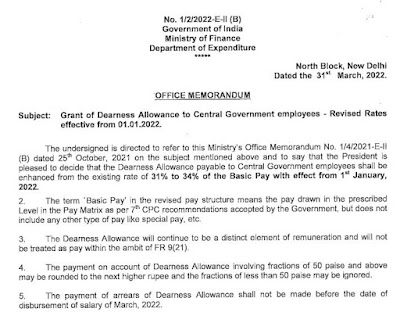
DA Jan 2022 - Grant of Dearness Allowance to Central Government employees - Revised Rates effective from 01.01.2022

 3% DA Hike - Revised Rates effective from 01.01.2022: DoE OM dated 31.03.2022 No. 1/2/2022-E-II (B) Government of India Ministry of Finance...