Wednesday, 13 March 2019

GDS: Revised eligibility criteria for engagement to Gramin Dak Sevaks posts

GDS: Revised eligibility criteria for engagement to Gramin Dak Sevaks posts

No. 17-02/2018-GDS
Government of India
Ministry of Communications
Department of Posts
(GDS Section)
Dak Bhawan, Sansad Marg New Delhi - 110001
Dated: 08.03.2019
To
All Chief Postmasters General/Postmasters General

Subject: Revised eligibility criteria for engagement to Gramin Dak Sevaks (GDS) posts.
 
The eligibility criteria/conditions for engagement to GDS posts were last reviewed and notified by the Department vide letter No.17-39/6/2012-GDS dated 14.01.2015. The matter has been examined. The competent authority has now decided to revise the same as per details below:-

I. Age Limit
The minimum and maximum age for the purpose of engagement to GDS posts shall be 18 and 40 years respectively as on the date of notification of the vacancy. Permissible relaxation in upper age limit for different categories are as under:-

Sl.No.CategoryPermissible age relaxation
1.Schedule Cast/Scheduled Tribe
(SC/ST)
5 years
2.Other Backward Classes
(OBC)
3 years
3.Economically Weaker Sections
(EWS)
No relaxation*
4.Persons with Disabilities (PwD)10 years*
5.Persons with Disabilities (PwD) + OBC13 years*
6.Persons with Disabilities (PwD) + SC/ST15 years*

Note: 1 * There will be no relaxation in upper age limit to EWS candidates. However, the persons belonging to EWSs who are not covered under the scheme of reservation for SCs, STs and OBCs shall get 10% reservation in engagement to Gramin Dak Sevaks posts in the Department of Posts as prescribed in Directorate letter No 17-09/2019 dated 26.02.2019 .

Note: 2 *All recruiting authorities shall maintain the above age relaxation for persons with disability for all categories of GDS posts as is applicable in regular appointment in Group 'C' cadre. This relaxation however is not applicable for persons with benchmark of disability "Blind", as in place of blind, candidate with Low Vision have been identified as prescribed in Directorate letter No. 17-8/2017-GDS dated 26.02.2019 . Relaxation in upper age limit is subject to the condition that maximum age of the applicant on the crucial date shall not exceed 56 years.

II. Educational Qualification
(i) Secondary School Examination pass certificate of 10th standard with passing marks in Mathematics and English (having been studied as compulsory or elective subjects) conducted by any recognized Board of School Education of the Government of India/State Governments/ Union Territories in India shall be a mandatory educational qualification for all approved categories of Gramin Dak Sevaks (i.e. BPM,ABPM & Dak Sevak ) referred to in Directorate Order No 17-3112016-GDS dated 25.06.2018.

(ii) Compulsory knowledge of Local Language
The candidate should have studied the local language at least up to 10th standard [as compulsory or elective subjects] as declared by the State Government or as per constitutional provisions relating to the 8th schedule of Constitution of India. The details of local language for each state/Union Territories is as given below:-

Sl.No.Name of CircleName of State / Union Territory covered  under Postal CircleLocal language as for the Postal Circle
1Andhra PradeshAndhra Pradesh1. Telugu
2. Urdu
2AssamAssam1. Assamese
2. Bengali
3. Bodo
3BiharBihar1. Hindi
2. Urdu
4ChhattisirarhChhatisgarhHindi
5Delhi
The Government of NCT of Delhi
Delhi1. Hindi
2. Punjabi
3. Urdu
6GuiaratGuiaratGujarati
Dadra Nagar HaveliTo be decided later
Daman and DiuGujarati
7HaryanaHaryana1.Hindi
2. Punjabi
8Himachal PradeshHimachal PradeshHindi
9J & K CircleJ & KUrdu
10JharkhandJharkhand1. Hindi,
2. Urdu,
3. Santhali,
4. Bangla,
5. Odia,
6. Maithili
11KarnatakaKarnatakaKannada
12KeralaKeralaMalayalam
LakshadweepMalavalam
13Madhya PradeshMadhya PradeshHindi
14MaharashtraMaharashtraMarathi
Goal. Konkani
2.Marathi
15North EastArunachal Pradesh(To be decided later)
Manipur
Meghalaya
Mizoram
Nagaland
Tripura
16OdishaOdishaOdia
17Punjab Chandiirnrh (Chandigarh)PunjabPunjabi
ChandigarhEnglish
18RaiasthanRaiasthanHindi
19TamilnaduTamilnaduTamil
PuducherryTamil for Puducherry Malayalam for Mahe Telugu for Yanam
20TelanganaTelanganal.Telugu
2.Urdu
21Uttar PradeshUttar PradeshI.Hindi
2.Urdu
22UttarakhandUttarakhandI.Hindi
2.Sanskrit
23West BengalWest Bengal1. Bengali,
2. Nepali,
3. Urdu,
4. Hindi,
5. Santhali,
6. Odia,
7. Punjabi
Andaman and Nicobar Islands)Hindi
SikkimNepali

(iii) Basic Computer Training
The candidates for all approved categories of GDS referred to in (i) above will be required to furnish Basic Computer Training Course Certificate of at least 60 days duration, from any Computer Training Institute run by Central Government/State Government I Universities I Boards /Private Institutions Organizations. This requirement of basic computer knowledge certificate shall be relaxable in cases where a candidate has studied computer as a subject in Matriculation or class XII or any other higher educational level and in such cases, a separate certificate will not be insisted upon .

III. Residence
The condition of residence shall apply as stipulated in Rule 3-A (vii) of GDS (Conduct and Engagement) Rules, 2011. The candidates must provide accommodation for Branch post office after selection but before engagement . The accommodation should meet the following prescribed standards :-
(i) The building may be owned by a Gram Panchayat or Central government or by State government such as school or offices or BPM's own house or a proper rented accommodation in a busy place of the village .

(ii) Location - The GDS Branch Post Office should be located in the main, busy part of the village .

(iii) Size - The minimum size of GDS Branch Post Office should not be less than 100 sq. feet preferably in 10'X10' dimensions and in ground floor.

(iv) Approach - The GDS Branch Post Office should have direct access/approach from village road and should be located in front portion of the building in which it is housed. The GDS Branch Post Office should not be housed in verandah, courtyards, kitchen, space under the stairs, bedroom, damaged rooms, makeshift accommodations , isolated buildings outside the village etc. which are difficult to access/approach by the customers.

(v) Structure - The accommodation should preferably be a brick and mortar structure to ensure safety and security. The room should be properly ventilated and lighted and should be properly maintained and neatly white washed.

(vi) Power supply - The post office room should have electrical power connection for charging of handheld devices and for fan, electricity bulb etc. It should have suitable place to install solar panels.

(vii) The accommodation for the GDS Branch Post Office should be exclusively available for Post Office use. It may work from a village shop but Post office working from shop should have an exclusive space to keep the registers, micro ATM or hand-held device and other items apart from space for prominently exhibiting the signage etc. giving due importance to Post Office.

(viii) At present DARPAN devices are using are of the four Network Service Providers (NSPs) viz, Airtel, Vodafone, Idea & BSNL for ensuring connectivity to Branch Post Offices. While providing accommodation for GDS BO, it should be ensured that, Network is available for any one of these NSPs.

Further, it is clarified that the candidate who provide the above prescribed standards of accommodation after selection but before engagement and if he is engaged as GDS BPM will be entitled for the drawal of Composite allowance @ Rs.500/-per month as prescribed in Directorate OM. No 17-31/2016-GDS dated 25.06.2018 & No 17-31/2016-GDS (pt) dated 28.09.2018. Further, if the candidate selected and engaged as GDS BPM provides accommodation for Post Office in a rent free government accommodation and staying in the Post village will be entitled for the Composite allowance Rs.250/- equal to that of BPMs who provide non-standard accommodation (those who are not fulfilling above standard are treated as non-standard accommodations) , as prescribed in Directorate OM. No. 17-31/2016-GDS dated 25.06 .2018 & No 17-31/2016-GDS (pt) dated 28.09.2018.

IV. Knowledge of Cycling
Knowledge of Cycling is a pre-requisite condition for all GDS posts. In case of a candidate having knowledge of riding a scooter or motor cycle, that may be considered as knowledge of cycling. The candidate has to submit a declaration to this effect.

V. Adequate means of Livelihood
The condition of adequate means of livelihood shall apply as stipulated in Rule 3- A (iii) of GDS (Conduct and Engagement) Rules, 2011. However, this condition shall not be a pre-requisite for candidates for the purpose of applying to the GDS post or selection there to and the selected candidate shall be required to comply with this prescribed condition within 30 days after selection but before engagement . The GDS will also have to ensure that he is having adequate additional means of livelihood during the period of engagement till his discharge.

VI. Furnishing of Security
On engagement as GDS, the person so engaged shall be required to furnish security in such manner as may be prescribed from time to time. The existing security amount in case of GDS Branch Postmaster and other approved categories of GDS i.e. ABPM & Dak Sevak is Rs.25,000/- & Rs.10,000/- respectively the same to be furnished in form of FIDELITY BOND for a period of five years and same to be renewed every five years during the period of engagement.

VII. Fulfillment of other terms and conditions
Terms and conditions of engagement to GDS posts shall apply as stipulated in the relevant rules of GDS (Conduct & Engagement) Rules, 2011modified from time to time by the Department of Posts.

VIII. Adequate representation of SC/ST/OBC, Persons with Disability, Ex­ Serviceman & Economically Weaker Sections (EWSs).
The instructions issued by the Department vide no.19-11/97-ED & TRG dated 27.11.1997, No. 17-08/2017-GDS dated 26.02.2019 and No. 17-09/2019 dated 26.02.2019 providing for adequate representation of SC/ST/OBC communities, Persons with Disability and Economically Weaker Sections (EWSs) respectively will continue to apply.

(i) The permissible disability for persons with Disability will be as given below :-
Sl. No Name of the Posts Categories of disability suitable for the post
1BPM/ ABPM/ Dak Sevaks a) Low vision (LV), b) D(Deaf), HH (Hard of hearing) , c) One Arm (OA), One leg (OL), Leprosy Cured, Dwarfism , Acid Attack Victim, d) Specific learning disability. Multiple disabilities from amongst disabilities mentioned at (a) to (d) above except Deaf and Blindness

(ii) The reservation to EWSs will be as given below:-
The persons belonging to EWSs who are not covered under the scheme of reservation for SCs, STs and OBCs shall get 10% reservation in engagement of GDS posts.

IX. Production of SC/ST/OBC/Disability/ Economically Weaker Sections Certificate :
Production of SC/ST/OBC/Disability/EWSs certificate in the prescribed format would be compulsory in case of such candidates.

X. Time Related Continuity Allowance (TRCA)
The following Minimum TRCA shall be payable to the deferent categories of GDS posts as mentioned in Directorate Order No 17-31120 16-GDS dated 25.06.20 18 :-
SI.No.·CategoryMinimum TRCA for 4 Hours/level 1Minimum TRCA for 5 Hours/level 2
1BPMRs.12000/-Rs.14500/-
2ABPM/Dak SevaksRs.10000/-Rs.12000/-

XI. Method of Engagement:
Method of engagement will continue to be as online engagement process for engagement of all categories of GDS as notified vide Directorate Letter No 17-2312016-GDS dated 01.08.2016.

(i) Exemption of fee for applying on GDS Posts
Male applicants belonging to the category UR/OBC/EWS have to pay a fee of Rs. 100/-(Rupees one hundred only) for each set of five options. Payment of fee is exempted for all female candidates, all SC/ST candidates and all PwD candidates.

(ii) Option for applying on GDS Posts
A candidate can apply for a maximum of twenty posts all over India per cycle of online engagement. This inter alia means that a prospective candidate can apply for twenty posts on a single application spread across one Circle or several Circles. This cap of twenty posts is inclusive of vacancies arising in candidate's home Circle. Home Circle means belonging or native I domicile state of a prospective candidate in which she/He is permanently residing and that Postal Circle is providing opportunity. Hence, candidates should exercise due care while utilizing the twenty choices available to her/Hm in each Cycle. However, only one post will be offered for each Circle if she/He has applied for one or more posts in each Circle.

Example: - If a candidate opts for five posts with preference post l, post2, post3, post4, post 5 etc. and selected as meritorious in more than one post, the post in the order of preference will be offered and the candidature for all the remaining posts will be forfeited.

XII. Job Profile

(i) BRANCH POSTMASTER (BPM)
The Job Profile of Branch Post Master will include managing affairs of GDS Branch Post Office, India Posts Payments Bank (IPPB) and ensuring uninterrupted counter operation during the prescribed working hours using the handheld device/Smartphone supplied by the Department. The overall management of postal facilities, maintenance of records, upkeep of handheld device, ensuring online transactions, and marketing of Postal, India Post Payments Bank services and procurement of business in the villages or Gram Panchayats within the jurisdiction of the Branch Post Office should rest on the shoulders of Branch Postmasters. However, the work performed for IPPB will not be included in calculation of TRCA. since the same is being done on incentive basis. Branch Postmaster will be the team leader of the GDS Post Office and overall responsibility of smooth and timely functioning of Post Office including mail conveyance and mail delivery. He/she might be assisted by Assistant Branch Post Master of the same GDS Post Office. BPM will be required to do combined duties of ABPMs as and when ordered . He will also be required to do marketing, organizing melas, business procurement and any other work assigned by IPO/ASPO/SPOs/SSPOs/SRM/SSRM etc. In some of the Branch Post Offices, the BPM has to do all the work of BPM/ABPM.

(ii) ASSISTANT BRANCH POSTMASTER (ABPM)
The Job Profile of Assistant Branch Post Master will include all functions of sale of stamps/stationery, conveyance and Delivery of mail at doorstep deposits/payments/other transactions under IPPB, assisting Branch Postmasters in counter duties using the handheld device/Smart phone supplied by the Department. However, the work performed for IPPB will not be included in calculation of TRCA. since the same is being done on incentive basis. He will also be required to do marketing, organizing melas, business procurement and any other work assigned by the Branch Postmaster or IPO/ASPO/SPOs/SSPOs/SRM/SSRM etc. ABPMs will also be required to do Combined Duty of BPMs as and when ordered.

(iii) DAK SEVAK
The Job Profile of Dak Sevaks will include all functions of viz sale of stamps and stationery, conveyance and delivery of mail and any other duties assigned by Postmaster/Sub Postmaster including IPPB work in the Departmental Post Offices/RMS. However, the work performed for IPPB will not be included in calculation of TRCA. since the same is being done on incentive basis. He may also have to assist Post Masters/Sub Postmasters in managing the smooth functioning of Departmental Post Offices and do marketing, business procurement or any other work assigned by the Post Master or IPO/ASPO/SPOs/SSPOs/SRM/SSRM etc.

2. The revised eligibility conditions and criteria of selection will come into effect for the vacancies to be notified on or after the date of issue of this notification. The engagement process initiated before this date shall be finalized as per the existing instructions.

3. Necessary amendments in the GDS (Conduct & Engagement), Rules 2011 are being issued separately.

4. Hindi version will follow.
(SB Vyavahare)
Assistant Director General (GDS/PCC)
Tele No. 011-23096629
Source: utilities.cept.gov.in

Dearness Allowance grant to railway employees - Revised rates effective from 1 January 2019

Dearness Allowance grant to railway employees - Revised rates effective from 1 January 2019

Grand of DA Rates (9% to 12%) effective from Jan 2019- Railways

GOVERNMENT OF INDIA (BHARAT SARKAR)
Ministry of Railways (Rail Mantralaya)
(Railway Board)
PC-VII No.- 131
File No. PC-VII/2016/I/7/2/1
RBE No : 37/2019
New Delhi, dated: 06.03.2019
The General Manager/CAOs(R),
All India Railways & Production Units,
(As per mailing list)

Sub: Grant of Dearness Allowance to Railway employees - Revised Rates effective from 01.01.2019.

The undersigned is directed to refer to this Ministry's letter RBE No. 132/2018 dated 10.09.2018 (F. No. PC-VII/2016/1/7/2/1) on the subject mentioned above and to say that the President is pleased to decide that the Dearness Allowance payable to Railway employees shall be enhanced from the existing rate of 9% to 12% of the basic pay with effect from 1st January, 2019.
  1. The term 'basic pay' in the revised pay structure means the pay drawn in the prescribed Level in the Pay Matrix as per 7th CPC recommendations accepted by the Government, but does not include any other type of pay like special pay, etc.
  2. The Dearness Allowance will continue to be distinct element of remuneration and will not be treated as pay within the ambit of Rule 1303 (FR 9(21)), Indian Railway Establishment Code, Volume -II (Sixth Edition - 1987) - Second Reprint 2005.
  3. The payment on account of Dearness Allowance involving fractions of 50 paise and above may be rounded to the next higher rupee and the fractions of less than 50 paise may be ignored.
  4. The payment of arrears of Dearness Allowance (from January to March) shall not be made before the date of disbursement of salary of March, 2019.
  5. This issues with the concurrence of Finance Directorate of Ministry of Railways.
(Jaya Kumar G)
Deputy Director, Pay Commission-VII
Railway Board
Source: Indian Railways

Monday, 11 March 2019

Announcement of Schedule for General Elections to Lok Sabha and Legislative Assemblies in Andhra Pradesh, Arunachal Pradesh, Odisha & Sikkim, 2019

Election Commission

Subject: Announcement of Schedule for General Elections to Lok Sabha and Legislative Assemblies in Andhra Pradesh, Arunachal Pradesh, Odisha & Sikkim, 2019.
11 MAR 2019
In continuation of the Commission’s Press Note No. ECI/PN/23/2019, dated 10th March, 2019, the following may be read as:

2. The date of poll in respect of Bye Elections for 18 ACs of Tamil Nadu, as mentioned at Sl.No. 14 to Sl. No. 31, as already scheduled for Phase 2(Two) of Election, shall be read as 18th April, 2019 instead of 23rd April, 2019.

3. In the details of Schedule No. 3, 4 & 5 in respect of PC (3-Anantnag) in Jammu & Kashmir, the Date of Issue of Notification, Last Date of Filing Nominations, Scrutiny of Nominations & Last Date for Withdrawal of Candidature, shall be read as 28th March, 2019, 04th April, 2019, 05th April, 2019 & 08th April, 2019, respectively only with Dates of Poll as 23rd April, 2019, 29th April, 2019 & 06th May, 2019, respectively.

4. Accordingly, the election schedule for Anantnag PC of Jammu & Kashmir will be held as per schedule:

1 Issue of Notification­ 28.03.2019
2 Last Date of filing Nominations 04.04.2019
3 Scrutiny of Nominations 05.04.2019
4 Last date for withdrawal of Candidature 08.04.2019
5 (a) Date of poll (in Anantnag District) 23.04.2019
5 (b) Date of poll (in Kulgam District) 29.04.2019
5 (c) Date of poll (Shopian & Pulwama Districts) 06.05.2019
6 Counting of Votes 23.05.2019
(SUMIT MUKHERJEE)
PRINCIPAL SECRETARY
PIB

Employees Union urges the Lavasa Committee report to be implemented by the central government


Employees Union urges the Lavasa Committee report to be implemented by the central government

A Jammu-based employees union on Sunday urged the Centre to implement the recommendations of the Ashok Lavasa Committee report ahead of the upcoming Lok Sabha polls to benefit lakhs of lower class employees and pensioners.

A high-level committee headed by the former Finance Secretary Ashok Lavasa submitted its report on allowances to 47 lakh government employees to Union Finance Minister Arun Jaitley in April 2017.

"The delay in accepting the recommendations of the Ashok Lavasa Committee report by the central government has left the employees concerned," president National Mazdoor Conference Subash Shastri said here.

"We urge Prime Minister Narendra Modi and the Finance minister to take a final decision in this regard before the announcement of the upcoming parliamentary elections," he said.

He said the Lavasa Committee had proposed a minimum scale pension of lower class employees and pensioners to Rs 21,000.

The committee was constituted in the wake of implementation of the seventh pay commission by the central government for removal of pay anomalies in the pay structure of lower class cadre of both the state and the central government, Shastri said, adding that it will be a major issue in the upcoming polls.

"The government employees and the pensioners constitute a sizeable voter constituency and this constituency can be a determining factor in the electoral considerations," he said.

PTI

Sunday, 10 March 2019

Lok Sabha Election 2019: ANNOUNCEMENT OF SCHEDULE FOR GENERAL ELECTIONS TO LOK SABHA AND LEGISLATIVE ASSEMBLIES IN ANDHRA PRADESH, ARUNACHAL PRADESH, ODISHA & SIKKIM, 2019

GENERAL ELECTIONS - 2019
SCHEDULE OF ELECTIONS

General Elections to Lok Sabha and State Legislative Assemblies of Andhra Pradesh, Arunachal Pradesh, Odisha and Sikkim 

ELECTION COMMISSION OF INDIA
Nirvachan Sadan, Ashoka Road,
No.ECI/PN/23/2019
Dated: 10th March, 2019
PRESS NOTE

SUBJECT: ANNOUNCEMENT OF SCHEDULE FOR GENERAL ELECTIONS TO LOK SABHA AND LEGISLATIVE ASSEMBLIES IN ANDHRA PRADESH, ARUNACHAL PRADESH, ODISHA & SIKKIM,2019.

The five-year term of the 16th Lok Sabha is due to expire on 03rdJune, 2019. Credible elections, conducted at regular prescribed intervals, are the very soul of any democratic system. Article 324 of the Constitution of India bestows the relevant powers, duties and functions upon the Election Commission of India while Section 14 of the Representation of the People Act, 1951 provides for the conduct of the elections to constitute a new Lok Sabha before the expiry of its current term. Taking into account these Constitutional and legal provisions, the Election Commission of India has made comprehensive preparations for the conduct of elections to the 17th Lok Sabha in a free, fair and peaceful manner.

2. Elections to the world’s largest democracy pose immense challenges with respect to logistics and man/woman and material management and Commission's endeavour in this direction has been to consult all the stakeholders,invite inputs from all the relevant departments/organization sand evolve a coordinated framework for smooth delivery of another round of General Elections.

3. In the course of assessing various dimensions involved in holding elections to the 543 Parliamentary Constituencies (PCs) and, in 3 particular,the parameters to be considered for their scheduling and phasing, the Election Commission of India has planned meticulously for each and every aspect of election much in advance to ensure that these elections are conducted in best professional manner.

4. The Commission organized a series of meetings wit hthe Chief Electoral Officers (CEOs) of all the 36 States and Union Territories (UTs) to review all the aspects of election preparedness in all the States and UTs and accordingly, appropriate instructions were issued to the CEOs for ensuring efficient conduct of the elections.

5. The Commission also held meeting with the Chief Secretaries, Directors General of Police, Home Secretaries, Chief Electoral Officers and Police Nodal Officers of all States and UTs on 21st, 22nd & 28th January, 2019, to assess the overall law and order situation, as certain State/ UT specific areas of concern,t o deliberate on the quantum of Central Armed Police Forces (CAPFs) required in each State/ UT and to review the overall preparedness of the election machinery. The cooperation of all authorities was sought for conducting free, fair and peaceful elections across the country, under the overall superintendence, direction and control of the Commission.

6. The Commission has visited different States to review the poll preparedness. During these visits,the Commission interacted with political parties, enforcement agencies, all District officers, SSPs/SPs, Divisional Commissioners, Range IGs and Chief Secretaries, Home Secretaries, DGPs and other Senior officers of the States.

7. The conduct of General Elections in the entire country requires considerable deployment of Central and State Police Forces to ensure peaceful, free,fair election with fearless participation of electors, especially in the vulnerable areas/pockets. Mobilization, deployment and disengagement of these forces with minimum criss cross movement and optimal utilization, involved complex planning and detailed analysis, carried out over several rounds of consultations with the senior officers of the Ministry of Home Affairs/CAPFs/Police Nodal Officers of the States/UTs. The Commission also held discussions with the Union Home Secretary to highlight the areas of coordination for effective deployment of these forces.

8. The Commission also held meeting with Railway and many others in regard to the specific requirements of special trains, including other logistics, for smooth and timely movement of CAPF Companies and other police forces across States/UTs, including their intra-State shifting during the election period.

9. Keeping in view the interests of the students and also the fact that Polling Stations are mostly located in school buildings and teachers are engaged as polling personnel, the Commission has consciously factored-in the examination schedules of various State Boards, including the Central Board of Secondary Education, in the process of finalizingthe poll dates. In addition to this, other relevant factors like various holidays and festivals falling in the months of March, April and May, harvest season in certain parts of the country and the inputs obtained from the Indian Meteorological Department on the pre-monsoon rainfall, on set and spread of monsoon and acute hot weather conditions in certain parts of the country have also been taken in to consideration.Thus, while deciding on the number of poll days for each State/UT and the composition of the PCs that go to polls on a particular pollday, the Commission has, to the extent possible, taken all relevant aspects and information, related there to, in to view

10. DELIMITATION OF PARLIAMENTARY AND ASSEMBLY CONSTITUENCIES : The General Election to the House of People, 2019 to constitute the17th Lok Sabha shall be held on the basis of the extent of Parliamentary Constituencies as contained in the “Delimitation of Parliamentary and Assembly Constituencies Order, 2008”. Therefore, there is no change in the extent and status of any Parliamentary Constituency after General election to Lok Sabha, 2009. Besides, the total number of Parliamentary Constituencies allotted to various States/UTs including SC/ST seats are also continued to be the same. Similarly, general elections to the Legislative Assemblies of Arunachal Pradesh, Odisha and Sikkim shall be held on the basis of the extent of Assembly Constituencies as contained in the said Delimitation Order, 2008. The total number of ACs allotted to these States including SC/ST seats shall also continue to be the same.

11. As per “Andhra Pradesh Reorganisation Act, 2014(No.6 of 2014) dated 1st March, 2014” & “Andhra Pradesh Reorganisation (Removal of Difficulties) Order, 2015 dated 23.4.2015” and subsequently,‘Commission’s Notification No.282/AP/2018(DEL) dated 22.9.2018, the total number of Parliamentary and Assembly Constituencies in respect of Andhra Pradesh and Telangana States shall be as under:

ANDHRA PRADESH
Parliamentary Constituencies: Total number of seats as allocated are 25, SC-4 and ST-1.
Assembly Constituencies: Total number of seats as allocated are 175, SC-29 & ST-7.

TELANGANA
Parliamentary Constituencies: Total number of seats as allocated are 17, SC-3 and ST-2.
Assembly Constituencies: -Total number of seats are 119, SC-19 & ST-12.
The extent of all Parliamentary and Assembly Constituencies in respect of Andhra Pradesh and Telangana States shall be as per the said Act(s) and the Commission’s Notification dated 22.9.2018, as referred above
State-wise poll details: Phase 7 (May 19)
Bihar (8), Jharkhand (3), MP (8), Punjab (13), West Bengal (9), Chandigarh (1), UP (13), Himachal (4); Total: 59
State-wise poll details: Phase 6 (May 12)
Bihar (8), Haryana (10), Jharkhand (4), MP (8), UP (14), West Bengal (8), Delhi-NCR (7); Total: 59
State-wise poll details: Phase 5 (May 6)
Bihar (5), J&K (2), Jharkhand (4), MP (7), Rajasthan (12), UP (14), West Bengal (7); Total: 51
State-wise poll details: Phase 4 (April 29)
Bihar (5), J&K (1), Jharkhand (3), MP (6), Maharashtra (17), Odisha (6), Rajasthan (13), UP (13), West Bengal (8); Total: 71
State-wise poll details: Phase 3 (April 23)
Assam (4), Bihar (5), Chhattisgarh (7), Gujarat (26), Goa (2), J&K (1), Karnataka (14), Kerala (20), Maharashtra (14), Odisha (6), UP (10), West Bengal (5), Dadra and Nagar Haveli (1), Daman and Diu (1); Total: 115
State-wise poll details: Phase 2 (April 18)
Assam (5), Bihar (5), Chhattisgarh (3), J&K (2), Karnataka (14), Maharashtra (10), Manipur (1), Odisha (5), Tamil Nadu (39), Tripura (1), UP (8), West Bengal (3), Puducherry (1); Total: 97
State-wise poll details: Phase 1 (April 11)
Andhra (25), Arunachal (2), Assam (5), Bihar (4), Chhattisgarh (1), J&K (2), Maharashtra (7), Manipur (1), Meghalaya (2), Mizoram (1), Nagaland (1), Odisha (4), Sikkim (1), Telangana (17), Tripura (1), UP (8), Uttarakhand (5), West Bengal (2), Andaman (1), Lakshadweep (1); Total (91)

Saturday, 9 March 2019

6th CPC DA from Jan 2019 @154% for CGE and Central Autonomous Bodies continuing to draw pre-revised pay


Rate of Dearness Allowance applicable w.e.f. 01.01.2019 to the Central Government Employees and Central Autonomous Bodies continuing to draw their pay in the pre­ revised pay scale/Grade Pay as per 6th CPC


6th CPC DA from Jan 2019 @154% for CGE and Central Autonomous Bodies continuing to draw pre-revised pay

No. 1/3(1)/2008-E.II(B)
Government of India
Ministry of Finance
Department of Expenditure
North Block, New Delhi
Dated the 8th March, 2019.
OFFICE MEMORANDUM

Subject:- Rate of Dearness Allowance applicable w.e.f. 01.01.2019 to the employees of Central Government and Central Autonomous Bodies continuing to draw their pay in the pre­ revised pay scale/Grade Pay as per 6th Central Pay Commission

The undersigned is directed to refer to this Department's O.M. O.M. No. 1/3/2008-E.ll(B) dated 11th September, 2018 revising the rate of Dearness Allowance (DA) w.e.f. 01.07.2018 in respect of employees of Central Government and Central Autonomous Bodies continuing to draw their pay in the pre-revised pay scale/Grade Pay as per 6th Central Pay Commission.
  1. The rate of DA admissible to above categories of employees of Central Government and Central Autonomous Bodies shall be enhanced from the existing 148% to 154% w.e.f. 01.01.2019.
  2. The provisions contained in paras 3, 4 and 5 of this Ministry's O.M.No.1 (3)/2008-E.ll(B) dated 29111 August, 2008 shall continue to be applicable while regulating Dearness Allowance under these orders.
  3. The payment of arrears of Dearness Allowance shall not be made before the date of disbursement of salary of March, 2019.
  4. The contents of this Office Memorandum may also be brought to the notice of all organisations under the administrative control of the Ministries/Departments which have adopted the Central Government scales of pay.
(A. Bandyopadhyay)
Under Secretary to the Government of India
Source: DoE

5th CPC DA from Jan 2019 @295% for CGE and Central Autonomous Bodies continuing to draw pre-revised pay

5th CPC DA from Jan 2019 @295% for CGE and Central Autonomous Bodies continuing to draw pre-revised pay

No. 1/3(2)/2008-E.II(B)
Government of India
Ministry of Finance
Department of Expenditure
North Block, New Delhi
Dated the 8th March, 2019.
OFFICE MEMORANDUM

Subject: Rate of Dearness Allowance applicable w.e.f. 01.01.2019 to the employees of Central Government and Central Autonomous Bodies continuing to draw their pay in the pre-revised pay scales as per 5th Central Pay Commission.

The undersigned is directed to refer to this Departments O.M. No, 1/3/2008-E.II(B) dated 11th September, 2018 revising the rate of Dearness Allowance (DA) w.e.f. 01.07.2018 in respect of employees of Central Government and Central Autonomous Bodies continuing to draw their pay in the pre-revised pay scales as per 5th Central Pay Commission.
  1. The rate of DA admissible to above categories of employees of Central Government and Central Autonomous Bodies shall be enhanced from the existing 284% to 295% w.e.f. 01.01.2019.
  2. The provisions contained in paras 3, 4 and 5 of this Ministry’s O.M.No.1(13)/97-EII(B) dated 3rd October, 1997 shall continue to be applicable while regulating Dearness Allowance under these orders.
  3. The payment of arrears of Dearness Allowance shall not be made before the date of disbursement of salary of March, 2019.
  4. The contents of this Office Memorandum may also be brought to the notice of all organisations under the administrative control of the Ministries/Departments which have adopted the Central Government scales of pay.
Sd/-
(A.Bandyopadhyay)
Under Secretary to the Government of India
Source: doe.gov.in

Grant of 10 Days Casual Leave to Industrial Employees: PCA(Fys) Order

Grant of 10 Days Casual Leave to Industrial Employees: PCA(Fys) Order

GOVERNMENT OF INDIA
MINISTRY OF DEFENCE
OFFICE OF THE PRINCIPAL CONTROLLER OF ACCOUNTS (FYS)
10-A, S.K. BOSE ROAD, KOLKATA: 700001

PAY TECH SECTION
No. Pay/Tech-II/1058
Date: - 07/03/2019
To
All Controllers of Finance & Accounts (Fys.).

Subject: Grant of 10 Days CL to Industrial Employees- reg

A copy of MoD ID No. 01(02)/2018/D(Civ-II) dated 23.10.2018 regarding extension of the provision of 10 days Casual Leave in terms of Para 9 of the Appendix-III of the CCS(Leave) Rules,1972 to the Industrial employees circulated vide OFB No. 265/Per/Policy dated 30.10.2018 is forwarded herewith for your information and necessary action, please.

Enclo: As above.
Sd/-
(Dr. D L Meena)
Deputy Controller of Accounts (Fys.)

MINISTRY OF DEFENCE
ORDNANCE FACTORY BOARD
AYUDH BHAVAN
10-A, SHAHEED KHUDIRAM BOSE ROAD
KOLKATA-700 001
No.265/Per/Policy
Date : 30/10/2018
To,
The Sr. General Manager(s)/General Manager(s)/Head of Unit(s)
All Ordnance Factories / Units

Sub: Grant of 10 days CL to those Civilian employees under Defence Establishments who are not entitled to 17 holidays per calendar year - regarding.

Ref: OFB circular of even number dated 02/08/2018.

In continuation of the circular cited under Ref above, a copy of MoD I.D. No.01(02)/2018/D(Civ-II) dated 23/10/2018 extending the provision of 10 days Casual Leave to Industrial Employees is forwarded herewith for information and compliance at all OFs/Units accordingly.

Encl.: As above
[ S. Sharad Rao ]
Dy. Director/Admin.
For Director General Ordnance Factories

Government of India
(Department of Defence)
Ministry of Defence
D(Civ-II)

Subject: Grant of 10 days Casual Leave to those Civilian employees under Defence Establishments who are not entitled to 17 holidays per calendar year.

Reference MoD ID No. 01(02)/2018/D(Civ-Il) dated 21st March, 2018 on the above mentioned subject.

The matter has been further examined and it has been decided with the approval of competent authority to extend the provision of 10 days Casual Leave in terms of Para 9 of the Appendix-III of the CCS(Leave) Rules, 1972 to Industrial employees who are entitled to 16 holidays in a year.

(Dalpat Singh)
Under Secretary to the Govt of India
Source: Pcafys.nic.in

House allocation to railway staff to improve accessibility and simplify the process

House allocation to railway staff to improve accessibility and simplify the process

GOVERNMENT OF INDIA
MINISTRY OF RAILWAYS
RAILWAY BOARD
No. 2018/Trans Cell/S&T/House Allotment
Dated: 05.03.2019
The General Manager, All Indian Railways/PUs, NF(Con), CORE
The DG/RDSO/Lucknow, DG/NAIR/Vadodara
CAOs, DMW/Patiala, WPO/Patna, COFMOW/NDLS , RWP/Bela, CAO/IROAF

Sub: Allotment of House to staff improving availability and simplification of process.

In order to improve availability of Houses for Railway Employees and to simplify the process of allotment, Board (ME, MS, FC & CRB) have approved the following:
  1. The quarters of a pool laying vacant for more than 3 months or so should be brought into a Common Pool. The process may be started from way side station colony and progressively moved to minor and major colony.
  2. There may be a single allotment agency considered at the station of the unit that would maintain the record and allot the quarters in accordance with the rules set out by the Rail way/Division/Unit.
  3. Vacant Quarter shall be allotted as per the rules set out, preferably within 7/15 days of the vacancy.
  4. Railway/Division/Unit may formulate necessary guidelines for implementation keeping in view the Local conditions and shall make the process transparent and preferably allot the quarters online.
  5. Other rules & guidelines including policy of allotment of quarters to essential staff as issued from Board shall remain unchanged and as modified from time to time.
This issues with the concurrence of Associate Finance of Transformation Cell of Railway Board.
Kindly acknowledge the receipt and ensure compliance .
sd/-
(Umesh Balonda)
Executive Director/S&T
Transformation Cell
Source: Indian railways

FAQ: Sexual Harassment of Women At Workplace (Prevention, Prohibition and Redressal) Act (the SH Act), 2013


FAQ: Sexual Harassment of Women At Workplace (Prevention, Prohibition and Redressal) Act (the SH Act), 2013

MINISTRY OF WOMEN & CHILD DEVELOPMENT
Government of India

1.What is Sexual Harassment at workplace ?
Sexual Harassment is any unwelcome act or behaviour (whether express or implied), such as:-
  • Physical contact or advance
  • A demand or request for sexual favours
  • Making sexually coloured remarks
  • Showing pornography
  • Any other physical, verbal or non-verbal conduct of a sexual nature.
Sexual harassment at workplace can take various forms. It can involve conduct such as:
  • unwelcome touching, hugging or kissing
  • staring or leering
  • suggestive comments or jokes
  • unwanted or persistent requests to go out
  • intrusive questions about another person’s private life or body
  • Deliberately brushing up against someone
  • insults or taunts of a sexual nature
  • sexually explicit pictures, posters, screen savers, emails, twitters, SMS or instant messages
  • accessing sexually explicit internet sites
  • inappropriate advances on social networking sites
  • behaviour which would also be an offence under the criminal law, such as physical assault indecent exposure sexual assault, stalking or obscene communications.
2.How many kinds of sexual harassment at workplace are there?
Sexual harassment of workplace is of two kinds:

  • Quid pro quo
  • Hostile work environment
3. What is ‘Quid Pro Quo’ kind of sexual harassment at workplace?
Quid pro quo is a Latin term which literally means ‘this for that’.
Quid pro quo sexual harassment means subjecting a woman to unwelcome sexual advances, requests for sexual favours and other verbal or physical conduct of a sexual nature on account of the following:
  • To force the woman to agree with such conduct by promising/threatening her (explicitly or implicitly) preferential/detrimental treatment in her job. For example: if you agree to accompany me on a study tour, I will give you promotion or in case you refuse, I will transfer you other place.
  • Submission to or rejection of such conduct by the woman is used as the basis for deciding the future course of her job. For example: if you refuse to obey my demand, I will not renew your contract.
4.What is ‘hostile work environment’ kind of sexual harassment at workplace?
Creation of a hostile, intimidating or an offensive work environment with the purpose of unreasonably interfering with woman’s work performance or subjecting woman to humiliating treatment likely to affect her health and safety.

5. What is unwelcome sexual conduct?
A sexual behaviour only becomes sexual harassment at workplace only if it is unwelcome to the woman who is in receipt of such behaviour.

6. Who can complain about of sexual harassment at workplace?
Here, student means a woman above 18 years of age. Those who are under 18 years of age can lodge an FIR under the Protection of Children from Sexual Offences Act, 2012

7. Does the act constituting sexual harassment have to occur at work?
No. The act does not necessarily have to occur at workplace only. It could occur in any of the following places:
  • Social event organised by your employer,
  • During work-related travel,
  • At a client or customer’s premises,
  • At training events, business lunches or dinners, promotional campaigns or public relations events with clients, customers or prospective partners or
  • During the course of work-related phone conversations or communications via electronic media.
8. If I am a victim of sexual harassment, what should I do?
If you feel comfortable in approaching the harasser yourself, you could directly tell the perpetrator that you find his behaviour unwelcome or inappropriate and ask him not to repeat. Or
You can approach the Internal Complaints Committee established within your organization under Sexual Harassment of Women at Workplace (Prevention, Prohibition and Redressal) Act (the SH Act), 2013 with a written complaint. Or

In case, your organisation does not have ICC or if you want to make a complaint against the employer himself or if you work in the capacity of domestic help, then you can lodge your complaint with Local Complaints Committee established in your respective district under the SH Act. Or,
You can contact the nearest police station to lodge an FIR against the perpetrator.

9. What is Internal Complaints Committee (ICC)?
Every organization has to constitute an Internal Complaints Committee (ICC) having following members
  • Chairperson - Women working at senior level in the organisation
  • 2 Members (at least) - Amongst employees committed to women issues, have legal knowledge or experience in social work
  • 1 Member - from NGO
If the organisation has workplaces located at different places or division or sub-division level, then ICC will be constituted at every workplace.

10.What is Local Complaints Committee (LCC)?
The State Government will notify the District Magistrate/Additional District Magistrate/ Collector/ Deputy Collector as District Officer in every district, who will constitute a Local Complaints Committee (LCC) so as to enable women in the unorganised sector or small establishments to work in an environment free of sexual harassment. The LCC will have following members:
  • Chairperson- Nominated from amongst the eminent women in the field of social work and committed to the cause of women
  • Member- Nominated from amongst the women working in the block, taluka or tehsil or ward or municipality in the district
  • 2 Members- Nominated from amongst such NGO/ associations/persons committed to the cause of women or familiar with the issues relating to sexual harassment, provided that:
    • At least one must be a woman
    • At least one must have a background of law or legal knowledge
  • Ex Officio member - The concerned officer dealing with social welfare or women and child development in the district
11. How to locate ICC within your organisation?
As per the Act, the employer is obligated to display the order constituting ICC at any conspicuous place in the workplace. However, if this is not done, then one can contact the employer/head of the department/human resource department to obtain information about the ICC constituted under the SH Act.

12. How to locate LCC in a particular district?
For locating LCC or one of its members, one can adopt following measures:
  • Contact the District Officer’s office
  • Contact One Stop Centre/Women Helpline (toll free thorugh181, 100 etc.) functioning in your district/State
  • Contact the State Commission for Women
  • Contact the State Department of Women and Child Development/department looking after women issues
13. What if ICC/LCC is not constituted in the organisation/district?
Non constitution of Complaints Committee is punishable with a fine of Rs. 50,000/- and repeat offenders will be punished with cancellation /withdrawal of licence/registration required for carrying on business activities. The aggrieved can approach the court to complain about the same.

14. Who can make a complaint?
  • Aggrieved Women Herself, or
  • In case of physical incapacity
    • Her relative
    • Friend
    • Co worker
    • Officer of NCW or SCW
    • Any person who has knowledge of incident with the written consent of complainant
  • In case of mental incapacity
    • Her relative
    • Friend
    • Special educator
    • Qualified psychiatrist or psychologist
    • Guardian or authority under whose care she is receiving treatment or care
    • Any person who has knowledge of incident jointly with any person mentioned above
  • In case woman is unable to file complain for any other reason, by any person who has knowledge of incident with her written consent
  • In case of woman’s death by:
    • Any person who has knowledge of incident with the written consent of her legal heir
    • Legal Heir
15. How to make a complaint of sexual harassment at workplace under the SH Act?
In case, aggrieved woman is unable to submit written complaint, the Complaints Committee will provide her all assistance so that the complaint could be submitted in written form.
Further, if the Complaints Committee is satisfied, it can extend the time limit for submission of complaint (not exceeding three months), however the reason for such exentsion will be recordedin writing.

16.What will the Complaints Committee does when a complaint is submitted to it?
The Complaints Committee (ICC/LCC) will conduct an inquiry into the complaint by calling all the concerned parties i.e. complainant, respondent [the person(s) against whom complaint is being made], witnesses etc. Later, on the basis of the testimonies of the concerned parties and evidences (documentary or otherwise) gathered, the Committee will frame its findings, which will be shared with the employer.
If the Committee comes to the conclusion that the allegations against the respondent are genuine, it shall recommend action that needs to be taken by the employer against such person. However, if the Committee concludes after inquiry that no case is being made against the respondent, it shall recommend that no action to be taken against the respondent.

17. Can the complainant ask for some interim relief during the inquiry from ICC?
During the inquiry, at the written request of complainant, ICC can provide following interim reliefs to the complainant:
  • Transfer the complainant or respondent to any other place
  • Grant leave to the complainant for upto 3 months in addition to her entitled leave
  • Restrain the respondent from reporting on the work performance/ writing confidential report of aggrieved
  • Restrain the respondent from supervising academic activities of aggrieved
18. What kind of punishment could be awarded under the Act?
  • As prescribed under the Service Rules
  • In case service rules do not exist
    • Disciplinary action including written apology, reprimand, warning, censure
    • withholding of promotion/ pay raise/ increment
    • Termination of employment
    • Undergo counselling
    • Community service
  • Deduction from salary for:
    • Mental Trauma, pain, suffering and emotional distress caused
    • Medical expenses incurred
    • The loss of career opportunity
    • The income and financial status of respondent
  • If the amount is not paid it can be recovered as arrear of land revenue
19. Is the inquiry under the SH Act has to be completed in a given time frame?
Yes, the SH Act envisages a time bound inquiry which needs to adhere to following timelines:
DescriptionTimeframe
Submission of ComplaintWithin 3 months of the last incident
Completion of InquiryWithin 90 days
Submission of Report by ICC/LCC to employer/DOWithin 10 days of completion of the inquiry
Implementation of Recommendations by employerWithin 60 days
AppealWithin 90 days of the recommendations

20. What about maintaining confidentiality of the cases related to sexual harassment at workplace?
The Act prohibits the disclosure of:
  • Identity and address of complainant, respondent and witnesses
  • Information pertaining to conciliatory/ inquiry proceedings or recommendation of ICC or action taken by the employer.
Breach of confidentially will invite a penalty of Rs. 5,000/- which will be collected by the employer
Exception: Dissemination of information regarding the justice secured without disclosure of name, address, identity and particulars of complainant or witnesses

21. What are the obligations of employer under the SH Act?
  • Formulation of an Anti Sexual Harassment Policy
  • Display within organisations the penal consequences of sexual harassment at places where it could be viewed by majority of the people
  • Create an ICC at each location and display their contact details
  • Sensitisation and training of employees and ICC members
  • Provide administrative support and monitor timely submission of reports by ICC
  • Mention the number of cases filed and disposed of under the SH Act within organisation’s annual report.
  • Help the aggrieved women in registering criminal case, if she so desires.
22. Can I register both FIR and lodge complaint with Complaints Committee at the same time?
Yes, a woman if she chooses to do so may both file the FIR with the police and complaint with Complaints Committee simultaneously.

Flash News

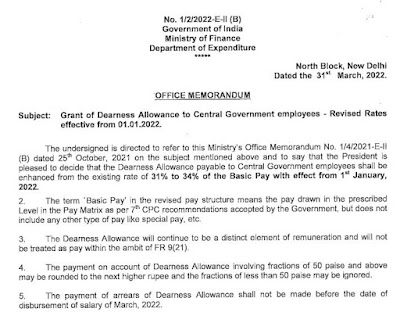
DA Jan 2022 - Grant of Dearness Allowance to Central Government employees - Revised Rates effective from 01.01.2022

 3% DA Hike - Revised Rates effective from 01.01.2022: DoE OM dated 31.03.2022 No. 1/2/2022-E-II (B) Government of India Ministry of Finance...