Friday, 28 September 2018

Supreme Court Judgement: Withholding of Pension or Gratuity


Supreme Court Judgement: Withholding of Pension or Gratuity
C.A. No.6770/2013 @ SLP (C) No. 1427 of 2009
REPORTABLE
IN THE SUPREME COURT OF INDIA
CIVIL APPELLATE JURISDICTION
CIVIL APPEAL NO. 6770 OF 2013
(Arising out of Special Leave Petition (Civil) No. 1427 of 2009)
State of Jharkhand & Ors.
….. Appellant(s)
Vs.
Jitendra Kumar Srivastava & Anr.
…..Respondent(s)
WITH
C.A. No. 6771/2013
(arising out of SLP(C) No. 1428 of 2009)
JUDGMENT
A.K. Sikri, J

1.Leave granted.

2. Crisp and short question which arises for consideration in these cases is as to whether, in the absence of any provision in the Pension Rules, the State Government can withhold a part of pension and/or gratuity during the pendency of departmental/ criminal proceedings? The High Court has - answered this question, vide the impugned judgment, in the negative and hence directed the appellant to release the withheld dues to the respondent.

Not happy with this outcome, the State of Jharkhand has preferred this appeal.

3. For the sake of convenience we will gather the facts from Civil Appeal arising out of SLP(Civil) No. 1427 of 2009. Only facts which need to be noted, giving rise to the aforesaid questions of law, are the following:

The respondent was working in the Department of Animal Husbandry and Fisheries. He joined the said Department in the Government of Bihar on 2.11.1966. On 16.4.1996, two cases were registered against him under various Sections of the Indian Penal Code as well as Prevention of Corruption Act, alleging serious financial irregularities during the years 1990-1991, 1991-1992 when he was posted as Artificial Insemination Officer, Ranchi. On promulgation of the Bihar Reorganisation Act, 2000, State of Jharkhand (Appellant herein) came into existence and the Respondent became the employee of the appellant State. Prosecution, in respect of the aforesaid two criminal cases against the respondent is pending. On 30th January, 2002, the appellant also ordered initiation of disciplinary action against him. While these proceedings were still pending, on attaining the age of superannuation, the respondent retired from the post of Artificial Insemination Officer, Ranchi on 31.08.2002.

Induction/transfer of Trackmen into other departments

Induction/transfer of Trackmen into other departments

GOVERNMENT OF INDIA
MINISTRY OF RAILWAYS
(RAILWAY BOARD)
RBE No. 146/2018

No. E(NG)II/2018/RR-I/13
New Delhi, Dated: 20.09.2018
The General Manager (P),
All Indian Railways/ PU s,
New Delhi.

Sub: Induction of Trackmen into other departments.

Para 179 (XV) of IREM Vol. I (Revised Edition-1989) provides for induction/transfer of Trackmen to Mechanical Engineering and Transportation (Power) Department, Traffic 86 Commercial Department and to the Works side of Engineering Department against 10% quota.

2. It is seen that the Railways have been experiencing difficulty in implementation of these instructions due to reliever(s) not being readily available in the Engineering Department. This has been considered by the Board. In order to ensure viable implementation of these instructions, it has been decided that henceforth 10% of the proposed intake for recruitment in Level-1 (erstwhile Group D) of all those departments where there is provision of induction of Trackmen against 10% quota, will be clubbed to recruit equivalent number of Trackmen in addition to the intake of Trackmen decided for the Engineering Department.

3. Trackmen in Engineering Department should be laterally transferred to those departments whose 10%, vacancies have been clubbed and utilized for recruitment of Other departments will be allowed to induct fresh personnel for the residual 90% of vacancies and also to meet their requirement through fresh personnel to the extent of deficiency not met through lateral transfer.

4. Terms and conditions of transfer of Trackmen to the above departments against this 10% quota as contained in. Para 179 (XV) of IREM Vol. I (Revised Edition-1989) remain unaltered with the reduced age limit of 38 years (reduced vide Board’s letter No. E(NG)I-99/CFP/23(VOLII) dated 14.11.2013).

5. Applications for lateral transfer of Trackmen to other departments should be called for department wise and applicants shortlisted on basis of seniority based on the length of service. Separate applications should be submitted for each such The complete list of applicants should be displayed and also placed on the web page of the division. It is reiterated that for transfer to other departments, a Trackman/Gangman should be suitable in all respects including possessing physical standards prescribed for recruitment to that Department/Workshop.
(M.M. Rai)
Joint Director Estt.(N)II
Railway Board

Wednesday, 26 September 2018

Reversion to old pension scheme due to administrative delay


Reversion to old pension scheme due to administrative delay

"NPS applicable to Government servants appointed to civil posts on or before 31.12.2003. The date on which the vacancies arose or the date on which the examination was conducted for filling up the vacancies is not relevant for deciding the applicability of the Central Civil Services (Pension) rules, 1972"

Reversion to old pension scheme

In accordance with the scheme for National Pension System (NPS), as notified vide Ministry of Finance (Department of Economic Affairs)'s Notification No. 5/7/2003-ECB & PR dated 22.12.2003, the System is mandatory for all new recruits to the Central Government service (except armed forces) from 01.01.2004. Accordingly, as per Rule 2 of the Central Civil Services (Pension) Rules, 1972, as amended on 30.12.2003, these rules are applicable to Government servants appointed to civil posts on or before 31.12.2003. The date on which the vacancies arose or the date on which the examination was conducted for filling up the vacancies is not relevant for deciding the applicability of the Central Civil Services (Pension) rules, 1972.

Ministry of Home Affairs have not sought any advice from Department of Pension and Pensioners’ Welfare on the question of having a policy to cover the paramilitary personnel appointed after 01.01.2004 under the Old Pension Scheme on the ground that the vacancies arose, or the examination was conducted, in the year 2003. However, a reference was received from Ministry of Home Affairs in a specific case relating to appointments as Sub-Inspector in various Central Para Military Forces after selection in August, 2003 on the basis of an Examination conducted in 2002.

Appointments on the basis of these selections were made in Central Reserve Police Force in 2003 and the candidates appointed were covered by the pension scheme under Central Civil Service (Pension) Rules, 1972. However, in the Border Security Force, offers of appointment on the basis of the same examination/selection were issued in January, 2004. On a petition filed by some personnel appointed in the Border Security Force on the basis of that examination, Hon'ble High Court of Delhi directed to cover the petitioners under the Central Civil Service (Pension) Rules, 1972 on the grounds of administrative delay on the part of Border Security Force in making appointments.

The order of Hon'ble High Court of Delhi was implemented by the Ministry of Home Affairs/Border Security Force in view of the peculiar circumstances of that case. The decision taken in that case is, however, not relevant for deciding applicability of Central Civil Service (Pension) Rules to all appointments made on or after 01.01.2004 in the Central Para Military Forces or in any other Department/organization on the basis of year of examination/selection.

This information was provided by the Union Minister of State (Independent Charge) Development of North-Eastern Region (DoNER), MoS PMO, Personnel, Public Grievances & Pensions, Atomic Energy and Space, Dr. Jitendra Singh in written reply to a question in Rajya Sabha on 19.7.2018.

Source: PIB

Appointment on compassionate grounds - Relaxation in upper age limit

Appointment on compassionate grounds - Relaxation in upper age limit

GOVERNMENT OF INDIA
MINISTRY OF RAILWAYS
(RAILWAY BOARD)
No. E(NG)II/2018/RC-1/32
New Delhi, dated 20.09.2018
The General Manager(P)
All Indian Railways & PUs

Sub: Appointment on compassionate grounds - Relaxation in upper age limit regarding.

Attention is invited to para IX (Authority competent to make appointments on compassionate grounds) and para VI(a) (Qualification and conditions to be fulfilled) Board’s letter dated 12.12.1990 which lays down that normally the persons seeking appointment on compassionate grounds should fulfil the conditions of eligibility regarding age and educational qualifications prescribed for appointment to the posts or grade concerned. However, the upper age limit may be freely relaxed on merits of the cases.

The lower age limit of 18 years normally required for appointment in Government may also be relaxed upto one year with the personal approval of the General Manager. Relaxation of the lower age limit beyond one year will require the approval of the Ministry of Railways. In making appointments on compassionate grounds, Divisional Railway Managers may relax age limit in the case of appointment to Group 'D' posts.

The issue of delegation of power to DRM/CWM regarding relaxation of upper age limit in making compassionate grounds appointment was under consideration in this office. It has now been decided by the Board that wherever DRM/CWM is competent to make the appointment on compassionate grounds, they may grant relaxation in upper age limit also.
sd/-
(Neeraj Kumar)
Director Estt. (N)II,
Railway Board
Source: AIRF

7th CPC Bonus Recommendations Report

7th CPC Bonus Recommendations Report
The Terms of Reference (ToR) of the Commission mandate that it examines the existing schemes for payment of bonus and their impact on performance and productivity.

Consultation with Stakeholders was Considered Important: The system of Performance Linked Bonus (PLB) and Ad hoc Bonus have been prevalent in the Central Government for a fairly long time. Therefore, for the replacement of the existing bonus schemes with any other incentive scheme, prior consultation with the stakeholders was considered essential

The Commission feels that there is strong need to create a culture of performance in government - from establishing standards of performance, to measuring, and promoting people based on performance. To emphasize on the culture of performance, the Commission has recommended that all the non-performers in the system should be phased out after 20 years. The Commission has recommended that Performance Related Pay should be introduced in the government and that all Bonus payments should necessarily be linked with productivity.

Bonus Schemes and Performance Related Pay

The Commission feels that any Performance Related Pay (PRP) for Central Government employees should provide a credible framework to drive performance across ministries/departments. Rather than a new system design, the favoured approach should be an incremental adaptation which can operate within the existing framework of rules with minor changes that can enable smooth implementation and operationalization of PRP.

In this backdrop, the Commission recommends introduction of the Performance Related Pay for all categories of Central Government employees, based on quality RFDs, reformed APARs and broad Guidelines, as enumerated above.

The Commission also recommends that the PRP should subsume the existing Bonus schemes. The Commission notes that there could be a time lag in implementing the Performance Related Pay by different departments. Till such time, the existing Bonus Schemes should be reviewed and linked with increased profitability/productivity under well-defined financial parameters.

Bonus Calculation: To illustrate, taking the calculation ceiling of monthly emoluments of Rs. 7000 (where actual average emoluments exceed Rs. 7000), Non-PLB (Ad-hoc Bonus) for thirty days would work out to Rs. 7000×30/30.4=Rs.6907.89 (rounded off to Rs.6908/-).

Central Government Rejects the Demand to Scrap National Pension System


Central Government Rejects the Demand to Scrap National Pension System

Abolition of Contributory Pension Scheme

Representations have been received from various Associations of Government Employees on the problems being faced and the demand to withdraw the National Pension System (NPS). The 7th Central Pay Commission (CPC) also in its report examined the issues related to NPS and made recommendations for addressing these issues.

Pursuant thereto, it was decided to constitute a Committee of Secretaries to suggest measures for streamlining NPS. The Committee has submitted its report. Due to rising and unsustainable pension bill and keeping in view of fiscal imperatives, it is not possible for the government to revert back to old pension scheme.

This information was provided by the Minister of State in the Ministry of Finance Shri. Shiv Pratap Shukla in written reply to a question in Rajya Sabha on 24.7.2018.

Source: Confederation

Denial of payment of Breakdown Allowance to the staff working in GP 2000/Level 3 of 7th CPC


Denial of payment of Breakdown Allowance to the staff working in GP 2000/Level 3 of 7th CPC

NFIR

National Federation of Indian Railwaymen
3, CHELMSFORD ROAD, NEW DELHI - 110055

No.I/5(g)/Pt.V
Dated: 22-09-2018
The Secretary (E)
Railway Board
New Delhi

Dear Sir,

Sub: Denial of payment of Breakdown Allowance to the staff working in GP 2000/Level 3 of 7th CPC - reg.

Ref: (i) Railway Board's letter No.E(P&A)II-2017/BDA-1 30-08-2017 (RBE No.106/2017)
(ii) NFIR's letter No.I/5(g)/Part V dated 11-04-2018
(iii) Railway Board's letter No.E(P&A)II-2017/BDA-1 dated 14-09-2018 (RBE No.138/2018)

Pursuant to NFIR's reference vide letter dated 11-04-2018 relating to admissibility of payment of Breakdown Allowance to the staff working in GP 2000/Level-3 of 7th CPC who were left erroneously in Board’s order dated 30th August,2017 (RBE No.106/2017), Railway Board vide letter dated 14-09-2018 (RBE No.138/2018) have issued clarification for grant of Breakdown Allowance to the Technicians Grade-III though drawing pay in higher pay level under MACPS at the rates prescribed for the post held by the employee. Federation however noticed that the said instructions are not in conformity with the Federation’s demand to grant Breakdown Allowance to the Staff working in GP 2000/Level-3 at the pay received in the same Grade Pay/Pay Level.

In this connection, Federation desires to state that the Breakdown Allowance is treated as Compensatory Allowance and is attached to the extra-ordinary duties performed by such staff. The Board's clarification dated 14-09-2018 limiting the payment of Breakdown Allowance to the post held by the staff i.e. substantive pay in GP 1900, is unjustified and needs to be corrected suitably to render justice to the staff of Technical Categories.

NFIR, therefore, urges the Railway Board to consider the above points and issue amendment to the clarification to letter dated 14-09-2018 soon duly endorsing copy to the Federation.
Yours faithfully
(Dr.M.Raghavaiah)
General Secretary
Source: NFIR

Transfer of railway employees with lower priority, on out-of-­turn basis


Transfer of railway employees with lower priority, on out-of-­turn basis

RBE N0. 139/2018
GOVERNMENT OF INDIA
MINISTRY OF RAILWAYS
(RAILWAY BOARD)
NO.E(NG)I-2018/TR/14
New Delhi, dated 17.09.2018
The General Managers (P)
All Zonal Railways & Production Units
(As per standard list)

Sub: One-way request transfer on out-of-turn basis.

References are being received from Zonal Railways seeking Board's approval for request transfer of railway employees with lower priority, on out-of-­turn basis After careful consideration of the matter. Board have decided that the General Managers themselves may take a decision to allow request transfer of non-gazetted railway employees on out-of-turn basis. Such requests may, however, be considered only in rare cases where NOC has been received from accepting Railway and have been approved by competent authority in the parent Railway. In each such case reasons for giving the approval should be recorded on file It is also stated to use "COMPTRAN" soft-ware to register and monitor all the cases of Inter-Railway Request Transfer as advised under Board’s letter No. ERP/Portal-Transfer/2013 dated 08.08.2018.

Please acknowledge receipt.

Hindi version will follow.

(M.K. Meena)
Deputy Director Estt (N)
Railway Board

Newly Launched Atal Bimit Vyakti Kalyan Yojna to Benefit More Than 3 Crore Insured Persons


Ministry of Labour & Employment

Newly Launched Atal Bimit Vyakti Kalyan Yojna to Benefit More Than 3 Crore Insured Persons
26 SEP 2018
Around 3.2 crore Insured Persons (IPs) will benefit from newly launched scheme of ESIC 'Atal Bimit Vyakti Kalyan Yojna'. The ESI Corporation has approved 'ATAL BIMIT VYAKTI KALYAN YOJNA' for Insured Persons (IP) covered under the Employees’ State Insurance Act, 1948. This scheme is a relief payable in cash directly to the Bank Account in case of unemployment and while they search for new engagement. The cash benefit given to the unemployed persons searching for new employment will be 25 percent of his average earning of 90 days. Shri Gangwar was addressing on the occasion of 7th National Conference on Security and Safety at Workplace and distribution of Safety Systems Excellence Awards in New Delhi today.

Addressing the function, the Minister added that there are around six crores of workers in organized sector who are getting benefits of EPFO, ESIC and Social Security Schemes. The Union Government has taken many steps to enhance their working conditions, safety and social security in order to improve their standard of living. Present government is continuously making efforts to improve life conditions of around 40 crore workers of the unorganized sector also. In last two years nearly one crore workers have been linked with ESIC benefits and more than one crore have been brought in the fold of EPFO. Pradhan Mantri Jeewan Jyoti Beema Yojna and Pradhan Mantri Suraksha Beema Yojna  are totally free for unorganized workers. He further said that nearly 3 crore workers are benefitting from these Social Security Schemes.

The honorarium of 14 Lakh Aanganwadi workers have been increased from Rs. 3,000 per month to Rs. 4,500 per month. Likewise, honorarium of Aanganwadi helpers has also been increased from Rs. 1,500 to Rs. 2,250 per month. The incentive of AASHA workers has also been doubled, he added.

Shri Gangwar further said that the Ministry is making efforts to increase employment opportunities through Pradhan Manrti Rojgar Protsahan Yojana. Twelve per cent of the Employees' Provident Fund (EPF) contribution of new employees is being given by government so that employers may not have to bear this cost. The government has spent Rs. 1,744 crores for this EPF contribution for around 72 Lakh employees of nearly 87,000 organizations in last two years.

The Minister congratulated all the winners of Safety Systems Excellence Awards and expressed hope that all the participants of this conference will gain from the ideas discussed on this forum.

PIB

Tuesday, 25 September 2018

7th CPC Allowances Related to Working on Holidays


7th CPC Allowances Related to Working on Holidays

7th Central Pay Commission Recommendations on Allowances Related to Working on Holidays

Allowances Covered
1. Holiday Compensatory Allowance
2. Holiday Monetary Compensation
3. National Holiday Allowance
Employees, who are regularly required to work on holidays, are compensated in a variety of ways. Some, like the employees of Delhi Police and the CISF, are granted an extra month's pay per year. Employees of other CAPFs are granted extra thirty days' leave. Some other categories of staff are paid allowances, which are dealt with in this section. There are 3 such allowances.

1. Holiday Compensatory Allowance

It is a compensation for non-gazetted staff of IB who are required to perform duties on holidays and weekends; granted at the rate of one day's (Basic Pay + DA) for up to thirty days in a financial year. No demands have been received regarding this allowance.

Analysis and Recommendations

The Commission notes that employees in almost all ministries/departments are, sometimes, required to work on weekends. They are usually compensated by providing a "compensatory off." Thus, grant of an allowance for weekend working is not justified.

At the same time, the sensitive, and time bound nature of work done by IB should also be kept in mind. Therefore, it is recommended that the non-gazetted staff of IB, presently covered under Holiday Compensatory Allowance, should, henceforth, be covered by National Holiday Allowance. They will be granted this allowance for up to twelve holidays in a year (including the three National Holidays) at the rates prescribed. Accordingly, Holiday Compensatory Allowance, as a separate allowance, should be abolished.

[Government Decision on Holiday Compensatory Allowance: Abolished as a separate allowance. Eligible employees to be governed by National Holiday Allowance. Not to be subsumed and retained as a separate allowance. Existing system to continue in Intelligence Bureau (IB) and Research and Analysis Wing (RAW)]

2. Holiday Monetary Compensation

This allowance is granted in Department of Posts and is payable to postmen and other departmental staff who are required to perform duty on second holiday if three consecutive holidays occur. The existing rates are:

Category Rate of Remuneration
Supervisor Rs.85 per holiday for 4 hours
Postal Assistant Rs.85 per holiday for 4 hours
PostmenSorting Postmen/Rs.85 per holiday
Multi-tasking staff Rs.60 per holiday for 4 hours
Demands have been received to increase the rate of this allowance to Rs.600 per holiday.

Analysis and Recommendations

Since the allowance is not DA indexed, it is proposed to raise the amount to Rs.200 per holiday for Supervisors, Postal Assistants and Postmen/Sorting Postmen; and Rs.150 per holiday for Multi-tasking Staff. The rate of allowance will further increase by 25 percent each time DA increases by 50 percent.

[Government Decision on Holiday Monetary Compensation: Retained. Rationalized. Accepted ]

3. National Holiday Allowance

This allowance is paid to non-gazetted Railway employees who are rostered to work on a "National Holiday." The existing rates are:

Pay in Pay Band + Grade Pay Rate
up to Rs.7260 Rs.256 per day
Rs.7261-Rs.9700 Rs.318 per day
Rs.9701 and above (limited to non-gazetted staff) Rs.420 per day

There are demands to increase the amount of this allowance to 1.5 x (one day's Basic Pay + DA)

Analysis and Recommendations
The Commission notes that although there are only three National Holidays, this allowance is granted for twelve days in a year due to operational constraints. Also, the allowance is already partially indexed to the DA. Hence, it is recommended that the amount should be increased by 50 percent to the following:

LevelRate of Allowance (per day)
1 and 2Rs.384
3 to 5 Rs.477
6 to 8 (limited to non-gazetted staff) Rs.630

The rate of allowance will further increase by 25 percent each time DA rises by 50 percent.

[Government Decision on National Holiday Allowance: Retained. Enhanced by 50%. Accepted ]

Flash News

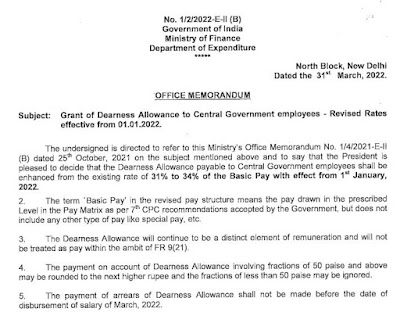
DA Jan 2022 - Grant of Dearness Allowance to Central Government employees - Revised Rates effective from 01.01.2022

 3% DA Hike - Revised Rates effective from 01.01.2022: DoE OM dated 31.03.2022 No. 1/2/2022-E-II (B) Government of India Ministry of Finance...