Showing posts with label OPS to NPS. Show all posts

Thursday, 14 March 2019

Suggestion to include the right of Central Government employees in your party's election manifesto regarding the scrapping of the National Pension System

Suggestion to include the right of Central Government employees in your party's election manifesto regarding the scrapping of the National Pension System

Proposal to include in the election manifesto of your party with regard to the scrapping of the National Pension System

"If you will be able to indicate your intention to replace the present new contributory scheme with the old Statutory Pension structure, in your manifesto, it might help immensely to elicit the support of the Central Government employees and their family members to your party candidates in the ensuing general election."
Proposal to include in the election manifesto of your party with regard to the scrapping of the National Pension System


 NJCA
National Joint Council of Action
4, State Entry Road, New Delhi - 110055
No.NC-JCM-2019/NPS
March 8, 2019
To
The Chief Executive,
All Recognised National and State level Political Parties

Sub:- Proposal to include in the election manifesto of your party with regard to the scrapping of the National Pension System which has taken away the pension right of Central Government Employees

Dear Sir /Madam,

We write this on behalf of the organisations of the Central Government employees participating in the Joint Consultative Machinery, set up by the Government of India in 1960s as a negotiating forum to settle various demands and grievances of the employees through discussions. In the meeting that was held on 8th February, 2019, of the Standing committee of the National Council, Staff Side, it was unanimously decided that I in my capacity as the Secretary, Staff side National Council, must write to you to draw your kind attention to one of the most significant demands of the Central Government employees i.e. to replace the newly introduced contributory pension scheme with the old statutory defined Pension system and also to restore the GPF Scheme which was withdrawn by the Government. I have been asked to seek your support to this vital demand of the employees especially of the young workers who have entered government service after 1.1 .2004 and obtain an assurance from you that you will accede to the demand for the withdrawal of the New contributory scheme to replace it with the old Statutory pension system if elected to power in the ensuing general elections to constitute the 1 i 11 Lok Sabha. Before going into the difficulties being faced by the employees governed under the New Contributory Pension Scheme which is at present christened as “National Pension System (NPS)”, I would like to invite your attention to the historical judgment delivered by the Hon’ble Supreme Court by a 5 Member Bench consisting of Hon’ ble Chief Justice Y.B.Chandrachud. The Hon’ble Supreme Coutt in this case has analyzed in detail the entire issue of Pension. The most impotant portion of the above historical judgment is reproduced below for your kind consideration please.

“From the discussions 3 things emerge
 (i) that pension is neither a bounty nor a matter of grace depending upon the sweeting of the employer and that it creates a vested rights subject to 1972 Rules which are statutory in character, because they are enacted in exercise of powers conferred by the proviso to Article 309 and Clause (5) of article 148 of the constitution,
(ii) that Pension is not an ex-gratia payment but it is a payment for the past service rendered and
(iii) it is a social welfare measure rendering socio economic justice to those who in the heyday of their life ceaselessly toiled for the employer on an assurance that in their old age they would not be left in the lurch.”

As you are aware Sir/Madam, that the new contributory pension scheme was introduced by the then NDA Government in 2004 initially through an executive fiat. Later, rather much later, a bill was introduced in the Parliament to enact the Pension Fund Regulatory and Development Authority. After the promulgation of the Notification in 2004, many State Governments adopted the scheme to cover their employees, the only exception being the State of West Bengal presently. The ostentatious reason adduced at the time of promulgation of the Notification and thereafter at the time of the introduction of the PFRDA bill, was the ever increasing financial outflow on pension account, which makes fiscal deficit management difficult. Prima facie the said reason appeared to be true as the quantum of outflow on account of Pension had been on increase. But the fact that it had always been on rise was concealed as also the one that as a percentage to the GDP, the pension payment had been continuously dwindling over the years.

The employees organisations had been pointing out to the Government that the desired objective of containing pension outflow would not come about for the next four decades. When the probable drastic reduction in pension under the new scheme was raised by the Staff Side in the National Council, the Government stated that under the new dispensation, employees will become entitled more annuity than the then existing entitlement of Pension, this assurance was given in writing by Government in the Standing Committee Meeting of the National Council (JCM) held under the Chairmanship of Secretary (Personnel) on 14th December, 2007 and went on to assure the Government’s intervention if things turns out otherwise. It is also pertinent to mention here that the Government has exempted the Armed Force Personnel from the NPS and they continue to be in the old Pension Scheme. If the NPS is so attractive then why the Government has exempted them from NPS. This is a clear proof that the NPS is vety much detrimental when compare to the old Pension Scheme.

The scheme is presently in vogue for the last 15 years. A few employees who were originally recruited as casual workers but got regularised later (retired before completion of the 33 or 35 years of service.) They were given a paltry amount as pension amounting to less than Rs, 2000. Had they been covered under the old Pension scheme, they would have certainly got more than 20,000 as pension. The new scheme has thus become “NO pension scheme’. The new scheme has thus created consternation of a very high order amongst the employees as they rightly feel that their hard earned savings are in effect compulsorily channelled to benefit the corporate entities. Since the Govt. will have to contribute equal amount or more (now 14%)the same would act in future as a real drain on the resources of the Government and will cause hardship in the form of increased tax liability. The anger and discontent of the employees have manifested itself in huge demonstrations and such other programmes and some of them have even resorted to strike action.

We are proud to mention that our principled opposition to the scheme right from the beginning, when it was introduced by the then NDA Government, has now been vindicated as it neither benefits the subscriber nor the Nation. Incidentally we may point out that in the wake of the 6th CPC, Government agreed to set up an expert committee under the chairmanship of Dr.Gayatri, at the Indian institute of social sciences to look into all aspects of the New Pension scheme. The committee has clearly indicated that the new scheme will draw more funds from the exchequer in the coming 40 years, before any reduction in the outflow could be brought about.

We fervently feel that the new contributory scheme must be replaced by the old Pension Scheme under the CCS (Pension) Rules, 1972. If you will be able to indicate your intention to replace the present new contributory scheme with the old Statutory Pension structure, in your manifesto, it might help immensely to elicit the support of the Central Government employees and their family members to your party candidates in the ensuing general election.

We shall also be grateful for favour of a word in response to this communication from your end.
With kindest regards,
Yours sincerely,
(Shiva Gopal Mishra)
Convener
Source: ncjcmstaffside.com

Wednesday, 26 September 2018

Reversion to old pension scheme due to administrative delay


Reversion to old pension scheme due to administrative delay

"NPS applicable to Government servants appointed to civil posts on or before 31.12.2003. The date on which the vacancies arose or the date on which the examination was conducted for filling up the vacancies is not relevant for deciding the applicability of the Central Civil Services (Pension) rules, 1972"

Reversion to old pension scheme

In accordance with the scheme for National Pension System (NPS), as notified vide Ministry of Finance (Department of Economic Affairs)'s Notification No. 5/7/2003-ECB & PR dated 22.12.2003, the System is mandatory for all new recruits to the Central Government service (except armed forces) from 01.01.2004. Accordingly, as per Rule 2 of the Central Civil Services (Pension) Rules, 1972, as amended on 30.12.2003, these rules are applicable to Government servants appointed to civil posts on or before 31.12.2003. The date on which the vacancies arose or the date on which the examination was conducted for filling up the vacancies is not relevant for deciding the applicability of the Central Civil Services (Pension) rules, 1972.

Ministry of Home Affairs have not sought any advice from Department of Pension and Pensioners’ Welfare on the question of having a policy to cover the paramilitary personnel appointed after 01.01.2004 under the Old Pension Scheme on the ground that the vacancies arose, or the examination was conducted, in the year 2003. However, a reference was received from Ministry of Home Affairs in a specific case relating to appointments as Sub-Inspector in various Central Para Military Forces after selection in August, 2003 on the basis of an Examination conducted in 2002.

Appointments on the basis of these selections were made in Central Reserve Police Force in 2003 and the candidates appointed were covered by the pension scheme under Central Civil Service (Pension) Rules, 1972. However, in the Border Security Force, offers of appointment on the basis of the same examination/selection were issued in January, 2004. On a petition filed by some personnel appointed in the Border Security Force on the basis of that examination, Hon'ble High Court of Delhi directed to cover the petitioners under the Central Civil Service (Pension) Rules, 1972 on the grounds of administrative delay on the part of Border Security Force in making appointments.

The order of Hon'ble High Court of Delhi was implemented by the Ministry of Home Affairs/Border Security Force in view of the peculiar circumstances of that case. The decision taken in that case is, however, not relevant for deciding applicability of Central Civil Service (Pension) Rules to all appointments made on or after 01.01.2004 in the Central Para Military Forces or in any other Department/organization on the basis of year of examination/selection.

This information was provided by the Union Minister of State (Independent Charge) Development of North-Eastern Region (DoNER), MoS PMO, Personnel, Public Grievances & Pensions, Atomic Energy and Space, Dr. Jitendra Singh in written reply to a question in Rajya Sabha on 19.7.2018.

Source: PIB

Central Government Rejects the Demand to Scrap National Pension System


Central Government Rejects the Demand to Scrap National Pension System

Abolition of Contributory Pension Scheme

Representations have been received from various Associations of Government Employees on the problems being faced and the demand to withdraw the National Pension System (NPS). The 7th Central Pay Commission (CPC) also in its report examined the issues related to NPS and made recommendations for addressing these issues.

Pursuant thereto, it was decided to constitute a Committee of Secretaries to suggest measures for streamlining NPS. The Committee has submitted its report. Due to rising and unsustainable pension bill and keeping in view of fiscal imperatives, it is not possible for the government to revert back to old pension scheme.

This information was provided by the Minister of State in the Ministry of Finance Shri. Shiv Pratap Shukla in written reply to a question in Rajya Sabha on 24.7.2018.

Source: Confederation

Wednesday, 2 March 2016

7th Pay Commission expressed its regret about transition from OPS to NPS

7th Pay Commission expressed its regret about transition from OPS to NPS
7th-Pay-Commission-OPS-NPS


7th Pay Commission expressed its regret about transition from Old Pension Scheme to New Pension Scheme in its report.

2004-2011 Entrants : Government employees who have joined service between 2004 and 2011 have suffered due to delay in finalizing the structure of the NPS and the issue of detailed instructions. Although they have made regular contributions, in many cases, this money and/or counterpart contributions were not deployed in the market. In the case of AIS officers, some states are yet  to release counterpart contributions or pay interest on delayed contributions. This has led to a situation where the accumulated corpus even after 11 years of service could be meagre. It is necessary that this situation which arose during the transition from OPS to NPS be addressed.

The Commission therefore recommends that Central Governments and State Governments should, in a time bound manner, ensure that all the due contribution along with compounded interest, where contributions have been delayed, be deposited in the accounts of the beneficiaries. Advisories should be issued to the State Governments to deposit amounts, if not already done, in respect of NPS beneficiaries belonging to All India Services.

Many Association have pointed out that unlike the facility under GPF, it is not possible to make withdrawals under NPS, even to meet obligatory social expenditure. This forces employees towards increased indebtedness as they have to borrow from elsewhere.

The Commission notes that under the NPS Tier-I account, a subscriber is permitted to make partial withdrawal of twenty five percent of the contributions made to his/her individual pension account for certain specified purposes. Such withdrawals are permitted a maximum of three times during the entire tenure of subscription and a period of at least five years should have elapsed between two such withdrawals.

The Commission further notes that there exists a voluntary Tier-II account. Under this account, a subscriber can, at any time, withdraw the accumulated wealth either in full or part and there is no limit on such withdrawals provided the account has sufficient balance of accumulated pension wealth to cover the amount being withdrawn. However, the Tier-II account is yet to be made operational. The Commission therefore recommends that PFRDA should take steps to make the Tier-II accounts operational as early as possible to enable the NPS subscribers the facility of withdrawals from their accounts in case of requirement.

Transparency under NPS : Many associations and individuals have complained that the information relating to the NPS is inadequate, resulting in high degree of uncertainty in the minds of contributors about post-retirement benefits. The Commission noted that PFRDA sends a communication to every participant each month with the current pension wealth and the latest contribution that has been credited. The Commission recommends that focused efforts be made to capture email addresses and mobile numbers of subscribers so that seamless communication is ensured for all subscribers. The Commission recommends that consultation with stakeholders should also be held periodically in different parts of the country.

The Commission notes that no department of Government of India is taking ownership of the NPS. The Commission recommends that a Committee consisting of Secretary, Department of Financial Services, Secretary, Department of Pensions and Pensioners Welfare and Secretary, Department of Administrative Reforms and Public Grievances may be constituted to review the progress of implementation of NPS. The Commission also recommends that steps should be taken for establishment of an Ombudsman for redressing individual grievances relating to NPS.

Tax Treatment under the NPS : NPS is under the Exempt–Exempt – Tax (EET) regime while the General Provident Fund under the OPS is under Exempt–Exempt–Exempt (EEE) dispensation. Under the NPS, while the contributions and the accumulations are tax-exempt, withdrawals are taxable. As such, this is an inferior tax treatment when compared to other pension programmes such as General Provident Fund, Contributory Provident Fund, Employees Provident Fund and Public Provident Fund wherein contributions, accumulations and withdrawals are tax-exempt.

The Commission feels that tax neutrality should be ensured across various avenues for long term savings for post retirement incomes so that the employees covered by NPS are not at a disadvantage. The Commission therefore recommends that withdrawals under the NPS should be tax-exempt to place NPS at par with other pension schemes. The Commission also recommends that the service tax levied at the time of annuity purchase by NPS subscribers should be exempted.

Flash News

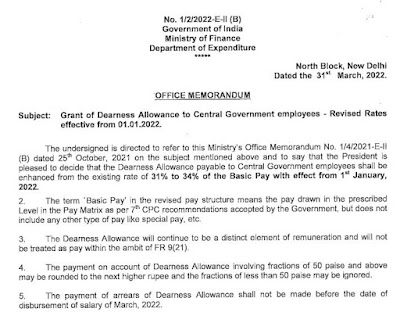
DA Jan 2022 - Grant of Dearness Allowance to Central Government employees - Revised Rates effective from 01.01.2022

 3% DA Hike - Revised Rates effective from 01.01.2022: DoE OM dated 31.03.2022 No. 1/2/2022-E-II (B) Government of India Ministry of Finance...