Sunday, 12 March 2017

DoPT Instruction regarding fixing of timelines for finalizing disciplinary proceedings


DoPT Instruction regarding fixing of timelines for finalizing disciplinary proceedings

F.No.11012/9/2016-Estt.A-III
Government of India
Ministry of Personnel, Public Grievances and Pensions
Department of Personnel & Training Establishment Division

North Block, New Delhi - 110001
Dated: 7 March, 2017
OFFICE MEMORANDUM

Subject: Amendment in Central Civil Services (Classification, Control & Appeal) Rules, 1965 regarding fixing of timelines for finalizing disciplinary proceedings - regarding.

The undersigned is directed to say that it has been proposed to amend the CCS(CC&A) Rules 1965 by introducing stringent timelines for completing Disciplinary proceedings in a time bound manner. The proposed draft Notification for amending CCS (CCA) Rules, 1965 is enclosed herewith. Before framing the Rules, all stakeholders, Ministries / Departments are requested to offer their comments/views, if any, in this regard at the e-mail address poulose.ev13.nic.in latest by 21st March, 2017.

(Poulose.E.V)
Under Secretary to the Govt. of India
Authority: www.dopt.gov.in

Last date of submission of Digital Life Certificate through Jeevan Pramaan Patra extended upto 31st March 2017


Last date of submission of Digital Life Certificate through Jeevan Pramaan Patra extended upto 31st March 2017

EPF & MP Act, 1952 made applicable to all staff employed in ECHS on contractual basis
A single page composite claim form in death cases replaces Form 20, form 5-IF and Form 10-D

Noticing that many pensioners are yet to submit Aadhaar authenticated Jeevan Pramaan as life certificate for continuation of drawal of pension, the EPFO has further extended the last date of submission of Digital Life Certificate through Jeevan Pramaan Patra upto 31st March 2017. Earlier the last date was 28th February 2017.

Members and pensioners of the Employees Pension Scheme, 1995 are required to furnish Aadhaar number by 31st March 2017. In case a member has not been allotted Aadhaar Number, a copy of Aadhaar Enrolment ID slip is required to be attached for settlement of claim under EPS, 1995, namely for pension processing and monthly pension payments. Aadhaar number however is not required in case a member of pension scheme having less than 10 years of service chooses to withdraw by making an application in Form 10-C.

An Employee Enrolment Campaign-2017, started by EPFO on January 1st 2017 to cover left out workers, continues upto 31st March 2017. Under the scheme:
  • The employee's share of contributions if not deducted by the employer is waived.
  •  Nominal damages to be paid by the employer, in respect of the employees for whom declaration has been made under this campaign, is at the rate of Rupee One per annum.
  • Administrative charges have been waived.
Even though the EPF & MP Act, 1952 does not differentiate between casual, contractual and regular employees, it was noted that a large number of contractual employees hired by principal employer including those by the government departments, PSU and autonomous Organizations have remained out of coverage under EPFO. It is the duty of the principal employer to ensure compliance of their outsourced / regular / contract / casual / daily wager to the schemes under EPF Act.

To ensure coverage of workers, principal employers have been advised to ensure that their contractors are registered with EPFO before award of any contract or making any payments. EPFO provides relevant information in this regard to principal employers online.

A health care scheme called ECHS was formulated by Ministry of Defence for its ex-servicemen. The contractual workers of ECHS till now were deprived of the social security benefits under EPFO. The ECHS now has been brought under the ambit of the EPF Act. Ministry of Defence has issued necessary directions to the ECHS for enrolling their contractual staff. Similarly, all eligible workers engaged by contractors working with Military Engineering Services (MES) and Indian Railways have also being requested to ensure coverage of contractual employees under EPFO.

Towards continuous strive to bring increased conveniences and efficiency, a single page Composite Claim Form (Aadhar) replaces Forms No. 19 (UAN), 10C (UAN) & 31(UAN) for subscribers seeding their Aadhar number with UAN. This can be submitted without the attestation of employers. For subscribers who are yet to seed Aadhaar and Bank details with their UAN, a new Composite Claim Form (Non-Aadhar) replaces the existing Forms No. 19, 10C & 31.

In addition, a Composite Claim Form in death cases replaces the existing Forms No, 20, 5-IF and 10-D. The claimants can apply for claim of Provident Fund, Insurance Fund and monthly pension through this single page composite claim form in case of death of a member.

Source: PIB

GPF Withdrawals - Amendment orders issued on 7.3.2017


GPF Withdrawals - Amendment orders issued on 7.3.2017

Amendment to the provisions of General Provident Fund (Central Service )Rules 1960 - liberalization of provisions for withdrawals from the Fund by the subscribers - regarding.

No.3/2/2017-P&PW(F)(ii)
Ministry of Personnel, PG & Pensions
Department of Pension & Pensioners' Welfare
Desk-F
3rd Floor, Lok Nayak Bhavan,
Khan Market, New Delhi-11 0003
Dated the 7th March, 2017.
OFFICE MEMORANDUM

Subject: Amendment to the provisions of General Provident Fund (Central Service) Rules 1960 - liberalization of provisions for withdrawals from the Fund by the subscribers - regarding.

The General Provident Fund (Central Service )Rules came into force in 1960 and Rule 15 of the said rules provide for withdrawals by the subscribers. Some amendments have been made from time to time to address the concerns raised by the subscribers. However, the provisions, largely remain restrictive. There is a felt need to liberalize provisions, raise limits and simplify the procedure.

2. The provisions in the rules have been reviewed and it has now been decided to permit withdrawals from the fund by the subscriber for the following purposes:
(i) Education - This will include primary, secondary and higher education, covering all streams and institutions,
(ii) Obligatory Expenses viz. betrothal, marriage, funerals, or other ceremonies of self or family members and dependants,
(iii) Illness of self, family members or dependants,
(iv) Purchase of consumer durables.
3. It has been decided to permit withdrawal of upto twelve months payor three-fourth of the amount standing at credit, whichever is less. For illness, the withdrawal may be allowed upto 90% of the amount standing at credit of the subscriber. A subscriber may seek withdrawal after completion of ten years of service.
(v) Housing including building or acquiring a suitable-house or a ready-built flat for his-residence,
(vi) Repayment of outstanding housing loan,
(vii) Purchase of house site for building a house,
(viii) Constructing a house on a site acquired,
(ix) Reconstructing or making additions on a house already acquired,
(x) Renovating, additions or alterations of ancestral house.
4. A subscriber may be allowed to withdraw upto ninety percent of the amount standing at credit for the above purposes. It is also decided do away with the present instructions which lay down that subsequent to the sale of house for which GPF withdrawal has been availed, the amount. withdrawn has to be deposited back. GPF withdrawal for housing purpose will no longer be linked with the limits prescribed under HBA rules. A subscriber may be permitted to avail the facility at any time during his service.
(xi) Purchase of motor car/motor cycle/ scooter etc. or repayment of loan already taken for the purpose,
(xii) Extensive repairs /overhauling of motor car,
(xiii)Making deposit to book a motor car/motor cycle/scoter, moped etc.
5. A subscriber may be permitted to withdraw three- fourth of the amount standing at credit or cost of the vehicle, whichever is less for the above purposes. Withdrawal for the above purpose will be permitted after completion of 10 years of service.

6. Presently, withdrawal of upto 90% of balance without assigning reasons is allowed for Government servants who are due for retirement on superannuation within a year. It is proposed that this may be allowed for upto two years before superannuation.

7. In all cases of withdrawal from the fund by the subscriber, the declared Head of Department is competent to sanction withdrawal. No documentary proof will be required to be furnished by the subscriber. A simple declaration form by the subscriber explaining the reasons for withdrawal would be sufficient.

8. As per the GPF(CS) Rule 1960, no time limit has been prescribed for sanction and payment of withdrawal amount. Therefore, it has been decided to prescribe a maximum time limit of fifteen days for sanction and payment of withdrawal from the Fund. In case of emergencies like illness etc., the time limit maybe restricted to seven days.

9. Necessary amendment to the GPF(Central Service)Rules 1960, giving effect to the above provisions will be issued in due course.

10. In so far as persons serving in Indian Audit and Accounts Department are concerned, these orders issue in consultation with the Comptroller and Auditor General of India.

11. This issues with approval of Department of Expenditure, vide their ID No. 4(1 )/EV/2017 dated 28.02.2017.

12. Hindi version of this OM will follow
sd/-
(Sujasha Choudhu)
Director
Click to view the order
Authority: http://www.pensionersportal.gov.in/

KV School Fee Structure : No Proposal to Increase at present


KV School Fee Structure : No Proposal to Increase at present

There is no such proposal to increase the fee structure is under consideration of the Central Government at present. The Minister of State for Human Resource Depvelopment Shri Upendra Kushwaha said in a wirtten reply to a question in Rajya Sabha on 2.2.2017.

No such proposal is under consideration of the Government at present. However, while issuing guidelines for pay revision of employees of Quasi - Government Organizations, Autonomous Organizations, Statutory Bodies etc., set up by and funded / controlled by the Central Government, the Government has inter alia stipulated that the autonomous organizations are expected to manage their affairs in such a fashion that their dependence on Central Government for financial support to meet the extra financial implications is minimal, as such autonomous organizations are expected to be financially self-sufficient so as not to cause any extra burden on the Central Exchequer.

NFIR: Railway Board's order dated 30.1.2017 curbing workers rights.


NFIR: Railway Board's order dated 30.1.2017 curbing workers rights.

No.IV/I/Pt.III
07.March, 2017
The General Secretaries of
Affiliated Unions of NFIR
Brother,

Subject: Railway Board's order dated 30.1.2017 curbing workers' rights.

In the DC/JCM meeting held on 7.3.2017, during Opening Address, both the Federations have taken a stand that the unconstitutional order dated 30.1.2017 preventing Safety (Supervisory) Staff from becoming Office bearers should be withdrawn by the Railway Board immediately to facilitate negotiations to resume.
The President, General Secretary, Working President etc. have conveyed their strong protest against the Board’s letter dated 30.1.2017.
The General Secretary/NFIR had stated that the Railway Board has betrayed the Federations and the Railway Board has equally failed on several counts on written commitments notably:
a) Replacement of GP 4600 with 4800
b) Upgradation from Gr.C to Gr.B (Gaz.)
c) Allotment of GP 4600 to Loco (Mail)
d) Stepping up of pay of Loco Inspectors inducted prior to 1.1.2006
e) Arbitrary reversal of various decisions given in the past (as a result of agreements with the Federations) and without caring to consult federations.
f) Track Maintainers upgradation (written commitment of Board)
In light of Railway Board's total failure, the Federation (NFIR) conveyed that it is not in a mood to participate in the negotiations of DC/JCM forum and at the same time demanded immediate withdrawal of Board's order dated 30.1.2017, if the Railway Board sincerely feels that industrial relations are required to be preserved.

With the above observations in the DC/JCM meeting, the leaders left the meeting place. Both the Federations have jointly walked away from the meeting.
Please convey to all employees the above development, as the Railway Board's order is a direct attack on the rights of workers, whether they are Supervisors or Non-Supervisors and it is a gross violation of Trade Union Act, ID Act etc.

Also convey the "Walk Out" decision of Federations to GMs, CPOs etc.
Yours fraternally,
sd/-
(Dr.M.Raghavaiah)
General Secretary
Source: NFIR

AIBEA: Retirement Gratuity Ceiling hiked to Rs.20 lakh for bank employees and officers


AIBEA: Retirement Gratuity Ceiling hiked to Rs.20 lakh for bank employees and officers

Joint Ciruclar on Gratuity Ceiling
CIRCULAR TO ALL UNITS & MEMBERS
March, 2, 2017
Dear Comrades,
Improvements in Gratuity under Gratuity Act

Our units are aware that Gratuity is one of the important retirement benefits for the bank employees and officers. In all Banks ( except SBI ), Gratuity is paid as per formula under BPS/OSR or under the Gratuity Act whichever is higher. (In SBI, Gratuity is payable under the Act only).

While there is no ceiling for Gratuity under BPS/OSR, under the Act, there is a ceiling which is at present Rs. 10 lacs. (from 25-5-2010). When an employee or officer retires from the Bank, his/her Gratuity entitlement would be calculated both under the Act and under BPS/OSR and the higher of the two will be paid.

For example, a senior substaff/Daftary retiring after 40 years’ service would be eligible for ( approx.) Rs. 5 lacs under BPS and Rs. 8 lacs under the Act and hence would be paid Rs. 8 lacs as Gratuity.

A senior Clerk/Special Asst. would be eligible for Rs. 9.50 lacs under the BPS and Rs. 10 lacs under the Act and hence would be paid Rs. 10 lacs.

A senior General Manager of a Bank retiring after 40 years’ service would be eligible for Rs. 17 lacs under the OSR and Rs. 10 lacs under the Act and hence would be paid Rs. 17 lacs.

Due to continued inflationary trend and erosion in value of rupee, AITUC and all other Central Trade Unions have been demanding improvement/removal of ceiling under the Gratuity Act. Due to their effort, the ceiling was increased from Rs. 1 lac to Rs. 2.50 lacs, and then to Rs. 3.50 lacs and to Rs. 10 lacs in May, 2010. They have been demanding for removal of ceiling on Gratuity under the Act.

AITUC and Central Trade Unions have been pursuing this issue for the last more than 4 years through various programmes and struggles.


Thus AIBEA and AIBOA have been part and parcel of all these programmes and strikes on the 12 Points Charter of Demands of the Central Trade unions which includes the demand for improvement in Gratuity Act.
AITUC and Central Trade Unions have been following up these demands with the Government and as a result, recently on 23-2-2017, the Central Government called for a Tripartite meeting on the issue of revising the ceiling on Gratuity. From AITUC, its Secretary, Com D L Sachdev participated and put forth the following suggestions.
i) While there should be no ceiling for Gratuity, as an interim measure, Government’s proposal to increase in ceiling of Rs. 20 lacs can be accepted.
ii) The revised ceiling should be made effective from January, 2016.
iii) Minimum service of 5 years for eligibility for Gratuity to be removed.
iv) Gratuity to be paid at 30 days wage per year instead of 15 days wage as atpresent.
v) All factories/establishments to be covered by the Act irrespective of number of workers.
All these matters have to be finally cleared by the Labour Ministry and then by Finance Ministry and then to be brought to the Parliament for amendment to the Gratuity Act.

Units are aware that improvement in Gratuity Act has been one of the demands of our strike on 28-2-2017. We are in touch with the AITUC and will keep our units informed of any further development in this regard.
With greetings,
Yours comradely,
sd/-
S. NAGARAJAN
GENERAL SECRETARY
AIBOA
sd/-C.H. VENKATACHALAM
GENERAL SECRETARY
AIBEA
Source: AIBEA

7th Pay Commission: Central employees to get higher allowances from April 1, says FinMin


7th Pay Commission: Central employees to get higher allowances from April 1, says FinMin

New Delhi: Central government employees will get higher allowances according to the 7th Pay Commission recommendations from April 1, a senior finance ministry official said.

The employees will get their April salaries with higher allowances in accordance with the 7th Pay Commission recommendations, he told our reporter at the finance ministry on Monday.

Everything is decided. The Cabinet and the prime minister have to approve the Committee on Allowances report. The finance ministry has no reason to raise any question on the report of committee on allowances, he added.

He said the process to implement the higher allowances would be completed soon.

The central government approved the 7th Pay Commission scale for its employees in June, offering a highest basic pay of Rs 2.5 lakh and a minimum of Rs 18,000.

The new basic pay has been given in August 2016 with arrears, effective from January 1, 2016. The allowances, however, other than dearness allowance referred to the Committee on Allowances headed by the Finance Secretary Ashok Lavasa in July 2016, for examination as the pay commission had recommended of abolishing 51 allowances and subsuming 37 others out of 196 allowances.

Accordingly, existing allowances are now paid to the employees according to the 6th Pay Commission recommendations until issuing of higher allowances notification.

The Committee on Allowances was initially given a time of four months to submit its report to the Finance Minister Arun Jaitley.

In October last year, Ashok Lavasa was quoted by some media outlets as saying he was ready with the report.

But the government gave extension to the committee up to February 22, 2017 on the pretext of demonetisation and the government said that the cash crunch was the reason behind the delay in announcing higher allowances.

The announcement of assembly elections in five states has given another excuse for the government as it cannot announce allowances hike till the model code of conduct is in place up to March 8.

The finance ministry official said the Committee on Allowances report states the current House Rent allowance (HRA) slab, which is 30 per cent of basic pay, for metros for employees. An announcement on the same is expected soon but no hike in Transport Allowance (TPTA) for central government employees in its report and the Transport Allowance will remain the same as 6th Pay Commission recommendations.
However, the pay panel had recommended that HRA be paid at the rate of 24 per cent, 16 per cent and 8 per cent of the new basic pay for Class X (metros), Y and Z cities, respectively.

TST

7th CPC Pay Matrix Anomaly: NFIR writes to Railway Board


7th CPC Pay Matrix Anomaly: NFIR writes to Railway Board

No.IV/NFIR/7 CPC (Imp)/2016/R.B./part I
Dated: 06/03/2017
The Secretary (E),
Railway Board,
New Delhi

Dear Sir,
Sub: Implementation of 7th CPC Pay Matrix - Pay fixation to staff - Anomaly resulting less pay to senior in comparison with junior - reg.

Ref: Notification issued by the Railway Ministry vide RBE No.90/2016 - Rule 10(2) therof.
NFIR desires to bring to the notice of the Railway Board, the anomalous situation arisen pursuant to sub-para (2) of Rule 10 of the Notification issued by the Railway Board vide RBE No.90/2016. A case on North Western Railway is cited below as example:-
  • Mr.X and Y have been working as SSE in the Loco Workshop, Ajmer in GP 4600/- (Level 7). Mr. X is senior to Mr. Y.
  • Both X & Y have been drawing pay equal to Rs.60,400/- on 1st July 2016. Both the employees are due for financial upgradation benefit under MACPS in the month of February 2017.
  • Mr.X has been given financial upgradation under MACPS and his pay when fixed in Level 8 comes to Rs.62,200/-. His next increment is due on 1st January 2018 when his pay will raise to 64,100/-.
  • Mr.Y has been denied financial upgradation due to 'Good ACR' for the year 2014. His pay on lst July 2017 will be Rs. 62,200/- in Level 7 which will be equal to Mr. Y's pay as on 1st July 2017.
  • When Mr.Y becomes fit for financial upgradation under MACPS sometime between July and December 2017, then his pay will be 64,100/- in Level 8 which will be equal to the pay of Mr.X in January 2018. Subsequently, when Mr.Y will be given next increment in January 2019 ultimately Mr. X will lag behind by six months despite being senior.
The position mentioned above clearly reveals that senior has been put to loss by way of drop in emoluments. This needs to be remedied to do justice to senior employees.

NFIR, therefore, requests the Railway Board to examine the case in the light of above illustration and take necessary action for rendering justice to senior staff in whose case, the drop in emoluments has taken place. Federation may also be apprised of Board’s response early.
Yours faithfully,
sd/-
(Dr.M.Raghavaiah)
General Secretary
Source: NFIR

EPFO: Here are 4 points govt is working on the retirement scheme to make it more subscriber friendly

EPFO: Here are 4 points govt is working on the retirement scheme to make it more subscriber friendly

After last year's fiasco over taxing of provident fund, the government seems to be working overtime to make changes to the retirement scheme. The government has introduced a slew of measures to make the Employee provident Fund Organsiation or EPFO more subscriber-friendly, while it is reportedly proposing more steps.
Here are the steps the government has taken or has proposed to take and what they mean to you:

1) The EPFO recently simplified the norms for provident fund claims by coming out with a single one-page form for all types of claims. This means you won't need to fill forms like Form 19, Form 10C, and Form 31 anymore to make the claims. These forms were being accepted for PF Final Settlement, EPS Pension withdrawal and PF Partial withdrawal respectively in the past.

The new form called the new Composite Claim Form (CFF) are of two types called CCF (Aadhaar) and CCF (non aadhaar). Even the process has now been made simple where the form can be submitted to EPFO which bypasses the employer completely if you are Aadhaar complaint and the account is seeded with your bank details. Here you will need to fill the CCF (AAdhaar) form and for those who are not Aadhaar compliant, they will have to fill the CCF (non aadhaar), and include the employer in the process.
Even taking advances from your PF corpus has been made easy, as going forward you don't need to provide any kind of document as proof. The recent order by the government says, "submission aadhar compliant and non-Aadhar compliant form duly signed by the EPF subscriber shall be construed as 'self-certification for the above partial withdrawals for which no documents would be required to be submitted to the EPFO offices." In short, less amount of paper work for employees as well as faster resolution of claims will be set in place.
2) By May this year EPFO is planning to launch an online facility which will simplify the claim process, EPFO Central Provident Fund Commissioner VP Joy told recently. Under the proposed scheme, the claims are expected to be settled within 20 days of submitting the form. It usually take 4-5 months for the process to get done and money to credit into your bank account. The institution is working to make the entire process computerised.

3) In another move the government is considering decreasing the employers liability towards Employees Provident Fund (EPF) in the construction sector to 10 percent of the basic pay as against the current 12 percent, as reported by The Financial Express. Reducing the amount of employer’s contribution, will possibly nudge more building/construction units to extend the EPF benefits to workers. Last year, the Delhi High Court had passed an order stating that all construction workers need to be mandatorily enrolled under the EPF scheme. The Hindu Business Line had reported, "Builders had expressed concerns over "ambiguity" in the eligibility of workers, many of whom were employed on a casual or short-term basis." And enrollment of construction workers in PF was below expectations.

4) EPFO is expected to launch a special housing scheme this month, which will make life of crores of members easier if they have or plan to avail a home loan. This scheme will enable members to make down payments or pay EMIs from their EPF account to buy houses.

According to PTI, the subscribers as well as their employers would be required to form a group housing society which would further tie up with banks and builders or sellers of homes so that EPFO members can buy homes. The scheme is likely to be launched anytime after 8 March.

Explainer: The granular details are yet to be out, only time will tell if this scheme is good.

Do keep tracking this space as we bring you more information when the scheme is launched.

Biometric attendance for 100,000 locopilots and 30,000 guards in trains

Biometric attendance for 100,000 locopilots and 30,000 guards in trains

NEW DELHI: To efficiently manage crew, Indian Railways is planning to start biometric sign on and sign off for 100,000 locopilots and 30,000 guards which will also lead to effective train operations.

The railways business plan for 2017-18 says that Indian Railways would be migrating in a big way towards biometric attendance of crew which will be far more accurate and will greatly enhance crew availability.
“Efficient management of crew is fundamental to effective train operations as it is a vital and costly input. Crew management on Indian railways has already been computerized through crew management systems rolled out over Indian Railways- with sign-on and sign-off being recorded on the system,” says the plan.
At present 15 percent of the crew is covered under biometric sign on signoff and it is targeted to increase coverage of crew under biometric sign on sign off to over 50 percent during 2017-18.

According to railway ministry, this will ensure that locopilots attend to compulsory 10 hours of duty hours as there have been complaints of data being tempered with. Earlier, the attendance was marked on a duty register maintained at platforms.

Under the biometric attendance, crew will now have to punch at station before joining of duty and sign off at end of duty and the database will be centrally integrated so that they can mark the presence across any station in the country.

Biometric attendance has been started in all central government offices so that employees don’t skip office or leave before stipulated time.

Flash News

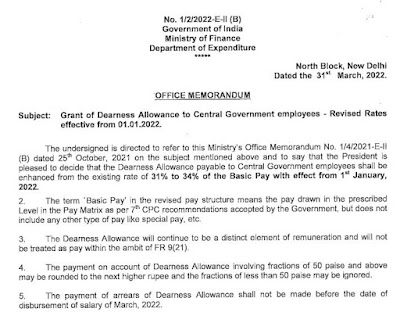
DA Jan 2022 - Grant of Dearness Allowance to Central Government employees - Revised Rates effective from 01.01.2022

 3% DA Hike - Revised Rates effective from 01.01.2022: DoE OM dated 31.03.2022 No. 1/2/2022-E-II (B) Government of India Ministry of Finance...