Saturday, 10 December 2016

Insurance Scheme For Railway Passengers

Insurance Scheme For Railway Passengers

An Optional Travel Insurance Scheme on a pilot basis for one year has been launched w.e.f 01.09.2016 for the Railway passengers who book e-ticket through official website of Indian Railway Catering & Tourism Corporation (IRCTC) at the premium of Rs. 0.92 per passenger.

This insurance scheme provides financial support to the family/legal heir in case of death/injury of reserved passengers due to train accident/untoward incidents as defined under section 123 read with Sections 124 and 124A of the Railways Act, 1989, subject to the qualification that the coverage will be valid from the actual departure of train from the originating station to actual arrival of train at the destination station including 'process of entraining' and 'process of detraining' the train.
The Sums Insured to be given to passengers are as follows: (i) In case of Death- Rs. 10 lakh, (ii) Permanent Total Disability - Rs. 10 Lakh, (iii) Permanent Partial Disability upto- Rs. 7.5 Lakh, (iv) Hospitalization Expenses for Injury -Rs. 2 Lakh, (v) Transportation of mortal remains - Rs. 10 Thousand.

IRCTC which is a wholly owned undertaking of Ministry of Railways has entered into an agreement with three Insurance Companies through Limited Tender, namely (i) Shriram General Insurance Company Ltd., (ii) ICICI Lombard General Insurance Company Ltd., and (iii) Royal Sundaram General Insurance Co. Ltd.

(a) Ex-gratia is paid to the victims of train accidents and untoward incidents at the following scales:
Train Accident
(Sec.124)
Untoward Incident
(Sec. 124- A)
In case of deathRs. 50,000/-Rs. 15000/-
In case of grievous injuryRs. 25,000/- lump sum for hospitalisation upto 30 days.
Rs. 300 per day at the end of every 10 day period or discharge,
whichever is earlier.
Rs.5000/- lump sum for hospitalisation upto 30 days.Rs. 1000/- per week or part thereof the period for indoor treatment
upto further six months of hospitalisation.
Rs. 500/- per week or part thereof the period for indoor treatment
upto further five months of hospitalisation.
The maximum period for which ex-gratia is payable to the
grievously injured passenger will be 12 months.
In case of simple injuryRs
5000/-
Rs. 500/-

The insurance scheme is available on optional basis to passengers of all reserved classes (SL, 1AC, 2AC, 3AC etc.) of all trains except passenger trains and sub-urban trains for tickets booked online on the IRCTC websites.

This Press Release is based on the information given by the Minister of State for Railways Shri Rajen Gohain in a written reply to a question in Rajya Sabha on 09.12.2016 (Friday).

PIB

CGHS & CS(MA) Rules: Revision of dependent income limit subsequent to implementation of 7th CPC

CGHS & CS(MA) Rules: Revision of dependent income limit subsequent to implementation of 7th CPC
No. S-11012/2/2016-CGHS-P
Government of India
Ministry of Health and Family Welfare
(CGHS-P Section)
Nirman Bhawan, New Delhi
Dated the 8th November, 2016
OFFICE MEMORANDUM

Sub: Revision of Income limit for dependency for the purpose of providing Central Government Health Scheme (CGHS) coverage to family members of the CGHS covered employees subsequent to implementation of recommendation of the seventh Central pay commission-regarding

The undersigned is directed to say that subsequent to the implementation of the recommendations of the 6th CPC, the income limit for dependency for the purpose of extending CGHS coverage to “family” members of the CGHS covered Central Government employees was enhanced to Rs. 3500/-per month plus the amount of dearness relief on the basic pension of Rs. 3500/- as on the date of consideration.

2. With the implementation of the recommendations of the 7th Central pay commission, the issue of revision of income limit for dependency for the purpose of providing CGHS coverage to family members of the CGHS covered Central Government employees and pensioner CGHS beneficiaries was under consideration keeping In view the amount of minimum pension/family pension fixed by the 7th Central pay commission.

3. On the basis of the recommendations of the 7th CPC, the Department of Pension and Pensioners’ Welfare under Para 5.2 of their OM No. 38/37/2016-P&PW (A)(i) dated 4/8/2016 , has fixed the amount of minimum pension a~ Rs. 9,000/- per month and under para 7.1 of this OM the amount of family pension has been fixed as 30% of the basic pay In revised pay structure and shall be subject to a minimum of Rs. 9,000/- per month and maximum of 30% of the highest pay in the Government. Vide Para 7.3 of the aforesaid O.M, It has been mentioned that there will be no other change in the provisions regulating family pension.

4. It has been decided, In consultation with the Department of Expenditure, to revise the income limit for the purpose of providing CGHS coverage to the family members of the CGHS covered Central Government employees to Rs. 9,000/- plus the amount of dearness relief on basic pension of Rs. 9,000/- as on the date of consideration.

5. As such, all the orders related to the CGHS Rules stand amended to the extent that the Income limit for Rs. 3500/- per month from all sources including pension/and family pension stands amended to an Income of Rs. 9000/- plus amount of the dearness relief on the basic pension of Rs. 9000/- as on the date of consideration. The amount of dearness relief, as indicated in the Income limit stands for the amount of dearness relief drawn by a pensioner/family pensioner on the date of consideration and not the amount of dearness relief due on the date of consideration.

6. The Income limit for dependency of “Rs.9000/- plus amount of the dearness relief on the basic pension of Rs. 9000/- as on the date of consideration”, shall also be applicable for the cases covered under CS(MA) Rules, 1944 for the purpose of examining eligibility of family members of the Central Government employee for medical facilities under the Rules.

7. The order shall be effective from the date of Issue of Instructions of this O.M.

8. This issues with the concurrence of Department of Expenditure vide their I.D. No.204/E- V/2016 dated 19/10/2016.
(Sunil Kumar Gupta)
Under Secretary to the Govt. of India
Source: www.cghs.gov.in

Delegation of powers to Heads of Departments in various Ministries/Departments for settling permission cases and post facto approval relating to referral system and medical reimbursement under CGHS - Enhancement of ceiling rate from Rs. 2 Lakhs to Rs. 5 Lakhs without consultation of IFD of concerned Ministry


CGHS - Enhancement of Financial Powers of HoD from Rs. 2 Lakhs to Rs. 5 Lakhs

No.S.11011/20/2014-CGHS (P)/EHSS
Government of India
Ministry of Health & Family Welfare
Department of Health & Family Welfare
EHS Section
Nirman Bhawan, New Delhi
Dated: the 23 November, 2016
OFFICE MEMORANDUM

Subject: Delegation of powers to Heads of Departments in various Ministries/Departments for settling permission cases and post facto approval relating to referral system and medical reimbursement under CGHS - Enhancement of ceiling rate from Rs. 2 Lakhs to Rs. 5 Lakhs without consultation of IFD of concerned Ministry - Reg.

The undersigned is directed to refer to this Ministry’s OM No. S.12020/4/97-CGHS (P), dated 27.12.2006 and its clarification issued vide this Ministry's OM No. S.11011/20/2014-CGHS (P), dated 20.06.2014, wherein financial powers were delegated to the Heads of Departments/Ministries to settle all such cases where there is no relaxation of rules involved and admissibility of claim was worked out with reference to the CGHS approved rate list and guidelines.

2. This Ministry has been receiving requests from different Ministries/Departments for enhancement of delegation of financial powers to Head of Departments to settle medical claims/medical advance cases involving financial implications upto Rs. 5 Lakhs without referring the case to Internal Finance Division (IFD).

3. The matter regarding enhancement of delegation of financial powers to the Heads of Departments/Ministries has been examined in this Ministry and it has been decided with the approval of the competent authority to enhance the existing limit of Rs. 2 Lakhs to Rs. 5 Lakhs to settle all cases where there is no relaxation of rules and the entitlement was worked out with reference to the rate list prescribed.

In respect of cases involving payment exceeding Rs. 5,00,000/- (Rupees 5 Lakhs only) but as per the prescribed rate list, the concerned Departments/Ministries may settle such cases in consultation with their respective Internal Finance Division. Only in those cases where the settled scheme/rules are required to be relaxed, should the case be referred to the Ministry of Health and Family Welfare.
4. This issue with concurrence of Internal Finance Division vide FTS No. 91725, dated 01.11.2016.

(Sunil Kumar Gupta)
Under Secretary to the Govt. of India
(Tel 2306 1986)
Source: www.cghs.gov.in

Thursday, 8 December 2016

7th Pay Commission - Govt Still thinking will it be feasible - about over higher Allowances

7th Pay Commission - Govt Still thinking will it be feasible - about over higher Allowances


The Finance Ministry official involved with the process of higher allowances on condition of anonymity, told that the Govt is facing the classic dilemma on the subject of issuing of notification of higher allowances under 7th pay commission recommendations.

“The October-November month is the scheduled for issuing notification for the Finance Ministry, but the time was extended by 2 months because the cash crunch on account of demonetisation, which is taking time to get normality.

“The Finance Ministry has got 2 months extension to issue the higher allowances notification under 7th Pay Commission recommendations”, a Finance Ministry official said on condition of anonymity.

Therefor,unless the banks can begin to function with a modicum of efficiency, the government will not issue notification on higher allowances to save demonetisation chaos,” the sources added.


The sources further added “the issue of increased financial activities after demonetisation compels the govt to keep in abeyance to issue higher allowances notification for getting normalized the position and it is likely to issue from January next, after the the cash crunch will ease. (‘Hopefully’).

As the demonetisation drive today completes 30 days, cash situation continues to stay critical in the country as evident by the unending queues outside banks and a few operational ATMs.

“The government dilemma in relation to issuing higher allowances notification will make to force central government employees to stand in long queues,” the official said. “That is the dilemma, the government is trying to work through.”

“The committee on Allowances has finalized the proposal on the allowances but the government is not interested to do it now,” an official said. “The government will decide to review all situation in respect of cash crunch, the Finance Minister Arun Jaitley is looking at all situations to normalize cash crunch, only then he will receive report on higher allowances.” sources added.

However, the committee on allowances head by Finance Secretary Ashok Lavasa said in October, “We are ready to submit our report, when the Finance Minister Arun Jaitley calls up.”

Latest Guidelines for nomination in SCOVA

Latest Guidelines for nomination in SCOVA

The Standing Committee of Voluntary Agencies (SCOVA) is a forum for holding consultation with the stakeholders, i.e., the pensioners through their Associations and various Ministries/Departments of the Government of India to get feedback on implementation of pension related policies, to discuss and critically examine the policy initiatives and to mobilise voluntary efforts to supplement the Government action.

A mechanism has been put in place for nomination of a Standing Group comprising of 5 Associations and a Rotating Group comprising of 10 Associations through a Resolution issued from time to time. As per the existing mechanism the Standing Group serves for 3 terms of 2 years each or till the pleasure of the Chairman of SCOVA whichever is earlier and Rotating Group serves for 1 term of 2 years and is eligible for re-nomination for one more term. These Associations represent various categories of Central Government pensioners from various Regions/States.

This was stated by the Minister of State in the Ministry of Personnel, Public Grievances and Pensions and Minister of State in the Prime Minister's Office Dr. Jitendra Singh in a written reply to a question by Shri Mahendra Singh Mahra in the Rajya Sabha today.

Implementation of recommendations of Administrative Reforms Commission

Implementation of recommendations of Administrative Reforms Commission

The reforms in the functioning of Government is a continuous ongoing process. Schemes like Pradhan Mantri Jan DhanYojana, e-Governance based services, Digital India, Direct Benefit Transfer for LPG, (DBT), Swachh Bharat Abhiyan, SwachhVidyalaya, Soil Health Card, Pradhan Mantri Fasal BimaYojna, Atal Pension Yojna etc. are some of the recent initiatives in this direction.

The Second Administrative Reforms Commission (2nd ARC) presented the following 15 Reports to the Government for consideration:


(i) Right to Information: Master Key to Good Governance.
(ii) Unlocking human capital: Entitlements and Governance - a Case Study.
(iii) Crisis Management: From Despair to Hope.
(iv) Ethics in Governance.
(v) Public Order: Justice for each.
(vi) Local Governance.
(vii) Capacity Building for Conflict Resolution - Friction to Fusion.
(viii) Combating Terrorism.
(ix) Social Capital - A Shared Destiny.
(x) Refurbishing of Personnel Administration - Scaling New Heights.
(xi) Promoting e-Governance - The Smart Way Forward.
(xii) Citizen Centric Administration - The Heart of Governance.
(xiii) Organizational structure of Government of India.
(xiv) Strengthening Financial Management System.
(xv) State and District Administration.

Barring the 8th Report on the subject of  'Combatting Terrorism' all other 14 reports were considered by the Government. In these 14 reports there were 1514 recommendations, out of which 1183 were accepted, 228 not accepted and 59 deferred and 21 referred to other foras. Decisions on the accepted recommendations had been conveyed to all concerned Central Ministries/Departments and States/Union territories’ Government for implementation. Reforms in the public administration by nature are a continuous process and cover a wide range of activities. It may be through simplification of procedures, issue of executive instruction, enactment of laws etc.

This was stated by the Minister of State in the Ministry of Personnel, Public Grievances and Pensions and Minister of State in the Prime Minister's Office Dr. Jitendra Singh in a written reply to a question by Shri Harivansh in the Rajya Sabha today.

PIB

Employees in India may get lower salary hike next year: Report

Employees in India may get lower salary hike next year: Report

New Delhi: Employees are expected to see an average 10 per cent increase in salary in 2017, lower than 10.3 per cent rise this year, and after taking inflation into account, the hike would be a paltry 4.8 per cent, says a report.

According to Korn Ferry Hay Group 2017 Salary Forecast, India salary growth is pegged at 10 per cent, while real wages are expected to rise by 4.8 per cent.

"Salary hikes in India, although still higher than many other countries across the globe, have stabilised and we expect them to be in the 9.5-10.5 per cent range in the next couple of years," Amer Haleem, Country Manager, Productized Services, Korn Ferry Hay Group said.

Haleem further noted, “We expect them to at the higher end of the range for entry level positions, given that our salaries are much lower at that level compared to most countries, even those within Asia”.

In Asia, salaries are forecast to increase by 6.1 per cent - down 0.3 per cent from last year, while real wages are expected to rise by 4.3 per cent - the highest globally.

The largest real wage increases are forecast in Vietnam (7.2 per cent), Thailand (5.6 per cent) and Indonesia (4.9 per cent).

The report noted that adjusted for inflation, workers around the world are expected to see real wage increases of 2.3 per cent, down slightly from last year’s prediction of 2.7 per cent.

“Although not as high as last year when we saw a three- year high, there are still positive real wage gains across the globe,” said Benjamin Frost, Korn Ferry Hay Group Global Manager - Pay.

Despite the turmoil following the Brexit decision, the United Kingdom is expected to see raises of 2.5 per cent (the same as the last three years). Adjusted for inflation, real wages are to increase by 1.9 per cent in 2017, which is slightly higher than the Western European average.

Workers in France and Germany are forecast to see real wage rises of 1.5 per cent and 2.2 per cent respectively.

“The global labor market is in flux as slower economic growth in mature economies keeps a check on pay rises. In emerging economies, upskilling workers is crucial for companies to maintain a competitive advantage - and those skilled employees can expect to see wages rise as talent shortages in certain regions drive salaries up,” Frost said.

The data was drawn from Hay Group PayNet which contains data for more than 20 million job holders in 25,000 organizations across more than 110 countries.

PTI

Resolving of old pension cases

Resolving of old pension cases

Ministries/Departments of the Government sanction pension/family pension as per Central Civil Services (Pension) Rules, 1972 and send pension papers through Pay and Accounts Office and Central Pension Accounting Office to the pension disbursing agency, which is generally a public sector bank. This department monitors grievances of retiring employees/pensioners through Centralised Pension Grievance Redress and Monitoring System (CPENGRAMS). The department rigorously monitors the grievances registered under CPENGRAMS. Various reports are generated and examined on the cases of delay/ pendency/non-payment. There is no grievance case, including that of lonely women, pending for over 10 years. There is no proposal under consideration for opening of Fast Track Unit of pension to resolve old and pending cases.

This was stated by the Minister of State in the Ministry of Personnel, Public Grievances and Pensions and Minister of State in the Prime Minister’s Office Dr. Jitendra Singh in a written reply to a question by Shri Anubhav Mohanty in the Rajya Sabha today.

PIB

Modernization of government offices

Modernization of government offices

The modernization, computerization & digitization of paper based records is a continuous ongoing process in the Government of India. The Department of Administrative Reforms & Public Grievances (DAR&PG), Ministry of Personnel, Public Grievances & Pensions does not maintain any centralized data/information relating to it. However, as part of an overall process of administrative reforms, the DAR&PG has been implementing a scheme for ‘Modernization of Central Government Offices’ based in Delhi since year 1987-88. Under the scheme funds are released by DAR&PG for financing 75% costs of the modernization projects, which involves civil & electrical works and acquisition of furniture, computers & electronic office equipment. Till date DAR&PG has extended financial assistance of Rs.72.40 crore for 453 modernization proposals.

The DAR&PG has the mandate to implement e-Office in all Central Ministries/Departments. As on 15.11.2016, 9 Central Ministries/Departments are on 100% e- Office platform, 14 additional Ministries/Departments are going to be 100% e-Office by 31.12.2016 and further 32 Ministries/Departments by 31st March, 2017. This also is a continuous ongoing exercise.

This was stated by the Minister of State in the Ministry of Personnel, Public Grievances and Pensions and Minister of State in the Prime Minister’s Office, Dr. Jitendra Singh in written reply to a question by Shri M. Chandrakasi in the Lok Sabha today.

CCS (CCA) Rules, 1965 - Clarification regarding effect of warning, censure etc on promotion

CCS (CCA) Rules, 1965 - Clarification regarding effect of warning, censure etc on promotion

F. No. 11012/12/2016-Estt.A-III
Government of India
Ministry of Personnel, Public Grievances and Pensions
Department of Personnel & Training
Establishment A-III Desk

North Block, New Delhi,
Dated: 6th December, 2016

OFFICE MEMORANDUM


Subject: CCS (CCA) Rules, 1965 - Clarification regarding effect of warning, censure etc on promotion.

The undersigned is directed to refer to this Department's O.M. No. 11012/6/2008-Estt.(A) dated 7th July, 2008 on the above mentioned subject and to say that vide para 2(iii) of the said OM, it was instructed that where a departmental proceeding has been instituted, and it is considered that a Government servant deserves to be penalized for the offence/misconduct, one of the prescribed penalties may only be awarded and no warning, recordable or otherwise, should be issued to the Government servant. However, while considering cases for empanelment, the ACC has observed that in many cases, rather than exonerating the officer or imposing a penalty on him, administrative warning is issued even when disciplinary proceeding were drawn against him. Administrative warning is not recognized as a penalty.

2. In view of the above, the following position as contained in various instructions issued so far on warning/Censure etc. are reiterated for strict compliance:
(i) As clarified in the Ministry of Home Affairs O.M. No. 39/21/56-Estt.(A) dated 13 th December, 1956, warning is administered by any authority superior to a Government employee in the event of minor lapses like negligence, carelessness, lack of thoroughness, delay etc. It is an administrative device in the hands of superior authorities for cautioning the Government employees with a view to toning up efficiency and maintaining discipline. There is, therefore, no objection to the continuance of this system. However, where a copy of the warning is also kept in the Confidential Report dossier, it will be taken to constitute an adverse entry and the officer so warned will have the right to represent against the same in accordance with the existing instructions relating to communication of adverse remarks and consideration of representations against them.

(ii) Where a departmental proceeding has been instituted under the provisions of CCS(CC&A) Rules 1965, after the conclusion of disciplinary proceedings, the officer is either exonerated or where it is considered that some blame attaches to the officer, he should be awarded one of the recognized statutory penalties as given in Rule 11 of the CCS (CCA) Rules, 1965 i.e. at least 'Censure' should be imposed. In such a situation, a warning, recordable or otherwise, should not be issued.

(iii) Warning, letter of caution, reprimands or advisories administered to Government servants do not amount to a penalty and, therefore, will not constitute a bar for consideration of such Government servants for promotion.

3. All the disciplinary authorities in Ministries/Departments are, therefore, requested to keep in view the above guidelines while dealing with disciplinary case against the Government servants.

4. Hindi version will follow.

(Mukesh Chaturvedi)
Director (E)

Click to download : Latest DOPT Order

Flash News

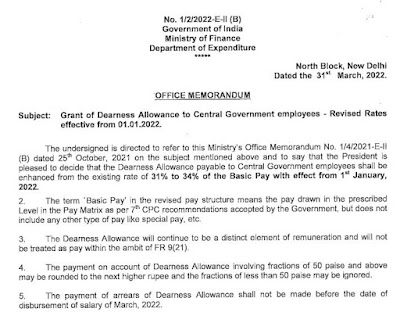
DA Jan 2022 - Grant of Dearness Allowance to Central Government employees - Revised Rates effective from 01.01.2022

 3% DA Hike - Revised Rates effective from 01.01.2022: DoE OM dated 31.03.2022 No. 1/2/2022-E-II (B) Government of India Ministry of Finance...