Monday, 22 February 2016

Abolition of affidavit and attestation by Gazetted Officer and adoption of self-certification in KVS

Abolition of affidavit and attestation by Gazetted Officer and adoption of self-certification in KVS

KENDRIYA VIDYALAYA SANGATHAN
18, Institutional Area, Shaheed Jeet Singh Marg,
New Delhi – 110 016
F.11029-9/2014-KVSHQ (Admn.-1)/
Date : 18.02.2016
The Deputy Commissioner
Kendriya Vidyalaya Sangathan
All Regional Offices

SUB: Abolition of affidavit and attestation by Gazetted Officer and adoption of self-certification in KVS-reg.

Sir/Madam,
In pursuance of the Ministry of Personnal Public Grievances & Pensions D.O. letter No.K-11022/67/2012-AR dated 17.07.2014, read with Govt. of Punjab Memo No.3/7/2010-Trg.(3)/1007 dated 10.03.2010, the competent authority, KVS has decided to implement the following in KVS with immediate:-

1 . Self -attested photocopy of Date of Birth Certificate by the parents/legal guardian of the child should be accepted, at the time of grant of admission instead of attestation by a Gazetted Officer/any other Authority.

2. All self-attested photocopy of testimonials from the candidates appointed in KVS be accepted instead of attestation by a Gazetted officer/any other Authority.

3. However, the self attested photocopies of Date of Birth certificate & other testimonials must be verified from the original documents for authenticity and a certificate to this effect must be recorded by Principal/Head of Office etc on the photocopy of the document before placing it on records.
This may be circulated among all Kendriya Vidyalayas functioning under your administrative jurisdiction with the instructions that the same may be brought to the notice of all staff members under proper acknowledgement. These instructions be followed by all Regional Offices/ZIETs Joint & KVs Commissioner meticulously.
sd/-
(Dr.E.Prabhakar)
Joint Commissioner (Pers.)
Source: www.kvsangathan.nic.in

KV SCHOOL ADMISSION SCHEDULE FOR 2016 – 17

Important Dates for ADMISSION in KV Schools 2016-2017

KV SCHOOL ADMISSION SCHEDULE FOR 2016 – 17
SCHEDULE FOR ADMISSION


Subject to availability of vacancies in a particular class.


The Admission Schedule for the Session 2016-17 will be as under :-

kv-school-admission-dates-2016

List of children registered, list of eligible children, category-wise list of provisionally selected children, waiting list and subsequent lists to be compulsorily displayed on the web-site of the Kendriya Vidyalayas concerned, in addition to display on School’s Notice Board.

Sunday, 21 February 2016

Good news for Central Government Employees! DA likely to be hiked to 125% from existing 119%

Good news for Central Government Employees! DA likely to be hiked to 125% from existing 119%
da-hike-12-percent-cg-employees


New Delhi: Narendra Modi government is likely to hike dearness allowance (DA) by 6 percent to 125 percent.

The likely increase in dearness allowance by six percent to 125 percent from existing 119 percent would benefit over 10 million central government employees and pensioners.

The new rate of DA will be implemented from January 1, 2016, which will be applicable for 4.8 million central government employees and 5.5 million pensioners. DA is paid as a proportion of basic pay of employees.

The proposal to hike DA is moved by the Finance Ministry on the basis of accepted formula for calculation. The Union Cabinet approves the DA hike for its employees.

The Centre revised DA twice in a year on the basis of one year average of retail inflation for industrial workers as per the accepted formula.

Earlier in September last year, DA was increased to 119 percent from 113 percent which was effective from July 1, 2015. In April last year, the government had hiked DA by 6 percentage points to 113 percent of their basic pay with effect from January 1, 2015.

Source: Zee news

Budget 2016: After its 7th Pay Commission Rs 40,000 crore ‘request’ denied, Indian Railways wants FinMin to bear PSO bill

Budget 2016: After 7th Pay Commission Rs 40,000 crore request of Indian Railways was denied, Rail Ministry Rail Ministry wants cost of its Public Service Obligations in 2016-17 to be shared by the finance ministry – Indian Railways has demanded that Budget 2016 bear the PSO cost. The PSO, sources said, includes a part of passenger subsidies but not all of it, as the Indian Railways is still to figure out what PSO is.

Even as experts call for an overhaul of the operations of the Indian Railways and its corporatisation, the transporter’s losses from the passenger segment and public service obligations are rising relentlessly and it is now looking for some relief from Budget 2016 (Union Budget 2016 presentation date is February 29).

Indian Railways gives as many as 53 types of concessions in passenger fares. Because of the various subsidises and concessions the transporter provides, Indian Railways had to bear an overall loss of Rs 32,000 core in FY14 for running passenger operations. All of passenger categories except AC three-tier are making losses for the Indian Railways.

Sources in the ministry of railways told FE that Indian Railways social obligation cost would be around Rs 34,000 crore this financial year, steeply higher than about Rs 25,000 crore in FY14. The figure is believed to have stood at over Rs 30,000 crore last financial year, although no official estimate is still out.

The Indian Railways carries out numerous transport activities which are uneconomical in nature but are considered to be in the larger interest of the society. The items which fall under PSOs and are making losses, include transport of essential commodities carried below cost, subsidies and concessions on passenger fares and other coaching services, operation of uneconomic branch lines and new lines opened for traffic during the last 15 years.

“There is no clarity on whether the Indian Railways is a commercial entity or a tool to meet social service obligations. As the transporter needs to invest a lot of money for the expansion and up keep of its infrastructure, there needs to be a proper framework to compensate the Indian Railways on the losses it makes on running passenger operations and the cost it incurs for meeting its public service obligations,” said Abhay Krishna Agarwal, Partner Infrastructure & PPP at EY LLP.

Sources said even the Standing Committee on Indian Railways has recommended the government to work out a procedure on the basis of which the public service obligation costs are reimbursed to the railways. Documents accessed by FE reveal that the finance ministry wants an independent body to evaluate and define what qualifies under ‘public service obligation’ for railways and also decide on the extent of relief which can be claimed from the government under it.

“Utilising your track for providing compensations and subsidises and running below cost operations is not a prudent way of running operations, who is stopping you from increasing passenger fares, political compulsions should not be factored into while deciding fares,” Raghvan Sivadasan, former railway board member said.

While the finance ministry wants an independent body to evaluate and decide on the quantum of burden to be shared, the ministry of railways has proposed an Inter-Ministerial Committee to be set-up for evaluating the impact and the framework of sharing the public service obligation cost borne by the railways. As an interim measure the transporter wants the general revenue to bear a certain percentage losses incurred by the Indian Railways in FY16.

Sources: Financialexpress.com

Budget 2016 expectations: From OROP, 7th Pay Commission overhang to sectoral impact, here are 10 points to note

Budget 2016 expectations: From OROP, 7th Pay Commission overhang to sectoral impact, here are 10 points to note

1. The FM’s priority in the 2016-17 budget will be higher growth, with fiscal rectitude, we believe. With the private sector capex yet to pick up, he will budget for higher plan capital expenditure (investments), in addition to the higher spends on OROP and 7th Pay Commission, which need to be factored in. These will be proposed to be financed by higher revenues from divestment/privatisation, higher indirect tax rates, telecom auctions and better tax compliance, apart from a cut in non-plan expenditure (subsidies) via DBT.

2. A lower fiscal deficit will leave more money available for the private sector, help in easing inflation, and moderate interest rates further. We expect targets under the FRBM Act to be largely maintained. We expect the FM to target a fiscal deficit of 3.7% for FY17 and budget for a gradual reduction in fiscal deficit per annum to 2.5% by FY19.

3. Expect FM Arun Jaitley to target real GDP growth of 7.7% in FY17 and bring it to over 8% next year. Larger and targeted plan expenditure capital outlays, with strict implementation timelines, would likely be announced, to ensure economic recovery and sustainable growth. We expect plan expenditure target to increase by 30% over FY16RE.

4. The budget will aim to provide an investment – led supply aid to growth (with private sector participation via Make in India campaign) as well as a consumption – led demand pull growth via 7th Pay Commission, OROP and DBT of subsidies.

5. On taxation front, we expect the Government to initiate reform process in direct taxes, in line with the announcements of the previous budget. The tax rate is expected to gradually come down from 30% to 25%, with a corresponding removal of exemptions / deductions available currently. On indirect taxes, we expect increase in service tax rate to bring it in line with the proposed GST rate of about 17-18%. Similarly, excise duties will likely be levied on various exempt items and increased for various items which are currently taxed at concessional rates. We are not expecting change in base rate of excise duty.

6. FM Arun Jaitley will have to restrict non plan expenditure to meet his FD targets. While the food subsidy burden will be taken up, we believe the FM will budget for lower fuel subsidy bill on the back of lower crude prices. He will also better target subsidies through the JAM trinity. The government has already announced on January 1, the launch of DBT for kerosene subsidy in a bid to cut down the diversion and black marketing of the fuel. The kerosene subsidy in FY15 was pegged at about Rs.248bn. As per reports, Direct Benefit Transfer (DBT) for LPG had resulted in savings of about Rs.140bn in FY15. We expect DBT to be gradually used for more subsidies. Implementation of DBT for fertilizer and crop subsidy could result in substantial savings.

7. To provide higher employment opportunities and to make the workforce employable, we expect measures to promote the ‘Make in India’ and ‘Skill India’ initiative. We also expect higher allocations towards agriculture and rural sector to support rural growth, after two continuous drought years in the country.

8. We expect the divestment target to be increased to Rs 500bn in FY17 v/s the FY16RE of Rs.200bn. Tax revenue targets (net) may be set at Rs.10.2trn, an 8% growth over FY16RE. Customs duty may be tweaked on several items to further the ‘Make in India’ cause. We expect implementation of GAAR to be postponed to FY18. We also expect tax benefits for the export-oriented sectors, in view of the consistently falling exports and some measures to restrict dumping.

9. SENSEX AND NIFTY TODAY: The 30-share index on Thursday opened 154.60 points up at 23,536.47 on account of firm global markets.

10. We believe that, the budget may have the following implications for the sectors: BUDGET IMPACT POSITIVE: Sectors – Auto, Banking/NBFCs, Capital Goods, Cement, Construction, Metals & Mining, Oil & Gas, Paints, Power, Shipping & Logistics. BUDGET IMPACT NEUTRAL: Sectors – Agro Chemicals, Aviation, FMCG, Information Technology, Media, Pharmaceuticals, Real Estate.

PTI Via financialexpress

Friday, 19 February 2016

Summary report of NJCA Meeting with 7th Pay Commission implementation Cell will be forwarded to the Empowered Committee soon

Summary report of NJCA  Meeting with 7th Pay Commission implementation Cell will be forwarded to the Empowered Committee soon

summary-report-NJCA-meeting-7thCPC

Latest 7th CPC News: Outcome of NJCA Meeting with 7th Pay Commission implementation Cell

Sources Close to the NJCA told that Meeting with 7th Pay Commission Implementation Cell took place as scheduled today.

Joint Secretary, Department of Expenditure, 7th Pay Commission Implementation Cell, represented the Government. It is told that the meeting of NJCA with 7th Pay Commission Implementation Cell continued for three Hours

Justification for 26 demands submitted by NJCA to Cabinet secretary has been summarized before the Joint Secretary, Implementation Cell. Various Issues including revising Fitment Formula, Increasing Minimum Pay, Revising Allowances, restoring Advances with increased rates and granting two increment on Promotion, increasing the rate of increment to 5% have been discussed in detail. Suitable justification was given by NJCA to establish their claims on these demands are reasonable.

It seems that the Points put by NJCA is well taken by the 7th CPC Implementation Cell and the same will be forwarded to Empowered Committee. It is told that the Empowered Committee headed by Cabinet Secretary will invite NCJCM Staff Side to discuss and finalize the issues discussed in this Meeting. After that It will be sent to Cabinet for its nod.

The summary report of this Meeting will be forwarded to the Empowered Committee soon. It is considered as a positive development towards the implementation of 7th Pay Commission recommendations with taking into consideration of NCJCM Staff Side Views.

Loans and Advances by the Central Government – Interest rates and other terms and conditions

Loans and Advances by the Central Government – Interest rates and other terms and conditions

MOST IMMEDIATE
F.No.5(3)-B(PD)/2015
Government of India
Ministry of Finance
Department of Economic Affairs
New Delhi, the 3rd February, 2016
OFFICE MEMORANDUM
Subject:- Loans and Advances by the Central Government – Interest rates and other terms and conditions.

Reference this Ministry’s Office Memorandum F.No.5(3)-B(PD)2014 dated 29th December, 2014 on the captioned subject.

2. The lending rates, categories and conditions prescribed in the
aforesaid Office Memorandum have been reviewed. The revised rates of interest, categories and conditions as given in the Table below, would be applicable from 1st April, 2015 and till the time these are reviewed:

S.No Category of borrower & type of loan Interest rate per cent per annum
1. State Governments:* 8.50
2. Union Territory Governments (with Legislature):

(i) Loans upto 1 year and EAP loan 8.50

(ii) Other Loans 9.00
3. Industrial and Commercial Undertakings in the Public Sector and Cooperatives.

(i) Investment loans # -

(ii) Working Capital loans and loans to meet Cash losses # -

(iii) Loans for implemantation of VRS in sick PSUs 10.00
4. Financial institutions in the Public Sector, Port Trusts, KVIC, NHAI, Municipal Corporation of Delhi,Commodity Boards, Social Service Institutions, Individuals, etc. @
5. National Bank for Agriculture and Rural Development (NABARD) 9.50
* Loans to State Government would be under EAP loans only. For Ways & Means loans, State Govts. have access to RBI window. In case any State has any specific contingent requirement, the proposal would be considered on case specific basis by Budget Division.

# The window of investment and working capital loan to CPSUs from Government of India in general, is hereby closed. CPSUs, in general, are hardly having debt and hence should raise debt from market or from banks. Only if CPSU is justified as significant from ‘Strategic’/ ‘Security’ angle, banks refuse loan to it and it has no real assets including land, to monetise, would loan be extended to it at 11% with the prior approval of Budget Division. However, wherever Investment and Working Capital loan has already been extended to CPSUs in 2015-16, the rate of interest would be at 11.50% and 13.50% respectively.

@The window pertaining to loans to Financial Institutions in the Public Sector, Port Trusts, KVIC, NHAI, Municipal Corporation of Delhi, National Co-operative Development Corporation (NCDC), Commodity Boards, Social Service Institutions, Individuals etc. in general, is hereby closed seeing the offtake under this in last 3 financial years. However, if a specific case still comes in future, it
would be examined by the Budget Division, DEA on merits of that case.

3. The terms, including interest rate of loans to Foreign Governments may be settled in consultation with Budget Division. Terms for on-lending of funds under externally aided projects should be in accordance with the prescribed pattern. In case, deviation is considered necessary, Budget Division should be consulted.
4. The interest rates prescribed above assume timely repayments and interest payments and hence no further rebate in rates is to be allowed for timely payments.

5. OTHER TERMS AND CONDITIONS
(a) The loan sanctioning authority should meticulously follow the instructions contained in General Financial Rules, 2005 (GFR 2005), particularly, rules framed under Chapter 9 (II-LOANS) of GFR, 2005, while sanctioning loans to various entities as stipulated therein.

(b) The instructions issued from time to time have been reviewed and are set out in the following paragraphs for facility of reference.
Click to read more: Finmin.nic.in

Advances to Government servants – Rate of interest for purchase of conveyances during 2015-2016

Advances to Government servants – Rate of interest for purchase of conveyances during 2015-2016
advances-rate-of-interest-government-servants

F.No. 5(2)-B(PD)/2015
Government of India
Ministry of Finance
Department of Economic Affairs


New Delhi, the 3rd February, 2016


OFFICE MEMORANDUM


Subject : Advances to Government servants — Rate of interest for purchase of conveyances during 2015-2016.

The undersigned is directed to state that the rates of interest for advances sanctioned to the Government servants for purchase of conveyances during 2015-2016 i.e. from 1st April, 2015 to 31st March, 2016 are as under:
    Rate of interest
per annum
(i)     Advance for purchase of conveyance other than motor car (viz. motor cycle, scooter etc.)     9%
(ii)     Advance for purchase of motor car     11.5%

The rates remain unchanged from those applicable for the financial year 2014-15.

(A.K. Bhatnagar)
Under Secretary (Budget)

To
1. All Ministries/Departments of the Government of India with spare copies for Integrated Finance Division (IFD), Controller of Accounts and Pay and Accounts Offices.

2. Finance Secretaries of UTs without legislature.

Copy forwarded to:—
1. C&AG of India, New Delhi.
2. C.G.A., New Delhi.
3. C.G.D.A., New Delhi.
4. All AGs and Director of Accounts.
5. Supreme Court of India.
6. UPSC, New Delhi.

Official Order

Government announced the Leave Travel Concession (LTC) rules for easy settlement of the LTC claims

Government announced the Leave Travel Concession (LTC) rules for easy settlement of the LTC claims

The amended Office Memorandum No.31011/3/2015-Estt(A.IV) seek to ease the procedural difficulties faced by government employees while applying for and settling LTC claims.

Setting outer time-limits for various LTC procedures, the DoPT today said leave or sanction of LTC leave advance would take no more than five days each. This would be extendable by three days where the government employee is away for the headquarters.

Besides, the administration will take no more than 10 days (13 where the employee is away from headquarters) to verify LTC claims after the LTC bill is submitted by the government employee.

The government also proposes to allow its employees to self-certify their proposed LTC journey. Under existing CCS (LTC) Rules, government employees are required to inform their controlling officer before the journey on LTC is to be undertaken.

Also, whenever a government employee applies for LTC, he /she may be provided with a copy of the guidelines to be followed while availing of the concession.

A government servant is allowed to avail of LTC once in a block of two years to visit his/her hometown, while LTC to any place in India can be availed once in a four-year block. If not availed during these blocks, the LTC may also be availed in the first year of the following block.

Latest developments in 7th pay commission implementation will be known after NJCA meeting

Latest developments in 7th pay commission implementation will be known after NJCA meeting

Internal Meeting of NJCA is postponed to tomorrow

One of the NJCA Leader told that the internal Meeting of NJCA scheduled to be held today at 05.00 PM has been postponed tomorrow 19-2-2015 at 9.00 AM.

Further he added that until they meet Implementation Cell tomorrow, they have nothing to tell about the developments in Implementation of 7th Pay Commission. “We must first know the views of Central Government before come to any conclusion “ he said.

When we asked him about the Rumors that ‘PMO has told the Empowered Committee to speed up the process of implementation of 7th Pay commission recommendation’ and ‘30 Percent increase is recommended by Empowered Committee in Basic Pay’, annoyed at hearing this rumors, he told, “Many stories like this is being circulated in News Media for unknown reasons.”

“But we are the Stake holders, we are not informed anything about this development. We are invited for the meeting tomorrow by 7th CPC implementation Cell. Only after attending the meeting, we will be able to tell about the recent developments in settling our Charter of Demands submitted to Cabinet Secretary. 26 demands pertaining to Modification of 7th CPC recommendation also has been included in the Charter of Demands” He added.

Source: govtstaffnews.in

Flash News

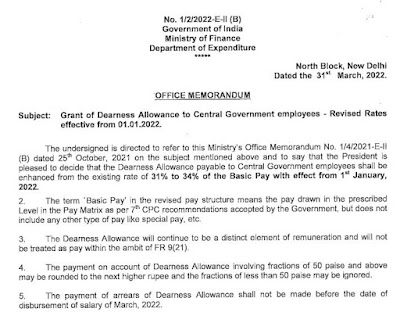
DA Jan 2022 - Grant of Dearness Allowance to Central Government employees - Revised Rates effective from 01.01.2022

 3% DA Hike - Revised Rates effective from 01.01.2022: DoE OM dated 31.03.2022 No. 1/2/2022-E-II (B) Government of India Ministry of Finance...