Tuesday, 19 January 2016

Press release on the eve of 3 Day Protest on the call of NJCA

Press release on the eve of 3 Day Protest on the call of NJCA

Central Government is not giving any priority to solve long pending demands of the Central Government employees. In spite of our sustained persuasions, to resolve of our demands of removal of retrograde recommendation of 7th CPC, payment of arrear of Productivity Linked Bonus etc. To register protest on this NJCA has chalked out a 3 day Protests programmes w.e.f 19.01.2016 to 21.01.2016. In this connection Com. Shiva Gopal Mishra has called upon all the Central Government employees, including the railwayemen to join all the programmes en masse on the call of the NJCA. Detailed press release is uploaded below…..
A.I.R.F.
All India Railwaymen’s Federation
4, State Entry Road,
New Delhi – 110055
PRESS RELEASE

New Delhi: 18th January, 2016 – “All India Railwaymen’s Federation is preparing for total shut- down with the Central Government under the banner of National Joint Council of Action”.
The above was stated by Shri Shiva Gopal Mishra, General Secretary of AIRF/NRMU and Convener of the NJCA in a Press Conference held today in AIRF Office, 4 State Entry Road, New Delhi.

Shri Mishra said that, the Central Government is not giving any priority to solve long pending demands of the Central Government employees. In spite of our sustained persuasions, to resolve of our demands of removal of retrograde recommendation of 7th CPC, payment of arrear of Productivity Linked Bonus, filling up of more than 2.5 lakhs vacancies of railway employees, indiscriminate outsourcing, handing over Production Units of Madherpura and Marohra of Electrical and Diesel Locomotive with assured off-take and thirteen years maintenance contracts to M/s Alstom and General Electric Companies, there is no headway on these issues. Outsourcing of maintenance of train-sets for thirteen years, amendment in the labour laws in favour of the corporate houses, non-creation of new posts for new assets, 100% FDI, PPP in the Railways, institution of the Railways Development Authority to promote privatization etc., have forced AIRF to join thirty six lakh Central Government employees for sustained struggle.

Shri Mishra further said that, AIRF cadre will join three days dharna at all state capitals and industrial centers from 19th to 21st January, 2016. All the affiliates of AIRF shall also conduct strike ballot on 11-12 February, 2016 to know the mood of the railway employees in favour of “Indefinite Strike”.

AIRF affiliates are also campaigning vigorously among the railwaymen to make the strike ballot and indefinite strike successful.

Northern Railwaymen’s Union is also going to launch a mass mobilization fortnight programme programme by contacting each and every railwayman from 25th January to 10th February, 2016.
Shri Mishra added that, the railwaymen are not responsible for economic crises in the Railways because they are running 22,000 pairs of trains round-the-clock, carrying 2.5 crors passengers everyday along entire length and breadth of the country, even by sacrificing their lives.

The Government of India should bear the burden of rupees twenty six thousand crore of subsidized traffic carried by the Railways and rupees twenty eight thousand crore being paid on railway pensioners. The Government should also stop charging Service Tax on the products of the Indian Railways and should also stop step motherly treatment and invest from the General Exchequer to improve upon the infrastructure of the Railways to support common man of this country. The Central Government should also wave off dividend to be paid by the Railways to the tune of around rupees ten thousand crore.

Shri Mishra said, we have kept this life line moving since 1974, but now, it has become difficult because of indifferent attitude of the Central Government. There has been no meeting of the National Council(JCM) for the last more than last five years, which should be at least thrice a year.

Shri Mishra said that, we don’t want to disturb the train service to create chaos in the country, but now we have no option, therefore, all the Central Government Employees Organization, including Railways, Postal, Ordinance Factories and other Civilian, Defense Establishment, other Central Government employees have decided to go on “Indefinite Strike”, if their demands are not resolved by end of February 2016.

He appealed to all the Central Government employees, including the railwayemen to join all the programmes en masse on the call of the NJCA.

For General Secretary

Source: AIRF

Flaws in Pay Matrix of 7th CPC: Less benefit on grant of Promotional Pay Scale i.r.o. Next Pay Scale

Flaws in Pay Matrix of 7th CPC: Less benefit on grant of Promotional Pay Scale i.r.o. Next Pay Scale

Pay fixation on promotion from UDC to Assistant immediate next pay scale is found more beneficial than the hierarchical promotion. Fixation of a UDC drawing Rs. 10960+2400 promoted to Assistant is given below:

Pay in PB in 6th CPC Pay Scale 10960
Grade Pay in 6th CPC Pay Scale 2400
Total Basic Pay in 6th CPC Pay Scale 13360
Fixation of Pay in New 7th CPC with factor 2.57 34435
New Basic Pay in New Pay Matrix 34300
Increment on 1.7.2016 35300
Fixation on Pay scale hierarchy i.e., 2800 GP
Increment on Promotion 1059
Total of Basic Pay and Increment 36359
Pay fixed at higher stage in 2800 Grade Pay 37000

Fixation on Promotional hierarchy i.e. Rs 4200 GP
Increment on Promotion 1059
Total of Basic Pay and Increment 36359
Pay fixed at higher stage in 4200 Grade Pay 36500

Similar deficiencies may be noticed in other cases also. For similar cases multiplication factor should be increased. Two increments should be granted on promotion.

Source : http://www.staffnews.in/

Monday, 18 January 2016

Who are entitled to 7th Pay Commission additional Bunching increment ?

Who are entitled to 7th Pay Commission additional Bunching increment ?

Analysis on 7th Pay Commission bunching Benefit discussed in Para 5.1.36 and Para 5.1.37 of 7th Pay Commission report – Pay in Grade Pay of Rs. 5400, 6600, 7600 and 8900 will be entitled to additional increment as bunching benefit

Who are entitled to 7th Pay Commission Bunching Benefit as per Para 5.1.36 of Pay Commission report ? – As per Illustration provided in the report Employees in GP 10,000 who are fitted in to minimum of Level 14 of New Pay Matrix will be eligible for one additional increment and would be fitted in to next cell of Level 14.

7th Pay Commission Pay Fixation:

As per Para 5.1.28 of 7th Pay Commission Report, pay fixation in the new pay structure will have to be made as follows

Step 1: Identify Basic Pay (Pay in the pay band plus Grade Pay) drawn by an employee as on the date of implementation. This figure is ‘A’.

Step 2: Multiply ‘A’ with 2.57, round-off to the nearest rupee, and obtain result ‘B’.

Step 3: The figure so arrived at, i.e., ‘B’ or the next higher figure closest to it in the Level assigned to his/her grade pay, will be the new pay in the new pay matrix. In case the value of ‘B’ is less than the starting pay of the Level, then the pay will be equal to the starting pay of that level

7th Pay Commission bunching Benefit:

In addition to above, 7th Pay Commission proposes bunching benefit in Para 5.1.36 whenever more than two stages are bunched together for fixation of pay in 7th CPC pay matrix, one additional increment equal to 3 percent may be given for every two stages bunched, and pay fixed in the subsequent cell in the pay matrix.

Further, Para 5.1.37 of the report provides an illustration for fixation of pay of two employees who are drawing pay of Rs.53,000 and Rs.54,590 in the GP 10000.

As per this illustration, after applying 7CPC multiplication factor of 2.57, both of these employees will have to be fixed in first cell of level 15 in the pay of Rs.1,44,200 as their revisesd pay are worked out to Rs.1,36,210 and Rs.1,40,296 respectively which are not more than the first cell of level 15 (Rs.1,44,200)

But to avoid bunching of these two stages of pay, the person drawing pay of Rs.54,590 will get fixed in second cell of level 15 in the pay of Rs.1,48,500, while the other who is drawing pay of Rs. 53,000 will have to be fixed in Rs.1,44,200.

Based on this illustration, a table containing Entry pay of Rs. 53,000 in GP 10000, subsequent stages for this pay (pay with increment of 3% for every year) and 7th Pay Commission pay fixation for the same has been prepared as below.

7CPC pay fixation for GP 10,000
6cpc pay basic pay X 2.57 7cpc pay matrix Fixation in 7CPC pay with bunching increment if applicable
53000 136210 144200 144200
54590 140296 144200 **148500
56230 144511 148500 148500
** One increment as bunching benefit

Employees in Grade Pay 5400, 6600, 7600 and 8700 who are fixed in stages next to entry pay will also be entitled to 7th Pay Commission Bunching Benefit

Applying same principles, we could find that next stage in entry pay in respect of Grade Pay 5400, 6600, 7600 and 8700 would be entitled to one additional increment as bunching benefit

1. Grade pay 5400 corresponding to pay band 15600-39100 (Entry Pay Rs. 21000 and subsequent stages of pay with increment of 3% for every year)

7CPC pay fixation for GP 5400 (15600-39100)
6cpc pay basic pay X 2.57 7cpc pay matrix Fixation in 7CPC pay with bunching increment if applicable
21000 53970 56100 56100
21630 55589
56100
57800 **
22280 57260 57800 57800
22950 58982 59500 59500
** One increment as bunching benefit

2. Grade pay 6600 (Entry Pay Rs. 25350 and subsequent stages of pay with increment of 3% for every year)

7CPC pay fixation for GP 6600
6cpc pay
basic pay X 2.57
7cpc pay matrix
Fixation in 7CPC pay with bunching increment if applicable
25350
65150
67700
67700
26120
67128
67700
69700 **
26910
69159
69700
69700
27720
71240
71800
71800
** One increment as bunching benefit

3. Grade pay 7600 (Entry Pay Rs. 29500 and subsequent stages of pay with increment of 3% for every year)

7CPC pay fixation for GP 7600
6cpc pay
basic pay X 2.57
7cpc pay matrix
Fixation in 7CPC pay with bunching increment if applicable
29500 75815 78800
78800
30390 78102
78800
81200 **
31310 80467 81200
81200
32250 82883 83600
83600
** One increment as bunching benefit

4. Grade pay 8900 (Entry Pay Rs. 49100 and subsequent stages of pay with increment of 3% for every year)

7CPC pay fixation for GP 8900
6cpc pay
basic pay X 2.57
7cpc pay matrix
Fixation in 7CPC pay with bunching increment if applicable
49100 126187 131100
131100
50580 129991 131100
135000 **
52100 133897 135000
135000
53670 137932 139100
139100
** One increment as bunching benefit

Whether Employees in who are fixed in the middle stages of new 7th CPC pay matrix will be eligible for Bunching Benefit ?

Relevant portions of 7th Pay Commission report (para 5.1.36 and Para 5.1.37) that discuss about Bunching increment are given under the heading “Entry Pay”.

The illustration provided by 7th CPC for fixation of pay with bunching increment also discusses only about entry pay in a grade pay.

Also, Para 5.1.28 of 7th Pay Commission Report which explains the method of fitment of existing 6th CPC pay in all stages in to 7th Pay Commission Pay Matrix does not contain any explanation about Bunching increment

Hence, it is not clear from the 7CPC report whether bunching benefit would apply to employees who are fixed in middle stages of new pay matrix.

For instance, we analysed the pay fixation of entry pay pertaining to Grade Pay Rs. 1800 and Grade Pay Rs. 2400 and its subsequent stages of pay with increment of 3% for every year

7CPC pay fixation for GP 1800
6cpc pay
basic pay X 2.57
7cpc pay matrix
Fixation in 7CPC pay
7000 17990 18000
18000
7210 18530 19100
19100
7430 19095 19100
19100 ##
7660 19686 20300
20300
7890 20277 20900 20900
## Bunching of 6cpc pay in two stages in to one stage of 7CPC Pay Matrix

7CPC pay fixation for GP 2400
6cpc pay
basic pay X 2.57
7cpc pay matrix
Fixation in 7CPC pay
11170 28707 29600 29600
11510 29581 30500 30500
11860 30480 30500 30500 ##
12220 31405 32300 32300
12590 32356 33300 33300

From the above, it could be seen that Pay pertains to Grade Pay of Rs. 1800 and Rs. 2400 in middle stages are getting bunched and fitted in to one stage of new pay structure as per the methods of fitment envisaged by 7th Pay Commission.

However, 7th pay Commission report has not discussed about applicability of Bunching Benefit in respect of pay fixation in middle stages of new pay matrix. It is also not clear whether bunching increment would apply to subsequent stages of pay when bunching increment is given to previous stage in the same level. For instance, 7th Pay Commission has recommended that pay of Rs. 54590 in GP 10,000 will be eligible for bunching increment and will be fitted in new of pay of Rs. 148,500. However, there is no discussion about the subsequent stage to Rs. 54,490 in GP 10,000 which is also getting fixed in same new Pay of Rs. 148,500/-

We are of the opinion that to clarify all these doubts, Govt has to come up clear-cut Clarification on Bunching Increment issue while 7th Pay Commission report is implemented

Source: gconnect

Full Pension 33 years or 20 Years- Latest status

Full Pension 33 years or 20 Years- Latest status

Latest on Pension 33 years or 20 years – Information on Implementation order in M.O. Inasu case
Online RTI Status Form

Registration Number: DP&PW/A/2015/60046
Name: S. Y. Savur
Date of Filing: 20/12/2015

Request filed with Department of Pensions & Pensioners Welfare
Status APPEAL DISPOSED OF as on 12/01/2016

Reply: – Dear Sir
Under the RTI Act the CPIO is required to provide only the information which is available with him/her in the material form. The order of Hon’ble CAT in O. A. No.715/2012 had been implemented in respect of the petitioners in that O.A. even before the dismissal of the Review Petition by Hon’ble Supreme Court.

The question of implementation of the orders in respect of Pre-2006 pensioners has been under consideration in consultation with the concerned Ministries/ Departments i.e. Ministry of Law, Department of Legal Affairs and Ministry of Finance, Department of Expenditure and the file has been referred to Department of Legal Affairs on 30.12.2015.

Thus the information given by the CPIO was correct.
In case you are not satisfied with this order, you may appeal against the decision to the Central Information Commission within 90 days, as per the RTI Act.

Harjit Singh
Deputy Secretary & Appellate Authority
Tel: 24624752

Source: Confederation

NJCA will meet on 8th February 2016 to decide the date of commencement of indefinite strike

NJCA will meet on 8th February 2016 to decide the date of commencement of indefinite strike

Conduct three days Dharna at all state capitals and Industrial Centres/Establishments on 19th, 20th & 21st January 2016.

NJCA head quarters decided to hold three days Mass Dharna at Jantar Mantar, New Delhi. Dharna shall commence at 10:30 AM and continue for full day on all three days.

There will be a huge rally of about 5000 Central Government employees (Railway, Defence, Confederation) at Jantar Mantar on 19th January during lunch hour. NJCA leaders will address the dharna and rally.

NJCA will meet on 8th February 2016 to decide the date of commencement of indefinite strike.

(M. Krishnan)
Secretary General
Confederation

Source: Confederation

Pay Matrix Recommended by 7th CPC is not final and subject to change – Federation Sources

Pay Matrix Recommended by 7th CPC is not final and subject to change – Federation Sources

The Constituent Unions of NCJCM has called for three days’ agitation Programme from 19-1-2016 to 21-1-2016 to draw the attention of central government to settle the Modified charter of demands.

Recently they demanded the government to constitute an empowered Committee to settle their demands through negotiation. However, the Cabinet gave its approval for constitution of an Empowered Committee to study the 7th Pay Commission report for implementation Process.

We asked some Trade Union Leaders about their expectation from the Government in respect of 7th Pay Commission report. They told that so far they didn’t have any formal meeting over Pay commission report with Government after the report submitted by commission. When asked about their opinion about the Format of Pay Matrix recommended by 7th Pay Commission,


they said " We don’t think that the Pay Matrix recommended by 7th CPC is Final, we won’t accept the Fitment factor recommended by the Commission”

They said, “Of course there will be some anomaly would arise when it is in the process of implementation in respect of Pay Matrix . That cannot be anticipated now. As of now Anomalies in bunching and Promotion benefits are expected. But we think this Pay scale recommended in 7th pay commission report is not FINAL and subject to change. Because it needs concurrence from both the end.”

They added further ” The central government may accept this recommendation without any modification. Because the central government itself told after giving four-month extension to the Pay Commission that the Seventh Pay Commission would be mindful of the fiscal concerns. It indicates the Central Government intention. But the Central Government Employees’ Unions and Association are very much disappointed with this recommendation and we sought modifications in many recommendations. Our Federations declared it as retrograde recommendation. Hence it will not be easy for the central government to implement the report without doing any change in the recommendations”.

So the Unions Federations are not getting too much involved in 7th CPC Pay Scales. Because they are firm in their decision that percentage of increase recommended in minimum pay is far below the required level prescribed by Dr. Akhroid formula and 15th ILC norms for determining Minimum Pay and it need to be increased. However, NFIR has tried to establish that the take home pay is very much less when compared to previous pay commissions. If the Central Government accept to increase the Minimum Pay, then that would be the criteria for arriving subsequent pay scales. Hence expecting changes in Pay Matrix is inevitable.

Source: govtstaffnews.in

Government may defer implementation of pay commission award

Government may defer implementation of pay commission award

The government is likely to defer of the Seventh Pay Commission award in a bid to improve financial resource crunch estimated for 2016-17.

The Union Cabinet approved last week the formation of an empowered committee of secretaries to work out ways for staggering the award through more than one financial year, instead of letting the Rs 1,02,100-crore bill from the implementation of the award come up at one go.

A source in Finance Ministry said one of the options for the empowered committee was to defer the increase in allowances for central government employees, while letting the rise in pay for all scales to go through.
According to finance ministry figures, the ratio of allowances to pay for these 4.7 million employees is 1:1.4. For instance, the Budget estimates in 2015-16 pegged the salary bill for all central government employees at Rs 60,731 crore, whereas the tab for allowances is Rs 84,437.4 crore.

The announcement of a deferral is expected to be part of Finance Minister Arun Jaitley’s Budget speech on February 29. The formation of an empowered committee for the pay panel recommendations, again a first for the central government, is meant to bring all stakeholders on board in the exercise.

The official explained ministry-wise consultations with the department of expenditure in the finance ministry, in the run up to the Budget, were mostly over. Those discussions had proceeded on the assumptions that the Pay Commission recommendations would be implemented. It was now necessary to bring the secretaries of key departments on board about the need for a drastic cut-back on those estimates.

The status quo on allowances would also allow the government to ignore the demand made by various staff associations to raise the minimum level of salary for employees. The Pay Commission has suggested that the minimum should be Rs 18,000 per month; the unions have demanded that it should be raised to a band of Rs 19,000 to Rs 21,000 a month. Such a change would have created a ripple effect.

About 70 per cent of the government employees are bunched in the non-executive ranks; the starting salary for them tops about Rs 42,000 a month, show calculations by the Commission. Even a modest increase in pay for them would cascade the bill for the government by another Rs 50,000 crore annually. The award of the Commission is slated to take effect from January 1 this year.

A key element in the plan to defer some elements of the Seventh Pay Commission recommendations will be the railway ministry. Government managers reckon the powerful unions of the Indian Railways need to be brought on board for this plan to be successful.

The higher wage bill for the Suresh Prabhu-led ministry works out to Rs 28,450 crore a year, only a shade less than the yearly loss it makes on its passenger services at present. No formal communications have been sent out to the railway unions by the committee.

“It will follow once the empowered committee has decided to take a call on which allowances to clip,” said the source.

In a recent television interview with NDTV, Minister of State for Finance Jayant Sinha had said the Pay Commission recommendations were the biggest headache for his ministry, struggling to keep the aggregate expenditure of the Union government under control.
Via  Business Standard

Income Tax Calculation for Interest on Housing Loan and Deduction u/s 80C with illustration

Income Tax Calculation for Interest on Housing Loan and Deduction u/s 80C with illustration

One Computation of Taxable Salary and allowances, Deduction for Interest on Housing Loan and Deduction u/s 80C.

Mr. X, a Central Govt. Officers in Delhi, is receiving Basic Pay Rs.23,720, grade Pay Rs.7,600, DA at prescribed rates, transport allowances @ Rs.3200+DA thereon, and HRA 30% of basic pay + grade pay (though living in his own house). His date of increment is Ist July. The following are other particulars of his income. Compute his taxable income and tax payable, for A.Y.2015-16.

income-tax-house-loan

Sunday, 17 January 2016

Ex-servicemen stage protest outside Jaitley residence for changing OROP scheme

Ex-servicemen stage protest outside Jaitley residence for changing OROP scheme

New Delhi: Ex-servicemen seeking changes in the government’s One Rank One Pension (OROP) scheme today staged a protest outside the official residence of Finance Minister Arun Jaitley here, alleging that he failed to respond to concerns raised by them during an earlier meeting.

This is the second time in two weeks the veterans have staged demonstrations outside the minister’s official residence.

“We had staged protest outside the Minister’s residence on January 3. At that time, he had assured us he will speak to Defence Minister (Manohar Parrikar) over our demands.

“He had said he would get back to us within a week. But it’s two weeks now that he has not responded. What kind of Finance Minister he is if he can not keep his word?” said Group Captain (retd) V K Gandhi.

Gandhi, general secretary of Indian Ex-Servicemen Movement, said the veterans will continue with their protest until Jaitley or Parrikar holds parleys with them.

“Either of the Ministers will have to come and speak to us. We will not move an inch from here until then. If they don’t want to give us actual OROP, they should clarify so to us. Why lie?” he said, reiterating that the government notification has “flaws” and was “unacceptable”.

Around 200 ex-servicemen including Major General Satbir Singh, who has been spearheading the protest, have been demonstrating outside Jaitley’s residence, Gandhi added.

PTI

Rates of Income Tax as per Finance Act, 2015 – Financial Year 2015-16(AY 2016/17)

Rates of Income Tax as per Finance Act, 2015 – Financial Year 2015-16(AY 2016/17)

RATES OF INCOME-TAX AS PER FINANCE ACT, 2015: As per the Finance Act, 2015, income-tax is required to be deducted under Section 192 of the Act from income chargeable under the head “Salaries” for the financial year 2015-16 (i.e. Assessment Year 2016-17) at the following rates:

Rates of tax : A. Normal Rates of tax:


Rates of tax for every individual, resident in India, who is of the age of sixty years or more but less than eighty years at any time during the financial year: 


In case of every individual being a resident in India, who is of the age of eighty years or more at any time during the financial year:


Education Cess on Income tax:

The amount of income-tax including the surcharge if any, shall be increased by Education Cess on Income Tax at the rate of two percent of the income-tax.

Secondary and Higher Education Cess on Income-tax:

An additional education cess is chargeable at the rate of one percent of income-tax including the surcharge if any, but not including the Education Cess on income tax.

No related posts.


Flash News

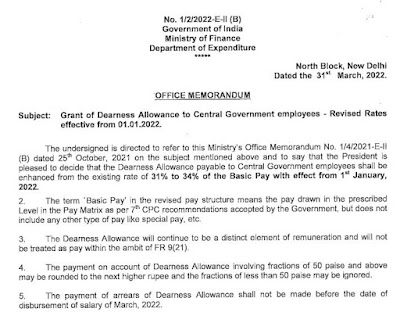
DA Jan 2022 - Grant of Dearness Allowance to Central Government employees - Revised Rates effective from 01.01.2022

 3% DA Hike - Revised Rates effective from 01.01.2022: DoE OM dated 31.03.2022 No. 1/2/2022-E-II (B) Government of India Ministry of Finance...