Showing posts with label recommendations of 7th CPC. Show all posts

Thursday, 27 December 2018

Recommendations of 7th CPC - Payment of Risk & Hardship Allowance for Track Maintainers working in construction s organization.

Recommendations of 7th CPC - Payment of Risk & Hardship Allowance for Track Maintainers working in construction s organization.

NFIR

No. IV/NFIR/7 CPC (Imp)/2016/Allowance/Part II
Dated: 24/12/2018
The Secretary (E),
Railway Board,
New Delhi

Dear Sir,

Sub: Recommendations of 7th CPC - Payment of Risk & Hardship Allowance for Track Maintainers working in construction s organization - Reg.

Ref: (i) Railway Board's letter No.87/2017) No. PC-VIII/ 2017/I7/5/4 dated 1/08/2017 (RBE (P), E.C. Railway vide letter

(ii) Railway Board's clarification issued to GM No. PC-VII/ 2017/I7/5/4 dated 25/10/2018.

Federation desires to bring to the kind notice of Railway Board that consequent to the acceptance of recommendations of 7th CPC relating to grant of Risk & Hardship Allowance to Track Maintainers, the Railway Board vide letter dated 10/0812017 (RBE No. 87/2017) issued instructions to the GMs of Zonal Railways to grant Risk & Hardship Allowance to the Track Maintainers of Indian Railways as per Cell R3 H2 of Risk and Hardship Matrix @ Rs 2700/- p.m. per person. The 7th CPC in its ;eport mentioned that the "Track Maintainers-I, II, III and IV of lndian Railways should be granted Risk & Hardship Allowance in view of hardship faced by these categories of employees".

It has however been brought to the notice ofthe Federation that on a reference received from GM (p), E.C. Railway, thelailway Board vide letter dated25ll0l2018 addressed to GM (p), E.C. Railway, has clarified that the Track Maintainers working in Construction Oiganizations are not eligible for grant of Risk and Hardship Allowance. Federation does not agiee with the unjustifieJ view taken by the Railway Board and the same is unacceptable to NFIR due to the following reasons:-
  • Track Maintainer is essentially required to work on Rail tracks, whether under Open line or in the Constructions Organizations.
  • In the Construction Organization, the Track Maintainers are required to perform duties of laying of rails, sleeper, points, and crossing in a programmed way and for completing work within targeted periods. Hardship and Risk is involved in their duties.
  • It needs to be appreciated that the Track Maintainer by designation, has been granted Risk and Hardship Allowance, therefore denying Risk and Hardship Allowance to the desisnated Track Maintainers working in Construction Organizations is improper.
The duties performed by the Track Maintainers working in Construction organization as mentioned above justify payment of Risk and Hardship Allowance in accordance with Board's instructions dated 10/0812017 (RBE No. 87/2017). The erroneous clarification of the Railway Board vide letter dated 25/10/2018 therefore needs to be withdrawn immediately.

NFIR, therefore, requests the Railway Board to review the case and withdraw Board's letter dated 25110/2018. Action taken in the matter may be apprised to the Federation.
Yours faithfully
(Dr. M. Raghavaiah)
General Secretary
Source: NFIR

Thursday, 17 August 2017

7th CPC - Abolishing Desk Allowance - DoPT Order


Implementation of Governments decision on the recommendations of the 7th CPC - Abolishing Desk Allowance - Reg.


No.A-27023/01/2017-Estt.(AL)
Government of India
Ministry of Personnel, Public Grievances and Pensions
Department of Personnel & Training

Old JNU Campus, New Delhi 110 067
Dated: 16.08.2017
OFFICE MEMORANDUM

Subject:-Implementation of Governments decision on the recommendations of the Seventh Central Pay Commission- Abolishing Desk Allowance - Reg.

Consequent upon the decisions taken by the Government on the recommendations of the Seventh Central Pay Commission, it is stated that Desk Allowance stands abolished.

2. These orders shall take effect from 1stJuly 2017.

3. Hindi version will follow.
(Navneet Misra)
Under Secretary to the Government of India
To:
All Ministries/Departments of the Govt. of India
NIC - For uploading on the website of this Department

Download Original PDF

Sunday, 21 May 2017

Recommendations of 7th CPC on benchmark for the purpose of MACPS clarification


Recommendations of 7th CPC on benchmark for the purpose of MACPS clarification

Recommendations of 7th CPC on benchmark for the purpose of MACPS

Government of India
Ministry of Railways
(Railway Board)
No. PC-V/2016/MACPS/1
New Delhi,
Dated :19.05.2017
The General Secretary,
NFIR,
3, Chelmsford Road,
New Delhi - 55

The General Secretary,
AIRF,
4,State Entry Road,
New Delhi - 55

Sirs,
Sub:- Recommendations of 7th CPC on benchmark for the purpose of MACPS - clarification reg.

The undersigned is directed to refer to NFIR's letter No.IV/MACPS/09/Part 10, dt. 23.01.2017 and AIRF's letter No.AIRF/MACPS (848), dt. 17.03.2017 on the above subject.The matter has been consulted with DoPT, the nodal department of Govt. on the subject and DoPT have stated that 7th CPC in para 5.1.45 of its report recommended that the benchmark, in the interest of improving performance level, be enhanced from 'Good' to 'Very Good'. In addition, introduction of more stringent criteria such as clearing of departmental examinations or mandatory training before grant of MACP can also be considered by the Government. This recommendation of the Pay Commission has been accepted by the Cabinet. Hence, withdrawal of DoPT's OM dt. 28.09.2016 is not feasible.

As DoPT is nodal department of Govt. for the purpose of MACPS, this Ministry is not in position to deviate from the instructions issued by them.
Yours faithfully,
S/d
for Secretary, Railway Board
Download Order

Monday, 20 February 2017

MACP and National Anomaly Committee Issues: Confederation


MACP and National Anomaly Committee Issues: Confederation

"VERY GOOD" BENCH MARK FOR MACP AND DENIAL OF PROMOTIONAL HEIRACHY

Eversince, the MACP scheme was introduced in 2008, confederation and the JCM staff side has been demanding promotional hierarchy instead of grade pay hierarchy. Govt, instead of considering this genuine demand, suddenly issued orders imposing "very good" bench mark condition for MACP. The JCM staffside was not even consulted. JCM staff side, secretary wrote a letter to cabinet secretary on 28-07-2016 as follows:

"The Govt. has accepted one of the adverse recommendations of 7th CPC without holding any consultation with the staff side. The recommendation of the 7th CPC regarding bench mark for performance appraisal for promotion and financial upgradation under MACPs, to be enhanced from “Good” to “very good”, has been accepted by the Govt. without considering the implication on the morale of the Central Government employees… We are of the firm opinion that Govt. should reconsider their decision on the above issues and we request you to kindly withdraw the same."

Subsequently the case was discussed in the JCM standing committee meeting also on 25-10-2016, as an agenda item given by staff side. Inspite of all these, the Government is not ready to withdraw or modify the orders.

This shows the attitude of the BJP led NDA Govt. towards JCM staff side and Central Govt. employees.

NATIONAL ANOMALY COMMITTEE

The National Anomaly Committee was constituted on 09-09-2016. Two meetings are held to discuss the anomaly regarding calculation of Disability Pension for Defence force personnel. As per the definition of anomaly notified by the Government no genuine "anomaly" can be termed as "anomaly". Hence the JCM staff side has demanded to modify the definition of anomaly, as defined in earlier National Anomaly Committees constituted by Govt. at the time of previous pay commissions. But till this day, Govt. has not conceded the request of the staff side.

Monday, 30 January 2017

Recommendations of 7th CPC for employees of Bureau of Indian Standards (BIS)


Recommendations of 7th CPC for employees of Bureau of Indian Standards (BIS) approves by Shri Ram Vilas Paswan

7th-CPC-BIS-Employees

 Press Information Bureau,
Government of India
Ministry of Consumer Affairs,
Food & Public Distribution
30-January, 2017 15:01 IST

Shri Ram Vilas Paswan approves recommendations of 7th CPC for employees of Bureau of Indian Standards (BIS)

Shri Ram Vilas Paswan, Union Minister of Consumer Affairs, Food and Public Distribution, has given approval for applicability of revised pay scales to employees of Bureau of Indian Standards (BIS) as per recommendations of 7th CPC.

The Union Minister said "Approval given to Bureau of Indian Standards (BIS) for applicability of revised pay scales to its employees on recommendations of 7th CPC. Financial arrangements to provide new pay scales to the employees of BIS will be made from own resources of this organization."

Sunday, 29 January 2017

Pay element relating to Running Staff after the recommendations of 7th CPC


Pay element relating to Running Staff after the recommendations of 7th CPC

GOVERNMENT OF INDIA
MINISTRY OF RAILWAYS
RAILWAY BOARD

No.E(P&A)II-2015/RS-25
New Delhi, dated: 24.01.2017
The General Manager,
All Indian Railways
and Production Units.

Sub: Pay element relating to Running Staff after the recommendations of Seventh CPC.

It has come to notice that on some of the zonal railways add-on pay element of 55% is not being reckoned for calculation of emoluments for the purpose of retirement benefits for the running staff on the basic pay fixed in the 7th CPC pay structure. As per Rule 924 (iii) of IREM-I that is still valid, 55% of Basic Pay is recokoned as add-on pay element for calculation of pension and DCRG of the Running Sitff. It is therefore advised that calculation of retirement benefits of the running staff may be made as per extant Rule 924 (iii) of IREM-I on the revised basic pay in the 7th CPC.

2. This issues with the concurrence of the Finance Directoiate of the Ministry of Railways.

(Dhruv Singh)
Executive Director
Pay Commission-I
Railway Board
Source: NFIR

Thursday, 10 November 2016

7% of 6th CPC Dearness Allowance Increased from 1.7.2016 - Finmin Order

7% of 6th CPC Dearness Allowance Increased from 1.7.2016 - Finmin Order

6th-CPC-Dearness-Allowance

"who continue to draw their pay in the pre-revised pay band/grade pay as per 6th CPC recommendations, shall be enhanced from the existing 125% to 132% w.e.f. 01.07.2016"

Rate of Dearness Allowance applicable w.e.f. 1.7.2016 to employees of Central Government and Central Autonomous Bodies continuing to draw their pay in the re-revised pay scale/grade pay as per 6th Central Pay Commission

No.1/3/2008-E.II(B)
Government of India
Ministry of Finance
Department of Expenditure

New Delhi, dated the 9th November, 2016.

OFFICE MEMORANDUM

Subject: Rate of Dearness Allowance applicable w.e.f. 1.7.-2016 to employees of Central Government and Central Autonomous Bodies continuing to draw their pay in the pre-revised pay scale/grade pay as per 6th Central Pay Commission Dearness Allowance calculator for DA from January 2017

Consequent upon acceptance of the recommendations of the Seventh Central Pay Commission by the Government, this Department vide O.M.No. 1/2/2016-E.II(B) dated 4th November, 2016 had. issued orders on rate of Dearness Allowance (DA) payable to Central Government employees based on the revised pay structure that came into effect from 01.01.2016.

2. The above rate, however, is not applicable to- those Central Government employees who had exercised an option to continue in the pre-revised scales of pay based on 6th CPC's recommendations or to those whose pay and allowances had not been revised, for different reasons.

3. Further, as the recommendations of 7th CPC have not been made applicable to the employees of Central Autonomous Bodies as of now, they continue to draw their pay in the pre-revised pay band/grade pay as per 6th CPC recommendations. Therefore, the above rate of DA is also not applicable to these employees also.

4. The rate of DA w.e.f.01.01.2016 for Central Government employees and employees of Central Autonomous Bodies in pre-revised scale of pay, were issued by Department of Expenditure vide O.M.No. 1/1/2016-E.II(B) dated 7th April, 2016.

5. Accordingly, the rate of DA admissible to employees of Central Government and Central Autonomous Bodies who continue to draw their pay in the pre-revised pay band/grade pay as per 6th CPC recommendations, shall be enhanced from the existing 125% to 132% w.e.f. 01.07.2016.

6. The contents of this Office Memorandum may also be brought to the notice of the Organisations under the administrative control of the Ministries/Departments which have adopted the Central Government scales of pay.
sd/-
(Nirmala Dev)
Deputy Secretary to the Govt. of India
Click to view the  order
Authority: http://finmin.nic.in/

Monday, 17 October 2016

Recommendations of Seventh CPC with regard to EDP Cadre


Recommendations of Seventh CPC with regard to EDP Cadre.

No.Misc-14017/14/2016-Estt.(RR)
Government of India
Ministry of Personnel P.G & pensions
Department of Personnel and Training
***
North Block, New Delhi
Dated: 17th Oct, 2016
OFFICE MEMORANDUM

Sub: Recommendations of Seventh CPC with regard to EDP Cadre.

The undersigned is directed to refer to para.7.7.22 of the report of 7th CPC in which it has been suggested to revisit the instructions issued by DoPT in the matter of cadre structure of EDP cadre.

2. In view of the above all Ministries/Departments are requested to furnish information on the following points:
I. Whether EDP cadre is existing, if yes, the hierarchy and the strength in each grade/level thereof;
II. Copy of the existing Recruitment Rules for all the levels.
III. Suggestions, if any, regarding the cadre re-structuring in the cadre.
IV. Comments on the recommendations of 7th CPC.
(Shukdeo Sah)
Under Secretary (RR-II)
To
All Ministries/Departments of Government of India
Click to get order

Friday, 14 October 2016

7th Pay Commission: Central Govt employees to discuss allowances on October 24 and 25


The finance ministry had recently issued a notification abolishing seven allowances as proposed by the 7th Central Pay Commission.

The Central government employees are apparently upset with the Narendra Modi government abolishing seven allowances hitherto paid to them, and are planning to discuss the issue in about 10 days. It may be recalled that the union finance ministry had issued a notification recently announcing the abolishment of seven allowances as recommended by the 7th Central Pay Commission (CPC).

The Confederation of Central Government Employees said that a meeting scheduled on Thursday (October 13) to take up the issue between the secretary (personnel), government of India and the Staff Side, National Council JCM, will now be held on October 25.

"I am directed to inform you that, the meeting under the Chairmanship of Secretary (Personnel) with the Staff Side, National Council JCM, to firm-up views of the Staff Side (JCM) on various allowances pertaining to DoP&T and also meeting of the Standing Committee, which were scheduled to be held on 13.10.2016 have been postponed.

"They will now be held at 3.00 p.m and 4.30 p.m respectively on 25.10.2016 vide Dy. Secretary (JCA) letter No. 6/8/2016-JCA 2 dated 5.10.2016 (already mail on 10.10.2016)," the Confederation of Central Government Employees said in a communication addressed to Standing Committee Members of the National Council (Staff Side) JCM.

A day prior to that, an Internal Meeting of the Standing Committee Members of the National Council (Staff Side) JCM will be held in New Delhi to discuss the matter, the Confederation of Central Government Employees said.

The abolished allowances include festival advance, bicycle advance and advance of leave salary among others, while those that have been retained are advances for medical treatment, travelling allowance for family of deceased, travelling allowance on tour or transfer and leave travel concession (LTC).
In its report, the pay commission had recommended abolition of 51 allowances and subsuming 37 others after examining 196 allowances.

A study by Tata Strategic Management Group had estimated the quantum of allowances at Rs. 34,000 crore. This could change if the committee differs from the hike proposed by the 7th CPC.

The recommendations of the 7th CPC cover 47 lakh Central government employees and 53 lakh pensioners, of which 14 lakh employees and 18 lakh pensioners are from the defence forces.

Source: Yahoo

Thursday, 29 September 2016

Clarification regarding bunching of stages in the revised pay structure under RS (RP) Rules, 2016


Clarification regarding bunching of stages in the revised pay structure under RS (RP) Rules, 2016

GOVERNMENT OF INDIA (BHARAT SARKAR)
Ministry of Railways (Rail Mantralaya)
(Railway Board)
S. No. 6/PC VII
RBE No.: 113/2016
File No. PC VII/2016/RSRP/3
New Delhi, dated: 26.09.2016
The General Manager/CAOs(R),
All India Railways & Production Units,
(As per mailing list)

Sub: Clarification regarding bunching of stages in the revised pay structure under RS(RP) Rules, 2016.

The recommendations of 7th CPC w.r.t. bunching of stages has been examined by Ministry of Finance and it has been decided that in. cases where in revision of pay, the pay of Government servants drawing pay at two or more stages in pre-revised Pay Band and Grade Pay or scale, as the case may be, get fixed at same Cell in the applicable Level in the new Pay Matrix, one additional increment shall be given for every two stages bunched and the pay of Government servant drawing higher pay in pre-revised structure shall be fixed in the next vertical Cell in the applicable Level.

2. . For this purpose, pay drawn by two Government servants in a given Pay Band and Grade pay or Scale where the higher pay is at least 3% more than the lower pay shall constitute two stages. Officers drawing pay where the difference is less than 3% shall not be entitled for this benefit.

3. . As per illustration given in para 5.1.37 of the Report of the 7th Central Pay Commission, if two persons drawing pay of Rs. 53,000 and Rs. 54,590 in the GP Rs. 10,000 are to be fitted in the new Pay Matrix, the person drawing pay of Rs. 53,000 on multiplication by a factor of 2.57 will expect a pay corresponding to Rs.1,36,210 and the person drawing pay of Rs. 54,590 on multiplication by a factor of 2.57. will expect a pay corresponding to Rs. 1,40,296. Revised pay of both should ideally by fixed in the first cell of Level 14 in the pay of Rs. 1,44,200 but to avoid bunching the person drawing pay of Rs. 54,590 will get fixed in second cell of Level 14 in the pay of Rs. 1,48,500.
sd/-
(Jaya Kumar G)
Deputy Director, Pay Commission-VII
Railway Board
Source: indianrailways

Monday, 12 September 2016

Committee to examine the recommendations of 7th CPC regarding Allowances: NFIR

NFIR – Committee to examine the recommendations of 7th CPC regarding Allowances

NFIR
National Federation of Indian Railwaymen
3, CHELMSFORD ROAD, NEW DELHI – 110055

Affiliated to:
Indian National Trade Union Congress (INTUC)
International Transport Workers’ Federation (ITF)

No. IV/NFIR/7 CPC (IMPL)/Allowances/2016

Dated: 08/09/2016

The Secretary (E),
Railway Board,
New Delhi

Dear Sir,

Sub: Committee to examine the recommendations of 7th CPC regarding Allowances-reg.

In the committee meeting held on 1st September 2016, under the Chairmanship of Finance Secretary at North Block (Room No. 72) New Delhi, the Standing Committee Members of JCM (Staff Side) expressed views on 7th CPC recommendations on Allowances. After hearing the views, the Chairman of the meeting stated that further meetings will be held and suggested that in the mean time the Staff Federations may send the list containing department specific Allowances to the concerned administrative ministries and JCM (Staff Side) may send list of common allowances to JS (Imp) MoF, New Delhi for consideration. The Railway Board Chairman was also present during discussions held on 1st September 2016.
In this connection, NFIR desires to convey to the Railway Board that:-

(a) while the previous Pay Commission had doubled various Allowances, the 7th CPC has recommended enhancement of only 50% of the existing rates in those cases of a few allowances recommended to be retained. This needs to be reviewed for improvement.

(b) The 7th CPC recommendations – mainly on Night Duty Allowance, National Holiday Allowance, Transport Allowance would in effect result reduction of existing amounts. These aberrations are required to be rectified and the amount of allowances enhanced.

(c) With regard to Allowances for Running Staff like Kilometerage, ALK etc., there should be separate discussions between the Federations and Railway Board for revision and improvement as was done in the past. Attention is also invited to Para 8.11.19 and 8.11.20 of the 7th CPC report.

(d) The Pay Commission in its report vide Para 8.2.5 has stated that any allowance not mentioned (and hence not reported to the Commission) shall cease to exist immediately. The Pay Commission has further stated that in case there is any demand or requirement for continuation of existing allowance, which has not been deliberated upon by the Commission, it should be re-notified by the Ministry concerned after obtaining due approval of MoF. NFIR suggests that this Para of the report be rejected by the Government. Alternatively, the administrative ministries be empowered for continuance of any such allowance, duly apprising the necessity of continuation to the MoF.

Federation also requests the Railway Board to kindly place before the Committee (chaired by Finance Secretary) the valid points brought out by the Federation through this letter and also impress upon the committee to retain the allowances listed in the Annexure and their enhancement, considering the fact that the Railways’ working is unique, complex and not comparable with any other Ministry.

DA/As above


Yours faithfully,

Sd/-
(Dr.M. Raghavaiah)
General Secretary


Annexure
 List of Allowances needed to be continued in the Railways:-
1. Break Down Allowance

2. Family Planning Allowance (should be continued to motivate the Government employees to adopt small family norms. It should be enhanced suitably).

3. Flying Squad Allowance for Ticket Checking Cadre.

4. Funeral Allowance

5. Handicapped Allowance

6. Hutting Allowance

7. Night Patrolling Allowance – needs to be continued in view of the necessity of the Patrolling of Railway Tracks during Night Time).

8. Operation Theatre Allowance

9. Outturn Allowance

10. Overtime Allowance

11. Rent Free Accommodation

12. Training Stipend

13. PCO Allowance to staff working in Production Control Organization.

14. Special Allowance to SSEs working in Workshops and PUs.

15. Special Allowance for performing announcing duties.

16. Daily Officiating Allowance

17. Split Duty Allowance

18. Special Allowance to specified categories.

[Railway Board’s letter No. E(P&A)I-2009/SP-1/Genl dated 30/04/2010).

19. Special Allowance for Central Ticket Squad of Railway Board.

(Railway Board’s letter No. 81/Ticket Checking/2/3 dated 12/05/1981 and letter No. E(P&A)I-2009/SP-l/Genl-1 dated 13/12/2012).

20. Cycle Allowance (The recommendation of Ministry of Railways for discontinuance is unjustified).

21. Special Allowance to Train Superintendent etc

22. Deputation (Duty) Allowance

23. Conveyance Allowance

24. Mileage Allowance for Journeys by Road

25. Children Education Allowance – Though retained at lower rates – needs to be enhanced to atleast 3000 and 8000 per month respectively for Education Allowance and Hostel Subsidy respectively with proviso that whenever D.A increases by 50%, the CEA shall be increased by 25%.

26. Fixed Medical Allowance may be increased to not less than Rs. 2000/- p.m.

27. Night Duty Allowance to be continued and rates revised.

28. Special Duty Allowance to be retained and rates revised.

29. Bad Climate Allowance to be retained and rates revised.

30. Tribal Area Allowance to be retained and rates revised.

31. Dress Allowance to be upwardly revised to not less than Rs. 10,000/-.

32. Washing Allowance may be granted from Rs. 300/- to Rs. 600/- p.m. to maintain the Uniform in nice condition.

33. Water Allowance for Track Maintainers.

Interest free advances to the Railway employees.

All interest free advances payable to Railway employees need to be retained in view of the fact that these are recovered from the salaries of employees.

Source : NFIR

Tuesday, 6 September 2016

Meeting of the Committee to examine the recommendations of 7th CPC regarding Allowances

Meeting of the Committee to examine the recommendations of 7th CPC regarding Allowances – September 1, 2016, North Block, New Delhi
NFIR
National Federation of Indian Railwaymen
3, CHELMSFORD ROAD, NEW DELHI – 110 055

No. IV/NFIR/7CPC(Imp)/Allowances/2016
Dated: 02.09.2016
The General Secretaries of
Affiliated Unions of NFIR

Dear Brother,

Sub: Meeting of the Committee to examine the recommendations of 7th CPC regarding Allowances – September 1, 2016, North Block, New Delhi-reg.

The meeting of the Committee was held on 1st September, 2016 at Room No. 72, North Block, New Delhi under the Chairmanship of Finance Secretary and Secretary (Expr) to discuss on 7th CPC allowances. The JCM (Staff Side) Standing Committee Members have participated in the meeting. All the Standing Committee Members (Staff Side) expressed their serious disappointment over non-fulfillment of the assurance given by the Finance Ministry on 6th July 2016 for setting up High Level Committee to examine 7th CPC issues mainly – Minimum Wage and Multiplying Factor.

The Leader Staff Side & General Secretary, NFIR Shri M. Raghavaiah has explained to the Finance Secretary, the discussions held between JCM (Staff Side) Leaders & Senior Ministers namely S/Shri Rajnath Singh, Arun Jaitley, Suresh Prabhu and Shri Manoj Sinha on the night of 30th June, 2016 and subsequent meeting held on 6th July, 2016 with Union Home Minister. He further explained that an assurance was given to appoint a High Level Committee to examine the issues relating to Minimum Wage, Multiplying Factor and other allied issues and accordingly Finance Ministry had issued statement on the night of 06th July, 2016 that a High Level Committee will be constituted. Pursuant to this assurance, the Strike action was deferred by the NJCA/JCM (Staff Side). He conveyed that the non-fulfillment of assurance is causing disappointment among employees. He requested the Chairman of the meeting to take initiative for ensuring that the assurance given is fulfilled.

He also expressed disappointment over non-holding of National Council (JCM) meetings since the last six years, resulting accumulation of grievances.

On the “Allowances”, he urged upon the 7th Chairman to consider granting 30%, 20% & 10% of 7th CPC Pay, for the staff working in X, Y & Z Cities/Towns w.e.f. 01/01/2016. He also contended that the date of effect of the Allowances should be January 1, 2016.

Mr. Raghavaiah has also highlighted the 7th CPC aberrations on Transport Allowance and requested to take action for rectification. He said that Fixed Medical Allowance be revised upwardly. He invited the special attention of the Finance Secretary to Para 8.2.5 of the 7th CPC recommendation which is retrograde and needed to be rejected as the same would cause harm to staff. He cited the case of PCO Allowance, Special Allowance for announcing duties, Special Incentive allowance etc., admissible in railways which are required to be continued and hiked

President/NFIR Shri Guman Singh, Working President Shri R. P. Bhatnagar, Vice President Shri K.S. Murty also spoke and stressed upon the need to continue the existing Allowances like Break Down Allowance in Railways. They also expressed serious disappointment over non-revision of Minimum Wage and Multiplying Factor.

While there has been no commitment from the Chairman and Official Side of the Committee, the Finance Secretary however stated that further meetings will be held and in the meantime the JCM (Staff Side) may list out common issues and send the same to the Joint Secretary (Imp) and equally Departmental specified issues be sent through the respective Administrative Ministries for examination.

The above is for information of Affiliates.
Yours faithfully
sd/-
(Dr. M. Raghavaiah)
General Secretary
Source : NFIR

Thursday, 25 August 2016

Implementation of the recommendations of 7th CPC – Fitment Factor and Pay Fixation for Running Staff

Implementation of the recommendations of 7th CPC – Fitment Factor and Pay Fixation for Running Staff
NFIR
National Federation of Indian Railwaymen
3, CHELMSFORD ROAD, NEW DELHI – 110 055
Affiliated to :
Indian National Trade Union Congress (INTUC)
International Transport Workers’ Federation (ITF)

No. IV/NFIR/7CPC( Imp)/2016/R.B.
Dated: 23/08/2016
The Secretary (E),
Railway Board,
New Delhi

Dear Sir,

Sub: Implementation of the recommendations of 7th CPC – Fitment Factor and Pay Fixation for Running Staff-reg.
Ref: (i) NFIR’s letter No. IV/NFIR/7CPC(Imp)/20161R.B. dated 13/07/2016.
(ii) Board’s letter No. PC-VII/2016/RSRP/2 dated 02/08/2016 (RBE No. 93/2016).
(iii) NFIR’s letter No. IV/NFIR/7CPC(Imp)/2016/R.B. dated 04/08/2016.
In continuation to NFIR’s letter of even number dated 04/08/2016, Federation desires to highlight some facts as mentioned below:-
  • The Fitment table issued by the Railway Board vide letter No. PC-VI/2008/1/RSRP/1 dated 12/09/2008 was very clear, consequently correct pay fixation was done in favour of Running Staff with effect from 01/01/2006.
    This time, no fitment table has been issued resulting disappointment among Loco and Traffic Running Staff in Railways.
  •  A statement showing the revised pay fixation on the 7th CPC Pay Matrices is enclosed. The statement shows that 14.29% hike is not ensured.
  •  According to the notification issued by Ministry of Finance (Department of Expenditure vide Para 12 of Resolution No. 1-2/2016-IC dated 25th July 2016, while revising the Pay of Running Staff it should be ensured that actual raise in Pay at the time of initial fixation of pay should be 14.29% as recommended by the 7th CPC. It is however, disappointing to note that the Railway Board’s decision communicated vide letter No. PC-VII/2016/ RSRP/2 dated 02/08/2016 (Annexure C) has not ensured Pay raise of 14.29%, consequently each Running Staff is deprived of more than Rs. 2000 p.m.
NFIR, therefore, requests the Railway Board to review and ensure pay raise of not less than 14.29% for the Running Staff while revising the pay in the 7th CPC Pay Matrices. Federation also urges the Railway Board to issue the revised fitment table duly ensuring 14.29% hike as was done on 12th September 2008 when 6th CPC Grade Pay/Pay Band was given effect from 01/01/2006.

Yours faithfully,
sd/-
(Dr. M. Raghavaiah)
General Secretary
Source: NFIR

Thursday, 14 July 2016

NFIR – Implementation of the recommendations of 7th CPC – Fitment Factor and pay Fixation for Running Staff

NFIR – Implementation of the recommendations of 7th CPC – Fitment Factor and pay Fixation for Running Staff
NFIR


No. IV/NFIR/7CPC(Imp)/2016/R.B.
Dated : 13/07/2016
The Secretary (E),
Railway Board,
New Delhi

Dear Sir.
Sub: Implementation of the recommendations of 7th CPC – Fitment Factor and pay Fixation for Running Staff – reg.

The Railway Board is aware that the Union Cabinet has decided on 29th June 2016 for implementation of revised Pay Matrices of the 7th Central Pay Commission w.e.f. 01/01/2016 duly applying 2.57 multiplier factor. The notification, in this regard, is expected from the Ministry of Finance in due course.

In this connection, the NFIR invites Railway Board’s attention to letter No. PC- VI/2008/1/RSRP/1 dated 12/09/2008 relating to Pay Fixation tables for Running Staff which were given effect from 01/01/2006 and wherein the Fitment Factor was 2.118 for Running Staff (in view of pay element) instead of 1.86.
Considering the 30% pay element of Running Stuff which is needed to be taken for arriving at multiplier factor, the Federation is of the view that the Fitment Factor for Pay Fixation of Running Staff in the 7th CPC Pay Matrix shall be “3” instead of “2.57”.

NFIR, therefore, urges upon the Railway Board to take the above points into consideration for the purpose of determining the Fitment Factor as “3” in the case of Running Staff for granting 7th CPC Pay Fixation w.e.f. 01/01/2016.
Yours faithfully
sd/-
(Dr. M. Raghavaiah)
General Secretary
Source : NFIR

Friday, 11 December 2015

Submitted a memorandum for correcting the negative and unwanted recommendations of 7th CPC - BPEFf

Submitted a memorandum for correcting the negative and unwanted recommendations of 7th CPC - BPEF

BHARATIYA POSTAL EMPLOYEES FEDERATION
BPEF & GENC ( Affiliated to BMS)
MEMORANDUM
GENC/7th C.P.C./Examination/ Recommendation /2015
Dated: 10-12-2015
To
Shri Jitender Singh Ji
Hon’ble Minister of MOS
Ministry of Personnel Public Grievances & Pension
Govt. of India
New Delhi – 110 001

Sub: Suggestion over various negative recommendations of 7th C.P.C. to Govt of India for correction of the same to the advantage of Employees and for the sake of constitutional provisions. –regarding..

Respected Sir,

The Government Employees National Confederation studied the report containing the recommendations of Seventh Central Pay Commission and observed that although there are some positive recommendation in it but also there are several instances came to notice the sprit and promises made by Chairman Shri A.K. Mathur as mentioned in para 1.29 that Govt. services are not merely only contract but is a status and employees expect fair treatment from the Govt. are not reflected in the recommendations properly. Some recommendations are negative to extent that they went against the constitutional rights of the employees. Few of them are :

(1) It tried to rationalize the Pay structure by devising “Index of Rationalization “but ended with several unwanted discrepancies.
(2) It is the fact that the Allowances were allowed by Departments as per their operational & administrative needs, but 7th C.P.C. on its own initiative has declared them “outlived their utility “and recommended for their discontinuance.
(3) Vide para 1.17 it expresses its views that status in society due to becoming a Govt. employee cannot be monetized. The commission has erred in considering the fact that the status requires money to maintain it. It wrongly computed consumption units of a normative family as per present policies towards women, Children and senior parents and, therefore, could not arrive at correct minimum salary demanded.
(4) It says that the concept of Grade Pay and pay Band has been done away and all grade pay at all levels has been subsumed into the pay matrix but has also done away with the promotional benefit of difference of Grade pay provided earlier on promotion and restricted itself to recommend only 3% increment on promotion.
(5) Vide para 9.1.1 it remarked that with increased salary packages these advances have lost their relevance and recommended that all 12 interest free advances like Medical, LTC, Cycle etc. should be abolished without considering its validly to the employees, its family and the Govt. policies towards extension of these advances.
(6) By recommending increase in bench mark to “very good” for grant of MACPS benefits and recommending stoppage of further increment for not attaining it depicts criminal action over the employees for his no fault .
G.E.N.C. suggestions
  1. Deficiency in PAY MATRIX
Although the intentions and promises made in Para 5.1.1 of 7th CP.C. are “simplification and rationalization” ,the 7th C.P.C. has wrongly taken up the entry pay for each grade pay devised by 6th CPC as the basis of rationalization and a “ index of renationalization” have been formed which is , for PB-I it is 2.57, for PB-2 it is s 2.62 , for PB-3 it is 2.67. It is amazing that at one hand 7th CPC says that the entry pay designed by 6th C.P.C. was disproportionate and on other hand chooses same for future rationalization in the form of recommended pay matrix.

Therefore, the G.E.N.C makes question that how a disproportionate entry pay, after going through process of rationalization through Index of rationalization .
  1. Will produce equidistant levels as promised ?
  2.  Will produce a judicious and caring horizontal matrix of entry pay of each level containing the exact compensation to Qualification, skill set required as well as increasing roles and responsibilities at each step of level?
  3. Will produce Proportionate increase in quantum of pay as promised in para 5.1.19?
  4. Will produce Levels, as status determiner as mentioned in para 5.1.18?
  5. Will Satisfy holistic approach of 7th pay commission towards salaries allowances and other perquisites of compensation structure at each level as promised in para 1.18.
In view of all above questions, the G.E.N.C. is proposing following modification while devising New pay matrix

(a) The Index of rationalization may be 15% enhancement in each 18 levels starting from G.P. 1800 and moving up to PB-3 onward instead of proposed disproportionate Index of rationalization of 7th C.P.C.

(b) After devising Pay matrix as above, the Post existing is G.P. 1900 may be merged with G.P. 2000 and similarly G.P. of 2400 may be merged with G.P. of 2800 as a provision of rationalization of Grade Pay in General. This method has been recommended by 7th C.P.C. to general commercial cadre existing in Ministry of Railways.

By 7th CPC
By G.E.N.C
G.P. Group of posts Quantum of Entry .Pay. Proposed by 7th CPC Percentage increase in pay with respect of previous  level Quantum of Entry .Pay. Proposed  by GENC Percentage increase  in pay with respect of   previous level
1800   C       18000
18000     –
1900   C       19900 10.5% 21000    15%-
2000   C       21700   9% 24150   15%
2400   C       25500 17% 27772   15%
2800   C       29200 12% 31937   15%
4200   B       35400 21% 36727   15%
4600   B       44900 26% 42236   15%
4800   B       47600 6% 48671 15%
5400 PB-II   B       53100 11.55% 55911 15%
5400 PB-III   A 56100 5.6% 64366 15%

For others level the same method can be adopted , if deemed fit. The GENC has taken up this rationalization up to cadre in which direct recruitment takes place.

2.MINIMUM PAY :
The minimum pay computed by 7th CPC vide Table Annexed to Chapter 4.2 needs careful modification as below.
  1. The rates mentioned as par 4.2.8 are taken as per product prices. Here, it is to say that any consumer has to buy the products at retail prizes which are always ahead of these product prizes because of middle man profit , sales tax , VAT etc. which when combined are at least ahead by 12% of product prize.
Therefore, adding 12% of 18000 i.e. 2160 to 18000 makes minimum wage of three consumption unit Rs. 20160. On this basis, the share of one consumption unit comes out to be Rs. 6720
  1. Several initiatives from side of Govt. has come forward these years with respect to women, Children & senior parents which are necessary to be included in the consumption unit as given by Doctor aykroyd . They are
(a) Senior Citizen and parents maintenance Act 2010 which provides liability of Mother and Father over employed Sons/Daughters.

(b) Gender bias reflected in ackroyed formula in respect of women employees as well as house wife, mother is not acceptable as per Govt. policy. The provisions of full unit for these dependents are to be included in consumption unit.

(c) Full consumption unit to Children below age 14 has to be made compulsory as the present day Govt. is health sensitive, therefore, we have to consider that the quantity and prizes of commodities used by children is much higher than commodities used by adults.

(d) Dating back to First CPC the lowest entering Govt. employee was mere 5th pass but as per the recommendations of 6th CPC, accepted by Govt., the lowest employee being inducted into Govt. service is 10th pass. Therefore mental labour of this skilled employee has also to be considered and monetized.
By computing all factors mentioned in 1 and 2 above following computation from minimum wage comes out
(i) 20160 minimum wage arrived at 1 above divided by 3 makes Rs. 6720 as full unit consumption.
(ii) Employee, wife, two Children below 14, Mother, & Father makes 6 consumption unit of newly recruited MTS in the Govt. sector.
(iii) Therefore, as per (i) & (II), Rs. 6720 X6 equals to Rs. 40320
(iv) 25% of 6720 i.e. 1680 being mental labour for 10th pass MTS, has to be added to Rs. 40320 above .
(v) Therefore , Rs. 40320 + Rs.1680 equal to Rs. 42000 as minimum wage.
The Govt. may also consider and arrive at the minimum wage on the basis of NET NATIONALPER CAPITA INCOME (neutralized inflation ) data of CSO ( Central statistical organization ) which is Rs. 6175 per consumption unit.

However, keeping in view the paying capacity of employees and economic situation of newly developing country of India, the GENC is proposing Rs. 24000 as minimum wage to a newly recruited employee.

3. FITMENT BENEFIT : Fitment benefit provided by the 7th C.P.C. is 2.57 which is 14.29 % more than 2.25. equivalent to the fitment benefit provided by 2nd CPC .

The GENC, therefore, demands that it should not be less than 51% of 2.25 as provided by 6th CPC. Which comes out to be 3.42.

4. INCREMENT AT THE TIME OF PROMOTION :
The GENC intends to remind you that the employees are getting only 3% replacement benefit in new pay Matrix on promotion. Previously the employees were getting 3% benefit along with difference of grade pay on promotion.
Therefore, we suggest that:-
(i)On each promotion, one extra increment in that promotional level may be provided. OR
(ii)The pay in new pay matrix may be fixed by providing one extra increment in the concerned level.
5. ANNUAL INCREMENT RATE : The Annual increment Rate provided by previous C.P.C. were calculated when pay scale system was prevalent and age for full pension was 33 years. In worst cases an employees with 3% increment Rate can reach to maximum from minimum in 33 years.

The 6th CPC has also endorsed the concept of 3% annual increment in pay band system but has suggested full pension in 20 years . This recommendation was later on accepted by Govt. and revision in pension rules were made accordingly.

Now it was turn of 7th CPC to take into account above facts and, therefore, would have devised annual increment of 5% considering that the employee in new pay matrix will reach in 20 Years for full pension benefit . Unfortunately this has not been done.

Therefore, in order to have coordination between previous and present criterion for providing increment on the basis of pension computation, the 5% annual increment rate may be considered to devises new pay Matrix.

6. Date of Annual Increment:- With present formula that each employee completing 6 months in a year will get increment, on 1st July. The concept of 1st July of year is not adequate for those entering in the service in any month between January and June & for those retiring any of the month of the year. Therefore, the GENC proposes that both type of above employees may be provided one increment irrespective of date of entry or date of retirement. Similarly, two dates i.e. 1st January or 1st July can be made for assessing and providing annual increment.

7.With holding of Annual increment to Non performer after 20 years – increase in MACPS benchmark and introducing efficiency Bar. Vide para 5.1.46 “there is a vide spread perception that increment as well as upward movement in the hierarchy happens as a matter of course. Also, grant of MACP is taken for granted. “

These lines are totally against the promises of Shri A.K Mathur Chairman 7th CPC quoting apex court judgement in para 1.29 “ it should always born in mind that legitimate aspirations of an employee are not gullitoned and a situation is not created where hopes ends in despair. Hope for everyone is gloriously precious and that a model employer should not convert it to be deceitful and treacherous by playing a game of chess with their seniority also vide para 1.30 it quotes that the employee should not be thought as criminal and unnecessary suspicion should not be made about him.

On availability of such sprit and promises, the bench mark “ Very good” should not be taken in a way that “average” and “good “remark are criminal activities and without any disciplinary proceeding their annual increment can be withheld. Similarly these remarks cannot declare employee a non performer. The GENC, therefore, request that the para 5.1.45 pertaining to MACPS & para 5.1.46 pertaining to efficiency Bar may not be considered for implementations. .

8.MACPS : (1) The 7th CPC has compiled the key demands received by it and quoted regarding MACPS demand in 5.1.12 (e) that the MACPS providing benefits in grade pay hierarchy, was giving in adequate benefit after long gap of 10, 20 & 30 Years and demanded that, it should be provided in promotional hierarchy instead of grade pay hierarchy. Similarly, the demand for increase in the frequency of administering MACP has also came for consideration. .

In view of all above, the 7th C.P.C. restricted itself to recommend that the frequency of MACP will remain 10, 20 & 30 years but in process to provide adequate MACPS benefits , it recommended , that it will be provided in immediate next level in the hierarchy.

The GENC is trying to analyze the words immediate next level in the hierarchy and concludes that it should simply mean the immediate next level in the hierarchy existing in the department.

After going through entire recommendation it has been observed that the word hierarchy was used for hierarchy existing in the department or a cadre. In case the meaning of immediate next level in the hierarchy is level hierarchy then It can be said that 7th CPC has not done there any modification in the MACPS scheme and it only tried by deceitful and treacherous method to take away the benefit as promised.

Therefore, the GENC strongly demand that the word immediate next level in the hierarchy may be made clearer so that it may mean immediate next level in the cadre / promotional hierarchy.

(2) Similarly, recommendation of stepping up has been made by 7th CPC in its para 11.40.82 in respect of Railway Accounts for MACPS anomalies.

Therefore the GENC strongly demand that the stepping up of pay of senior for MACPS anomalies with Junior to all seniors drawing lesser pay than junior in entire Central Govt. Employees may be made. It is to remind that MACPS scheme is common to all and is not restricted to any cadre or Department.

9.House Rent Allowance: The factor of 0.8 has been introduced illogically and without any justification. This factor should be removed & H.R.A. should be to restored on the basis of Metro and Non metro classification of cities only with percentage 40 & 30 respectively .

10.CGEIS Benefit : Many banks especially corporation Bank of India is providing Insurance cover on natural death over salary account to the tune of 10 to 20 Lacks . Therefore, it is not advisable to increase the Insurance Benefit heavily and also its premium.

If saving fund is the basis of this increase in CGEIS premium then all New entrant may be allowed for G.P.F. contributions.

11. Child Care leave: This leave for all two years may be granted with full salary. Its benefit should also be extended to Male employees.

12.Medical Advances : As the terms of Children Education Allowance and Traveling Allowance were made easier , the terms of Medical Advance may also be made easier and advances up to 1 lacs amount should be allowed to be sanctioned by the Head of the office instead present 10 thousand ceiling.

13. Leave Travel Concession:- should be allowed exactly on same terms as it is presently. It is to remined that the facilities was devised to boost up the tourism Industry and also to get relief to the employees and its family from getting tired due to routine work.

14. Bonus: Bonus in all forms may be continued as it is considered as deferred wage.

15. Income Tax issues: Present limit of income tax may be enhanced to 2.57 times . All allowances of Central Govt. employees may be kept out from preview of Income tax. The Pension amount should be exempted from tax .Death cum retirement gratuity should be exempted form income tax.

16. Fitment benefits of to decide quantum of minimum pension: should be equal to minimum wage and fitment benefit of 2.57 may be increased to 3.

17. Allowances: All Allowances were devised as per requirement of existing Govt. policies and conditions of service in the Department. Therefore, any decision taken abruptly is certainly going to produce unrest. The GENC quotes certain allowances that are certainly to be restored and instead its rate should also be enhanced and rationalized.

Assisting Cashier Allowance , Caretaking Allowance , Family planning Allowance , FMC, Funeral Allowance, Ghat Allowance , Handicapped Allowance, Head quarter Allowance, Kit Maintenance Allowance., ,Over times Allowance, Rent free Accommodation, Risk Allowance , Training stipend , Treasurer Allowance Washing allowance , Cash Handling Allowance ., Cycle Allowance etc.

18.Compassionate Appointment: Ceiling of 5% over DR vacancies imposed over Central Govt. employees at the time of compassionate appointment may be removed and it may be made 100%

19. Gramin Dak Sewak: GENC demands that Negative recommendation of 7th C.P.C. to treat GDS a non Govt. employees to the extent that their salary may be separated from salary other regular employees being drawn from consolidated fund of India may be expunge out from recommendation of 7th C.P.C. as Department of Posts has already constituted a GDS committee to look into to all service condition and employment matters in entirety.

20. New Pension Scheme: It is to emphasis that Article 366 (17) defines Pension. On its basis AIR 1983 SC 130 held that Pension is not an exgratia payment but it is payment of past services rendered. Similarly, Supreme Court reiterated that pension is not a bounty of state. It is earned by the employees for services rendered to fall back upon after retirement. It is attached to the office it cannot be arbitrarily denied.
In a judgement in U.O.I. & others (1990) 4 SSC 207) – It was never held that both the pension retiree and PF release form a homogeneous class and that any further classification among them would be voilative of Article -14.

The 7th CPC held that under the pension scheme, the Govt. obligation begins on his retirement and then continuous till the death of employees. In Para 10.1.64 the 7th CPC quotes there is clear evidence that Govt. has progressively moved towards liberalized regime for past pensioners. The 6th CPC has provided additional pension and 7th CPC has provided one Rank one pension.

Unfortunately no promise has been made by the 7th CPC. But vide para 10.3.3 it quotes that the commission notes that the NPS is the culmination of a series of social securities and pension related reforms initiatives in India . At present OASIS has concluded that instead of defined benefit scheme for pension , the defined contribution scheme should be introduced. In NPS 40% of accumulated wealth is invested for pension purpose and 60% is paid at the time of retirement. NPS is not covered in GPF. On the death of employee 80% wealth is utilized for purchase of annuity and 20% is paid to legal heir.

7th C.P.C. Vide para 10.3. clearly speaks that uncertainty over the NPS scheme should be removed. Therefore the BPEF suggest that
1.The quantum of pension should be made equivalent to old pension scheme and this decision may be notified along with 7th C.P.C. recommendations.
2.The amount of gratuity for NPS should be made equal to old pension.
3.Family pension & other benefit to the NPS employees should be declared along with 7th CPC recommendations.
With regards and hopes for positive correction
Yours sincerely
Sd/-
( Sadhu Singh )
Source: bpefsg.blogspot.in

Flash News

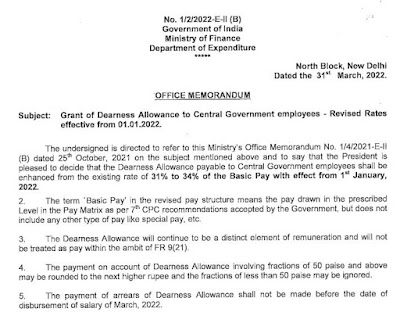
DA Jan 2022 - Grant of Dearness Allowance to Central Government employees - Revised Rates effective from 01.01.2022

 3% DA Hike - Revised Rates effective from 01.01.2022: DoE OM dated 31.03.2022 No. 1/2/2022-E-II (B) Government of India Ministry of Finance...