Thursday, 6 February 2020

Second National Judicial Pay Commission has filed the subject of Pay, Pension and Allowances, in Supreme Court on 29.01.2020

Second National Judicial Pay Commission has filed the subject of Pay, Pension and Allowances, in Supreme Court on 29.01.2020.
Latest-Central-Government-Employees-News-pay-commission-pay-pension-allowances

Ministry of Labour & Employment
Second National Judicial Pay Commission submits its Report

06 FEB 2020

The Second National Judicial Pay Commission has filed the main part of the Report in 4 volumes covering the subject of Pay, Pension and Allowances, in the Registry of the Supreme Court on 29.01.2020. The Commission has been constituted pursuant to the Order of the Supreme Court in All India Judges Association case and the Government of India, Ministry of Law & Justice issued a Notification dated 16.11.2017 in this regard. Shri Justice P.V. Reddi, former Judge of the Supreme Court is the Chairman, Shri Justice R. Basant, former Judge of Kerala High Court is the Member and Shri Vinay Kumar Gupta, District Judge of Delhi Higher Judicial Service is the Member-Secretary of the Commission.

Also check: 7th Pay Commission Latest News 2020

The Interim Report was submitted by the Commission in 2018.

The salient recommendations are:

PAY: The Commission having considered various alternative methodologies has recommended the adoption of Pay Matrix which has been drawn up by applying the multiplier of 2.81 to the existing pay, commensurate with the percentage of increase of pay of High Court Judges. @ 3% cumulative has been applied.

As per the revised pay structure evolved by the Commission, the Junior Civil Judge / First Class Magistrate whose staring pay is Rs.27,700/- will now get Rs.77,840/-. The next higher post of Senior Civil Judge starts with the pay of Rs.1,11,000/- and that of the District Judge Rs.1,44,840/-. The highest pay which a District Judge (STS) will get, is Rs.2,24,100/-.

The percentage of Selection Grade and Super Time Scale District Judges proposed to be increased by 10% and 5% respectively.

The revised pay and pension will be effective from 01.01.2016. Arrears will be paid during the Calendar year 2020 after adjusting the interim relief.

PENSION: Pension at 50% of last drawn pay worked out on the basis of proposed revised pay scales is recommended w. e. f. 1-1-2016. The family pension will be 30% of the last drawn pay. Additional quantum of pension will commence on completing the age of 75 years (instead of 80 years) and percentages at various stages thereafter are increased. The existing ceiling of retirement gratuity and death gratuity will be increased by 25% when the DA reaches 50%.

Nodal officers will be nominated by the District Judges to assist the pensioners / family pensioners.
Recommendation has been made to discontinue the New Pension Scheme (NPS) which is being applied to those entering service during or after 2004. The old pension system, which is more beneficial, will be revived.

ALLOWANCES: The existing allowances have been suitably increased and certain new features have been added. However, the CCA is proposed to be discontinued.

Recommendations are made to improve the medical facilities and to simplify the reimbursement procedure. Medical facilities will be granted to pensioners and family pensioners also.

Certain new allowances viz. children education allowance, home orderly allowances, transport allowance in lieu of pool car facility, have been proposed. HRA proposed to be increased uniformly in all States. Steps to ensure proper maintenance of official quarters recommended.

The recommendations made by the Commission are applicable to the Judicial officers throughout the country.

Supreme Court will have to issue directions regarding the implementation of recommendations after hearing the stakeholders.

PIB

360 Degree evaluation of Civil Servants - Latest Central Government Employees News

360 Degree evaluation of Civil Servants


Ministry of Personnel, Public Grievances & Pensions

06 FEB 2020

A system of 360 degree appraisal involving a Multi-Source Feedback from various stakeholders including from seniors, peers and juniors etc. has been introduced in the process of empanelment of officers for holding senior level positions in the Government of India. Apart from Multi-Source Feedback, the empanelment process takes into account the overall service record, vigilance status and suitability of the officers concerned.

The candidates who have been appointed as Joint Secretary under lateral recruitment policy have signed a Contract Agreement with Government. As per this Agreement, the performance of Joint Secretary appointed under lateral recruitment policy will be evaluated annually.

This information was provided by the Union Minister of State (Independent Charge) Development of North- Eastern Region (DoNER), MoS PMO, Personnel, Public Grievances & Pensions, Atomic Energy and Space, DrJitendra Singh in written reply to a question in Rajya Sabha today.

PIB

Review of Creamy Layer for SCs/STs and OBCs


Ministry of Social Justice & Empowerment
Review of Creamy Layer for SCs/STs and OBCs

05 FEB 2020

As regard SC/ST reservation, at present, there is no concept of creamy layer. Hence question of the review of creamy layer does not arise.

As regard OBC reservation, an Expert Committee has been constituted by the Government of India under the Chairmanship of Shri B.P. Sharma (former Secretary, DOPT) on 08.03.2019 to examine the issues related to Creamy layer equivalence among the Socially and Educationally Backward Classes (SEBCs).

Also check: Implementation of creamy layer criteria

The Expert Committee, after consultation with all stakeholders including the State / UT Governments, has submitted its report to the Minister for Social Justice and Empowerment on 17.09.2019. At present, the report is under consideration.

This information was given by Minister of State for Social Justice and Empowerment Shri Krishan Pal Gurjar in a written reply in Rajya Sabha today.

PIB

Defence Ex-Servicemen Welfare of Retired Personnel

Defence Ex-Servicemen Welfare of Retired Personnel
Ministry of Defence
Welfare of Retired Personnel

Defence personnel latest news

FEB 2020 3:49PM

Defence Ex-Servicemen Welfare of Retired Personnel
The Department of Ex-Servicemen Welfare was created in the Ministry of Defence on 22nd September, 2004 in order to pay focused attention to the welfare and resettlement of Ex-Servicemen (ESM). It has 3 Attached offices namely, Kendriya Sainik Board Secretariat (KSB Sectt.), Directorate General of Resettlement, (DGR) and Central Organisation, Ex-servicemen Contributory Health Scheme (CO, ECHS).

KSB Sectt. is responsible for the welfare of Ex-Servicemen and their dependents and also for the administration of various welfare schemes for them.

The office of Directorate General of Resettlement implements various Policies / Schemes / Programmes for pre and post retirement training, re-employment and self- employment of ex-servicemen.

Central Organisation, Ex-Servicemen Contributory Health Scheme takes care of the healthcare and medical needs of Ex-servicemen and their dependents through a network of various polyclinics across the Country.

The Service Headquarters for Army, Air Force and Navy also have dedicated Directorates i.e. Directorate of Indian Army Veterans (DIAV), Directorate of Air Veterans (DAV) and Directorate of Ex-Servicemen Affairs (DESA) respectively to assist veterans in resolving their Pension and welfare issues.

You may like this : 7TH PAY COMMISSION PAY MATRIX TABLE FOR DEFENCE PERSONNEL

Service HQs organize Veteran’s Day on 14th January every year.

Events are organized by State / UTs at State and District level in form of ‘Sainik Adalat’ to redress their grievances.

Interaction at DGR open forum twice a week at DGR office.

DGR Ex-Servicemen Seminar cum Job fairs are organized pan India. Approximately 8 job fairs are organized in a year.

Regular interaction during visit of DGR / DRZ (Directorate of Re-settlement Zone) officials in their Area of Responsibility (AoR).

Veteran personnel are also invited at ‘At Home’ functions during Army/Air Force/Navy Day celebrations.

A single window online grievance redressal mechanism (CPGRAMS) is already in place by the Department of Administrative Reforms and Public Grievances in which any citizen can lodge their grievances online and get response from the concerned department.

The link of CPGRAMS /CPENGRAMS website has also been given in the website of Department of Ex-Servicemen Welfare, CGDA and all Pension Sanctioning Authorities so that ex-servicemen can lodge their grievances in any websites from their home by clicking on the pgportal.gov.in and get their grievances redressed speedily.

This information was given by Raksha Rajya Mantri Shri Shripad Naik in a written reply to Ram Mohan Naidu Kinjarapuin Lok Sabha today.

PIB

Wednesday, 5 February 2020

Defence - Reservation in Sainik School - 27% reservation for OBCs

Defence - Reservation in Sainik School - 27% reservation for OBCs

Ministry of Defence

Reservation in Sainik School

FEB 2020

At present, there are 31 Sainik Schools functioning in the country. State wise details of Sainik Schools in the country is as under:

Read this: Central government servant representation on their service matters - CGA


S. No.Name of SchoolState
1Sainik School KorukondaAndhra Pradesh
2Sainik School KalikiriAndhra Pradesh
3Sainik School East SiangArunachal Pradesh
4Sainik School GoalparaAssam
5Sainik School NalandaBihar
6Sainik School GopalganjBihar
7Sainik School AmbikapurChhattisgarh
8Sainik School BalachadiGujarat
9Sainik School KunjpuraHaryana
10Sainik School RewariHaryana
11Sainik School SujanpurTiraHimachal Pradesh
12Sainik School NagrotaJammu & Kashmir
13Sainik School TilaiyaJharkhand
14Sainik School BijapurKarnataka
15Sainik School KodaguKarnataka
16Sainik School KazhakootamKerala
17Sainik School RewaMadhya Pradesh
18Sainik School SataraMaharashtra
19Sainik School ChandrapurMaharashtra
20Sainik School ImphalManipur
21Sainik School ChhingchhipMizoram
22Sainik School PunglwaNagaland
23Sainik School BhubaneswarOdisha
24Sainik School KapurthalaPunjab
25Sainik School ChittorgarhRajasthan
26Sainik School JhunjhunuRajasthan
27Sainik School Amaravathi NagarTamil Nadu
28Sainik School GhorakhalUttarakhand
29Sainik School MainpuriUttar Pradesh
30Sainik School JhansiUttar Pradesh
31Sainik School PuruliaWest Bengal
Admission to Sainik School is strictly merit based through a competitive exam and medical fitness. As per Sainik School Society Rules and Regulations 1997, seats for admission in Sainik Schools are reserved for candidates belonging to SC, ST and Defence categories. It has been decided on 10th January, 2020 to have 27% reservation for OBCs in admissions to align with the formulations of the M/o Human Resources Development on the matter of admissions.

This information was given by Raksha Rajya Mantri Shri Shripad Naik in a written reply to Shri Margani Bharatin Lok Sabha today.

Also read: Pay Rules / Regulations 2017 for Army / Navy / Air force officers, MNS, JCOs / OR & Equivalent for revision of option to come over to revised pay structure

PIB

Introduction of Paternity Leave System


Ministry of Labour & Employment
Paternity-Leave-Central-Government-Employees
Introduction of Paternity Leave System

05 FEB 2020

The Government is not planning to introduce any paternity leave system to men employed by organizations / companies in private sector.

Also check: PATERNITY LEAVE FOR CHILD ADOPTION/CHILD ADOPTION LEAVE

This information was given by Shri Santosh Kumar Gangwar, Minister of State (I/C) for Labour and Employment in written reply to a question in Rajya Sabha today.

PIB

Tuesday, 4 February 2020

7th CPC Charge Allowance Notional pay fixation and revision of Pension of Pre-2016

7th CPC Charge Allowance Notional pay fixation and revision of Pension of Pre-2016

7th CPC

Charge Allowance may have been paid w.e.f. 01.01.2016 to 30.06.2017 at old rates which was admissible before 2016, the same may be reckoned for calculation of retirement benefits of employees who retired between the periods from 01.01.2016 to 30.06.2017
PC-VII No.148/2020
RBE No.14 /2020

GOVERNMENT OF INDIA (BHARAT SARKAR)
MINISTRY OF RAILWAYS (RAIL MANTRALAYA)
(RAILWAY BOARD)

No. D-43/15/2019-F(E)III

New Delhi, dated: 30.01.2020.

The General Managers / Principal Financial Advisors,
ll Zonal Railways / Production Units.

Sub : Reckoning of Charge Allowance for the purpose of revision of Pension of Pre-2016 retirees in terms of 7th CPC recommendations - reg.

Consequent upon the recommendations of 7th CPC, instructions were issued vide Board’s letters No.2016/F(E)III/1(1)/7 dated 10.08.2016 and 22.05.2017, regarding revision of pension / family pension of pre-2016 pensioners / family pensioners. A number of references have been received in this office for reckoning of Charge Allowance for the purpose of notional fixation of pay and accordingly revision of pension w.e.f. 01.01.2016.

2. The true nature of charge allowance was earlier considered by the Board and it was decided that the charge allowance, which is actually in the nature of pay restricted under FR-35. should be reckoned as 'Pay' as defined in Rule 1303(FR-9)(21) (a)(i) R-II/6th Edition and as such, it would count as pay for the purposes of pension. gratuity etc. as well as for leave encashment. Accordingly, instructions were issued vide letter No. F(E)III/94/PN1/26 dated 23.06.1995.

3. The issue has again been examined in Board keeping in view the earlier decision on charge allowance cited in para 2 above and it has been decided as follows:-
  • Since. Board had already decided to treat the charge allowance as pay restricted under FR-35 and to reckon it as emoluments for pensionary benefits vide letter dated 23.06.1995, the charge allowance may be taken into account for notional fixation of pay for the purpose of revision of pension / family pension of pre-2016 retirees w.e.f. 01.01.2016 in terms of first formulation as conveyed by Board’s letter No. 2016/F(E)III /1(1)/7 dated 22.05.2017.
  • Pay fixed in terms of Board’s letter No. PC-VII/2017/ 1/7/5/8 dated 08.08.2019 w.e f. 01.07.2017 may also be treated as emoluments in terms of Rule 49 of the Railway Services (Pension) Rules, 1993 for the purpose of fixation of pension.
  • Since, Charge Allowance may have been paid w.e.f. 01.01.2016 to 30.06.2017 at old rates which was admissible before 2016, the same may be reckoned for calculation of retirement benefits of employees who retired between the periods from 01.01.2016 to 30.06.2017.
4. Please acknowledge receipt.

(G. Priya Sudarsani)
Director, Finance (Estt.),
Railway Board.

Monday, 3 February 2020

Bank Employees Dearness Allowance from February 2020 - DA 2020

Bank Employees Dearness Allowance from February 2020 - DA 2020

According to the 10th Bipartite Settlement for the period from February, March and April 2020, 75.90 percent of the Dearness Allowance (DA) grants to Bank employees. In this regard the Indian Banks Association (IBA) released a circular and the same is reproduced and provided for your information below :

Indian Banks’ Association
HR & Industrial Relations
No.CIR/HR&IR/ 76/D/2019-20/ 8619

February 1, 2020

All Members of the Association (Designated Officers)

Dear Sirs,
Dearness Allowance for Workmen and Officer Employees in banks for the months of February, March & April 2020 under X BPS / Joint Note dated 25.5.2015.

The confirmed All India Average Consumer Price Index Numbers for Industrial Workers (Base 1960= 100) for the quarter ended December 2019 are as follows:-
  • October 2019 - 7418.42
  • November 2019 - 7486.90
  • December 2019 - 7532.55
The average CPI of the above is 7479.29 and accordingly the number of DA slabs are 759 (7479 - 4440 = 3039 / 4 = 759 Slabs) The last quarterly Payment of DA was at 717 Slabs. Hence there is an increase in DA slabs of 42 i.e 759 Slabs for payment of DA for the quarter February, March and April 2020.

AICPIN for December 2019 – Press Release

In terms of clause 7 of the 10th Bipartite Settlement dated 25.05.2015 and clause 3 of the Joint Note dated 25.05.2015, the rate of Dearness Allowance payable to workmen and officer employees for the months of February, March & April 2020 shall be 75.90% of pay. While arriving at dearness allowance payable, decimals from third place may please be ignored.

Yours Faithfully,
sd/-
S K Kakkar
Senior Advisor (HR&IR)

MoD – Defence Budget 2020 – 2021 – Defence Pension 2020

MoD – Defence Budget 2020 – 2021 – Defence Pension 2020


MoD – Defence Budget 2020 – 2021 – Defence Pension 2020


The Union budget for the 2020-21 financial year, presented to Parliament on February 01, 2020 by Finance Minister Smt Nirmala Sitharaman, envisaged a total outlay of Rs 30,42,230 crore. Rs 3,37,553 crore (excluding Defence Pension) has been allocated for Defence. A amount of Rs 1,33,825 crore was provided for Defence Pension in Budget Estimates 2020-21.

There is an increase in total Defence allocations (Rs 4,71,378 crore) of Rs 40,367.21 crore including Defence Pension over the 2019-20 fiscal year. Total defence budget accounts for 15.49 per cent of total central government spending for the 2020-21 fiscal year.

The allocation of Rs 4,71,378 crore reflects a 9.37 per cent increase over Budget Estimates (Rs 4,31,010,79 crore) for the 2019-20 financial year.

Of the Rs 3,37,553 crore allocated for the 2020-21 financial year, Rs 2,18,998 crore is for revenue (Net) expenditure and Rs 1,18,555 crore is for capital expenditure for Defence Services and Ministry of Defense organizations / departments. The total of Rs 1,18,555 crore allocated for capital spending includes expenditure related to modernisation.

Input from PIB

Budget 2020 – Personal Income Tax and tax simplification

Budget 2020 – Personal Income Tax and tax simplification

In order to provide significant relief to individual taxpayers and to simplify the Income-Tax law, the Finance Minister proposed to introduce a new and simpler personal income tax system in which income tax rates will be substantially reduced for individual taxpayers who forgo such deductions and exemptions.

The proposed tax-slab adjustments are listed in the table below:

Taxable Income Slab (Rs.)Existing tax ratesNew tax rates
0-2.5 LakhExemptExempt
2.5-5 Lakh5%5%
5-7.5 Lakh20%10%
7.5-10 Lakh20%15%
10-12.5 Lakh30%20%
12.5-15 Lakh30%25%
Above 15 Lakh30%30%


Surcharge and cess shall be continued to be levied at the existing rates.

In the new tax system, a taxpayer will gain substantial tax benefit, depending on the exemptions and deductions that he seeks. Thus its tax burden in the new regime will be reduced by Rs. 78,000. He would still be the gainer in the new regime, even though under the old regime he took deduction from Rs. 1.5 Lakh under various sections of Chapter VI-A of the Income Tax Act.

To individuals the new tax system will be free. An person currently benefiting from more deductions and exemptions under the Income Tax Act may choose to take advantage of them and continue to pay tax in the old regime.

The new rates for personal income tax would require foregone revenue of Rs. 40,000 crore per year. Measures were implemented to pre-fill the income tax return so that a person who opts for the new regime would not need an expert’s assistance to file their report and pay income tax.

The Finance Minister said that over the past several decades she has reviewed all exemptions and deductions that have been incorporated into the income tax legislation. The Income Tax Act currently provides more than one hundred exemptions and deductions of different character. In the new simplified regime, she said she has removed about 70 of them. She said that in the coming years, the remaining exemptions and deductions would also be reviewed and rationalized to further simplify the tax system and lower the tax rate.

Budget 2020 – Personal Income Tax and tax simplification

Flash News

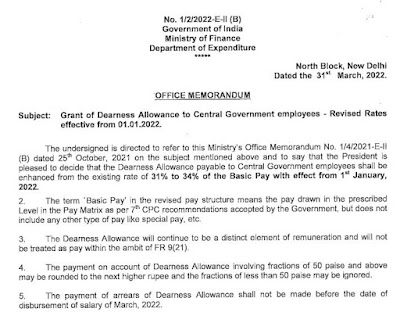
DA Jan 2022 - Grant of Dearness Allowance to Central Government employees - Revised Rates effective from 01.01.2022

 3% DA Hike - Revised Rates effective from 01.01.2022: DoE OM dated 31.03.2022 No. 1/2/2022-E-II (B) Government of India Ministry of Finance...