Tuesday, 6 September 2016

Consolidated Instructions on compassionate appointment - Review of FAQs dated 30.05.2013/25.02.2015 with regard to married son

F.No.14014/02/2012-Estt.(D)
Government of India
Ministry of Personnel, Public Grievances and Pensions
Department of Personnel & Training
North Block, New Delhi
Dated the 05th September, 2016
OFFICE MEMORANDUM

Subject:- Consolidated Instructions on compassionate appointment — Review of FAQs dated 30.05.2013/25.02.2015 with regard to married son.

The undersigned is directed to invite attention to this Department's O.M. No.14014/6/1994-Estt.(D) dated 09th October, 1998 and OM of even number dated 16th January, 2013 vide which Consolidated Instructions on compassionate appointment were issued.

Subsequently, vide FAQ No. 13 dated 30.05.2013 it has been clarified that married sons are not considered as dependent family member and hence not eligible for consideration for compassionate appointment. The clarification with regard to married son as stipulated in FAQ No. 13 dated 30.05.2013 has been reviewed vide FAQ No 60 of even number dated 25.02.2015 as under:-

Sl.
No
Question Answer
60Whether 'married son' can be considered for compassionate appointment?Yes, if he otherwise fulfils all the other requirements of the Scheme i.e. he is otherwise eligible and fulfils the criteria laid down in this Department's O.M. dated 16th January, 2013. This would be effective from the date of issue of this FAQ viz. 25th February, 2015 and the cases of compassionate appointment already settled w.r.t. the FAQs dated 30th May, 2013, may not be reopened. Sr.No.13 of the FAQs dated 30th May, 2013 may be deemed to have been modified to this extent.

2. Pursuant to various Court Orders, the clarification/FAQ No. 13 dated 30.05.2013 and FAQ No. 60 dated 25.02.2015 has been further reviewed in consultation with the Department of Legal Affairs. It has been decided that married son can be considered for compassionate appointment if he otherwise fulfils all the other requirements of the Scheme i.e. he is otherwise eligible and fulfils the criteria laid down in this Department's O.M. dated 16th January, 2013.

3. FAQ No. 13 dated 30.05.2013 and FAQ No. 60 dated 25.02.2015 stands withdrawn from the date of their issue.

4. The cases of compassionate appointment rejected solely on the grounds of marital status in terms of FAQ No. 13 dated 30.05.2013 during the intervening period i.e. w.e.f. 30.05.2013 to 25.02.2015 in respect of married son may be
reopened/reconsidered against vacancies occurring after issue of this OM.

5. Hindi version will follow.
(G. Jayanthi)
Director (E-I)
Phone No. 23092479
See the circular

Constitution of a Committee to review the Long Term Contracting (LTC)

Constitution of a Committee to review the Long Term Contracting (LTC)

Government of India
Ministry of Railways
Railway board
No. ERB-I/2016/23/42
New Delhi,dated 09.08.2016
ORDER

Reference Ministry of Railways (Railway Board)’s letter No.2010/RS(G)/779/9 dated 08.1.2016 regarding implementation of the policy of long term contracting on Indian Railways.

2. Ministry of Railways (Railway Board) have decided to constitute a Committee to review the aforesaid policy of Log Term Contracting (LTC) on Indian Railways. The Committee will consist of the following:-
(i) Exe. Director/RS(S), Railway Board …. Convenor
(ii) Exe. Director/ME(W), Railway Board….. Member
(iii) Exe. Director/EE(RS), Railway Board….. Member
(iv) Exe. Director/Finance(S), Railway Board….. Member

3. The Terms of reference of the Committee will be as under:-
“To review the policy of Log Term Contracting (LTC) to make it more implementable over a wide number of items to bring the real benefit of improvements in quality, cost, economy and superior compliance.”

4. The Committee should submit its report by the End of August, 2016.

5. The Headquarters of the Committee will be at New Delhi.

6. RS(G) Branch of Railway ‘Board will be the Nodal Branch for functioning of the Committee. ‘Therefore, all related works/issues including ParI. Questions, RTI cases, their execution and other formalities should be dealt with by the Nodal Branch,

7. The Convenor and Members of the Committee will draw TA/DA as per extant Rules
sd/-
(M.M Rai)
Deputy Secretary (Estt)
Railway Board
Source : NFIR

7th Pay Commission: Licence to splurge

7th Pay Commission: Licence to splurge

Beneficiaries of the payout tell us how they plan to spend the money coming their way

With the festive season around the corner, the stock markets and consumer goods sector are upbeat about the expected payout from the 7th Central Pay Commission (CPC) recommendations. About Rs.1-lakh crore worth of money will land in the pockets of more than one crore Central government employees and pensioners this year — as salaries, allowances and pension benefits.

About two-thirds of that amount would have already kicked-in — as payment of eight-month arrears of salary — spelling cheer for consumer goods manufacturers. This year, the 7th CPC had recommended a pay hike of 23.5 per cent for Central government employees.

How are the beneficiaries of this bounty planning to spend it? Here’s a quick survey.

Loan repayment
“I just received about eight months of arrears along with my salary,” confirmed Kulwinder Singh, an employee with Prasar Bharati’s Doordarshan Television Network. The newly-revised salary is applicable from January 1 of this year. “The amount is not substantial in absolute terms. I will use the amount to make future payments relating to a recent land purchase,” says Singh. Overall, he is happy with the extent of the hike.

Kripasankari Srivatsa, working at the office of the Accountant General (A&E) of Tamil Nadu, has similar plans. “I had taken an education loan a few years ago to sponsor my daughter’s education abroad. I will pre-pay a part of this loan.”

The last time, Central government employees got a hike, things were different. The 6th CPC-recommended salaries — notified in 2008-09 but paid retrospectively from January 1, 2006 — was quite a big amount in real terms for the employees. “It was equivalent to 30 months of arrears and was quite a bounty,” recollects Asif Mirza (name changed), working with the Income Tax Department. Also, the extent of hike was higher than it has been this time, averaging 35 per cent. This time around, about Rs.70,000 on average would have been doled out to about one crore employees as arrears this month. Mirza plans to buy the long-coveted 42-inch LED TV while his colleagues have diverse plans — buying gold jewellery, electronic items or a four-wheeler.

Perking up demand
About 30 per cent of Central government employees earn less than Rs.30,000 a month, while another 45 per cent earn in the Rs.30,000-50,000 range and another 12 per cent between Rs.70,000 and Rs.1 lakh a month, according to reports.

The salary hike following the 7th CPC recommendations would lead to massive reshuffle in composition of Central government employees under various income brackets, according to a report from ICICI Securities. With the salary hike, there would be a 20 per cent reduction in the number of employees in the earning-less-than-Rs.30,000 bracket — in favour of those in the Rs. 30,000-50,000 bracket (6 per cent) and Rs.50,000-75,000 bracket (14 per cent).

Typically, as the income level rises, spending on essential items such as food plateaus, while that on discretionary items goes up. While such payments were made last time in 2008 following the 6th CPC recommendations, there was a pick-up in sales of personal transport like cars and jeeps, jewellery, travel and tourism. Additionally, consumer durables like washing machines, air-conditioners and refrigerators saw a boost in demand.

“During the last pay hike, the lumpsum amount was big enough to buy myself a car,” recollects Mirza. With the increment not being as big this time, it is likely that low-ticket items such as cooking and household appliances get the initial boost in demand.

Moreover, the age profile of the employees has a bearing on the extent of spending.

Take, for instance, Vikram Malhotra, a 75-year-old retired police officer, who feels he is in the last lap of life. “I don’t look forward to saving much and plan to replace my old car with a new one.” Another retiree from BARC plans to mostly save the bounty by investing in fixed deposits towards medical emergencies.
“Not counting chickens before they hatch,” he reasons. According to reports, almost half of the one crore beneficiaries of the 7th CPC are pensioners.

Also, among the working Central government employees, about 30 per cent are in the 52-60 age bracket.
And they are unlikely to be very liberal with their wallets unlike the youngsters.

“I am planning to move into a three-BHK rented flat with better amenities than the one I am currently staying in,” says Mani Subramanian (name changed), a Central government employee. Some of his colleagues are contemplating buying a flat in the suburbs, with improved income levels.

As income level increases, households typically tend to spend more on rent. Those who own flats already look to refurbish it. “I am planning to paint my house as well as change the flooring,” says Supriya Mule (name changed), another Central government employee. Housing and related sectors such as building materials (tiles, etc) are, therefore, expected to get a leg-up.

However, this time around, given the extent of payout, it’s more likely that the rental yield might go up first.
The current macro-economic situation is partly favourable and partly non-conducive. On the one hand, interest rates are lower.

This, in turn, could spur demand for buying consumer items on credit.

Prabhu Das, for instance, plans to buy an LG 450 litre fridge by making initial payments from the 7th Commission payouts and going for a loan to make the rest of the payments.

However, with consumer inflation remaining high, it’s likely that the consumer might curb spends to adjust to the uncertain price scenario. Not the least, the threat of the central bank increasing interest rates to control inflation could play spoilsport.

Moreover, it is likely that the spending would be made not at one go but over a period of time, say, 9-12 months.

And with the revisions of the State governments likely round the corner — state governments usually replicate the recommendations of central CPC with a lag — the Indian consumption story could get a good thrust.

Source: thehindu

7th Pay Commission – CG Employees Step up Pressure – At the very start of the meeting, representatives of the unions expressed their anguish for non-formation of High Level Committee

7th Pay Commission – CG Employees Step up Pressure – At the very start of the meeting, representatives of the unions expressed their anguish for ‘non-formation of High Level Committee’.

7th pay commission To obtain the views of the National Council (Staff Side) (JCM) on the recommendations of the 7th pay commission relating to Allowances, the second meeting of the Committee on Allowances was held on Thursday under the chairmanship of Secretary, Finance (Expenditure), Government of India, with the National Council (Staff Side) JCM.

At the very start of the meeting, representatives of the unions expressed their anguish for ‘non-formation of High Level Committee’. According to them it was agreed to in July by the Group of Ministers (Government of India) for settling the issue of Minimum Wage and Multiplying Factor. The unions want the ‘minimum wage’ for Central employees to be fixed at Rs. 26,000 as opposed to Rs. 18,000 recommended by the 7th Pay Commission (CPC).

“The Secretary, Finance (Expenditure) told that, the committee constituted under the chairmanship of Addl. Secretary (Exp.) with J.S. (Pers.), JS (Estt.) and JS(Imp.) as Members has been made only for this purpose. Let us believe that, after the meeting, report of the said committee would be sent to the Government of India for its acceptance’’, Mr. Mishra, secretary (Staff Side) of the National Council/Joint Consultative Machinary, noted.

At the meeting, the unions made a strong case for implementation of the allowances to be decided by the Committee from January 1, 2016.

Besides, they wanted that House Rent Allowance be fixed at range 10 to 30 per cent of the basic linked to the classification of the town of posting, children education allowance of Rs. 3,000 and hostel subsidy of Rs.10,000. All these allowances should be tax exempt.

Staff Side demanded inclusion of post-graduate and professional courses in children education allowance. The issue of special duty allowance was also raised for Northeastern region.

They also demanded, ‘Fixed Medical Allowance’ of Rs. 2,000 with Dearness Allowance Indexation, review of overtime allowance, small family allowance and dress allowance.

“Various Departmental Allowances, which have been abolished, should be allowed to continue, like Breakdown Allowance in the Railways and Fixed Conveyance Allowance to Postal Department employees”, Mr. Mishra noted.

Separately, M. Ragaviah, National Federation of Indian Railwaymen - NFIR (an affiliate of INTUC) said, “While there has been no commitment from the Chairman and Official Side of the Committee, the Finance Secretary however stated that further meetings will be held and in the meantime the JCM (Staff Side) may list out common issues and send the same to the Joint Secretary (Imp) and equally Departmental specified issues be sent through the respective Administrative Ministries for examination”.

Source: The Hindu

Income Declaration Scheme 2016 – Government issues Clarifications in the form of Sixth Set of Frequently Asked Questions (FAQs)

Income Declaration Scheme 2016 – Government issues Clarifications in the form of Sixth Set of Frequently Asked Questions (FAQs)

The Income Declaration Scheme, 2016 (the Scheme) provides an opportunity to persons who have not paid full taxes in the past to come forward and declare their undisclosed income and assets. The Scheme has come into effect from 1.6.2016 and is open for declarations up to 30.9.2016. The Income Declaration Scheme, 2016 Rules (the Rules) have been notified on 19.5.2016. The amount payable under the Scheme can be paid in instalments viz. 25% of the total amount payable by 30.11.2016; another 25% by 31.3.2017 and balance 50% by 30.9.2017.

In order to address concerns of the stakeholders and to clarify the queries relating to the provisions of the Scheme, the Rules have been amended from time to time and six set of circulars (FAQs) have been issued. The following major issues addressed through Rules and FAQs are as under:
• The information in respect of a valid declaration is confidential and shall neither be shared with any law enforcement agency nor shall be enquired into by the Income-tax Department.
• The assets declared under the Scheme are to be valued at cost of acquisition or at fair market price as on 1.6.2016 as determined by the registered valuer, whichever is higher. However, an option for valuation of registered immovable property on the basis of stamp duty value of acquisition adjusted with the Cost Inflation Index has also been provided.
• Credit for unclaimed TDS made on declared income shall be allowed.
• Neither any capital gains tax nor any TDS shall be levied on transfer of declared benami property from benamidar to the declarant without consideration.
• The amount of fictitious liabilities recorded in audited balance sheet and not linked to acquisition of an asset can be disclosed under the Scheme as such.
• The period of holding of declared registered immovable assets shall be taken on the basis of the actual date of registration.
• The valuation report obtained by the declarant from a registered valuer shall not be questioned by the department. However, valuer’s accountability will remain.
• No adverse action shall be taken by FIU or the income-tax department solely on the basis of the information regarding cash deposit made consequent to the declaration under the Scheme.
• No enquiry/investigation shall be made in respect of the undisclosed income and assets declared under the Scheme even if the evidence of same is found subsequently during course of search or survey proceedings (circular No.32 dated 01.09.2016).
Further, vide Circular No. 31 dated 30.8.2016 an option has been provided to the declarants to file the declaration under the Scheme electronically under digital signature with the Commissioner of Income-tax, Centralised Processing Centre, Bengaluru [CIT(CPC)]. In case the declarant exercises the said option the declaration shall not be shared with the jurisdictional Principal Commissioner/Commissioner under the Income-tax Act.

In view of the fact that all the major queries and concerns of stakeholders have already been addressed by issue of circulars (FAQs) and also to provide stability and certainty to the Scheme, it is envisaged that no further clarifications on the Scheme shall be issued.

It is reiterated that the Scheme closes on 30.09.2016. The extension of the scheme is out of question.

PIB

Meeting of the Committee to examine the recommendations of 7th CPC regarding Allowances

Meeting of the Committee to examine the recommendations of 7th CPC regarding Allowances – September 1, 2016, North Block, New Delhi
NFIR
National Federation of Indian Railwaymen
3, CHELMSFORD ROAD, NEW DELHI – 110 055

No. IV/NFIR/7CPC(Imp)/Allowances/2016
Dated: 02.09.2016
The General Secretaries of
Affiliated Unions of NFIR

Dear Brother,

Sub: Meeting of the Committee to examine the recommendations of 7th CPC regarding Allowances – September 1, 2016, North Block, New Delhi-reg.

The meeting of the Committee was held on 1st September, 2016 at Room No. 72, North Block, New Delhi under the Chairmanship of Finance Secretary and Secretary (Expr) to discuss on 7th CPC allowances. The JCM (Staff Side) Standing Committee Members have participated in the meeting. All the Standing Committee Members (Staff Side) expressed their serious disappointment over non-fulfillment of the assurance given by the Finance Ministry on 6th July 2016 for setting up High Level Committee to examine 7th CPC issues mainly – Minimum Wage and Multiplying Factor.

The Leader Staff Side & General Secretary, NFIR Shri M. Raghavaiah has explained to the Finance Secretary, the discussions held between JCM (Staff Side) Leaders & Senior Ministers namely S/Shri Rajnath Singh, Arun Jaitley, Suresh Prabhu and Shri Manoj Sinha on the night of 30th June, 2016 and subsequent meeting held on 6th July, 2016 with Union Home Minister. He further explained that an assurance was given to appoint a High Level Committee to examine the issues relating to Minimum Wage, Multiplying Factor and other allied issues and accordingly Finance Ministry had issued statement on the night of 06th July, 2016 that a High Level Committee will be constituted. Pursuant to this assurance, the Strike action was deferred by the NJCA/JCM (Staff Side). He conveyed that the non-fulfillment of assurance is causing disappointment among employees. He requested the Chairman of the meeting to take initiative for ensuring that the assurance given is fulfilled.

He also expressed disappointment over non-holding of National Council (JCM) meetings since the last six years, resulting accumulation of grievances.

On the “Allowances”, he urged upon the 7th Chairman to consider granting 30%, 20% & 10% of 7th CPC Pay, for the staff working in X, Y & Z Cities/Towns w.e.f. 01/01/2016. He also contended that the date of effect of the Allowances should be January 1, 2016.

Mr. Raghavaiah has also highlighted the 7th CPC aberrations on Transport Allowance and requested to take action for rectification. He said that Fixed Medical Allowance be revised upwardly. He invited the special attention of the Finance Secretary to Para 8.2.5 of the 7th CPC recommendation which is retrograde and needed to be rejected as the same would cause harm to staff. He cited the case of PCO Allowance, Special Allowance for announcing duties, Special Incentive allowance etc., admissible in railways which are required to be continued and hiked

President/NFIR Shri Guman Singh, Working President Shri R. P. Bhatnagar, Vice President Shri K.S. Murty also spoke and stressed upon the need to continue the existing Allowances like Break Down Allowance in Railways. They also expressed serious disappointment over non-revision of Minimum Wage and Multiplying Factor.

While there has been no commitment from the Chairman and Official Side of the Committee, the Finance Secretary however stated that further meetings will be held and in the meantime the JCM (Staff Side) may list out common issues and send the same to the Joint Secretary (Imp) and equally Departmental specified issues be sent through the respective Administrative Ministries for examination.

The above is for information of Affiliates.
Yours faithfully
sd/-
(Dr. M. Raghavaiah)
General Secretary
Source : NFIR

Regulation of entitlement of Passes & PTOs till issue of orders on the basis of Railway Services (Revised Pay) Rules, 2016

Regulation of entitlement of Passes & PTOs till issue of orders on the basis of Railway Services (Revised Pay) Rules, 2016
Government of India
Ministry of Railways
(Railway Board)
No. E(W)2016/PS5-1/8
New Delhi, dated 31.08.2016
The General Managers (P)
All Indian Railways &
Production Units.

Sub: Regulation of entitlement of Passes & PTOs till issue of orders on the basis of Railway Services (Revised Pay) Rules, 2016.

Ref: Board’s letters No.E (W) 2008/PS5-1/38 dated 06.01.2011 & 3.02.2011.
Revised pay limits for entitlement of Passes & PTOs as well as travel entitlements linked with the Grade Pay were introduced vide Board’s above referred letters, consequent to implementation of 6th Central Pay Commission’s recommendations.

2. Pursuant to the notification of Railway Services (Revised Pay) Rules, 2016, Railway servants shall draw pay in the revised pay structure in the Level applicable to the post to which appointed, and the Grade Pay Component has been done away with. The issue regarding linking of the Level of posts for pass entitlement on the revised pay structure is under consideration. Hence, till further orders, Grade Pay in the pre-revised scales i.e. 6th Central Pay Commission’s scale shall continue to be the basis for gradation and related entitlement on all kinds of Passes as well as PTOs.

3. In respect of persons appointed to different posts on or after 01.01.2016, the notional Grade Pay which they would have drawn in the pre-revised pay structure should be taken into account for fixing their pass entitlement.
sd/-
(V. Muralidharan)
Dy. Director Estt. (Welfare)-I
Railway Board
Source: Indian Railways

Monday, 5 September 2016

7th Pay Commission: BJP asks Puducherry government to implement

7th Pay Commission: BJP asks Puducherry government to implement

Puducherry: BJP State President V Swaminathan asked Puducherry government to implement the 7th pay commission recommendations to the government employees.

He also on Saturday condemned government’s failure to implement pay commission award on the pretext of financial crisis.

In a statement he said there are only 30,000 government employees and the expenditure to the exchequer will be Rs.13 crore.

The government is collecting an amount of Rs 200 crore as tax revenue in a month and as such the salary for the government employees will come only 6.5 percent of the tax revenue being collected.
However, the state government is not implementing the pay commission to cast a black mark on the BJP government at the centre, he charged.

He wondered why the government which is citing financial crisis to implement the 7th pay commission recommendations is proving free rice and gas subsidy to the wealthy people and thus wasting an amount of Rs 100 crore.

He said ‘inefficiency” in governance and corruption were the main cause for the financial crisis and added that the BJP would seek from the Union Home Ministry to appoint a commission to inquire into the asset mobilization of the officials of the departments which had shown financial crisis for the last ten years.

TST

Saturday, 3 September 2016

2nd September 2016 General Strike Reflection of Workers’ Anger: Confederation Of Central Government Employees

2nd September 2016 General Strike
Reflection of Workers’ Anger
Hemalata

The country wide general strike on 2nd September this year was even bigger and more widespread than that held on the same day last year, as initial reports from all over the country suggest. The country wide general strike this year too was held on the same 12 point charter of demands. The central trade unions claimed a participation of 15 crore workers in the strike last year. The impact of the strike this year was so huge that even before the trade unions made any claims, the electronic media reported that 18 crore workers participated in the strike.

This gives big rebuff to the claims made by the government that it was working for the benefit of the workers and for providing them social security benefits. It is also significant that the BMS, which withdrew from the strike in the last minute in 2015, did not join the strike call this year at all. Besides, the BJP led government used everything within its capacity to create confusion among the workers and sabotage the strike. The BMS became a willing ally of the government in these efforts, declaring that it was ‘withdrawing’ from a strike that it has never called, but also claiming ‘historic victory’ for the workers. All these were nothing but manoeuvres by the BJP and the BMS, both members of the same parivar headed by the RSS to deceive the workers in their efforts to serve their corporate masters. The corporate media, particularly the electronic media, as usual, aired these false claims and added their might to the misinformation campaign.

But the working class of the country refused to be deceived. As the reports show, despite the call of the BMS leadership to organise ‘victory rallies and meetings’, BMS members were not willing to oppose the strike. In fact, in several places they joined the strike. Workers who were not organised into any unions, who joined the strike last year, as in Pune industrial area, joined the strike this time too. In several places the strike spread to newer areas encompassing newer sections of workers. In many states, not only the states that are traditional strongholds of trade unions, but in many others, the strike turned into a bandh. This was mainly due to the massive participation of the road transport workers as a result of which life in these states came to a standstill. In many districts of Assam, Bihar, Haryana, Jharkhand, Karnataka, Madhya Pradesh, Odisha, Punjab wore a bandh like look. Despite the attempts by the TMC government in West Bengal to suppress the strike by issuing warnings and threats to the workers, state transport buses in the state plied empty and a bandh like situation prevailed in almost all the districts. In Kerala and Tripura, as always, strike turned into a bandh.

The anger of the workers against the policies of the government was visible in many ways. Around 70000 anganwadi employees and ASHAs, most of them who were not members of any union joined the strike in Gujarat. Thousands of them participated in the demonstrations held at the district headquarters in many districts. All the workers in the minor ports of Bhavnagar in Gujarat, Gangavaram and Kakinada in Andhra Pradesh joined the strike. These workers are not members of any of the central trade unions that called the strike. Similarly in many industrial clusters across the country, thousands of workers, who are not members of any union, joined the strike.

While there were a few areas like the port sector where the strike was not as good as the last time, and a few districts where the strike in the road transport sector was not as effective as last year, overall the strike was observed in many more industrial clusters and sectors and many newer sections of workers joined it.
It was not only the misinformation and misleading campaign of the government with its huge advertisements in the media aided and abetted by the BMS that the workers confronted. In several states they were subjected to victimisation, police repression and physical attacks. In Haryana 22 leaders of road transport workers’ union were arrested and the striking workers were lathi charged; police went to the residential areas where contract workers lived and coerced them to join duties. Several coal workers in Jharkhand were suspended for joining the strike. The police conducted a flag march to intimidate workers and also lathi charged workers standing peacefully near a theatre in Noida. In West Bengal CITU leader and former MP Suraj Pathak and many CITU leaders were arrested. TMC goons attacked the workers and their supporters, including women, participating in the rallies. Around 5000 workers were arrested in different parts of Assam.

The extent of the strike and the support it received could be gauged from the reports that were available till the evening of 2nd September though comprehensive reports from all the states and sectors are yet to come. In several states local state level unions joined the strike. In Telangana, the TRS affiliated union joined the strike; the TNTUC belonging to the ruling TDP in Andhra Pradesh supported the strike in Telangana. Even in Vijayawada in Andhra Pradesh, though TNTUC opposed the strike, workers belonging to it joined the strike. In Odisha the chief minister himself expressed his support to the strike when the trade union leaders met him. The Left parties openly supported the strike. Even while the BMS was not part of the strike and BMS leadership directed its members to observe ‘victory rallies’, local units of the BMS were not in a position to oppose the strike; in several states BMS members joined the strike.

Overwhelming majority of bank and insurance employees all over the country joined the strike. State government employees in most of the states joined the strike. Particularly noteworthy is the participation of state government employees in the north eastern states including Arunachal Pradesh, Manipur, Mizoram, Nagaland, Meghalaya etc who participated in the strike for the first time. Participation of central government employees – of the income tax employees, postal employees in particular was massive. Defence employees in several defence production units joined the strike. BSNL employees all over the country joined the strike. The strike was near total in the coal sector. Overwhelming majority of contract workers in the public sector participated in the strike. Strike among medical and sales representatives was total in almost all the states.

Scheme workers including anganwadi employees, ASHAs, midday meal workers participated in the strike all over the country. Teaching and non teaching staff of National Child Labour Project joined the strike in Bihar, Maharashtra etc. Traditional sector workers like the plantation workers, cashew, coir, and fisheries workers participated in the strike in their lakhs. Unorganised workers in beedi, construction, head load workers, auto and rickshaw drivers, street vendors, domestic workers in several states joined the strike and also participated in the demonstrations, rasta roko and rail roko. Municipal and conservancy workers, panchayat workers, village chowkidars etc also joined the strike.

In Andhra Pradesh, strike was total in Vizag steel and DCI; around 70% of workers of permanent workers in the Vizag Shipyard participated in the strike. The TTD in the holy town of Tirupati was totally paralysed. Autos all over the state went on strike. Almost all the industrial clusters including the Renigunta industrial area were closed down. In several major cities truck owners associations participated in the strike. This along with the strike of the head load workers throughout the state brought all commercial transactions in the state to a standstill.

In Assam strike took the form of complete bandh in almost all districts seriously affecting public and private transport. No oil refinery in the state functioned. ONGC remained paralysed. More than 15 lakhs tea garden workers joined the strike. All public and private educational institutions remained closed. Railway transport was disrupted due to the rail roko by the unorganised workers, peasants, agricultural workers etc.

In Bihar too the strike was turned into bandh in many districts. Road transport including bus and tempo services was off the road. Workers in several industrial clusters went on strike.

Workers in almost all the major industrial areas in NCR Delh joined the strike. Massive joint demonstrations were held in several centres. The central demonstration was addressed by the national trade union leaders.
In Gujarat, an estimated 4 lakhs workers in 22 districts joined the strike and organised demonstrations in many districts.

Strike was highly successful in Haryana including in the Gurgaon, Manesar industrial areas. Workers in the Manesar plant of Maruti Suzuki, Honda, Hero Honda and other industrial units joined the strike and held demonstrations.

Demonstrations were held in Jammu region in support of the strike while Kashmir region continues to be under curfew. Thousands of workers from different sectors participated in the demonstrations
In Jharkhand strike was observed in industrial areas including in Jamshedpur that never participated in any strike till now. It was reported to be more massive than the strike in 2015.

An estimated 50 lakhs workers participated in the strike in Karnataka. Strike was total in the road transport sector and in all the major industries in Bengaluru and Mysore. 19 lakhs workers in the industrial clusters of Bengaluru joined the strike. Strike was total in both the units of Mico, L&T, Chenna metals, Toyota, ITC, Vikrant Tyres etc. In BEL in Bengaluru, the union affiliated to INTUC did not join the strike; despite this 80% of workers, 800 out of the total 1073 workers, more than the membership of the CITU affiliated union, joined the strike

The strike in transport sector in several cities and towns in Madhya Pradesh was total. Hamalis of agricultural mandis also participated affecting commercial transactions.
Strike was total in many private industrial areas in Maharashtra including the Pune, Aurangabad, Nagpur, Nasik, Mumbai, Solapur etc. Major industries like Ceat Ltd, Thysun Crupp, Sansonite India, Crompton Grieves, beer manufacturing units, pharma industries, liquor and textile industries were closed. Strike was total among beedi and power loom workers in Solapur.

Strike created a bandh like situation in Odisha. It was total among iron ore, manganese and coal mines workers and near total among the contract workers. Road transport including autos was totally paralysed.
Strike evoked massive response in Punjab with workers. Road transport was paralysed and industrial clusters remaining closed. Unorganised workers participated in the demonstrations in thousands.

The garment industry in Tiruppur in Tamil Nadu witnessed total strike. Strike was also effective in the Coimbatore industrial area. It was total in Ashok Leyland, Ennore Foundries, Simpson Group of companies and all three factories of TI Group in Chennai. Workers in BHEL Trichy and Ranipet, ordinance factory in Nilgiris, defence production units in Avadi and Aravangadu were totally in strike. In Aravangadu, BMS members also joined the strike. Contract workers in Manali industrial belt MFL, ATC Tyres in Tirunelveli and TCL Lancer, in L&T, in Tyre machinery making Honey Well company went on strike.

There was bandh like situation in the state due to the total participation of road transport workers in the strike in Telangana. There was total strike in most of the public sector undertakings in the state. Strike was also total in most of the industrial clusters in and around Hyderabad. On the whole the strike was reported to be even more successful than last year

Strike was total in Udhampur industrial area of Uttarakhand and partial in that in Haridwar. It was also total in public road transport in the state but partial in private road transport.

In West Bengal, bandh like situation prevailed in many districts despite the threats and intimidation of the TMC government and its goons. Government ran buses without passengers in the morning but was compelled to withdraw later. Jute mills were closed. Commercial activities were nominal. Educational institutions in several districts were closed. Most of the tea gardens remained closed.

This strike, the seventeenth joint country wide general strike after the advent of neoliberal policies in the country, was preceded by joint campaign that was better organised and taken up to the block and in some states lower level to reach the workers. In addition, CITU prepared campaign material to make the workers aware of the issues and their relationship to the government policies. Booklets exposing government claims were also published which were translated into local languages. During the strike the lower level committees were regularly up dated with information exposing government claims. This has helped in preventing the workers from succumbing to the confusion sought to be created by the government and the BMS.

This country wide general strike will definitely be a mile stone in the working class struggles of the country.

Source: confederation

Confederation of Central Government employees: PRESS STATEMENT Dated 2nd September 2016

Confederation of Central Government employees: PRESS STATEMENT Dated 2nd September 2016

PRESS STATEMENT
Dated 2nd September 2016

The initial report received at the Confederation Central Head Quarters indicate the participation of about ten lakhs Central Government employees in today’s nationwide general strike action of the Indian Working Class. Earlier, endorsing the call of the Central Trade Unions, the Confederation of Central Government employees and workers had called upon the Central Government employees to take part in the one-day strike to compel the Government to withdraw the anti-people and anti-labour neo-liberal policies pursued by the Central Government.

Offices of the Postal, Income Tax, Ground Water Board, Survey of India, Geological Survey of India, Printing and Stationery department, Botanical Survey of India, Indian Bureau of Mines, RMS offices, census department, Indian Space Research organization, Central Government Health Scheme, Atomic Energy, Medical Stores depots, Film Institute of India, AGMARK, Indian Council for Medical Research, Film division and various other autonomous scientific and research institutions etc. remained closed and the work completely paralysed.

The strike also affected the functioning of various offices of Indian Audit & Accounts department, Civil Accounts, Central Excise and Customs, CPWD etc. Total civilian employees of various Defence organisations and Defence Accounts Departments participated in the strike. The Strike was total in Kerala, West Bengal, Tamilnadu, Andhra, Telangana, Jharkhand, Chattisgarh, Odisha, Assam, North Eastern states, Karnataka, Maharashtra, Punjab, Madhya Pradesh and 70 to 80% in other states.

The Central Government employees were particularly unhappy over the totally negative attitude of the NDA Government towards their demands while implementing 7th Central Pay Commission recommendations. Ban on creation of new posts, non-filling up of about six lakhs vacant posts, introduction of New Contributory Pension Scheme, non-regularisation of Gramin Dak Sevaks and casual, contract workers, ceiling on compassionate appointments, rejection of the demand for increase in the minimum wage and fitment formula, reduction in the percentage of House Rent Allowance, abolition of 52 allowances etc. are some of the retrograde measures taken by the Central Government.

The Confederation National Secretariat Congratulates the Central Government employees, who undertook intensive campaign to make the strike a grand success. The Confederation salutes all its members for their whole hearted participation in the strike and making it an unprecedented success.
M. Krishnan
Secretary General
Confederation

Flash News

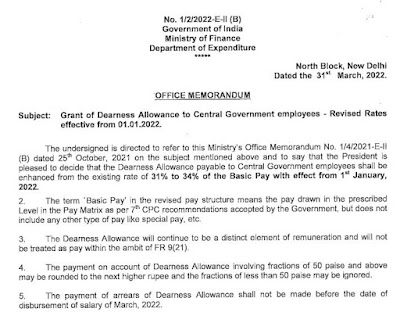
DA Jan 2022 - Grant of Dearness Allowance to Central Government employees - Revised Rates effective from 01.01.2022

 3% DA Hike - Revised Rates effective from 01.01.2022: DoE OM dated 31.03.2022 No. 1/2/2022-E-II (B) Government of India Ministry of Finance...