Friday, 12 August 2016

2016 SEPTEMBER 2nd GENERAL STRIKE – CONFEDERATION SERVED STRIKE NOTICE TO GOVT. OF INDIA

2016 SEPTEMBER 2nd GENERAL STRIKE – CONFEDERATION SERVED STRIKE NOTICE TO GOVT. OF INDIA

All affiliated organisations are once again requested to serve Strike Notice to their respective Departmental Heads today itself. If any organisation could not serve today, they should serve it before 17th August 2016 without fail. Copy of the Strike Notice should be sent to Confederation CHQ.

M. Krishnan
Secretary General
Confederation
Mob: 09447068125
E-mail: mkrishnan6854@gmail.com
confederationhq@gmail.com


No. Confdn/Strike/2016
Dated: 12th August 2016
To
The Cabinet Secretary,
Cabinet Secretariat,
Government of India,
Rastrapathi Bhawan,
NEW DELHI – 110004
Sir,
This is to give notice that the employees who are members of the affiliated organisations of the Confederation of Central Government Employees and Workers will go on one-day strike on 2nd September 2016. The Charter of demands in pursuance of which the employees will embark upon the one-day Strike action is enclosed.
Thanking you,
Yours faithfully,
(M. Krishnan)
Secretary General
Encl : Charter of demands

ANNEXURE

CHARTER OF DEMANDS

PART – A

1. Urgent measures for containing price rise through universalization of public distribution system and banning speculative trade in commodity market.

2. Containing unemployment through concrete measures for employment generation.

3. Strict enforcement of all basic labour laws without any exception or exemption and stringent punitive measures for violation of labour laws.

4. Universal social security cover for all workers.

5. Minimum wage of not less than 18000/- per month with provisions of indexation (for unskilled worker).

6. Assured enhanced pension not less than 3000 p.m for the entire working population (including unorganized sector workers).

7. Stoppage of disinvestment in Central/state public sector undertakings.

8. Stoppage of contractorisation in permanent/perennial work and payment of same wage and benefits for contract workers as that of regular workers for the same and similar work.

9. Removal of all ceilings on payment and eligibility of bonus, provident fund and increase in quantum of gratuity.

10. Compulsory registration of trade unions within a period of 45 days from the date of submitting application and immediate ratification of ILO conventions C-87 and C-98.

11. No FDI in Railways, Defence and other strategic sectors.

12. No unilateral amendment to labour laws.

PART – B

Demand of the Central Govt. Employees

1. Avoid delay in implementing the assurances given by Group of Ministers to NJCA on 30thJune 2016, especially increase in minimum pay a fitment formula. Implement the assurance in a time bound manner.

2. Settle issues raised by the NJCA, regarding modifications of the 7th CPC recommendations, submitted to Cabinet Secretary on 10th December 2015.

3. Scrap PFRDA Act and New Pension System (NPS) and grant Pension/Family Pension to all Central Government employees under CCS (Pension) Rules 1972.

4. No privatization, outsourcing, contractorisation of Government functions.

5. (i) Treat Gramin Dak Sevaks as Civil Servants and extend all benefits on pay, pension and allownaces of departmental employees.
(ii) Regularise casual, contract, contingent and daily rated workers and grant equal pay and other benefits.

6. Fill up all vacant posts by special recruitment. Lift ban on creation of new posts.

7. Remove ceiling on compassionate appointments.

8. Extend benefit of Bonus Act amendment 2015 on enhancement of payment ceiling to the Adhoc bonus/PLB of Central Govt. employees with effect from the financial years 2014-15. Ensure payment of revised bonus before Pooja holidays.

9. Revive JCM functioning at all levels.

Source : Confederation

Method of Calculation of disability where two types of IDs are involved

Method of Calculation of disability where two types of IDs are involved

No. 16(02)/2015-D(Pen/Pol)
Government of India Ministry of Defence
Department of Ex-Servicemen Welfare

New Delhi, Dated 8th August 2016
To,
The Chief of the Army Staff,
The Chief of the Naval Staff,
The Chief of the Air Staff,

Subject- Method of Calculation of disability where two types of IDs are involved.

Sir,
It has been observed during perusal of RMB/IMB proceedings that some Armed Forces Personnel have sustained some disability under category ‘B’ & ‘C’ as well as battle casualty under category ‘D’ & ‘E’ of Govt of India, Ministry of Defence letter No. 1(2)/97/D(Pen- C) dated 31st January, 2001 and composite assessment is made for all the disabilities by the Medical Board.

 2. The composite assessment of disabilities may be equal to or less than the mathematical sum of percentage of disabilities. Since the calculation method of normal disability and war injury is different and assessment of disabilities including both i.e. normal disability and war injury are assessed as composite, therefore, in absence of clear directions/ guidelines, calculation of pension value for disabilities including both types of disabilities is not possible. It is also mentioned that rounding off benefit is presently given only in Invalidment cases attributable to or aggravated by military service and not in discharge cases.

3. Now, the issue has been analyzed in totality and the undersigned is directed to state that the methodology of calculation of pension values in cases where War Injury Element and Disability Element both exist may be carried out as follows. Firstly, the composite assessment for all accepted disabilities shall be derived. The higher element, i.e. War Injury Element (WIE) shall be deducted from the composite assessment and paid in full, irrespective of the percentage of assessment. The remainder shall be calculated as the normal Disability Element (DE). The minimum assessment criterion shall not be ‘applicable in such cases as the net assessment reckonable for WIE and DE together is more than 20%.
(a) Discharge Cases- Cases where Armed Forces Personnel are discharged from service on completion of prescribed terms of engagement, the higher element, i.e. the War Injury Element (WIE) Shall be deducted from the composite assessment and paid in full, irrespective of the percentage of assessment. The remainder shall be calculated as normal Disability Element (DE).

(b) Invalidment Cases- Cases where Armed Forces Personnel are invalided out on medical ground which is attributable to or aggravated by military service, the composite assessment and war injury element will be rounded off in terms of para 7.2 of GOL MOD letter No.1 (2)/97/D(Pen-C) dated 31.01.2001. Further, rounded percentage of War Injury Element (WIE) shall be deducted from the rounded percentage of composite assessment. The remainder shall be calculated as normal Disability Element (DE). The provisions of this letter shall take effect from the date of issue,
5. This issues with the concurrence of Finance Division of this Ministry vide their ID No 10(07)/2016/Fin/Pen dated 01/07/2016

6. Hindi version will follow,
Yours faithfully
sd/-
( Manoj Sinha)
Under Secretary to the Government of India
Source : http://www.desw.gov.in/

Ordnance Factory Board - DEFENCE

Ordnance Factory Board

Majority of the requirement of items like Ammunition, Armoured Vehicles, Troop Comfort items etc for Indian Army are met through the Ordnance Factory Board (OFB). The contribution of OFB in meeting the requirement of the Army has increased over the years. In value terms, the supplies by OFB to Army has increased by over 25% in the year 2015-16 compared to 2014-15.

Further, for communicating long term requirement of Army, the system of Five Year Roll On Indent for Ammunition items has been introduced since 2010. In order to ensure time bound delivery to Army, a system of Letter of Intent (LoI) has been introduced to indicate the tentative quantities to OFB in the beginning of the year to enable OFB to initiate procurement.

This information was given by Defence Minister Shri Manohar Parrikar in a written reply to Shri Arvind Sawant in Lok Sabha today.

PIB

Exercise option within Three Months of the Date of Notification

Exercise option within Three Months of the Date of Notification

To Exercise option under the provisos to rule 5 with in three months of the Notification of Revised Pay Rule 2016 is issued.

shall be exercised in writing in the form appended to these rules so as to reach the authority mentioned in sub-rule (2) within three months of the date of notification of Revised Pay Rule 2016.

Exercise of option :-

(1) The option under the provisos to rule 5 shall be exercised in writing in the form appended to these rules so as to reach the authority mentioned in sub-rule (2) within three months of the date of notification of these rules or where any revision in the existing pay structure is made by any order subsequent to the date of notification of these rules, within three months of the date of such order:

Provided that :-
(i) in the case of a Government servant who is, on the date of such notification or, as the case may be, date of such order, out of India on leave or deputation or foreign service or active service, the said option shall be exercised in writing so as to reach the said authority within three months of the date of his taking charge of his post in India; and
(ii) where a Government servant is under suspension on the 1st day of January, 2016, the option may be exercised within three months of the date of his return to his duty if that date is later than the date prescribed in this sub-rule.

(2) The option shall be intimated by the Government servant to the Head of his Office along with an undertaking, in the form appended to these rules.

(3) If the intimation regarding option is not received by the authority within the time specified in subrule (1), the Government servant shall be deemed to have elected to be governed by the revised pay structure with effect from the 1st day of January, 2016.

(4) The option once exercised shall be final.

Note 1: Persons whose services were terminated on or after 1st January, 2016 and who could not exercise the option within the prescribed time limit, on account of discharge on the expiry of the sanctioned posts, resignation, dismissal or discharge on disciplinary grounds, shall be entitled to exercise option under sub-rule (1).

Note 2: Persons who have died on or after the 1st day of January, 2016 and could not exercise the option within prescribed time limit are deemed to have opted for the revised pay structure on and from the 1st day of January, 2016 or such later date as is most beneficial to their dependents if the revised pay structure is more favorable and in such cases, necessary action for payment of arrears shall be taken by the Head of Office.

Note 3: Persons who were on earned leave or any other leave on 1st day of January, 2016 which entitled them to leave salary shall be entitled to exercise option under sub-rule (1).

Source : Finmin.nic.in

7th Pay Commission: Central government employees can expect revised allowances by November

7th Pay Commission: Central government employees can expect revised allowances by November
Central government employees can expect to get the enhanced allowances by November this year when the special committee to examine the proposals submits its report.

The BJP-led NDA government is likely to take a decision about the hike in allowances for Central government employees by November this year when the panel appointed to examine it submits its report.
The committee headed by finance secretary has secretaries from home affairs, defence, health and family welfare as its members; the first meeting of the committee that was constituted on July 22 was held on August 4.

The information was given by finance minister Arun Jaitley to the Rajya Sabha on Tuesday in response to a question pertaining to the pay commission.

The hike in the salary component as recommended by the 7th Central Pay Commission (CPC) was accepted with retrospective effect from January 1, 2016. The arrears have been paid to the 47 lakh employees while 52 lakh pensioners are expected to get their arrears in due course.

A study by Tata Strategic Management Group had estimated the quantum of allowances at Rs. 34,000 crore. This could change if the committee differs from the hike proposed by the 7th CPC.

The committee has been asked to submit its report within four months. Therefore, a decision on increased allowances for about 1 crore employees and pensioners can be expected by November.

While approving the recommendations of the 7th CPC, the government has said in an official statement on June 29 that the committee to examine the allowances will submit its report in a time-bound manner.

The pay commission had recommended abolition of 51 allowances and subsuming 37 others after examining 196 allowances.

"Given the significant changes in the existing provisions for Allowances which may have wide ranging implications, the Cabinet decided to constitute a Committee headed by Finance Secretary for further examination of the recommendations of 7th CPC on Allowances. The Committee will complete its work in a time bound manner and submit its reports within a period of 4 months. Till a final decision, all existing Allowances will continue to be paid at the existing rates," the statement said.

The Union Cabinet also decided to appoint two separate committees to examine implementation of pension under the National Pension Systems (NPS) and discrepancies/anomalies that could stem from implementing the 7th CPC.

The recommendations of the 7th CPC cover 47 lakh Central government employees and 53 lakh pensioners, of which 14 lakh employees and 18 lakh pensioners are from the defence forces.

Source: ibtimes

Annual Increment on 1st January 2016 to Govt Servants appointed from 2nd January 2015 to 1st July 2015

Increment Anomaly in 7th CPC – Employees recruited in the period between 2.1.2015 and 1.7.2015

Annual Increment on 1st January 2016 to Govt Servants appointed from 2nd January 2015 to 1st July 2015

When one Increment Date was introduced in Sixth CPC , there was an anomaly in granting Annual Increment to Government servants whose Increment date falls between 2nd January and 1st July 2006. It was raised in Anomaly Committee and the Committee had  recommended to grant one Increment for the aggrieved government servants.

Identical to that situation is observed in this Pay Commission also. There was an issue of unable to grant Annual increment even after  completing required service for the Government Servants recruited in the period between 2nd January and 1st July in Sixth CPC Regime. To address this issue Staff Unions and Association demanded to introduce Two Increment dates. The Central Government Accepted the demand and approved 1st January and 1st July as two dates for granting Annual Increment after fulfilling the conditions laid down in Rule No.10 in Revised Pay Rules 2016

But the Government Servants those who are appointed during the period between 2nd January and 1st July 2015 has to travel few more months  in 7th Pay Commission to get their first Annual Increment after completing 12 Months Service.

What CCS (Revised Pay) Rule 2016 says..?

In the illustration laid down in Rule No,10, it has been stated that..
(b) In case of an employee appointed or promoted in the normal hierarchy or under MACPS during the period between 2nd day of January, 2016 and 1st day of July, 2016, who did not draw any increment on 1st day of July, 2016, the next increment shall accrue on 1st day of January, 2017 and thereafter it shall accrue after one year on annual basis:

Though it is applicable for those who are appointed or promoted in the normal hierarchy or under MACPS during the period between 2nd day of January, 2016 and 1st day of July, 2016, why  it shouldn’t be extended to the Government servants those who are appointed  or promoted between 2nd January 2015 and 1st July 2015.

Since they have been travelling in 7th Pay Commission after completing 12 Months Service without Annual Increment, it is to be considered an Anomaly and it should be addressed at the earliest, otherwise should be raised in 7th CPC Anomaly committee.

Special concessions to Central Government Employees working in Kashmir Valley in attached / subordinate offices or PSUs falling under the control of Central Government

No. 18016/1/2016-Estt.(L)
Government of India
Ministry of Personnel, Public Grievances & Pensions
(Department of Personnel & Training)

New Delhi, the 11th August, 2016
OFFICE MEMORANDUM

Subject:- Special concessions to Central Government Employees working in Kashmir Valley in attached / subordinate offices or PSUs falling under the control of Central Government.

The undersigned is directed to refer to this Department’s O.M. No. 18016/3/2011-Estt.(L) dated 20th April, 2015 on the subject mentioned above and to state that it has been decided by the competent authority to extend the package of concessions/incentives to Central Government employees working in Kashmir Valley for a further period of two years w.e.f. 01.01.2016. The package for two years is as per Annexure.
2. The package of incentives is uniformly applicable to all Ministries / Departments and PSUs under the Government of India and they should ensure strict adherence to the rates prescribed in the package. The concerned Ministry / Department may ensure implementation and monitoring of the package in conformity with the approved package, and therefore, all Court cases in which verdicts are given contrary to the package would have to be contested by the Ministries / Departments concerned.
(Mukul Ratra)
Director
ANNEXURE
ANNEXURE to DOPT’ s  O.M. No.18016/1/2016-Estt.(L) dated the 11th August, 2016

DETAILS OF PACKAGE OF CONCESSIONS TO CENTRAL GOVERNMENT EMPLOYEES WORKING IN KASHMIR VALLEY IN ATTACHED/SUBORDINATE OFFICES OR PSUs FALLING UNDER THE CONTROL OF CENTRAL GOVERNMENT.

[Kashmir Valley comprises of ten districts namely, Anantnag, Baramulla, Budgam, Kupwara, Pulwama, Srinagar, Kulgam, Shopian, Ganderbal and Bandipora]

I. ADDITIONAL H.R.A. AND OTHER CONCESSIONS :

(A) Employees posted to Kashmir Valley:
(i) These employees have an option to move their families to a selected place of their choice in India at Government expense. T.A. for the families allowed as admissible in permanent transfer inclusive of transportation of personal effects, lump-sum payment for packing etc.
(ii) Departmental arrangements for stay, security and transportation to the place of work for employees.
(iii) HRA as for Class ‘Y’ city applicable for employees exercising option at (i). Such employees will be eligible for drawing the normal HRA as well at their place of posting provided Departmental arrangement is not made for his/her stay.
(iv) The period of temporary duty extended to six months. For period of temporary duty daily allowance at full rate is admissible, apart from departmental arrangements for stay, security and transportation.

(B) Employees posted to Kashmir Valley who do not wish to move their families to a selected place of residence :
A per diem allowance of Rs.50/- is paid for each day of attendance to compensate for any additional expense in transportation to and from office etc.

II. MESSING FACILITIES:
Messing allowance is paid to all the employees posted in J&K @ Rs. 85.96/- per day.

III. PAYMENT OF MONTHLY PENSION TO PENSIONERS OF KASHMIR VALLEY:
Pensioners of Kashmir Valley who are unable to draw their monthly pensions through either Public Sector Banks or PAO treasuries from which they were receiving their pensions, would be given pensions outside the Valley where they have settled, in relaxation of relevant provisions.
NOTE : 1. The package of concession/facilities shall be admissible in Kashmir Valley comprising of ten districts namely, Anantnag, Baramulla, Budgam, Kupwara, Pulwama, Srinagar, Kulgam, Shopian, Ganderbal and Bandipora.

2. The package of concessions/facilities shall be admissible to Temporary Status Casual laborers working in Kashmir Valley in terms of Para 5(i) of the Causal Laborers (Grant of Temporary Status and Regularization) Scheme of Government of India, 1993.

3. The benefit of additional HRA admissible under the Kashmir Valley package shall be admissible to all Central Government employees posted to Kashmir Valley irrespective of whether they are natives of Kashmir Valley, if they choose to move their families anywhere in India subject to the conditions governing the grant of these allowances.

4. The facilities of Messing Allowance and Per Diem Allowance shall also be allowed to natives of Kashmir Valley in terms of the Kashmir Valley package.
Source : http://ccis.nic.in/

Cabinet approves introduction of Pension and Post-Retirement Medical Schemes as part of superannuation benefits for Employees of Food Corporation of India

Cabinet approves introduction of Pension and Post-Retirement Medical Schemes as part of superannuation benefits for Employees of Food Corporation of India

The Union Cabinet chaired by the Prime Minister Shri Narendra Modi has given its approval for introduction of Pension and Post-Retirement Medical Schemes as part of superannuation benefits for Employees of Food Corporation of India (FCI) as per guidelines of Department of Public Enterprises (DPE).

The annual financial implication for both schemes combined would be around Rs. 134.4 crore at present level of salaries of the employees.

Salient Features of New Pension Scheme for Employees of FCI
1. Coverage - All employees. (Category I, II, III and IV) of the Corporation on the payroll as on 1.12.2008 or appointed thereafter are covered under the scheme.
2. Eligibility - Minimum service period of 15 years before superannuation except in case of death.
3. Effective date of implementation - 01.12.2008. (as per effective date of wage revised allowances.
4. Employer's Contribution - 10% of Basic pay and DA per month in respect of all existing employees as on 01.12.2008 or appointed thereafter.
5. Employees' Mandatory Contribution - 2% of basic pay + DA per month. Employees' Voluntary Contribution - upto 25% of basic pay + DA per month
6. Benefits - Pension (Annuity) on superannuation and Death Cover.

Salient Features of New Post-Retirement Medical Scheme for employees of FCI
1. Applicability - All employees Category I, II, III & IV employees of the Corporation including retired employees who are members of the current employee funded Medical Health Scheme for Retirees.
2. Eligibility - Minimum service period of 15 years before superannuation except in case of death.
3. Employer contribution - 3.83% of Basic + DA w.e.f. 01.04.2016.
4. Employee Contribution - Last drawn Basic pay and DA at the time of retirement / death during service (for spouse), subject to minimum of Rs.10,000.
5. Coverage - The Scheme would cover the medical expenses of retired member, his/her spouse and dependent disabled child at any hospital in India subject to the overall annual ceiling.
Background:
FCI was established in 1965 under the Food Corporations Act, 1964 for the purpose of procurement, storage, distribution and sale of foodgrains and other foodstuffs. Over the years it has played a pivotal role in achieving the objective of food security for the country. Given its strategic importance, size of operations and other parameters, FCI has been recognised as Schedule 'A' Central Public Sector Enterprises (CPSEs).

PIB

Change in criteria for benchmarking of ACR as per 7th CPC recommendations

Change in criteria for benchmarking of ACR as per 7th CPC recommendations:-

GOVERNMENT OF INDIA
MINISTRY OF PERSONNEL,PUBLIC GRIEVANCES AND PENSIONS
RAJYA SABHA
QUESTION NO 2087
ANSWERED ON 04.08.2016

Change in criteria for benchmarking of ACR
2087 Shri Rajeev Shukla

Will the Minister of PERSONNEL,PUBLIC GRIEVANCES AND PENSIONS be pleased to state :-
(a) whether there is any proposal to introduce any mechanism to review the performance outcome of Government officials and to change the criteria for benchmarking of Annual Confidential Report (ACR); and
(b) if so, the details thereof and whether this would be implemented along with implementation of the recommendations of the Seventh Pay Commission?

ANSWER
Minister of State in the Ministry of Personnel, Public Grievances and Pensions and Minister of State in the Prime Minister’s Office. (DR. JITENDRA SINGH)
(a) & (b): The Government of India has accepted the recommendation of the Seventh Pay Commission with regard to Modified Assured Career Progression (MACP) scheme and withholding of annual increments as under:-
(i) Benchmarking for performance appraisal for promotion and financial upgradation under MACPS to be enhanced from ‘Good’ to ‘Very Good’.
(ii) Withholding of annual increments in the case of those employees, who are not able to meet the benchmark either for MACP or a regular Promotion within the first 20 years of service.
*****
ENGLISH VERSION HINDI_VERSION

Wednesday, 10 August 2016

7th Central Pay Commission : Implementation of Seventh Central Pay Commission recommendations – CGDA

7th Central Pay Commission : CGDA – Implementation of Seventh Central Pay Commission recommendations – Instructions
IMPORTANT/IMMEDIATE CIRCULAR
CGDA
UIan Batar Road, Palam, Delhi Cantt- 110010
AN/XlV/14162/Seventh cpc/Vol-l
Dated : 05.08.2016
To,
All PCsDA/CsDA/PlFA/lFAs/PCA(Fys) Kolkata IJCDA(AF) Nagpur
CDA(ITSDC) Secunderabad

Subject: Implementation of Seventh Central Pay Commission recommendations – Instructions regarding.

A copy of Ministry of Finance , Department of Expenditure (Implementation Cell, 7th CPC) Office Memorandum bearing No. 1-5/2016-IC dated 29.07.2016, Ministry of Finance (Department of Expenditure) notification No.512 dated 25.07.2016 , Ministry of Finance (Dept of Expenditure ) Resolution dated 25.07.2016 may please be downloaded from the CGDA website inter alia the instructions laid down as under so far as regulation of pay of DAD employees as per 7th CPC is concerned.

2. The salient features of the notification are as under
(i) Minimum pay in government with effect from 01.01.2016 at Rs.18000/-per month

(ii) Fixation of initial pay in the revised pay structure
The manner of initial fixation of pay has been indicated in Rule 7 of CCS(RP) Rules 2016. The fixation of pay of the employee in the new pay Matrix will be determined by multiplying the existing pay (pay in pay Band plus Grade Pay) in the pre-revised structure as on 31st day of December, 2015 on 1St day of January, 2016,7he existing pay (pay in pay Band plus Grade Pay) in the pre-revised structure as on 31St day of December, 2015 shall be multiplied by a factor of 2.57 and the figure so arrived at is to be located in the Level corresponding to employee’s Pay Band and Grade Pay or Pay Scale in the new Pay Matrix. The pay Matrix comprising two dimensions having horizontal range in which each level corresponds to a “functional role in the hierarchy” with number assigned 1,2,3 and so on till 18 and “vertical range” denoting “pay progression” has been laid down at Schedule read with Rule 3(vi) and 7(2) of CCS(RP) Rules 2016. Illustration for pay fixation has been given under Rule 7 of RPR 2016.

If a cell identical with the figure so arrived at is available in the appropriate level, that Cell shall be the revised pay; otherwise the next higher cell in that level shall be the revised pay of the employee. The fitment factor of 2.57 to be applied uniformly for all employees. All PCsDA/CsDA may circulate copies of RPR 2016 to all sections in Main Office and sub offices and obtain a certificate from them that all the staff members have noted its contents.
(b) In case , a Government servant has been placed in a higher grade pay or scale between 1st January 2016 and the date of notification of these rules on account of promotion or up gradation, the Government servant may elect to switch over to the revised pay structure from the date of such promotion or upgradation, as the case may be.

(c) The fixation of pay in case of promotion from one level to another in the revised pay structure on or after 01.01.2016 will be regulated as under:
One increment shall be given in the level from which an employee is promoted and he shall be placed at a Cell equal to the figure so arrived at in the level Of the post to which he is promoted and where no such cell is available in the level to which he is promoted, he will be placed at the next higher Cell in that Level.

(d) The option to retain the existing pay structure under the‘provisions to this rule shall be admissible only in respect of existing pay band and Grade pay or scale.

(e) The aforesaid option is not applicable to any person appointed to a post for the first time in Government service or by transfer from another post on or after 1st day of January 2016.

(f) Where the Government servant is in receipt of personal pay immediately before the date of notification of these rules, which together with ‘his existing emoluments exceed the revised , the difference/excess arrived at shall be allowed to such Government servants as personal pay to be absorbed in future increases in pay.

(g) MACP will continue to be administered at 10,20 and 30 years as before and granted in hierarchy horizontally in new pay Matrix i.e the employee will move to immediate next level in hierarchy. Fixation of pay will follow the same principle as that for a regular promotion in the pay Matrix. MACPS will continue to be applicable to all employees up to Higher Administrative Grade (HAG) level except members of organized Group ‘A’ Services.

(h) Pay of employees whose pay have been fixed conditionally based on direction of Hon’ble Court order and the same is still sub-judice before Hon;ble Court may be fixed under CCS(RP)2016 conditionally/provisionally subject to outcome/finalization of appeals filed before respective courts.
(iii) Fixation of pay of employees appointed by direct recruitment on or after 1st day of January 2016

Pay of direct recruits appointed on or after 1St day of January 2016 shall be fixed at the minimum pay or the first cell in the level, applicable to the post to which such employees are appointed.

Provided that where the existing pay of such employee appointed on or after 1st day of January 2016 and before the notification of these rules, has already been fixed in the existing pay structure and if his existing emoluments happen to exceed the minimum pay or the first Cell in the Level, as applicable to the ,post to which he is appointed on or after 1st day of January 2016, such difference shall be paid as personal pay to be absorbed in future increments of pay.

(iv) Increments in Pay Matrix
The Increments in Pay Matrix will move vertically down the same cells applicable in the Pay Matrix. Illustration to regulate the same has been laid down under Rule 9 of CCS(RP) Rules 2016.

(v) Date of increment in the revised gay structure
There will be two dates for grant of increment namely, 1St January and 1st July every year , instead of existing uniform date of 1st July:

Provided that an employee shall be entitled to only one annual increment either on 1st January or 1St July depending on the date of appointment , promotion or grant of financial upgradation.

(b) The increment in respect of an employee appointed /promoted/financial upgradation including Modified Assured Career Progression Scheme during the period between 2nd January and 1st July (both inclusive) shall be granted on 1St January and those appointed promoted/financial upgradation including Modified Assured Career Progression Scheme between 2nd July and 1St January (both inclusive) shall be granted on 1St July. Illustrations to regulate the same has been provided under Rule 10 of CCS (RP) Rules 2016.

(c) Benchmark for performance appraisal for promotion and financial upgradation under MACPS to be enhanced from “Good” to”Very Good”.

Annual increments will be withheld in the case of those employees who are not able to meet the benchmark either for MACP or a regular promotion within the first 20 years of their service.

(vi) Rate of allowances
The revised rates and the date of effect of all allowances (other than Dearness Allowance) based on the recommendations of the 7th Central Pay Commission shall be notified subsequently and separately. Until then, all such allowances shall continue to be reckoned and paid at the existing rates under the terms and conditions prevailing in the pre-revised pay structure as if the existing pay structure has not been revised under CCS(RP) Rules 2016 issued on 25.07.2016.

The reference base for calculation of Dearness Allowance shall undergo change in the revised RPR 2016 and will be linked to average index as on 01.01.2016 and notified by government at a later stage.

(vii) Regulation of Interest free advances
The existing system of interest free advances for medical treatment , Travelling Allowance for family of deceased, travelling allowance on tour or transfer and LTC shall continue as hitherto. The recommendation of the seventh Central Pay Commission relating to interest bearing advances (refer Para 9.15 of report) has also has been accepted by the Government.

(viii) Payment of Dearness Allowance
The revised pay structure effective from 01.01.2016 includes the Dearness Allowance of 125% sanctioned from 01.01.2016 in the pre-revised pay structure. The Dearness Allowance in the revised pay structure shall be zero from 01.01.2016.

The rate and date of effect of the first installment of Dearness Allowance in the revised pay structure shall be as per the orders to be issued in this behalf in future.

(ix) Deduction of CGEGIS
The existing rate of monthly contributions under Central Government Employees Group insurance Scheme (CGEGIS) shall continue to be applicable under the existing rates until further orders.

(x) Mode of payment of arrears of pay
The arrears accruing on account of revised pay consequent upon fixation of pay under CCS(RP) Rules 2016 w.e.f. 01.01.2016 shall be paid in cash in one installment alongwith the payment of salary for the month of August 2016, after making necessary adjustment on account of GPF and NPS, as applicable , in view of the revised pay. The paying authority shall ensure that the action is taken simultaneously in regard to Government’s contribution towards enhanced subscription.

With a view to expedite authorization and disbursement of arrears, arrear claims may be paid without pre-check of fixation of pay in the revised scales of pay. However, the facility has not been dispensed with in respect of those Government servants who have relinquished service on account of dismissal, resignation, discharge, retirement etc. after the date of implementation of the Pay Commission’s recommendations but before the preparation and drawl of arrear claims, as well as in respect of those employees who had expired prior to exercising their option for the drawal of pay in the revised scales.

The requirement of pre~check of pay fixation having been dispensed with, it is not unlikely that the arrears due in some cases may be computed incorrectly leading to overpayments that might have to be recovered subsequently. Therefore , paying authority, should, make it clear to the employees under their administrative control, while disbursing the arrears; that the payments are being made subject to adjustment from amounts that may be due to them subsequently should any discrepancies be noticed later. For this purpose , an undertaking may also be obtained in writing from every employee at the time of exercising option under Rule 6(1) thereof. A specimen form of the undertaking as prescribed as per a “Form of Option” under Rule 6(2) of CCS(RP) Rules 2016 is enclosed as Annexure-III.

In order to facilitate a smooth and systematic fixation of pay, a proforma has been annexed for the purpose (Statement of Fixation of Pay) is enclosed as per CCS(RP) 2016 to be prepared in triplicate and one copy thereof be placed in the service book of the employee concerned and another copy made available to the concerned accounting authorities [ Chief Controller of Accounts/Controller of Accounts/Accounts Officer] for post check.

(xi) Deduction of Income Tax
In authorizing the arrears, Income Tax due may also be deducted and credited to the Government in accordance with the instructions on the subject.

(xiii) Hindi Version will follow.
Please acknowledge receipt.
sd/-
(T.K.Jajona)
Sr.Dy.CGDA(AN)
Source : cgda.nic.in

Flash News

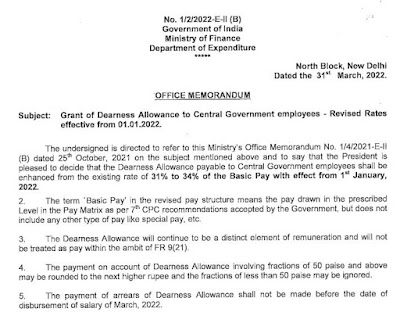
DA Jan 2022 - Grant of Dearness Allowance to Central Government employees - Revised Rates effective from 01.01.2022

 3% DA Hike - Revised Rates effective from 01.01.2022: DoE OM dated 31.03.2022 No. 1/2/2022-E-II (B) Government of India Ministry of Finance...