Sunday, 10 April 2016

7th Pay Commission: Guess who else is going to benefit from Central Government Employees Pay Hike!

7th Pay Commission: Guess who else is going to benefit from Central Government Employees Pay Hike!
7th-CPC-pay-hike-7CPC


It is not just Central government employees eagerly anticipating implementation of the 7th pay commission and take home higher monthly pay package.

Your next-door real estate agent, car dealer and consumer durables seller are also seen gaining from the pay commission hike. According to reports, almost 3.4 crore individuals (employees and pensioners) will witness increase in their incomes, resulting in a multiplier effect on a couple of professions.

Real estate agent: Realty sector is expected to eventually succeed in shaking off the sluggish demand and witness spurt in the sale of houses in tier 1 and tier 2 cities as more than 80 percent of Central government employees lives in these cities

As a result of the foreseen demand, the Reserve Bank of India expects sharp, quick and continuous spurt in the housing index.

Car dealer: With implementation of the 7th CPC, your next door car or two wheeler dealer may rejoice too. The industry expects double digit increase in automobile sales especially two-wheeler, the mini and the compact hatch back segment.

Consumer durables seller: The increase in disposable income will no doubt boost the disposable income leading to increased demand for consumer durables goods like refrigerators, TV etc

Banker: Of course, peaking demand for automobiles, real estate and consumer durable will create demand for consumer loans. The consumer loans section of banks and NBFCs will vie to get the larger share of the indirect gain from the 7th CPC salary hike.

The scenario of crores of potential customers and falling interest rate will announce a win win situation for the banks and consumers both.

Via:  Zee News

7th Pay Commission: Reasons of delay in implementation

7th Pay Commission: Reasons of delay in implementation
7th-Pay-Commission-delay

Central Government employees must be wondering why Centre is taking so much time to implement Seventh Pay Commission recommendations.

It's already four months since Pay Commission had submitted its report to Finance Ministry to give final touch to it.

Though, Modi Government recently dropped enough hint that it will implement increment process soon, but no particular time frame was given to the Central staff.

Here are the possible reasons why Government is taking time to implement the hike.


Government needs to arrange fund

As Rs 1.02 lakh crore is needed to implement whole increment process, Centre needs to have proper strategy for the same.

At a time when OROP's expenditures is already taking toll on the exchequer, pay Commission will put extra burden on the government budget.


Grievances of various stakeholders

Government needs to address grievances of various stakeholders including government staff and Army men before taking final call on the same.

While Babus are unhappy with minimum basic pay, Defence personnels say that they shouln't be treated at par with their civilian counterparts in terms of salary and allowances.


Assembly elections

As model code of conduct is in place, Government doesn't want to take risk by announcing implementation date. Centre doesn't want to displease voters at a time when poll process is going on in many crucial states. It is being believed that notification for the 'increment proposal' will be issued once State election will be over.


Procedural delay

Pay Commission will be implemented after cabinet will give it a final approval. Currently, the Implementation cell of the Empowered Committee of Secretaries is trying to address various issues with it. After giving final touch to the report, Empowered Committee will send recommendations to PMO for its nod. Once PMO will through the report, it will be placed before the Cabinet.

Via at OneIndia news

Saturday, 9 April 2016

Dealing with incompetent Officers at Central Government Offices

Dealing with incompetent Officers at Central Government Offices

Everyone who’s ever had a officer has experienced frustration, but most of the officers at central government offices earn their position based on intelligence.

Sometimes the disgruntled employees are right — some officers can be truly incompetent. There are as many types of incompetent officers, who on their way to humiliate employees in front of clients.

A research showing that officers who feel incompetent really do lash out at others to temper their own inferiority.

Some officers feel they need to be superior and competent. When they don’t feel they can show that legitimately, they’ll show it by taking people down a notch or two.

Flattery seems to temper the aggressive urges of insecure officers. It is often seen incompetent officers are aggressive because of a hurt ego, for a simply threat to their power.

This might also explain why officers in their offices both big and small surround themselves with yes-men.
Blind flattery may not be the best solution for the 4.8 million central government employees estimated to have experienced in offices. But easing officers into new positions of power, or telling them that it’s natural to feel daunted, could prevent future outbursts.

It’s important central government employees remain solution-minded when dealing with incompetent officers, especially those lacking initiative.

However, keep in mind that senior enforcers are notoriously resistant to change, so don’t bother introducing any groundbreaking ideas until a few allies ready to back up.

It’s also best to wait for a large meeting before making any proposal.

Technical Resignation – Consolidated Guidelines issued by DOPT

The resignation is treated as a technical formality where a Government servant has applied through proper channel for a post in the same or some other Department, and is on selection, required to resign the previous post for administrative reasons.

DoPT consolidated  guidelines/ instructions regarding Technical Resignation – Counting of past service towards pension, Carry forward  of Leave benefits, Carry forward of LTC, Pay  Protection, GPF transfer, transfer of existing NPS account etc are some of the benefits of technical resignation

No.28020/1/2010-Estt.(C)
Government of India
Ministry of Personnel, Public Grievances & Pensions
(Department of Personnel & Training)
North Block, New Delhi
 Dated the  & 8th April ,  2016
OFFICE MEMORANDUM

Subject: Technical Resignation & Lien- Consolidated guidelines.

    The undersigned is directed to refer to this Department’s OM of even number dated the 26th  December, 2013 on the above subject and to say that guidelines/ instructions regarding Technical Resignation have been issued from time to time. It is now proposed to further consolidate these instructions and clarify the related issues as the Department continues to receive frequent references on these issues.

2. Before these  clarifications  in the draft O.M are  finalized, it is requested to furnish comments/views in this regard, if any, by 22.04.2016 to the undersigned at the  e-mail address: dse@nic.in.
Director (Estt.)
Telefax: 23093176

Download  DoPT OM No.28020/1/2010-Estt.(C) dated 08.04.2016

No.28020/1/2010-Estt.(C)
Government of India
Ministry of Personnel, Public Grievances & Pensions
(Department of Personnel & Training)
North  Block, New Delhi
Dated  the  April,  2016
OFFICE MEMORANDUM

Subject: Technical Resignation & Lien- Consolidated guidelines.

The undersigned is directed to refer to this Department’s OM of even number dated the  26th December,  2013  on  the  above  subject and  to  say  that  guidelines/  instructions regarding Technical Resignation have been issued from time to time. It is now proposed to further  consolidate  these  instructions  and  clarify  the  related  issues  as  the  Department continues to receive frequent references on these issues.

2. Technical Resignation

1. As per the Ministry of Finance OM No.33 79-E.III (B)/65 dated the 17th June, 1965, the resignation  is treated as a technical formality where a Government servant has applied through proper channel for a post in the same or some other Department,  and is on selection, required to resign the previous post for administrative reasons. The resignation will be treated as technical resignation if these conditions are met, even if the Government servant has not mentioned the word “Technical” while submitting his resignation. The benefit of past service, if otherwise admissible under rules, may be given in such cases. Resignation in other cases including where competent authority has not allowed the Government servant to forward the application through proper channel will not be treated as a technical resignation and benefit of past service will not be admissible. Also, no question of benefit of a resignation being treated as a technical resignation arises in case of it being from a post held on ad hoc basis.

2.   This benefit  is  also  admissible to  Government servants who have applied before joining  the Government service and on that account the application was not routed through proper channel. The benefit of past service is allowed in such cases subject to the fulfillment of the following conditions:-
(i) the  Government  servant  should  intimate  the  details  of  such  application immediately on their joining;

(ii) the Government servant at the time of resignation should specifically make a request, indicating that he is resigning to take up another appointment under Government/ Government organisation for which he applied before joining the Government service;

(iii) the  authority  accepting  the  resignation  should  satisfy  itself  that  had  the employee been in service on the date of application for the post mentioned by the  employee,   his  application   would  have  been  forwarded   through   proper channel.
2.1  Carry forward  of Leave benefits

(i)    In terms of Rule 9(2) of the CCS (Leave) Rules, 1972,   technical resignation shall not result in the lapse of leave to the credit of the Government servant.  The balance of unutilised CCL as well as all other leaves of the kind due & admissible will be carried forward.

(ii)  As  per  rule  39-D  of  the  CCS(Leave)  Rules, 1972,   in  case  of  permanent absorption in PSUs/ Autonomous Bodies/ State Government etc.,  the Government servant shall be granted cash equivalent of leave salary in respect of EL & HPL at his credit subject to overall limit of 300 days.

2.2  Carry forward of LTC

Entitlement to L TC may be carried forward in case of a Central Government Servant who joins  another post after having submitted Technical Resignation.   In case of a Govt Servant  who  resigns  within  8   years  of  his  appointment  and joins  another  post  in  the Government after Technical Resignation, Govt Servant will be treated as a fresh recruit for a period of 8 years from the date of his initial appointment under Government.

2.3   Pay  Protection,  eligibility  of  past  service  for  reckoning of  the  minimum period for grant of Annual Increment

In cases of appointment of a Government servant to another post in Government on acceptance of technical resignation, the protection of pay is given in terms of the Ministry of Finance OM No. 3379-E.III (B)/65 dated the I J1h June, 1965 read with provisions of FR 22- B.  Past service rendered by such a Government servant is taken into account for reckoning of the minimum period for grant of annual increment in the new post/ service/ cadre in Government under the provisions of FR 26 read with Rule 10 of CCS (RP) Rules, 2008.   Pay of the substantive post held by the Government servant is protected. After Sixth Pay Commission, only the pay in the pay band is protected and the employee gets the grade pay of the post to which he is appointed after his resignation.

2.4   GPF transfer

Transfer  of  GPF on technical resignation would be governed by  Rule  35 of the General Provident Fund (Central Services) Rules, 1960.

2.5 Seniority

The tenure of periods spent in the past service does not get included in determining the eligibility for the next promotion. In case of employees who retain a lien on submitting Technical Resignation, in the event of their reversion to their previous job, the period spent in the  new job would  not  be  counted  for  calculation  of  minimum  qualifying service  for promotion in their previous job. The individual will however in case of his reversion to parent organisation regain his seniority with effect from the date of his reversion .

2.6 Applicability of Pension  Scheme

In cases  where  Government   servants,   who had  originally  joined government   service prior  to 01.01.2004,    apply  for posts  in the same  or other  Departments   and  on selection  they are asked to tender  technical  resignation,   the past  services   are counted towards pension  if the new  post  is  in a pensionable   establishment   in terms of  Rule  26(2)  of  CCS(Pension)  Rules 1972.

2.7  New Pension   Scheme

In  case  of  ‘Technical   Resignation   ‘of  Government   servant  covered  under  National Pension   System(NPS),    the  balance   standing   to  their  Personal   Retirement   Account   (PRA) along-with  their PRAN,  will be carried  forward  to the new office”.

2.8  Transfer  of Service  Book  from  parent   Department    to present   Department.

As per SR-  198, the Service  Book is to be maintained  for a Government  servant  from the date of his/her  first appointment   to Government  service and it must be kept in the custody of the Head of Office  in which  he is serving and transferred  with him from office to office.

2.9 Need  for Medical   examination.
In cases  where  a person  has already  been examined  by a Medical  Board  in respect  of his previous  appointment   and  if standard  of medical  examination   prescribed  for the new post  is the same, then he need not be required  to undergo  a fresh examination.

2.10  Verification of Character  & Antecedents

In the case of a person who was originally employed in an office of the Central Government, if the period intervening between date of discharge from his previous office and the date of securing a new appointment, is less than a year,  it would be sufficient if the appointing authority, before making the appointment, satisfies itself by a reference to the office in which the candidate was previously employed that, (a) that office have verified his character and antecedents; and (b) his conduct while in the employ in that office did not render him unsuitable for employment under Government.  If however, more than a year has lapsed after the discharge of the person from his previous office, verification should be carried out in full/afresh, in accordance with O.M.No.18011/9(s)/78-Estt(B) dated 2″d July,1982.

3 Lien

(i) Lien represents the right of a Government employee to hold a regular post, whether permanent or temporary, either immediately or on the termination of the period of absence. The benefit of having a lien in a post/service/cadre is enjoyed by all employees who are confirmed in the post/service/cadre of entry or who have been promoted to a higher post, declared as having completed the probation where it is prescribed. It is also available to those who have been promoted on regular basis to a higher post where no probation is prescribed under the rules, as the case may be.

(ii)  The above  right  will,  however,  be subject  to the condition  that the junior-most   person in the cadre  will  be liable  to be reverted  to the  lower  post/service/cadre    if at any  time  the number  of  persons   so  entitled   is more  than  the  posts  available   in  that  cadre/service.      For example,   if a person  who holds a lien to a post reverts  from deputation  or foreign  service   and if there  is no vacancy  in that post/service/cadre   to accommodate   him,  the junior-most   person will be reverted.   If, however, this officer himself is the junior-most, he will be reverted to the next lower post/service/cadre from which he was earlier promoted.

3.1 Lien on a post

A Government servant who has acquired a lien on a post retains a lien on that post-
(a)  while performing  the duties of that post;
(b)  while  on foreign  service,   or holding  a temporary  post or officiating  in another post;
(c)  during  joining   time   on  transfer   to  another   post;    unless   he  is  transferred substantively  to a post on lower pay,  in which case his lien is transferred  to the new post from the date on which he is relieved  of his duties in the old post;
( d)  while on leave; and
( e)  while under suspension.
A Government servant on acquiring a lien on a post will cease to hold any lien previously acquired on any other post.

3.2  Retention of lien for appointment in another central government office/ state government

(i)  A permanent Government servant appointed in another Central Government Department/Office/ State Government, has to resign from his parent department unless he reverts to that department within a period of 2 years, or 3  years in exceptional cases. An undertaking to abide by this condition may be taken from him at the time of forwarding of his application to other departments/offices.

(ii) The exceptional cases may be when the Government servant is not confirmed in the department/office where he has joined within a period of 2 years. In such cases he may be permitted to retain the lien in the parent department/ office for one more year. While granting such permission, a fresh undertaking similar to the one indicated above may be taken from the employee.

(iii)  Timely action  should  be taken to  ensure  extension/ reversion/ resignation  of the employees to their parent cadres on completion of the prescribed period of 2/3  years. In cases, where employees do not respond to instructions, suitable action should be initiated against them for violating the agreement/ undertaking given by them as per (3) and (4) above and for termination of their lien. Adequate opportunity may,  however, be given to the officer prior to such consideration.

(iv)  Temporary  Government  servants will be required to  severe connections  with the Government in case of their selection for outside posts.    No lien will be retained in such cases.

3.3 Termination Of Lien

(i) A Government servant’s  lien on a post may in no circumstances be terminated even with his consent if the result will be to leave him without a lien upon a permanent post. Unless his lien is transferred, a Government servant holding substantively a permanent post retains lien on that post. It will not be correct to deny a Government servant lien to a post he was holding substantively on the plea that he had not requested for retention of lien while submitting  his Technical  Resignation,  or to relieve such a Government  servant with   a condition  that no lien will be retained.

(ii)       A Government employee’s lien on a post shall stand terminated on his acquiring a lien on a permanent post (whether under the Central Government or a State Government) outside the cadre on which he is borne.

(iii)     No lien shall be retained:
(a) where  a Government   servant  has proceeded  on immediate  absorption  basis to a post  or service  outside  his service/  cadre/  post  in the  Government   from the date of absorption;   and

(b) on foreign service/ deputation beyond the maximum limit admissible under the orders of the Government issued from time to time.
3.4 Transfer Of Lien

The lien of a Government servant, who is not performing the duties of the post to which the lien pertains, can be transferred to another post in the same cadre subject to the provisions of Fundamental Rule 15.

4   Joining Time, Joining Time Pay &Travelling Allowance

Provisions relating to joining time are as follows:
(i) For appointment to posts under the Central Government on results of a competition and/or interview open to Government servants and others, Central Government employees and permanent/ provisionally permanent  State Government employees will be entitled to joining  time under the  CCS(Joining Time) Rules,1979.   Joining time will be included as qualifying service in the new job.

(ii)  A Government servant on joining time shall be regarded as on duty during that period and shall be entitled to be paid joining time pay equal to the pay which was drawn before relinquishment of charge in the old post. He will also be entitled to Dearness Allowance, if any,  appropriate  to  the joining  time  pay.  In  addition,  he  can  also  draw  compensatory allowances like House Rent Allowance as applicable to the old station from which he was transferred. He shall not be allowed Conveyance Allowance or permanent Transfer.

(iii) For appointments to posts under the Central Government on the basis of results of a competition and /or interview open to Government servants and others, Central Government employees   and permanent/   provisionally   permanent   State  Government  employees   shall  be entitled  to  Transfer   Travelling   Allowance (TT A).  However,  temporary   Central  Government employees  with less than 3  years of regular  continuous  service would not be entitled  for TT A, as they are not entitled joining time pay under Joining Time Rules.
5   All Ministries/ Departments are requested to bring the instructions/ guidelines to the notice of all concerned.
(Mukesh  Chaturvedi)
Director  (Estt.)
Telefax:  23093176

Kendriya Vidyalaya has issued Public Notice regarding fake notice dated 29.3.2016 appearing in some social media

KVS disowns the public notice dated 29.3.2016 appearing in some social media in respect of cancelled examination for the posts of PRT and PRT(Music) as no fresh dates have been decided

Kendriya Vidyalaya has issued Public Notice regarding fake notice dated 29.3.2016 appearing in some social media
Kendriya Vidyalaya Sangathan (HQ)
18, Institutional Area, Saheed Jeet Singh Marg
New Delhi – 110016
Fax: 26514179
website: www.kvsangathan.nic.in
E-mail: kvs.jcadmn@gmail.com
F. 11054/3/2015-KVSHQ (RPS)
Dated : 04.04.2016

PUBLIC NOTICE

It has come to the notice of Kendriya Vidyalaya Sangathan that a public notice dated 29.3.2016 bearing file No. 11054/29/2016 – KVSHQ (RPS) has appeared in some social media regarding conduct of written examination on for the post of PRT & PRT (Music) for the year 2014-15 and 2015-16 on 18.4.2016. Some candidates/citizens are enquiring about this notice from KVS (HQ) over phone and email.

In this regard it is clarified that KVS vide its public notice dated 04.10.2015 bearing file No. 11054/3/2015-KVSHQ (RPS) had informed all concerned that the new date of examination for both these posts will be posted on KVS website www.kvsangathan.ni.in. All candidates were accordingly advised to keep a watch on KVS website in future in this regard.

In the light of above, KVS disowns the aforesaid public notice dated 29.3.2016 appearing in some social media as no fresh dates have been decided for conduct of cancelled examination for the posts of PRT and PRT(Music) for the year 2014-15 and 2015-16. The public notice dated 29.3.2016 appearing on behalf of KVS in some social medica is fake and misleading.

The candidates/interested persons are, therefore, one again advised to rely upon only the information available in KVS website i.e. www.kvsangathan.nic.in

Further, KVS is not responsible for such type of false/ misleading information being circulated in social media and / or other websites.

(S. VIJAYA KUMAR)
Jt. Commissioner (Admn)

Download Kendriya Vidyalaya circular F. 11054/3/2015-KVSHQ (RPS) dated 04.04.2016

Friday, 8 April 2016

Innovative approach: 50 percent of 7th Pay commission arrears to be invested in bond

Innovative approach: 50 percent of 7th Pay commission arrears to be invested in bond 

The government is considering an innovative proposal under which 50% of increased salary of higher-income government staff under the Seventh Pay Commission will be compulsorily invested in bank capitalisation bonds. The proceeds will be used to recapitalise banks without additional pressure on the fiscal.

While this will result in less cash in the hands of higher-income employees, as a sweetener they will get income tax rebate on the amount invested. Those wanting to invest more than 50% to save tax will be allowed to do so. The Bank Recapitalisation Scheme, as this proposal is being called, will be voluntary for employees with lower salaries (those in the Rs 5,200-20,200 bracket) and pensioners.

A finance ministry official confirmed that preliminary discussions around this proposal were held at a meeting on A finance ministry official confirmed that preliminary discussions around this proposal were held at a meeting on Thursday, but no decision on its implementation was taken. “The issue was discussed. We are looking at all options,” he said.

“The proposal entails that through a provision under Income Tax Act, tax rebate should be offered to all employees receiving extra salary income through pay commission in the year 2016-17 and 2017-18, provided the money is invested in this Bank Recapitalisation Scheme,” added the official.

The government will have to additionally shell out Rs 40,000-50,000 crore annually on account of implementation of the seventh pay commission recommendations with effect from January 1, 2016. If this proposal is accepted, a portion of this money will be used to capitalise banks. According to finance ministry estimates, state-run banks will require Rs 1.8 lakh crore of additional capital in the next four financial years, of which Rs 70,000 crore will be provided by the government.

The government has budgeted Rs 25,000 crore for bank capitalisation in the current fiscal. While the government has said it has made adequate provision in the Budget to cover the extra spending on account of the pay commission recommendations, analysts reckon it is not adequate and full implementation of award will make it difficult to achieve the fiscal deficit target of 3.5% of GDP.

“Increase in government employee wages and pension expenditure on account of seventh pay commission recommendations is not fully provided for in the Budget,” Morgan Stanley had said in a report.

The proposal currently under consideration gives the government the leeway to meet both its pay commission and bank capitalisation commitments without putting the fiscal deficit target under threat. Bonds will provide the exchequer some wriggle room. The payment will become due when bonds mature, leaving the government with only the interest payment liability in the current fiscal.

The flip side is that the proposed scheme could annoy government employees expecting a greater take-home pay. Hence the scheme has a tax exemption lollipop.

A second government official said this amount will be used to recapitalise banks through a special bank capitalisation fund that will invest in perpetual non-redeemable preference shares issued by banks. Banks will pay 5.1% dividend that is also proposed to be exempted from the dividend distribution tax. The fund will in turn pay 5% interest to government employees, retaining 0.1% as administrative charge.

“This interest income will also be tax free for government employees,” he said, which will increase the effective yield. The government will eventually pay back the amount in four equal investments after 8, 9, 10 and 11years, spreading the fiscal burden of repayment over that period. It will guarantee payment of 5% interest and repayment of deposits irrespective of whether the banks pay the dividend or not, the official added.

Source: ET

Central Government Employees get 6 per cent DA hike from January 1

Central Government Employees get 6 per cent DA hike from January 1

Dearness allowance for central government employees has been hiked to 125 per cent of basic pay, up by 6 percentage points, with effect from January 1, 2016, the Finance Ministry said today.

Dearness Allowance payable to central government employees shall be enhanced from existing rate of 119 per cent to 125 per cent from January 1,2016,” according to a Finance Ministry office memorandum bringing into effect the DA hike announced last month.

The decision to release an additional instalment of DA to central government employees and Dearness Relief (DR) to Pensioners from January 1, 2016, was taken by Union Cabinet on March 23.

The combined impact on the exchequer on account of both DA and Dearness Relief would be of Rs 6,796.50 crore per annum and Rs 7,929.24 crore respectively, in 2016-17 (for a period of 14 months from January, 2016 to February, 2017).

The DA will benefit 50 lakh central government employees and 58 lakh pensioners.

Dearness Allowance is paid as a portion of basic pay of employees to neutralise the impact of inflation. Pensioners get Dearness Relief.

The Centre revises DA twice a year on the basis of one year average of retail inflation for industrial workers as per a pre-determined formula.

In September last year, DA was increased to 119 per cent from 113 per cent with effect from July 1, 2015. In April last year, the government had hiked DA by 6 percentage points to 113 per cent of the basic pay with effect from January 1, 2015.

PTI

DoPT Order: Discontinuation of Interview at Lower Level Posts

F.No.39020/09/2015-Estt.B
Government of India
Ministry of Personnel, Public Grievance and Pensions
(Department of Personnel and Training)
Estt. B Section
Discontinuation of Interview at Lower Level Posts

The Prime Minister in his address to the nation on the Independence Day has stressed the need to discontinue holding interviews for recruitment for such junior level posts where personality assessment is not an absolutely necessary requirement.

He has called upon the Government Organizations’ to end this practice at the earliest as it will help in curbing corruption, more objective selection in transparent manner substantially easing the problems of poor people.
He has emphasized that the recruitment should be made on merit basis through transparent, online processes leading to less Government and more Governance.

The Department of Personnel and Training on the basis of recommendations made by the Committee of Secretaries has already taken a decision to discontinue interviews at the junior level posts at Group ‘B’ (Non-Gazetted), Group ‘C’ ,Group ‘D’ (which are now reclassified as Group ‘C’) and all equivalent posts.
All the advertisement for future vacancies will be without the Interview as part of the recruitment process.

From 1 st January 2016 there will be no recruitment with interview at the junior level posts, in Government of India Ministries/ Departments/attached Office/Subordinate Office/Autonomous Bodies/Public Sector Undertakings.

The interviews will be done away even in cases where the selections were made purely on basis of performance in the interview. The inistries/Departments/Organizations’ will consider revising the scheme for selection or such cases.

As the Skill Test or Physical Test is different from Interview they may continue. However these tests will only be of qualifying nature. Assessment will not be done on the basis of marks for such tests.

The decision to discontinue interview for the junior level posts across the country will be major step towards achieving the objectives of citizen centric transparent governance.

The matter has also been taken up with the State Governments/UTs to undertake similar exercise, from time to time. In this regard letters from Secretary (Personnel) to the State Chief Secretaries have been issued on 4th September 2015 and letters from MoS(PP) to the State Chief Ministers have been issued on 29 th September 2015 and 1 st January, 2016.

To facilitate the implementation of the directions of the Hon’ble Prime Minister further by the various Organizations/Ministries/Departments/Governments a one day workshop was also organized by the DOPT on 16th November 2015.

Some of the State Government have shared the status in this regard with the DOPT.

The Summary of the State Responses on the Discontinuation of Interview is as follows:

Daman & Diu, Dadra and Nagar Haveli No interviews in Group B (non gazetted), C and D posts. They have issued a recruitment pattern.
Gujarat Government of Gujarat has informed that the State Government had implemented the policy of cancellation of interview in the direct recruitment, on the lower level posts.
Haryana No interviews at Group ‘D’ level
Himachal Pradesh There is a proposal to discontinue interview for Group C and Group B Posts
Jharkhand No interview in ‘D’, ‘C’, and ‘B’ (non-gazetted)
Karnataka Government of Karnataka has informed that the State Government has discontinued the procedure of conducting interview for selection to Technical and Non-Technical Posts in Group-C category, in the Government
Kerala At present no interview are there for group ‘C’ and ‘D’ posts and even for some of the gazetted posts.
Maharashtra Interviews for the recruitment of the clerks have been discontinued. For Class 2 non-Gazetted, Class 3 and 4 posts, interviews have been done away. The State Government has taken a decision and issued directions to the effect that the direction of discontinuation of Interview will also be applicable to all State Government undertakings and local bodies. About 61% of the recruitment is done without interview.
Manipur It was informed that the State Government had undertaken the recruitment of Graduate Teachers under the Rashtriya Madhyamik Sikhsha Abhiyaan (RMSA) without conducting interview. This measure was successfully undertaken and was completely transparent and corruption free. It was informed that the second pilot measure in this regard is being undertaken by the Health Department.
Puducherry Notification for discontinuation of interviews for Group C, D, and nongazetted Group B has been issued.
Punjab Some of the Departments have already implemented the decision and that there has been no problem with completely doing away with interviews for the posts of SDO in Irrigation Department, Senior Assistant in Secretariat and for a few lower level posts in Agro Industry Department.
Rajasthan The representative from Rajasthan informed that interviews have been discontinued in some posts and retained in some of them. For Class 3/Ministerial staff and Group D/Class 4 level recruitment, there have been no interview. Similarly for Constable, there have been only written test and physical test. The interviews have been dispensed away for all the posts under the Rajasthan Education Service Rules, 1970.
Sikkim For Group D/Class 4 level posts there are no interviews. At Group C/III level, for 90% of posts there are no interviews.
Telangana Teachers — no interviews
Tamil Nadu The recruitment is done by the following four recruitment boards and the status vis-a-vis conducting the interview is as follows:- 5) Uniform Services Board- No interview

6) Medical Services Board- No interview
7) Teachers Recruitment Board- No interview
8) Tamil Nadu Public Service Commission (TNPSC) — has assorted posts in which there is some degree of posts with interviews.
In the State 85% of the total posts do not have interview as a part of recruitment process.
Uttarakhand The state Government has abolished interviews in the group ‘C’ and ‘B’ (non gazetted). There has been no interview in Class 3/4 levels of posts.
Uttar Pradesh No more interview for teachers.

DoPT Circular

Good News for Pre-2006 Pensioners – Indian Military Info

This article has been written by Indian Military Info in the backdrop of recent orders of Department of Pension for granting full Pension for Pre 2006 Pensioners with less than 33 Years

Good News for Pre-2006 Pensioners – Indian Military Info article on comparison of Ministry of Personnel and Defence Ministry in dealing with Pension issues

Most readers would be aware that the orders regarding calculation of pension of pre-2006 retirees based on minimum of pay within the pay band for each separate grade/rank and not on minimum of the pay band itself, with arrears from 01-01-2006 rather than 24-09-2012, were issued for Central Government pensioners in July 2015 by the Government as per the decision of the Delhi High Court, which essentially followed a decision of the Punjab & Haryana High Court, and then upheld by the Supreme Court. The High Court had held that the anomaly (though later removed by the Government itself from 24-09-2012) had to be removed from the date of the inception of the anomaly, that is, 01-01-2006. Similar orders were later issued by the Ministry of Defence.

On a similar analogy, many decisions by various Benches of the Central Administrative Tribunal (and then upheld by the High Courts) were rendered de-linking the service requirement of 33 years for grant of full pension for pre-2006 retirees at par with post-2006 retirees for whom there is no such requirement. Some Special Leave Petitions preferred by the Government against such orders were also dismissed, though not by way of detailed decisions. The Punjab  Haryana High Court had also passed a detailed verdict on the same subject for pensioners of the Central Armed Police Forces. Till date, the pensions of pre-2006 pensioners with less than 33 years of service (including weightage) were being calculated by way of proportionate reduction.

Through this earlier post dated 22-01-2016, in view of multiple queries in this regard, I had informed by way of general information that the matter of issuance of orders on this subject for similarly placed retirees was being examined by the Department of Pensions & Pensioners’ Welfare, Ministry of Law & Justice and Ministry of Finance.

The Department of Pensions and Pensioners’ Welfare has now issued universal orders giving effect to the judicial decisions of the High Courts and has removed the requirement of 33 years service for full pension. Now, irrespective of length of service, all pre-2006 pensioners shall be eligible for full pension as is admissible to those pre-2006 pensioners who had rendered 33 years or more service including weightage. Full arrears are also admissible with effect from 01-01-2006. The biggest gainers would be voluntary retirees and those released from service on medical grounds or before completing full service. Similar orders should now be issued for defence pensioners also by the Ministry of Defence.

A word of caution- This change would not affect the concept of One Rank One Pension (OROP) applicable with effect from 2014 since while this development is based on 50% of minimum emoluments introduced by the 6th Central Pay Commission for each grade, the concept of OROP is based on live data of actual pension based on real time emoluments as per length of service of in-service personnel. Readers are hence requested not to mix up the two dispensations which operate by way of separate dynamics.

We must again place on record extreme gratitude to the Department of Pensions and Pensioners’ Welfare functioning under Ministry of Personnel, Public Grievances & Pensions which has once again taken a stand for all Central Government pensioners and ensured issuance of universal directions just on simple dismissal of a Special Leave Petition by the Supreme Court even without a detailed order. One cannot also help but compare this with the attitude of the Ministry of Defence which continues to file appeals against its pensioners and disabled pensioners based on artificial distinctions even when the law has been fully settled by the Supreme Court in a plethora of detailed landmark decisions and which also militates against the grain of the opinion expressed by the highest of political executive, including the Prime Minister. I however maintain and retain full hope that the current Raksha Mantri would be able to rein in the unruly horses.

Jai Hind.

Source: Indian Military Info

MHA for Pay on Par with Army for Paramilitary

In its presentation before the ECOS, the MHA also batted for a ‘special pay’ on par with the army. The defence forces get a special allowance in the form of military service pay (MSP) over and above their salaries.

MHA for Pay on Par with Army for Paramilitary – While recommending a ‘CAPF service pay’, the home ministry said, “CAPF fulfills all attributes required for military service pay, which includes separation from family.

Drawing a parallel with defense forces, Rajnath Singh-led home ministry, has recommended equivalent pay for a second in command (2IC) in central paramilitary to that of a lieutenant colonel in the army. At present, there is a difference of Rs 40,000 in their salaries “despite operational role of both ranks being similar in nature,” the home ministry informed the empowered committee of secretaries (E-COS) in its recent discussion.

In its presentation before the ECOS, the MHA also batted for a ‘special pay’ on par with the army. The defence forces get a special allowance in the form of military service pay (MSP) over and above their salaries.

While recommending a ‘CAPF service pay’, the home ministry said, “CAPF fulfills all attributes required for MSP, which includes separation from family.

They are the key pillars of internal and border guarding, handle warlike situation and continuously engaged in operations.”

According to an MHA official, the proposal for a ‘CAPF special pay’ was earlier mooted before the 7th pay commission last year. However, it was shelved at the last minute.

He also stated that the CAPF has raised nearly 40 demands, which were examined at the MHA, before recommending 11 of them to E-COS.

While terming it to be a “great morale booster” for the forces, the home ministry in its recommendation also sought additional leave travel concession (LTC) for CAPF personnel serving in high altitude on par with defense forces that will “facilitate personnel to visit at least twice to their families on government cost,” MHA said in its representation.

Home ministry also sought to address the problem of stagnation among the paramilitary by proposing that modified assured career progression scheme (MCAP). It shall be allowed four times at an interval of 8, 16, 24 and 32 instead of 3 times at an interval of 10, 20,30 years. “At present, it takes 20-22 years for them to get their first promotion and this has also led officers to quit. As many as 9,300 personnel quit ITBP, CISF, SSB BSF, CRPF, due to non-friendly working conditions,” said an official.

The government also advocated for a better leave structure for the personnel who are deployed for counter-insurgency operations across the country.

Source: Economic Times

Flash News

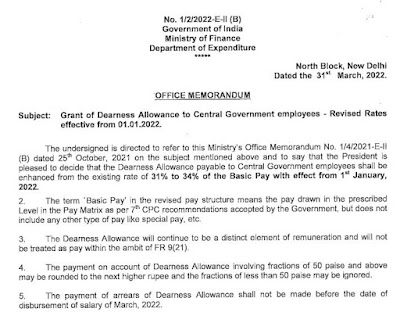
DA Jan 2022 - Grant of Dearness Allowance to Central Government employees - Revised Rates effective from 01.01.2022

 3% DA Hike - Revised Rates effective from 01.01.2022: DoE OM dated 31.03.2022 No. 1/2/2022-E-II (B) Government of India Ministry of Finance...