Tuesday, 8 September 2015

All you wanted to know about 7th Pay Commission?

All you wanted to know about 7th Pay Commission?

Government offices are currently buzzing with excitement as employees await the recommendations of the Seventh Pay Commission. While the babus may have reason to smile as they may soon have more money in the pocket, it might not be equally good news for others.


What is it?

A Pay Commission is appointed by the government once every 10 years to look at the pay structure of Union and State government employees and pensioners. Typically, the commission takes 18 months to submit its report. The Seventh Pay Commission was constituted in February 2014 under the chairmanship of Justice Ashok Kumar Mathur to submit its recommendations by August 2015.
Pay commissions study the current pay scales and make recommendations on not just pay increases, but also pay structure. For example, the Sixth Pay Commission recommended that transport allowance, which was a lump-sum amount earlier, be paid along with a Dearness Allowance component. Likewise, the House Rent Allowance calculation was pegged to a percentage of pay. From the Seventh Pay Commission, there are expectations of tweaks to retirement age, performance-linked pay and flexible work hours for women and employees with disabilities, apart from pay hikes. The recommendations are expected to be effective from January 1, 2016. If there are delays, the pay revisions would be done with retrospective effect.


Why is it important?
For three reasons. One, it has an impact on government spending and fiscal deficit. For example, after the Sixth Pay Commission was implemented, the fiscal deficit that year doubled to 6 per cent in 2008-09, partly due to the resulting increases.

Currently, Central government pay and allowances account for 1 per cent of the country’s GDP. This could increase if the pay hikes are significant. Based on the medium-term expenditure framework presented to Parliament, a 16 per cent pay increase is likely from the Seventh Pay Commission. This could add 0.2-0.3 per cent of GDP by way of additional expenditure in 2016-17, estimates DBS.

Two, if the government sticks to its fiscal deficit targets, the higher outgo may entail cuts in other items of spending, including capital expenditure.

Three, pay increases granted by the commission can act as a stimulus to the economy by boosting the consumption leg of GDP. At last count, India employed 48 lakh Central government employees and 55 lakh pensioners and over one crore State and local government employees. The Fourteenth Finance Commission estimates that after the Sixth Pay Commission, pay and allowances to Central government employees more than doubled in a four-year period between 2007-08 and 2011-12.


Why should I care?
If you are a government employee, retiree or a job aspirant, you probably would be watching out eagerly for the report. As an investor, you can consider consumption as a theme to bet on — there is a co-relation between pay commission increases and discretionary spending in urban India. Higher disposable income in the hands of the people could aid automobile and property sales.

The country’s fiscal deficit is a cause for concern as it impacts tax policies.

The bottomline
Pay attention to the recommendations of this commission. It matters to the economy, to the deficit and to your portfolio.

Source: www.thehindubusinessline.com

Minimum speed of BSNL Landline Broadband will be 2Mbps from 1.9.2015

Minimum speed of BSNL Landline Broadband will be 2Mbps from 1.9.2015

BSNL Upgrades the speed of all Landline Broadband customers from 512 kbps to minimum 2 Mbps

Committed to the Government’s Digital initiatives announced by Hon.ble PM, BSNL has decided to upgrade Broadband speed to minimum 2 Mbps at no additional cost for all the Broadband customers on PAN-India Basis from 1st October 2015. This is another major service offering from BSNL for the benefits of customers in continuation to offering free night calling from BSNL landline to all operator network from 9:00 PM to 7:00 AM and free incoming roaming services for its mobile customers. BSNL is also offering 1Gb free E-Mail box to their customers from 50 Mb mail box.

Shri Ravi Shankar Prasad Hon’ble MOC &IT, GOI announced this today here at Gurgaon in a function organized by BSNL. The function was graced by Shri Rao Inderjeet Singh Hon’ble MOS for Planning & MOS for Defence (Independent charge) GOI. Shri Anupam Srivastav CMD BSNL, Shri N K Gupta Director (CFA), Smt Sujata Ray Director (HR) BSNL Board and Shri R C Arya CGM Haryana circle were also present on the occasion.

The speed up-gradation will benefit all the existing and new Broadband customers of BSNL. Under this scheme, BSNL is upgrading the speed of existing Broadband plans of 512 Kbps & 1 Mbps to 2 Mbps speed. With this upgradation, BSNL customers can access / surf the internet including social network websites like Facebook, Google, Twitter, etc. at high speed.

BSNL is the first service provider to provide the Broadband Access to the country. BSNL launched the Broadband services over its landline in India in 2005 with speed of 256kbps and above over the state of art Multi Protocol Label Switching (MPLS) based IP infrastructure in urban as well as Rural areas.

BSNL since then is constantly working for increasing the broadband speed for the enhanced experience of customer in urban as well as rural areas as envisaged in New Telecom Policy 2012.. Now, BSNL offers Broadband services with various plans ranging from 2 mbps to 100 mbps speed using ADSL/VDSL and fiber based GPON technology in a very affordable price range. BSNL is currently having around 10 Mn Broadband customers including about 1.1 Mn. Rural customers.

This up-gradation shall enhance customer experience while surfing on internet and enjoying live video streaming by all customers even in the low price range. This scheme is expected to attract new customers for subscribing BSNL Broadband customers in an affordable manner.

BSNL is one of the largest Telecom Service providers in India. BSNL has installed Quality Telecom Network in the country & focusing on improving it, expanding the network, introducing new telecom services with ICT applications. BSNL is having more than 77 Million Mobile customers, more than 16 million wired line telephone connections and around 10 million wired Broadband connections.

For further information, customers can access the BSNL Customer Care Service through Toll free number 1500 (from BSNL number) & 1800 345 1500 (from other operator number) or visit the BSNL website www.bsnl.co.in.

Source: PIB News

Wait for final OROP order for clarity: Parrikar

Wait for final OROP order for clarity: Parrikar

Mumbai: With confusion surrounding who among the retirees will get the benefits of One Rank One Pension, Defence Minister Manohar Parrikar today asked all those concerned to wait for the final order, which will “explain it properly”.

“You have to wait for the final order (on OROP) which will come. Why is there so much excitement till then the PM has made it amply clear that those who are being allowed to retire through proper procedure will not be (adversely) impacted. You need to wait for the exact wording,” he told reporters on the sidelines of an Engineers’ Conclave.

He also clarified that the concept of ‘Voluntary Retirement Scheme (VRS) does not exist in the Armed Forces.

“In the Armed Forces even if you apply, you may not get voluntary retirement, unlike (in) civilian (service), where you can get it. In the Armed Forces, you can be refused. There are many people who because of health reasons apply and the Armed Forces also want them to retire and, if that happens before the minimum service requirement, then they don?t get pension.

“We will explain this properly, no one should unnecessarily create confusion on it,” Parrikar said.
Parrikar said many things needed to be considered before Rs 8000 crore is sanctioned for implementing OROP.

“A lot of things have to be considered before sanctioning Rs 8,000 crore…it is not a matter of Rs 8. There were a lot of issues involved with it, why blame someone? It is very easy to say that give it (money), but when one has to give the money, it is not easy,” he said.

He was asked whether differences between bureaucracy and the political leadership had delayed the announcement.

Prime Minister Narendra Modi had yesterday said those who had had to quit the defence forces prematurely would also be entitled to OROP benefits.

PTI

No salary deduction on bandh day for Bengal Government Employees on paid leaves

No salary deduction on bandh day for Bengal Government Employees on paid leaves

Kolkat: West Bengal government employees who were on child care leave, maternity leave, earned leave etc. On September 2, the day when the central trade unions called a bandh, will not have to forgo their day’s salary.

A memorandum issued by the state finance department has said no salary would be deducted from such employees who had taken prior paid leaves.

“Now, to remove the confusion, it is clarified that absence will not be treated as ‘dies non’ and no salary will be deducted or treated to be inadmissible in case of leaves like child care leave, maternity leave, earned leave, etc sanctioned before the date of issuance of finance department’s order,” the memo said.

The government had made it mandatory for all its employees to be present on the strike day. An earlier directive had said absence of employees on that date would be treated as ‘dies non’ and no salary would be admissible.
PTI

7th CPC recommendation expected: Minimum Basic 15000, Average increase 15%-20% and Maximum 33 Years Service

7th CPC recommendation expected: Minimum Basic Pay 15000, Average increase 15%-20% in salary and Maximum 33 Years service


The basic salary is expected to be increased to 15 thousand
The central government’s personnel is not likely to get a big gift from the Seventh Pay Commission. According to sources, the average increase in wages is likely to be between 15-20 percent. While the good news is that the minimum basic salary is expected to be increased to 15 thousand. Central Pay Commission personnel can determine the maximum term of 33 years. It could be a losing proposition for personnel.
According to highly placed sources Pay Commission completed the process of consultations with the stakeholders and is now trying to finalize its recommendations. Within the next two months, the Commission will submit its report to the government. India trusted the three issues have been reported on the Pay Commission has almost finished its opinion.
Between 15-20 percent the average salary increase
Pay Commission’s first attempt is that the average wage increase should be limited to between 15-20 percent. If you look at the SPC, the average salary increase was 60-70 per cent. But the seventh pay commission believes that the Sixth Pay Commission recommendations received after the spectacular rise of the increase is unlikely to be.
Maximum period of service 33 years
Secondly, it is going to pay the Commission a significant recommendation that the maximum period of service of public employees 33 years may be prescribed. Means a personnel official in 20 years to find a job, he will be retired in 53 years. For others, retirement age remains 60 years. Although most memorandum to the Pay Commission has been seeking to increase the retirement age. Personnel want the retirement age to 62 years.
The minimum basic wage of 15 thousand rupees
According to the third issue is likely to be the minimum basic pay of 15 thousand rupees. From 3050 to 7730 it was raised last Pay Commission. Now it is likely to be Rs 15 thousand.
Journey of  Basic Salary
1946- First Pay Commission had fixed basic pay 35 Rupees.
1959- Second Pay Commission is Rs.80
1973 – Third Pay Commission – Rs.260
1986 – Fourth Pay Commission – Rs.950
1996 – Fifth Pay Commission – Rs.3050

Source: geod.in

Monday, 7 September 2015

Uniform Pension Scheme to retiring Railway employees at par with the ex-servicemen- reg.

Uniform Pension Scheme to retiring Railway employees at par with the ex-servicemen- reg.

NFIR
National Federation of Indian Railwaymen
3, CHELMSFORD ROAD, NEW DELHI – 110 055

Affiliated to :
Indian National Trade Union Congress (INTUC)
lnternational Transport Workers Federation (ITF)

No. IV/NPS/PFRDA BILL
Dated: 06/09/2015
Shri Narendra Modi,
Hon’ble Prime Minister of lndia,
South Block,
Raisina Hills,
New Delhi

Respected Sir,

Sub: Uniform Pension Scheme to retiring Railway employees at par with the ex-servicemen-reg.

At the outset, the National Federation of Indian Railwayemn (NFIR) thanks the Government for conceding to the demand of ex-servicemen for introduction of “One Rank – One pension” for them.

In this connection, Iwould invite your kind attention to the case of Railway employees numbering over 1.3 million as placed below:-

The Railway employees have been subjected to injustice as a result of introduction of New Pension Scheme (which is a contributory pension scheme) with effect from 01/01/2004. Consequently those employees who.joined railways on and after 01/01/2004 are governed by the contributory pension scheme with present nomenclature “New pension System” (NPS).

Presently, there are two sections of Rail Workforce – one governed by the Liberalized pensior Scheme (applicable to pre 0l/01/2004 appointees) and the other one governed by the contributory pension
scheme i.e. NPS applicable to post 0l/0l/2O04 appointees.

Since 2004, NFIR has been pressing the Government of lndia and the Ministry of Railways to withdraw New Pension Scheme as the duties and responsibilities of Railway employees are very complex, complicated and their working conditions are arduous as they perform duties at remote places extremist infested areas, jungle areas, without any supply chain. Vast percentage of Railway employees cannot afford to have timely medicines. social life, schooling facilities etc., Pursuant to the discussions held with the Railway Ministry on our pending demand seeking abolition of New Pension scheme in Railways, the then Railway Minister shri Mallikarjun Kharge had agreed with the demand and accordingly he had sent a communication to the Finance Minister on 29/03/2014 duly explaining the nature of duties of the Railway employees and seeking Government’s approval for exempting the Railway employees from the NPS whereby they can be governed by the Liberalized Pension Scheme. This issue is continued to remain unresolved.

For your kind appreciation. I mention here that according to the report of the Dr, Anil Kakodkar committee, submitted to the Railway Ministry in the year 2012. the death rate of Railway employees in the course of performing duties was much larger than the public. I quote below the figures given by the High Level Safety Review Committee headed by Dr. Kakodkar.


Killed Injured
(a) Railway employees 1600 8700
(b) Passenger/Public 1019 2110
(c) Unmanned Level crossing 723 690

The above position reveals that the Railway employees killed during the period 2001 – 08 to 2011 were 1600 while those injured on duty were 8700. This figure would convince that the duties of Railway
employees cannot be treated as less arduous in comparison with the defence and para-military forces. Like armed forces, Railway employees are expected to remain at their place of ‘posting even during periodic rest and they cannot afford to leave the headquarters and they perform duties under open sky facing inclement weather conditions and ensure running of trains round the clock.

It would therefore, be necessary to exempt Railway employees from the New Pension System (NPS).

2. Need to provide Uniform Pension Scheme or One Rank – One Pension to Rail Workforce:

The Railway employees discharge their duties round the clock by shifts and over 85% staff work in remote places where no human life exists. Their duties are safety-oriented. They are facing continuous stress and strain in the course of performing Train passing duties causing health hazards leading to pre-mature death, medical invalidation at a scale larger than the armed/para-military forces. The demand for  introduction of Uniform Pension Scheme to Railway employees of the same rank regardless of their date of retirement deserves consideration like that of retiring armed personnel.

I therefore, request you to kindly see that the Government accords approval, exempting Railway employees from the New Pension System for the purpose of covering them under the Liberalized Pension Scheme. I also request that “One Rank – One Pension” Scheme i.e. uniform pension for Railway employees retiring in the same rank regardless of their retirement may kindly be approved by the Government, considering the fact that Railway personnel are serving the nation, transporting military hardware and the army to the borders and ensuring uninterrupted movement of rail transport services at all times round the clock in all weather conditions.
Yours faithfully,
(Dr. M.Raghavaiah)
General Secretary
Source: NFIR

One Rank One Pension – Expected Pension hike and Arrears for ex-servicemen

Expected Pension hike and Arrears for ex-servicemen

“After the centre’s announcement of implementation, all ex-servicemen are curious to know about their likely increments and arrear in pension revision.”

Despite the fact that the Central Government has announced the implementation of OROP, which has been the long-standing demand of ex-servicemen for more than 40 years now, anti-government protests and rallies continue to rock New Delhi.

The ex-servicemen have made clear their disappointment over certain important demands and expectations related to the OROP, including the amendments in the pension revision, date of implementation, constituting a one-man commission, fixing of the base year, and the case of those who chose to retire early. These are also the reasons why protests have resumed.

According to the Ex-servicemen statement, 46% of ex-servicemen are PMRs(Pre Mature Retirement). So, this is the very important aspect in this scheme and we cannot compromise, veterans said.

The relay fast that was started at New Delhi’s Jantar Mantar in order to demand the immediate implementation of OROP, continues even after 83 days. Finally some of the war veterans launched a fast-unto-death protest. These protests, that were carried out in order to get the government to take some concrete action, instead of just making promises, succeeded. But, instead of celebrating the success of their protests, the ex-servicemen forced to declare that their protests will continue.

On the other hand, however, the Central Government has also splashed pictures of ex-servicemen delegates greeting the Prime Minister with bouquets, congratulating him for implementing the OROP scheme. But, there is no denying the fact that the announcement has brought cheers to all the ex-servicemen in the country.

Meanwhile, the big question among ex-servicemen now is – how much will the actual increment be? What is the arrears amount? When will it be delivered?

Understanding the OROP scheme is getting more and more complicated with new demands and clarifications being raised with each passing day. Only by debating and discussing on these issues can they be understood clearly. It is difficult to predict the increments and arrears of each and every pensioner accurately. There is no fixed age of retirement for all. The arrears and increments have to be calculated on the basis of their ranks, the number of years that they had served, and the year of their retirement.

It would be easier to calculate this if the Government releases a detailed PROJECTED OROP TABLE of revision of pension for all categories.

But, everyone, justify from the Jawans, up to senior officers, is assured of enhancement of approximately Rs.2200 to Rs.22,000 pm.

Source: http://www.cgstaffnews.in/

NFIR Demands Scrapping of New Pension Scheme (NPS) and grant of “One Rank – One Pension” to Railway Employees.

NFIR Demands Scrapping of New Pension Scheme (NPS) and grant of “One Rank – One Pension” to Railway Employees.

Press Statement of Dr.M. Raghavaiah, General Secretary, NFIR

The National Federation of Indian Railwaymen while welcoming the Government’s announcement for introduction of “One Rank – One Pension” for ex-servicemen, urges upon the Hon’ble Prime Minister to take steps for granting similar pensionary benefits to the Railway employees also, the duties of Railway employees are hazardous, risky and complex. They work at over 8,000 Railway stations covering the Railway Tracks of over 65,000 kms. Over 85% of Railway employees perform duties at remote places, extremist infested areas and places where no township or medical or drinking water or schooling fbcilities exist. Like Army, Railway employee cannot leave their post till another employee takes over the charge. The Railway tracks are maintained by the employees facing inclement weather conditions and working under open sky akin to that of defence personnel. On an average 800 Railway employees get killed per year in the course of performing duties and nearly 3000 sustain injuries while on duty.

For ensuring uninterrupted services the Railway employees are required to be on high alertness at all times. The Railway employees maintain high degree of discipline and efficiency to ensure that the Rail Transport System functions without interruption. The Chairman of the Railway Safety Review Committee” Justice H.R. Khanna (Retired Supreme Court Judge) had observed in his report that the working of the Railway system is more like armed forces, thus historically the Indian Railways functions differently from other Government Institutions.

The uniqueness in duties being performed by Railway employees is unmatched as these employees are involved in safe and efficient train operations more particularly the statf like Train Controllers, Station Masters, Electric Signal Maintainer. Technical Staff, Loco pilot. Guards.

Technical Supervisors whose duties and responsibilities are similar to that of defence personnel.
Indian Railways plays crucial role not only for the economic development of the country but also for ensuring rapid movement of Army, Military Hardware to the Borders and rises to the occasions when the security of the country is at stake. Railway employees face war like situation in their day-to-day working i.e. breaches, bandhs. civil disobedience movements. accidents etc.. and ensure maintaining the supply line all throughout.
It is unfortunate that the Railway employees have been subjected to injustice by governing them under New Pension Scheme with effect from January, 2004, Railwaymen’s demand for abolition of New Pension Scheme is unresolved even though Railway Minister Mallikarjun Kharge had recommended for exemption of Railways from New Pension Scheme.

I therefore, appeal to the Prime Minister of India to scrap New Pension Scheme in Railways and grant “One Rank – One Pension” Scheme to the Railway employees as has been agreed to in the case of retiring defence personnel.

Source: NFIR 

Seventh Pay Commission is no ogre: T.T. Ram Mohan

Seventh Pay Commission is no ogre: T.T. Ram Mohan


The report of the Seventh Pay Commission (SPC) is set to be released soon. The new pay scales will be applicable to Central government employees with effect from January 2016. Many commentators ask whether we need periodic Pay Commissions that hand out wage increases across the board. They agonise over the havoc that will be wrought on government finances. They want the workforce to be downsized. They would like pay increases to be linked to productivity. These propositions deserve careful scrutiny. The reality is more nuanced.
Critics say we don’t need a Pay Commission every ten years because salaries in government are indexed to inflation. At the lower levels, pay in the government is higher than in the private sector. These criticisms overlook the fact that, at the top-level or what is called the ‘A Grade’, the government competes for the same pool of manpower as the private sector. So do public sector companies and public institutions — banks, public sector enterprises, Indian Institutes of Technology (IITs), Indian Institutes of Management (IIMs) and regulatory bodies — where pay levels are derived from pay in government. 

The annual increment in the Central government is 3 per cent. Adding dearness allowance increases of around 5 per cent, we get an annual revision of 8 per cent. This is not good enough, because pay at the top in the private sector has increased exponentially in the post-liberalisation period.
Competition for talent
A correct comparison should, of course, be done on the basis of cost to the organisation. We need to add the market value of perquisites to salaries and compare them with packages in the private sector. We cannot and should not aim for parity with the private sector. We may settle for a certain fraction of pay but that fraction must be applied periodically if the public sector is not to lose out in the competition for talent.
True, pay scales at the lower levels of government are higher than those in the private sector. But that is unavoidable given the norm that the ratio of the minimum to maximum pay in government must be within an acceptable band. (The Sixth Pay Commission had set the ratio at 1:12). Higher pay at lower levels of government also reflects shortcomings in the private sector, such as hiring of contract labour and the lack of unionisation. They are not necessarily part of the ‘problem with government’.
 Perhaps the strongest criticism of Pay Commission awards is that they play havoc with government finances. At the aggregate level, these concerns are somewhat exaggerated. Pay Commission awards typically tend to disrupt government finances for a couple of years. Thereafter, their impact is digested by the economy. Thus, pay, allowances and pension in Central government climbed from 1.9 per cent of GDP in 2001-02 to 2.3 per cent in 2009-10, following the award of the Sixth Pay Commission. By 2012-13, however, they had declined to 1.8 per cent of GDP.
This happened despite the fact that the government chose to make revisions in pay higher than those recommended by the Sixth Pay Commission.
Today, Central government pay and allowances amount to 1 per cent of GDP. State wages amount to another 4 per cent, making for a total of 5 per cent of GDP. The medium-term expenditure framework recently presented to Parliament looks at an increase in pay of 16 per cent for 2016-17 consequent to the Seventh Pay Commission award. That would amount to an increase of 0.8 per cent of GDP. This is a one-off impact. A more correct way to represent it would be to amortise it over, say, five years. Then, the annual impact on wages would be 0.16 per cent of GDP.
The medium-term fiscal policy statement presented along with the last budget indicates that pensions in 2016-17 would remain at the same level as in 2015-16, namely, 0.7 per cent of GDP. Thus, the cumulative impact of any award is hardly something that should give us insomnia.
There are a couple of riders to this. First, the government is committed to One Rank, One Pension for the armed forces. This would impose an as yet undefined burden on Central government finances. Second, while the aggregate macroeconomic impact may be bearable, the impact on particular States tends to be destabilising.
The Fourteenth Finance Commission (FFC) estimated that the share of pay and allowances in revenue expenditure of the States varied from 29 per cent to 79 per cent in 2012-13. The corresponding share at the Centre was only 13 per cent. The problem arises because since the time of the Fifth Pay Commission, there has been a trend towards convergence in pay scales. The FFC, therefore, recommended that the Centre should consult the States in drawing up a policy on government wages.
Downsizing needed?
It is often argued that periodic pay revisions would be alright if only the government could bring itself to downsize its workforce — by at least 10 to 15 per cent. From 2013 to 2016, the Central government workforce (excluding defence forces) is estimated to grow from 33.1 lakh to 35.5 lakh. Of the increase of 2.4 lakh, the police alone would account for an increase of 1.2 lakh or 50 per cent. What is required is not so much downsizing as right-sizing — we need more doctors, engineers and teachers.
Downsizing of a sort has happened. The Sixth Pay Commission estimated that the share of pay, allowances and pension of the Central government in revenue receipts came down from 38 per cent in 1998-99 to an average of 24 per cent in 2005-07. Based on the budget figures for 2015-16, this share appears to have declined further to 21 per cent. In financial terms, this amounts to a reduction of 17 percentage points over 17 years or an annual downsizing of 1 per cent. It’s a different matter that it is not downsizing through reduction in numbers of personnel.
It is often said that pay increases in government must be linked to productivity. We are told that this is where government and the private sector differ hugely. However, the notion that private sector pay is always linked to productivity is a myth. In his best-selling book, Capital in the 21st Century, economist Thomas Piketty argues that the explosion in CEO pay in the West has been increasingly divorced from performance. He also argues that the emergence of highly paid “supermanagers” is an important factor driving inequality in the West.
We are seeing a similar phenomenon in the private sector in India. The serious public policy challenge, therefore, is not so much to contain a rise in pay in the public sector as finding ways to rein in pay in the private sector. It is also ironical that people should harp on linking pay to performance in the public sector when high-profile firms in the private sector such as Google and Accenture are turning away from such measurement.
A better idea would be to conduct periodic management audits of government departments on parameters such as cost effectiveness, timeliness and customer satisfaction.
Improving service delivery in government is the key issue. Periodic pay revision and higher pay at lower levels of government relative to the private sector could help this cause provided these are accompanied by other initiatives. The macroeconomic impact is nowhere as severe as it is made out to be. (T.T. Ram Mohan is professor at IIM, Ahmedabad)
Read at: The Hindu

Small issues in OROP will be dealt in future: Defence Minister

Small issues in OROP will be dealt in future: Defence Minister

Defence minister Manohar Parrikar on Sunday said there might be a few small issues pertaining to implementation of ‘One rank, one pension’ (OROP) scheme, which over time will get automatically addressed.

“OROP as a principle has been accepted, full financial requirements have been fulfilled. There might be a few small issues which over a period of time will get automatically addressed,” he told reporters here.

Parrikar said the issue has more or less been resolved.

“According to me the issue is more or less resolved, have you ever seen that 100 per cent things are fulfilled to everyone’s satisfaction?,” Parrikar said.

Prime Minister Narendra Modi today made it clear that the armed forces jawans who have had to give up their jobs prematurely would be covered by OROP benefits announced by the government on Saturday. Welcoming the statement the agitating ex-servicemen decided to call off their hunger strike but said would continue their protest till all the “sticky” issues are resolved.

Maj Gen (retd) Satbir Singh, leader of the association leading the agitation, said the protest will continue till four specific points raised by the ex-servicemen are not accepted by the government.

One of them was revision of pension every two years but the government has decided to revise pension every five years.

PTI

Flash News

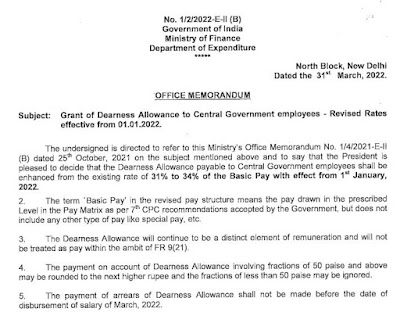
DA Jan 2022 - Grant of Dearness Allowance to Central Government employees - Revised Rates effective from 01.01.2022

 3% DA Hike - Revised Rates effective from 01.01.2022: DoE OM dated 31.03.2022 No. 1/2/2022-E-II (B) Government of India Ministry of Finance...