Saturday, 4 January 2020

Public Provident Fund Scheme 2019-2020 - Gazette Notification


Public Provident Fund Scheme 2019-2020 - Gazette Notification

Public Provident Fund Scheme 2019-2020 - Gazette Notification

PPF Scheme 2019-2020

NOTIFICATION

New Delhi, the 12th December, 2019

G.S.R. 915(E).- In exercise of the powers conferred by section 3A of the Government Savings Promotion Act, 1873 (5 of 1873), the Central Government hereby makes the following Scheme, namely:-

1. Short title and commencement.-
(1) This Scheme may be called the Public Provident Fund Scheme, 2019.
(2) It shall come into force on the date of its publication in the Official Gazette.

2. Definitions.-
(1) In this Scheme, unless the context otherwise requires,-
(a) “account” means an account under this scheme;
(b) “account holder” means an individual in whose name the account is held;
(c) “Act” means the Government Savings Promotion Act, 1873 (5 of 1873);
(d) “Form” means forms appended to this Scheme;
(e) “General Rules” means the Government Savings Promotion General Rules, 2018;
(f) “year” means the financial year.

(2) Words and expressions used herein but not defined shall have the meanings respectively assigned to them in the Act and in the General Rules.

3. Limits of number of accounts.-

(1) An individual may open an account by making an application in Form-1.

(2) An individual may also open one account on behalf of each minor or a person of unsound mind of whom he is the guardian:
Provided that only one account shall be opened in the name of a minor or a person of unsound mind by any of the guardian.

(3) Joint account shall not be opened under this Scheme.

4. Limits of subscription.-
(1) A deposit which shall not be less than five hundred rupees and not more than one lakh fifty thousand rupees in multiple of fifty rupees may be made in an account in a year.

(2) Maximum limit of one lakh fifty thousand rupees as specified in sub-paragraph (1) by an individual shall be inclusive of the deposits made in his own account and in the account opened on behalf of the minor.

5. Manner of making deposit.-
(1) The account shall be opened with a minimum initial deposit of five hundred rupees and thereafter deposit of any sum in multiples of fifty rupees shall be made.

(2) The deposit in the account subject to the limits mentioned in paragraph 4 may be made in the account in one lump sum or in instalments.

6. Discontinuation of account.-
(1) Any account in which the account holder, having deposited five hundred rupees in the initial year, fails to deposit the minimum amount in the following years, shall be treated as discontinued.

(2) An account treated as discontinued under sub-paragraph (1), may be revived during its maturity period on payment of a fee of fifty rupees along with arrears of minimum deposit of five hundred rupees for each year of default:

Provided that the balance in a discontinued account not revived by the account holder before its maturity shall continue to earn interest at the rate applicable to the Scheme from time to time.
(3) The account holder of a discontinued account shall not be eligible to open a new account before closure of such discontinued account after maturity:

Provided that the facility of loan and partial withdrawal shall not be allowed in such an account and the account holder shall be prohibited from opening another account in his name under this Scheme till final closure of such account.

(4) Facility of loan and partial withdrawal shall be allowed to regular accounts only as per the provisions of this Scheme.

(5) The total deposit in a year as specified in paragraph 4, shall be inclusive of deposits made in respect of years of default of the preceding years but excluding the default fee.

7. Interest.-

(1) Interest at 7.9 per cent. per annum shall be eligible for a calendar month on the lowest balance at the credit of an account between the close of the fifth day and the end of the month.

(2) Interest shall be credited to the account at the end of each year.

(3) Interest shall be credited at the end of the year irrespective of the change of the account office due to transfer of the account during the year.

8. Loans.-

(1) At any time after the expiry of one year from the end of the year in which the initial subscription was made but before expiry of five years from the end of the year in which the initial subscription was made, the account holder may, apply in Form-2, to the accounts office for obtaining a loan consisting of a sum of whole rupees not exceeding twenty-five per cent. of the amount that stood to his credit at the end of the second year immediately preceding the year in which the loan is applied for.

(2) In case of an account opened on behalf of a minor or a person of unsound mind, the guardian may apply for the loan for the benefit of the minor or the person of unsound mind by submitting the following certificate to the accounts office, namely:-

“Certified that the amount sought to be withdrawn is required for the use and welfare of Shri/ Smt./ Master/ Kumari ……. who is a minor/ a person of unsound mind/ a person incapable of operating his account due to physical infirmity and is alive on this ……. the day of ……. (month), ……….(year).”
(3) An account holder shall not be entitled to get a fresh loan so long as earlier loan has not been repaid in full together with interest thereon.

(4) An account holder shall be entitled for only one loan in a year.

9. Repayment of loan and interest.-

(1) The principal amount of a loan shall be repaid by the account holder before the expiry of thirty-six months from the first day of the month following the month in which the loan is sanctioned:
Provided that the repayment may be made either in one lump sum or in instalments.
(2) After the principal amount of the loan is fully repaid, the account holder shall pay interest thereon in not more than two monthly instalments at the rate of one per cent. per annum of the principal for the period commencing from the first day of the month following the month in which the loan is drawn upto the last day of the month in which the last instalment of the loan is repaid:
Provided that where the loan is not repaid, or is repaid only in part, within a period of thirty-six months, interest on the amount of loan outstanding shall be charged at six per cent. per annum instead of at one per cent. per annum with effect from the first day of the month following the month in which the loan was obtained, to the last day of the month in which the loan is finally repaid.
32 THE GAZETTE OF INDIA : EXTRAORDINARY [PART II -SEC. 3(i)]
(3) The interest on the amount of loan outstanding under the proviso to sub-paragraph (2) and any portion of interest payable, but not paid, on any loan, the principal amount of which has already been repaid within the period of thirty-six months, may, on becoming due, be debited to the holder’s account.

(4) The interest recoverable shall accrue to the Central Government.

(5) The interest on outstanding loans which are not paid before the expiry of thirty-six months or paid partly shall be debited to the holder’s account at the end of each year.

(6) In case of death of the account holder, the nominee or legal heir shall be liable to pay interest on the loan availed by the account holder but not repaid before his death. Such amount of due interest shall be adjusted at the time of final closure of the account.

10. Withdrawal from account.-

(1) Any time after the expiry of five years from the end of the year in which the account was opened, the account holder may, avail withdrawal by applying in Form-2, from the balance to his credit, an amount not exceeding fifty per cent. of the amount that stood to his credit at the end of the fourth year immediately preceding the year of withdrawal or at the end of the preceding year, whichever is lower:
Provided that the amount of loan outstanding, if any, along with interest shall be paid by the account holder before availing the facility of withdrawal under this paragraph:
Provided further that the facility of withdrawal may be availed only once in a year only from the accounts which have not become discontinued.
(2) In case of an account opened on behalf of a minor, or a person of unsound mind, the guardian may apply for the withdrawal for the benefit of the minor or a person of unsound mind by submitting the following certificate to the accounts office, namely:-

“Certified that the amount sought to be withdrawn is required for the use and welfare of Shri/Smt./Master/ Kumari……………………………. who is a minor/ a person of unsound mind/ a person incapable of operating his account due to physical infirmity and is alive on this……the day of…………..(month), ……….(year).”.

11. Closure of account or continuation of account without deposits after maturity.-

(1) Any time after the expiry of fifteen years from the end of the year in which the account was opened, the account holder may apply in Form-3 to the accounts office for the closure of his account. The accounts office shall allow the withdrawal of the entire balance along with due interest up to the last day of the month preceding the month in which the account is closed.

(2) The account holder may retain his account after maturity without making any further deposits for any period and the balance in the account will continue to earn interest at the rate applicable to the Scheme:

Provided that the account holder may make one withdrawal, in each year, of any amount within the balance.

(3) Once the account is continued without deposits for more than a year, the account holder shall not have the option again to continue the account with deposits.

12. Extension of account with deposits after maturity.-

(1) Subject to the provisions of paragraph 11, the account holder on the expiry of fifteen years from the end of the year in which the account was opened, may extend his account and continue to make deposit under paragraph 4 for a further block period of five years by applying to the accounts office in Form-4.

(2) The option of extension of account under sub-paragraph (1) shall be made by the account holder before expiry of one year from the maturity of the account:

Provided that an account opened on behalf of a minor or a person of unsound mind may be extended at the request of the guardian.

(3) No deposits can be made in the account, if the account holder fails to give his option to continue the account within one year from the date of maturity. Any deposit made in such account shall be treated as irregular and refunded by the accounts office immediately without any interest:

Provided that the balance in the account on the date of maturity shall continue to earn interest upto the end of the month preceeding the month of closure.

(4) Facility of partial withdrawal under paragraph 10 of the Scheme shall be available to the account extended under sub- paragraph (1), subject to the condition that the total withdrawal during the block period of five years shall not exceed sixty per cent. of the balance at credit at the commencement of the block period:
Provided that the withdrawal, subject to the ceiling as specified above may be made either in a single or in yearly instalments.
(5) Provisions of sub-paragraphs (1) to (4) shall also apply on accounts after maturity on expiry of the each extended block period of five years.

(6) If the account is continued with deposits for one or more five block periods, the account holder may leave the account without deposits on completion of any block period and the account shall continue to earn interest till it is closed and the account holder may make one withdrawal every year from the account.

(7) An account holder who has given his option for the extension of the account for a period of five years shall not have the option to withdraw his request at a later stage.

13. Premature closure of account.-

(1) An account holder shall be allowed premature closure of his account or the account of a minor or person of unsound mind of whom is the guardian on an application to the accounts office in Form-5, on any of the following grounds, namely:-

(a) treatment of life threatening disease of the account holder, his spouse or dependent children or parents, on production of supporting documents and medical reports confirming such disease from treating medical authority;
(b) higher education of the account holder, or dependent children on production of documents and fee bills in confirmation of admission in a recognised institute of higher education in India or abroad;
(c) on change in residency status of the account holder on production of copy of Passport and visa or Income- tax return:
Provided that an account under this Scheme shall not be closed before the expiry of five years from the end of the year in which the account was opened:

Provided further that on such premature closure, interest in the account shall be allowed at a rate which shall be lower by one per cent. than the rate at which interest has been credited in the account from time to time since the date of opening of the account, or the date of extension of the account, as the case may be.

14. Closure of account on death of the account holder.-

(1) In the event of the death of the account holder, the account shall be closed and the nominee or the legal heir shall not be allowed to continue the account.
(2) The balance in the account of the deceased account holder shall earn interest till the end of the month preceeding the month in which the eligible balance is paid to the nominee or the legal heir, as the case may be.

15. Protection of credit balance from attachment.-

Amount standing to the credit of any account holder shall not be liable to attachment under any order or decree of any court in respect of any debt or liability incurred by the account holder.

16. Application of General Rules.-

Provisions of the General Rules shall, so far as may be, apply in relation to the matters for which no provisions have been made in this Scheme.

17. Power to relax.-
Where the Central Government is satisfied that the operation of any of the provisions of this Scheme causes undue hardship to an account holder, it may, by order for reasons to be recorded in writing, relax the requirements of that provision or provisions in a manner not inconsistent with the provisions of the Act.

[F. No. 2/2/2018-NS (Pt. I)]
RAJAT KUMAR MISHRA, Jt. Secy

Kisan Vikas Patra Scheme 2019-2020 - Gazette Notification


Kisan Vikas Patra Scheme 2019-2020

Kisan-Vikas-Patra-Scheme-2019-2020

NOTIFICATION

New Delhi, the 12th December, 2019

G.S.R. 920(E). - In exercise of the powers conferred by section 3A of the Government Savings Promotion Act, 1873 (5 of 1873), the Central Government hereby makes the following Scheme, namely:-

1. Short title and commencement.-
(1) This Scheme may be called the Kisan Vikas Patra Scheme, 2019.
(2) It shall come into force on the date of its publication in the Official Gazette.

2. Definitions.-
(1) In this Scheme, unless the context otherwise requires,-
(a) “account” means an account opened under this Scheme;
(b) “account holder” means an individual in whose name the account is held;
(c) “Act” means The Government Savings Promotion Act, 1873 (5 of 1873);
(d) “Form” means forms appended to this Scheme;
(e) “General Rules” means the Government Savings Promotion General Rules, 2018;
(f) “year” means a period of twelve months commencing from the date of deposit in the account.
(2) Words and expressions used herein but not defined shall have the meanings respectively assigned to them in the Act and the General Rules.

3. Type of accounts.- (1) On an application to the accounts office in Form-1, the following types of accounts can be opened under the Scheme, namely :-
(a) Single Holder Type Account;
(b) Joint A- Type Account; and
(c) Joint B- Type Account.
(2) (a) A Single Holder Type Account may be opened by an adult for himself, or on behalf of a minor or a person of unsound mind of whom he is the guardian, or by a minor who has attained the age of ten years;
(b) Joint A -Type Account may be opened jointly in the names of upto three adults payable to all the account holders jointly or to the survivors;
(c) Joint B -Type Account may be opened jointly in the name of upto three adults payable to any of the account holders or to the survivor or survivors.

4. Deposits.-
(1) A minimum of one thousand rupees and any sum in multiples of one hundred rupees may be deposited in an account.
(2) There shall be no maximum limit for deposit in an account or in accounts held by an account holder.
(3) An individual may open any number of accounts.

5. Payment on maturity.-
(1) Deposits made in the account shall double on maturity. Maturity period of an account shall be nine years and five months commencing on the date of deposit. Amount of maturity may be repaid to the account holder on an application in Form-2 submitted to the accounts office.
(2) The maturity period of the deposit under this Scheme shall be determined on the rate of interest applicable at the time of opening the account.

6. Premature closure of account.-
(1) The account may be prematurely closed by the account holder by making an application in Form-3 to the accounts office, at any time before maturity under the following circumstances, namely:-
(a) on the death of the account holder in a single account, or any or all the account holders in a joint account;
(b) on forfeiture by a pledgee, being a Gazetted Officer;
(c) when ordered by a court.
(2) On the closure of the account under sub-paragraph (1), principal amount along with simple interest calculated at the rate applicable from time to time to Post Office Savings Account for the complete months for which the account has been held, shall be payable.
(3) Notwithstanding anything contained in sub-paragraph (2), if an account is closed any time after the expiry of two years and six months from the date of opening of the account, the amount, inclusive of interest shall be payable as specified in the table below:-
(Table showing premature closure value of account opened on or after date of notification with 1,000 rupees)

TABLE

Period from the date of the account to the date of its
pre-mature closure
Amount payable inclusive of interest (Rupees)
(1)(2)
Two and half years but less than three years1173
Three years but less than three and half years1211
Three and half years but less than four years1251
Four years but less than four and half years1291
Four and half years but less than five years1333
Five years but less than five and half years1377
Five and half years but less than six years1421
Six years but less than six and half years1467
Six and half years but less than seven years1515
Seven years but less than seven and half years1564
Seven and half years but less than eight years1615
Eight years but less than eight and half years1667
Eight and half years but less than nine years1722
Nine years but before Maturity of Certificate1778
On maturity of certificate2000
7. Pledging of account.-
(1) An account may be pledged or transferred as security, on an application made by the depositor in Form-4 supported with acceptance letter from the pledgee.
(2) Transfer of an account under this Scheme may be made to-
(a) the President of India or the Governor of a State in his official capacity;
(b) the Reserve Bank of India or a Scheduled Bank or a Cooperative Society, including a Co-operative Bank;
(c) a public or private corporation or a Government company;
(d) a local authority; or
(e) a housing finance company approved by the National Housing Bank and notified by the Central Government: Provided that the transfer of an account opened on behalf of a minor or a person of unsound mind shall not be permitted under this Scheme unless the guardian of the minor or the person of unsound mind, as the case may be, certifies in writing that the minor or the person of unsound mind, as the case may be, is alive and that the transfer is for the benefit of the minor or the person of unsound mind.
(3) When any account is transferred as security under sub-paragraph (1), the authorised officer shall make the following endorsement in the record of the Account, including the Savings Certificate, namely:-
“Transferred as security to …..” .
(4) Except as otherwise provided in this Scheme, the transfer of an account under this paragraph shall, until it is re-transferred back under sub-paragraph (5), be deemed to be the depositor.
(5) An account transferred under this Scheme may, on written authority of the transferee, be re- transferred back with the previous sanction in writing of the authorised officer and when any such retransfer is made, the authorised officer of the accounts office shall make the following endorsement in the record of the account, including certificate, namely:-
“Re-transferred to……”.
(6) A blind person or a person with physical infirmity making him incapable of operating the account may pledge his deposit through any literate individual whom he authorises for this purpose.

8. Transfer of account.- An account may be transferred from one individual to another, subject to the condition that the transferee is eligible to open an account under this Scheme, in the following cases, namely:-
(i) on the death of the account holder in case of a single account or on the death of all the account holders in a joint account, the amount shall be transferred to the legal heirs or the nominees, as the case may be;
(ii) on the order of the court, the account shall be transferred from the account holder to the court or to any other individual as per the orders of the court;
(i) on pledging, account shall be transferred in accordance with paragraph 7;
(ii) in the event of the death of any of the account holders in a joint account, the account shall be transferred in the name of the surviving account holder or account holders, as the case may be.

9. Payment on the death of account holder.-
(1) In the event of death of the depositor of a single account or of all the depositors in a joint account, the deposit shall be payable to the nominee if a nomination exists or to the legal heir(s).
(2) Where there are not more than three surviving nominees or legal heirs, they may, at their option continue the account and receive the amount of deposit along with interest on maturity in the manner provided for in this scheme, as if they had opened the account themselves.
(3) Where the account is not continued under sub-paragraph (2), it shall be closed and the amount of deposit along with interest as provided in paragraph 6 shall be repaid.
(4) On the death of one or two of the account holders in a joint account, the surviving account holder or holders, if any, shall be treated as the owner or owners of the account and such account holder or holders may continue the account under sub-paragraph (2) or close the account under sub-paragraph (3).

10. Application of General Rules.-
The provisions of the General Rules shall, so far as may be, apply to this Scheme in relation to the matters for which no provisions have been made herein.

11. Power to relax.-
Where the Central Government is satisfied that the operation of any of the provisions of this Scheme causes undue hardship to the amount holder, it may be by order, for reasons to be recorded in writing, relax the requirements of that provision in a manner not inconsistent with the provisions of the Act or the rules made there under.

[F.No.2/2/2018 NS (Pt.I)]
RAJAT KUMAR MISHRA, Jt. Secy

Friday, 3 January 2020

Rate of interest on various National Small Savings Schemes with effect from 1st January 2020


Rate of interest on various National Small Savings Schemes with effect from 1st January 2020

National Small Savings Schemes 2020 interest rate

Rate of interest on various National Small Savings Schemes with effect from 1st January 2020

SB Order No.01 /2020

F.No 113-03/ 2017-SB
Govt. of India Ministry of Communication
Department of Posts (F.S. Division)

Dak Bhawan, New Delhi-110001
Dated: 01.01.2020

To,
All Head of Circles/ Regions
Addi. Director General, APS, New Delhi

Subject: Revision of interest rates for Small Savings Schemes w.e.f. 01.01.2020

Madam/Sir,
The undersigned is directed to say that vide memorandum No. 01/04/2019-NS dated 31.12.2019 (copy enclosed), Govt. of India, Ministry of Finance, Department of Economic Affairs (Budget Division) have informed that the rate of interest on various National Small Savings Schemes for the fourth quarter of financial year 2019-20 ( starting from 1st January ,2020 and ending on 31st March, 2020) shall remain unchanged from those notified for the third quarter of Financial Year 2019-20 (01st October 2019 to 31st December, 2019). The details are indicated below for ready reference.


SI. No.InstrumentsRate of interest w.e.f. 01.10.2019 to 31.12.2019Rate of interest w.e.f 01.01.2020 to 31.03.2020 (Unchanged)Compounding Frequency *
01.Post Office Savings Account4.04.0Annually
02.1 Year Time Deposit6.96.9Quarterly
03.2 Year Time Deposit6.96.9Quarterly
04.3 Year Time Deposit6.96.9Quarterly
05.5 Year Time Deposit7.77.7Quarterly
06.5 Year Recurring Deposit7.27.2Quarterly
07.Senior Citizen Savings Scheme8.68.6Quarterly and Paid
08.Monthly Income Account7.67.6Monthly and paid
09.National Savings Certificate (VIII Issue)7.97.9Annually
10.Public Provident Fund Scheme7.97.9Annually
11.Kisan Vikas Patra7.6 (will mature in 113 months)7.6 (will mature in 113 months)Annually
12.Sukanya Samriddhi Account Scheme8.48.4Annually
3. It is requested to circulate it to all concerned for information and necessary guidance. Same may also be placed on the notice board of all Post Offices in public area.The necessary calculation tables will be supplied in due course on receipt from the DEA/ MoF.


Also check the previous Rates of small savings schemes for the year 2017-18

4. This issues with the approval of Competent Authority.

Yours Faithfully,
(Devendra Sharma)
Assistant Director (SB)

Payment of 7th CPC Leave Salary to the Running Staff - Railway Employees NFIR

Payment of 7th CPC Leave Salary to the Running Staff - Railway Employees NFIR

NFIR

No.IV/NFIR/7th CPC (Imp)/ Allowance/2016/Part I
Dated: 27/12/2019

The Secretary(E),
Railway Board
New Delhi

Dear Sir,

Subject: Payment of Leave Salary to the Running Staff after implementation of 7th CPC recommendations-reg.

Ref: (i) NFIR’s PNM Items No. 47/2018 & 57/2016.
(ii) Railway Board’s letter No. E(P&A)II/2017/RS-22 dated 28/12/2018 (RBE No.2204/2018).
(iii) NFIR’s letter No. IV/NFIR/7th CPC (Imp)/Allowance/2016/Part II dated 12/01/2019, 18/03/2019, 28/05/2019 & 17/08/2019.

Federation invites kind attention of the Railway Board to the references cited above relating to payment of Leave Salary to the Running Staff pursuant to the implementation of the recommendations of 7th Central Pay Commission. Federation once again reiterates that though the Railway Board have issued orders vide RBE No. 204/2018 dated 28/12/2018 but, however, there is no clarity in the said orders regarding date of effect i.e. from 01/01/2016, consequently in the provision in IPAS, date of effect has been taken as 01/07/2017 and the Running Staff have been put to recurring financial loss for 18 months (from 01/01/2016 to 30/06/2017) leave salary. Though the Federation has been making efforts to persuade the Railway Board to set right the technical snag but however action to correct/up-date IPAS has no been taken yet with the result Federation continues to receive grievances from the Running Staff from Zonal Railways.

Also check: 7th CPC: Payment of leave salary to the running staff after the implementation of 7th CPC recommendations

NFIR, therefore, once again urges upon the Railway Board to kindly intervene and issue suitable instructions to all concerned to rectify/up-date the IPAS giving effect to the instructions vide RBE No. 204/2018 dated 28/12/2018 from 01/01/2016 repeat from 01/01/2016 and not from 01/07/2017.
Action taken in the matter may kindly be apprised to the Federation.

Yours faithfully
(Dr. M. Raghavaiah)
General Secretary

Thursday, 2 January 2020

Appointment of officers working in the Ministries under CSS/Non-CSS posts to NITI Aayog under CSS on lateral shift basis

Latest DoPT Orders 2020

Appointment of officers working in the Ministries under CSS/Non-CSS posts to NITI Aayog under CSS on lateral shift basis

No. 7/3/2018 EO(MM-II)Pt.I
Government of India
Ministry of Personnel, P.G. and Pensions
Department of Personnel and Training
(Office of the Establishment Officer)

North Block, New Delhi
Dated 31st December, 2019

To,
All Secretaries,
Ministries/ Departments of Government of India

Subject : Appointment of officers working in the Ministries /Departments under CSS / Non-CSS posts to National Institution for Transforming India (NITI) Aayog under Central Staffing Scheme on lateral shift basis.

Sir/ Madam,
This is regarding filling up the posts of Deputy Secretary/ Director level in the National Institution for Transforming India (NITI) Aayog under the Central Staffing Scheme on lateral shift basis. The applications were invited for the post vide circular of even number dated 27.11.2019 (copy enclosed).

2. It has been decided to extend the last date for submission of application till 05.02.2020.

3. This may be brought to the notice of all concerned and the application(s) of the eligible candidate(s) may please be forwarded accordingly.

Yours faithfully,
(J.Srinivasan)
Director(MM)
If the officer is selected for the post, it will be treated as a 'lateral shift', which would entail additional tenure of three year as per the special dispensation allowed for appointment in NITI Aayog that permits total deputation tenure up to 8 years on shift to NITI Secretariat or vice versa. The +3 option would be available only to those officers who are already working on a CSS/Non-CSS post/ex-cadre post the, centre. The additional tenure is subject to completion of two years on the present stint on the deputation post and availability of cadre clearance in the absence of cadre clearance (for +3 tenure), the tenure will he restricted to the balance period of four/five years central deputation tenure
Source: DoPT

Tuesday, 31 December 2019

AICPIN for the month of November 2019 - Expected DA 2020


AICPIN for the month of November 2019

According to a press release issued by the Labor Office on 31.12.2019, the AICPIN (Consumer Price Index for Industrial Workers by 2001=100) for the month of November 2019 has been raised to 328 from the current level of 325.
AICPIN-November-2019-Expected-DA-2020


No.5/1/2019-CPI
Government of India
Ministry of Labour & Employment
Labour Bureau

‘Claremont’, Shimla-171004
Dated: 31st December 2019

Press Release

Consumer Price Index for Industrial Workers (CPI-1W) - November, 2019

The All-India CPI-IW for November, 2019 increased by 3 points and pegged at 328 (three hundred and twenty eight). On 1-month percentage change, it increased by (+) 0.92 per cent between October and November, 2019 whereas no change observed during corresponding months of last year.

The maximum upward pressure to the change in current index came from Food group contributing (+) 1.98 percentage points to the total change. At item level, Rice, Arhar Dal, Moong DaI, Urd Dal, Goat Meat, Poultry Chicken, Milk Cow, Garlic, Onion, Cabbage, Carrot, Green Coriander Leaves, Lady Finger, Potato, Hot Drink- Tea Readymade, Cooking Gas, Fire Wood. Etc. are responsible to the increase in index.

Also check: Expected DA Table January 2020 Calculation for Central Government Employees

However, this increase was checked by Fish Fresh, Chillies Green, Ginger, Banana, Cauliflower, Coconut, French Beans, Gourd, Lemon, Orange, Peas, Radish, Tomato, Electricity Charges, Toilet Soap, etc., putting downward pressure on the index. Year- on-year inflation based on all-items stood at 8.61 per cent for November, 2019 as compared to 7.62 per cent for the previous month and 4.86 per cent during the corresponding month of the previous year. Similarly, Food inflation stood at 9.87 per cent against 8.60 per cent of the previous month and (-) 1.57 per cent during the corresponding month of an year ago.

At centre level, Rourkela observed the maximum increase of 14 points followed by Kodarma (12 points), Madurai (9 points) and Salem (8 points). Among others, 7 points increase was observed in 3 centres, 6 points in 4 centres, 5 points in 6 centres, 4 points in 7 centres, 3 points in 10 centres, 2 points in 11 centres and 1 point in 15 centres. On the contrary, Chhindwara and Kanpur recorded a maximum decrease of 3 points each followed by Ahmedabad and Jaipur (2 points each). Other 4 centres observed a fall in index by 1 point. Rest of 10 centres’ indices remained stationary. The indices of 31 centres are above All-India Index and 46 centres’ indices are below national average. The index of Warangal centre remained at par with All- India Index.

The next issue of CPI-IW the month of December, 2019 will be released on Friday 31st January. 2020. The same will also be available on the office website www.labourbureaunew.gov.in.

sd/-
(AMRID LAL JANGID)
DEPUTY DIRECTOR

Also check: Expected DA January 2020 - Expected to increase by 4% from 17% to 21%

According to the advance calendar, the statistics of the All India Consumer Price Index (AICPI) for the month of November 2019 may be published by the Labor Office on 31 December 2019. The table below shows the date of publication of AICPIN in advance.


Release DateCPI (IW)
January - 201928 Feb 2019
February - 201929 Mar 2019
March - 201930 Apr 2019
April - 201931 May 2019
May - 201928 Jun 2019
June - 201931 Jul 2019
July - 201930 Aug 2019
August - 201930 Sep 2019
September - 201931 Oct 2019
October - 201929 Nov 2019
November - 201931 Dec 2019
December - 201931 Jan 2020

DA Calculation January 2020

The index is an important element in the calculation of the percentage of the Dearness Allowance (DA) for government employees with effect from 1.1.2020.

In order to finalize the additional percentage of the Dearness Allowance (DA and DR) from January 2020 for CG employees and pensioners, AICPIN for 6 months from July to December 2019 is required. The data for the 5th month of November was released on 31.12.2019.


MonthYearAICPIN (IW) BY 2001=100
July2019319
August2019320
September2019322
October2019325
November2019328
December2019?

Government Savings Scheme - Sukanya Samriddhi Account Scheme 2019 - Gazette Notification


Sukanya Samriddhi Scheme : The account shall mature on completion of a period of twenty-one years from the date of its opening


Sukanya-Samriddhi-Account-Scheme-2019-girl-children


NOTIFICATION

New Delhi, the 12th December, 2019

G.S.R. 914(E) - In exercise of the powers conferred by section 3A of the Government Savings Promotion Act, 1873 (5 of 1873), the Central Government hereby makes the following Scheme, namely:-

1. Short title and commencement : (1) This Scheme may be called the Sukanya Samriddhi Account Scheme, 2019.

(2) It shall come into force on the date of its publication in the Official Gazette.

2. Definitions: (1) In this Scheme, unless the context otherwise requires,-

(a) “account” means an account opened under this Scheme;
(b) “account holder” means a girl child in whose name the account is held;
(c) “Act” means the Government Savings Promotion Act, 1873 (5 of 1873);
(d) “birth certificate” means birth certificate issued by the municipal authority or any office authorised to issue birth and death certificate by the Registrar of Births and Deaths or the Indian Consulate as defined in clause (d) of sub-section (1) of section 2 of the Citizenship Act, 1955 (57 of 1955);
(e) “family” means a unit consisting of a person and his spouse (both or either of whom are alive or deceased) and their children, adopted or otherwise;
(f) “financial year” means the period commencing on the 1st day of April and ending on the 31st day of March of the following year;
(g) “Form” means forms appended to this Scheme;
(h) “General Rules” means the Government Savings Promotion General Rules, 2018;
(i) “maturity” means maturity of an account on completion of a period of twenty-one years from the date of its opening.

(2) Words and the expressions used herein but not defined shall have the meanings respectively assigned to them in the Act and the General Rules.

3. Opening of account : (1) The account may be opened by one of the guardian in the name of a girl child, who has not attained the age of ten years as on the date of opening of the account.
 (2) Every account holder shall have a single account under this Scheme.
(3) The application in Form-1 for opening an account shall be accompanied by birth certificate of the girl child in whose name the account is to be opened, along with required documents of guardian.
(4) An account under this Scheme may be opened for a maximum of two girl children in one family:
Provided that more than two accounts may be opened in a family if such children are born in the first or in the second order of birth or in both, on submission of an affidavit by the guardian supported with birth certificates of the twins/triplets regarding the birth of such multiple girl children in the first two orders of birth in a family:

Provided further that the above proviso shall not apply to girl child of the second order of birth, if the first order of birth in the family results in two or more surviving girl children.

4. Deposits : (1) The account may be opened with a minimum initial deposit of two hundred and fifty rupees and in multiples of fifty rupees thereafter and subsequent deposits shall be in multiples of fifty rupees subject to the condition that a minimum of two hundred and fifty rupees shall be made as deposit in a financial year in one account.
(2) The total amount deposited in an account shall not exceed one lakh fifty thousand rupees in a financial year:
Provided that the deposit in excess of one lakh fifty thousand rupees in any financial year, if accepted due to any accounting error, shall not be eligible for any interest and be returned immediately to the depositor.
(3) Deposits may be made in the account till the completion of a period of fifteen years from the date of opening of the account.
(4) An account in which minimum amount as specified in sub-paragraph (1) has not been deposited shall be considered as an account under default:
Provided that an account under default may be regularised any time till completion of a period of fifteen years from the date of opening of account on payment of a penalty of fifty rupees for each year of default along with the minimum annual deposit in respect of the defaulted years.
(5) In case of an account under default, if not regularised within the time specified under sub-paragraph (4), then the whole deposit, including the deposits made prior to the date of default, shall be eligible for interest at the rate applicable to the Scheme till closure of the account.

5. Interest on deposit : (1) Deposits in the account shall earn interest at the rate 8.4 per cent per annum.
(2) The interest shall be calculated for the calendar month on the lowest balance in the account between the close of the fifth day and the end of the month. The interest shall be credited to the account at the end of each financial year and any amount of interest in fraction of a rupee shall be rounded off to the nearest rupee and for this purpose any amount of fifty paisa or more shall be treated as one rupee and any amount less than fifty paisa shall be ignored.
(3) Interest shall be credited at the end of the financial year irrespective of the change of the account office due to transfer of the account during the financial year.

6. Operation of account :
(1) The account shall be operated by the guardian till the account holder attains the age of eighteen years. The account shall be operated by the account holder herself after attaining age of eighteen years by submitting necessary documents.

7. Premature closure of account :
(1) In the event of death of the account holder, the account shall be closed immediately on application in Form-2, on production of death certificate issued by the competent authority and the balance at the credit of the account and interest due thereon till the date of death shall be paid to the guardian.
(2) Interest for the period between the date of death of the account holder and date of closure of the account shall be paid at the rate applicable on Post Office Savings Account for the balance held in the account.

(3) Where the accounts office is satisfied that in case of extreme compassionate grounds such as medical support in life- threatening diseases of the account holder or death of the guardian that the operation or continuation of the account is causing undue hardship to the account holder, it may, after complete documentation establishing the grounds for such closure, by order and for reasons to be recorded in writing, allow premature closure of the account. Outstanding balance in the account with interest due as applicable to the Scheme shall be paid to the account holder or guardian, as the case may be:

Provided that no premature closure of an account under this sub-paragraph shall be made before completion of five years from the date of opening of the account.

8. Withdrawal : (1) On an application in Form-3, withdrawal of upto a maximum of fifty per cent. of the amount in the account at the end of the financial year preceding the year of application for withdrawal, shall be allowed for the purpose of education of the account holder:

Provided that such withdrawal shall be allowed after the account holder attains the age of eighteen years or has passed tenth standard, whichever is earlier.

(2) The application for withdrawal under sub-paragraph (1) shall be accompanied by documentary proof in the form of a confirmed offer of admission of the account holder in an educational institution or a fee-slip from such institution indicating such financial requirement.

(3) The withdrawal under sub-paragraph (1) may be made in one lump sum or in instalments, not exceeding one per year, for a maximum of five years, subject to the ceiling specified in sub-paragraph (1):

Provided that the amount of withdrawal shall be restricted to the actual requirement on account of fee and other charges required at the time of admission as shown in the offer of admission or the relevant fee-slip issued by the educational institution.

9. Closure on maturity : (1) The account shall mature on completion of a period of twenty-one years from the date of its opening.

(2) The closure of the account may also be permitted before completion of twenty-one years if the account holder on an application makes a request for such closure for the reason of intended marriage of the account holder on furnishing of a declaration duly signed on non-judicial stamp paper attested by the notary supported with proof of age confirming that the applicant will not be less than eighteen years of age on the date of marriage:

Provided that no such closure shall be allowed before one month from the date of the intended marriage or after three months from the date of marriage.

(3) On an application in Form-4 by the account holder, the balance outstanding along with interest as applicable under paragraph 5 shall be payable to the account holder.

10. Application of General Rules :
Provisions of the General Rules shall, so far as may be, apply in relation to the matters for which no provisions have been made in this Scheme.

11. Power to relax :
Where the Central Government is satisfied that the operation of any of the provisions of this Scheme causes undue hardship to the account holder, it may, by order and for reasons to be recorded in writing, relax the requirement of that provision or provisions in respect of such account holder, in a manner not inconsistent with the provisions of the Act.

[F. No. 2/2/2018-NS (Pt. I)]
RAJAT KUMAR MISHRA, Jt. Secy

Grant of scholarship for the children of Non-Statutory Departmental Canteens Employees

Grant of scholarship for the children of Non-Statutory Departmental Canteens Employees

Scholarship-Scheme-for-Children-of-NonStatutory-Departmental-Canteen-employees


No.20/1/2011-Dir. (C)
Government of India
Ministry of Personnel, P.G. and Pensions
(Department of Personnel & Training)

Lok Nayak Bhawan, Khan Market,
New Delhi dated 24th December, 2019.

OFFICE MEMORANDUM

Subject: Revision of Scholarship Scheme for the Children of Non-Statutory Departmental Canteen employees out of Discretionary Fund of Director of Canteens

The Scheme for grant of scholarship for the children of Non-Statutory Departmental Canteens, out of the funds available in the Discretionary Fund of Director of Canteens was introduced vide this Department’s O.M.No.20/1/88-Dir. (C), dated 3.12.98 and revised O.M.No.20.1.2011-Dir.(C), dated 2.09.2011. In suppression of this office O.M. of even number dated 2.9.2011; the amended scheme has been introduced to encourage higher studies for those children whose past performance had been meritorious. The details of the scholarships from Academic Year 2019-2020 being instituted and the considerations which will apply are given below:

Scholarships

The categorical details of the scholarships are as below:-


Name of Scholarship / Class of studiesNo. of ScholarshipsAmount of each Scholarship
Class IX,X or MatriculationFour (Two Scholarships per class)Rs.1000/- Per Annum
Class XI,XII or intermediate or PUC (for Science stream)Two (One Scholarship per class)Rs.1000/- Per Annum
Class XI,XII or Intermediate or PUC (for Non-Science Stream)Two (One Scholarship per class) Rs.1000/- per Annum
Under Graduate Studies of three years duration (for Science Stream)Three (One Scholarships per class) Rs.2500/- per Annum
Under Graduate Studies of three years duration ( for Non-Science Stream)Three (One Scholarships per class) Rs.2500/- per Annum
Post Graduate studies of two years duration (for Science Stream)One ScholarshipRs.5000/- per Annum
Post Graduate Studies of two years duration (for Non-Science Stream)One ScholarshipRs.5000/- Per Annum
ITI course/Diploma courses in Engineering/ArchitectureOneRs.5000/- Per Annum
B.E./B.TechOneRs.10,000/- Per Annum
Bachelor of ArchitectureOneRs.10,000/- per Annum
MBBS/Medical CoursesOneRs.10,000/- Per Annum
Financial coursesOneRs.10,000/- Per Annum
3. Awards will be given on yearly basis and every aspirant will have to meet the prescribed norms in regards to the percentage of marks in the previous year of study for being considered for grant of fresh award during the course of his/her studies. The awards will be given strictly in accordance with the principle of the highest one or next highest one (if there are more than one scholarship) getting the Scholarship.

Also check: 7th CPC Cooking Allowance to Non- Statutory Departmental canteen employees

Conditions

(a) Candidates seeking award of Scholarship should have obtained a minimum of 60% marks in the aggregate in the previous year of examination;

(b) Children belonging to SC /ST categories and Handicapped children would be given a relaxation of 10% marks in the minimum standard. 25% of the awards for school level and Under Graduate level studies (Serials (1) to (5) of para (2) will be earmarked for such candidates. However, being an award Scheme there will be no strict applications of general orders relating to SC/ST/ Physically Handicapped. In the event of the earmarked awards remaining unutilised due to non-satisfaction of the minimum prescribed norms, the award will be transferred to the general category;

(c) One Scholarship will be reserved for girl child for class IX & X. Notwithstanding the prescribed minimum percentage the award will be given to those securing the highest marks. Only aggregate marks will be taken into account. However, every applicant should have obtained the minimum pass marks in all subjects;

(d) Children of only those Canteen Employees who are working in Central Govt. Offices / Establishments and who have been declared as Central Govt. employees will be eligible to apply;
(e) The Canteen employees from the Department of Telecommunications. Posts etc. which are already having separate Scholarship Scheme are to certify that their children are not already in receipt of Scholarship under the Schemes of their Department.

4. The Scholarship will be awarded considering the performance of the candidates in the previous years of examination. In case the studies were discontinued in the previous years(s) i.e. prior to the academic year but an applicant otherwise becomes eligible for consideration, detailed justification for break in the studies during the preceding year(s) will have to be submitted. All applications will have to be submitted in the appended format only. Applications will have to be accompanied by the attested true copies of the Mark Sheets given by the recognised Institution such as School. Central/State Boards of Education/ Universities. Original certificates will be submitted, if called for, for verification.

5. The individual applying for award of scholarship is required to furnish the following documents:

(a) (i) Aadhaar enrolment ID, if he has enrolled, or
(ii)A copy of request made for Aadhaar enrolment;

(b) (i) Bank Passbook with Photo or
(ii) Voter's ID card or
(iii) PAN Card or
(iv) Passport; or
(v) Driving Licence or
(vi) Ration Card; or
(vii) Photo ID Card issued by the Government.

6. The last date for receipt of applications in the Office of Director (Canteens) will be 31st October, during the year 2020 and all subsequent years. . It is expected that awards will be finalised by the month of January of the following year. In no case any application received after the prescribed date will be entertained.

7. Applications will be forwarded to the office of the Director (Canteens) through concerned Head of Organization who in turn will get the same routed through the Head or the Department in the controlling Ministries /Department.

8. The awards of Scholarships will be decided by a duly designated Committee, as may be appointed from time to time. The decision taken by the Committee will be final and no representation in the matter will be entertained after awards are finalised.

9. It is requested that wide publicity of this Scheme may be given amongst all concerned.

(Kulbhushan Malhotra)
Under Secretary to the Government of India

Monday, 30 December 2019

Year End Review 2019 - Ministry of Labour and Employment

Ministry of Labour & Employment

Year End Review 2019 : Ministry of Labour and Employment

More than 39 Lakhs Beneficiaries Enrolled In PM-SYM and more than 20,000 in NPS - Traders

1,52,778 establishments covering 1,21,65,587 Employees Benefitted under PMRPY

30 DEC 2019

Ministry of Labour and Employment has taken a number of initiatives for bringing transparency and accountability through reforms and enforcement of Labour Laws, with the objective of strengthening the safety, security, health, social security for every worker and bringing ease of compliance for running an establishment to catalyze creation of employment opportunities. These initiatives include governance reforms through use of e-governance measures and legislative reforms by simplifying, amalgamating and rationalizing the existing labour laws into 4 labour codes. Two mega pension schemes were launched during the year for old age protection and social security of unorganized workers.

LEGISLATIVE INITIATIVES: LABOUR LAW REFORMS

Labour Codes: As per the recommendations of the 2nd National Commission on Labour, Ministry has taken steps for codification of existing Central labour laws into 4 Codes by simplifying, amalgamating and rationalizing the relevant provisions of the Central Labour laws. At present, the Ministry has been working on to simplify, amalgamate & rationalize the provisions of the existing Central labour laws into 4 Labour Codes.
(I) Labour Code on Wages: The Code on Wages, 2019 subsumes 4 existing Laws, viz. the Minimum Wages Act, 1948; the Payment of Wages Act, 1936; the Payment of Bonus Act, 1965; and the Equal Remuneration Act, 1976. It has been passed by both Houses of the Parliament and assented to by the President on 08.08.2019.
(II) Labour Code on Industrial Relations: The draft Labour Code on Industrial Relations subsumes the existing Laws viz. The Trade Union Act, 1926; The Industrial Employment (Standing Orders) Act, 1946; The Industrial Disputes Act, 1947. The Code has been introduced in the Lok Sabha on 28.11.2019.
(III) Labour Code on Social Security & Welfare: The draft Code on Social Security subsumes 09 Labour Acts like: The Employees’ Compensation Act, 1923, The Maternity Benefit Act, 1961, The Payment of Gratuity Act, 1972, The Unorganized Workers’ Social Security Act, 2008 etc.
The Code has been introduced in Lok Sabha on December 11, 2019.
(IV) Labour Code on Occupational Safety, Health & Working Conditions: The Occupational Safety, Health & Working Conditions Code, 2019 subsumes the 13 Labour Acts like: The Factories Act, 1948, The Plantation Labour Act, 1951, The Mines Act, 1952, The Building and Other Constructions Workers’ (Regulation of Employment and Conditions of Service) Act, 1996 etc.
The Occupational Safety Health & Working Conditions Code, 2019 was introduced in the Lok Sabha on 23.07.2019. Presently, the Code has been referred to the Parliamentary Standing Committee on Labour for examination.

GOVERNANCE REFORMS THROUGH TECHNOLOGY 

Shram Suvidha Portal:
The Ministry of Labour & Employment has developed a unified Web Portal ‘Shram Suvidha Portal’, to bring transparency and accountability in enforcement of labour laws and ease complexity of compliance.

Allotment of unique Labour Identification Number (LIN) to Units after registration to facilitate online inspection & compliance was started on the Portal with its launch on 16.10.2014 itself. Unique Labour Identification Number (LIN) has been allotted to 27,81,065 units as on 08.11.2019.
Transparent Labour Inspection Scheme in Central Sphere was started on the Portal with its launch on 16.10.2014 itself. Since the launch of the Labour Inspection Scheme, 5,24,189 inspection reports across the four Central Labour Enforcement Agencies have been uploaded on Shram Suvidha Portal.

ONLINE RETURN - Unified Online Annual Returns have been made mandatory in respect of eight (8) Central Labour Acts, namely, the Payment of Wages Act, 1936, the Minimum Wages Act, 1948, the Maternity Benefit Act, 1961, the Payment of Bonus Act, 1965, the Industrial Disputes Act, 1947.the Contract Labour (Regulation and Abolition) Act, 1970, the Inter-State Migrant Workmen (Regulation of Employment and Conditions of Service) Act, 1979, and the Building and Other Construction Workers (Regulation of Employment and Condition of Service) (BOCW) Act, 1996. These Returns which were half yearly/annually earlier, now need to be filed by all employers annually only and are to be filed online. 1,08,711 online returns have been filed on the Shram Suvidha Portal as on 08.11.2019 Since launch of the Online Annual Return.
31,047 online returns have been filed on the Shram Suvidha Portal till November 08, 2019 under Mines Act, 1952 (Coal Mines Regulations, Metallurgical Mines Regulations and Oil Mines Regulations).

Unified monthly Electronic Challan-cum-Return (ECR) for EPFO and ESIC has been made operational.

COMMON REGISTRATION: Common Registration form for EPFO and ESIC has been made operational. 1,27,544 units have been registered with EPFO & 1,07,681 units have been registered with ESIC as on November 08, 2019.

Common Registration under three Central Acts namely the Building and Other Construction Workers (Regulation of Employment and Condition of Service) Act, 1996, the Inter-State Migrant Workmen (Regulation of Employment and conditions of Service) Act, 1979 and the Contract Labour (Regulation and Abolition) Act, 1970 is being provided online on Shram Suvidha Portal. 6052 registrations have been issued using this facility as on 08.11.2019.

Licenses under two Central Acts, namely, the, Inter-State Migrant Workmen (Regulation of Employment and Conditions of Service) Act, 1979 and the Contract Labour (Regulation and Abolition) Act, 1970 have been made online. 20,316 licenses have been issued using this facility as on 08.11.2019.

State Integration
Integration of States with Shram Suvidha Portal is under way. As on date, Haryana, Gujarat, Rajasthan, Uttar Pradesh, Madhya Pradesh, Maharashtra, Punjab, Uttarakhand and Delhi are being integrated with the Portal. Data is being shared and LIN is being allotted to the establishments covered by the state labour enforcement agencies.

Start Up India
Facility for exemption from Labour Inspections under six (6) Central Labour Acts is being provided to the Start-ups which submit self certified declarations through Shram Suvidha Portal.
State/UT Governments have been advised to regulate the inspections for the Start-Ups, wherever applicable and extend the self-certification compliance regime from 3 years to 5 years. 27 States/UTs have taken action on the advisory dated 12.01.2016 /06.04.2017 issued by this Ministry for self-certification and to regulate inspection under the four (4) labour laws viz. the Building & Other Construction Workers (Regulation of Employment and Conditions of Service) Act, 1996, the Inter-State Migrant Workmen (Regulation of Employment and Conditions of Service) Act, 1979,the Payment of Gratuity Act, 1972 and the Contract Labour (Regulation and Abolition) Act, 1970 for the start-ups wherever applicable.

Social Security Schemes
Government of India has launched two pension schemes for old age protection and social security of Unorganised Workers in 2019.

Pradhan Mantri Shram Yogi Maan-dhan (PM-SYM), a voluntary and contributory pension scheme, was launched in February, 2019 for the benefit of unorganized workers. It is central sector scheme open to unorganised workers, whose monthly income is Rs.15000/- or below and who has an Aadhar number as well as savings bank / jan-dhan account. The minimum age for joining the scheme is 18 years and the maximum is 40 years. Under the scheme, minimum assured monthly pension of Rs.3000/- will be provided to the beneficiaries from the age of 60 years onwards. Enrolment to the Scheme is done through the Common Service Centres, with its network of 3.50 lakh Centres across the country. In addition eligible persons can also self-enroll through visiting the portal www.maandhan.in. Under the scheme, the subscriber is required to pay the prescribed monthly contribution amount and the Central Government provides equal contribution. Life Insurance Corporation of India (LIC) is the Pension Fund Manager and shall be responsible for pension pay-out. Total number of 39,00,525 beneficiaries under PM-SYM have been enrolled as on 10.12.2019.

National Pension Scheme for Traders, Shopkeepers and Self-Employed Persons has been launched on 12.09.2019. It is a voluntary and contributory pension scheme. Enrolment to the Scheme is done through the Common Service Centres, with its network of 3.50 lakh Centres across the country. In addition eligible persons can also self-enroll through visiting the portal www.maandhan.in. The traders in the age group of 18-40 years with an annual turnover, not exceeding Rs.1.5 crore and who are not a member of EPFO /ESIC/ NPS/ PM-SYM or an income tax payer, can join the scheme. Under the scheme, 50% monthly contribution is payable by the beneficiary and equal matching contribution is paid by the Central Government. Subscribers, after attaining the age of 60 years, are eligible for a monthly minimum assured pension of Rs.3,000/-. Total number of 20,000 beneficiaries under NPS-Traders have been enrolled as on 10.122019.
Pension Week was also celebrated in all the States/UTs w.e.f. 30th November to 06th December, 2019 in coordination with Common Service Centres, to increase the enrolments under both the Schemes, i.e. PM-SYM and NPS-Traders. A Central level function was inaugurated on 30.11.2019 by Minister for Labour and Employment launching the Pension Week/Pension Saptah. All the State Governments/UT Governments were requested for popularizing and bringing more awareness about the scheme. The progress of the Scheme is being reviewed regularly in the Ministry for taking initiatives under Mission Mode.

Major Steps Taken In EPFO
Three new apps to improve service delivery of subscribers were launched by Shri Santosh Kumar Gangwar, Minister of State (I/C) for Labour and Employment on EPFO Foundation Day. The details of three important digital initiatives of EPFO are as under:
  1. Online Facility for UAN generation by worker: Now any workers can obtain Universal Account Number (UAN) directly on EPFO website which enrolls them for PF, Pension and Life Insurance benefits and a worker need not depend on his employer alone for UAN. This is in the direction of ease of living and ensuring universal social security.
  2. EPS Pensioner’s PPO in DigiLocker website / Application (APP) EPFO integrates with DigiLocker of NeGD to create depository of electronic PPOs which is accessible to individual pensioners. This is a move towards paperless system and ease of living for pensioners.
  3. e-Inspections: Digital interface of EPFO with employers: The E-Inspection Form would be available in user login of employers not filing ECR which enables employer to inform either closure of business or unpaid dues with proposal for payment. It will nudge employers for compliant behavior and prevent undue harassment of non-willful defaulters and eliminate inspector raj.
Central Board of Trustees, EPF recommends crediting of 8.65% rate of interest on Accumulations in the EPF Member’s Account for the year 2018-19:

In 224th meeting of the Central Board of Trustees, EPF under the chairmanship of Union Minister of State for Labour and Employment (I/C) Shri Santosh Kumar Gangwar, the Central Board recommended crediting of 8.65 % rate of interest on the EPF accumulations in the EPF member’s account for the year 2018-19.

New Initiatives taken in Central Board of Trustees (CBT) meeting held on 21 August 2019:
1. Amendment in Employees’ pension Scheme 1995:

In a major decision, the Central Board of Trustees (CBT) EPF in a meeting held at Hyderabad on 21 August 2019, approved the proposal to recommend for amendment in Employees' Pension Scheme (EPS) 1995 for restoration of commuted value of pension to the Pensioners after 15 years of drawing commutation which will benefit approx. 6.3 lakhs pensioners. This was a long pending demand of the pensioner

2. Launch of Revamped EPFIGMS 2.0 Version:
The Chairman CBT also launched the revamped EPFIGMS 2.0 version which will benefit more than 5 crores subscribers and lakhs of employers by speedy and smooth resolution of grievances.
Selection of ETF Manufacturers: The Board approved the decision to choose the Exchange Traded Fund (ETF) manufacturers through public bidding by 30/10/2019, extension of the term of the present ETF manufacturers (SBI MF and UTI MF) till then and also to authorized the Finance Investment & Audit Committee (FIAC) to conduct the exercise of choosing ETF manufacturers.
Allocation of investment in Nifty 50 and Sensex: The Board approved the proposal that the fund allocation between Nifty 50 and Sensex ETFs be divided evenly, i.e. in the ratio of 50% to 50%.
Appointment of a Consultant in addition to M/s. CRISIL Ltd: The Board approved the nomination of members from employer’s and employee side in a Committee constituted to select and appoint a separate Agency/Consultant in addition to M/s. CRISIL limited, inter-alia to review the working of the Portfolio Managers (PMs), assist the investment Committee in redemption of ETFs, etc.

Appointment of Portfolio Managers for managing funds of Central Board, EPF: The Central Board approved Request for Proposal (RFP) document for appointment of Portfolio Managers and recommendation of the FIAC on appointment of Portfolio Managers.

Exercise of early redemption options available in DHFL Bonds: The Board approved for early redemption option in DHFL bonds recommended by FIAC.

Major Steps Taken In ESIC

Rate reduction in ESI Contribution- The ESI Corporation has reduced rates of ESI Contribution being paid by employees and employers covered under ESI Scheme from 6.5 % (Employees’ share 1.75% & Employers’ share 4.75%) to 4% (Employees’ share 0.75% & Employers’ share 3.25%) with effect from 01.07.2019. This reduction of contribution rates, will ensures financial relief to employers and employees. However, the healthcare benefits under the ESI scheme will remain the same. The decision will benefit 36 million workers and 1.28 million employers.

Health Passbook for ESI Beneficiaries - ESIC has introduced a Health Passbook for ESI Beneficiaries in Phased manner. This Health Passbook serves as a user-friendly mechanism for beneficiary identification, recording of clinical finding and consultation advice by the Insurance Medical Practitioner(s). Salient feature of Health Passbook is as under: -
  • Separate Passbook with Unique Health ID, QR code and photograph of Insured Persons and his/her family members.
  • Serves for beneficiaries identification & recording of clinical findings and consultation advice by ESI Doctors/ IMPs.
  • Passbook would be issued by the ESIC Branch Offices in a phased manner.
Insured Persons of ESIC from newly implemented area to get treatment under Ayushman Bharat - Pradhan Mantri Jan Arogya Yojana (PMJAY): ESIC has decided to provide cashless medical care services to entitled Insured Persons and Beneficiaries under Ayushman Bharat package rates in newly implemented area of 102 designated Districts through PMJAY empanelled hospitals up to a maximum limit of Rs.5.00 lakh, beyond which individual case will be channelled to ESIC for seeking approval for further expenditure on ESI beneficiaries. Similarly, PMJAY beneficiaries may get in-house medical treatment services as per Ayushman Bharat approved packages from underutilized ESI Hospitals.

ESIC - Chinta Se Mukti app launched - The Corporation has also launched the ESIC “Chinta Se Mukti” app available on the UMANG platform to facilitate stakeholders to view contribution details, eligibility for benefits, claim status, etc. in their Mobile Handset.

Extending medical benefits to Non-IPs - The Corporation has extended its medical services to Non-Insured Persons (General Public) in its under-utilized hospitals. Now, Non-IPs can avail medical services from underutilized ESIC Hospital, at Alwar (Rajasthan), Bihta (Bihar), Gulbarga (Karnataka), Bareilly Varanasi, Sarojani Nagar (Lucknow) & Jajmau (Kanpur) on a nominal charge of Rs.10/- for OPD Consultation and at 25% of CGHS package rates for IPD.

Unified Website - In order to maintain the corporate identity of ESIC and to have a repository of common information, and also to have uniformity in design and content, a Unified Website www.esic.nic.in has been launched. All the Regional Offices/Sub-Regional Offices, ESIC Hospitals and ESIC Medical Institutions & Hospitals have been made part of this single unified website.

ESIC- contributing excellence in sports - ESIC had recruited 135 meritorious sports persons including Shri Pramod Bhagat, ace para-shuttler from all across India during the year 2016. Shri Pramod Bhagat, an ESIC employee at Regional Office, Bhubaneswar has received prestigious Arjuna Award for the current year on 29th Aug., 2019. Shri Pramod Bhagat has many tournaments to his credit including five international titles in six tournaments he participated. He won a gold medal in the men’s singles SL3 category at the BWF Para-Badminton World Championships in Basel. Bhagat said he is now focusing to clinch a gold medal in the Olympics.

Strengthening of Medical Infrastructure - In order to provide in-house quality medical services in the major ESIC Hospitals, of late, ESIC has procured state-of-the-art medical equipments viz. MRI, CT Scan etc. for ICU, Secondary & Super Speciality care.

National Career Service Project-(NCS) - The Ministry is implementing the National Career Service (NCS) Project as a Mission Mode Project for transformation of the National Employment Service to provide a variety of employment related services like career counselling, vocational guidance, information on skill development courses, apprenticeship, internships etc. The services under NCS are available online and can be accessed directly, through Career Centres, Common Service Centres, post offices, mobile devices, cyber cafes etc. The various stakeholders on the NCS platform include job-seekers, industries, employers, employment exchanges (career centres), training providers, educational institutions and placement organizations.

The progress of NCS Portal is given below:

NATIONAL CAREER SERVICE


Sl. No.ParametersNumber as on 31st October, 2019
1Active Jobseekers Registered1.01 crore
2Active Employers Registered25184
3Total Vacancies Mobilized58.50 lakh
With the increased focus of Government on Career Counselling, the Ministry proposes to create a network of Career Counsellors where the Career Centres will become the hub of Career Counselling in their area. Under the process, 5645 Active Career Counsellors from various States/UTs have got registered at NCS Portal.

The NCS Project also envisaged setting up of Model Career Centres (MCCs) to be established in collaboration with States and other institutions to deliver employment services. Approval for 146 MCCs has been accorded (including 07 MCCs on non-funding basis). These model centres can be replicated by the States from their own resources. The Government now, keeping in view of the importance of the employment as a thrust area in Government Schemes, and to provide employment related services to maximum job seekers and other stakeholders has decided to establish 100 more Model Career Centres (MCCs) thereby extending the geographical coverage of the scheme increasing number of Government funded MCCs to 200 during 14th Finance commission (2017-2020).
Proposals were received from different States. On the recommendations of the Appraisal Committee, Government has approved 171 (including 07 on non-funding basis) Model Career Centres. Further 37 more model career centers have been recommend by the Inter Ministerial Appraisal Committee in the meeting held on November 20, 2019.

National Career Service Centres for Differently Abled (NCSC-DAs): 21 National Career Service Centres for Differently Abled (NCSC-DAs) are functioning in the country under the administrative control of Directorate General of Employment, M/O Labour & Employment. These Centres evaluate residual capacities of Persons with Disabilities, provide Vocational Training, and extend Vocational Rehabilitation assistances etc. to Persons with Disabilities (PWDs). The Services of NCSC- DAs are open to Persons with Disabilities irrespective of the gender and education in the category of Locomotor, Visual & Hearing impaired, Mild Mental Retardation and Leprosy Cured.

6644 Candidates have been rehabilitated upto October 31, 2019 by NCSC-Das.
National Career Service Centre Centres (NCSCs) for SC/STs; Directorate General of Employment is implementing the scheme for “Welfare of SC/ST job seekers through Coaching, Vocational Guidance and Training and Introduction of new courses in existing National Career Service Centre Centres (NCSCs) for SC/STs and Establishment of new NCSCs in the States not covered so far” Under the scheme, National Career Service Centre Centres (NCSCs) for SC/STs has been set up by Govt. of India, Ministry of Labour& Employment, DGE to enhance the employability of SC/ST job seekers through coaching/training. So far 25 National Career Service Centre Centres for SCs/STs have been set up.

67761 candidates have been provided guidance and counselling services, 5621 students were trained in typing and shorthand and 1050 candidates were trained in computer skills by NCSC-SC/STs upto October 31, 2019.

Pradhan Mantri Rojgar Protsahan Yojana (PMRPY) - Under the scheme, Government of India is paying Employer’s full contribution i.e. 12% towards EPF and EPS both (as admissible from time to time) for a period of three years to the new employees through EPFO.

This scheme has a dual benefit, where, on the one hand, the employer is incentivised for increasing the employment base of workers in the establishment, and on the other hand, a large number of workers will find jobs in such establishments. A direct benefit is that these workers will have access to social security benefits of the organized sector. All the beneficiaries under this scheme are Aadhaar Seeded.

152778 Establishments covering 12165587 Beneficiaries have benefitted till November 25, 2019 under Pradhan Mantri Rojgar Protsahan Yojana (PMRPY).

BRIEF OF WORKERS EDUCATION SCHEME 

The Dattopant Thengadi National Board for Workers Education & Development (renaming of CBWE), an autonomous body under the Ministry of Labour & Employment, Government of India conducts the Workers Education Programmes of varied nature and duration in the country through its 50 Regional and 7 Sub-Regional Directorates spread Kashmir to Kannyakumari and Leh and laddakh for all categories without making any distinction on the basis of male and female in Organised, Unorganised and Rural Sectors. The DTNBWED training programmes aim at creating desired awareness among the workers in general and unorganized/ rural workers in particular about their rights and entitlements under various welfare schemes of the Central / State government etc.

The Board has organized 1625 training programme organized sector workers, 1120 programme conducted for unorganized and 150 for rural workers.

PIB
Year End Review 2019, Ministry of Labour and Employment, PMSYM, PMRPY, EPFO, ESIC, Pension, EPF, Employees pension Scheme, Central Government Employees News,

Maximum of 300 Days Leave Allowed to Encash at the time of regular Retirement for Central Government employees


Central Government servant resigns or quits service, the maximum encashment of leave allowed is 150 day

Maximum of 300 Days Leave Allowed to Encash at the time of regular Retirement for Central Government employees

Leave Encashment of Employees

As per Rule 39 of the CCS (Leave) Rules, 1972, a Central Government servant is entitled to cash equivalent of leave salary for both earned leave and half pay leave at his / her credit on the date of retirement, subject to a maximum of 300 days including the period of encashment allowed in the previous employment under the Central Government.

In case a Government servant resigns or quits service, the maximum encashment of leave allowed is 150 days.

The above information was given by the Minister Shri Jitendra Singh in a written reply in the Rajya Sabha on 5.12.2019.

Flash News

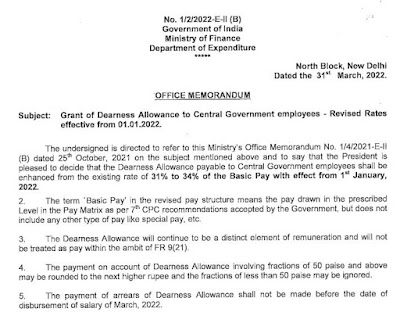
DA Jan 2022 - Grant of Dearness Allowance to Central Government employees - Revised Rates effective from 01.01.2022

 3% DA Hike - Revised Rates effective from 01.01.2022: DoE OM dated 31.03.2022 No. 1/2/2022-E-II (B) Government of India Ministry of Finance...