Wednesday, 11 April 2018

Clarification regarding demarcation of CGHS covered areas under CGHS Wellness Centre

Clarification regarding demarcation of CGHS covered areas under CGHS Wellness Centre

Government of India
Ministry of Health & Family Welfare
Department of Health & Family Welfare
Directorate General of CGHS
Nirman Bhawan, Maulana Azad Road
New Delhi 110 011

No. C 14012/02/2018/CGHS-III/DIR
Dated: 6th April, 2018
OFFICE MEMORANDUM

Subject:- Clarification regarding demarcation of CGHS covered areas under CGHS Wellness Centre

With reference to the above subject the undersigned is directed to state that in some of the CGHS Cities the areas covered under CGHS were not specified resulting in inconvenience to the beneficiaries. The matter has been reviewed and it is now decided that hereinafter the coverage of CGHS shall be limited to the areas within 5 km (approx.) radius of the CGHS Wellness Centres , in all CGHS covered Cities , where such demarcations were not specified. The Additional Director, CGHS concerned City shall notify such areas covered under CGHS Wellness Centres.

The serving Central government employees residing outside the CGHS covered areas shall be covered under CS(MA) Rules. However, in all CGHS covered cities the serving Central government employees residing within the Municipal limits of the city, shall be given a onetime choice to opt for CGHS (instead of CS(MA) Rules) from the nearest CGHS Wellness Centre.
S/d,
(Dr.D.C.Joshi)
Director, CGHS
Signed copy

Reiteration of instructions relating to application of own merit in Direct Recruitment for appointment of Other Backward Classes (OBCs)

Reiteration of instructions relating to application of own merit in Direct Recruitment for appointment of Other Backward Classes (OBCs)

F. No. 43011/4/2018-Estt.(Res.)
Government of India
Ministry of Personnel, Public Grievances and Pensions
Department of Personnel and Training
Establishment (Reservation-I) Section
North Block, New Delhi
Dated April 4, 2018
OFFICE MEMORANDUM

Subject : Reiteration of instructions relating to application of own merit in Direct Recruitment for appointment of Other Backward Classes (OBCs)-regarding

The undersigned is directed to say that the Hon’ble Supreme Court in its judgment in the case of R. K. Sabharwal vs. State of Punjab, had, inter-alia, observed that “the reserve category candidates can compete for the non-reserve posts and in the event of their appointment to the said posts their number cannot be added and taken into consideration for working out the percentage of reservation.”

2. As per instructions issued vide this Department’s OM No. 36012/2/96-Estt.(Res) dated 02.07.1997, in direct recruitments to Central Government jobs and services, the reserve category candidates who are selected on the same standard as applied to general candidates will not be adjusted against reserved vacancies. As per instructions issued vide DOP&T OM No. 36011/1/98-Estt.(Res) dated 01.07.1998, only when a relaxed standard is applied in selecting a reserved candidate, for example in the age limit, experience, qualification, permitted number of chances in written examination, etc., such candidates will be counted against reserved vacancies.

3. It has been brought to the notice of this Department by the Hon’ble Parliamentary Committee on Welfare of OBCs that these instructions are not being followed in some cases in direct recruitments to Central Government jobs and services. It is, therefore, reiterated that while making Direct Recruitments, guidelines issued vide this Department’s OM No. 36012/2/96-Estt.(Res) dated 02.07.1997 and OM No.36011/1/98-Estt.(Res) dated 01.07.1998 may be kept in view by all concerned.

4. All Ministries/ Departments are requested to bring the contents of this O.M. to the notice of all concerned for information and compliance.
S/d,
(Raju Saraswat)
Under Secretary to the Government of India
Tel.: 23092110
Signed Copy

Equal basic Pension under 7th CPC – Lok Sabha Q&A

Equal basic Pension under 7th CPC – Lok Sabha Q&A

Government of India
Ministry of Finance
Department of Expenditure
LOK SABHA

UNSTARRED QUESTION No.6447
TO BE ANSWERED ON FRIDAY, APRIL 6, 2018/CHAITRA 16, 1940 (SAKA)

EQUAL BASIC PENSION UNDER SEVENTH CPC

6447: SHRI P. K. KUNHALIKUTTY
Will the Minister of FINANCE be pleased to state:

(a) whether the Seventh Central Pay Commission (CPC) has recommended option-I for ensuring equal basic pension to pre – 2016 and post – 2015 pensioners retiring from similar/equal posts and stages and if so, the details thereof;

(b) whether the Government has finally not accepted that recommendation and if so, the details thereof; and
(c) the steps taken/being taken by the Government to ensure that such similarly placed pensioners get equal basic pension from 01.01.2016?

ANSWER

MINISTER OF STATE FOR FINANCE
(SHRI P. RADHAKRISHNAN)

(a) to (c) The 7th Central Pay Commission had recommended two formulations for revision of pension of employees who retired before 01.01.2016 and the employees were given option to choose whichever formulation was beneficial. As per the first formulation, the Commission recommended for revision of pension based on notional pay arrived at by adding the number of increments an employee had earned in the appropriate level while in service. This formulation was later on examined by a Committee under the Chairmanship of Secretary, Department of Pension and Pensioners’ Welfare.

The Committee recommended that instead of counting of increments earned in the retiring scale and applying directly to the 7th Pay Commission Pay Matrix, a more scientific and rational method would be to refix pay in each successive Pay Commission as per the formula for revision of pay right up to the 7th Pay Commission. This method of fixing notional pay and pension would benefit a larger number of pensioners as compared to the increment method which benefits only a select segment of pensioners who served for a longer period in the retiring scale without being promoted to a higher grade.

This has been accepted by the Government and appropriate orders have been issued.

Source : Lok Sabha
================== 7th CPC, Disability Pension,Lok Sabha Q&A,central government employee news


GOVERNMENT OF INDIA
MINISTRY OF DEFENCE
DEPARTMENT OF EX-SERVICEMEN WELFARE
LOK SABHA

UNSTARRED QUESTION NO.6124
TO BE ANSWERED ON THE 4TH APRIL, 2018

DISABILITY PENSION

6124. SHRI KRUPAL BALAJI TUMANE:
SHRIMATI BHAVANA PUNDALIKRAO GAWALI PATIL:

Will the Minister of DEFENCE be pleased to state:

(a) whether concerns expressed by armed forces before Seventh Central Pay Commission regarding disability pension are being resolved and if so, the details thereof;

(b) the reasons for converting existing percentage based system of disability pension into slab based system;

(c) the steps taken by the Government to rectify the discrepancies that have emerged in disability pension system after Seventh Central Pay Commission;

(d) whether the Government is considering to bring disability pension of defence services equivalent to disability pension in civil sector in Seventh Central Pay Commission and make a review thereof; and

(e) if so, the details thereof and if not, the reasons therefor?

ANSWER

MINISTER OF STATE (DR. SUBHASH BHAMRE)
IN THE MINISTRY OF DEFENCE

(a) to (e): The 7th Central Pay Commission (CPC) recommended the following on disability pension:-

The Commission is of the considered view that the regime implemented post 6th CPC needs to be discontinued, and recommended a return to the slab based system. The slab rates for disability element for 100 percent disability would be as follows:-


The above recommendation was accepted and Resolution dated 30.09.2016 issued accordingly.


The 6th CPC dispensation of the calculation of disability element on percentage basis, however, continued for civil side which resulted in an anomalous situation. The issue was accordingly referred to the Anomaly Committee. The Anomaly Committee recommended that parity with civilians for grant of disability element which was granted to the Defence Forces Personnel under 6th CPC may be maintained which was approved by the Cabinet. Government order in this regard has been issued on 4th September, 2017.

Source: http://loksabha.nic.in/

7th Pay Commission Reports, some question raised in lok sabha

7th Pay Commission Reports, some question raised in lok sabha
 
GOVERNMENT OF INDIA 
MINISTRY OF FINANCE 
LOK SABHA

STARRED QUESTION NO: 568
ANSWERED ON: 06.04.2018

Pay Commission Reports

JOSE K. MANI Will the Minister of FINANCE be pleased to state:- (a) whether the reports of successive Pay Commissions have been increasing the burden on Government finances/ exchequer in partially accepting their recommendations for increase in wages and if so, the details thereof;

 (b) whether the last Pay Commission has suggested productivity linked pay hike to the deserving employees to eliminate below average or mediocre performance and if so, the details thereof;

 (c) whether such periodic hikes in wages resulting from Pay Commission recommendations trigger similar demands from the State Government/public utility employees, imposing burden on already strained State finances and if so, the details thereof; and

(d) whether the Government is considering an alternative for increasing the salaries and allowances of Central Government employees and pensioners in future instead of forming Pay Commission and if so, the details thereof?

ANSWER MINISTER OF STATE IN THE MINISTRY OF FINANCE (SHRI P. RADHAKRISHNAN)

A Statement is laid on the Table of the House Statement Annexed with the Lok Sabha Starred Question No. 568 dated 06.04.2018 raised by Shri Jose K. Mani regarding Pay Commission Reports
(a) The financial impact of the recommendations of the Central Pay Commission, as accepted by the Government, is normally more pronounced in the initial year and gradually it tapers off as the growth in the economy picks up and fiscal space is widened. While implementing the recommendations of the last Central Pay Commission, i.e., the Seventh Central Pay Commission, the Government staggered its implementation in two financial years. While the recommendations on pay and pension were implemented with effect from 01.01.2016, the recommendations in respect of allowances have been implemented with effect from 01.07.2017 after an examination by a Committee. This has moderated the financial impact of the recommendations. Moreover, unlike the previous 6th Pay Commission, which entailed substantial impact on account of arrears, the impact in the year 2016-17 on account of element of arrears of revised pay and pension on the present occasion of the 7th Central Pay Commission pertained to only 2 months of the previous financial year of 2015-16.

 (b) The Seventh Central Pay Commission in Para 5.1.46 of its Report proposed withholding of annual increment in the case of those employees who are not able to meet the benchmark either for Modified Assured Career Progression (MACP) or regular promotion within the first 20 years of their service.

 (c) The service conditions of employees of State Governments fall within the exclusive domain of the respective State Governments who are federally independent of the Central Government. Therefore, the concerned State Governments have to independently take a view in the matter.

 (d) No such proposal is under consideration of the Government.

 Loksabha

Admission in KV Schools through MP recommendations

Admission in KV Schools through MP recommendations

Procedure for Admission in KV Schools through MP recommendations

As per the decision taken in the 103rd Board of Governors meeting held on 30.10.2015, the existing quota of 06 (six) children for admission in Kendriya Vidyalayas on the recommendation of Hon’ble Members of Parliament during each academic session under the Special Dispensation Scheme is enhanced from 06 to 10 (ten) with effect from the academic session, i.e. 2016-17.

The Revised Scheme of Special Dispensation Admission for Members of Parliament comes into vogue with effect from the academic session 2016-17 with the following features:

1. Each Hon'ble Member of Parliament can refer 10 (ten) cases for admission under the scheme in an academic year but such recommendations shall be confined to children whose parents belong to his constituency either by domicile or on account of having been soon-before posted there or else on account of exigencies of service, migrate to his constituency. Such recommendations would be for admissions in Kendriya Vidyalaya(s) located in his constituency only. In case there is no Kendriya Vidyalaya in the constituency of the Hon'ble MP(Lok Sabha), she/he can recommend these admissions in the Kendriya Vidyalaya(s) located in any neighbouring contiguous constituency. For Members of Rajya Sabha, the State from which the member has been elected would be deemed to be his constituency for this purpose. Nominated members of Rajya Sabha and Lok Sabha can recommend 10 cases for admission in any one or more Kendriya Vidyalaya(s) of the country.

2. These admissions shall be over and above the class strength.

3. These recommendations would be made for classes I and IX.

4. These admission would be made at the beginning of the academic year and no admission would be allowed after the prescribed cutoff date of the year.

5. The recommendations to be made shall be valid only if these are made in the prescribed format provided to each Members of Parliament by KVS(HQ). Recommendations sent in any other format/manner shall not be considered.

6. The children recommended by Hon'ble Members of Parliament must be otherwise eligible for admission as per the extant KVS Admission Guidelines.

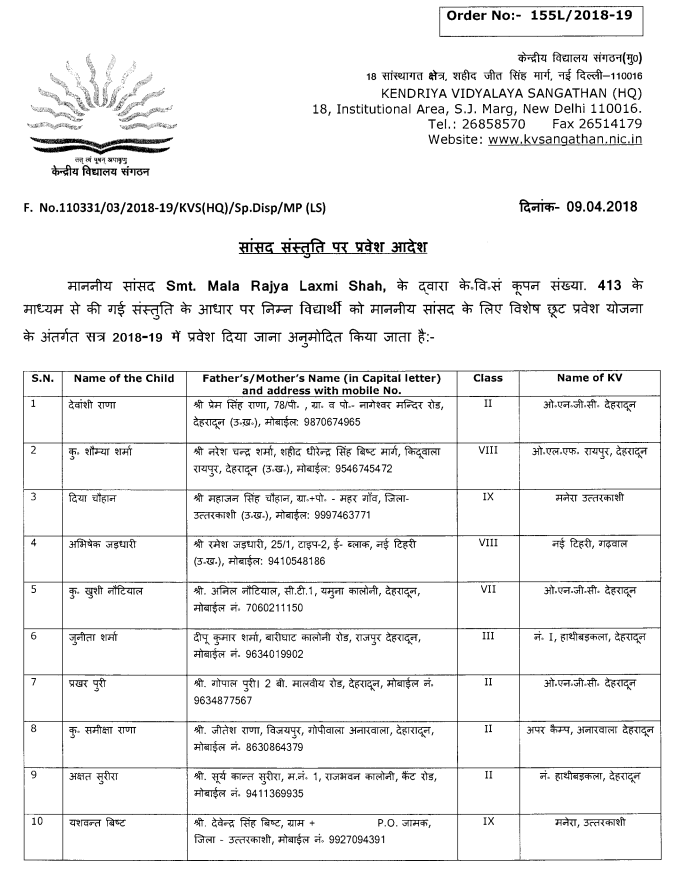
Sample Coupon: (Published by KVS (HQ)

MP-KVS-Coupon

Monday, 9 April 2018

7th CPC Payment of arrears arising out of leave salary - NFIR


7th CPC Payment of arrears arising out of leave salary - NFIR

NFIR

No. I/3/Part I
Dated: 04/04/2018
The Secretary (E),
Railway Board,
New Delhi

Dear Sir,
Sub: Payment of arrears arising out of leave salary consequent to the implementation of the report of 7th CPC for the period from 01/01/2016 and onwards - denial of payment on Zonal Railways.

Federation invites kind attention of the Railway Board to the provisions contained in Para 924 read with Sub-Para (iv) of IREM Vol. I wherein it has been stipulated that when Running Staff are on leave (including Casual Leave), they shall be paid leave salary based on the Basic Pay plus 30% thereof and other Allowances including DA/ADA due on the Basic Pay plus 30% thereof. Reports continued to be received from many zones that the arrears arising out of leave salary as a result of implementation of 7th CPC with effect from 01/01/2016 are not being paid to the Running Staff more particularly the West Central Railway.

In this connection, Federation also invites kind attention of the Railway Board letter No. E(P&A)II-2016/FE.2/5 dated 16/10/2017 (RBE No. 148/2017) wherein instructions were issued for reckoning of 30% pay element for calculation of leave salary on 6th CPC pay, to the Running Staff during the period 0l/01/2016 to 31/08/2008 on raising the issue by NFIR through PNM agenda item No. 57/2016 at the level of Railway Board. Unfortunately, similar instructions have not been issued for payment of leave salary taking into account 30oh of pay element to the Running Staff consequent to implementation of the recommendations of 7th CPC w.e.f. 01/01/2016 with the result running staff are not being paid leave salary on Zonal Railways reckoning 30% pay element on 7th CPC Pay in the absence of Board's instructions.

NFIR, therefore, requests the Railway Board to consider the above facts and issue suitable instructions to the Zonal Railways for reckoning 30% pay element for payment of leave salary (7th CPC Pay) to the Running Staff w.e.f. 01/01/2016 and onwards. A copy of the instructions may be endorsed to the Federation.

Download Order
Source: NFIR

Child Care Leave (CCL) Permitted leave headquarters , LTC , Foreign travel


Child Care Leave (CCL) Permitted leave headquarters , LTC , Foreign travel
Child-Care-Leave-CCL-Central-Government-Employees


No. 13018/6/2013-Estt(L)
Government of India
Ministry of Personnel, Public Grievances and Pensions
Department of Personnel & Training
Old JNU Campus, New Delhi 110 067
Dated: 3rd April, 2018
OFFICE MEMORANDUM

Subject: Child Care Leave (CCL) - Clarification Reg.

The undersigned is directed to refer to DoP'Ts O.M. No. 21011/08/2013- Estt.(AL), dated 25.03.2013 and to say that references have been received with regard to leaving Head Quarters/Station while on CCL and availing LTC during CCL.

2. In this regard, it is has now been decided that:
(i) An employee on CCL may be permitted to leave headquarters with the prior approval of appropriate competent authority.
(ii) LTC may be availed while an employee is on CCL.
(iii) An employee on CCL may proceed on foreign travel provided clearances from appropriate competent authorities are taken in advance.
3 Hindi version will follow.
(Sandeep Saxena)
Under Secretary to the Government of India

NFIR WRITES TO MINISTER OF RAILWAYS

NFIR WRITES TO MINISTER OF RAILWAYS

NFIR

No.II/95/2018
Dated: 05/04/2018
Shri Piyush Goyal,
Hon'ble Minister of Railways & Coal,
Rail Bhavan,
New Delhi

Respected Sir,
Sub: Meeting with the Federations on 4th April, 2018 at Rail Bahvan, New Delhi-reg.
Ref: Railway Board’s letter No. 2018/E(LR)III/Ref/NFIR & AIRF/03 dated 02/04/2018.

While thanking you for sparing your valuable time and joining the Federations during discussions with Member Staff on 4th April, 2018 at Rail Bhavan, New Delhi, I desire to bring your kind notice that though agreements were reached on the following issues years back, between the full Board and the Federations, the orders are however yet to be issued:-

(i) Stepping up of pay of Loco Inspectors inducted prior to 01/01/2006.
(ii) Replacement of 6th CPC GP 4600 with GP 4800.
(iii) Upgradation of Apex Level Group 'C' posts of 6th CPC GP 4600 to GP 4800 (3335 posts).

You may kindly appreciate that abnormal delay on the part of Railway Ministry has been causing disappointment among Railway employees in general and those working in critical safety categories in particular. I seek your kind intervention to see that Railway Board issues orders for implementation of commitment on the above.

Yesterday i.e. on 04th April, 2018, during discussions I made a special appeal to you to reach the Finance Minister and Hon'ble Prime Minister for exempting Railways from the National Pension System (NPS), considering the uniqueness of Railways and its complex working and un-comparable nature of duties being performed by Railway employees under open sky facing all odds for ensuring uninterrupted movement of trains and maintenance of infrastructure. I am thankful to you for positive response on the subject. I however, once again appeal to you to kindly take special initiative so that Railways is exempted from NPS. I also enclose copy of my letter No. IV/NPS/PFRDA BILL/Part I dated 19/03/2018 for kind perusal and necessary action.
Yours sincerely,
(Dr. M. Raghavaiah)
General Secretary
Download letter
Source: NFIR

Anomaly in computation of Pension - IBA Circular


Anomaly in computation of Pension - IBA Circular
Anomaly in computation of Pension Civil Appeal No. 5525 of 2012, Filed in the Hon'ble Supreme Court of India by Bank of Baroda & Ors with other Civil Appeals.

HR & INDUSTRIAL RELATIONS
No.HR&IR/2018-19/G2/4829
April 6, 2018
Chief Executives of Member Banks which
Are parties to the 7th Bipartite Settlement

Dear Sir/Madam,
CORRIGENDUM

Anomaly in computation of Pension Civil Appeal No. 5525 of 2012, Filed in the Hon'ble Supreme
Court of India by Bank of Baroda & Ors with other Civil Appeals.

Please refer to our circular No. HR&IR/2018-19/G2/4786 dated 3rd April 2018 on the captioned subject.

2. There is a typographical error in the date mentioned in para (I) of the above circular. Kindly read as under-

" On 29-10-1993, a Bi-partite Settlement was signed at Industry level between India Banks' Association (representing member Banks) and Workmen Unions (representing Workmen) under the provisions of Industrial Dispute Act, 1947 for introduction of Pension as a second retiral benefit in lieu of "Banks contribution to Provident fund". On similar lines a Joint Note dated 29-10-1993 between Indian Banks' Association (representing member Banks) and Officers Association (representing Officers) was signed".

Inconvenience caused is regretted.
Yours faithfully,
B Raj Kumar
Deputy Chief Executive

View Circular
Source: http://www.iba.org.in/

Anomaly in Computation of Pension - SC Judgement


Anomaly in Computation of Pension - SC Judgement
Anomaly in computation of Pension Civil Appeal No. 5525 of 2012, Filed in the Hon'ble Supreme Court of India by Bank of Baroda & Ors with other Civil Appeals

HR & INDUSTRIAL RELATIONS
No.HR&IR/2018-19/G2/4786
April 3, 2018
Chief Executives of Member Banks which
are parties to the 7th Bipartite Settlement

Dear Sir,

Anomaly in computation of Pension Civil Appeal No. 5525 of 2012, Filed in the Hon'ble Supreme Court of India by Bank of Baroda & Ors with other Civil Appeals.

On 9-10-1993, a Bi-partite Settlement was signed at Industry level between Indian Banks' Association (representing member Banks) and Workmen Unions (representing Workmen) under the provisions of Industrial Dispute Act, 1947 for introduction of Pension as a second retiral benefit in lieu of "Banks contribution to Provident fund." On similar lines a Joint Note dated 29-10-1993 between Indian Banks' Association (representing member Banks) and Officers Associations (representing Officers) was signed.

2. The respective member Banks in exercise of their power under Section 19 of Banking Companies (Acquisition & transfer of undertakings) Act, 1970/1980 pursuant to above referred Bi-partite Settlement/Joint Note, framed and notified in the Gazette of India "Bank Employees Pension Regulations, 1995."

3. Another Joint Note/Bi-partite Settlement was signed between respective parties as mentioned herein above on 14-12-1999 and 27-3-2000 respectively relating to Wage revision. As per the provisions of said Joint Note / Bi-partite Settlement, 1684 points of Consumer Price Index (CPI) were merged with existing basic pay of Officers/employees and revised basic pay was worked out accordingly. However, as per agreed terms & conditions, pay for the purpose of pension was worked out after merging 1616 points of CPI as against 1684 points. These provisions were made effective w.e.f. 1-4-1998. As such, pay for the purpose of pension was less than the actual Pay the Employee/Officer concerned was getting on or after 1-4-1998. This anomaly was removed vide Joint Note/Bi-partite Settlement signed on 2-6-2005. However, monetary benefits were given w.e.f. 1-5-2005.

4. Due to this anomaly, the employees/Officers who retired after 1-4-1998, including those who retired under Special Voluntary Retirement Scheme, 2000 filed various Writ Petitions before different Hon'ble High Courts, praying that they be held entitled to Payment of Pension on the basis of actual average pay drawn by them during last 10 months as per the provisions of Bank Employees Pensions Regulations, 1995.

5. When the matter came up before Hon'ble High Court of Karnataka and Madras, the Hon'ble Courts decided the matter against Banks and ultimately concerned Banks approached Hon'ble Supreme Court by filing Civil Appeals viz., CA No 5525/2012, 6254/2012, 5611/2012, 3026-3253/2013, 3257-3262/2013, 11205-11340/2014, 11342-11435/2014, 9533-9646/2014, 8557/2014, 4711-4800/2014 and 1880/2018, 1881-1888/2018, 1890/2018, 1892-1912/2018, 1918/2018, 1919-2087 and 2088-2092/2018.

6. The Hon'ble Supreme Court vide its order dated 13/2/2018 (copy enclosed) have dismissed these appeals filed by the Banks and inter-alia has held that:-

"17…the provisions contained in Regulation 35 also make an incumbent entitled for opting the pension on the basis of average emoluments. The average emoluments have to be calculated on the basis of the preceding ten months. Adding Explanation (c) to Regulation 2(s), as done, could have created no fictional basis in view of clear and unambiguous provisions in other provisions of the Regulations. Besides, the definition of the average emoluments in Regulation 2(d) itself makes it clear that it is average pay drawn "during the last ten months" of his service by an employee. It cannot mean pay drawn by the employee even before several years. Mentionably there is no amendment made in the aforesaid provision of Regulation 2(d) and the expression during the preceding last ten months before date of retirement is clearly culled out in Regulation 38(1) and 38(2). Thus, in our considered opinion, the view taken by the then Chief Justice Vikramajit Sen as he then was, at Karnataka High Court and by the High Court of Madras are appropriate and the view taken by the Delhi High Court cannot be said to be sustainable for the various other reasons too mentioned hereinafter.

29. Thus, in our opinion, the Regulations which were in force till 2003, would apply with full force and as a matter of fact, the amendments made in it by addition of Explanation (c) in Regulation 2(s) did not have the effect of amending the Regulations relating to pension, as contained in Regulation 38 read with Regulations 2(d) and 35 of the Regulations of 1995. Even otherwise, if it had the effect of amending the pay and perks ‘average emoluments', as specified in Regulation 2(d), it could not have operated retrospectively and taken away accrued rights. Otherwise also, it would have been arbitrary exercise of power. Besides, there was no binding statutory force of the so called Joint Note of the Officers' Association, as admittedly, to Officers' Association even the provisions of Industrial Disputes Act were not applicable and Joint note had no statutory support, and it was not open to forgo the benefits available under the Regulations to those officers who have retired from 1.4.1998 till December 1999 and thereafter, and to deprive them of the benefits of the Regulations. Thus, by the Joint Note that has been relied upon, no estoppel said to have been created. There is no estoppel as against the enforcement of statutory provisions. The Joint Note had no force of law and could not have been against the spirit of the statutory Regulations and the basic service conditions, as envisaged under the Regulations framed under the Act of 1970. They could not have been tinkered with in an arbitrary manner, as has been laid down by this Court in Central Inland Water Transport Corporation Limited & Anr. vs. Brojo Nath Ganguly & Anr., (1986) 3 SCC 156 & Delhi Transport Corporation vs D.T.C. Mazdoor Congress, (1991) Supp.1 SCC 600.

33. The only purpose of the addition of Explanation (c) to Regulation 2(s), was to take away the actual computation of the pension on the basis of the salary, which was drawn in the preceding ten months. Thus, we have to hesitation to strike it down being arbitrary and repugnant to other provisions/Regulations namely 2(d), 38(1)(2) and 35. The Explanation (c) to Regulation 2(s) is hereby struck down, as it could not have been enacted retrospectively to take away accrued rights. Even otherwise also it is held to be arbitrary and irrational. More so, in view of the fact that only by way of a temporary measure, that discrimination was created and the Explanation was deleted with effect from 1.5.2005."

34. Thus, we set aside the judgment rendered by the High Court of Delhi and affirm that of High Courts of Karnataka at Bangalore and the High Court of Madras. The appeals filed by the Banks are dismissed and the appeal filed by the Association is allowed. Resultantly, let the amount which was due and payable be paid with 9% interest, be calculated and paid within four months from today.
35. All pending applications stand disposed of."

7. The matter was put up to the Managing Committee of IBA in its meeting held on 28.3.2018. The committee resolved that the judgement of the Hon'ble Supreme Court may be forwarded to all member banks which are party to above mentioned Joint Note / Bipartite Settlement for their necessary action. As such, a copy of the judgement of Hon'ble Supreme Court is enclosed.

8. As directed by Managing Committee we have taken a Legal Opinion to know the impact of the judgement on various Banks which is given below:

(a) All Nationalized Banks who have Pension Regulations, 1995 will have to give effect to the judgement and pay the differential arrears in the amount of Pension which was due and payable with 9% interest within 4 months from the date of judgement i.e. 13.02.2018.

(b) Banks incorporated under special statutes will also have to give effect to the judgement if they have implemented provisions of the above mentioned Joint Note / 7th Bipartite Settlement.

(c) Private Banks which are not amenable to the Writ jurisdiction of the Hon'ble High Courts/Supreme Court, though can take the plea that captioned judgement is not applicable to them, should also give effect and comply with the captioned judgement if they have implemented provisions of the above mentioned Joint Note/7th Bipartite Settlement. The view expressed in this point Is based on the possibility that if the employees of the Private Banks approach the Civil Court on the basis of said Hon'ble Supreme Court judgement, they would procure a favourable verdict.

Yours faithfully,
B Raj Kumar
Deputy Chief Executive
Source: http://www.iba.org.in/
SC JUDGEMNT

Flash News

DA Jan 2022 - Grant of Dearness Allowance to Central Government employees - Revised Rates effective from 01.01.2022

 3% DA Hike - Revised Rates effective from 01.01.2022: DoE OM dated 31.03.2022 No. 1/2/2022-E-II (B) Government of India Ministry of Finance...