Wednesday, 27 December 2017

NFIR New Year Message

NFIR New Year Message

No.IV/NFIR/7 CPC(Imp)/Allowance/2016/Part I


Dated: 25/12/2017
MESSAGE

Dear Brothers/Sisters,

We Will be celebrating New Year Day on January 1, 208 with disappointment and  agony as the Government has done grave injustice by reducing the percentage or various  Allowances and also by not granting the Allowances from 1st January. 2016. Almost all Railway employees in all corners Of Indian Railways have been deprived Of their legitimate Allowances in terms Of percentages existed prior to acceptance Of 7th CPC report.

The Running Staff, Brothers/Sisters, are aware that NFIR has placed cogent case before the Railway Board for hiking Kilometrage rates on the basis of Running Allowance formula and revision of TA rates. Our presentation was admired by the Running Staff. The Railway Board has discussed with NFIR twice on revision of Running Allowance rates and on both the occasions we conveyed the logic for upward revision or mileage rates and also revision of other related Allowances.

It is sad to mention that the decisions reached negotiated settlement concerning various categories of employees are yet to be implemented while we are walking into New Year on 1st January, 2018. As part of celebrations, everyone of us should convey our deep sense Of disappointment and anguish to the Railway Ministry and the Government and at the same time urge the Government to respond to our issues quickly and positively.

Yours fraternally,

sd/-
(Dr. M.Raghavaiah)
General Secretary
Source: NFIR

Ministry of Finance: Year End Review 2017 - Regarding 7th Central Pay Commission


Ministry of Finance: Year End Review 2017 - Regarding 7th Central Pay Commission

7TH-CPC-Year-End-Review-2017


Enhancing the quality of life remained primary goal for Government when it put into implementation the recommendations of the 7th Central Pay Commission to benefit more than 48 Lakh Central Government Employees.

Department of Expenditure (DOE)
  • General Financial Rules (GFRs), 2017 were released on 7th March, 2017 to enable an improved, efficient and effective framework of fiscal management while providing the necessary flexibility to facilitate timely delivery of services.
  • 7th CPC - On 28th June 2017, the Union Cabinet chaired by the Prime Minister Shri Narendra Modi approved the recommendations of the 7th CPC on allowances with some modifications. The revised rates of the allowances came into effect from 1st July, 2017 benefitting more than 48 lakh Central Government Employees.
While approving the recommendations of the 7th CPC, the Cabinet had decided to set-up the Committee on Allowances (CoA) in view of substantial changes in the existing provisions and a number of representations received. The 7th CPC adopted a threepronged approach in examining a total of 197 allowances which involved an assessment of the need for continuation of each allowance, appropriateness of the set of people covered by the allowance and rationalisation which involved clubbing of allowances with similar objectives. Based on the examination on these lines, the 7th CPC recommended that 53 allowances be abolished and 37 be subsumed in an existing or a newly proposed allowance. For most of the allowances that were retained, the 7th CPC recommended a raise commensurate with inflation as reflected in the rates of Dearness Allowance (DA).

A new paradigm was evolved to administer the allowances linked to risk and hardship. The myriad allowances, their categories and sub-categories pertaining to civilians employees, CAPF and defence personnel were fitted into a table called the Risk and Hardship Matrix (R&H Matrix).

Source: DoE

Promotion of Defence Production


Promotion of Defence Production

Defence manufacturing is primarily driven by capital acquisition of defence equipment. Under 'Make in India' initiative of the Government, several measures have been taken to promote indigenous design, development and manufacture of defence equipment in the country by harnessing the capabilities of the public and private sector. These measures include according preference to procurement from Indian vendors under the Defence Procurement Procedure (DPP), liberalization of the licensing regime and FDI policy by raising the cap on FDI in the defence sector, simplification of export procedure, streamlining of defence offset guidelines etc. Recently, the Government has notified the ‘Strategic Partnership (SP)’ Model which envisages establishment of long-term strategic partnerships with Indian entities through a transparent and competitive process, wherein they would tie up with global Original Equipment Manufacturers (OEMs) to seek technology transfers to set up domestic manufacturing infrastructure and supply chains.

In the last three financial years i.e., 2014-15 to 2016-17, the Government has accorded Acceptance of Necessity (AoN) for 105 proposals worth Rs.2,33,000 Crore approximately, in 'Buy (Indian-Indigenously Designed & Developed Manufactured (IDDM)', 'Buy (Indian)', 'Buy and Make (Indian)' and 'Make' categories of capital acquisition i.e. Request for Proposal (RFP) will be issued to Indian vendors only.

As on date, no in-house development project proposal approved by Ordnance Factory Board for development of small arms is pending for approval by Department of Defence Production.

This information was given by Raksha Rajya Mantri Dr. Subhash Bhamre in a written reply to Shri PR Senthil Nathan and Shri Bharathi Mohan RK in Lok Sabha today.

Pay Revision of Nurses


Pay-Revision-Nurses-7TH-CPC

GOVERNMENT OF INDIA
MINISTRY OF HEALTH AND FAMILY WELFARE
LOK SABHA
STARRED QUESTION NO: 103
ANSWERED ON: 22.12.2017

Pay Revision of Nurses
BHAVANA GAWALI (PATIL)
Will the Minister of
HEALTH AND FAMILY WELFARE be pleased to state:

Will the Minister of HEALTH AND FAMILY WELFARE be pleased to state:
(a) whether the All India Nurses Confederation has demanded review of their pay scale and increase in their allowances;
(b) if so, the details thereof;
(c) whether the Government has taken any decision in this regard and if so, the details thereof; and
(d) whether the Union of Nurses had called a pan-India strike in the recent past and if so, the details thereof along with the action taken by the Government to address their grievances?

ANSWER
THE MINISTER OF HEALTH AND FAMILY WELFARE
(SHRI JAGAT PRAKASH NADDA)
(a) to (d) : A Statement is laid on the Table of the House.
STATEMENT REFERRED TO IN REPLY TO LOK SABHA
STARRED QUESTION NO. 103* FOR 22TH DECEMBER, 2017

(a) to (c) - Government has not received any representation/demands from All India Nurses Confederation. However, representation from All India Government Nurses Federation (AIGNF) was received in the Ministry demanding revision in pay and allowances against 7th Central Pay Commission's report. The Government examined their demands along with demands of other Associations. The Government accepted the Commission's recommendations on minimum pay, fitment factor, Index of Rationalisation, Pay matrices and general recommendations on pay without any material alteration vide Resolution dated 25.07.2016. The recommendation on allowances was referred to an Empowered Committee comprising of Finance Secretary and Secretary (Expenditure) as Chairman and Secretaries of Home Affairs, Defence, Health & Family Welfare, Personnel & Training, Posts & Chairman, Railway Board as Members for further consideration.

AIGNF threatened to go on a nationwide strike with effect from 2nd August, 2016. Their main demands were granting entry pay of PB-3 with GP 5400/- to Staff Nurse ( Nursing Officer), Nursing allowance, Nurses to be covered under Risk and Hardship Matrix (R1H1), Uniform and Washing allowance, Knowledge allowance and other allowances according to the Grade Pay. Ministry of Health and Family Welfare examined their demands and recommended entry Grade Pay of Rs.5400/- to Staff Nurse (Nursing Officer) to Ministry of Finance. Detailed note in respect of allowances admissible to nurses vide 7th CPC recommendations, demand of nurses and Ministry's response thereon was sent to Empowered Committee for consideration. (Annexure).

(d) AIGNF went on a nationwide strike on 2nd September, 2016 reiterating their earlier demands on revision of pay and allowances. The strike was called off after discussion on 3.9.2016. The Ministry of Health & Family Welfare again referred the demands of the Association along with its recommendations to the Empowered Committee. AIGNF also made their presentation before the Committee on allowances on 15.9.2016.

The Empowered Committee examined the demands of the Nurses Associations. The accepted recommendations on allowances were notified vide Government of India notification dated 06th July, 2017. The Government of India has accepted to retain and rationalize Nursing allowance and Operation theatre allowance. Uniform and washing allowance has been retained and subsumed under the Dress allowance. Most of the demands of AIGNF have been considered and concluded to their satisfaction and a robust system of monthly interaction with nurses has been put in place.

LOK SABHA

Revival and Restructuring of CPSEs


Revival and Restructuring of CPSEs

GOVERNMENT OF INDIA
MINISTRY OF FINANCE
LOK SABHA
UNSTARRED QUESTION NO: 1375
ANSWERED ON: 22.12.2017
Revival and Restructuring of CPSEs
SHRIKANT EKNATH SHINDE
DHARMENDRA YADAV
ANANDRAO ADSUL
PRITAM GOPINATH MUNDE
Will the Minister of

FINANCE be pleased to state:-
(a) whether the ailing Central Public Sector Enterprises (CPSEs) need revival and restructuring and if so, the details thereof:
(b) whether the Government has issued guidelines for revival and restructuring of such ailing CPSEs and if so, the details thereof:
(c) whether the private participation is also being considered in this regard and if so, the details thereof: and
(d) the extent to which these guidelines will be beneficial for revival and restructuring of these CPSEs?

ANSWER
THE MINISTER OF STATE IN THE MINISTRY OF FINANCE
(SHRI PON. RADHAKRISHNAN)

(a) to (d) Department of Public Enterprises (DPE), as a nodal department, have issued guidelines on 29.10.2015 for “Streamlining the mechanism for revival and restructuring of sick/ incipient sick and weak CPSEs”. CPSEs function under the administrative control of various Ministries/ Departments. As per the guidelines, the responsibility for addressing the sickness of Central Public Sector Enterprises (CPSEs) lies with the concerned administrative Ministries/ Departments. The administrative Ministries/ Departments monitor the sickness of CPSEs and identify the sick/ incipient sick/ weak CPSEs functioning under their control based on the performance and take timely redressal measures. The concerned administrative Ministries/ Departments formulate revival/ restructuring plans, which may include disinvestment or privatization, for the CPSEs on a case-to-case basis. Guidelines lay down that the process for revival and restructuring of sick / incipient sick and weak CPSEs be made time bound, comprehensive, performance driven and efficient.

Government says No Proposal to Revise Income Tax Rates this year


Government says No Proposal to Revise Income Tax Rates this year

GOVERNMENT OF INDIA
MINISTRY OF FINANCE
DEPARTMENT OF REVENUE

LOK SABHA
UNSTARRED QUESTION No. 1355

TO BE ANSWERED ON FRIDAY, THE 22ND DECEMBER, 2017
01, PAUSHA, 1939 (SAKA)
AMEND INCOME TAX RATES
1355. SHRI DEVENDRA SINGH BHOLE:

Will the Minister of FINANCE be pleased to state:

(a) whether the Government proposes to amend the present rates of income tax so that more people may pay income tax;
(b) if so, the details thereof and the benefits likely to accrue to common man and the Government by this step; and
(c) if not, the reasons therefor?

ANSWER
MINISTER OF STATE IN THE MINISTRY OF FINANCE
(SHRI SHIV PRATAP SHUKLA)

(a) to (b) No Madam. Currently, there is no such proposal under consideration.
(c) The rates of income tax are prescribed through the Finance Act every year

Tuesday, 26 December 2017

Is the House Rent Allowance paid to Central Government employees as per the recommendations of 7th Pay Commission sufficient?


Is the House Rent Allowance paid to Central Government employees as per the recommendations of 7th Pay Commission sufficient?

If the question is to be answered at a superficial level, the answer is yes. Let us analyze things from the angle of a lower rung employee.

An employee is paid HRA at the rate of 24%, 16% and 8% of his basic salary based on the city where he works. For HRA purpose, cities in India are divided into three groups, namely X, Y and Z, and HRA is paid respectively at the rate of 24%, 16% and 8% uniformly for all categories of employees.
A person employed in Delhi will get 24% of his basic salary as HRA and an employee employed in Kanyakumari will get 8% of his basic salary as HRA. The minimum basic salary of a Central Government employee is Rs.18000. Accordingly, a person working in Delhi should get Rs.18000 x 24% = Rs.4320, and a person employed in Kanyakumari should get Rs.18000 x 8% = Rs.1440. But the minimum HRA applicable to all the three group of cities, namely X,Y and Z, are Rs.5400, Rs.3600 and Rs.1800 respectively. Accordingly, an employee working in Delhi will get Rs.5400, while an employee employed in Kanyakumari will get Rs.1800 as House Rent Allowance.

The important point to be noted here is Sixth Pay Commission had recommended HRA at the rate of 10%, 20% and 30% for Central Government employees and they were paid accordingly from 2008 to 2015. But the recommendation of the Seventh Pay Commission to reduce the HRA rates has led to the dissatisfaction among Central Government employees.

Though Seventh Pay Commission salary is paid to Central Government employees from 1-1-2016, the revised HRA paid since 1-7-2017 has increased their dissatisfaction further.

Moreover there was a great expectation for arrear payment for the period January 2016 to June 2017.
Non-fulfillment of these two highly expected demands has made the Central Government employees unhappy with HRA.


Classification of Cities / Towns Rate of HRA Rate of HRA (DA over 25%) Rate of HRA (DA over 50%)
X 24 % 27% 30%
Y 16% 18% 20%
Z 8% 9% 10%


Give asset details or lose promotions and foreign postings: Government to IAS officers


Give asset details or lose promotions and foreign postings: Government to IAS officers

All IAS officers have been asked to submit details of their assets by next month and warned that the failure to do so would lead to a denial of vigilance clearances needed for promotions and foreign postings.

The Department of Personnel and Training (DoPT) has written to all Central government departments, states and union territories asking them to ensure submission of Immovable Property Returns (IPRs) by IAS officers working with them by January 31, 2018.

"In view of the DoPTs instructions dated April 4, 2011, it is reiterated that failure to ensure timely submission of IPR would result in denial of vigilance clearance," Establishment Officer and Additional Secretary P K Tripathi said in the recent missive.

According to the 2011 instructions, officers who did not submit their IPR as on January 1, 2018, on time would be denied vigilance clearances and will not be considered for promotions and empanelment for senior- level posts in the government of India.

"Those who do not submit property details on time will not be considered for any posts of the Central government including foreign postings," a senior DoPT official said.

An online module has been designed for the purpose of filing of the IPR. Officers have the option of uploading the hard copy of the IPR by January 31 in the online module, the December 22 letter said.

There are 5,004 Indian Administrative Service (IAS) officers working across the country, according to the DoPTs latest data.

PTI

7th Pay Commission: Challenging year for Central Government Employees


7th Pay Commission: Challenging year for Central Government Employees

The central government employees passed a challenging year for a number of factors including hike in pay, minimum pay hike, raising of fitment factor, pay anomalies and non-payment of arrears on allowances, employees unions said.


The delayed implementation of allowances have saved the government nearly Rs 40,000 crore. The non-payment of arrears on allowances caused tremendous irritation and frustration among the central government employees, said a unions leader.

The government gave higher basic pay in August 2016 with arrears, effective from January 1, 2016 to its employees on the recommendations of the 7th pay commission but the allowances notified on June 6 without arrears, which came into effect from July 1, 2017.

The recommendations of the 7th Pay Commission got the Cabinet nod on June 29, 2016 in respect of basic pay, the pay panel had recommended a 14.27 per cent hike in basic pay. The previous 6th Pay Commission had recommended a 20 per cent hike, which the government doubled while implementing it in 2008.

All pay commissions made up pay gap in respect of basic pay between lower paid employees and top bureaucrats from second Pay Commission 1:41 ratio to Sixth pay commission 1:12, while 7th Pay Commission made it higher about to 1:14.

The 7th pay panel recommended minimum pay from Rs 7,000 to Rs 18,000 per month while the maximum pay from Rs 80,000 to Rs 2.5 lakh with a fitment factor of 2.57 times uniformly of basic pay of 6th pay commission.

However, the Unions have been demanding minimum pay Rs 26,000 instead of Rs 18,000 with 3.68 fitment factor.

The unions had claimed that the recommended pay hike was the lowest in the last 70 years and the Pay Commission award was not discussed with them, hence they had threatened to go on an indefinite strike over proper pay hike on July 11, 2016.

The unions had called off their indefinite strike after the government announced that a High Level Committee would be formed to address their demands.

So, the government formed the 22-member National Anomaly Committee (NAC) headed by Secretary, Department of Personnel and Training (DoPT) in September, 2016 instead of High Level Committee to look into pay anomalies arising out of the implementation of the 7th Pay Commission’s recommendations.

In the meantime, DoPT issued a letter on October 30 stating that the demand for increase in minimum Pay and fitment formula do not appear to be treated as anomaly, therefore, these do not come under the purview of NAC.

However, Finance Minister Arun Jaitley had said in Rajya Sabha on July 19, 2016, The minimum pay Rs 18,000 was made on recommendations of the 7th Pay Commission. But government will consider hiking it after discussions with all stakeholders, once the proposal in this regard will be submitted to government.

The sources in DoPT said, "The NAC is ready with it’s interim report and which will be submitted soon but no minimum pay and fitment formula will be included in the interim report."

"I would be lying if I said the DoPT letter doesn’t bother me at all, but the truth is, it doesn't bother me much because of the way of government made decisions. A hike in minimum pay has been one of the long-standing our demands. The 14.27 per cent hike in basic pay for us under the 7th Pay Commission is the lowest in 70 years. The government had issued statement on July 6, 2016 to assure us that the pay scales matter raised by us would be considered," a top union leader said.

"Our unions members often ask us what we should do to respond to the DoPT letter," he said.

"If government doesn't hike our pay, we will have no choice but to proceed on an indefinite strike," he added.

He considers 2017 a challenging year for central government employees and many of those challenges won't be going away just because 2018 calendars are hanging. He also says he's confident the government will make the right decisions during the next year.

PCDA Circular 30 - Payment of enhanced Monetary Allowances attached to pre and post independence Gallantry Awards


PCDA Circular 30 - Payment of enhanced Monetary Allowances attached to pre and post independence Gallantry Awards

Office of the Pr.C.D.A.(Pensions),
Draupadighat, Allahabad - 211014
Circular No. 30
Date: 22.12.2017
To,
1. The Director of Treasuries
2. The Post Master, Kathua, Srinagar (J&K)
3. The Post Master, Campbell Bay (Andaman & Nicobar)
4. The Defence Pension Disbursing Officer ……..
5. The Pay and Accounts Officer ……..
6. The Assistant Military Attache(P) Embassy of India,Kathmandu,(Nepal)
7. The Director of Accounts, Panaji (Goa)
8. The Chief Accounts officer (PGTPF), Gangtok, Sikkim- 737101
9. Director of Accounts, Moti Daman- 396220
10. The Chief Manager, CPPC …..
11. The Manager, Link Bank (other than CPPC) ……..
12. Director of Accounts & Treasuries, Puducherry- 605001

Subject : Payment of enhanced Monetary Allowances attached to pre and post independence Gallantry Awards.
Reference: This office Important Circular No. 9 dated 10.06.2011.

(Available on this office Website address www.pcdapension.nic.in)

Consequent upon issue of letters bearing No. 7(62)/20014-D (AG) dated 4th Dec, 2017 by Govt. of India, Ministry of Defence(reproduced as Annexure 'A' and 'B' respectively to this circular), the rates of Pre- Independence Gallantry Awards and Post-Independence Gallantry Awards have been revised w.e.f. 01st August, 2017.

2. The revised rate of monetary allowance attached with Gallantry Awards may please be paid to all recipients at revised rate, irrespective of rank and income.
3. The terms and condition for payment of monetary allowance on the authority of Pension Payment Order (PPO) notified by this office in above categories of cases is stated in brief in following Paras
i. The allowance will be admissible to the recipient of the award and on his death to his widow lawfully married by a valid ceremony. The widow will continue to receive the allowance until her death. Ordinarily, the widow who was first married shall receive the allowance, but with the special sanction of the Government, the allowance may be divided equally between the lawfully married widows of recipients.

ii. When the award has been made posthumously to a bachelor, the monetary allowance shall be paid to his father or mother, and in case the posthumous awardee was a widower, the allowance shall be paid to his son below 18 years or unmarried daughter as the case may be.

iii. Each bar to the decoration will carry the same amount of monetary allowance as admissible to the original award.

iv. The monthly monetary allowance will be paid in respect of all gallantry awards received by an individual.

v. The monetary allowance will not be taken into account for computing dearness relief.
For CMDs/Chief Managers of Link Bank/CPPCs/Director of Treasuries/ all other PDA's
It is requested that a copy of these orders / instructions may be provided to all Paying Branches/ Treasuries under your jurisdiction for making payment of the monetary allowance at the enhanced rate.

The order has also been uploaded on this office web site www.pcdapension.nic.in . The copy of same may be downloaded at your end for immediate implementation of the Government orders.

No. G-1/M/068/ICO's/Vol- V
Date: 22 .12.2017
(S.C. SAROJ)
Sr.Accounts officer (Pensions)

Flash News

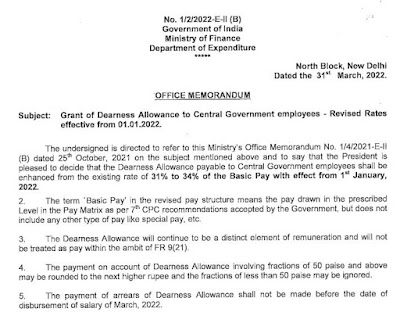
DA Jan 2022 - Grant of Dearness Allowance to Central Government employees - Revised Rates effective from 01.01.2022

 3% DA Hike - Revised Rates effective from 01.01.2022: DoE OM dated 31.03.2022 No. 1/2/2022-E-II (B) Government of India Ministry of Finance...