Monday, 20 November 2017

Denial of pay fixation benefit in the case of Sr. P. Way Supervisors (GP 4200 PB-2) merged with JE/P.Way (GP 4200+PB-2)


Denial of pay fixation benefit in the case of Sr. P. Way Supervisors (GP 4200 PB-2) merged with JE/P.Way (GP 4200+PB-2)

NFIR

No. I/2/Part IV
Dated: 16/10/2017
The Secretary (E),
Railway Board,
New Delhi
Dear Sir,

Sub: Denial of pay fixation benefit in the case of Sr. P. Way Supervisors (GP 4200 PB-2) merged with JE/P.Way (GP 4200+PB-2)

Ref: (i) NFIR's PNM agenda item No. 53/2016.
(ii) RailwayBoard's letter No. PC-III/20l6/FE-II/3 dated 08/09/2016.
(iii) NFIR's letter No. VZlPart trI dated 12/09/2016 & No. 1/2/Part IV dated
05/06/2017.
(iv) Railway Board's letter No. PC-III/20l6/FE-II/3 dated 05/07/2017.
(v) NFIR's letter No. I/2Part IV dated 10/07/2017.
(vi) Railway Board's letter No. PC-III/20l6/FE-II/3 dated 26/07/2017.

The reply sent by the Railway Board vide letter dated 2610712017 is not acceptable to the Federation as the Railway Board has ignored the fact that the Sr. P. Way Supervisors have been made to shoulder higher responsibilities of Jr. Engineer (P. Way) and in such sifuations, pay fixation under erstwhile Rule FR 22 (C) is needed to be extended to the staff. Federation further desires to state that Enbloc merger and upgradation granted by the Railway Board, should not undermine the right of the employee to claim benefit of pay fixation when he is shifted to the higher post with higher responsibilities.

NFIR wanted the Railway Board to cite the rule under which pay fixation is not admissible in these cases, but sadly the Board have not cited any rule position. Relying on Rule 1313 and denying the benefit of pay fixation is highly improper.

This being a PNM subject, the Federation will discuss the issue in the ensuing PNM meeting at the level of MS & FC.
Yours faithfully,
(Dr. M. Raghavaiah)
General Secretary
Source: NFIR

Aadhaar Data is Never Leaked or Breached: UIDAI


Aadhaar Data is Never Leaked or Breached: UIDAI

The Unique Identification Authority of India (UIDAI) responding to a news report, appeared in certain section of media on "210 Government sites made Aadhaar info public" as if Aadhaar data is leaked or breached, has said that such report is a skewed presentation of the facts and poses as if the Aadhaar data is breached or leaked which is not the true presentation. UIDAI said in a statement here that the Aadhaar data is fully safe and secure and there has been no data leak or breach at UIDAI.

UIDAI said that this said data on these websites was placed in public domain as a measure of proactive disclosure under RTI Act by these government and institutional websites which included beneficiaries’ name, address, bank account, and other details including Aadhaar number and was collected from the third party/users for various welfare schemes. It was this collected info which had been displayed in the public domain under RTI Act. There was no breach or leakage of Aadhaar data from UIDAI database or server as has been aired by the said report.

UIDAI said that acting promptly on this, UIDAI and Ministry of Electronics & IT had directed the concerned Government departments/ministries to immediately remove it from their websites and ensure that such violation do not occur in future. Certain other measures were also taken at various levels to ensure that such incidents of display of Aadhaar numbers do not take place. Following UIDAI’s action such data were removed from these websites immediately. However, the news presented the facts in a skewed manner and misleads readers as if Aadhaar data has been leaked or breached at 210 websites posing Aadhaar security is vulnerable.

UIDAI reiterated that Aadhaar security systems are best of the international standards and Aadhaar data is fully secure. There has been no breach or leakage of Aadhaar data at UIDAI. Also, the Aadhaar numbers which were made public on the said websites do not pose any real threat to the people as biometric information is never shared and is fully secure with highest encryption at UIDAI and mere display of demographic information cannot be misused without biometrics.

UIDAI clarified that Aadhaar number is not a secret number. It is to be shared with authorized agencies when an Aadhaar holder wishes to avail a certain service or benefit of government welfare scheme/s or other services. But that does not mean that the proper use of Aadhaar number poses a security or financial threat. Also, mere availability of Aadhaar number will not be a security threat or will not lead to financial/other fraud, as for a successful authentication fingerprint or iris of individual is also required. Further all authentications happen in presence of personnel of respective service provider which further add to the security of the system.

Furthermore, UIDAI security system has people's participatory security system like Biometric Lock facility available at UIDAI portal which any Aadhaar holder can use to put his/her own lock on one’s biometric by visiting UIDAI's official website www.uidai.gov.in.

Sunday, 19 November 2017

DOPT : Items proposed by the Staff-Side, NC(JCM) for discussion in the National Anomaly Committee

DOPT : Items proposed by the Staff-Side, NC(JCM) for discussion in the National Anomaly Committee

F.No.11/2/2016-JCA-I(Pt.)

Government of India
Ministry of Personnel, Public Grievances & Pensions
Department of Personnel Training

North Block, New Delhi
Dated the 30th October, 2017

To

Shri Shiv Gopal Mishra
Secretary, Staff-Side National Council,
JCM 13-C, Ferozshah Road,
New Delhi-110001

Subject:— Items proposed by the Staff-Side, NC(JCM) for discussion in the National Anomaly Committee — Comments of DoPT regarding.

Sir,

I am directed to refer to your letters no. NC-JCM-2017/7th CPC Anomaly dated 16th August, 2017 and 31th August, 2017 with which a total of 18 items have been sent to DoPT for discussion in the NAC meetings. These 18 items are about various issues over which, the Staff-Side has opined, anomaly has arisen as a result of the 7th CPC’s recommendations or absence of them.

2. On the other hand, DoPT after examining them in the light of the three postulates which, as described in DoPT’s OM. No. 11/2/2016-JCA dated 16th August, 2016 and 20th February, 2017, would constitute anomaly is of the view that there are certain items in the lists sent which are not in accord with them and hence cannot be called anomalies as such notwithstanding the merit that they may have otherwise. There are also certain items which should be taken up at the Departmental Anomaly Committees of the other administrative Ministries concerned. A few items are those which, for a detailed examination, need more relevant documents/papers etc. These have been briefly described below:

Si. No

DescriptionAnomaly     
Comments
1.      
Anomaly     in computation          of Minimum Wage
As against the Minimum Wage decided to be Rs. 18000/- by the Govt. w.e.f. 01.01.2016, the Staff-Side has said that this should be not less than Rs. 26,000/-and the multiplication factor ought to have been 3.714 and not 2.57.

 They have further asked for the pay matrix to be changed. Objecting to the methodology adopted by the 7th CPC in computing the Minimum Wage, they have given a number of reasons like the retail prices of the commodities quoted by the Labour Bureau being irrational, adoption of the 12 monthly average of the retail price being contents to the Dr. Avkrovd f ormula, the website of the Agriculture Ministry giving the retail prices of commodities forming the basis of computation of minimum wage provides a different picture, so on and so forth.

However, when one compares this item with the three situations given in DoPT’s OM. No. 11/2/2016-jCA dated 16th August, 2016 and 20th February, 2017, it does not appear that this satisfies any of them to be treated as an anomaly.

2.      
3% Increment in all stages
The Staff-Side argues that in spite of the foreword to the Report making it clear in para 1.19 that the prevailing rate of increment is considered quite satisfactory and has been retained, an illustrative list appended by them shows instances where the pay, gone up after the addition of annual increment by 3%, falls short of what it would have been. They have quoted para-5.1.38 of the report also which states that the rate of annual increment would be 3%.

While what the Staff-Side has stated has its own merits, the fact of the matter is that the principle followed here is whenever a stage of pay, after addition of an increment, falls short of the nearest hundred by less than 50, the employee would be entitled to get the amount mentioned in the immediately next cell in the Pay-Matrix. However, when the gap is that of more than 50, the pay, on addition of an increment, is rounded off to the nearest hundred which travels backward.

For instance, if staying at Rs. 46,100/- one gets an increment @ 3%, instead of having his/her pay fixed at Rs. 47,483/- (which is the exact figure), it will be Rs. 47,500/- (thus gaining by Rs. 13/-). Thus it is not a case of permanent loss as the loss in one year is made good in the second/third year. Considering this to he a situation of swings and roundabouts, this may not be treated as a case of anomaly.

3.      
Anomaly due to index rationalization
The Staff-Side has taken exception to the index rationalization followed by the 7th CPC while formulating its views as per which the fitment factor varies and moves upward as one goes up the hierarchical ladder with the level of responsibility and accountability also steadily climbing up commensurately. The Staff-Side argues that the multiplication factor should be one, i.e. 2.81.
Although the Staff-Side has remonstrated that
the vertical relativity will suffer distortion in the process, it has to be stated that it is a policy decision about by the Staff-Side comes to be distorted when the pay of a feeder-cadre post and that of a promotional post becomes same. In this case it is not
so. Hence it does not appear to qualify for being called an anomaly.

4.      
Minimum Pension
The Staff-Side says the minimum pension fixed after 7th CPC should be corrected and revised orders issued. From the brief explanatory note recorded under this point, it appears that the CPC had sounded out D/o pension on what the latter thought what the minimum pension should be.

This is an exclusively pension-related issue on which, as informed by the Staff-Side, D/o Pension was asked for their views by the 7t1 CPC. Moreover, as will be evident, the basic focus of DoPT’s Q.M. No. 11/2/2016-JCA dated 16th August, 2016 and 20th February, 2017 is on taking on board those anomalies which are pay-related. Hence, this item may be taken up separately by the Staff-Side with the D/o Pension. Thus, instead of treating this as a case of anomaly, the Staff-Side is requested to take it up with the D/o Pension separately.

5.      
Date of effect of allowances HRA, Transport Allowance, CEA etc.
The Staff-Side has demanded that the grant of the allowances (revised) mentioned alongside should be made effective from 01.01.2016 and not from 01.07.2017.

This is a demand and cannot be treated as an anomaly. Moreover, the date from which a benefit is to be made effective is something which can be decided only by the Government. Hence, this may not be taken up at the NAC.

6.      
Anomaly in the grant of D.A instalment w.e.f 01.01.2016.
Here the Staff-Side has questioned the methodology adopted by the Government in computing the DA instalment w.e.f. 01.01.2016.

It has, however, to be pointed out that even if there is merit in the contention of the Staff-Side involving this item, it does not qualify being called an anomaly when it is examined in the light of the three situations which, as per DoPT’s Q.M. No. 11/2/2016-JCA dated 16th August, 2016 and 20th February, 2017, would constitute anomalies.


3. Items to be taken up at the Departmental Anomaly Committees.
Si. No

DescriptionAnomaly     
Comments
1.
Implement  the recommendation on Parity in Pay Scale between Sr.  Auditor/Sr. Accountant of IA&AD and organized Accounts with Assistant Section Officer of CSS.
The Staff-Side says that although the 5th, 6th and now 7th CPC’s have recommended that the pay-scales of different cadres/categories/grades requiring the same recruitment qualifications should be the same, denial of the same benefit to the Statistical Assistants (SA’s) who are otherwise at par with Assistant Section Officers (erstwhile ‘Assistant’) is a violation of the principle. While ASO’s are placed in the Pay-Matrix of 7, SA’s are in the Pay-Matrix of 6. This arrangement is stated to have disturbed the horizontal relativity between the pay-scales of the SA’s in the Organized Accounts and IA&AD Cadre and ASO’s in the CSS cadre. In conclusion, it has been requested that SA’s should also be placed in Pay-Matrix no. 7.
Even if, the present case comes across as one of anomaly, it appears that the interests of the Statistical Assistants only are involved. ASO’s of CCS are coming into the question; but only as a reference point, by way of comparison. Hence the Staff-Side is requested to take up this issue at the Departmental Anomaly Committee concerned.

2.
Technical Supervisors     of Railways
This particular item is exclusively Railways-specific. The Staff-Side, NC OCM) is requested to take it up at the Departmental Anomaly Committee of MR) Railways.

3.
Anomaly     in       the assignment  of replacement of Levels of pay in the Ministry of Defence, Railways, Mines etc in the case of Store Keepers     .

Staff-Side says that although ‘Store keeper’ is one such category of posts which is common to various Departments like Defence, Mines, Railways etc and in spite of the nature of job, responsibilities being similar, the pay-scale of storekeepers across all the Departments is not the same. It is still less in the M/o Defence even after the entry-level qualifications which were different before the 7th CPC stage, have been revised.
If what the Staff-Side remonstrates that even after the requisite changes had been carried out in the R/Rules, the 7th CPC did not take any cognizance of it is true, it has to be assumed that it is a policy decision of the Government. Moreover, the issue appears to be M/o Defence-specific. The Staff-Side is requested to take it up at the Departmental Anomaly Committee meeting of the M/o Defence.


4.       Item to be taken up separately with the Department of Pension.

Si. No

DescriptionAnomaly     
Comments
1.
Anomaly     arising from the decision to reject option-1 in pension fixation
As per the ToR of the NAC, anomalies are basically pay-centric. Under this point, the contention of the Staff-Side is pension-centric. Furthermore, the Staff-Side has themselves clarified that post-7th CPC, Government had set up a CoS headed by Secretary(Pension) to look into the first option recommended by the 7th CPC. Eventually, this was not found feasible to be implemented. With such a decision having been taken at the CoS level, it cannot be called an anomaly. In view of this, we may inform the Staff-Side to separately take it up with D/0 Pension without treating it as an anomaly that can be taken up at the NAC.


5.       More details required to examine the following item.

Si. No

DescriptionAnomaly     
Comments
1.
Parity in Pay Scales between      Assistants  /Stenographers      in field / subordinate officers and assistant Section Officer and stenographers in CSS.
Although the         heading of this item is          self-explanatory, the relevant text given in the paper sent  is not complete as the pay-scales of Assistants and stenos posted in field have not been mentioned therein. Until their pay-scales are known
they cannot be compared to check whether there is indeed any anomaly. The Staff-Side is requested to provide more information that is relevant so that it can be properly examined to find out whether an anomaly arises here or not.

 Yours faithfully,
 S/d,
(D.K. Sengupta)
Deputy Secretary to the Government of India

Signed Copy

Eligibility of widowed/divorced daughter for grant of Family Pension clarification – Desw Orders dt. 17.11.2017

Eligibility of widowed/divorced daughter for grant of Family Pension clarification – Desw Orders dt. 17.11.2017

No.1(9)/2013-D(Pen/Policy)
Government of India
Ministry of Defence
Department of Ex-Servicemen Welfare
New Delhi -110011

Dated 17th November, 2017

To
The Chief of the Army Staff
The Chief of the Naval Staff
The Chief or the Air Staff

Subject: Eligibility of widowed/divorced daughter for grant of Family Pension clarification.

The undersigned is directed to state that the provision for grant of family pension to a widowed/divorced daughter beyond the age of 25 years has been made vide GoI, Ministry of personnel, P.C. & Pensions, Department of Pension & Pensioners Welfare 0M No.1/19/03-(E) dated 2S.08.2004 Circulated vide GoI MOD letter No.878/A/D(Pen/Sers)/04 dated 21.09.2004 applying the same provision to the Armed Force Personnel.

2. It was clarified vide Government of India, Ministry of Personnel, P.G- & Pensions, Department of Pension & Pensioners Welfare OM No.1/13/09-P&PW (E) dated 11.09.2013 circulated vide MOD ID No.1(9)/2013/D(Pen/Pol) dated 16.09.2015, the family pension is payable to the children as they are considered to be dependent on the Government servant/pensioner or his/her spouse. A child who is not earning equal to or more than the sum of minimum family pension and dearness relief thereon is considered to be dependent on his/her parents. Therefore, only those children who are dependent and meet other conditions of eligibility for family pension at the time of death of the Government servant or his/her spouse, whichever is later, are eligible for family pension. If two or more children are eligible for family pension at that time, family pension will be payable to each child on his/her turn provided he/she is still eligible for family pension when the turn come. Accordingly, divorced daughters who fulfil other conditions are eligible for family pension if a decree of divorce had been issued by the competent court during the life time of at least one of the parents.

3. Grievances were being received from various quarters that the divorce proceedings are a long drawn procedure which take many years before attaining finality. There are many cases in which the divorce proceedings of a daughter of Government employee/pensioner had been instituted in the competent court during the life of one or both Government employee/pensioner & spouse, but none of them was alive by the time the decree of divorce was granted by the competent authority.

4. The matter has been examined in this department and it has been decided that the clarification “grant family pension to a divorced daughter in such cases where the divorce proceedings had been filed tn a competent court during the life time of the employee/pensioner or his/her spouse but divorce took place after their death-provided the claimant fulfils all other conditions for grant of family pension. In such cases, the family pension will commence from the date of divorce” given by Government of India. Ministry of Personnel, P.G. & Pensions’, Department of Pension & Pensioners Welfare vide 0M No.1/13/09- P&PW (E) dated 19.07.2017 would also apply mutatis mutandis to divorced daughters of Armed Force personnel.

5. This issues with the concurrence ofthe Finance Division of this Ministry vide their ID No.10(09)/2015/Fin/Pen dated 17.10.2017.

6. Hindi version will follow.

sd/-
(Manoj Sinha)
Under Secretary to the Govt. of India

Authority: http://www.desw.gov.in/

CGHS : Extension of Empanelment of AYUSH Hospitals/Centers under CGHS and CS (MA) Rules for Ayurveda, Unani and yoga & Naturopathy treatments/Procedures till 15.12.2017

CGHS : Extension of Empanelment of AYUSH Hospitals/Centers under CGHS and CS (MA) Rules for Ayurveda, Unani and yoga & Naturopathy treatments/Procedures till 15.12.2017

F.No.S.11011/90/2016-CGHS (HEC/ Ayush)

Government of India
Ministry of Health & family welfare
Directorate General of Central Government Health Scheme

Nirman Rhavari, New Delhi
Dated: 9th November, 2017

OFFICE MEMORANDUM

Subject: Extension of Empanelment of AYUSH Hospitals/Centers under CGHS and CS (MA) Rules for Ayurveda, Unani and yoga & Naturopathy treatments/Procedures till 15.12.2017.

Reference is invited to the O.M. dated 24.07.2017 by which empanelment of Ayush hospitals under CGHS was extended till 31.10.2017.In furtherance to that O.M. undersigned is directed to state that all existing empanelled gush hospitals under CGHS would further remain empanelled till 15.12.2017 on same terms and conditions on which they were empanelled vide O.M. dated 01.10.2015.

This issues with the approval of AS DO (CGHS).

S/d,
(Dr.D.C.Joshi)
Director (CGHS)
Tel.No.011-23062800

Signed Copy

Combined Defence Services Examination (I), 2017 – Declaration of Final Result

Combined Defence Services Examination (I), 2017 – Declaration of Final Result

The following are the lists, in order of merit of 209 (124+75+10) candidates who have qualified on the basis of the results of the Combined Defence Services Examination (I), 2017 conducted by the Union Public Service Commission in February, 2017 and SSB interviews held by the Services Selection Board of the Ministry of Defence for admission to the 144th Course of Indian Military Academy, Dehradun; Indian Naval Academy, Ezhimala, Kerala and Air Force Academy, Hyderabad (Pre-Flying) Training Course i.e. No. 203 F (P) Course.

There are some common candidates in the three lists for various courses.

The number of vacancies, as intimated by the Government is 150 for Indian Military Academy [including 19 vacancies reserved for NCC ‘C’ certificates (Army Wing) holders], 45 for Indian Naval Academy, Ezhimala, Kerala Executive(General Service) [including 06 vacancies reserved for NCC ‘C’ Certificate holders (Naval Wing)] and 32 for Air Force Academy, Hyderabad.

The Commission had recommended 3611,2154 and 650 as qualified in the written test for admission to the Indian Military Academy, Indian Naval Academy and Air Force Academy respectively. The number of candidates finally qualified are those after SSB test conducted by Army Head Quarters. The results of Medical examination have not been taken into account in preparing these lists. Verification of date of birth and educational qualifications of these candidates is still under process by the Army Headquarters. The candidature of all these candidates is, therefore, Provisional on this score. Candidates are requested to forward their certificates, in original, in support of Date of Birth/Educational qualification etc. claimed by them, along with Photostat attested copies thereof to Army Headquarters /Naval Headquarters /Air Headquarters, as per their first choice. In case, there is any change of address, the candidates are advised to promptly intimate directly to the Army Headquarters /Naval Headquarters /Air Headquarters. These results will also be available on the UPSC website at http://www.upsc.gov.in. However, marks of the candidates will be available on the website after completion of its complete process i.e. after declaration of final result of Officers’ Training Academy (OTA) for Combined Defence Services Examination (I), 2017.

For any further information, the candidates may contact Facilitation Counter near Gate ‘C’ of the Commission’s Office, either in person or on telephone Nos.011-23385271/011-23381125/011-23098543 between 10:00 hours and 17:00 hours on any working day.

LATEST POSITION REGARDING MINIMUM PAY AND FITMENT FORMULA

LATEST POSITION REGARDING MINIMUM PAY AND FITMENT FORMULA — GOVT INFORMED STAFFSIDE NATIONAL COUNCIL JCM THAT INCREASE IN MINIMUM PAY AND FITMENT FORMULA WILL NOT COME UNDER ANOMALY COMMITTEE ITEM.
During the last 2 – 3 months both print and electronic media are continuously reporting that increase in 7th CPC Minimum Pay and Fitment Factor is under serious consideration of the Govt. and National Anomaly Committee will give its recommendation to Govt. and orders for increased Minimum Pay and Fitment Formula will be given effect from April 2018. We are reproducing below a letter from Govt. dated 30.10.2017 addressed to Secretary, Staff Side , National Council JCM stating that the demand for increase in Minimum Pay and Fitment Formula will not come under the purview of National Anomaly Committee. Further Govt. has not yet constituted the HIGH LEVEL COMMITTEE for increasing Minimum Pay and Fitment Formula as assured by the Group of Ministers including Home Minister Sri Rajnath Singh, Finance Minister Shri Arun Jaitley on 30.06.2016. The so-called Senior Officers Committee has also not discussed this agenda even though staff Side has repeatedly demanded discussion and settlement as per the assurance given by Senior Cabinet Ministers. Now 17 months are over. 32 lakhs Central Govt. Employees and 33 lakhs Pensioners are being continuously betrayed by the NDA Govt.
M. Krishnan
Secretary
General Confederation
Mob. & Whats App: 09447068125
Email: mkrishnan6854@gmail.com
Source: http://confederationhq.blogspot.in

Inviting comments on the definition of "Operational Staff" which would be eligible for Overtime Allowance

Inviting comments on the definition of "Operational Staff" which would be eligible for Overtime Allowance
No.A-27016/ 01/ 2017-Estt. (AL)
Government of India
Ministry of Personnel, Public Grievances and Pensions
Department of Personnel & Training
Block-IV, Old JNU Campus,
New Delhi - 110067,
Dated: 16th November, 2017.
Office Memorandum 

Subject: Inviting comments on the definition of "Operational Staff" which would be eligible for Overtime Allowance

As per the Dept. of Expenditure's Resolution No. 11-1/2016-IC dated 06.07.2017, following is the decision of Government on Overtime Allowance (OTA): "Ministries/Departments to prepare a list of those staff coming under the category of 'Operational Staff'. Rates of Overtime Allowance not be revised upwards". Further it has been clarified by the Dept. of Expenditure that the Government has decided that given the rise in the pay over the years, the recommendations of the 7th CPC to discontinue OTA for categories other than Operational Staff and industrial employees who are governed by statutory provisions may be accepted.

2. Accordingly, it has been decided to implement the aforesaid decision of the Government on Overtime Allowance across all the Ministries/Departments and attached and subordinate office of the Government of India.

3. However, this Department has been receiving queries from various Deptts. as
to which staff would be covered under the term "Operational". Thus it appears that there is a lack of clarity as to what constitutes Operational Staff. In pursuance of decision taken on the recommendations of the 7th CPC relating to OTA, a broad definition has been attempted in order to assist in identification of operational Staff.

Definition: "All non-ministerial non-gazetted staff directly involved in smooth operation of the office including those tasked with operation of some electrical or mechanical equipment."

4. Inputs and suggestions are requested from all Ministries/Departments taking into account the specific peculiar requirements of staff under each of them keeping in view the content of work being performed by them. The inputs /suggestions may be kindly sent to the undersigned on mail id: sandeep.saxena@nic.inwithin 15 days of the issue of this O.M.

(Sandeep Saxena)
Under Secretary to the Government of India

To
1. All Ministries/Departments of Government of India.
2. NIC with a request to upload the OM on the website of DoPT

Source: DoPT

Friday, 17 November 2017

Cabinet approves Continuation of sub- schemes under Umbrella Scheme "Integrated Child Development Services (ICDS)" for the period till November, 2018


Cabinet approves Continuation of sub- schemes under Umbrella Scheme "Integrated Child Development Services (ICDS)" for the period till November, 2018

The Cabinet Committee on Economic Affairs chaired by the Prime Minister Shri Narendra Modi has given its approval for continuation of Anganwadi Services, Scheme for Adolescent Girls, Child Protection Services and National Crèche Scheme from 1.4.2017 to 30.11.2018 with an outlay of over Rs.41,000 crore. These are the sub-schemes under Umbrella Scheme "Integrated Child Development Services (ICDS)"

Features:
. The approved Schemes include:
i. Anganwadi Services
ii. Scheme for Adolescent Girls
iii. Child Protection Services
iv. National Crèche Scheme
. The Cabinet has also approved:
i. implementation of Scheme for Adolescent Girls for out of school girls in the age group of 11-14 years, its phased expansion
ii. phasing out of the on–going Kishori Shakti Yojana for out of school girls in the age group of 11-14 years.
. The decision also provides for conversion of National Creche Scheme from Central Sector to Centrally Sponsored Scheme with the revised cost sharing between Centre and States as 60:40 for all States and UTs with legislature, 90:10 for NER and Himalayan States and 100% for UTs without legislature and implementation of the Scheme through States/UTs instead of existing implementation agencies.
Impact:
The sub-schemes listed above are not new schemes but are continuing from the XII Five Year Plan. The programme through targeted interventions will strive to reduce the level of malnutrition, anaemia and low birth weight babies, ensure empowerment of adolescent girls, provide protection to the children who are in conflict with law, provide safe place for day-care to the children of working mothers, create synergy, ensure better monitoring, issue negative alerts for timely action, encourage States/UTs to perform, guide and supervise the line Ministries and States/UTs to achieve the targeted goals and bring more transparency.

Beneficiaries:
More than 11 crore children, pregnant women & Lactating Mothers and the Adolescent Girls will be benefited through this scheme.

Financial Outlay:
The details of expenditure for the period from 01.04.2017 to 30.11.2018 for various sub-schemes are as follows:
(Rupees in crore)
Name of the sub-scheme Amount approved
Anganwadi Services34441.34
National Nutrition Mission (proposed) 4241.33
Scheme for Adolescent Girls1238.37
Child Protection Services1083.33
National Crèche Scheme349.33
Total 41353.70

Implementation Strategy and Targets:
Anganwadi Services (ICDS) and Child Protection Services are already in operation in the entire country. The Scheme for Adolescent Girls will be expanded in a phased manner. National Creche Scheme will continue to be implemented in 23,555 creches. Approval for National Nutrition Mission shall be obtained separately.

States/districts covered:
Anganwadi Services (ICDS) and Child Protection Services are already in operation in the entire country. National Nutrition Mission will be rolled out in a phased manner. Similarly, Scheme for Adolescent Girls will be expanded in a phased manner.

Background:
The ongoing schemes have been rationalized by the Government in financial year 2016-17 and have been brought under Umbrella ICDS as its sub-schemes. These sub-schemes need to be continued for delivering the child related services to the intended beneficiaries. The aims of these schemes are as under:
a. Anganwadi Services (ICDS) aims at holistic development of children under the age of six years and its beneficiaries are children of this age group and Pregnant Women & Lactating Mothers.

b. The objective of the Scheme for Adolescent Girls is to facilitate, educate and empower Adolescent Girls so as to enable them to become self-reliant and aware citizens through improved nutrition and health status, promoting awareness about health, hygiene, nutrition, mainstreaming out of school AGs into formal/non formal education and providing information/guidance about existing public services.

c. The objectives of Child Protection Services are to provide safe and secure environment for children in conflict with law and children in need of care and protection, reduce vulnerabilities through a wide range of social protection measures, prevent actions that lead to abuse, neglect, exploitation, abandonment and separation of children from families etc., bring focus on non-institutional care, develop a platform for partnership between Government & Civil Society and establish convergence of child related social protection services.

d. National Creche Scheme aims at providing a safe place for mothers to leave their children while they are at work, and thus, is a measure for empowering women as it enables them to take up employment. At the same time, it is also an intervention towards protection and development of children in the age group of 6 months to 6 years.
PIB

Cabinet approves the increase in the carpet area of houses eligible for interest subsidy under the Credit Linked Subsidy Scheme for the Middle Income Group under Pradhan Mantri Awas Yojana


Cabinet approves the increase in the carpet area of houses eligible for interest subsidy under the Credit Linked Subsidy Scheme for the Middle Income Group under Pradhan Mantri Awas Yojana 

The Union Cabinet chaired by Prime Minister Shri Narendra Modi has approved the increase in the carpet area of houses eligible for interest subsidy under the Credit Linked Subsidy Scheme (CLSS) for the Middle Income Group (MIG) under Pradhan MantriAwasYojana (Urban).

To further enhance the scope, coverage and outreach of the Scheme, the Cabinet has approved the following:

i. increasing the carpet area in the MIG I category of CLSS from the existing 90 square metre to "up to 120 square metre" and increasing the carpet area in respect of MIG II category of CLSS from the existing 110 square metre to "up to 150 square metre"; and

ii. making the above change effective from 01.01.2017 i.e. the date the CLSS for MIG had become effective.
The CLSS for MIG is a pro-active step in meeting the challenges of urban housing shortage. It also is a pioneering step to enable the Middle Income Group to access the benefits of an interest subsidy scheme.

The CLSS for MIG covers two income segments in the MIG viz. Rs.6,00,001 to Rs.12,00,000 (MIG-I) and Rs.12,00,001 to Rs.18,00,000 (MIG-II) per annum. In the MIG-1, an interest subsidy of 4% has been provided for loan amounts up to Rs.9 lakh while in MIG-2, an interest subsidy of 3% has been provided for loan amount of Rs.12 lakh. The interest subsidy will be calculated at 9% NPV over a maximum loan tenure of 20 years or the actual tenure, whichever is lesser. Housing loans above 9 lakh and 12 lakh will be at non-subsidized rates.

The CLSS for MIG is currently effective up to 31.03.2019.

Impact
· The limit of 120 sq m. and 150 sq m. is seen as a reasonable enhancement and would cater to the market generally scouted by the MIG belonging to the two income categories specified in the scheme.
· The increase in carpet area will enable the Ml category of individuals to have a wider choice in Developers' projects.
· The increased carpet area will also give a boost to the sale of ready built flats in the affordable housing segment.
Background:
Ministry of Housing and Urban Affairs is implementing the Credit Linked Subsidy Scheme for Middle Income Group (CLSS for MIG) under the Pradhan MantriAwasYojana (Urban) since 1.01.2017 pursuant to Hon'ble Prime Minister's address to the Nation on 31.12.2016 announcing increased benefits for poor people availing housing loans, and a new interest subsidy scheme for housing loans for the Middle Income Group (MIG).

PIB

Flash News

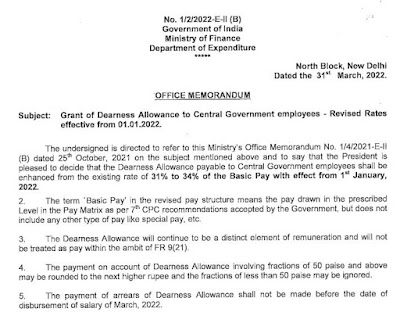
DA Jan 2022 - Grant of Dearness Allowance to Central Government employees - Revised Rates effective from 01.01.2022

 3% DA Hike - Revised Rates effective from 01.01.2022: DoE OM dated 31.03.2022 No. 1/2/2022-E-II (B) Government of India Ministry of Finance...