Tuesday, 21 March 2017

Disability Pension for Soldiers


Disability Pension for Soldiers


The 7th Central Pay Commission (CPC) recommended the following on disability pension:

The Commission is of the considered view that the regime implemented post 6th CPC needs to be discontinued, and recommended return to the slab based system. The slab rates for disability element for 100 percent disability would be as follows:

RanksLevelsRate per month (INR)
Service Officers10  and  above27000
Honorary Commissioned Officers
Subedar Majors / Equivalents6 to 917000
Subedar / Equivalents
Naib Subedar / Equivalents
Havildar / Equivalents5 and below12000
Naik / Equivalents
Sepoy / Equivalents

The above recommendation has been accepted and Resolution dated 30.09.2016 issued accordingly.
The 6th CPC dispensation of the calculation of disability element on percentage basis, however, continues for civil side which has resulted in an anomalous situation. The issue has accordingly been referred to the Anomaly Committee. The disability element which was being paid as on 31.12.2015 will, however continue to be paid till decision on the recommendations of Anomaly Committee is taken by the Government.

This information was given by Minister of State for Defence Dr. Subhash Bhamre in a written reply to Shri Husain Dalwai in Rajya Sabha today.

PIB

7th Pay Commission: CPSEs to spend Rs 20,000 crore on salary hikes


7th Pay Commission: CPSEs to spend Rs 20,000 crore on salary hikes

After getting pay hikes last year on implementation of the 7th Pay Commission, the central public sector enterprises (CPSEs) are likely to spend additional Rs 20,000 crore in the next fiscal year (FY17-18) as recompense to 12 lakh employees.

As per 7th Pay Commission, in the first installment, four lakh CPSE executives will likely to receive salary revision in July with effect from January 1, 2017. The expected cost for the same will be Rs 8,000 crore per year, as reported by The Financial Express.

Additionally, the pay hikes are likely to be followed by a wage revision for over 8 lakh workers which will cost CPSEs nearly Rs 12,000 crore, the report said quoting a source.

As per the report, this salary revision is based on the recommendations of the 3rd Pay Revision Commission (PRC), which constitutes the department of public enterprises, and the exercise will be carried out by each CPSE separately after negotiating with the employee unions.

Last year in June, as per The Economic Times report, the government had appointed a committee to review and revise the structure of salary at CPSEs.

That time, the government had released a notification, which said, The step was taken on recognising that in the prevailing business environment the CPSEs have to be commercially viable and competitive, and that the employees of the CPSEs have to be provided with suitable working conditions, emoluments and incentives to motivate them to strive for further growth, productivity and profitability of their enterprises.

Source: Zee News

Special Leave connected to inquiry of sexual harassment: CCS (Leave) Amendment Rules, 2017


Special Leave connected to inquiry of sexual harassment: CCS (Leave) Amendment Rules, 2017

THE GAZETTE OF INDIA: EXTRAORDINARY [PART II-SEC. 3(i)]
MINISTRY OF PERSONNEL, PUBLIC GRIEVANCES AND PENSIONS
(Department of Personnel and Training)

NOTIFICATION
New Delhi, the 15th March, 2017

G.S.R. 251(E).-In exercise of the powers conferred by the proviso to article 309 read with clause (5) of article 148 of the Constitution and after consultation with the Comptroller and Auditor General of India in relation to the persons serving in the Indian Audit and Accounts Department, the President hereby makes the following rules further to amend the Central Civil Services (Leave) Rules, 1972, namely:-

1. (1) These rules may be called the Central Civil Services (Leave) Amendment Rules, 2017.
    (2) They shall come into force on the date of their publication in the Official Gazette.

2. In the Central Civil Services (Leave) Rules, 1972, for rule 48, the following rule shall be substituted, namely:

48, Special Leave connected to inquiry of sexual harassment - Leave upto a period of 90 days may be granted to an aggrieved female Government Servant on the recommendation of the Internal Committee or the Local Committee, as the case may be, during the pendency of inquiry under the Sexual Harassment of Women at Workplace (Prevention, Prohibition and Redressal) Act, 2013 and the leave granted to the aggrieved female Government Servant under this rule shall not be debited against the leave account.

[F. No. 13026/2/2016-Estt. (L)]
GYANENDRA DEV TRIPATHI, Jt. Secy.

Footnote : The principal rules were published vide Notification Number 80. 940, dated the 8th April, 1972 f and were last amended vide Notification number G.S.R. 711(E) dated the 8th October, 2014.
Note : The principal rules were published in the Gazette of India, Extraordinary, Part-II, Section 3, Sub-section (i), vide number S.O. 940 dated the 8th April, 1972 and have been subsequently amended.

Read at dopt.gov.in

Monday, 20 March 2017

Regarding Revision of Pension of Autonomous body Pensioners , Finance Ministry has clarified as follows


Regarding Revision of Pension of Autonomous body Pensioners , Finance Ministry has clarified as follows :


Central Government does not issue any instructions regarding implementation of recommendations of the Central Pay Commission PERTAINING TO PENSION IN RESPECT OF EMPLOYEES OF AUTONOMOUS BODIES. In view of this , NO ORDERS REGARDING IMPLEMENTATION OF RECOMMENDATIONS OF 7th CPC IN RESPECT OF EMPLOYEES OF AUTONOMOUS BODIES IN THE MATTER OF PENSION ARE TO BE ISSUED BY FINANCE MINISTRY. The appropriate decision is to be taken by the concerned Autonomous Body in consultation with the concerned Administrative Ministry in keeping with the practice on the previous occasions and also in the light of the Rules and Regulations/Bye-laws governing the service conditions of respective Autonomous Bodies.

M. KRISHNAN
Secretary General
Confederation
Mob & WhatsApp : 09447068125
Email : mkrishnan6854@gmail.com
Source: http://confederationhq.blogspot.in/

EPFO takes various steps for speedy settlement of claims

EPFO takes various steps for speedy settlement of claims

The Employees Provident FundsOrganization (EPFO) has taken various steps for speedy settlement of claims which inter alia include:
  • Composite Claim Form (Aadhaar) and Composite Claim Form (Non-Aadhaar) has been introduced by replacing the erstwhile Claim Forms No. 19, 10C and 31, with a view to simplify the submission of claims by the subscribers. The Composite Claim Form has been further simplified to include self-certification by EPF subscribers. The Composite Claim Form (Aadhaar) can be submitted to the EPFO without attestation of their employers.
  • EPFO has mandated to settle claims within 20 days.
  • Online Transfer Claim Portal (OTCP) has been introduced to facilitate seamless transfer of claims.
  • An online payment facility has been developed for employers for payment of dues. The internet banking (INB) facility enhances efficiency and payment and ensures anytime, anywhere online access while usage of existing internet bank account to make payments online.
  • National Electronic Fund Transfer (NEFT) has been introduced for payments.

The Employees Provident Funds & Miscellaneous Provisions (EPF & MP) Act, 1952 is applicable to every establishment employing 20 or more persons which is either a factory engaged in any industry specified in Schedule-I of the Act or an establishment to which the Act has been made applicable by the Central Government by notification in the Official Gazette.

There was a total of 17.14 crore Employees Provident Fund (EPF) accounts as on 31.03.2016. 12.21 lakh accounts were pending for updation. As per consolidated Annual Accounts of EPFO for the year 2015-16, the closing balance in Interest Account as on 31st March, 2016 is Rs. 45,135.25 crore.

This information was given by Shri BandaruDattatreya, the Minister of State (IC) for Labour and Employment,in written reply to a question in Lok Sabha.

PIB

Payment of Wages by cheque or crediting to bank accounts


Payment of Wages by cheque or crediting to bank accounts

The present wage limit for applicability of the provisions of the Payment of Wages Act, 1936 is Rs. 18,000/- per month. The Act has been amended by Payment of Wages (Amendment) Act, 2017 (effective from 28.12.2016) to enable the employers to pay wages to their employees by (a) cash or (b) cheque or (c) crediting to their bank account. The amendment in the Act also enables the appropriate Government to specify the industrial or other establishment, by notification in the Official Gazette, which shall pay to every person employed in such industrial or other establishment, the wages only by cheque or by crediting in his bank account.

This information was given by Shri BandaruDattatreya, the Minister of State (IC) for Labour and Employment,in written reply to a question in Lok Sabha.

PIB

Several relaxations brought in GP Fund rules


Several relaxations brought in GP Fund rules

In a major relief for government employees, Ministry of Personnel, Public Grievances and Pensions has announced several relaxations in General Provident Fund Rules, with liberalization and simplification, particularly relating to advances and withdrawals by the subscriber/ employee.

According to the Union Minister of State (Independent Charge) for Development of North Eastern Region (DoNER), MoS PMO, Personnel, Public Grievances, Pensions, Atomic Energy and Space, Dr Jitendra Singh, the existing GP Fund (Central Service) Rules came into force way back in 1960 and even though certain amendments have been made from time to time to address the concerns raised, it was felt to be the need of the hour to bring in some more changes for the convenience of the Government employees. The liberalization in the provisions was essentially meant to bring in ease of procedures, especially for activities like house building, education of children etc., thus making the rules more employee-friendly.
Elaborating further, Dr Jitendra Singh stated that the requirement of documentary proof for withdrawing GP Fund has been done away with. As a result, a simple declaration by the subscriber / employee would suffice henceforth, he added. Similarly, the minimum time limit for sanction and payment of GP Fund withdrawal would not be more than 15 days and in case of an emergency like illness, etc., it could only be 7 days. At the same time, the limit of withdrawal also has been increased following which, now the withdrawal for housing can be up to 90% of the balance at credit and withdrawal for purchase of vehicle / car can be up to 3/4th of the balance at credit.

Considering the importance of education, the definition of education for the purpose of withdrawal of GP Fund has now been widened to include primary, secondary and higher education covering all streams and institutions. Not only this, GP Fund advance can now also be applied for travel and tourism related activities, he said.

Dr Jitendra Singh said, the Government expects its employees to work with full dedication, sincerity and diligence, but at the same time, it is also always seriously considering various means and provisions to provide them with a work-friendly environment and socio-economic stability, so that they may put in their best without any unnecessary distraction.

PIB

Most of the Central Government employees feel that the enhancement of DA/DR is meager

Most of the Central Government employees feel that the enhancement of DA/DR is meager

Calculation of DA/DR based on AICPIN only

"Calculation of Dearness Allowance and Dearness Relief for Central Government Employees and Pensioners based on the methodology prescribed by the recommendations of Central Pay Commission"

Dearness Allowance is issued twice a year and the Seventh Pay Commission has adopted the same calculation methods that were prescribed by the Sixth Pay Commission.

The same series of the All-India Average Consumer Price Index Numbers for Industrial Workers (Base 2001=100) are used for the calculation of DA/DR to be continued. The 7th CPC recommendations are implemented from 1.1.2017 and no DA from 1.1.2017 to 1.7.2017. And from 1.7.2017, 2% DA calculated as per the same formula recommended by 6th CPC. And then now, same calculation with the Consumer Price Index, the figure of two percent was arrived.

Most of the Central Government employees feel that the enhancement of DA/DR is meager.
The Central Government had nothing to do with the Dearness Allowance issued to the Central Government employees in the past, which were as high as 10 percent. Similarly, the government is in no way connected with the current announcement of two percent DA/DR.
The same AICPIN (CPI IW BY2001=100) adopted for the calculation of Dearness Allowance to draw their pay in the pre-revised pay scale of 5th and 6th CPC. For 6th CPC, 4% Dearness Allowance was calculated on the basis of the same method. In other words, it will be expected to increase from 132 percent to 136.

The Dearness Allowance is calculated based on the changes in the prices of essential commodities in 75 cities and towns in India, over a period of six months. The monthly data, called the AICPIN, are released each month, by the Labour Bureau under the Ministry of Labour and Employment.

Central Government employees and Pensioners are not only getting the DA and DR, also employees working under Bank, CPSE etc,. The CPI(I-W) series are used for the calculation of DA for Bank Staff and IDA for CPSE employees. Almost the same enhancement of DA will adopt for the employees working in State Governments. Consumer Price Index will impact on the salaries and pension of more than 2 crore employees and pensioners directly.

Just watch the difference of DA amount between 6th and 7th CPC:

As on 1.1.2016As on 1.7.2016DA from 1.1.2017
6th CPC Basic Pay10,000 (2400GP) 10,300412 (4%)
7th CPC Matrix Pay26,30027,100542 (2%)
da-calculation-7th-CPC

Source: www.govtenews.com

20% teachers posts vacant in higher educational institutions


20% teachers posts vacant in higher educational institutions

New Delhi: Vacancies of teachers in higher educational institutions has become a "serious problem" and around 20% posts in central universities are yet to be filled, HRD Minister Prakash Javadekar said today.

Javadekar said in Lok Sabha that students were not keen to take up teaching jobs, resulting in shortage of faculty members in higher education institutions.

"Vacancies in higher education institutions is a serious problem. Around 20 per cent posts in central universities are currently vacant," he said during Question Hour.

There are 41 central universities under the purview of the HRD Ministry.

"Filling up of vacancies in central universities is an ongoing and continuous process… The onus of filling up of posts lies in the central universities which are autonomous bodies created under the respective Acts of the Parliament," he said.

In order to meet the situation arising out of shortage of teachers in universities and the consequent vacant positions, the age of superannuation for teachers in central educational institutions has already been enhanced to 65 years, Javadekar said.

"Teachers can also be re-employed on contract appointment beyond the age of 65 years and upto 70 years, subject to availability of vacant positions and fitness," he said.

Cabinet clears GST supplementary legislations


Cabinet clears GST supplementary legislations

Goods and Services Tax


The Cabinet today cleared four supporting GST legislations, paving the way for their introduction in Parliament as early as today.

The four supporting legislations the Compensation Law, the Central-GST (C-GST), Integrated-GST (I-GST) and Union Territory-GST (UT-GST) would be introduced as Money Bill, sources said.

The GST legislations have been cleared by the Cabinet.

These would be introduced in Parliament this week, could be even today, a source said.
The GST legislations were the only agenda in today's meeting of the Union Cabinet, chaired by Prime Minister Narendra Modi.

Sources said the four legislations would be taken up for discussion together in Parliament. Once approved by Parliament, the states would start taking their SGST bill for discussion and passage in the respective state assemblies.

The GST Council, in its previous two meetings, had given approval to the four legislations as also the State-GST (S-GST) bill. While the S-GST has to be passed by each of the state legislative assemblies, the four other laws have to be approved by Parliament.

Passage of all the legislations would pave the way for introduction of Goods and Services Tax (GST) from July 1.

The government is hoping the C-GST, I-GST, UT-GST and the GST Compensation laws will be approved in the current session of Parliament and the S-GST by each of the state legislatures soon.

While a composite GST will be levied on sale of goods or rendering of services after the new indirect tax regime is rolled out, the revenue would be split between the Centre and the states in almost equal proportion.

This is because central taxes like excise and service tax and state levies like VAT will be subsumed in the GST.

While the C-GST will give powers to the Centre to levy GST on goods and services after Union levies like excise and service tax are subsumed, the I-GST is to be levied on inter-state supplies.

The S-GST will allow states to levy the tax after VAT and other state levies are subsumed in the GST. The UT-GST will also go to Parliament for approval.

The Council has already finalised a four-tier tax structure of 5, 12, 18 and 28 per cent, but the model GST law has kept the peak rate at 40 per cent (20 per cent to be levied by the Centre and an equal amount by the states) to obviate the need for approaching Parliament for any change in rates in future.

Similarly, the cess to be levied on top of peak rate on selected demerit goods like luxury cars for creation of a corpus that will be used for compensating states for any loss of revenue from GST implementation in the first five years, has been capped at 15 per cent.

PTI

Flash News

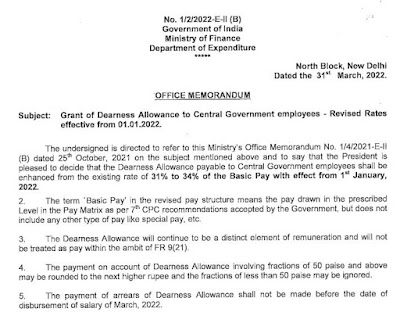
DA Jan 2022 - Grant of Dearness Allowance to Central Government employees - Revised Rates effective from 01.01.2022

 3% DA Hike - Revised Rates effective from 01.01.2022: DoE OM dated 31.03.2022 No. 1/2/2022-E-II (B) Government of India Ministry of Finance...