Monday, 5 December 2016

7th Pay Commission: Finmin gets 2 months more to issue higher allowances notification

7th Pay Commission: Finmin gets 2 months more to issue higher allowances notification

New Delhi: The Finance Ministry has got 2 months extension to issue the higher allowances notification under 7th Pay Commission recommendations, a Finance Ministry official said on Monday on condition of anonymity.

"The October-November month is the scheduled for issuing notification for the Finance Ministry, but the time was extended by 2 months because the cash crunch on account of demonetisation, which is taking time to get normality.

Therefor,unless the banks can begin to function with a modicum of efficiency, the government will not issue notification on higher allowances to save demonetisation chaos," the official said.

He further said “the issue of increased financial activities after demonetisation compels the government to keep in abeyance to issue higher allowances notification for getting normalized the position and it is likely to issue from January next, after the the cash crunch will ease.

However the government wants to issue the higher allowances notification speedily in a time bound manner."

The committee on allowances head Finance Secretary Ashok Lavasa said in October, "We are ready to submit our report, when the Finance Minister Arun Jaitley calls up."

The government constituted the committee on allowances in June headed by Finance Secretary Ashok Lavasa to examine the 7th Pay Commission recommendations on allowances, other than dearness allowance.

"The committee has been asked to submit its report within four months and it was ready to submit its report in advance but the government intends to accept the report after December 30, deadline for depositing demonetised notes," the official said.

Existing allowances are now being paid to the central government employees according to the 6th Pay Commission recommendations until issuing of higher allowances notification.

Government asks staff to become ambassadors for digital push

Government asks staff to become ambassadors for digital push

New Delhi: Government has asked its employees to maximise use of debit cards for personal transactions and become 'ambassadors' for promoting digital payments.

The Finance Ministry has asked all ministries/departments to encourage their employees to make use of debit cards for personal transactions instead of cash, an official statement said.

It said that given the progress made in banking technology, it is assumed that each employee would be in possession of a debit/ATM card linked to his/her bank account.

"Ensuring and encouraging government employees to maximise the usage of debit cards for personal related transactions instead of cash would go a long way, with the employees serving as ‘ambassadors’ for the digital push, and also motivate, encourage the general public in taking up the cause," the ministry added.

Government and PSUs have been disbursing salaries to majority of their employees through electronic mode into their bank accounts.

The ministry said that in the recent years, advancements in banking technology, progress in mobile banking and innovative technologies to facilitate digital payments have enabled large number of small denomination transactions to be handled smoothly in electronic mode.

Following the announcement of demonetisation of 500 and 1000 rupee notes on November 8, the government has been taking a slew of measures to promote digital transaction.

While the Finance Ministry has asked public and private sector banks to waive off transaction costs for all payments made through debit cards, the Road Transport Ministry has asked vehicle manufacturers to provide a digital tag on all new cars for e-payments at toll plazas and check posts.
The Finance Ministry has also asked government departments to liaise with their accredited banks and set up special camps to ensure that all its employees are in possession of debit cards.

It also asked other ministries/departments to issue similar advisories to their attached offices, PSUs and autonomous bodies.

PTI

High Court asks RBI to consider issue of salary payment to teachers

High Court asks RBI to consider issue of salary payment to teachers

Mumbai: The Bombay High Court today asked the RBI to consider the issue of payment of salaries to aided school teachers since it is disbursed through district cooperative banks which have been prohibited from depositing and exchanging old currency notes.

The Mumbai, Solapur, Nashik and Pune District Central Cooperative Banks had approached the high court challenging the RBI circular of November 14, restricting them from exchanging or depositing old currency notes of Rs 500 and Rs 1,000, which were declared as illegal tender under the government’s demonetisation move on November 8.

Solapur co-operative bank counsel V M Thorat today informed the court that the bank receives around Rs 95 crore from the state government for salaries of teachers in aided schools, but due to the circular the bank is not able to disburse the amount.

A division bench of Justices A S Oka and Anuja Prabhudessai asked the Reserve Bank to consider the issue.

"RBI needs to consider this issue. We cannot take this matter up on merits as the Supreme Court is already seized of the main contentions raised in the petitions, but this particular issue about teachers’ salaries can be looked into," Justice Oka said.

"It is common knowledge that teachers of aided schools get their salaries from cooperative banks. We want to know how teachers will get their salaries now," the court said.

Thorat informed the bench today that the banks have filed application in the apex court seeking clarification on whether the high court can hear the matter.

"The application along with the transfer petition filed by the Union government seeking for all petitions filed on the demonetisation issue to be heard by SC itself is posted for hearing on December 9," the counsel said.

The high court then adjourned the cooperative banks petitions to December 14.

PTI

7th CPC - Govt will consider the report of Committee, says in Parliament

7th CPC - Govt will consider the report of Committee, says in Parliament

Pay hike after implementation of 7th CPC

GOVERNMENT OF INDIA
MINISTRY OF FINANCE
RAJYA SABHA

UNSTARRED QUESTION NO-1526

ANSWERED ON-29.11.2016

Pay hike after implementation of Seventh Central Pay Commission

1526 . Dr. Sanjay Sinh

(a) the salient features of the Seventh Central Pay Commission;

(b) the percentage of increase in the salaries of employees after the implementation of the recommendations of Seventh Central Pay Commission;

(c) the percentage of increase in the salaries of employees after the fourth, fifth and sixth Central Pay Commission;

(d) whether the extent of pay hike this time is very less as compared to the previous pay hikes; and

(e) whether Government would reconsider it in view of the resentment among employees and pay anomalies?

ANSWER

MINISTER OF STATE IN THE MINISTRY OF FINANCE
(SHRI ARJUN RAM MEGHWAL)

(a): The Seventh Central Pay Commission (7th CPC) has recommended the minimum pay of Rs. 18,000 per month and uniform fitment factor of 2.57 for all employees. The system of Pay Band and Grade Pay has been replaced with separate Pay Matrices for Civil, Defence and Military Nursing Services personnel. The Commission has recommended abolishing 52 allowances and subsuming of another 36 allowances either in an existing allowance or in newly proposed allowances. Allowances relating to Risk and Hardship will be governed by a Risk and Hardship Matrix. The Commission has also recommended revised pension formulation for all personnel who have retired before 01.01.2016 to bring about complete parity of past pensioners with current retirees.

(b) to (e): Salary of all employees will increase by at least 14.29 per cent after the implementation of Seventh Central Pay Commission (7th CPC) recommendations. The 7th CPC has mentioned that increases given in Minimum Pay were 27.6%, 31.0% and 54.0% by Fourth, Fifth and Sixth Central Pay Commissions, respectively. The anomalies arising out of implementation of the recommendations of the 7th CPC will be examined by the Anomalies Committee which has already been constituted. Based on the report of the Committee, the matter will be considered by the Government and appropriate decision will be taken.

Source: http://rajyasabha.nic.in/

Sunday, 4 December 2016

7th Pay Commission Anomaly Committee - Agenda Item relates to Disability Pension

7th Pay Commission Anomaly Committee - Agenda Item relates to Disability Pension

Agenda for 1st Anomaly Committee of 7th CPC is given below:

AGENDA FOR DISCUSSION IN THE ANOMALY COMMITTEE MEETING TO BE HELD AT 11.00 A.M. ON 01.12.2016 UNDER THE CHAIRMANSHIP OF SECRETARY, DoPT)

The Agenda for discussion pertains to the issue of demand of Defence Forces Personnel for restoration of the percentage-based methodology for the calculation of Disability Pension to the Defence Forces Personnel. The 7th CPC has recommended a slab-based methodology for calculation of Disability Pension for them. As per their demand, while the 7th CPC has recommended slab-based system for calculation of Disability Pension for the Defence Forces Personnel, it has not made any recommendation for the civilians which continues to be percentage-based. Therefore, their contention is that the proposed slab-based Disability Pension system will lead to an anomaly between the Civilian side and the Defence Forces Personnel.

It has been decided to refer the matter for urgent consideration before the National Anomaly Committee.

2. The recommendations of the 7th CPC on this issue is contained in para no. 10.2.55 which is at Annexure-I.

3. The justification for the recommendation given by the 7th CPC in paras 10.2.49 to 10.2.51 are at Annexure-II, III & IV.

4. The representatives from the Defence Forces Personnel in a meeting held on 11.11.2016 have inter alia contended that:

a) That the 7th CPC-recommended slab-based Disability Pension System will, if implemented, lead to an anomaly between the civilian side and the Defence Forces Personnel because the civilian side will continue to be governed under a percentage- based system.

b) The basis of the 7th CPC recommendations for introduction of the slab-based system for the Defence Forces Personnel, viz. that the percentage of officers retiring with disability element has increased, is erroneous. According to their contention between 5th & 6th CPC, the number of retirement cases with disability element has, in fact, fallen as below:

Rank 5th CPC Regime Range (Slab Based) 6th CPC Regime Range (Percentage Based)
Lt. Col. 12% to 38% 7.5% to 21.2%
Col. 4.8% to 24.9% 3.3% to 23.3%
Brig. 4% to 17% 2.7% to 21.6%
Maj. Gen. 4% to 17.5% 0% to 16.5%
Lt. Gen. 10% to 50% 0% to 15.4%

c) 7th CPC has erroneously assumed that the slab-based system would benefit the lower ranks by narrowing down the gap between the maximum and the minimum. As per their conclusion, except for benefitting a miniscule number of Defence Forces Personnel who would get invalidated out in the lower ranks of service, the slab- based system would be detrimental to most ranks in all superannuation cases.

5. Point-wise inputs on the contention received from the D/o Ex-Servicemen Welfare at Annexure-V are briefly as under:

a) 7th Pay Commission has recommended slab-based system for disability element of disability pension for Defence Forces Pensioners. However, the 7th CPC has not made any recommendation for the civilians. The existing system of disability on percentage-based system would, therefore, continue in civil side. This has led to an anomalous situation.

b) A comparative statement indicating the percentage of retirees with disability during 5th CPC era when slab-system was prevalent vis-a-vis retirees with disability during 6th CPC when percentage system was placed, is as under:

Ranks Percentage of retirees with disability during 1996 to 2005 (5th CPC)
Percentage of retirees with disability during 2006 to 2015 (6th CPC)
Lt. Col/Equivalent 2.04%-18.3%
7.5%-21.2%
Colonel / Equivalent 1.56%-17.38%
3.3%-23.3%
Brigadier / Equivalent 2.08%-17.42%
2.7%-21.6%
Major
General / Equivalent
0.0%-11.27%
0.0%-l 6.5%
Lt. General/Equivalent 0.0%-21.88%
0.0%-15.4%

It could be seen from the data given by CGDA office that percentage of retirees for commissioned officers have increased in 6th CPC regime vis-a-vis 5th CPC.

c) Pre 2016 retirees 
The comparison between slab and percentage system of disability element for pre-1.1.2016 retiree pensioners have been made with reference to pay last drawn by migrating the same in 7th CPC pay structure and also by working out the disability element by linking the same with revised sendee pension under 7th CPC. The statements indicating rank wise, qualifying sendee wise status in both the said scenario are attached as Annexure- V('D' and 'C') respectively. The statement indicates that all commissioned officers are at disadvantage in case the slab recommended by 7th CPC is implemented. However, in case of JCO/ORs, lower ranks are getting benefited under slab rates.

Further the details of 1,09,988 JCO/OR retirees have also been analyzed on actual basis as data for these pensioners were readily available. It could be seen from the outcome tabulated as Annexure-V('D'), that lower ranks of JCO/OR are getting benefited especially Sepoy, Naik & Naib Subedar. Out of 1,09,988 records of JCO/OR processed, 85,640 (77.86%) pensioners would get benefited under slab rates. It is also intimated to the Ministry that pension for all pre-1.7.2014 retirees have been revised under OROP orders. It has been observed/analyzed that the pension of JCO/OR pensioners who are drawing pension on OROP rates (pre-2006 retirees and post-2006 retirees who retired upto 2009-10), are getting benefitted under slab rates of disability pension.

Post 2016 retirees 
For post-1.1.2016 retirees, no comparison has been made as notification relating to pay entitlement are not yet finalized. However, based on the recommendations of 7th CPC, it could be visualized that future progression in new pay structure percentage-based system would definitely be beneficial for post-7th CPC retirees in all ranks.

6. The matter is placed before the National Anomaly Committee for consideration.
Annexure-'I'
Para No. 10.2.55 


The feature that stands out when the historical evolution of the regime relating to disability pension is studied is the shift from slab-based system to a percentage based disability pension regime consequent to the implementation of the 6th CPC's recommendations. This move has been contrary to the tenets of equity insofar as treatment of disability element between Officers and JCOs/ORs is concerned borne out by the fact that the ratio of maximum to minimum quantum of compensation for disability across the ranks is now disproportionately high at 8.6. The Commission is, therefore, of the considered view that the regime implemented post 6th CPC needs to be discontinued, and recommends a return to the slab-based system. The slab rates for disability element for 100 percent disability would be as follows:

Rank
Levels
Rates (in Rs. per month)
Service Officers
10 and above
27,000
Honorary Commissioned Officers
Subedar Major/Equivalent
6 to 9
17,000
Subedar/Equivalent
Naib Subedar/Equivalents
Havildar / Equivalents
5 and below
12,000
Naik/Equivalents
Sepoy Equivalents
Annexure-'II'
10.2.49: The notable facts about the disability payout regime are:
a) There was a gradual rationalization in the number of slabs from eight, prior to 3rd CPC to three after the 4th CPC.

b) The ratio of maximum to minimum quantum of compensation for disability across the ranks witnessed a decline from 4.85 prior to the 3rd CPC to 1.67 post 5th CPC. As a consequence of the implementation of the recommendations of the percentage based system based on the 6th CPC Report the ratio of the maximum to minimum was reversed and now stands at 8.60.

c) Implementation of the 6th CPC recommendations resulted in a substantial increase in tire disability element. For 100 percent disability, at the minimum level, i.e., for ORs, it went up from Rs. 1,550 to Rs. 3,138, i.e., a little over double and at highest level amongst officers from Rs. 2,600 to Rs. 27,000, i.e., by 10.38 times.

d) Disability pension consists of two elements viz., service element and disability element. While the service element was linked with the qualifying service, disability element was not. Therefore, for the same level of disability, the service officer invalided out and one who served on and retired in due course, got the same quantum of disability element.
Annexure-'III'
10.2.50 To examine the recent trends in disability cases, the Commission sought data and further clarifications with regard to all cases of pensioners with disability element. The total number of pensioners superannuating with disability element, each year, from 2007-08 to 2013-14, as provided by the Controller General of Defence Accounts (CGDA) is tabulated below:

Financial Year JCOs/ ORs Commissioned Officers Total Total JCO/OR Retirees Total Officer Retirees
2007-08
9,355
285
9,640
49396
2096
(18.9)
(13.6)
(18.7)
2008-09
6,908
318
7,226
50913
2118
(13.6)
(15.0)
(13.6)
2009-10
2,644
284
2,928
39133
1712
(6.8)
(16.6)
(7.2)
2010-11
1,840
316
2,156
38209
1678
(4.8)
(18.8)
(5.3)
2011-12
4,765
321
5086
48201
1626
(9.9)
(19.7)
(10.2)
2012-13
5,837
327
6,164
53446
1643
(10.9)
(19.9)
(11.2)
2013-14
4,037
318
4,355
55901
1606
(7.2)
(19.8)
(7.6)

Annexure-IV
10.2.51:- The following trends are discernible:
a. As a percentage of the total officer retirees, the number of officers retiring with disability has increased in 2013-14, as compared to 2007-08 (13.6 percent to 19.8 percent).
b. The percentage of JCOs/ORs retiring with disability is, on the other hand, decreasing (18.9 percent to 7.2 percent).
c. The percentage of officers retiring with disability is considerably higher than JCO/ORs retiring with disability.
ANNEXURE-V
Government of India
Ministry of Defence
Department of Ex-Servicemen Welfare
D(Pension/Policy)

Subject: 1st Anomaly Committee Meeting to be held on 1/12/2016 under the Chairmanship of Secretary(P) on calculation of Disability Pension for Defence Forces personnel as per the recommendations of the 7th Central Pay Commission.

The undersigned is directed to refer to Department of Personnel & Training OM No. 11/2/2016-JCA(Pt) dated 15th November 2016 on the above subject.

2. Point-wise inputs for the agenda note on the issues raised by the representatives from the Defence Force Personnel raised in the meeting held on 11.11.2016 are as under:

(a) 7th Pay Commission has recommended slab based system for disability element of disability pension for Defence Forces Pensioners. However the 7th CPC has not made any recommendation for the civilians. The existing system of disability on percentage based system would therefore continue in civil side. This has led to an anomalous situation.

(b) A comparative statement indicating the percentage of retirees with disability during 5th CPC era when slab system was prevalent vis-a-vis retirees with disability during 6th CPC when percentage system was placed , is as under:

Ranks Percentage of retirees with disability during 1996 to 2005(5th CPC) Range of retirees with disability during 2006 to 2015(6th CPC)
Lt. Col/ Equivaqlent
2.04%-18.3%
7.5%-21.2%
Colonel/ Equivalent
1.56%-17.38%
3.3%-23.3%
Brigadier/ Equivalent
2.08%-17.42%
2.7%-21.6%
Major General/ Equivalent
0.0%-11.27%
0.0%-16.5%
Lt. General/ Equivalent
0.0%-21.88%
0.0%-15.4%

It could be seen from the data given by CGDA office that percentage of retirees for commissioned officers have increased in 6th CPC regime vis-a-vis 5th CPC.

(c) Pre 2016 retirees 
The comparison between slab and percentage system of disability element for pre- 1.1.2016 retiree pensioners have been made with reference to pay last drawn by migrating the same in 7th CPC pay structure and also by working out the disability element by linking the same with revised service pension under- 7th CPC. The statements indicating rank wise, qualifying service wise status in both the said scenario are attached as Annexure - B & C respectively. The statement indicates that all commissioned officers are at disadvantage in case the slab recommended by Seventh CPC is implemented. However in case of JCO/ORs, lower ranks are getting benefitted under slab rates.

Further the details of 1,09,988 JCO/OR retirees have also been analysed-on actual basis as data for these pensioners were readily available. It could be seen from the outcome tabulated as Annexure - D, that lower ranks of JCO/OR are getting benefitted especially Sepoy, Naik & Naib Subedar. Out of 1,09,988 records of JCO/OR processed, 85,640 (77.86/0) pensioners would get benefitted under slab rates. It is also intimated to the Ministry that pension for all pre-1.7.2014 retirees have been revised under OROP orders. It has been observed/ analysed that the pension of JCO/OR pensioners who are drawing pension on OROP rates (pre-2006 retirees and post- 2006 retirees who retiree upto 2009-10), are getting benefited under slab rates of disability pension.
Post 2016 retirees


For post-1.1.2016 retirees, no comparison has been made as notification relating to pay entitlements are not yet finalized. However, based on the recommendations of 7th CPC, it could be visualized that future progression in new pay structure percentage based system would definitely be beneficial for post-7th CPC retirees in all ranks.
(Manoj Sinha)
Under Secretary (Pen/Policy)
Shri D K Sengupta
Deputy Secretary
DoPT, North Block, New Delhi
MoD ID 3840/D(Pen/Pol)/2016 dated 22 November 2016
7th CPC grievances, disability Pension, 7th CPC, 7th Pay Commission Anomaly Committee, 7th Pay Commission ================ 7th pay commission, 7th pay commission latest news, autonomous bodies, Implementation of 7th CPC, 7CPC
Finance Ministry clarification on  the Applicability of recommendations of the 7th Pay Commission in respect of Autonomous/Statutory Bodies

Department of Expenditure issued a communication regarding Applicability of recommendations of the 7th Pay Commission in respect of Autonomous/Statutory Bodies

F. No. 1/1/2016-E.III (A) (eFTS-298581/2016)

Government of India
Ministry of Finance
Department of Expenditure
North Block, New Delhi
 Dated 17th November 2016

Subject: Applicability of the revised pay scales based on the recommendations of the 7th Central Pay Commission in respect of employees of Quasi-Government Organizations, Autonomous Organizations, Statutory Bodies set-up by and funded/controlled by the Central Government-regarding.

All the Financial Advisors of various Ministries/Departments under the Central Government are aware that the recommendations of the Central Pay Commissions are not directly applicable in case of employees of Quasi-Government Organizations, Autonomous Organizations, Statutory Bodies set-up by and funded/controlled by the Central Government. Therefore, once the recommendations of the Central Pay Commissions are accepted and implemented by the Central Government in respect of Central Government employees, separate orders are issued by the Ministry of Finance, Department of Expenditure, regarding extension of the orders applicable to the Central Government employees to the employees of Quasi-Government Organizations, Autonomous Organizations, Statutory Bodies set-up by and funded [controlled by the Central Government, based on the stipulations and conditions laid down therein. This was the practice adopted at the time of the 4th, 5th & 6th Pay Commissions. A reference is made to this Ministry's OM No. 7/23/2008~E-IIIA dated 30.9.2008 issued at the time of 6th Central Pay Commission.

2. No orders have so far been issued by the Ministry of Finance, Department of Expenditure in regard to applicability of the orders issued by the Government regarding revised pay scales based on the 7th Central Pay Commission in respect of the employees of Quasi-Government Organizations, Autonomous Organizations, Statutory Bodies set-up by and funded/controlled by the Central Government. The matter is under consideration. As and when a decision is taken regarding applicability of the revised pay scales based on the 7th Central Pay Commission, as accepted by the Government in respect of the Central Government employees, in case of such employees, appropriate orders will be issued for its applicability in respect of employees of Quasi-Government Organizations, Autonomous Organizations, Statutory Bodies set-up by and funded/controlled by the Central Government. Till such time, revised pay scales shall not be extended in respect of such employees.

3. This issues with the approval of Finance Secretary.


(Ashok Kumar)
Under Secretary to the Govt. of India

Brief of the 1st meeting of the National Anomaly Committee

Brief of the 1st meeting of the National Anomaly Committee

Sub: Brief of the 1st meeting of the National Anomaly Committee

The first meeting of the National Anomaly Committee was held today under the Chairmanship of Secretary(P), Government of India, to discuss the issue of calculation of Disability Pension for Defence Forces Personnel as per recommendations of the 7th CPC, which was attended by the Member Staff Railway Board and the Secretaries from other departments of the Government of India.

 AIRF was represented by the undersigned and Com. J.R. Bhosale, Treasurer AIRF while Army personnel were represented by the officials of all the three wings of the defence. At the outset, I urged upon the Secretary (DoP&T), to frame the definition of the "Anomaly", which has been already demanded by the Staff Side, NC/JCM.

This is in respect of report of the VII CPC, which has granted slab system on Disability Pension for the Defence Personnel, which was far short of the existing disability pension for the army officers. We explained the life of the army personnel and their cases of disability in the enemies’ action.

After threadbare discussions we urged upon the Official Side to see that there is no drop in the disability pension for any of the categories of the army personnel and paramilitary forces, rather they should be well compensated for their best they are giving for defending our motherland.

Source: AIRF

1st meeting of the National Anomaly Committee

1st meeting of the National Anomaly Committee

The 1st meeting of the National Anomaly Committee was held on 01.12.2016 on the anomaly of calculation of the disability pension for Defence Forces Personnel as per the recommendations of the 7th CPC. The representative of the Armed Forces made a presentation in the meeting demanding that the recommendations of the 7th CPC to grand disability pension on a slab system if implemented will lead to an anomaly between the civilian side and the Defence Forces Personnel because the civilian side will continue to be governed under a percentage based system. After studying the presentation, the Staff Side of NC-JCM has suggested that the slab system will be beneficial to the lower Rank personnel and hence both the slab system and percentage system may be accepted by the Govt. on an optional basis, alternatively the slab amount recommended by 7th CPC can be increased to avoid the anomalous situation. Secretary (P) informed that the issue would be further studied in consultation with CGDA.

Source: Confederation

Friday, 2 December 2016

AICPIN for October 2016

AICPIN for October 2016 : All-India Average Consumer Price Index Numbers for Industrial Workers (Base 2001=100)


Item General Index
Jan-16 269
Feb-16 267
Mar-16 268
Apr-16 271
May-16 275
Jun-16 277
Jul-16 280
Aug-16 278
Sep-16 277
Oct-16 278
Nov-16
Dec-16
Average

Encouraging usage of Debit Cards among Government employees

Encouraging usage of Debit Cards among Government employees

F.No.25(30)/E.Coord/2016
Ministry of Finance
Department of Expenditure

New Delhi, December 2016

OFFICE MEMORANDUM

Subject: Encouraging usage of Debit Cards among Government employees

In the recent years advancements in banking technology, progress in mobile banking and innovative technologies to facilitate digital payments have enabled large number of small denomination transactions to be handled smoothly in electronic mode. The Government of India has taken policy decisions encouraging cashless/electronic transactions.

2. In its endeavour on moving towards electronic payments, Central Government Ministries/Departments have been crediting the salary and other payments for the majority of its employees electronically, direct into the designated bank accounts of the employees. Given the progress made in banking technology, it is assumed that each employee would be in possession of a Debit/ATM card linked to his/her bank account. Ensuring and encouraging government employees to maximise the usage of Debit cards for personal related transactions instead of cash would go a long way serving with the employees serving as 'ambassadors' for the digital push and also motivate, encourage the general public in taking up the cause.

3. All Ministries/Departments are requested to encourage their employees to make use of Debit Cards for personal related transactions instead of cash Ministries/Departments should liaise with their accredited banks and set up special camps to facilitate obtaining of and ensure that all its employees are in possession of Debit Cards. Ministries/Departments may also issue similar advisories to their attached/subordinate offices, PSI's, Autonomous Bodies etc.

sd/-
(H.Atheli)
Director
Authority: www.finmin.nic.in

NFIR writes to 7th CPC Implementation Cell regarding specific allowances

NFIR writes to 7th CPC Implementation Cell regarding specific allowances

NFIR
National Federation of Indian Railwaymen
3,CHELMSFORD ROAD, NEW DELHI - 110 055


No.IV/NFIR/7 CPC (IMPL)/Allowances/2016


Dated: 29/11/2016
The Joint Secretary (Implementation Cell) 7th CPC,
Room No. 214, Ashoka Hotel,  Chanakyapuri
New Delhi-110021

Dear Sir,
Sub: 6th Meeting of Committee on Allowances constituted to examine the recommendations of 7th CPC on Allowances-reg.

In the meeting held on 28th November, 2016 in Room No. 169-D (Fresco), 1st Floor, North Block, New Delhi, the General Secretary, NFIR Shri M. Raghavaiah has at the outset invited attention of the Chairman to the Meeting held on 1st September, 2016 wherein it was suggested by the Chairman that the Federations may send their list containing department specific Allowances to the concerned Administrative ministries. He said that the NFIR has accordingly given the list to the Railway Board as well as to the Chairman, Railway Board on 08th & 09th September, 2016 respectively. He further requested that the Pay Commission’s recommendation vide Para 8.2.25 that any Allowance not mentioned and hence not reported to the Commission shall cease to exist, should be rejected by the Government out right as in the Railways, there are specific Allowances which have been sanctioned in the System’s interest.

The General Secretary/NFIR M. Raghavaiah has explained in the meeting, the views of the Federation on Railways specific allowances as below:

(i) PCO Allowance (Serial No. 11 of the chart relating to specific Allowances - Ministry of Railways).
The PCO Allowance is unique for Workshops/Productions Units in Railways as the staff in PCO are being deprived of incentive bonus and for compensating the said loss, PCO Allowance has been granted and continued since decades. The 7th Central Pay Commission’s recommendation for reducing the percentage of PCO Allowance is unjustified and it would therefore be necessary to allow 7.5 & 15% of 7th CPC Basic Pay as PCO Allowance for eligible staff in GP 4600 & 4200 respectively.

(ii) Shoe Allowance for Track Maintainers (Serial No. 17 of the chart relating to specific Allowances - Ministry of Railways)

The nature of duties of Track Maintainers is such, that the uniform presently provided will not last beyond three months due to field working conditions, exposure to dust, heat, rain, winds etc. It would therefore be necessary to grant Rs. 10,000/- towards Dress Allowance for Track Maintainers (subsuming Shoe Allowance). Similarly, Running Staff in Railways should also be granted not less than Rs. 10,000/- towards Dress Allowance.

(iii) ASV Allowance (Serial No. 19 of the chart relating to specific Allowances - Ministry of Railways).
The Account Stock Verifiers of Railways are expected to conduct Stock Verification of Stores, materials etc., at various remote places on Indian Railways throughout the year (covering over 66,000 kms). Considering the peculiar nature of duties, outdoor work and unlimited duty hours away from their headquarters stations, these staff have been granted ASV Allowance to motivate them and volunteer for the post of Stock Verifier. The Railway Board Chairman in his speaking order vide No. PC-VI/2001/R/I dated 07/06/2001 had mentioned the difficult nature of duties being performed by the staff and for the said purpose this Allowance has been granted. Hence this Allowance needs to be retained and enhanced further.

(iv) Breakdown Allowance (Serial No. 20 of the chart relating to specific Allowances - Ministry of Railways).

In the interest of Railways, the Breakdown Allowance has to be retained and enhanced substantively as the staff nominated are expected to report within 45 minutes of the siren/hooster given and proceed to the site of accident/tracks breaches, sites where OHE wires snapped for restoring the services.

(v) Coal Pilot Allowance (Serial No. 21 of the chart relating to specific Allowances - Ministry of Railways).

This Allowance needs to be continued considering the fact that the staff are directly connected with movement of coal from collieries and perform duties in all weather conditions. It is requested to enhance the Allowance suitably.

(vi) Flying Squad Allowance (Serial No. 22 of the chart relating to specific Allowances - Ministry of Railways).

The recommendation of Pay Commission for abolition of this Allowance is irrational and illogical. The Ticket Checking Staff in Flying Squads are playing very crucial role in preventing Ticketless travel, unauthorized entry of anti-social elements and also levy penalty on Ticket Fare for realization of dues to the Railways. This Allowances needs to be retained and improved further.

(vii) Handicapped Allowance (Serial No. 23 of the chart relating to specific Allowances - Ministry of Railways).

Abolition of Handicapped Allowance in the case of physically challenged, orthopedically challenged and staff suffering from spinal deformity is an unjustified recommendation by the Pay Commission. The Federation further cites the decision of the Apex Court allowing the Allowance in Writ Petition (Civil) No. 107 of 2011 - decided on 12/12/2013. It would therefore, be necessary to retain the Allowance and enhance the same further.

(viii) Operation Theatre Allowance (Serial No. 24 of the chart relating to specific Allowances - Ministry of Railways).

This Allowance needs to be continued for motivating the staff Nurses to perform duties in ICU/Operation Theatres. The Railway Ministry had in fact agreed with NFIR's demand and accordingly proposal was sent to the Ministry of Health & Family Welfare/Ministry of Finance. The Abolition of Allowance recommended by the Pay Commission needs to be rejected for retaining and improving the Allowance.

(ix) Night Patrolling Allowance (Serial No. 25 of the chart relating to specific Allowances - Ministry of Railways).

In view of duties and responsibilities of Patrolmen as placed below, the Night Patrolling Allowance should be retained and substantially improved.

(a) Walk to and fro over the beat in accordance with the chart pertaining to his "patrol- section" looking out for subsidence, slips, signs of erosion, trees blown across the track during storms or any other causes likely to endanger the safety of line. Bridges and their approaches should be especially watched.

(b) Apprehend damage to line when

(i) the flood exceeds danger level at any of the bridges
(ii) when there is damage to the protection work or on approaches even before danger level is reached.
(iii) the water on one side of the embankment is at a much higher level than on the other side.
(iv) when any obstruction such as a fallen tree is blocking the water-way of a bridge.
(v) the track shows signs of a settlement

(c) Take immediate steps in accordance with Para 1011 to stop trains when any portion of the line is likely to be rendered unsafe due to abnormal rain or flood or any other cause.

(d) When no danger is apprehended, stand on the cess on the left hand side facing the train and exhibit his number place, turning the light of his lamp on to it, so that the number can be seen from the passing train. He should also blow the whistle, when the engine and the brake-van of the train pass him.

(e) Obtain the signature of the Station Master/ Block Hut-in-charge on duty at the Station/Block Hut concerned for his arrival and departure and exchange patrol books with adjacent patrolmen.

(f) Exchange the reports as to the conditions on their beats with adjacent patrol men and stationary watchmen on the way.

(g) Heed instructions from drivers who may report a condition of danger at a kilometrage and proceed to the place indicated and take necessary measures.

It is of supreme importance that patrolmen and watchmen thoroughly understand what they have to do in the event of emergency. In the event of an emergency the patrolmen should devote their whole time and energy to the protection of the line and summoning of assistance. Having protected the line and summoned assistance, they should resume their patrolling.

(x) Rajdhani Allowance (Serial No. 27 of the chart relating to specific Allowances - Ministry of Railways).

The 7th CPC recommendation for abolition of the Allowance is not in the interest of Railways, as the Train Superintendent of Rajdhani Express Train Performs duties as Captain of the train controlling on-board staff of all departments and monitoring punctuality, Safety & Security of passengers as well their comforts. As these staff perform duties as incharge of the entire train, the Allowance has been granted for motivating them to opt for the post. Hence the 7th CPC recommendation for abolition should be rejected and Allowance be further improved.

(xi) Track Maintainers Risk & Hardship Allowance (Serial No. 5 of the chart of common issues relating to specific Allowances - Ministry of Railways).

The recommendation of 7th CPC for Risk & Hardship Allowance based on the Cell R3H2 (Rs. 2700/- p.m.) may be accepted and the recommended Allowance be granted. The Track Maintainers presently paid Special Level Crossing Gate Allowance for manning level crossing gates also should be paid this Allowance mentioned in Cell R3H2 (Rs. 2700/- p.m.).

(xii) Daily Officiating Allowance (Serial No. 6 of the chart of common issues relating to specific Allowances - Ministry of Railways).

This Allowance needs to be continued as the system cannot afford to keep the safety and operational posts unmanned even for a single day. The system of granting of Daily Officiating Allowance has been in vogue in terms of Rule 1427 of the Indian Railways Establishment Code Vol.II. Railways being an operational system, working round the clock, this concept of payment of Daily Officiating Allowance has been working satisfactorily. It would therefore be necessary to retain and enhance the rates of Daily Officiating Allowance.

The General Secretary, NFIR M. Raghavaiah has also brought to the notice of the Chairman of the Meeting that in Railways Special Allowance for announcing duties has been in vogue. He cited an example of Station Master performing announcing duties in addition to his designated duties of Train Operations etc. Such Allowances are required to be retained and revised upwardly.

The General Secretary, NFIR also mentioned that Train Controllers Allowance recommended by the 7th CPC be accepted. He further suggested to consider grant/improvement of Special Allowances in the case of following categories in Railways:

(a) Loco Pilots,
(b) Assistant Loco Pilots,
(c) Guards,
(d) Training Allowance be revised to 30% of 7th CPC Pay
(e) In Railways, Cycle Allowance may be retained and revised.

Concluding his views, M. Raghavaiah expressed confidence that the Committee Chaired by Finance Secretary would favourbly recommend the proposals made by the Federation as placed above.

He also requested that the above points may be made part of the minutes of the meeting held on 28/11/2016

Yours faithfully,
(Dr. M. Raghavaiah)
General Secretary

Source: NFIR

Flash News

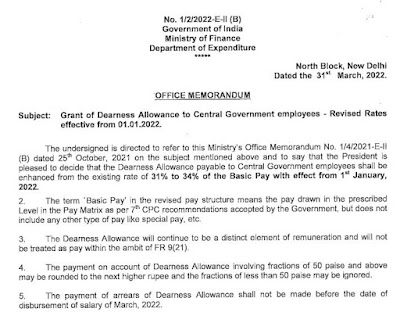
DA Jan 2022 - Grant of Dearness Allowance to Central Government employees - Revised Rates effective from 01.01.2022

 3% DA Hike - Revised Rates effective from 01.01.2022: DoE OM dated 31.03.2022 No. 1/2/2022-E-II (B) Government of India Ministry of Finance...