Thursday, 29 September 2016

Good News For Railwaymen: Centre May Announce 78 Day Wages As Bonus


Good News For Railwaymen: Centre May Announce 78 Day Wages As Bonus

Ahead of the festive season, railway employees are likely to get 78 day wages as bonus this year, the same as in the last four years despite the financial crunch.

We have demanded 78 day wages as productivity linked bonus (PLB) for railway employee this year and expecting the government to declare the same next week,"National Federation of Indian Railwaymen General Secretary M Raghavaiah told Press Trust of India.

Productivity linked bonus is paid to about 12 lakh railway employees each year before the Dussehra festival.
Mr Raghavaiah said the 78 day wage is expected to be around Rs. 18,000 per employee. In 2011-12, 2012-13, 2013-14 and 2014-15 also, 78 day wages were also given as PLB to railway employees.
Facing a shortfall of about Rs. 10,000 crore in the earnings due to slowdown in loadings and drop of passengers in short train journey, the railways will get the cabinet approval for the 78 day bonus proposal next week.

The bonus decision is expected to cost the railways about Rs. 2000 crore.

All-India Railwaymen’s Federation General Secretary Shiv Gopal Mishra said the bonus is expected to motivate the employees to improve the financial position of the public transporter.

Mr Mishra said, "Since the PLB ceiling has been revised to Rs. 7000 from Rs. 3500, we expect each employee will get double the amount as against the last year’s bonus."

Last year, the minimum bonus paid was Rs. 8,975 per employee.

PLB covers all non gazetted railway employees (excluding RPF/RPSF personnel) spread over the entire country.

Source : NDTV

Central Government has a proposal to Pay 1% DA from July 2016 as an interim Measure


Central Government has a proposal to Pay 1% DA from July 2016 as an interim Measure

DA from July 2016 as an interim Measure


The Sources Close to the Ministry of finance informed that there is proposal to Pay 1% DA from July as an interim Measure.It is said that the Central Government has not yet decided about the DA rates in Revised Pay scale.

Sources close to Finance Ministry told that the initial installment of DA to central government employees on the revised pay structure w.e.f 1.7.2016 is under consideration. Mean time there is a proposal to pay the DA from July 2016 at the rate of 1% to all CG Staffs. It will be a shocking news for CG Staff, since they are already expecting 2 to 3% DA from July 2016.

PRU is asked to submit Financial Implication of 1% DA

But the fact is the Department of Expenditure has directed the PRU of the Finance Ministry to furnish the details of additional Financial Implications for 1% increase of DA with effect from 1.7.2016 on the revised Pay Structure.

Further the Pay Research Unit has been requested to furnish financial implications for the Period of July 2016 to February 2017 on account of granting 1% DA from July 2016 to all central government employees including Armed Forces and UT Employees.

According to the above information, it is believed that announcement of 1% DA for July installment may be made any time soon.

Source: http://govtstaffnews.in/

Sunday, 25 September 2016

Government Notification of 7th Central Pay Commission Recommendations Fixation of pay and arrears

Government Notification of 7th Central Pay Commission Recommendations Fixation of pay and arrears

PAY-TECH-CIRCULAR

No. Pay/Tech-01/7thCPC I
Dated: 21/09/2016
(All Cs FA)

Subject: Government Notification of 7th Central Pay  Commission Recommendations Fixation of pay/arrears.
Ref: (i) This office circular of even No. dated 11 Aug, 2016.

Please refer to this office Part I office order No. AT/02 circulated vide No. Pay/Tech 01 /7th CPC I dated 11.08.2016 through which a copy of CGDA New Delhi No. AT/II/2701/0rders dated 10 Aug, 2016 has been forwarded for necessary action.

2. It has been stated therein to ensure completion of post audit of fixation of pay/arrear claims within 3 months and the work relating to post audit should be monitored at PCsDA/CsDA level by instituting suitable reporting system for watching the progress of work. A Monthly Report in this regard in a format prescribed therein is required to be furnished to Headquarters office so as to reach by 15th of every month. The first report showing the position as on 31.08.2016 was due to reach HQrs office by 15th Sep, 2016. Kindly confirm its timely submission to HQrs office. Also please forward a copy of the said report to this office for our record & reference.

3. Please ensure submission of the report for the subsequent months within scheduled date with a copy endorsed to this office.

4. Please acknowledge receipt.
Sd/-
Astt. Controller of Accounts (Fys)
Source : http://pcafys.gov.in/

Government Employees: Understanding Minimum Wages and Bonus

Government Employees: Understanding Minimum Wages and Bonus

Understanding-Minimum-Wages-Bonus


Press Information Bureau
Government of India
Ministry of Labour & Employment

A minimum wage is the lowest remuneration that employers may legally pay to workers or it is the price floor below which workers may not sell their labour.

The concept of minimum wages first evolved with reference to remuneration of workers in those industries where the level of wages was substantially low as compared to the wages for similar types of labour in other industries. As far back as 1928, the International Labour Conference of International Labour Organization, at Geneva, adopted a draft convention on minimum wages requiring the member countries to create and maintain a machinery whereby minimum rates of wages can be fixed for workers employed in industries in which no arrangements exist for the effective regulation of wages and where wages are exceptionally low. Also, at the Preparatory Asian Regional Labour Conference of International Labour Organisation held at New Delhi in 1947 and then at the 3rd session of the Asian Regional Labour Conference, it was approved that every effort should be made to improve wage standards in industries and occupations in Asian Countries, where they are still low. Thus, the need of a legislation for fixation of minimum wages in India received an impetus after World War II, on account of the necessity of protecting the interest of demobilized personnel seeking employment in industries.

The justification for statutory fixation of minimum wage is obvious. Such provisions which exist in more advanced countries are even necessary in India, where workers organizations are yet poorly developed and the workers bargaining power is consequently poor.

To provide for machinery for fixing and revision of minimum wages a draft Bill was prepared and discussed at the 7th session of the Indian Labour Conference in November, 1945. Thereupon the Minimum Wages Bill was introduced in the Central Legislative Assembly. The Minimum Wages Bill having been passed by the Legislature received the assent on 15th March, 1948. It came on the Statute Book as the Minimum Wages Act, 1948.

The Act provides for fixation by the appropriate Governments of minimum wages for employments covered by Schedule to the Act. The Central Government is the appropriate Government in respect of 45 scheduled employments in the Central Sphere. The minimum wages fixed for Central sphere are applicable to the scheduled employments in the establishments under the authority of Central Government, railway administrations, mines, oil-fields, major ports or any corporation established by a Central Act. Employments other than the scheduled employment for Central Sphere come under the purview of the State Government and accordingly State Government wages are applicable in such employments. The minimum wages for Central Sphere are revised from time to time based on the increase in Consumer Price Index effective from April and October.

According to Section 3(1)(b) of the Minimum Wages Act, 1948, the appropriate government shall review at such intervals, as it may think fit, such intervals not exceeding five years, the minimum rates of wages so fixed and revise the minimum rates if necessary.

The norms recommended by the Indian Labour Conference, in 1957, fox fixing the minimum wages are: (a) consumption units for one wage earner; (b) minimum food requirements of 2700 calories per average Indian adult; (c) clothing requirements of 72 yards per annum per family; (d) rent corresponding to the minimum area provided for under Government's Industrial Housing Scheme; and (e) fuel, lighting and other miscellaneous items of expenditure to constitute 20% of the total minimum wage.

In 1991, the Hon'ble Supreme Court delivered a historic judgement and directed that children's education, medical requirement, minimum recreation including festivals/ceremonies, provision for old age, marriage etc. should further constitute 25% of the minimum wage and be used as a guide in fixation of minimum wage.

The Act envisages appointment of an Advisory Board, by the appropriate Government, for the purpose of advising the appropriate Government in the matter of fixing and revising minimum rates of wages.

The Central Government revises the wages in the scheduled employments from time to time in accordance with the provisions of the Minimum Wages Act, 1948. Draft Notifications for all the Scheduled Employments in the Central Sphere were issued on 1st September, 2016 simultaneously, in fact for the first time. The basic rate of minimum wages for an unskilled worker in the scheduled employment other than agriculture has been proposed at Rs.350 in Area 'C' from the current minimum wage (basic wage + variable dearness allowance) of Rs.246 resulting in an increase of about 42%. The basic rate of minimum wages for an unskilled worker in the scheduled employment 'agriculture' has been proposed at Rs.300 in Area 'C' from the current minimum wage (basic wage + variable dearness allowance) of Rs.211 resulting in an increase of about 42%.

The proposed revision in the rates of basic minimum wages would indeed provide much needed solace to the labour fraternity.

Bonus

Bonus payment is an extra payment given for doing one's job well also known as performance related pay or pay for performance.

The practice of paying bonus in India appears to have originated during First World War when certain textile mills granted 10% of wages as war bonus to their workers in 1917. In certain cases of industrial disputes demand for payment of bonus was also included. In 1950, the Full Bench of the Labour Appellate Tribunal evolved a formula for determination of bonus. A plea was made to raise that formula in 1959. At the second and third meetings of the eighteenth Session of Standing Labour Committee (G.O.I) held in New Delhi in March/ April 1960, it was agreed that a Commission be appointed to go into the question of bonus and evolve suitable norms. A Tripartite Commission was set up by the Government of India to consider in a comprehensive manner, the question of payment of bonus based on profits to employees employed in establishments and to make recommendations to the Government. The Government of India accepted the recommendations of the Commission subject to certain modifications. To implement these recommendations the Payment of Bonus Act, 1965 was enacted, which came into force on 25.9.1965.

The objective of the Payment of Bonus Act, 1965 is to provide for the payment of bonus to the persons employed in certain establishments on the basis of profits or on the basis of production or productivity and for matter connected therewith.

It applies to (i) Every Factory; and (ii) Every other establishment in which 20 or more persons are employed on any day during an accounting year subject to the exemptions under section 32. Every employee shall be entitled to be paid by his employer in an accounting year, bonus, in accordance with the provisions of this Act, provided he has worked in the establishment for not less than thirty working days in that year. While the minimum bonus is 8.33% of the salary or wage earned by the employee during the accounting year, the maximum bonus is 20% of such salary or wage.

Two ceilings are available under the said Act generally known as eligibility limit and calculation ceiling respectively. Clause 13 of Section 2 of Payment of Bonus Act, 1965 defines an employee based on salary or wage per mensem. This is usually taken as the 'eligibility limit' for computation of bonus. Similarly, Section 12 of the Payment of Bonus Act, 1965 provides for calculation of bonus of an employee based on salary or wage per mensem. This is known as 'calculation ceiling'.

The two ceilings are revised from time to time to keep pace with the price rise and increase in the salary structure. At present, the calculation ceiling has been enhanced to Rs.7000 or the minimum wage for the scheduled employment, as fixed by the appropriate Government, whichever is higher and the eligibility limit has been enhanced to Rs.21,000/-.

Due to this revision, additional 55 lakh workers would be benefited. This would indeed, be a good gesture on the part of the Government towards the labour fraternity.

Source : PIB

Accumulation of NFIRs PNM Items due to non finalization

No. NFIR/PNM/108
Dated: 22/09/2016
The Mernber Staff,
Railway Board,
New Delhi

Dear Sir,

Sub: Accumulation of NFIRs PNM Items due to non finalization - reg.

NFIR sends herewith a list containing 12 PNM Items which are pending from the year 2011 to 2016. Most of the items are relating to grant of financial upgradation under MACPS. Although it was agreed to arrange meeting at the level of MS & FC on MACPS issues, no such meeting has been convened and on the other hand, the issues have not been resolved through discussions with the Federation.

Federation is afraid that the number of pending items will continue to grow, if Board does  not devote for setting the issues through mutual discussions.

NFIR, therefore, requests the Railway Board (MS) to kindly see that speedy action is taken on all pending PNM items. Federation will be ready to discuss on dates convenient to both.
DA/As above
Yours faithfully,
(Dr.M.Raghavaiah)
General Secretary I
Source: NFIR

Scheme for Promotion of Adventure Sports & Similar Activites amongst Central Government Employees, Calandar of Programme to be conducted by Nehru Institute of Mountaineering, Uttarkashi

No.125/1/2015-16-CCSCSB
Government of India
Ministry of Personnel, Public Grievances & Pensions
(Department of Personnel & Training)

Lok Nayak Bhawan, New Delhi
Dated 22nd September, 2016.

OFFICE MEMORANDUM

Sub: Scheme for Promotion of Adventure Sports & Similar Activities amongst Central Government Employees, Calendar of Programme to be conducted by Nehru Institute of Mountaineering, Uttarkashi.

The undersigned is directed to refer to the Department of Personnel & Training Office Memorandum of even number dated 26th April 2016 regarding Scheme for Promotion of Adventure Sports & Similar Activities amongst Central Government Employees. The same may be seen at www.persmin.nic.in-Welfare-sports-general/recent circulars miscellaneous.

2. The Department of Personnel & Training has approved the following programme under the Scheme to be conducted by Nehru Institute of Mountaineering, Uttarkashi during November, 2016 to January, 2017:

S. NoProgrammeDurationFee
1.Mountain Craft, Trekking, Skiing, Adventure Courses20 Nov 30 Nov 2016;Rs. 1100/- per day plus 15% service tax*
20 Dec 30 Dec 2016;
31 Dec 16 to 10 Jan 2017
*Fee includes a wholesome and nutritious veg/non-veg meal, accommodation, equipment(less trekking shoe, socks, goggles, head gear), instructors, expenditure on porters, medical support and transportation within general area Uttarkashi.

3. The content of the courses are as under:
(a) Physical fitness training(b) Multipurpose Obstacle
(c) Sports Climbing (Difficulty & Speed)(d) Trekking on uneven routs
(e) Bouldering(f) Anchoring & belaying
(g) Rappelling(h) Jummaring
(i) Rock Climbing/Rock Craft(j) Rope Knots, Coiling & Roping u
(k) Mountain Stream Crossing(l) Lectures on adventure aspects
(m) Outdoor Camping(n) Camp Cooking

4. The interested Government Employee may approach Registrar, NIM, Uttarkashi (01374-222123, 09411532901) or Training Clerk, NIM, Uttarkashi (01347-223580, 09412323226) and submit his/her application directly to them and a copy of the same endorsed to Secretary, CCSCSB, Lok Nayak Bhawan, Khan Market, New Delhi with Bank Details (Name of Bank, Account Number, Branch Name and IFSC Code) for smooth reimbursement of claim after completion of program.

5. In view of the above, it is requested that the contents of the Scheme (copy enclosed) may please be disseminated amongst the employees who are eligible to avail the benefits of the Scheme and encourage to participate in the Scheme.
(Md.Nadeem)
Under Secretary to the Govt. of India.
To
Director/Deputy Secretary (Administration) of all Ministries/Departments.

Source: ccis.nic.in

Saturday, 24 September 2016

7th Pay Commission Resolution for the supreme court Employees & Officers

7th_CPC_resolution_supreme_court_employees_officers

REGD.No.D.L.33004/99
The Gazette of India
EXTRAORDINARY
Part I, Section 1
Published by Authority
No.302
New Delhi, Friday, September 23, 2016/Asvina 1,1938
Supreme Court of India
Resolution
New Delhi, the 23rd September, 2016

No. F.6/2016 SCA(I) The Seventh Central Pay Commission (Commission) was set up by the Government of India vide Resolution No. 1/1/2013-E.III (A), dated the 28th February, 2014. The Terms of Reference of the Commission also includes the Officers and Employees of the Supreme Court. The period for submission of report by the Commission was extended upto 31st December, 2015 vide Resolution No. 1/1/2013 E.III(A), dated the 8th September, 2015. The Commission, on 19th November, 2015, submitted its Report on the matters covered in its Terms of Reference as specified in the aforesaid Resolution dated the 28th February, 2014.

2.The Chief Justice of India, after consideration, has decided to accept the recommendations of the Commission in respect of the Officers and Employees of the Supreme Court in the manner as specified hereinafter.

3.The Chief Justice of India has accepted the Commission's recommendations on Minimum Pay, Fitment Factor, Index of Rationalisation, Pay Matrix and general recommendations on pay without any material alteration in respect of Officers and Employees of the Supreme Court.

4. (1) The Pay Matrix, in replacement of the Pay Bands and Grade Pays as in force immediately prior to the notification of this Resolution, shall be as specified in Annexure I in respect of Officers and Employees of the
Supreme Court.

(2) With regard to fixation of pay of the Officers and Employees of the Supreme Court in the new Pay Matrix as on 1st day of January, 2016, the existing pay (Pay in Pay Band plus Grade Pay) in the pre revised structure as on 31st day of December, 2015 shall be multiplied by a factor of 2.57. The figure so arrived at is to be located in the Level corresponding to employee’s Pay Band and Grade Pay or Pay Scale in the new Pay Matrix. If a Cell identical with the figure so arrived at is available in the appropriate Level, that Cell shall be the revised pay; otherwise the next higher cell in that Level shall be the revised pay of the employee.

(3) After fixation of pay in the appropriate Level as specified in sub-paragraph (2) above, the subsequent increments in the Level shall be at the immediate next Cell in the Level.

5.There shall be two dates for grant of increment namely, 1st January and 1st July of every year, instead of existing date of 1st July; provided that an employee shall be entitled to only one annual increment on either one of these two dates depending on the date of appointment, promotion or grant of financial upgradation.

6. The Commission's recommendations and Chief Justice of India’s decision thereon with regard to revised pay structure for Officers and Employees of the Supreme Court as specified at Annexure I and the consequent pay fixation therein as specified at Annexure II shall be effective from the 1st day of January, 2016. The arrears on this account shall be paid during the financial year 2016 to 2017.

7. The recommendations on Allowances (except Dearness Allowance) having been referred by the Government to a Committee which will submit its report within a period of four months, till a final decision on Allowances is taken based on the recommendations of the said Committee, all Allowances will continue to be paid to Supreme Court Officers and Employees at existing rates in existing pay structure, as if the pay had not been revised with effect from 1st day of January, 2016.

8. The recommendations of the Commission relating to interest bearing Advances as well as interest free Advances have been accepted with the exception that interest free Advances for Medical Treatment, Travelling Allowance for family of deceased, Travelling Allowance on tour or transfer and Leave Travel Concession shall be retained.

9. The recommendations of the Commission for increase in rates of monthly contribution towards Central Government Employees Group Insurance Scheme (CGEGIS) for various categories of employees having not been accepted, the existing rates of monthly contribution shall continue.

10. As requisite sanction for upgradation has been received and upgraded scale have already been implemented, the list of cases of upgradation of pay scales of posts recommended by Seventh Central Pay Commission in which no action is required is specified at Annexure III.

11. The Chief Justice of India has approved for setting up of an Anomalies Committee by the Registry to examine individual, post-specific and cadre-specific anomalies arising out of implementation of the recommendations of the Commission.

12. The Chief Justice of India wishes to place on record their appreciation of the work done by the Commission.

By Order and under the authority of Chief Justice of India.
M.V. RAMESH, Registrar(Admn.I)

Payment of Allowances in Revised pay may satisfy the Government Staff

Payment of Allowances in Revised pay may satisfy the Government Staff


It is believed that Payment of Allowances in Revised pay may at least satisfy the Government Staff, despite the fact that the Pay Hike is not sufficient.7th CPC Allowances

Bapus are annoyed about the inordinate delay in announcing Allowances. Talks are doing rounds that the government is deliberately playing the delaying tactics to make the CG Staff to accept the decisions of Allowance Committee.

Central Staff upset with Pay Hike
Already the Central Government Staff are very much upset with Pay Hike recommended for next Ten Long years. They in fact are not happy about the Arrears paid to them. Though the Govt has defended that the Pay Revision arrears will not be as high as in previous Pay Commission, because Arrears for couple of years had been paid in previous Pay Commission. But this time Pay Revision took place within seven months from the due date. So obviously the Pay Revision Arrears will be lesser than previous Pay Commission.

Though a Committee was formed to review the Minimum Pay and Fitment Factor, it is believed that it was wrapped up already. But the federations are Optimistic. They expect somehow the Committee will help them to pacify the Govt Servants on this particular issue.

But nonpayment of Allowances in revised Pay will certainly axe the feel good factor in Central Government Offices. They are started losing patience over it and expect the government to announce it soon. Because the take home pay after pay revision is unbelievably very low comparing to the previous Pay commission. The Central government should not reduce the rate of Allowances and it should be implemented with effect from 1.1.2016

Compassionate ground appointments in Public Sector Banks

Compassionate ground appointments in Public Sector Banks

ALL INDIA BANK EMPLOYEES’ ASSOCIATION
Central Office: PRABHAT NIVAS Regn. No.2037
Singapore Plaza, 164, Linghi Chetty Street, Chennai 600001
Phone: 2535 1522 Fax: 4500 2191, 2535 8853
e mail - chv.aibea@gmail.com & aibeahq@gmail.com
Web: www.aibea.in

CIRCULAR LETTER No.27/200/2016/33
24.5.2016
TO ALL OFFICE BEARERS, STATE FEDERATIONS AND
ALL INDIA BANKWISE ORGANISATIONS:
Dear Comrades,
Reg: Compassionate ground appointments in the Banks

Units are aware that despite the guidelines from the Government of India, some of the Banks are not implementing the scheme on compassionate ground appointment properly both in regard to eligibility and also on relaxations in qualifications. In the Associate Banks, even the Govt. guidelines have not been placed before the Boards of the respective Banks and unilateral instructions of the SBI are being adhered to whereby compassionate ground appointments are being denied. From AIBEA we have taken up the matter with the Finance Minister. Arising out of the recent UFBU meeting, UFBU also has addressed a letter to the Finance Minister and same is reproduced herein for the information of our units.

With greetings,
Yours Comradely,
C.H. VENKATACHALAM
GENERAL SECRETARY
UFBU Letter to Finance Minister
IBA/GOVT/2016/139
Date: 21st May, 2016
Shri Arun Jaitley,
Hon'ble Minister of Finance,
Government of India, New Delhi.

Respected Sir,

SCHEME FOR COMPASSIONATE APPOINTMENT IN PUBLIC SECTOR BANKS

We are thankful to you for restoring the Compassionate Appointment Scheme in Public Sector Banks (PSBs) vide your letter D.O.F.No.18/2/2013 IR dated the 7th August 2014, conveying the approval of the Government to open the Compassionate Appointment in PSBs on the lines of Central Government with a request to the Indian Banks’ Association (IBA) to take appropriate action to circulate the revised scheme to all PSBs for adoption with the approval of their respective Boards. Further, the decision of the Government was conveyed by Ministry of Finance vide letter F.No.18/2/2013 IR dated 05.12.2014 that all PSBs can have both the options i.e., compassionate appointment or payment of lumpsum ex-gratia amount.

2. It will note be out of context to mention here that the issue of restoration of compassionate appointment scheme in Public Sector Banks (PSBs) has been under discussions between UFBU and IBA since the last ten years and in accordance with the suggestion of Department of Financial Services, a joint proposal on broad parameters was submitted by IBA for approval of the Government. The sustained struggle by UFBU ended with your kind intervention resulting in approval as above from the Government of India.

3. However, we are shocked to observe that the managements of some of the banks have unilaterally decided to continue, with certain modifications, the scheme for compassionate appointment in exceptional circumstances only and the scheme for payment of Ex-gratia Lumpsum Amount in lieu of Compassionate Appointment, totally ignoring the approval of Government of India to open the Compassionate Appointment Scheme in Public Sector Banks (PSBs) on the lines of Central Government.

4. Further, the concessions / relaxations, as provided under the scheme envisaged by the Government, as applicable to Central Government employees, such as exemption from the requirement of minimum educational qualification etc., have not been extended in the Banking Industry, thereby making them ineligible and denying the appointments.

5. The unilateral decisions of the managements as above, is not only total ignorance of the directives of the Government of India to open the Compassionate Appointment Scheme on the lines of Central Government but also deliberate utter disregard to the sustained struggle of bank workmen and officers for nearly a decade in getting the scheme approved by the Government.

6. Hence, we earnestly seek your kind intervention in the matter and arrange to appropriately instruct all the Public Sector Banks, which have not introduced the Compassionate Appointment Scheme on the lines of Central Government, as approved by the Government of India and advised by you and also on provision of concessions / relaxations as applicable to Government employees, under the compassionate appointment scheme.

Please acknowledge receipt of this communication and advise us the developments in this regard.
With best regards
Yours sincerely,
Sd..
(M.V.MURALI)
CONVENOR
Copy to All Constituent Units of UFBU.
Source: http://aibea.in/

Friday, 23 September 2016

Casual Labourers with temporary Status in Deptt of Post, Clarification regarding GPF and Old Pension Scheme

Casual Labourers with temporary Status in Deptt of Post - Clarification regarding contribution to GPF and Pension under the Old Pension Scheme

No.01-07/2016-SPB-I
Government Of India
Ministry Of Communications & IT
Department of Posts

Dak Bhawan, Sansad Marg,
New Delhi 110 001.

Dated: 12th September, 2016

Subject: Casual Labourers with temporary Status - Clarification regarding contribution to GPF and Pension under the Old Pension Scheme.

Sir,
I am directed to refer to this Department’s letter no.01-07/2016-SPB-I dated 22.07.2016 on the above cited subject and say that following clarifications are hereby issued in respect of Casual Labourers in the Postal Department in line with DOP&T OM No.49014/2/2014-Estt(c) dated 28.07.2016:

(a) The Department’s letter No.01-07/2016-SPB-I dated 22.07.2016 restores the provisions of the scheme as it existed prior to this Department’s letter No.45-6/2005-SPB-I dated 02.09.2005. The benefit of GPF and Old Pension Scheme is applicable to all those Casual Labourers who are covered under the Casual Labourers (Grant of Temporary Status and Regularization) Scheme issued vide letter No.45-95/87-SPB-I dated 12.04.1991 even if they have been regularized on or after 01-01-2004.

(b) As the benefit of Old Pension Scheme and GPF is applicable to only those casual workers who are covered under the above stated scheme of 1991, all the circles may strictly ensure that it does not lead to demand by regularly recruited fresh employees appointed on or after 01.01.2004 for similar benefit in place of NPS.


Yours faithfully,

(Abhay Kumar)
Assistant Director General (SPN)
Source: Department of Posts [Click here]

Flash News

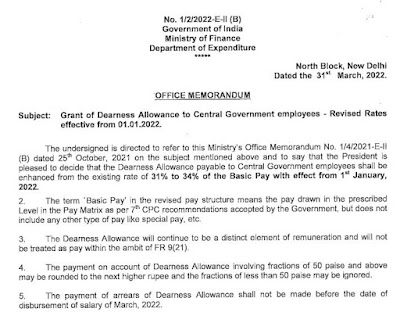
DA Jan 2022 - Grant of Dearness Allowance to Central Government employees - Revised Rates effective from 01.01.2022

 3% DA Hike - Revised Rates effective from 01.01.2022: DoE OM dated 31.03.2022 No. 1/2/2022-E-II (B) Government of India Ministry of Finance...