Sunday, 22 May 2016

Government all set to launch special colour coded Aadhaar card for disabled

Government all set to launch special colour coded Aadhaar card for disabled

Aadhaar-card-color-disabled
Aadhaar card will be marked by three different colours — red, blue and yellow to indicate the degree of disability.

The government is all set to launch special colour-coded Aadhaar card for disabled for easy linkage to the government’s schemes and services.

The Social Justice and Empowerment Ministry is likely to launch the process for registration of disabled persons on a centralised e-platform to issue Unique Disabled Identity (UDID) cards.

The card will be marked by three different colours — red, blue and yellow to indicate the degree of disability.

First Aadhaar cards are likely to be delivered in August in Ratlam in Madhya Pradesh, which is the chosen district for the pilot project.

According to officials, rough estimates put the number of the disabled persons having disability certificate at not more than one crore. The UDID portal is expected to create real time data for planning and disbursal of benefits to the disabled.

The UDID portal will be launched in the public domain in June for registration at the district level and the first cards are likely to be handed out to eligible persons in mid-August. The cards will be marked by a colour bar at one end.

Red colour will indicate disability of 80% and above, blue for disability between 40% and 80% and yellow for disability below 40%.

It has been designed by National School of Design, Ahmedabad. It will have a hologram meshed in to prevent any attempts at duplication.

All applicants will be certified after due verification by the CMO and only then the UDID will be generated.

Considering that everyone may not have access to the online platform, offline applications will also be accepted. “The database will be unique hence there will be no chance of duplication,” an official explained.

The states that will be covered in the first phase include UP, Haryana, Chandigarh, Rajasthan, Gujarat, Madhya Pradesh, Maharashtra, Odisha, Telangana, Kerala, Tripura, Jharkhand and Tamil Nadu. The remaining states will be covered by 2018.

Saturday, 21 May 2016

Kendriya Vidyalayas admin warns employees against lobbying for awards

Kendriya Vidyalayas admin warns employees against lobbying for awards

New Delhi: The administration of central government-run Kendriya Vidyalaya Sangathan (KVS) schools has warned all employees against bringing pressure through VIPs for granting incentive award or national award to them.

In a circular put on its website, the KV administration has told its employees that henceforth applications regarding awards, if received through VIP references, will not be considered.

It said keeping in view this kind of “misconduct”, the persons concerned will be barred from applying for the award for three years.

This is the second time this month that the KV administration has issued a circular against the tendency of employees to seek recommendations of VIPs.

Earlier this month, it had put out a circular asking them not to seek transfers by bringing “outside pressure” through VIP recommendations.

PTI

Time limit fixed for filing Appeal for grant of Family Pension

Time limit fixed for filing Appeal for grant of Family Pension

Time limit fixed for filing Appeal for grant of Ordinary Family Pension, Special Family Pension, Liberalized Family Pension and disability/ war injury pension/ element etc.

Department of Ex-Servicemen welfare has extended  the time limit for filing Appeal for grant of Ordinary Family Pension, Special Family Pension, Liberalized Family Pension and disability/ war injury pension/ element etc.

No.1(3)/2008/D(Pen/Pol)
Ministry of Defence
Department of Ex-Servicemen welfare
New Delhi

Dated: 17th May 2016

To
The Chief of the Army Staff
The Chief of the Air Staff
The Chief of the Naval Staff

Subject: Prescription of time limit for filing Appeal for grant of Ordinary Family Pension, Special Family Pension, Liberalized Family Pension and disability/ war injury pension/ element etc.

It has been observed that Service Hqrs are processing the appeal case files-(First Appeal/ 2nd Appeal) for grant of Ordinary Family Pension, Special Family Pension, Liberalized Family Pension and disability/War injury pension/ element etc after elapse of considerable time from the date of rejection of claim/ date of discharge or invalidment of the personnel from Service.

2. The matter has been under consideration of this Ministry for quite some time and President of India is pleased to decide that, a time limit of five years is prescribed for filing an appeal for consideration of the case for grant of Ordinary Family Pension, Special Family Pension, Liberalized Family Pension, disability/war injury pension/ element etc from the date of discharge/ invalidment from service or from the date of rejection of claim. The time limit of five years prescribed in this order is applicable in the case of belated appeal only and the period of six months prescribed in the Pension Regulation and Entitlement Rules etc for filling appeals in respect of disability/ war injury element, special Family Pension etc would continue to be governed under the existing provisions.

    3. The time limit of five years prescribed now will not be applicable in the case of delayed manifestation of disease and all such cases would continue to be governed under the existing previsions provided under regulation 86 of Pension Regulation for Army Part. I [2008].

    4. Para 1(a)(vi) of Ministry of Defence Order No.4684/DIR(PEN)/2001 dated 14th August 2001 and Para 2(c) of Ministry of Defence letter No. 4684/Dir(Pen)/2001 dated 7th November 2001 maybe modified as “Time bar sanction for filing appeals for all type of Family Pension and disability/War injury pension/ element etc in respect of officers and PBORS beyond twelve months to five years”.

    5. A period of one year from the date of issue of this order is granted for submission of the appeal in respect of past cases. This one time relaxation may be allowed judiciously in deserving cases.

    6. This issue with the concurrence of Finance Division of this Ministry Vide their ID No PC-2 to 26(7)/2013/Fin/Pen dated 13/14 April 2016.

    Hindi version will follow.

    Yours faithfully,
    (R K Arora)
    Under Secretary to the Government of India

Download DESW circular No.1(3)/2008/D(Pen/Pol) dated 17.05.2016

Who are entitled to 7th Pay Commission additional Bunching increment ?

Who are entitled to 7th Pay Commission additional Bunching increment ?

Who are entitled to 7th Pay Commission Bunching Benefit as per Para 5.1.36 of Pay Commission report ? – As per Illustration provided in the report Employees in GP 10,000 who are fitted in to minimum of Level 14 of New Pay Matrix will be eligible for one additional increment and would be fitted in to next cell of Level 14.

7th Pay Commission Pay Fixation:

As per Para 5.1.28 of 7th Pay Commission Report, pay fixation in the new pay structure will have to be made as follows

Step 1: Identify Basic Pay (Pay in the pay band plus Grade Pay) drawn by an employee as on the date of implementation. This figure is ‘A’.

Step 2: Multiply ‘A’ with 2.57, round-off to the nearest rupee, and obtain result ‘B’.

Step 3: The figure so arrived at, i.e., ‘B’ or the next higher figure closest to it in the Level assigned to his/her grade pay, will be the new pay in the new pay matrix. In case the value of ‘B’ is less than the starting pay of the Level, then the pay will be equal to the starting pay of that level


In addition to above, 7th Pay Commission proposes bunching benefit in Para 5.1.36 whenever more than two stages are bunched together for fixation of pay in 7th CPC pay matrix, one additional increment equal to 3 percent may be given for every two stages bunched, and pay fixed in the subsequent cell in the pay matrix.

Further, Para 5.1.37 of the report provides an illustration for fixation of pay of two employees who are drawing pay of Rs 53,000 and Rs54,590 in the GP 10000.

As per this illustration, after applying 7CPC multiplication factor of 2.57, both of these employees will have to be fixed in first cell of level 15 in the pay of Rs1,44,200 as their revised pay are worked out to Rs1,36,210 and Rs1,40,296 respectively which are not more than the first cell of level 15 (Rs1,44,200)

But to avoid bunching of these two stages of pay, the person drawing pay of Rs54,590 will get fixed in second cell of level 15 in the pay of Rs1,48,500, while the other who is drawing pay of Rs 53,000 will have to be fixed in Rs1,44,200.

Based on this illustration, a table containing Entry pay of Rs. 53,000 in GP 10000, subsequent stages for this pay (pay with increment of 3% for every year) and 7th Pay Commission pay fixation for the same has been prepared as below.

7CPC pay fixation for GP 10,000
6cpc pay basic pay X 2.57 7cpc pay matrix Fixation in 7CPC pay with bunching increment if applicable
53000 136210 144200 144200
54590 140296 144200 **148500
56230 144511 148500 148500
** One increment as bunching benefit
Employees in Grade Pay 5400, 6600, 7600 and 8900 who are fixed in stages next to entry pay will also be entitled to 7th Pay Commission Bunching Benefit

Applying same principles, we could find that next stage in entry pay in respect of Grade Pay 5400, 6600, 7600 and 8900 would be entitled to one additional increment as bunching benefit

1. Grade pay 5400 corresponding to pay band 15600-39100 (Entry Pay Rs. 21000 and subsequent stages of pay with increment of 3% for every year)

7CPC pay fixation for GP 5400 (15600-39100)
6cpc pay basic pay X 2.57 7cpc pay matrix Fixation in 7CPC pay with bunching increment if applicable
21000 53970 56100 56100
21630 55589
56100
57800 **
22280 57260 57800 57800
22950 58982 59500 59500
** One increment as bunching benefit

2. Grade pay 6600 (Entry Pay Rs. 25350 and subsequent stages of pay with increment of 3% for every year)

7CPC pay fixation for GP 6600
6cpc pay
basic pay X 2.57
7cpc pay matrix
Fixation in 7CPC pay with bunching increment if applicable
25350
65150
67700
67700
26120
67128
67700
69700 **
26910
69159
69700
69700
27720
71240
71800
71800
** One increment as bunching benefit

3. Grade pay 7600 (Entry Pay Rs. 29500 and subsequent stages of pay with increment of 3% for every year)

7CPC pay fixation for GP 7600
6cpc pay
basic pay X 2.57
7cpc pay matrix
Fixation in 7CPC pay with bunching increment if applicable
29500 75815 78800
78800
30390 78102
78800
81200 **
31310 80467 81200
81200
32250 82883 83600
83600
** One increment as bunching benefit

4. Grade pay 8900 (Entry Pay Rs. 49100 and subsequent stages of pay with increment of 3% for every year)

7CPC pay fixation for GP 8900
6cpc pay
basic pay X 2.57
7cpc pay matrix
Fixation in 7CPC pay with bunching increment if applicable
49100 126187 131100
131100
50580 129991 131100
135000 **
52100 133897 135000
135000
53670 137932 139100
139100
** One increment as bunching benefit

Whether Employees in who are fixed in the middle stages of new 7th CPC pay matrix will be eligible for Bunching Benefit ?

Relevant portions of 7th Pay Commission report (para 5.1.36 and Para 5.1.37) that discuss about Bunching increment are given under the heading “Entry Pay”.
The illustration provided by 7th CPC for fixation of pay with bunching increment also discusses only about entry pay in a grade pay.
Also, Para 5.1.28 of 7th Pay Commission Report which explains the method of fitment of existing 6th CPC pay in all stages in to 7th Pay Commission Pay Matrix does not contain any explanation about Bunching increment
Hence, it is not clear from the 7CPC report whether bunching benefit would apply to employees who are fixed in middle stages of new pay matrix.
For instance, we analysed the pay fixation of entry pay pertaining to Grade Pay Rs. 1800 and Grade Pay Rs. 2400 and its subsequent stages of pay with increment of 3% for every year
7CPC pay fixation for GP 1800
6cpc pay
basic pay X 2.57
7cpc pay matrix
Fixation in 7CPC pay
7000 17990 18000
18000
7210 18530 19100
19100
7430 19095 19100
19100 ##
7660 19686 20300
20300
7890 20277 20900 20900
## Bunching of 6cpc pay in two stages in to one stage of 7CPC Pay Matrix
7CPC pay fixation for GP 2400
6cpc pay
basic pay X 2.57
7cpc pay matrix
Fixation in 7CPC pay
11170 28707 29600 29600
11510 29581 30500 30500
11860 30480 30500 30500 ##
12220 31405 32300 32300
12590 32356 33300 33300

From the above, it could be seen that Pay pertains to Grade Pay of Rs. 1800 and Rs. 2400 in middle stages are getting bunched and fitted in to one stage of new pay structure as per the methods of fitment envisaged by 7th Pay Commission.

However, 7th pay Commission report has not discussed about applicability of Bunching Benefit in respect of pay fixation in middle stages of new pay matrix. It is also not clear whether bunching increment would apply to subsequent stages of pay when bunching increment is given to previous stage in the same level. For instance, 7th Pay Commission has recommended that pay of Rs. 54590 in GP 10,000 will be eligible for bunching increment and will be fitted in new of pay of Rs. 148,500. However, there is no discussion about the subsequent stage to Rs. 54,490 in GP 10,000 which is also getting fixed in same new Pay of Rs. 148,500/-

We are of the opinion that to clarify all these doubts, Govt has to come up clear-cut Clarification on Bunching Increment issue while 7th Pay Commission report is implemented.

Friday, 20 May 2016

7th Pay Commission Report – Areas which require Revision / Modification by Empowered Committee

7th Pay Commission having been tabled already, now it is left to Empowered Committee (appointed for examining the report of the Commission) to consider the demands of Staff Side.

7thPayCommissionReport-revision

7th Pay Commission Report – Areas which require Revision / Modification by Empowered Committee as per Staff Side demands – Minimum Pay, Fitment Formula, Annual Rate of Increment, Date of Effect, Ratio between Minimum Pay and Maximum Pay, Fixation of Pay on Promotion etc.

After 7th Pay Commission formed in February 2014, staff side JCM consisting of members who are also office bearers of various staff organisations had submitted detailed memorandum to the Commission  and suggested the quantum of Minimum Pay, Fitment Formula, Annual Rate of Increment, Date of Effect, Ratio between Minimum Pay and Maximum Pay, Fixation of Pay on Promotion etc., for taking in consideration by 7th Pay Commission in its recommendations.

However, many of the demands of the staff side were not favourbly considered by the 7th Pay Commission in its recommendations.

Now, Staff Side have been impressing upon Empowered Committee, the need for rectification / modification / revision of many of retrograde recommendations of 7th Pay Commission

We provide here a brief of the areas with respect to which Staff Side members will have to demand for revision / modification of the recommendations of 7th Pay Commission.

1. Minimum 7th Pay Commission Pay and Ratio between Minimum and Maximum Pay:

7th Pay Commission has proposed a basic pay of Rs. 18000 as minimum entry pay in Central Government Service (Pay of MTS). However, Staff Side JCM is of the view that as per approved methods such as Dr.Aykroyd Formula, minimum pay in Central Government Service should be Rs. 26,000.


2. Date of Effect and Fitment Formula:

Staff Side JCM had put forth before 7th Pay Commission that uniform fitment formula / multiplication factor of 3.7 to be applied while fixing the basic pay of existing employees.

With regard to Date of effect of 7th Pay Commission pay and allowances, members representing staff side submitted before 7th CPC that Central Government Employees are due for pay revision every ten years and that in order to rectify the delay in implementation of pay commission award in the past, the present pay commission award has to be given effect from 1st January 2014.

Contrary to Staff Side JCM’s suggestions, 7th Pay Commission has fixed the fitment formula / multiplication factor as 2.57. While mere merger of DA with existing pay in pay band and Grade pay would require a multiplication factor of 2.25, 7CPC proposed fitment formula / multiplication factor of 2.57 would result in increase in basic pay to an extent of 14.22% only.

Hence, convincing 7th CPC empowered committee for a higher multiplication factor / fitment formula would be the foremost concern of Staff Side JCM.

As far as date of effect of 7th Pay Commission award is concerned, the commission has not accepted the suggestion of Staff Side. It has observed that since the previous pay commission was given effect from 1st January 2006, the present pay commission award will have to be made effect only from 1st January 2016.


3. Annual Rate of Increment and Date of Increment:

Staff JCM in its memorandum before 7th Pay Commission suggested that since most of the PSUs including the banking industries provide the incremental rate at 5% and over a period of time it raised the salary level of the personnel, rate of  annual increment for Central Government Employees will have to be fixed at 5%.

Further, uniform date of increment prescribed by the 6th CPC resulted in many anomalies, Staff Side JCM submitted that two specific dates as increment dates, Viz. 1st January and 1st July will have to be introduced.  Those recruited/appointed/promoted during the period between 1st January and 30th June will have their increment date on 1st January and those recruited/appointed/promoted between 1st  July and 31st  December will have it on 1st  July next year.

Also, staff side required that those who retire on 30th June or 31st December are granted one increment on the last day of their service, since they serve the entire one year of service required for an increment as on the date of retirement

Recommendation of 7th Pay Commission on the rate of increment:

In spite of valid argument of staff side for recommending annual increment rate of 5%, 7th Pay Commission has not made revision in annual increment and Promotional increment which have been recommended at the rate of 3% of basic pay.

4. Scrapping of NPS:

Staff Side JCM is of the view that New Pension system (NPS) has to be scrapped and all the employees who have joined in Govt Servic on or after 01.01.2004, are to be brought to defined pension scheme.

However, 7th Pay Commission observed that the NPS will have to be continued; that Govt should frame necessary law / Policy for proper investment of NPS fund in Equity and that a strong grievance redressel will have to be formed to serve NPS employees.

5. Transport Allowance:

With regard to Transport Allowance, Staff Side JCM presented the demand that if at all Transport allowance is meant to defray transport charges then low paid employees ought to have been paid higher transport allowance then higher level officers as they only travel from long distances to reach office. Hence, it was suggested by Staff Side that uniform transport allowance be paid irrespective of level of the cadre

Pay Range X class cities other places
Up to Rs.75,000 Rs. 7500 plus DA Rs. 3750 plus DA

 However, 7th Pay Commission has not modified the structure of Transport allowance on the basis of pay level. The existing DA on Transport Allowance has been proposed to be merged. The new rates of Transport Allowance suggested are as follows:

Pay Level
Higher TPTA Cities
(Rs. pm)
Other Places
(Rs. pm)
9 and above 7200+DA 3600+DA
3 to 8
3600+DA 1800+DA
1 and 2
1350+DA 900+DA


6. MACP:

It has been demanded by Staff Side JCM that five hierarchical promotions to be granted under MACP. Presently only 3 financial upgradations either in the form of promotion or time bound financial upgradation to next grade pay are being ensured under MACP.

7th Pay Commission has not made any proposal for revising the number of upgradations under MACP which is three at present.

With regard to the benchmark for performance appraisal for MACP as well as for regular promotion, 7th Pay Commission has recommended that in the interest of improving performance level, the same has to be enhanced from ‘Good’ to ‘Very Good.’

7th Pay Commission has also noted that introduction of more stringent  criteria such as  clearing of departmental examinations or mandatory training before grant of MACP can also be considered by the government.

Withholding Annual Increments of Non-performers:

7th Pay Commission has proposed that employees who do not meet the laid down performance criterion should not be allowed to earn future annual increments.

The Commission has proposed for withholding of annual increments in the case of those employees who are not able to meet the benchmark either for MACP or a regular promotion within the first 20 years of their service.

7. House Building Advance:

Staff Side JCM had demanded for increasing the advance to 50 times of the Salary and fixing the rate of interest not more than 5%.

As per 7th Pay Commission’s recommendations, 34 times of Basic Pay OR Rs.25 lakh OR anticipated price of house, whichever is least can be availed as House Building Advance.

The requirement of minimum 10 years of continuous service to avail of HBA has been proposed to be reduced to 5 years.

If both spouses are government servants, 7CPC has proposed that HBA should be admissible to both separately. Existing employees who have already taken Home Loans from banks and other financial institutions would be allowed to migrate to this scheme, as recommended by 7CPC.

8. Children Education Allowance:

Suggestions of Staff Side:

Presently the allowance is admissible for two children, for studying in a recognised school up to XII standard. The maximum ceiling  is stipulated at Rs.18000/- since this allowance had been hiked by 50% because of the DA component in salary having been crossed 100% on 1.1.2014. It is suggested that doubling of this allowance and increasing the same by 50 % whenever the DA crosses over by 50%

Further, it has been suggested that the CEA scheme may be extended to cover children studying for Graduate/Post Graduate and Professional courses.

7th Pay Commission’s recommendations on Children Education Allowance:


CEA (Rs. pm) 1500×1.5 = 2250 Whenever DA increases by 50%, CEA shall increase by 25%
Hostel Subsidy (Rs. pm) 4500 x 1.5 = 6750 (ceiling) Whenever DA increases by 50%, Hostel
Subsidy shall increase by 25%

7th Pay Commission has not accepted the Staff Side’s demand that CEA to be applicable for children beyond class 12.

9. HRA:

House Rent Allowance suggested by Staff Side JCM

X classified cities 60%
Y classified towns 40%
Z classified/unclassified  places  20%

House Rent Allowance recommended by 7th Pay Commission
Population of
Cities/Towns
Class of
Cities/Towns
HRA rates as % of Basic Pay
(including MSP and NPA)
50 lakh and above
X
24
50–5 lakh
Y
16
Below 5 lakh
Z
8

HRA when DA crosses 50%
Population of
Cities/Towns
Class of
Cities/Towns
HRA rates as % of Basic Pay
(including MSP and NPA)
50 lakh and above
X
27
50–5 lakh
Y
18
Below 5 lakh
Z
9

HRA when crosses 100%
Population of
Cities/Towns
Class of
Cities/Towns
HRA rates as % of Basic Pay
(including MSP and NPA)
50 lakh and above
X
30
50–5 lakh
Y
20
Below 5 lakh
Z
10

10. LTC:

Staff Side JCM demanded the following as far as Leave Travel Concession applicable to Central Government Employees is concerned

1. Permission for air journey for all categories of employees to and from NE Region.

2. Permission for personnel posted in NE Region for a journey within NE Region.

3. To increase the periodicity of the LTC once in two years.

4. Explore the possibility of allowing an employer to undertake tour outside India once in a service career  in lieu of the LTC.

7th Pay Commission Report on LTC:

It could be found that suggestions of Staff Side JCM such as increasing the frequency of All India LTC, permission for air travel for all categories of employees in respect of NE Region etc., were not discussed in the report of 7th Pay Commission.

The proposal to split hometown LTC has been considered and it is recommended that splitting of hometown LTC should be allowed in case of employees posted in North East, Ladakh and Island territories of Andaman, Nicobar and Lakshadweep.

Also, it is obsered by 7th Pay Commission that LTC to foreign countries is not in the ambit of this Commission.


11. Gratuity:

Suggestions of Staff Side JCM:

Staff Side JCM suggested that in respect of gratuity payable to employees ceiling of 16.5 times and the quantum limit of Rs. 10 lakhs should also be removed. It was pointed out that in the banking industry there is no such ceiling of 16.5 months‟ salary but the retiring bank employees are getting at the rate of ½ a month salary for every year of service even over and above 33 years of service. Hence, in respect of Central Government Employees also for a service span exceeding 33 years, the gratuity should be higher and the above ceiling be withdrawn.

7th Pay Commission’s recommendations on Gratuity:

It has been recommended by 7th Pay Commission that ceiling of gratuity is to be raised from the existing Rs.10 lakh to Rs. 20 lakh from 01.01.2016. Further, as per Commission’s recommendations, Gratuity is to be partially indexed to Dearness Allowance. It is proposed that the ceiling on gratuity may increase by 25% whenever DA rises by 50 percent.

Via gconnect.in

Minister of Railways introduced Wi-Fi services at Three More Railway Stations i.e. Patna, Ranchi & Visakhapatnam

Minister of Railways introduced Wi-Fi services at Three More Railway Stations i.e. Patna, Ranchi & Visakhapatnam

The Minister of Railways, Shri Suresh Prabhakar Prabhu inaugurated the High Speed Wi-Fi services at Patna (Bihar), Ranchi (Jharkhand) & Visakhapatnam (Andhra Pradesh) Railway Stations through Video Conferencing from Rail Bhawan, New Delhi for the commuters at these Railway Stations. The Wi-Fi facility for the visitors & rail users at these stations has been commissioned by RailTel in association with Google for providing high speed state of the art world class internet experience to the commuters. Chairman, Railway Board Shri A.K. Mital, Member Engineering Shri V.K. Gupta, M.D. RailTel Shri R.K. Bahuguna, and other board Members were present at Rail Bhawan to grace the occasion. Various dignitaries were also presented at the respective abovementioned Railway Stations.

Speaking on the occasion, the Minister of Railways Shri Suresh Prabhakar Prabhu said that as the India is heading towards digitalization, Internet has become the basic need of every individual for which they are entitled to. He said that to bring the railway stations to world standard and to keep pace with the latest technology, provision of high speed WiFi is the first step in this direction. He said that so far this facility has been provided at 19 Railway Stations which will be extended to 100 Railway Station in the coming one year. He said that after completion of this project of providing WiFi facility at all 400 stations, it would be the biggest WiFi service in the world. He said that Indian Railways have been taking lot of measures to improve the facilities for the railway users and the coming time will also bring lot of new facilities which will make the railway passengers feel proud.

PIB

Union Home Minister announced ex-gratia amount of Rs.25 lakh

Union Home Minister announced ex-gratia amount of Rs.25 lakh

Union Home Minister Shri Rajnath Singh has expressed his deep sorrow and grief on the sad demise of Shri M.M. Khan, Deputy Law Officer of New Delhi Municipal Council (NDMC). Shri M.M. Khan was murdered on May 16, 2016.

In his message, Shri Rajnath Singh has said that Shri M.M. Khan was a dedicated and honest employee of NDMC. Delhi Police has apprehended all the seven accused in the murder of Shri M.M. Khan within 48 hours of the incident. Union Home Minister has conveyed his deepest condolence to the family of Shri M.M. Khan and has said that every possible support to the family of the deceased would be given.

Shri Rajnath Singh has announced an ex-gratia amount of Rs.25 lakh to the family of the deceased. On the directions of Home Minister, NDMC has offered a job to the wife of late Shri M.M. Khan on compassionate grounds. NDMC has also been directed to extend every possible support to the family of the deceased. The employees of NDMC have also shown their solidarity to the family of Shri M.M. Khan and have decided to contribute their one day salary to the family of Shri M.M. Khan.

Union Home Minister has said that Ministry of Home Affairs and NDMC stand united with the family of late Shri M.M. Khan in their moment of grief.

PIB

7th Pay Commission Latest News – 27% increase expected as against 14.29% recommended


7th Pay Commission Latest News – 27% increase expected as against 14.29% recommended by 7th CPC – Increase in Minimum pay expected now is Rs. 20,000 in the place of Rs. 18000 recommended by 7th Pay Commission
In addition to revision of minimum entry pay and multiplication factor, staff side has been demanding revision of annual increment from 3% to 5%, and reconsider 7th Pay Commission’s proposal to abolish various allowances 

Recent developments regarding implementation of 7th Pay Commission recommendations indicate that Govt may consider some of the demands of Staff Side, JCM such as minimum pay and multiplication factor etc., relating revision of Pay Central Government Employees.

7th Pay Commission has recommended that minimum Basic Pay of Central Government Employees which is Rs. 7000 presently to be increased to Rs. 18,000. This works out to 14.29 % increase when taking in to account the dearness allowance of 125% with effect from 1st January 2016.

As far as existing employees are concerned 7th CPC has recommended that their present basic pay has to be mulitiplied by 2.57, to arrive at new new basic pay as on 1st January 2016. This new basic pay is 14.22% more than the existing one.

Multiplication Factor as per 7th Pay Commission Report:


Multiplication Factor
Existing Basic Pay (Pay in pay band + Grade Pay 1
Existing Basic Pay with DA 2.25
7CPC recommended Basic Pay 2.57
(Net increase = 14.22%)


Since the implementation of 6th Pay Commission recommendations provided an increase of 30% to 40% in the pay of Employees, pay hike of 14.22% proposed by 7th Pay Commission was termed by Staff Side, JCM as very meagre and retrograde.

In this background, now it is disclosed by reliable sources that Empowered Committee formed by the Govt to process the 7CPC recommendations is considering the staff side’s demand to revise the minimum pay to Rs. 26,000. Minister of State for Finance has also promised to consider the demands of staff side for revising the minimum and multiplication factor, favourably.

It is learnt that Govt may persuade Staff Side to settle with the minimum pay of 20,000 and multiplication factor of 2.86. This is 27% more than present pay. As a result Net increase in Basic Pay will be 27%

In addition to revision of minimum entry pay and multiplication factor, staff side has been demanding for revision of annual increment from 3% to 5%.

7th Pay Commission on pay and pension: Pensioners to Gain the Most


Based on the 7th Pay Commission data, already pension payments account for a third of the government’s wage bill. That is going to rise sharply over the next 10 years.

7th Pay Commission – Pensioners to Gain the Most – While the 7th Pay Commission pay scale increase of serving employees is 16%, pensioners will see a 23.63% rise.

7th Pay Commission on pay and pension: Once the recommendations of the 7th Pay Commission are implemented, the biggest gainers will be pensioners. While the 7th Pay Commission pay scale increase of serving employees is 16%, pensioners will see a 23.63% rise. However, the big gain per se is in allowances, which rise by as much as 63%. Here is an elaboration of the 7th Pay Commission pension recommendations:

Going by the numbers, pension payments could well be the next time-bomb. Based on the 7th Pay Commission data, already pension payments account for a third of the government’s wage bill. That is going to rise sharply over the next 10 years. It is driven by the fact that 9.48 lakh employees accounting for 29% of the 30.32 lakh employees on the rolls now are in the 50-60-year band. By this time in 10 years, that means the government will need to pay for an additional million pensioners. So, the pension bill will continue to rise – with better health, most people live almost 20 years after retirement.


The Urban Development Ministry will see the sharpest fall (61.3%) followed by the Department of Posts (41.6%). However, the Indian Railways will account for half of the retirees (4.94 lakh). Despite the 37.5% fall in employees, the Indian Railways will still have 9.22 lakh employees if no new ones are hired.

This is also due to the fact that there has been no real move to reduce the government employee base over the years. While there are 33 lakh employees now it was 32.74 lakh in 2006 and 32.31 lakh in 2010. The only relief from the pension bomb will come when those employed after 2004 come to retirement age. These people are covered under the National Pension Scheme where the pensions they receive will depend on the payout they make while being employed. However, these employees will reach the retirement age a good 30 years from now. Check out 7th Pay Commission on pay and pension quick calculator below:

Dept. Employees (in lakh) In 50-60- yr group % share
Railways 13.16 4.94 37.54%
MHA 9.8 0.68 6.94%
Defence (civil) 3.98 1.51 37.94%
Posts 1.9 0.79 41.58%
Urban devp 0.31 0.19 61.29%
Atomic energy 0.32 0.11 34.38%
Health 0.21 0.07 33.33%
Accts & audit 0.48 0.16 33.33%
Revenue 0.96 0.33 34.38%
Others 1.86 0.7 37.63%
Total 32.98 9.48 28.74%

Source: The Financial Express

Appointment of the Additional Secretaries to the Government of India

Appointment of the Additional Secretaries to the Government of India

No. 36/02/2016-EO(SM.I)
Government of India
Secretariat of the
Appointments Committee of the Cabinet
Ministry of Personnel,Public Grievances and Pensions
Department of Personnel and Training 
New Delhi, the 19th May, 2016

The Appointments Committee of the Cabinet has approved the following appointments:


1.  Ms Shalini Prasad, IAS (UP:1985), presently in her Cadre as Additional Secretary, Ministry of Power vice Shri Badri Narain Sharma, IAS (RJ:1985) on his appointment as Additional Secretary, Department of Revenue, Ministry of Finance.

2.  Ms Madhulika P Sukul, IDAS (1982), presently in her Cadre as Additional Secretary, Department of Consumer Affairs, Ministry of Consumer Affairs, Food and Public Distribution vice Shri G. Gurucharan,IAS (KN:1982) on his appointment as Secretary (Performance Management), Cabinet Secretariat.

3.  Shri Rajani Ranjan Rashmi, IAS (MN:1983), Additional Secretary, Department of Commerce, Ministry of Commerce and Industry as Additional Secretary, Ministry of Environment, Forest and Climate Change vice Shri Hem Kumar Pande, IAS (WB:1982) on his appointment as Secretary, Department of Official Language, Ministry of Home Affairs.


4.  Shri Girish Chandra Murmu, IAS (GJ:1985), Additional Secretary, Department of Expenditure, Ministry  of Finance as Additional Secretary, Department of Financial Services, Ministry of Finance vice Ms Snehlata Shrivastava, IAS (MP:1982) on her appointment as Secretary, Department of Justice, Ministry of Law and Justice.


5.  Ms Amita Prasad, IAS (KN:1985), Joint Secretary, Ministry of Water Resources, River Development and Ganga Rejuvenation as Additional Secretary, Ministry of  Environment, Forest and Climate Change vice Shri Susheel Kumar, IAS (UP:1982) on his appointment as Secretary (Border Management), Ministry of Home Affairs.


6.  Shri Nikhilesh Jha, IAS (MN:1984), Additional Secretary, Ministry of  Water Resources, River Development and Ganga Rejuvenation as Additional Secretary and Financial Adviser, Department of Food and Public Distribution, Ministry of Consumer Affairs, Food and Public Distribution vice Shri Prabhas Kumar Jha, IAS (UP: 1982) on his appointment as Secretary, Ministry of Parliamentary Affairs.


7.  Shri U P Singh, IAS (OR:1985), Additional Secretary, Ministry of Petroleum and Natural Gas as Additional Secretary, Ministry of Water Resources, River Development and Ganga Rejuvenation vice Shri Nikhilesh Jha, IAS (MN:1984) on his appointment as Additional Secretary and Financial Adviser, Department of Food and Public Distribution, Ministry of Consumer Affairs, Food and Public Distribution.

(Rajiv Kumar)
Secretary
Appointments Committee of the Cabinet
&  Establishment Officer
DoPT Order

Flash News

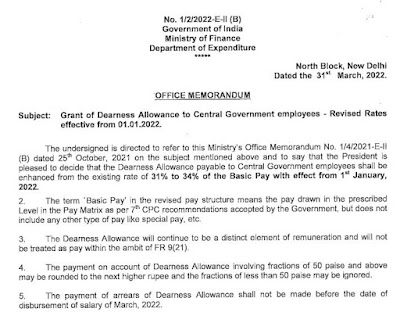
DA Jan 2022 - Grant of Dearness Allowance to Central Government employees - Revised Rates effective from 01.01.2022

 3% DA Hike - Revised Rates effective from 01.01.2022: DoE OM dated 31.03.2022 No. 1/2/2022-E-II (B) Government of India Ministry of Finance...