Wednesday, 18 May 2016

NFIR: Supply of subsidized meal/food to the Running Staff-reg.

NFIR: Supply of subsidized meal/food to the Running Staff-reg.

NFIR
National Federation of Indian Railwaymen

No. IV/RSAC/Conf./Part VI
Dated: 16/05/2016
The Secretary (E),
Railway Board,
New Delhi

Dear Sir,

Sub: Supply of subsidized meal/food to the Running Staff-reg.

Ref: (i) NFIR's PNMM Item No. 9/2015.
(ii) Railway Board's letter no. 2006/M(L) /467 12 dated 12/08/2015 .
(iii) NFIR's letter No. IV/RSAC/Conf/Part V dated 19/08/2015, 25/08/2015, 05/10/2015, 09/11/2015 and No. IV/RSAC/Conf./Part VI dated 22/02/2016.
(iv) Railway Board's letter No. 2006/M(L)/467/2 dated 26/04/2016 addressed to GS/NFIR.

With reference to NFIR's PNM Item No. 9/2015, the Railway Board vide letter dated 12/08/2015, had issued instructions for revision of the amount of subsidy per meal at Rs.4l or 90% of the cost of meal, whichever is less for Running Staff, considering the prices of food items. In the subsequent letter dated 26/04/2016 addressed to the GSAIFIR, the Board has conveyed that the rate of meal was increased from Rs.30 to Rs.46 out of which, 90% of the cost of meal or Rs.41, whichever is less, would be subsidized.

The reports received by the Federation however reveal that the Running Staff are disappointed very much as the supply of subsidized food suffers with number of flaws as listed below:-

  • the option of Veg/Non-Veg food is no longer available, thus the staff are compelled to eat whatever food prepared by the contractor,
  • sub-standard food is supplied by the contractor,
  • The contractors secure contract on the basis of 'lowest bidder' at far below the cost of Rs.46/-. These contractors utterly fail to maintain quality for fear of incurring losses and they manage to make up the losses with the other contracts like 'Safai', House keeping etc., of Running Rooms. There are cases wherein the contracts of "Supply of food to Running Staff have further been entrusted to sub-contractors who are not the genuine caterers.
  • System of bidding needs review so that the reputed firms/hoteliers with back ground of hotel management or owning good hotels in the area can only take part in the bidding process.
  • Regular inspections by the Committee of Divisional Officers (Sr.DME, Sr.DEE, Sr.DOM, Sr.DSO etc) not being done, consequently quality suffers.
  • The practice of preparation of food one time only taking place instead preparing food like dal/curries as and when staff arrive in Running Room.

NFIR, therefore, requests the Railway Board to kindly arrange to review the matter in the in text of growing dissatisfaction among Running Staff for ensuring that quality food items are served by the caterer/contractor.

Yours faithfully,
(Dr. M. Raghavaiah)
General Secretary
Copy to the General Secretaries of Zonal Unions of NFIR.
Media Centre/NFIR.
File No.9/2015 (PNM).

Source: nfirindia.org

7th Pay Commission Latest News – Unilateral decision by Government will not be accepted – Staff Side

Staff Side is ready for resorting to indefinite strike from 11th July 2016, if Govt did not call NJCA for talks before implementing 7th Pay Commission Report

7th Pay Commission Latest News – Unilateral decision by Government will not be accepted – Staff Side JCM writes to Govt for conducting negotiation with Staff Side Associations before taking a decision on 7th Pay Commission recommendations

Though the central government employees are ardently waiting for the implementation of the Seventh Pay Commission, reports suggest that it will not be done before the results for the Assembly elections are announced. If reports are to be believed then the proposal of minimum pay of 24,000 will be taken into consideration and the reasonable expectations of central government employees will be met while announcing the salary hikes in accordance with the 7th pay commission.

According to a Zee news report, “Other than the pressure of trade unions, the results of the Assembly election in five states, West Bengal, Assam, Tamil Nadu, Kerala, Pondicherry, are likely to have an influence on the final pay out.

The notification towards implementation of the seventh pay commission will be announced only after the result of the elections. If the mandate goes totally in favour of the Opposition, the government will be under greater pressure to keep the dissatisfaction related to salalry hike in check.”

‘No unilateral decision on salary hikes under 7th Pay Commission acceptable’ The central government employees lead by the National Council (Staff Side) Joint Consultative Machinery have said that they will not accept unilateral decision on salary hikes under the seventh Pay Commission and would like to have more say in the way their monthly salaries and allowances are shaped up by the Empowered Committee of Secretaries. “Neither did the Government side made any commitment on any demands, nor did they indicate in the minutes that further discussion will be held with the staff side to arrive at a negotiated settlement on each demands.

It seems that the Modi Government is moving ahead to issue unilateral orders taking the staff side for a ride”, M Krishnan, Secretary General of the central government employees confederation was quoted as saying in the Zee report. “The staff side on the other hand has taken a position that if unilateral orders are issued, without taking the staff side into confidence, the NJCA shall go ahead with the indefinite strike from 11th July 2016 as already informed to the government”, Krishnan further added in the report.

An empowered committee of Secretaries was formed under the Cabinet Secretary to process the recommendations of the pay panel.

This committee also invited the Joint Consultative Machinery which is the group representing the Staff side (central employees union) to understand their view point. The central employees union has clearly said that they will not accept any unilateral decision on the issue and needs a bilateral negotiation on the matter.

Source: One India

Finmin constitutes Fiscal Responsibility and Budget Management panel, N K Singh to be chairman

Finmin constitutes Fiscal Responsibility and Budget Management panel, N K Singh to be chairman

The Union Finance Ministry on Tuesday constituted a five member Fiscal Responsibility and Budget Management (FRBM) panel.

The panel would be headed by former Revenue and Expenditure Secretary and Member of Parliament N K Singh. Former Finance Secretary Sumit bose, Chief Economic Advisor Arvind Subramanian, Director of National Institute of Public Finance and Policy Rathin Roy and Deputy Governor of RBI Urijit Patel will be its members.

The panel will examine fiscal deficit range instead of fixed targets and look into feasibility of fiscal expansion or contraction in relation to credit expansion and contraction.

The FRBM Act deals with matters of fiscal discipline, such as spending and deficit, along with management of macro-economic factors and public funds.

The FRBM committee would submit its report to the government by October 31.

The panel, which was announced by Union Finance Minister Arun Jaitley in his Budget speech, will look into factors that influence the country’s fiscal targets.

ANI

Tuesday, 17 May 2016

7th Pay Commission Pay hike – Financial Express ideas

The financial Daily advises Central Government Employees to prudently spend the extra money in their hand in the form of 7th CPC pay and allowances increase.

7th Pay Commission Pay hike – Financial Express ideas for effectively utilising the additional payout in provisioning for Emergency fund creation, financial goals, asset allocation, long term and short term investments etc.

7th Pay Commission: While you wait for the payout, FeMoney advises you to give a hard look at your entire finances and then decide on how you want to go about spending the money.

If you are a central government employee, you must be eagerly awaiting the notification of the 7th Pay Commission, which might come close after the declaration of the state election results on May 19. The payout could be substantial with salary hike and arrears adding up to a Rs 1.02 lakh crore impact on government finances.

The 7th Pay Commission recommendation, which are to come into effect from January 1, 2016, will enlarge the pay package of 47 lakh central government employees and 53 lakh pensioners. The Commission has recommended a 23.55 per cent hike in pay and allowance. While pay will go up by 16 per cent, increase in allowance will be 63 per cent and increase in pension 24 per cent.

The huge payout by the government has already made the Reserve Bank of India worried over the its impact on inflation. In its recent credit policy, the central bank said that it expect inflation to go up by 1-1.5 per cent on account of the increased money in hand of central government employees.

So if you are one of the beneficiaries of the 7th Pay Commission, what should you do with the bonanza that is expected to come soon? As is natural with such one-time windfall coming your way, there would be that temptation of splurge, plan for an expensive holiday or buy that new car that you have been eyeing for some time.

However, while you wait for the payout, FeMoney advises you to give a hard look at your entire finances and then decide on how you want to go about spending the money.

Financial advisor, Sanjeev Govila, CEO, Hum Fauji Initiative, believes one of the priorities should be to create an emergency fund out of the arrears that one gets in lump-sum. In his five-point advise to Central Government employees Govilla says one should keep finanical keep financial goals and proper asset allocation in mind while dealing with the money. “It is absolutely essential that the bulk money which one gets as 7th Pay Commission arrears should go for meeting financial goals. And that is where the asset allocation and risk attitude should flow from,” Govila told FeMoney.

Here are Govila’s 5-point suggestions on dealing with the 7th PayCommission bonanza:
Emergency fund creation: Creation of emergency fund out of the payout is the prime requirement. Even before looking at life’s goals one has to be prepared for unforeseen events. Most of us remain oblivious to this and do not plan for it. This results in costly loans, embarrassing borrowings from friends and relatives or emptying long-term coffers. As a thumb-rule, about six month’s expenses should set aside for an emergency fund. The question is where to keep it? It could ideally be in multiple small bank fixed deposits or liquid mutual funds.

Cater to life’s financial goals: Life’s goals can be divided into critical goals and lifestyle goals. Critical goals are those which have to be met at all costs, like children education and marriage, retirement and medical expenses, while the lifestyle goals, like changing your car, vacations, leisure and passion activities.

Proper asset allocation: Spreading investment across various assets to minimise risks should be considered the final frontier of life’s financial planning. Whatever wealth creation or destruction takes place finally, is generally due to correct or incorrect asset allocation. An asset allocation directly results as a delicate balance between your future money requirements, indicating the type of investment avenues you should invest in, and your risk attitude and risk taking capacity.

Decide between long-term and short term: As a general rule, equity is for long-term and debt for the short term, with real estate and gold figuring somewhere in between. Investment in real estate and gold should depend on the future outlook of both these asset classes as prices of these physical assets are dependent on their seasonal cycles.

Assesment of risk-taking ability: Risk-taking is erroneously tagged to age, even by many financial planners. However, it is both an attitude and the capacity to take risks, the latter being dictated more by your current financial well-being. Hence, it is always better to go in for a risk-profiling rather than guessing the same by ‘indications’ of behaviour.

Source: Financial Express

EPFO disbursed Rs. 47,630 crore as member benefits and Rs. 8,200 crore as monthly pensions in 2015-16

EPFO disbursed Rs. 47,630 crore as member benefits and Rs. 8,200 crore as monthly pensions in 2015-16

In 2015-16, EPFO disbursed approximately Rs. 47,630 crore as member benefits and Rs. 8,200 crore as monthly pensions.

To monitor the status of enrolment of contractual employees especially in municipalities, EPFO has taken steps towards putting in place a system where principal employers including government bodies who enroll workers directly or through contractors can view details of contractors including the amount paid towards PF dues on real time basis. Now, EPFO will be in a position to compare the PF dues reimbursed to contractors and the PF dues actually remitted by contractors. Mismatch in the amounts would indicate possible specific evasion that can be followed up towards seeking compliance. A facility already exists in public domain wherein all principal employers can check the amounts remitted by contactors’ establishments. Any person through this report can also check if her / his name appears in the list of employees submitted by contractor to EPFO on a monthly basis. EPFO is also in the process of digitizing compliance reporting system. It is expected that reporting in Compliance area shall be online and real time by the second quarter of this financial year.

The process of seeding EPS pensioners’ data with Aadhaar is underway in EPFO. While seeding the data, it has been noticed that in certain cases there is data mismatch between EPF data and Aadhaar data in respect of date of birth and name of pensioner. To rectify it, pensioners / members are being advised to correct either their details provided to EPFO offices or to correct the details given in Aadhaar, whichever is correct.
It is also seen that a number of online transfer applications by members are pending with the employers for attestation and verification of member details by the employers Field offices of EPFO have been directed to take up the matter with employers to clear this on priority.

On the occasion of International Labour Day, EPFO launched a special mission consolidation drive “One –Employee-One – EPF Account”. The drive is to consolidate multiple accounts of members so that they are able to access variety of IT enabled services such as e-mail / SMS alerts, access to e-passbook at their leisure. Shri Bandaru Dattatreya, Union Minister of State for Labour & Employment (Independent Charge) while presiding over the function marking International Labour Day stated that this drive would result in EPF members having lifelong one EPF account and multiple conveniences. The Universal Account Number (UAN) that is Aadhaar seeded will consolidate multiple past service accounts, across various spells of employment of an EPF member.

The month of April also saw withdrawal of notification dated 10th February 2016 on amendment in Paragraph 68 NN, 68-O and 69 and insertion of new Para 68 –NNNN in the EPF Scheme, 1952. The interest rate of 8.8% to be credited to members’ accounts for the financial year 2015-16 was also finalized by the Government as recommended by the Central Board of Trustees, EPF.

PIB

References/Representations/Court Cases in various Ministries/Departments/ Organisations for grant of MACPS benefits in the promotional hierarchy

References/Representations/Court Cases in various Ministries/Departments/ Organisations for grant of MACPS benefits in the promotional hierarchy – reg.

No. 22034/04/2013-Estt.(D)
Government of India
Ministry of Personnel Public Grievance & Pensions
Department of Personnel & Training
* **
North Block, New Delhi
Dated: 17.05.2016
Office Memorandum

Subject :- References/Representations/Court Cases in various Ministries/Departments/Organisations for grant of MACPS benefits in the promotional hierarchy – reg.

In continuation of Department of Personnel Training’s earlier O.M. of even no. dated 20.01.2016 and dated 01.03.2016 on the above mentioned subject, the undersigned is directed to forward a copy of the decision dated 28.04.2016 of Hon’ble CAT, Calcutta Bench in OA No. 351/00195/2014 filed by Shri S.H.K. Murti & Others Vs. UOI &Ors whereby the demand of the applicant for MACP in promotional hierarchy has been dismissed, for necessary action and compliance. The Hon’ble Tribunal in the aforesaid decision dated 28.04.2016 has held that the MACP benefit would be given in the hierarchy of next higher Grade Pay and not in Grade Pay of promotional hierarchy which will be payable on actual promotion.

2. All Ministries/Departments are requested to upload it on their websites for wider publicity.
(G.Jayanthi)
Director (E-I)
Phone No. 23092479
All Ministries/Departments of the Government of India.

Circular

7th Pay Commission Latest News – Issues to be addressed

7th Pay Commission Latest News – Issues to be addresse

It is a general view of all Central Government Employees that certain allowances, reimbursement and advances which have been abolished or restricted in 7th CPC report are to be allowed to continue
7th-CPC-Issues

7th Pay Commission Latest News – Employees of Accounts and Audit Department raises certain Common issues in respect of 7th Pay Commission Recommendations which are applicable to all Central Government Employees

7th Pay Commission Latest News – As per representation made by the employees of Accounts and Audit Department certain common issues in respect of allowances, Interest Free Advances and Interest bearing Advances

Issues related to Allowances:

House Rent Allowance:
Recommendation of 7th Pay Commission:

The Commission recommends that HRA be paid at the rate of 24 percent, 16 percent and 8 percent of the new Basic Pay for Class X, Y and Z cities respectively. The Commission also recommends that the rate of HRA will be revised to 27 percent, 18 percent and 9 percent respectively when DA crosses 50 percent, and further revised to 30 percent, 20 percent and 10 percent when DA crosses 100 percent”

What is to be changed / taken care of in this issue on implementation of 7th Pay Commission Report ?

In para 8.7.14, the Commission took note of the link between increase in HRA and increase in house rent after implementation of recommendations of 6th CPC. There was a sharp rise in the index from the first half of 2009, immediately following 6th CPC recommendations. There is likely to a similar rise in House Rent after implementation of recommendations of 7th CPC. Hence the existing percentage of House Rent may be retained at the rate of 30 percent, 20 percent and 10 percent of the new Basic Pay for Class X, Y and Z cities respectively.

Composite Transfer and Packing Grant (CTG)

Recommendation of 7th Pay Commission:
The Commission recommended that CTG should be paid at the rate of 80 percent of last month basic’s pay. However, for transfer to and from the island territories of Andaman, Nicobar and Lakshadweep, CTG may continue to be paid at the rate of 100 percent of last month’s Basic Pay.

What is to be changed / taken care of in this issue on implementation of 7th Pay Commission Report ?
As the labour charges and cost of packing materials are continuously rising, the CTG may continue to be paid at the rate of 100 percent of last month’s Basic Pay.

Reimbursement of staying accommodation charges:
Recommendation of 7th Pay Commission:
The commission made flowing recommendations:

Level Level Ceiling for
Reimbursement (Rs.)
14 and above 7500
12 and 13 4500
9 to 11 2250
6 to 8 750
5 and below 450

For levels 8 and below, the amount of claim (up to the ceiling) may be paid without production of vouchers against self-certified claim only. The self- certified claim should clearly indicate the period of stay, name of dwelling, etc. The ceiling for reimbursement will further rise by 25 percent whenever DA increases by 50 percent. Additionally, it is also provided that for stay in Class‘X’ cities, the ceiling for all employees up to Level 8 would be Rs.1,000 per day, but it will only be in the form of reimbursement upon production of relevant vouchers.

What is to be changed / taken care of in this issue on implementation of 7th Pay Commission Report ?
The main objective of the Audit Department is to carry out Audit function which entails long periods of stay out of headquarters. Consequently, officials at pay level 5 to 11 have to visit small towns (at Block/Sub-division level). For such places, as per recommendations of the 7th CPC, officials of pay level 8 and below will be entitled to the claim without production of vouchers (ie. against self-certified claim only), where as officials of the pay level 9 and above will have to produce vouchers for the similar claim.

To eradicate such anomalous situation, it is submitted that claims, as admissible upto pay level 8, may be paid without production of vouchers against self-certified claim to all pay level officials.

Reimbursement of travelling charges:
Recommendation of 7th Pay Commission:
The commission made following recommendations:

Level Level Ceiling for
Reimbursement (Rs.)
14 and above AC Taxi charges up to 50 km
12 and 13  Non-AC Taxi charges up to 50 km
9 to 11 Rs. 338 per day
6 to 8 Rs. 225 per day
5 and below Rs. 113 per day
Similar to Reimbursement of staying accommodation charges, for levels 8 and below, the claim (up to the ceiling) should be paid without production of vouchers against self certified claim only.

What is to be changed / taken care of in this issue on implementation of 7th Pay Commission Report ?
In the same analogy, as mentioned against reimbursement of staying accommodation charges above, it is submitted that claims, as admissible upto pay level 8, may be paid without production of vouchers against self-certified claim to all pay level officials.

Family Planning Allowance:-
Recommendation of 7th Pay Commission:
The Pay Commission has recommended to abolish the Family Planning Allowances

What is to be changed / taken care of in this issue on implementation of 7th Pay Commission Report ?
This is an incentive for promoting small family norms and therefore, it needs to be continued.

Interest free advances:
Medical Advance:
Recommendation of 7th Pay Commission:
The pay Commission has recommended abolition of Medical Advance.

What is to be changed / taken care of in this issue on implementation of 7th Pay Commission Report ?
As per the existing practice, medical advance is paid to an employee to the extent of 90% of the estimated cost of treatment in case of treatment of self and dependents. Cost of treatment for illness particularly of critical/life threatening ailments, such as heart transplant/ cancer/ kidney transplant etc., even under CGHS rules, is extremely expensive. It is also pertinent to note that many hospitals even in emergent situations insist on advance payment before commencing treatment/surgery. It is very difficult for a low paid employee such as MTS/LDC/UDC etc or even for group ‘B’ and ‘A’ officers to make available large amounts required for medical treatment. Without medical advance, an official will have great difficulty in getting proper/appropriate medication.
Therefore, it is submitted that medical advance may be continued with as per existing practice.

TA Advance:
Recommendation of 7th Pay Commission:
The pay Commission has recommended abolition of TA Advance.

What is to be changed / taken care of in this issue on implementation of 7th Pay Commission Report ?
The main function of IA &AD is auditing of Central/State Government/ PSUs etc. These auditee units are spread across the states down to the block/Panchayat level. In order to discharge audit responsibility, touring is a continuous requirement. It is not an occasional tour for short period, expenditure of which can be met out by the individual and reimbursement claimed subsequently. The officials have to be on tour continuously for upto a quarter (i.e 03 months) or even more.

For an official at pay level 6(Senior Auditor), as per the recommendations of the 7th CPC, the tour allowance for a day works out to Rs. 1770/- (Rs. 750 for accommodation+225 for travelling +Rs. 800 for food bills) and for a month it would be Rs. 53250/-. Besides, he has to incur expenditure for to and fro (i.e Hqrs. to field office and back) train/ bus fare. Monthly salary of a pay level 6 employee, as per recommendations of 7th CPC is Rs. 35400/-. As is clearly brought out, the likely monthly expenditure on tour will be significantly more than the employees’ monthly salary.

Therefore, advance is necessary to defray tour expenditure for performing official duties. This will create huge administrative issues in the department and adversely impact the Audit functions.
In view of the above, TA Advance, requires to be continued and paid as per extant provisions.

LTC Advance:
Recommendation of 7th Pay Commission:

The pay Commission has recommended abolition of LTC Advance.

What is to be changed / taken care of in this issue on implementation of 7th Pay Commission Report ?

Under LTC facility the expenses incurred on travel to visit the destination is reimbursable. Advance upto 90% of expenses on travel to visit the destination place is admissible. This amount serves as great help to the employees to undertake the journey in arranging train/air tickets. Without this advance, the employees will find it difficult to purchase train/air tickets for his family Besides travelling expenses, an official has to incur expenditure on account of Boarding and lodging/local travel also.

As per the recommendation of 7th CPC, officials of pay level 05 to 08 are entitled to travel by train. The travel tickets for family of four will cost more than Rs. 18000/- for a journey from Delhi to Thiruvananthapuram. Further, for level 9 and above the return tickets in economy class for the same destination i.e. Delhi to Thiruvananthapuram will cost more than Rs. 2 lakh.

A government official cannot afford such a huge amount to spent upfront for performing journey for availing home town LTC or All India LTC. Hence LTC advance is required to be continued as per extant provisions.

Bicycle Advance, Warm Clothing Advance:
Recommendation of 7th Pay Commission:
The pay Commission has recommended abolition of these Advances.

What is to be changed / taken care of in this issue on implementation of 7th Pay Commission Report ?

These advances may continued to be paid as per existing rules as these are admissible only to low paid employees upto Grade pay of Rs. 2800 /- (Level 5)
Festival advance, advance in the event of natural calamities like Flood, Drought, Cyclone etc.

Recommendation of 7th Pay Commission:
The pay Commission has recommended abolition of these Advances.

What is to be changed / taken care of in this issue on implementation of 7th Pay Commission Report ?
These advances may continue to be paid as per existing rules as these interest free advances are payable to Group ‘B & C’ employees as a welfare measure.
Advance of TA to a family of a deceased Govt. employee

Recommendation of 7th Pay Commission:
The pay Commission has recommended abolition of this Advance.

What is to be changed / taken care of in this issue on implementation of 7th Pay Commission Report ?
This advance may continue to be paid as per existing rules as this helps the family of a deceased Govt. employee to cope with immediate expenses for travel to their place of settlement.

Interest Bearing Advances:-
Motor Car/Motor Cycle Advance.
Recommendation of 7th Pay Commission:
The pay Commission has recommended abolition of this Advance.

What is to be changed / taken care of in this issue on implementation of 7th Pay Commission Report ?
The Pay Commission has abolished the Motor Car/Motor Cycle Advance on the plea that there are several schemes available in market. There are several schemes in the markets for House Building Advance also. However, the Pay Commission has not only recommended to continue with HBA but also proposed to increase the ceiling. Therefore, the plea of the commission to discontinue MCA on the basis that schemes for purchase of vehicles are available in the market does not hold good.

Further, several documentation/guarantees are required for seeking the said advances from the market. As it is convenient and safe for a Government Servant to avail such advances from the office without any hassles, these interest bearing advances may be continued as per the extant provisions.

Fixed Medical Allowance (FMA) to Central Government Pensioners
Recommendation of 7th Pay Commission:
The Commission has maintained status quo of the Fixed Medical Allowance which is presently paid @ Rs. 500/- per month.

What is to be changed / taken care of in this issue on implementation of 7th Pay Commission Report ?
The costs have increased for medicines, consultations fees and Pathological Tests required for day to day medical treatment. This has risen at a much steeper rate than that of the General Price Index. A large number of pensioners are residing in remote areas or villages having no access to CGHS dispensaries and as such are wholly dependent on the paltry amount of Fixed Medical Allowance for day to day treatment.. Therefore it needs to be revised to at least Rs. 2000/- per month.

Modified Assured Career Progression Scheme (MACPS) :
Recommendation of 7th Pay Commission:
Assured Career Progression was introduced in 1999 with a view to grant at least two financial up gradations at an interval of 12 and 24 years where officials are stagnating for want of promotion. It was further modified to 03 financial up gradations on the recommendations of the 6th CPC. However, the 7th CPC recommended continuing with the same without any change. Also the bench mark has been increased from ‘Good’ to ‘ Very Good’

What is to be changed / taken care of in this issue on implementation of 7th Pay Commission Report ?
There should be at least four financial upgradations in entire service career of an employee at regular interval of 8 years. Hence, the MACPS may be granted to an employee after completion of 8, 16, 24 and 32 years of service.

Further, the bench mark for financial up gradation may be continued as per the existing practice – i.e. the bench mark prescribed for the post for promotion.

Transport Allowance (TPTA)
Recommendation of 7th Pay Commission:

The 7th CPC has just revised the Transport Allowance by merging 125% of DA with the existing rate of transport allowance. The revised rates are as mentioned below:

Pay level Proposed  (Higher TPTA Cities) Proposed  (Other TPTA Cities)
9 and above 7200+DA 3600 +DA
3 to 8  3600+DA 1800 + DA
1 and 2 1350+DA 900 + DA
What is to be changed / taken care of in this issue on implementation of 7th Pay Commission Report ?
The following is proposed for the revised Transport Allowance (TPTA)
Pay level Proposed  (Higher TPTA Cities) Proposed  (Other TPTA Cities)
9 and above 10000 + DA 5000 + DA
3 to 8  5000 + DA 2500 + DA
1 and 2 2500 + DA 1250 + DA

Child Care Leave (CCL):
Recommendation of 7th Pay Commission:
The 7th CPC has proposed that CCL should be granted at 100 percent of the salary for first 365 days, but at 80 percent of the salary for the next 365 days. However, CCL has been extended to single parent also.
What is to be changed / taken care of in this issue on implementation of 7th Pay Commission Report ?
It is proposed that the CCL be paid at 100 percent of salary for the entire period.

Children Education Allowance (CEA):
Recommendation of 7th Pay Commission:
The Commission has recommended CEA @ Rs. 2250/- per month and Hostel Subsidy @ Rs. 6750/- per month.
What is to be changed / taken care of in this issue on implementation of 7th Pay Commission Report ?
Keeping in view the steep rise in tuition fees, cost of stationery, Books, Uniform etc. the CEA and Hostel Subsidy may be increased @ Rs. 3000/- and @ Rs. 8000/- per month respectively.

Special Casual Leave (SCL):
Recommendation of 7th Pay Commission:

SCL is granted to employees to cover their absence from duty for various occasions like sports events, cultural activities, participation in Republic Day Parade, voluntary blood donation, Trade Union meetings, etc. Full pay is granted during SCL and it can be sanctioned with retrospective effect also.
The Pay Commission has expressed its concern at the widespread use of SCL as a means of getting away from duty. However, because of the extensive scope and case specific nature of this leave, no concrete recommendations have been made.
It has suggested that the government may, however, consider the following: (a) Review the purposes for which SCL is presently granted.

(b) Limit the number of purposes for which an employee can be granted SCL in a year.

(c) Limit the total number of days that an employee can be granted SCL in a year.
What is to be changed / taken care of in this issue on implementation of 7th Pay Commission Report ?
Since SCL is granted to employees to cover their absence from duty for various occasions like sports events, cultural activities, participation in Republic Day Parade, voluntary blood donation, Trade Union meetings/ casting votes in their constituency, it may be continued to be granted as per existing practice.

Source: Indian Accounts and Audit Department

Monday, 16 May 2016

7th Pay Commission arrears to be paid in August

7th Pay Commission arrears to be paid in August

New Delhi: The central government is going to start payment of salaries to its 48 lakh officials and employees according to 7th Pay Commission award from July and six months’ arrears are to be paid in August.

As per official calculation, no huge amount will be required for the payment of arrears.

The government in its annual budget has provisioned Rs 70,000 crore to meet the demand for implementation of 7th Pay Commission for central government employees which will take effect from January 1, 2016, while the allowances would be paid from July 1, 2016.

Basic salary of central government employees is likely to be tripled under the 7th Pay Commission award with employees in the lower rung getting the highest percentage of raise.

In the highest grade, basic salary is likely to rise around to Rs 2,70,000 to Rs 2,50,000 and in the lowest grade to Rs 21,000.

In June end, the cabinet is likely to approve the new pay scales for central government employees after considering report of the 7th Pay Commission, led by Justice A K Mathur, and the report of the 13 member Empowered Committee of Secretaries headed Cabinet Secretary P K Sinha to process the recommendations of the 7th Pay Commission, which was set up in January.

The officials familiar with the developments told The Sen Times that the Finance Minister Arun Jaitley has not been under pressure to meet the demand as he has surplus money in the national exchequer.

“We have provisioned for around 60-70 per cent of the total burden that was talked about,” the officials said adding about Rs 70,000 crore has been provided in the Budget.

The government will issue a circular in respect of online pay-fixation, which will reduce hassles as doing the same manually is both time-consuming and harassing. Pay fixation is a mandatory procedure for getting new pay and perks, the officials told us.

“We’re at the for issuing the notification and one more month will be required to issue after cabinet nod, so we hopefully say that central government employees will get new pay and arrears in July and August respectively,” a source close to the developments told The Sen Times.

TST

Increase in Bonus Eligibility and ceiling – Advisory Note by Defence

Increase in Bonus Eligibility and ceiling – Advisory Note by Defence

Increase in Bonus Eligibility and ceiling – Advisory Note by  DGR advisory of Defence on Payment of Bonus to all Guards & Other Staff employed by DGR

Defence circular on increase of bonus to guards based on the Payment of Bonus (Amendment) Bill, 2015

ADVISORY ON BONUS

The Payment of Bonus (Amendment) Bill, 2015 notified : Increase in the Eligibility Limit under clause (13) of Section 2 and Calculation Ceiling under Section 12 of the Payment of Bonus Act 2015

1. The Payment of Bonus (Amendment) Bill, 2015 was passed by the Parliament in the just concluded Winter Session of the Parliament. The Payment of Bonus (Amendment) Act, 2015 has been published in the Gazette of India, Extraordinary on 1st January, 2016 as Act No.6 of 2016. The provisions of the Payment of Bonus (Amendment) Act, 2015 shall be deemed to have come into force on the 1st day of April, 2014.

2. The Payment of Bonus (Amendment) Act, 2015 envisages enhancement of eligibility limit under section 2(13) from Rs.10,000/- per month of Rs. 21,000/- per month and Calculation Ceiling under section 12 from Rs.3500 to Rs.7,000 or the minimum wage for the scheduled employment, as fixed by the appropriate Government, whichever is higher. The Payment of Bonus (Amendment) Act, 2015 also mandates previous publication of draft subordinate legislations, framed under the enabling provisions under the said Act, in the Official Gazette for inviting objections and suggestions before their final notification.

3. The Government has been receiving representations from trade unions for removal of all ceilings under the Payment of Bonus Act, 1965. It is also one of the demands made by them during the country-wide General Strike held in February, 2013 and September, 2015. As the last revision in these two ceilings were made in the year 2007 and was made effective from the 1st April, 2006, it was decided the Government to make appropriate amendments to the Payment of Bonus Act, 1965.

4. These changes in the Payment of Bonus Act, 1965 will be benefit thousands of work force.

(Gangesh Kumar)
Commodore
Principal Director (Employment)
Dte Gen Resettlement
Ministry of Defence
New Delhi – 110066

File : 2112/SA/Bonus/Emp
Date : 24 Feb 16,
Place : New Delhi

Download Defence circular dated 24.02.2016

7th Pay Commission Latest News

7th Pay Commission Latest News – PMO keen on 7th CPC Salary to be based on Inflationary Trend – Reasonable expectations of central government employees will be met.

The Central government has hardly been insensitive to the reasonable expectations of central government employees while announcing salary hikes in pay commissions. The same appears in the case of the 7th Pay Commission as well.

The Prime Minister’s Office is keenly awaiting the final touch up to the 7th Pay panel’s recommendations, and is keen that inflationary trends be kept in perspective while finalising the salary structure of the government employees.

The trade unions, while protesting the 7th Pay Panel’s recommendations, said that the proposed 7th Pay Commission hike was the lowest in many decades and not in sync with inflation.

Other than the pressure of trade unions, the results of the Assembly election in five states, West Bengal, Assam, Tamil Nadu, Kerala, Pondicherry, are likely to have an influence on the final pay out.

The notification towards implementation of the seventh pay commission will be announced only after the result of the elections. If the mandate goes totally in favour of the Opposition, the government will be under greater pressure to keep the dissatisfaction related to salalry hike in check.

Even other wise, the government would like to nip the popular opinion building up that the current government is apathetic to the needs of common man.

The two earlier policy decisions on the proposed EPF changes and their subsequent rollback showed government in a bad light.

Source: Zee News

Flash News

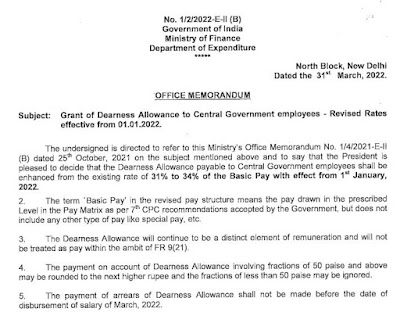
DA Jan 2022 - Grant of Dearness Allowance to Central Government employees - Revised Rates effective from 01.01.2022

 3% DA Hike - Revised Rates effective from 01.01.2022: DoE OM dated 31.03.2022 No. 1/2/2022-E-II (B) Government of India Ministry of Finance...