Friday, 4 March 2016

Handing over of the Railway Catering System to IRCTC

Handing over of the Railway Catering System to IRCTC

As announced in the Rail Budget Speech 2016-17, Indian Railway Catering and Tourism Corporation (IRCTC) would begin to manage catering service in a phased manner.

The objectives of transferring the catering services from Railways to IRCTC were not fulfilled, as IRCTC could not professionalize the catering services. Therefore, the management of catering services were taken back by Railways from IRCTC as per the provisions of Catering Policy, 2010 .

In 2015, Sreedhran Committee, set up by the Ministry of Railways recommended transfer of catering services back to IRCTC since IRCTC was setup as an extended arm of the Indian Railways to professionalize catering services on Indian Railways. It has been decided to give back the catering services to IRCTC in a phased manner with unbundling catering services by creating a distinction primarily between food preparation and food distribution. In order to address the problems faced earlier, it has been decided that there will be no complete handing over of catering service by IRCTC to private licensees and Zonal Railways will have powers of supervision and monitoring.

This information was given by the Minister of State for Railways Shri Manoj Sinha in a written reply to a question in Rajya Sabha on 04.03.2016 (Friday).

PIB

JS LEVEL VACANCY UP TO April, 2016

JS LEVEL VACANCY UP TO April, 2016
<<< DISCLAIMER >>>
Anything contained in this document would not lead to any legal claim on part of any individual for any purpose.

Subject: JS LEVEL VACANCY UP TO April, 2016
S.NO NAME OF THE POST
1. DG (Information), Election Commission of India
2. Joint Secretary, M/o Minority Affairs
3. Additional Director General, M/o Tourism
4. DG, Election Commission of India
5. Joint Secretary, D/o Electronics & Information Technology
6. Dy. Election Commissioner, Election Commission of India
7. Joint Secretary, M/o Home Affairs
8. DDG, Chandigarh, UIDAI, D/o Electronics & Information Technology
9. Joint Secretary, D/o Defence
10. DDG, Mumbai, UIDAI, D/o Electronics & Information Technology
11. DEC, Election Commission of India
12. Joint Secretary, D/o Commerce
13. ADGFT, Mumbai, DGFT, D/o Commerce
14. Joint Secretary, D/o Defence
15. DDG, HQ, Delhi, UIDAI, D/o Electronics & Information Technology
16. Joint Director, LBSNAA, D/o Personnel & Training
17. DDG, UIDAI, D/o Electronics & Information Technology
18. Joint Secretary, M/o Environment, Forest & Climate Change
19. Joint Secretary, D/o Animal Husbandry, Dairying & Fisheries
20. Joint Secretary, M/o Information & Broadcasting
21. Joint Secretary, Cabinet Secretariat
22. Joint Secretary, M/o Panchayati Raj

<<< DISCLAIMER >>>
Anything contained in this document would not lead to any legal claim on part of any individual for any purpose.

Source: persmin.nic.in

Indian Railways Dedicates two More New Trains in the Service of the Nation

Indian Railways Dedicates two More New Trains in the Service of the Nation

Indian Railways will work to the maximum extent possible to provide better rail transportation to the people of India : Suresh Prabhu

The Indian Railways has been working effortlessly to connect every part of the country with rail network. In this direction, the Minister of Railways, Shri Suresh Prabhakar Prabhu, today i.e. on 04.03.2016 flagged off two new trains in the service of the nation through video-conferencing. The first one is a new Express train viz. 15623/15624 Kamakhya-Bhagat Ki Kothi (Jodhpur) Express(Weekly) and the second one is a new Passenger service viz. 75713/75714 Siliguri-New Coochbehar DEMU (6 days a week) on the newly constructed New Coochbehar-Changrabandha section. Minister of State for Railways Shri Manoj Sinha was especially present on the occasion. At New Delhi end, Chairman, Railway Board along with Board Members and senior officers were present. Various Public Representatives and Senior Officials were also present at New Coochbehar Station and Kamkhya Station.

Speaking on the occasion, Minister of Railways Shri Suresh Prabhakar Prabhu said that this was a long-standing demand of the people of North-Eastern region to provide train services in these areas. He said that the connectivity through DEMU train between New Coochbehar & Changrabandha in West Bengal will benefit all sections of the society including daily-passengers and businessmen. He said that the other train service i.e. the Kamakhya-Bhagat Ki Kothi Express will not only connect North India from North East India but will also help lakhs & lakhs of pilgrims who come to visit Maa Kamakhya Temple to pay their tribute. He said that this train will reach Bhagat Ki Kothi Station by passing 7 States of India. He said that this is a historic day and Indian Railways will work to the maximum extent possible to provide better rail transportation to the people of India.

BACKGROUNDER : -

The schedule including timings, composition, stoppages etc. of these train services are as under:
Introduction:

1. 15623/15624 Kamakhya-Bhagat Ki Kothi Express (Weekly)

15623 Bhagat Ki Kothi- Kamakhya Express ↓Station↑ 15624 Kamakhya-Bhagat Ki Kothi Express
Arrival Departure
Arrival Departure
- 15.25 BGKT 22.00 -
04.30 05.00 DLI 10.20 10.40
03.30 03.40 PNBE 13.20 13.30
22.55 - KYQ - 17.15
  • Days of run: Ex-BGKT- Tuesday & Ex-KYQ- Friday

  • Stoppages: Merta Road jn., Degana, Khatu, Chhoti Khatu, Didwana, Ladnun, Sujangarh, Churu, Sadulpur, Luharu, Mahendragarh, Rewari, Gurgaon, Delhi Cantt, Delhi Jn., Ghaziabad, Moradabad, Bareilly, Lucknow, Ayodhaya, Shahganj, Faizabad, Varanasi,  Mughalsarai, Buxar, Ara, Patna, Barauni, Khagaria, Naugachia, Katihar, Sonaili, Kishanganj, New Jalpaiguri, New Coochbehar, New Alipurduar, Kokrajhar, New Bongaigaon Jn., Barpeta Road, Rangiya.

  • Composition: LWLRRM-2, LWACCN-3, LWACCW-2, LWSCN-6, LS-6=19 coaches

  • Primary Maintenance: Kamakhya

  • Nature of Service: Express

  1. 75713/75714 Siliguri-New Coochbehar DEMU (6 days a week)
75713 Siliguri-New Coochbehar DEMU (6 days a week) ↓Station↑ 75714 New Coochbehar- Siliguri DEMU (6 days a week)
Arrival Departure
Arrival Departure
- 15.25 BGKT 22.00 -
04.30 05.00 DLI 10.20 10.40
03.30 03.40 PNBE 13.20 13.30
22.55 - KYQ - 17.15

Ø Days of run: Ex-SGUJ- 6 days a week & Ex-NCB- 6 days a week (Except Sunday)
Ø Stoppages: New Mal Jn., at all stations/halts in between New Mal Jn. and New Coochbehar
Ø Composition: DPC-2, TC-4, DTC-2 = 08 coaches
Ø Primary Maintenance: Siliguri
Ø Nature of Service: Passenger service (DEMU)

PIB

7th Pay Commission: Government to implement salary hike in FY 2016-17

7th Pay Commission: Government to implement salary hike in FY 2016-17

The Budget documents state that the implementation of the Seventh Pay Commission due from January 1, 2016 is to be implemented during the financial year 2016-17.

“The government has made provisions for the additional liabilities on these count,” it said, without giving the amount allocated for implementation.

With absence of an explicit overall provision for the 7th Pay Commission in budget raising questions, government on Wednesday said the once-in-a-decade pay hike has been built in as interim allocation for different ministries and budget numbers were credible.

Economic affairs secretary Shaktikanta Das said the number cannot be quantified and it has been built up in budget of various ministries. “We cannot really quantify how much we require in 2016-17. Because the Committee of Secretaries have to first give its recommendations, then govt will take a decision and then only we will know what is the requirement in FY17,” he said in New Delhi.

Implementation of the pay commission report is to cost the government Rs.1.02 trillion. “We have the Pay Commission recommendations with us, we have analysed the likely requirement and it has been built into the Budget of various ministries. Some suitable interim provisions have been made,” he said without elaborating.
“Hence the expenditure and revenue numbers are credible.” Das said finance minister Arun Jaitley in his budget speech stated that interim provisions have been made. “And these provisions are there in the Demands for Grants for individual departments and ministries. It is built into and subsumed into those allocations.”
“The Budget reaffirmed the commitment of the government to continue with the process of fiscal consolidation as projected in the Medium Term Fiscal Policy Statement of 2015-16 despite a tough external environment,” the budget documents said. Accordingly, fiscal deficit has been projected at 3.5% of the GDP in 2016-17.

“In accordance with the amended FRBM targets, the fiscal deficit of 3 per cent is projected to be achieved in 2017-18 onwards.” “Keeping in view the challenge of reduction of fiscal deficit by 0.4 per cent of GDP in a difficult year in 2016-17 with substantial additional liabilities on pay revision etc, the government is quite optimistic of fully achieving the fiscal deficit target of 3 per cent or below by March 2018,” the documents said.

With PTI Inputs

How to calculate your revised pay with 7th CPC Pay Calculators?

How to calculate your revised pay with 7th CPC Pay Calculators?

7thCPC-Pay-Calculator-7CPC

“Our 7th CPC Pay and Allowances Calculator is a simple tool for finding new basic pay and allowances of Central Government employees as per the recommendations 7th CPC as on 1.1.2016.”

Three months have passed since the 7th Pay Commission submitted its recommendations to the government, but still little bit confusion persists in using of our calculator. So, we have to explain how the calculator is working and how to calculate with this tool.

First option is the calculator needs your current basic pay as on 1.1.2016. Basic pay means Pay in the pay band + Grade pay. Suppose your Grade pay is 4200 and your pay in the pay band is 10500 means, you have to enter 14700 as basic pay in the first option.

This figure helps you to find out your new and revised basic pay as per the recommendations of 7th CPC.
2nd option is the tool is asking your Grade Pay. To find out your level of the 7th CPC. See the table given below…

Pay Band Grade Pay Level
 5200 – 20200 1800 1
1900 2
2000 3
2400 4
2800 5
 9300 – 34800 4200 6
4600 7
4800 8
5400 9
 15600 – 39100 5400 10
6600 11
7600 12
 37400 – 67000 8700 13
8900 13A
10000 14

Third one is House Rent Allowance, select in the drop down menu which is your current percentage of HRA. To find out new rate of HRA as given in the table

Class of
Cities
Rates of HRA
(% of Basic
Pay)
Revised Rate of
HRA
(% of Basic
Pay)
X 30% 24%
Y 20% 16%
Z 10% 8%

Last one is Transport Allowance. The calculator is now modified so as not to ask your current rate of TA. Since the entitlement for particular rate of TA in sixth CPC is not correlated to 7th CPC entitlement for TPTA. So there is no need for taking sixth CPC Transport Allowance rates for calculating TPTA as per 7th CPC recommendations. Select your city whether it is TPTA or Other places. TPTA Cities are given below the calculator table. Because, eligibility of TA in 7th CPC  is as per Level only. The table given below will help you understand this better.

Grade Pay Pay Level Higher TPTA Cities  Other Places
5400 above 9 & above 7200 + DA 3600 + DA
2000 to 4800 3 to 8 3600 + DA 1800 + DA
1800 & 1900 1 and 2 1350 + DA 900 + DA

The commission has recommended to remove the ambiguous clause of sixth CPC in respect of eligibility criteria for TA rates that “Grade pay below Rs.4200 but pay in the pay band equivalent or above Rs.7440 ”, and has recommended a hike in travel allowance for all cg employees those who are within the Pay Scale of GP 2000 to 2800 category.

So, this is the correct way of calculating your revised pay as per the recommendations of 7th CPC .

Click to view our calculator : 7th Pay Commission Pay Scale Calculator 

Thursday, 3 March 2016

Filling up the post of Financial Adviser and Chief Accounts Officer in EPFO

Filling up the post of Financial Adviser and Chief Accounts Officer in EPFO – reg.


EPFO-Employees-Provident-Fund-Organization


MINISTRY OF LABOUR & EMPLOYMENT
SHRAM SHAKTI BHAVAN
NEW DELHI – 110001
D.O. No. A-12026/05/2015-SS.1
February 17, 2016
Dear Secretary,

Employees Provident Fund Organization is an autonomous body under the Ministry of Labour & Employment. The financial/ accounts matter in the EPFO are looked after by FA & CAO which is in PB-4, GP: Rs. 10,000/-. The post of FA & CAO has fallen vacant on 29.12.2015 due to repatriation of its incumbent and is required to be filled on deputation/ short term contract basis. This Ministry has already issued a vacancy circular (copy enclosed) for the said post and the same has also been published in Employment News dated 6-12 February, 2016. The said vacancy circular is also available on the official website of this Ministry.

2. I shall be grateful, if you could kindly arrange to circulate the same amongst all eligible officers of organized Group ‘A’ service under your Ministry/Department and forward applications of interested & eligible officers to this Ministry before last date to receive such application .i.e. 21.03.2016.
With regards,
Yours sincerely,
(Shankar Aggarwal)
Encl: As above.
Shri Sanjay Kothari
Secretary,
Department of Personnel & Training,
Ministry of Personnel, Pub. Grievances & Pensions,
North Block,
New Delhi.
**********

F.No. A-12026/05/2015 – SS.I
Government of India/Bharat Sarkar
Ministry of Labour & Employment/Shram Aur Rozgar Mantralaya

New Delhi, dated the 13 January 2016

VACANCY CIRCULAR

Subject: Application for the post of Financial Adviser & Chief Accounts Officer (PB-4- Rs-37400-67000 Plus grade Pay Rs.10,000) on deputation/short term contract basis in Employees’ Provident Fund Organization — reg.

Applications are invited for filling up of one post of Financial Adviser & Chief Accounts Officer(PB-4- Rs-37400-67000 plus grade Pay Rs.10,000) to be filled on deputation/short term contract basis in Employees’ Provident Fund Organization under the administrative control of Ministry of Labour & Employment, New Delhi.

2. Following officers are eligible to apply for the post:-

Officers of the Central Government (including Officers of the Organized Accounts Services)/Officers of the Employees’ Provident Fund Organization failing which Officers of statutory or autonomous Organization who are :-

(a)(i) holding analogous post on regular basis; or
(ii) with 6 years’ regular service in the pay band of Rs.37,400-67,000 or equivalent in the grade pay of Rs.8700/-. and

(b) possessing minimum 5 years experience in budget, establishment and accounts

1. Period of deputationlcontract including period of deputation in another ex-cadre post held immediately preceding this appointment in the same or some other organization/department of the Central Government shall not exceed 5 years.

2, The maximum age limit for appointment by deputation shall be not exceeding :56 yearas off the closing date of receipt of application.

3. The Pay and allowance of the selected officer shall be regulated as per Deptt of Pers. & Trang OM No- 6/8/2009-Estt(Pay-II) dated 17.6.2010, as amended from time to time. Officers who volunteer for the post will not be permitted to withdraw their names subsequently.

4. It is requested that applications (in triplicate), in the prescribed profonna (Annexure) in respect of eligible and interested officers may be forwarded to Shri Manish Kumar Gupta, Joint Secretary, M/o Labour & Employment, Room No-106, Shram Shakti Bhawan, Rafi Marg, New Delhi through concerned Cadre Controlling Authorities along with following documents so as to reach within 45 days from the date of publication of this vacancy circular:-

a) Attested copies of the ACRs/APARs for last 5 years i.e. 2011-12 to 2015-16
b) Vigilance clearance
c) No penalty certificate
d) Integrity Certificate

5. Application received after prescribed date or without requisite documents will not be considered. Details of the Organization can be accessed at www.epfindia.com.
(Ajay Malik)
Under Secy to the Govt of India
Encl As above.
Original Circular

Highlights of Railway Budget 2016-17 in Questions and Answers Format (Q & A Format)

Highlights of Railway Budget 2016-17 in Questions and Answers Format (Q & A Format)

Highlights-Railway-Budget-2016-17-QA

 Ministry of Railways
Press Information Bureau,
Government of India
03-March 2016

For the Convenience, the Highlights of Railway Budget, 2016-17 have been complied in questions and answers format which is given below : – Rail Budget 2016-17

Q. What is the theme of this Budget?
  • To Reorganise, Restructure and Rejuvenate Indian Railways.
      A new approach, a new way of working – “चलो, मिलकर कुछ नया करें”.
  • Objectives:
    Ø to improve customer service,
    Ø regain the lost modal share, and
    Ø to introduce a new way of working by relooking the processes and structures.
  • 3 pillars of the strategy :
    Ø Nav Arjan or New revenues (focus on new sources of revenue),
    Ø Nav Manak or New norms (optimising outgo on each activity), and
    Ø Nav Sanrachna or New Structures (revisiting all processes, rules, and structures).
Q Is this budget reform oriented?
  • Yes, the Budget 2016-17 focusses on consolidation of the vision set out in the Budget 2015-16.
  • Draft Bill on regulator to be finalized
  • Restructuring Railway Board on business lines
  • Forming cross-sectoral directorates
  • Setting up Railway Planning and Investment Organisation
  • Setting up a holding company for Railway PSUs
  • Creating a separate organization Special Railway Establishment for Strategic Technology & Holistic Advancement (SRESTHA) for R&D
  • Creating an organization Special Unit for Transportation Research and Analytics (SUTRA) for data analytics
  • Setting up duly empowered missions to take forward 7 activities with time bound targets – missions are for switching over to 25 tonne axle load, increasing speeds, accounting reforms, commissioning 100 sidings/PFTs in 2016-17, preparing a blueprint of utilizing the network once DFC is commissioned, zero accident for safety and for procurement and consumption efficiency.
Q How is capacity augmentation planned?
  • Plan Budget is pegged at Rs. 1.21 lakh crore, 21% higher than the expected Plan expenditure in 2015-16.
  • 2015-16 will surpass target of commissioning 2,500 km Broad Gauge lines.
  • 2016-17 commissioning of 2,800 kms of Broad Gauge track.
  • 90 new projects involving a total investment of Rs. 1,26,172 crore covering about 8,432 kms covering new line, doubling, gauge conversion and Metropolitan Transport Project (MTP) included in the Budget.
  • In 2016-17, Broad Gauge lines at the rate of over 7 km per day against an average of about 4.3 Km per day in the last 6 years.
  • This pace will increase to about 13 kms per day in 2017-18 and 19 kms per day in 2018-19
  • Railway Electrification – 1,600 kms to be commissioned in 2015-16; in 2016-17 propose to electrify 2,000 kms.
  • High speed passenger corridor from Ahmedabad to Mumbai; SPV to be registered; will bring in modern technology for the country.
  • DFC – three new freight corridors: North-South connecting Delhi to Chennai, East-West connecting Kharagpur to Mumbai & East Coast connecting Kharagpur to Vijayawada through innovative financing mechanisms including PPP
  • Port connectivity: Tuna Port commissioned in 2015-16 and rail connectivity projects to ports of Jaigarh, Dighi, Rewas and Paradip under implementation. For 2016-17, to take up connectivity for the ports of Nargol and Hazira under PPP.
Q What is there for the Common Man?
  • Introduction of Antyodaya Express, a long-distance, fully unreserved, superfast train service, to be operated on dense routes
  • Addition of two to four Deen Dayalu coaches in some long distance trains for unreserved travel with facility for potable drinking water and a higher number of mobile charging points
  • Sale of tickets through hand held terminals
  • Sale of platform tickets through ticket vending machines both cash and card compatible
  • E-ticketing facility to foreign debit/credit cards for foreign tourists and NRIs
    Facility of cancellation through the 139 helpline using ‘One Time Password’
  • Bar coded tickets, scanners and access control on a pilot basis
  • Progressive CCTV coverage at tatkaal counters
  • ‘Vikalp’ (Alternative Train Accommodation System) scheme to be expanded to provide choice of accommodation in specific trains to wait-listed passengers.
  • IRCTC to manage catering services in a phased manner.
  • Extending e-catering services from 45 stations to all 408 ‘A-1’ and ‘A’ class stations.
  • Explore making mandatory catering services optional in trains.
  • Introducing a new policy where each stall at station can provide multiple products including milk products and OTC medicines
  • Option to our customers for drinking tea in kulhad
  • To convert all operational halts into commercial halts.
  • Information boards in trains to list on-board services and also GPS based digital displays inside coaches to provide information regarding halts.
  • A1 class stations to be manned with duly empowered Station Directors supported by cross functional teams.
  • Passenger amenities and beautification on stations at pilgrimage centres including Ajmer, Amritsar, Bihar Sharif, Chengannur, Dwarka, Gaya, Haridwar, Mathura, Nagapattinam, Nanded, Nasik, Pali, Parasnath, Puri, Tirupati, Vailankanni, Varanasi and Vasco.
  • Aastha circuit trains to connect important pilgrim centres.
  • Porters to have new uniforms and train them in soft skills, to be henceforth called sahayak.
Q What is there for Cleanliness?
  • ‘Clean my Coach’ service through SMS.
  • Ranking of A1 and A stations based on periodic third party audit and passenger feedback.
  • Waste segregation and recycling centres.
  • ‘Awareness campaigns’ for cleanliness.
  • Additional 30,000 bio-toilets.
  • Providing portable structures with bio-toilets at all platforms of select stations for senior citizens, Divyang and women travellers.
Q What is there for farmers?
  • Encouraging development of cold storage facilities on vacant land near freight terminals. Local farmers and fishermen would be given preferential usage of the facility. A policy in this regard would be issued in the next 3 months.
  • Allowing floriculture/horticulture along tracks.
Q What is there for Industry?
  • Expanding the freight basket by looking beyond core commodities
  • Starting a time-tabled freight container, parcel and special commodity trains on a pilot basis
  • Container sector to be opened to all traffic barring coal and specified mineral ores and part-loads during the non-peak season.
  • Existing terminals/sheds to grant access to container traffic, where feasible
  • Review of tariff policy to evolve a competitive rate structure vis a vis other modes, permit multi-point loading/unloading and apply differentiated tariffs to increase utilization of alternate routes
  • Signing long term tariff contracts with key freight customers using pre-determined price escalation principles
  • To develop Rail side logistic parks and warehousing in PPP mode
  • 10 goods sheds to be developed by Transport Logistics Company of India (TRANSLOC) in 2016-17.
  • Inaugurating soon India’s first rail auto hub in Chennai to capture automobile traffic.
  • Exploring feasibility of opening up leasing of general purpose wagons.
  • Appointing Key Customer Managers to liaison with our major freight stakeholders.
Q. What are the measures for environment and energy conservation?
  • To reduce energy consumption in non-traction area by 10% to 15%; all new light provisions will be LED luminaire only
  • More than 2,000 locations provided with Rain Water Harvesting (RWH) facility; RWH systems will be provided in a phased manner in all establishments having rooftop areas of more than 200 square metres
  • Environmentally friendly composite sleepers made up of recycled plastic waste will be used over all girder bridges
  • Tender documents for 50 MW solar plants at rooftop issued and facility for another 100 MW being set up
  • To commission 132.5 MW of windmill power plants in 2016-17
  • Automatic coach washing plants to be commissioned in major coaching depots with a holding of more than 500 coaches
  • To convert all production units as well as at least one workshop in each Zonal Railway as green industrial unit
Q. Are there any measures in the budget for Staff Welfare?
  • To tie up with the Ministry of Health for ensuring an exchange between Railways hospitals and Government hospitals.
  • Introduce ‘AYUSH’ systems in 5 Railway hospitals.
  • All gang men to be provided devices called ‘Rakshak’ which will intimate them about approaching trains.
  • to reduce weight of the tools carried by gangmen while patrolling
  • Provide toilets and air-conditioning in cabs for loco pilots.
  • one C T Venugopal chair on Strategic Finance, research and policy development
  • One Kalpana Chawla chair on geo-spatial technology for IR.
  • Rail University at Vadodara
  • Skill development on IR premises with Ministry of Skill Development
  • Railway Workshops and Production Units to develop ‘Centres of Excellence for Skill Development’, focussing on one/two specialized activities for the general public
  • Join hands with prominent NGOs to provide skilling to people in remote areas including wards of Railways employees.
Q. Are there any passenger friendly initiatives to cater to special needs, including Senior Citizens, Divyang (differently-abled) etc?
  • Expansion of Sarathi Seva to help old and disabled passengers requiring assistance at stations.
  • Strengthen existing services for enabling passengers to book battery operated cars, porter services, pick up and drop, and wheel chair services – Rail Mitra Sewa.
  • Ensuring all stations under redevelopment are accessible by Divyang
  • At least one Divyang friendly toilet at each platform in A1 class stations in 2016-17.
Q Are there any measures for the business traveller?
  • For passengers transiting railway network for freshening up before moving on with their business for the day, hourly booking of retiring rooms to be allowed instead of the existing minimum of 12 hours.
  • Retiring rooms to be handed over to IRCTC for management.
Q What is there for Suburban systems?
  • Mumbai Urban Transport Project (MUTP) III to be taken forward.
  • Financial closure and an early award of tenders for two elevated suburban corridors between Churchgate-Virar and CSTM-Panvel
  • Raise all low level platforms in Mumbai suburban stations in 2016-17
  • Issues related to East West Corridor of Kolkata Metro resolved and Phase I will be completed by June 2018; working on the possibility of extending the East West Corridor by 5 km.
  • Reviving the Ring Railway system in Delhi in partnership with the State Government.
  • Major programme to build an integrated suburban ecosystem of IR by launching a new investment framework with sharing of equity contribution with the State Governments and ensuring cost neutrality on operations; detailed policy in 4 months.
  • Partnership with State Governments of Gujarat, Telengana, Karnataka, Kerala and Tamil Nadu for developing suburban sections in Ahmedabad, Hyderabad, Bengaluru, Thiruvananthapuram and Chennai, respectively by deploying innovative financing mechanisms.
Q Are there any measures for Women?
  • To make available of children’s menu items on trains.
  • Baby foods, hot milk and hot water to be made available on stations
  • Changing boards for babies would be provided in train toilets.
  • CCTV cameras would continue to be installed in coaches
  • Sub-quota in allotment of stalls
  • Encouragement to self-help groups to supply food on trains
Q. Are there any measures for youth?
  • Open up IR to 100 students across Engineering and MBA schools for 2-6 months’ internships each year.
  • Wi-Fi at 400 stations in next two years
  • Rs. 50 crore earmarked for Innovation Fund for encouraging innovations and start-ups.
Q. Are there any measures for journalists?
  • E-booking of tickets on the concessional passes available to them
Q What is there for the North East & J&K?
  • States of Mizoram and Manipur will come on the Broad Gauge map of the country with commissioning of the Kathakal-Bhairabi and Arunachal-Jiribam Gauge Conversion projects.
  • Decongestion work on the Jalandhar- Jammu line, an important link to the valley, is going on in full swing. Doubling of two bridges will be commissioned by March 2016, while the other two bridges will be completed by 2016-17.
Q What are the provisions for Technology?
  • Integrating various facilities into two mobile apps – one dealing with all ticketing issues and the other for receipt and redressal of complaints and suggestions.
  • Physical progress on DFC to be monitored in 2016-17 using latest drone and Geo Spatial based satellite technology
  • Initiated system wide integration of IT programs/systems, both horizontal and vertical, akin to an ERP through innovative partnership models.
  • Process leading to award of tenders electronically to be rolled out on a Pan-India basis in 2016-17.
Q Is there anything related to innovation and startups?
  • Setting aside a sum of Rs. 50 crore for innovation grants to employees, startups and growth oriented small businesses
  • Innovation labs to be set up in workshops and production units to support creative innovation by locals and staff.
  • Annual innovation challenge
  • To develop a Test Track for testing prototypes.

Q What is there for State Governments?
  • Creation of Joint Ventures with State Governments for undertaking rail based projects. Received in principle approval from 17 states, out of which 6 MOUs have already been signed.
  • 44 new line, gauge conversion and doubling projects proposed in partnership mode
Q How are resources proposed to be mobilized?
  • LIC has agreed to invest Rs. 1.5 lakh crore over five years on extremely favourable terms.
  • Looking forward to setting up a Fund with multilateral assistance for financing railway projects.
  • Non fare revenues
  • Station redevelopment will help monetize land and buildings through commercial exploitation of vacant land and space rights over station buildings.
  • Monetizing land along tracks
  • Monetizing soft assets such as data, software and some of the free services such as PNR enquiry, e-commerce activities on IRCTC website.
  • Target to increase the advertising revenues by more than 4 times the current revenues.
  • To liberalize the current parcel policies including opening the sector to container train operators
  • Expanding our service offerings specially to growing sectors such as e-commerce.
  • Pilot project for online booking of parcels.
  • Revenues from manufacturing activity of production units and workshops for domestic and international market; revenue targeted at Rs. 4,000 crore by 2020.
Q Make in India
  • After agreement for setting up two loco factories in India with an order book of about Rs. 40,000 crore, a similar bid process started for train sets for Rajdhani and Shatabdi services; current procurement to be increased by 30%.
  • Production units and workshops to aim at generating annualised revenues of about Rs 4,000 crore by 2020 through manufacturing products for domestic and international markets.
Q Is there anything special for the passenger services?
For the unreserved passenger
  • Antyodaya Express, a long-distance, fully unreserved, superfast train service, to be operated on dense routes.
  • Addition of two to four Deen Dayalu coaches in some long distance trains with facility for potable drinking water and a higher number of mobile charging points.
  • For the reserved passenger
  • Humsafar would be fully air-conditioned third AC service with an optional service for meals.
  • Tejas will showcase the future of train travel in India. Operating at speeds of 130 kmph and above, it will offer onboard entertainment, local cuisine, Wi-Fi, etc.
  • Overnight double-decker, Utkrisht Double-Decker Air-conditioned Yatri (UDAY) Express on the busiest routes.
  • Modern coaches
  • Designing coaches to ensure higher carrying capacity and automatic doors, bar-code readers, bio-vacuum toilets, water-level indicators, accessible dustbins, ergonomic seating, improved aesthetics, vending machines, entertainment screens, LED lit boards for advertising, PA system.
Q Have any social initiatives been announced?
  • IRCTC has begun the process of empanelling Self-help groups for providing catering/cooking services.
  • Partnering with NABARD to provide support and access to our IRCTC website to ensure extensive e- marketing for products produced by the Self-help groups.
  • Partnered with Khadi and Village Industries Commission to support creation of employment and self-reliance in rural India resulting in the generation of 17 lakh man days; will continue to partner with them
  • Will encourage sourcing of products from SC/ST entrepreneurs.

Q Are there any measures related to tourism?
  • Partner with the State Governments for operating tourist circuit trains and explore the possibility of a revenue sharing model.
  • Recently upgraded our National Rail Museum; promotion of tourism through Railway museums and UNESCO world heritage Railways
  • To spread awareness about our National Animal, the Tiger, we will offer complete packages including train journey, safaris and accommodation to cover the wildlife circuit comprising Kanha, Pench and Bandhavgarh.
*********
PIB

Over 6 Lakh Vacant Posts in Central Government Departments

Over 6 Lakh Vacant Posts in Central Government Departments

Jitendra-Singh-central-government-vacant-posts
Over Six lakh posts in various central government ministries are vacant, the Rajya Sabha was informed today.

Out of the total sanctioned posts of 37,16,520, a total of 6,02,325 are vacant, Minister of State for Personnel, Public Grievances and Pension Jitendra Singh said in a written reply.

Of the total vacancies, 5,33,081 are at Group C level (comprising clerical and support staff), 51,478 are of Group B level and 17,766 are of Group A officers’ level, he said.
PTI

Latest Parliament News published by PIB

Latest Parliament News published by PIB

Reservation in Promotion

The instructions issued by Department of Personnel & Training provide for reservation in promotion to persons belonging to Scheduled Castes (SCs) and Scheduled Tribes (STs) in posts in the Central Government upto the lowest rung of Group ‘A’. These instructions are also being implemented by Central Public Sector Undertakings, wherever reservation in promotion is applicable.

The Supreme Court in its judgment dated 19.10.2006 in the matter of M. Nagaraj & Others vs. Union of India and Ors., while upholding the validity of some of the Constitutional Amendments, observed that the concerned State will have to show in each case the existence of compelling reasons, namely, backwardness, inadequacy of representation and overall efficiency of administration before providing reservation in promotion. In order to provide impediment free reservation in promotion to SCs and STs, the Constitution (One Hundred and Seventeenth Amendment) Bill, 2012 was introduced in Rajya Sabha in September, 2012. The Bill was passed by the Rajya Sabha on 17.12.2012 and transmitted to the Lok Sabha for consideration and passing. The Bill could not be considered in the Lok Sabha and lapsed on the dissolution of 15th Lok Sabha. The issues emanating from the Supreme Court judgment in M. Nagaraj case are under examination.

This was stated by Minister of State for Personnel, Public Grievances and Pensions and Minister of State in the PMO Dr. Jitendra Singh in a written reply to a question by Shri Kaushal Kishore in the Lok Sabha today.


Time Taken to Dispose Appeal

As per the Right to Information Act, 2005 it is mandatory on the part of Public Information Officer either to provide the information or reject the request for any of the reasons specified by the RTI Act within 30 days of receipt of the request. However, information concerning life or liberty of a person has to be provided in forty-eight hours of the receipt of request.

Similarly, as per the RTI Act, an appeal shall be disposed of within 30 days on the receipt of the appeal by the First Appellate Authority or within such extended period not exceeding a total of 45 days from the date of filing thereof, as the case may be, for reasons to be recorded in writing.

The Act, however, does not prescribe time limit or target for disposal of 2nd appeal/complaint by the Central Information Commission.

The Commission, however, on 22.03.2011 decided that each Information Commissioner including Chief Information Commissioner will endeavour to decide about 3200 appeals/complaints per year. During 2015, a total of 27,922 appeals/complaints were disposed off.

This was stated by Minister of State for Personnel, Public Grievances and Pensions and Minister of State in the PMO Dr. Jitendra Singh in a written reply to a question by Shri Sharad Tripathi, Shri Y.V. Subba Reddy and Shri K.N. Ramachandran in the Lok Sabha today.


Simplified Forms

The subjects like registration of birth and death certificate falls within the State List of the Constitution of India. It is for the States and Union Territory Administrations to take action for simplification of their forms as per the need and requirement. As a part of `Minimum Government & Maximum governance’ various initiatives are being undertaken in the Central Government for reforms, which includes simplification of procedures and forms. Accordingly, Department of Administrative Reforms & Public Grievances has on 15.02.2016 requested all Ministries/Departments to undertake an exercise to review forms concerning citizens’ services and explore the possibility making them one page. Further, administrative reforms, inter-alia, concerning simplification of procedures and forms are a continuous exercise and depend on the requirements of the day.

This was stated by Minister of State for Personnel, Public Grievances and Pensions and Minister of State in the PMO Dr. Jitendra Singh in a written reply to a question by Shri V. Panneerselvam, Shri B. Vinod Kumar, Shri Prem Singh Chandumajra, Shri PR Senthil Nathan and Shrimati V. Sathya Bama in the Lok Sabha today.


Monitoring of Grievances

The total number of grievances received on the online Centralized Public Grievance Redress and Monitoring System(CPGRAMS) in respect of Central Government Ministries/ Departments during the last four years are as under:-

YearNo. of Grievances received
2012176126
2013209637
2014270255
2015881132
The increase is due to a number of citizen friendly measures taken by the Government particularly integration of Prime Minister Office Public Grievances Redress Mechanism with CPGRAMS, launch of a Mobile App through which grievances can be lodged on CPGRAMS through android based Mobile phones, integration of Common Services Centre portal with the CPGRAMS and also higher expectations of the citizens from the Government.

Instructions have been issued by the Department of Administrative Reforms and Public Grievances to Secretaries of all the Ministries/Departments to accord top level priority to the redress of grievances by including monitoring of grievance pendency as an agenda item in review meetings in their Ministries/Departments and to make it clear to all concerned dealing with public grievances that unwarranted delays in redressing grievances would be viewed seriously. To enable effective monitoring of grievances at Secretary level, an electronic Dashboard has been created showing the consolidated status of grievances disposed and pending on CPGRAMS for which the user IDs and passwords have been duly provided to all the Secretaries of Central Ministries/Departments. Secretaries of all the Departments having substantial public dealing have been advised to personally examine at least 10 grievances every week and upload the report on e samiksha portal of Cabinet Secretariat.

Some of the other important steps taken by the Department of Administrative Reforms and Public Grievances for expeditions and effective disposal of public grievances include : a Grievance Analysis Study of the top 20 grievance receiving Ministries/Departments/Organisations for identifying the major grievances , root cause analysis and systemic reforms for reducing the grievances and regular review meetings in the Department of Administrative Reforms and Public Grievances for monitoring the pendency of public grievances.

This was stated by Minister of State in the Personnel, Public Grievances and pensions and Dr. Jitendra Singh in a written reply to a question by Kunwar Haribansh Singh, Dr. Sunil Baliram Gaikwad, Shri Sudheer Gupta, Shri S.R. Vijayakumar, Dr. J. Jayavardhan, Shri Gajanan Kirtikar, Dr. Kirit P. Solanki, Shri Ashok Shankarrao Chavan and Shri Bidyut Baran Mahato in Lok Sabha today.

Don’t recover excess payment from staff facing hardship: Central Government Departments

Don’t recover excess payment from staff facing hardship: Central Government Departments

The recovery of excess payment made to central government employees in excess of their entitlement due to unintentional mistakes committed by the concerned competent authorities may not be recovered if they are facing extreme hardships, the Centre said today.

The matter of recovery of such amount was examined in consultation with the Department of Expenditure and the Department of Legal Affairs by Department of Personnel and Training (DoPT).

It has been decided to take into consideration a Supreme Court verdict which directs government to take into consideration exceptional cases of hardship.,

The apex court while observing that it was not possible to postulate all situations of hardship which would govern employees on the issue of recovery, where payments have mistakenly been made by the employer, in excess of their entitlement has summarised few situations, wherein recoveries by the employers would be impermissible in law, DoPT said in Office Memorandum F.No.18/03/2015-Estt.(Pay-I), issued today.
It includes recovery from retired employees, or those who are due to retire within one year of the order of recovery, and recovery in cases where an employee has wrongfully been required to discharge duties of a higher post, and has been paid accordingly, even though he should have rightfully been required to work against an inferior post.

Citing the Supreme Court order, it said recovery of excess amount will not be permissible from employees belonging to Class-III and Class-IV service–comprising support staff.

The DoPT said that the waiver of recovery in such conditions of hardships may be allowed with the express approval of Department of Expenditure.
PTI

Flash News

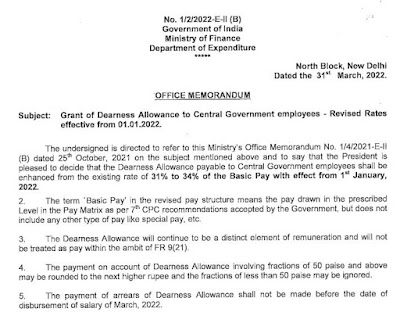
DA Jan 2022 - Grant of Dearness Allowance to Central Government employees - Revised Rates effective from 01.01.2022

 3% DA Hike - Revised Rates effective from 01.01.2022: DoE OM dated 31.03.2022 No. 1/2/2022-E-II (B) Government of India Ministry of Finance...