Friday, 24 July 2015

LTC advance – 65 days before the proposed date of outward journey

LTC advance – 65 days before the proposed date of outward journey

Period for applying LTC advance

A Government servant can draw the Leave Travel Concession advance 65 days before the proposed date of outward journey.

Indian Railways has fixed the advance reservation period as 120 days excluding the date of journey w.e.f. 01.04.2015 for all long distance mail/express trains as well as Shatabdi Express trains.

The issue of any change in instructions relating to drawal of advance for LTC has to be decided keeping in view all factors including changes made by the Railways, as well as financial implications.

This was stated by the Minister of State in the Ministry of Personnel, Public Grievances and Pensions and Minister of State in the Prime Minister’s Office, Dr. Jitendra Singh in a written reply to a question by Shri Kiranmay Nanda in the Rajya Sabha today.

PIB News

Thursday, 23 July 2015

Child Care Leave to West Bengal Female Teachers at par with Central Government Employees

Child Care Leave to West Bengal Female Teachers at par with Central Government Employees

Already granted Child Care Leave for maximum period of 2 years (730 days) with effect from Jan 2012 to the female employees of State Government. Now, this 2 years leave facility may be granted to female teachers and non-teaching employees, who are having minor children, working under State Govt/Non Govt aided Schools. The detailed order has been uploaded in the WB Finance Portal and the same reproduced is given below for your ready reference…

Government of West Bengal
Finance (Audit) Department
‘Nabanna’
Howrah – 711 102
No.5560-F(P)
Dated, the 17th July, 2015
MEMORANDUM

The matter regarding extension of benefit of the Child Care Leave for a maximum period of 2 (two) years i.e. 730 days to the regular female teaching and non-teaching employees of Government sponsored/Non-Govt. aided Schools, Boards, District Primary School Councils, School Service Commission as well as to the regular female employees of Panchayat Raj and other Local Bodies, Undertakings, Corporations, Statutory Bodies was under active consideration of the State Government.

Now after careful consideration, the Governor is hereby pleased to decide to extend the said benefit to the regular female employees of the educational institutions, establishments, organizations, entities etc. as mentioned above subject to the following conditions –
i) The same will be admissible during the entire period of service for taking care of upto 2 (two) children upto 18 years of their age whether for rearing or to look after any of their needs like examination, sickness etc.

ii) During the period of such leave, the female employees shall be paid leave salary equal to the pay drawn immediately before proceeding on leave.

iii) It may not be granted in more than 3 (three) spells in a calendar year.

iv) It may not be granted for less than 15 days in a spell.

v) Child Care Leave shall not be debited against the leave account.

vi) It may be combined with leave of the kind due and admissible.

vii) Child Care Leave should not ordinarily be granted during the probation period except in case of certain extreme situations where the leave sanctioning authority is fully satisfied about the need of Child Care Leave to the probationer. It may also be ensured that the period for which such leave is sanctioned during probation is minimal.

viii) Other terms and conditions as applicable to sanctioning Earned Leave shall be applicable in the matter of sanctioning Child Care Leave. ix) An account for the purpose shall have to be maintained under proper attestation by the leave sanctioning authority.
2.This order shall take effect from 1st August, 2015.”

3. Necessary amendments in the relevant rules or regulations or bye-laws as applicable may be made by the concerned administrative department in due course.
Sd/-
A. K. Das
O.S.D. & E.O. Joint Secretary to the
Government of West Bengal
Source: www.wbfin.nic.in
Click to view the order
Click to view the order for Government Staff

Purchase of Car through CSD – Discontinuing Centralised Car Sanction Process

Purchase of Car through CSD – Discontinuing Centralised Car Sanction Process

Centralised Car Sanction by CS Dte on behalf of the QMG is being discontinued with effect from 20 Jul 2015 and individual will process the car sanction through the CSD Depots as hither- to- fore prior to Jan 2012. The detailed order has been published by CS Dte on behalf of QMG.

DISCONTINUING CENTRALISED CAR SANCTION FOR PURCHASE OF CAR THROUGH CSD
Tele: 2309 3660

Integrated HQ of MOD (Army)
Quartermaster General’s Branch
Dy Dte Gen Canteen Services
Army Headquarters
Room No. 14A, L-1 Block,
Church Road, New Delhi- 110001
No. 96410/Q/DDGCS/
13th July 2015
To
All Head Quarters including OFB & KSB

DISCONTINUING CENTRALISED CAR SANCTION FOR PURCHASE OF CAR THROUGH CSD

1. Refer following letters:-
(a) This HQ letter No 96410/Q/DDGCS dated 15 Apr 2011.
(b) This HQ letter No 96410/Q/DDGCS dated 16 Jan 2012

2. Due to budgetary constraints, the car sanction was centralised in Jan 2012. However, due to the improved Budgetary allocations, the centralised Car Sanction by CS Dte on behalf of the QMG is being discontinued with effect from 20 Jul 2015. Individual(s) will process the car sanction through the CSD Depots as hither-to-fore prior to Jan 2012. The new indent form to be submitted to CSD Depot is att at Appx and also can be downloaded from www.csdindia.gov.in/www.indianarmy.nic.in. Guidelines for purchase of four wheeler from CSD is also enclosed.

3. The countersigning authorities and CSD Depots will exercise due diligence while scrutinising the documents to verify the authenticity of applicant and ensure that only eligible category avail this facility as enunciated vide our letter No 95286/SG/Q/DDGCS dated 29 Apr 2015 (Copy att). The onus of correctness of application will be on both applicant and countersigning authority to prevent any misuse/malpractice of this facility. Each application will be vetted by CSD Depot for orrectness in all respects. In case any malpractice/misuse is noticed, strict disciplinary action will be initiated.

4. This Letter be given vide publicity inculuding display in the notice boards in Station HQs Zila Sainik Boards and URCs for information of all concerned.
sd/-
(Vivek Siwach)
Lt Col
Joint Director
Canteen Services
for DDGCS
Source: http://csdindia.gov.in/

CSD Car purchase order

Finance Ministry issued orders on upgradation of cities / towns on the basis of Census 2011 for the purpose of House Rent Allowance

Finance Ministry issued orders on upgradation of cities / towns on the basis of Census 2011 for the purpose of House Rent Allowance
The new and revised list of cities & towns has been declared by the Finance Ministry today for the purpose of House Rent Allowance on the basis of Census 2011.
House Rent Allowance to Central Government employees is now calculated on the basis of the population census of 2001. The cities and towns are classified as X, Y, and Z, based on their population. Employees in these towns are eligible for 30%, 20% and 10% House Rent Allowances respectively.

Population census is conducted once every ten years. The most recent census was held in 2011. Official information and findings of the Census was sent by the registrar General & Census Commissioner to the Finance Ministry a long time ago.

There is no denial in the fact that the Confederation of Central Government Employees has been constantly demanding this upgrading. The Confederation had, on 28.04.2014, sent a letter to the Finance Ministry. The letter said that even though the 2011 Census Report CD was received, there is no official announcement from the Government in this regard. The letter also demanded that a revised HRA and TA be implemented immediately in the reclassification of cities and towns on the basis of 2011 Census. On 30.07.2014, the Finance Ministry had, in reply to the mail, said that steps are being taken to implement the revised HRA and TA rates to the Central Government employees of these cities and towns.

Now, Finance Ministry issued orders on re-classification / upgradation of cities / towns on the basis of Census 2011 for the purpose of House Rent Allowance to Central Govt employees with effect from 1.4.2015.
G.I. Min. of Finance, Dept. of Exp. O.M.No.2/5/2014-E.II(B), dated 21.7.2015

Subject : Re-Classification / Upgradation of Cities / Towns on the basis of Census-2011 for the purpose of grant of House Rent Allowance (HRA) to Central Government employees.

Reference is invited to this Department’s O.M. No.2(13)/2008-E.II(B) dated 29.08.2008 relating to grant of House Rent Allowance (HRA) to Central Government employees on the recommendations of the 6th Central Pay Commission (CPC) whereby a list of cities / towns classified as “X”, “Y” and “Z” for the purpose of grant of HRA was enclosed as Annexure. The matter relating to re-classification of cities / towns on the basis of Census-2011 for the purpose of grant of HRA to Central Government employees has been considered by the Government.

2. The President is pleased to decide that in supersession of all the existing orders relating to classification of cities/towns for the purpose of grant of HRA to Central Government employees, cities/towns shall now be re-classified as “X”, “Y” and “Z” for the purpose of HRA as enumerated in the Annexure to these orders.

3. Consequent upon implementation of the recommendations of the 5th Central Pay Commission, certain cities / towns were placed in a lower classification as compared to their existing classification for HRA purpose, vide this Department’s O.M. No.2(30)/97-E.II(B) dated 03.10.97. However, these cities/towns were allowed to retain their existing higher classification, vide Para 3 thereof; and further extended vide O.M. No.2(21)/E.II(B)/2004 dated 16.03.2005 & O.M. No.2(13)/2008-E.II(B) dated 07.01.2009. As other cities / towns to which protection of retaining earlier higher classification was allowed, got upgraded during the intervening period and as on date only two cities i.e. Ajmer in Rajasthan and Durgapur in West Bengal were retaining such protection. Consequent upon upgradation of these two cities also on the basis of their population as per Census-2011, provisions contained in Para 3 of this Department’s O.M. No. 2(30)/97-E.II(B) dated 03.10.97 which Were allowed to further continue vide O.M. dated 16.03.2005 & 07.01.2009, stand withdrawn/discontinued.

4. Special orders allowing continuance of HRA at Delhi (‘X” class city) rates to Central Government employees posted at Faridabad, Ghaziabad, NOIDA and Gurgaon, at Jalandhar (“Y” class city) rates to Jalandhar Cantt., at “Y” class city rates to Shillong, Goa & Port Blair vide this Department’s O.M. No.2(13)/2008-E.II(B) dated 29.08.2008, and continuance of HRA at par with Chandigarh (“Y” class city) to Panchkula vide this Department’s O.M. No.2(13)/2008-E.II(B) dated 04.03.2011, shall continue to be applicable till the recommendations of 7th CPC are considered by the Government.

5. These orders shall take effect from 1st April, 2015.

6. The Orders will apply to all civilian employees of the Central Government. The orders will also be applicable to the civilian employees paid from the Defence services Estimates. In respect of Armed Forces personnel and Railway employees, separate orders will be issued by the Ministry of Defence and the Ministry of Railways, respectively.

7. In so far as the persons serving in the Indian Audit and Accounts Department are concerned, these orders issue in consultation with the comptroller & Auditor General of India.
Authority: www.finmin.nic.in

Click to view the order in English

Wednesday, 22 July 2015

7th CPC contemplates to recommend the Compensatory City allowance again

7th Pay Commission contemplates to recommend the Compensatory City allowance again

Sources said that the 7th CPC may recommend the Compensatory City allowance in its report for Central Govt employees. Upto 5th Pay Commisson, CCA has been granted to all CG Employees and we all know that the 6th CPC has abolished. The NC JCM Staff Side strongly suggested in its memorandum to introduce again the CCA to submitted to 7th Pay Commission earlier. The unconfirmed sources said, the CCA will come with two criteria as granting in the 5th CPC.

The Compensatory City allowance has been granted to Central Government employees since the First Central Pay Commission. This allowance was sanctioned to compensate for the high cost of living in bigger cities classified as such for grant of house rent allowance. Upto 3rd CPC it used to be certain percentage of pay for different pay ranges and different classified towns. The 4th and 5th CPC, however, recommended lump sum amounts as CCA. 5th CPC in para 106.10 (Pge 1582) of their report has commented that :
“We also do not support the demand for making CCA a percentage of basic pay because this amounts to admitting a firm and casual relationship between CCA and income.”
When it is admitted that CCA is essentially an allowance given to offset the imperfection in Dearness allowance as a measure of relative expensiveness of classified Cities, it really becomes an additional DA. When the DA is at a percentage of Pay, how can CCA not be fixed as a percentage of pay. The basis on which the lumpsum amount of CCA was recommended by the 4th and 5th CPCs had also not been disclosed and therefore, it appears to be an arbitrary decision.

The 6th CPC on the other hand recognised that the only two factors viz. accommodation and transportation contribute to high cost of living in classified towns. They, recommended the revised HRA and Transport allowance to adequately compensate for relative expensiveness of the classified cities. In view of that contention, they stated that the CCA stands subsumed in Transport allowance. We are unable to agree with the idea of subsuming CCA in Transport allowance as recommended by the 6th CPC on the consideration that the relative expensiveness in bigger cities is only on account of problems of accommodation and transportation. There are various other factors due to which the expensiveness of a particular city either increases or decreases. CCA was a component in determination of overtime allowance prior to the implementation of the 6th CPC recommendations. By allowing this to be subsumed in the transport allowance, it became difficult to factor the CCA component in the computation of over time allowance.
For these reasons, we propose the Commission to recommend the following rates of City Compensatory allowance
7cpc-Compensatory-City-allowance

Source: http://7thpaycommissionnews.in/

Para Military Service pay only under consideration not OROP – Minister said in Parliament

Para Military Service pay only under consideration not OROP – Minister said in Parliament

While answering to a question in Parliament today (22.7.2015) on the demand of OROP to Paramilitary Forces, the Minister of State for Home Affairs said there is no proposal under consideration by the Ministry.

Demand of One Rank One Pension by paramilitary forces
There have been some requests demanding One Rank One Pension on the line of demand in Defence Forces. There is no proposal under consideration of the Ministry on the issue.

Proposals regarding granting of Para Military Service pay and enhancement of casual leave at par with Army have been received in this Ministry. The same have been referred to the 7th Central Pay Commission for consideration.

This was stated by the Minister of State for Home Affairs, Shri Kiren Rijiju in a written reply to a question by Smt. Rajani Patil and Shri A.K. Selvaraj in the Rajya Sabha today.

Source: PIB News

Tuesday, 21 July 2015

Preparation of list of Government servants due to retire along with their Aadhaar numbers and incorporation of Aadhaar number in PPO Booklet: CPAO's OM

Preparation of list of Government servants due to retire along with their Aadhaar numbers and incorporation of Aadhaar number in PPO Booklet: CPAO's OM

GOVERNMENT OF INDIA
MINISTRY OF FINANCE
DEPARTMENT OF EXPENDITURE
CENTRAL PENSION ACCOUNTING OFFICE
TRIKOOT-II, BHIKAJI CAMA PLACE,
NEW DELHI-110066
PHONES : 26174596, 26174456, 26174438
CPAO/Tech/Jeevan Pramaan/2015-16/515 to 662.
10.07.2015

Office Memorandum
Subject:- Preparation of list of Government servants due to retire along with their Aadhaar numbers and incorporation of Aadhaar number in PPO Booklet.

1. As a part of Digital India initiatives, Digital Life Certification (DLC) of the pensioner has been made an option for submission of life certificate by the pensioner in the month of November each year. As the role of Aadhaar has become vital, a column for Aadhaar has already been provided in the Pension Payment Order booklet. Accordingly, all Heads of Offices have to ensure that wherever available same is provided to their Pay & Accounts Offices alongwith pension papers of the retiring government servants. In this regard, a provision has also been made in CAM-52 (PPO Booklet) by adding the following columns after existing column no.5.

6. Permanent Account Number for Income Tax (PAN)
7. Aadhaar No. (if Available)
8. Mobile No. (if Available)
9. E-Mail ID (if Available)
 
2. The seeding of Aadhaar with pensioners’ PPO number and their bank accounts is being closely monitored by Prime Minister Office. While this information is being regularly collected by CPAO from banks, the processing of fresh pension cases alongwith Aadhaar number is a very important requirement for expediting seeding of Aadhaar number by banks with PPO number & bank account and smooth implementation of submission of DLCs by pensioners in the month of November.

3. Further, attention is invited to Rule 56 of CCS (Pension) Rules which provides that:-

“(1) Every Head of Department shall have a list prepared every three months, that is, on the 1st January, 1st April, 1st July and 1st October each year, of all Government servants who are due to retire within the next twelve to fifteen months of that date.
 
(2) A copy of every such list shall be supplied to the Accounts Officer concerned not later than 31st January, 30th April, 31st July or 31st October, as the case may be, of that year.”
 
4. To avoid any delay in finalizing the pension cases all Heads of Offices should have first-hand information of the Aadhaar number while preparing the list of retiring government officials as per the provision of Rule 56 of CCS (Pension) Rules and should provide the same to the Accounts Officer concerned not later than 31st January, 30th April, 31st July or 31st October of that year.
 
5. In has been observed that during the month of June, 2015; out of 3101fresh PPOs (Pension Payment Orders), only in 220 cases Aadhaar numbers have been indicated. All Pr. CCAs/CCAs/ AGs are once again requested to ensure that all fresh PPOs are sent to CPAO with Aadhaar numbers wherever available and quarterly list of would be retirees as mentioned in para 3 & 4 above also mention Aadhaar numbers wherever available.

(Subhash Chandra)
Controller of Accounts
Source: http://cpao.nic.in/pdf/cpao_tech_jeevan_praman_2015-16.pdf

7th Pay Commission Rumours – Discarding Grade Pay system – Will it be beneficial ?

7th Pay Commission Rumours – Discarding Grade Pay system – Will it be beneficial ?
A study on difference in Fitment benefit for 7th Pay Commission Pay Fixation in the case of principles of 5th CPC Pay fixation is adopted in lieu of Fitment Benefit in the form of Grade Pay System evolved by 6th CPC

Fitment benefit in the form of Grade Pay provided by 6th CPC was computed based on highest pre-revised pay in each of the pre-revised Pay Scale – Fitment benefit advocated by previous pay commisions were reckoned with Pre-revised basic Pay drawn on the effective date of CPC

While Central Government Employees keep their fingers crossed after 7th Pay Commission finished all the interaction sessions with the Employees Federations and started finalising its report to be submitted to Govt, many surmises and speculations have already started filling the air through Internet and through word of mouth about possible 7th CPC pay fixation methods.

Some of those 7th Pay Commission rumours are as follows
  • There will be no running Pay band and Grade Pay System
  • The Minimum Pay will be Rs. 21000
  • The uniform multiplication factor for arriving revised pay will be 2.86
  • The Criteria for retirement age will be either completion of 33 Years of service or at the age of 60 Years whichever is earlier.
Interestingly, these rumours are spread out this time carry the tags as “inside information provided by Employees federations which participated in the 7th Pay Commission meetings”. The very character of a rumour is, it may be true or false. God only knows.

Among these, the unconfirmed news that 7th Pay Commission is to discard Pay Band – Grade Pay System may be affecting the Pay Structure of Central Government Employees very much if it is true.
In fact this is an off-shoot of proposal moot out by Confederation of Central Government Employees and
Workers in its reply to 7th Pay Commission Questionnaire

In this background, we made an analysis as to whether discarding of Grade Pay System would be beneficial to Central Government Employees.

As per the proposal of Confederation, the Pay Band and Grade Pay system evolved by the 6th CPC brought about innumerable anomalies and the same has to be replaced by the Pay scale structure, which was in vogue prior to the implementation of the 6th CPC.

What was Pay Scale Structure prior to 6th CPC ?  How fixation pay was made in that pay scale ?

Obviously, Pay Scale Structure contemplated by Confederation is 5th Pay Commission Pay Structure which is the Pay Structure prior to 6th CPC pay Structure.
Now, let us have a look at the 5th CPC Pay Structure and how pre-revised 4th CPC Pay was revised and fit into the same.

5th Pay Commission Pay fixation Method :

As per Central Civil Services (Revised Pay) Rules 1997 which was notified by Ministry of Finance for implementation of 5th Pay Commission Report, Revised Pay Scales against 4th CPC pay scales are as follows

4th CPC Pay scales5th CPC pay scales
750-12-870-14-940S-12550-55-2660-60-3200
775-12-871-12-1025S-22610-60-3150-65-3540
775-12871-14-955-15-1030-20-1150S-2A2610-60-2910-65-3300-70-4000
800-15-1010-20-1150S-32650-65-3300-70-4000
825-15-900-20-1200S-42750-70-3800-75-4400
950-20-1150-25-1400/950-20-1150-25-1500/1150-25-1500S-53050-75-3950-80-4590
975-25-1150-30-1540/975-25-1150-30-1660S-63200-85-4900
1200-30-1440-30-1800/1200-30-1560-40-2040/1320-30-1560-40-2040S-74000-100-6000
1350-30-1440-40-1800-50-2200/1400-40-1800-50-2300S-84500-125-7000
1400-40-1600-50-2300-60-2600/1600-50-2300-60-2660S-95000-150-8000
1640-60-2600-75-2900S-105500-175-9000
2000-60-2120S-116500-200-6900
2000-60-2300-75-3200/2000-60-2300-75-3200-3500S-126500-200-10500
2375-75-3200-100-3500 / 2375-75-3200-100-3500-125-3750S-137450-225-11500
2500-4000S-147500-250-12000
2200-75-2800-100-4000/2300-100-2800S-158000-275-13500
2200-75-2800-100-4000NEW SCALE8000-275-13500(Group A Entry)
2630/- FIXEDS-169000
2630-75-2780S-179000-275-9550
3150-100-3350S-1810325-325-10975
3000-125-3625/3000-100-3500-125-4500/ 3000-100-3500-125-5000S-1910000-325-15200
3200-100-3700-125-4700S-2010650-325-15850
3700-150-4450/3700-125-4700-150-5000S-2112000-375-16500
3950-125-4700-150-5000S-2212750-375-16500
3700-125-4950-150-5700S-2312000-375-18000
4100-125-4850-150-5300/4500-150-5700S-2414300-400-18300
4800-150-5700S-2515100-400-18300
5100-150-5700/5100-150-6150/5100-150-5700-200-6300S-2616400-450-20000
5100-150-6300-200-6700S-2716400-450-20900
4500-150-5700-200-7300S-2814300-450-22400
5900-200-6700/5900-200-7300S-2918400-500-22400
7300-100-7600S-3022400-525-24500
7300-200-7500-250-8000S-3122400-600-26000
7600/-FIXED /7600-100-8000S-3224050-650-26000
8000/- FIXEDS-3326000(FIXED)
9000/- FIXEDS-3430000(FIXED)

Further, 5th CPC revised pay of Central Government Employees was worked out by adding DA as on 01.01.1996, two installments of Interim Relief (IR-1 and IR-2) and 40% of pre-revised basic pay with Pre-Revised Basic pay drawn as on 01.01.1996. Then resultant revised basic pay was stepped up to nearest incremented pay in the revised 5th CPC pay scale against the existing 4th CPC pay scale in which the pay was drawn. The following illustration would provide clear cut idea about 5th Pay Commission Pay fixation method

Illustration for 5th Pay Commission Pay fixation

Existing 4th CPC pay scaleRs. 1640-60-2600-75-2900
Revised 5th CPC pay scaleRs. 5500-175-9000
Pre-Revised Basic PayRs. 2360
D.A as on 01.01.1996 @ 148%Rs. 3493
IR-1Rs. 100
IR-2Rs. 236
Add 40% of pre-revised B.PRs. 944
TotalRs. 7133
Nearest incremented pay in revised 5th CPC pay scale —-ARs, 7250
If one increment is ensured in the revised pay scale for every three increments in the pre-revised pay scale, the revised basic will be —- BRs. 6250
5th CPC revised Basic Pay as on 01.01.1996 (A or B whichever is higher)Rs. 7250

From the above it could be found that fitment benefit of 40% is calculated using the pre-revised basic pay received by an employee as on 01.01.1997. On the contrary, in the case of fitment benefit allowed by 6th Pay Commission in the form of Grade Pay, it has been calculated at 40% of highest Pay in each of 5th CPC Pre-Revised pay scale.

6th Pay Commission Pay Band and Grade Pay hierarchy

5th CPC Pay Scales6th CPC Pay Band and Grade Pay
GRADESCALEPay BandGrade Pay
S-12550-55-2660-60-3200-1S4440-74401300
S-22610-60-3150-65-3540-1S4440-74401400
S-2A2610-60-2910-65-3300-70-4000-1S4440-74401600
S-32650-65-3300-70-4000-1S4440-74401650
S-42750-70-3800-75-4400PB-15200-202001800
S-53050-75-3950-80-4590PB-15200-202001900
S-63200-85-4900PB-15200-202002000
S-74000-100-6000PB-15200-202002400
S-84500-125-7000PB-15200-202002800
S-95000-150-8000PB-29300-348004200
S-105500-175-9000PB-29300-348004200
S-116500-200-6900PB-29300-348004200
S-126500-200-10500PB-29300-348004200
S-137450-225-11500PB-29300-348004600
S-147500-250-12000PB-29300-348004800
S-158000-275-13500PB-29300-348005400
NEW SCALE8000-275-13500(Group A Entry)PB-315600-391005400
S-169000PB-315600-391005400
S-179000-275-9550PB-315600-391005400
S-1810325-325-10975PB-315600-391006600
S-1910000-325-15200PB-315600-391006600
S-2010650-325-15850PB-315600-391006600
S-2112000-375-16500PB-315600-391007600
S-2212750-375-16500PB-315600-391007600
S-2312000-375-18000PB-315600-391007600
S-2414300-400-18300PB-437400-670008700
S-2515100-400-18300PB-437400-670008700
S-2616400-450-20000PB-437400-670008900
S-2716400-450-20900PB-437400-670008900
S-2814300-450-22400PB-437400-6700010000
S-2918400-500-22400PB-437400-6700010000
S-3022400-525-24500PB-437400-6700012000
S-3122400-600-26000HAG+SCALE75500-80000NIL
S-3224050-650-26000HAG+SCALE75500-80000NIL
S-3326000(FIXED)APEX SCALE80000(FIXED)NIL
S-3430000(FIXED)CAB. SEC.90000(FIXED)NIL

We are of the view that if the 7th CPC fitment benefit is calculated on the basis of existing pre-revised pay as in the case of 5th CPC then revised 7th CPC pay would be lesser than the revised 7th CPC Pay calculated by adopting the methods 6th CPC, in which grade pay (fitment benefit) has been arrived at on the basis of highest pay in the pre-revised pay Scale.

At the same time it may not be viable to arrive 7th CPC fitment benefit on the basis of highest Pay in each of Pay Band as 6th CPC Pay Band Structure has been designed in such a way that each of the Pay band accommodates many 5th CPC Pre-Revised Pay Scales

However, even after discarding Grade pay System, if the fitment benefit for 7th Pay Commission Pay revision is provided on the basis of highest pay in the fitment table provided vide O.M 1/1/2008-IC dated 30.08.2008 for the each of the 5th CPC Pre-Revised Pay Scale, then it would be Pay wise beneficial to Central Government Employees.

We invite valuable opinion of readers in the form of comments to this article so that pay fixation method beneficial to CG Employees community can be highlighted

Source: gconnect

7CPC: Maruti Suzuki to get boost from Seventh Pay Commission’s recommendations

7CPC: Maruti Suzuki to get boost from Seventh Pay Commission’s recommendations


MUMBAI: Investors expect Maruti Suzuki to get a boost from the Seventh Pay Commission's recommendations later this year that will lead to salaries of government employees rising. The Pay Commission is expected to submit its report by October and this is likely to be implemented from July 2016, likely adding to an expected double-digit growth in passenger car sales in FY17. Maruti Suzuki is expected to be the main beneficiary, analysts said. The last Pay Commission report had resulted in car sales rising 18 per cent annually between FY09 and FY11.
"The Sixth Pay Commission, which was implemented in August 2008, resulted in almost 10 times increase in Maruti's sales to government employees from FY08 to FY12," Jatin Chawla and Akshay Saxena, research analysts at Credit Suisse, wrote in a July 15 report.

The market value of Tata Motors surged past Maruti Suzuki in 2010, after the Indian company turned JLR around following its acquisition from Ford in 2008. JLR more than made up for Tata Motors' poor domestic performance over the past few years. The Chinese decline has forced many carmakers to scale down targets.
JLR said June sales were flat because strong growth in Europe and North America was offset by a dramatic slowdown in China.
German luxury carmaker Audi has abandoned a target to sell 600,000 cars this year in China, its biggest market, as the country's stock market rout sapped demand for luxury cars, Bloomberg reported on Thursday. Audi's Chinese sales rose 1.9 per cent to 273,853 cars in the first half. Credit Suisse reckons that a salary increase could boost demand for cars in India by 10 per cent. It upgraded the expectation for volume growth at Maruti Suzuki for FY17 to 23 per cent from 17 per cent on account of the expected pay commission boost. It also increased the stock's target price to Rs 5,100 at the end of 2017 fromRs 4,370 previously. Maruti expects there will be a repeat this time around.
"We have sold almost 200,000 vehicles to government employees in FY15," said Randhir Singh Kalsi, executive director, sales, Maruti Suzuki. "We certainly believe we can get more incremental volumes after implementation of the Seventh Pay Commission." Maruti saw a pickup mostly in the Rs 2.5-5 lakh price bracket last time around.
Others also expect a bounce. "An increase in disposable income certainly will help potential buyers to purchase high quality products. So, definitely a salary hike of government employee will propel the industry growth," said Rakesh Srivastava, president, sales, Hyundai India. Growth was seen across segments and geographies after the last pay increase, he said.
There are about 30 lakh central government employees while state government workers number about three times that. About a fourth of them are paidRs 30,000-50,000 per month and nearly 10 per cent may buy cars, Credit Suisse estimates, adding up to an additional volume of about 300,000 units.
Among those who get a pay increase, those who have set aside enough for children's education and own a home will be the ones most likely to buy a new car, said Maruti's Kalsi, pointing out that brands will need to target the entire family, not just breadwinners.
"Importantly, car buying is no longer a prerogative of the parents and their teenage children now play an important role in choosing a car," he said.
Changing consumer preferences also indicate that it won't be just entry-level cars that are likely to rise; some may look to upgrade.
"We are (expecting) incremental demand from employees for compact as well as sedan cars," said Srivastava of Hyundai. Apart from the additional pay, arrears will also play a role. The Sixth Pay Commission award saw employees getting arrears for 32 months in two installments in FY09 and FY10. This means that any delays in payment enhance the ability of an employee to buy a car. Carmakers offer special discounts for government employees and it's easier for them to get loans from public sector banks as well.

Via Economic Times

7CPC: Seventh Central Pay Commission to submit report by October 31

7CPC: Seventh Central Pay Commission to submit report by October 31

New Delhi: The eyes of the central government employees will be firmly glued on the forthcoming seventh central pay commission reports which is likely to be be submitted by October 31 for implementation from April 2016.

The pay panel is likely to finalise and submit its report on salary and allowance hike by October 31, sources said. The members and officials of the panel had made several field tours and collected valuable suggestions, which are all going to be trashed as the Commission winds up its office within three month.

After getting recommendations, the central government may announce to accept it in the budget 2015-16 to implement it from April 2016.

It is expected that seventh pay panel to suggest hiking the tripled salaries of central government employees.
The salaries of central government employees were roughly tripled with retrospective effect from 1996 and tripled once again with retrospective effect from 2006 by the fifth pay panel and sixth pay panel respectively. This shows the salaries of central government employees have tripled every decade.

According to media report says that investors are expecting car bazar to get a boost from the seventh central pay commission’s recommendations from mid-next year on account of getting arrears of rising salaries of central government employees.

The last Pay Commission report had resulted in car sales rising 18 per cent annually between financial year 2009-10 and financial year 2010-11.

The last pay commission was implemented in August 2008 with retrospective effect from January 2006 which resulted in getting huge salary arrears to central government employees to enable them to purchase car from their arrears on loan basis.

They paid margin amount from arrears and installments from salaries but this pay panel will be implemented from January 2016, hence no such huge arrears will be paid to central government employees this time to pay margin amount for car loan. So car bazar will not get a boost from the seventh central pay commission’s recommendations.

TST

Flash News

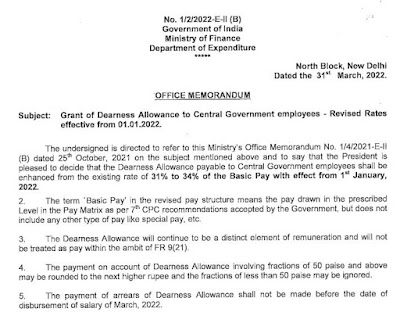
DA Jan 2022 - Grant of Dearness Allowance to Central Government employees - Revised Rates effective from 01.01.2022

 3% DA Hike - Revised Rates effective from 01.01.2022: DoE OM dated 31.03.2022 No. 1/2/2022-E-II (B) Government of India Ministry of Finance...