Sunday, 5 April 2015

Mass Demonstration at New Delhi on 28.04.2015 – Protest to settle 10 Point Charter of Demands

Mass Demonstration at New Delhi on 28.04.2015: National Joint Council of Action – Protest to settle 10 Point Charter of Demands


You are all aware that the constituents of the National Council (JCM) representing the employees in Railways, Defence, Postal, Income Tax, Audit Departments etc., have jointly conducted a convention at New Delhi on 11.12.2014 and adopted a joint declaration demanding the central government to settle the Ten Point Charter of demands also against the anti workers policies.
Subsequently, National Joint Council of Action (NJCA) was formed at National level and Railway Federations have taken the responsibilities of forming Joint Council of Action at State level and District levels. Accordingly the employees were organised and conducted protest meetings demanding the Government of India to consider to settle the demands.


1. Effect wage revision of Central Government Employees from 01.01.2014 accepting the memorandum of the Staff Side JCM: ensure 5 year wage revision in future: grant Interim Relief and Merger of 100% of DA. Ensure submission of the 7th CPC report with the stipulated time frame of 18 months; include Gramin Dak Sevaks within the ambit of the 7th CPC. Settle all anomalies of the 6th CPC.
2. No Privatisation, PPP or FDI in Railways and Defence Establishments and no corporatisation of Defence Ordnance Factories and Posta Services.
3. No Ban on recruitment / creating of posts.
4. Scrap PFRDA Act and re-introduce the defined benefit statutory pension scheme.
5. No outsourcing; Contractorisation, Privatisation of government functions; withdraw the proposed move to close down the Printing presses; the publication, form store and stationery departments and Medical Stores Depots; regularise the existing daily rated/casual and contract workers and absorption of trained apprentices;
6. Revive the JCM Functioning at all levels as an effective negotiating forum for settlement of the demands of the Central Government Employees.
7. Remove the arbitrary ceiling on compassionate appointments.
8. No labour reforms which are inimical to the interest of the workers.
9. Remove the Bonus Ceiling.
10. Ensure five promotions in the service career.
Since, no response was reviewed from the Government of India to settle the demands, it was decided by the NJCA decided in its meeting to conduct a Mass Demonstration at New Delhi on 28.04.2015 at 09.00 Hrs by organising the Central Government Employees to participation in large numbers.

Source: INDWF
[http://indwf.blogspot.in/2015/04/mass-demonstration-at-new-delhi.html]

Fake Dearness Allowance Order Surfaces Online

Fake Dearness Allowance Order Surfaces Online

Announcements that have appeared on social media, proclaiming a hike in Dearness Allowance for Central Government employees, have been declared false and misleading. Also, claims that an announcement was made by the Finance Ministry on March 30 have also been stated as false.

Central Government employees are given a deadness allowance hike in Jan and July of each year. The announcement of DA as declared by the Cabinet Ministry in March and September. So, the enhanced payment of DA will be given in the March and September salary itself. And also the arrears will be given for two months.

Confirmation of the 6% DA hike for 01.01.2015 will be issued by the Ministry of Finance after getting the Cabinet’s approval only. With no approval being given until March 30, some social media carried reports on April 1 that a hike was announced by the Finance Ministry.

Although it was obvious that the order was a fake one, it did create a sense of shock. Since it was April 1, many sensed that it was an April Fool’s Day prank. But the Finance Ministry issued a clarification on the same day claiming that the announcement was fake.

The fake order said that the order will have retrospective effect, from January 1, 2015 onwards. It also said that a DA hike of 115, instead of 107% will be provided to the employees this time.

In the statement issued by Subhash Chand, of the Department of Expenditure, Ministry of Finance, said, “The announcement that was supposedly made on March 30 is false. No such announcement was made by the Department of Expenditure, Ministry of Finance. Therefore, do not act upon the announcement.” The message was issued to all the ministries, departments and offices of the Central Government.

Pay Commission be designated as ‘Pay and Productivity Commission': 14th Finance Commission

Pay Commission be designated as ‘Pay and Productivity Commission': 14th Finance Commission

“We recommend the linking of pay with productivity, with a simultaneous focus on technology, skill and incentives. We recommend that Pay Commissions be designated as ‘Pay and Productivity Commissions’, with a clear mandate to recommend measures to improve ‘productivity of an employee’, in conjunction with pay revisions.We urge that, in future, additional remuneration be linked to increase in productivity.” – 14th Finance Commission

14th Finance Commission’s recommendations related to Pay Commission, Salary, Pension:- Recommendations

x. We reiterate the views of the FC-XI for a consultative mechanism between the Union and States, through a forum such as the Inter-State Council, to evolve a national policy for salaries and emoluments. (para 17.28)

xi. We recommend the linking of pay with productivity, with a simultaneous focus on technology, skill and incentives. We recommend that Pay Commissions be designated as ‘Pay and Productivity Commissions’, with a clear mandate to recommend measures to improve ‘productivity of an employee’, in conjunction with pay revisions.We urge that, in future, additional remuneration be linked to increase in productivity. (para 17.29)

xii. We urge States which have not adopted the New Pension Scheme so far to immediately consider doing so for their new recruits in order to reduce their future burden. (para 17.30)

Recommendations – Public Expenditure Management

118. We reiterate the views of the FC-XI for a consultative mechanism between the Union and States, through a forum such as the Inter-State Council, to evolve a national policy for salaries and emoluments.

119. We recommend the linking of pay with productivity, with a simultaneous focus on technology, skill and incentives. We recommend that Pay Commissions be designated as ‘Pay and Productivity Commissions’, with a clear mandate to recommend measures to improve ‘productivity of an employee’, in conjunction with pay revisions. We urge that, in future, additional remuneration be linked to increase in productivity. (para 17.29)

120. We urge States which have not adopted the New Pension Scheme so far to immediately consider doing so for their new recruits in order to reduce their future burden. (para 17.30)

14th Finance Commission’s detail report related to Pay Commission, Salary, Pension:- Fiscal Deficit

3.4 The fiscal deficit of the Union Government relative to GDP declined steadily from 6.1 per cent in 2001-02 to 4.5 per cent in 2003-04. The FRBM Act mandated reducing the fiscal deficit to 3 per cent by 2008-09. The Union Government achieved this target in 2007-08, with the fiscal deficit declining to 2.5 per cent of GDP. However, in 2008-09 the Union Government undertook several fiscal expansionary measures such as revision of pay scales based on the recommendations of the Sixth Pay Commission, waiver of farm loans and the expansion of the Mahatma Gandhi National Rural Employment Guarantee Act (MGNREGA) to all districts from the 200 districts it was originally slated to cover. In addition, oil prices escalated sharply, leading to a rise in subsidy. As a consequence of all this as well as the global crisis, the fiscal deficit of Union Government increased to 6 per cent in 2008-09 and 6.5 per cent in 2009-10.

3.38 The share of capital expenditure in the total expenditure of the Union Government declined from 22.8 per cent in 2004-05 to 10.2 per cent in 2008-09 and has remained in the range of 11 per cent to 13 per cent since then. Correspondingly, the revenue expenditure increased to 89.8 per cent in 2008-09, and thereafter declined only marginally, despite expenditure tightening measures. As a ratio of GDP, the revenue expenditure of the Union Government increased from 11.9 per cent in 2004-05 to 14.1 per cent in 2009-10 and is estimated at 12.2 per cent in 2014-15 (BE). The major components of revenue expenditure comprising subsidies, interest payments, defence expenditure, pay and allowances and pensions are briefly analysed in the following paragraphs.

 Major Subsidies : Pay and Allowances and Pensions

3.46 Pay and allowances of Union Government employees more than doubled between 2007-08 and 2011-12, from Rs.74, 647 crore to Rs.166, 792 crore due to the implementation of the Sixth Central Pay Commission recommendations( Including Defence Services). As a ratio of GDP, it jumped from a little over 0.9 per cent in 2007-08 to 1.2 per cent in 2008-09 and about 1.4 per cent in 2009-10 on account of both pay revision and payment of arrears. However, it moderated to a little over 1 per cent in 2012-13.
3.47 As in the case of salaries, expenditure of the Union Government on pensions, which had declined to less than 0.5 per cent of GDP in 2007-08, increased to about 0.9 per cent of GDP in 2009-10 due to the impact of revision in pensions. Subsequently, it came down to 0.7 per cent in 2010-11 and is estimated at 0.6 per cent in 2014-15 (BE).

3.48 Expenditure on salary, pensions and interest payments together accounted for 5.67 per cent of GDP in 2004-05 but declined marginally to 5.56 per cent of GDP in 2009-10, with the rise in expenditure on salaries and pensions being more than compensated by the decline in interest expenditure. These expenditures declined further to 4.9 per cent of GDP in 2012-13.

Revenue Expenditure : Pensions

6.34 Pensions are another committed liability which has been fully provided for in our assessment. The assessment of pensions is based on the growth rate of pension expenditure obtained from past data. The year-on-year growth of pension expenditure has shown volatility, with growth declining to a low of 0.42 per cent in 2002-03 and increasing to a high of 70.46 per cent in 2009-10. Given these fluctuations, it is not appropriate for us to take a long-run trend growth rate for this expenditure as a norm for assessment. It would be more appropriate to use the observed growth in the recent past. However, a potential fiscal liability may arise in the future with the introduction of the ‘one rank one pension scheme’ for Defence Services. The Budget 2014-15 has also made an additional allocation for this scheme, which is reflected in the increase in the growth of pension expenditure to10.67 per cent over the 2013-14 (revised estimates) growth of 6.62 per cent. While the Ministry of Finance projects an increase in pension payments by 8.7 per cent in 2015-16, a 30 per cent increase is expected in 2016-17 on account of the impact of the Seventh Pay Commission, followed by an annual growth rate of 8 per cent in subsequent years. Pension expenditures between 2011-12 and 2014-15 have grown on a year-on-year basis at the rate of 9.35 per cent per annum. We are of the view that annual revisions in the Dearness Allowance and annual accretions in the number of pensioners and the corresponding pension obligations can be covered by this growth in pension expenditure during our assessment period.

Defence Revenue Expenditure

6.35 Revenue expenditure on defence has grown at an annual rate of 11.21 per cent between 2001-02 and 2012-13 and at the rate of 10.1 per cent between 2008-09 and 2012-13. In its submission to the Commission, the Ministry of Defence argued that there has been a decline in the defence expenditure-GDP ratio over the years and defence expenditure allocation in the Union budget needs to be increased to expand the acquisition of arms and improve defence preparedness. The Ministry pointed out that it has not been able to make necessary procurements because of the constraint of funds and large amounts of committed expenditure. The Ministry also mentioned that a substantial part of the defence capital budget went into meeting committed expenditures. The Ministry of Finance has also highlighted the need to increase defence outlays in order to modernise and maintain defence assets and to finance defence acquisitions. Accordingly, its projections have provided for an increase in defence revenue expenditure (including salaries) of 30 per cent in 2016-17 which will incorporate the Pay Commission impact, with a stable growth rate of 20 per cent per annum in the remaining years.

Fiscal Consolidation: Assessment and Issues

14.48 Our review shows that, at an aggregate level, States made significant improvements in complying with the FRBM targets prescribed by the FC-XII and FC-XIII. In the pre-crisis period, fiscal consolidation at the State level was aided by a number of factors, including implementation of state-level fiscal responsibility acts, debt waiver and restructuring recommended by Finance Commissions, and improvement in revenues on account of buoyancy of Central taxes and introduction of value-added tax (VAT) at the state level. Despite States experiencing pressure on their fiscal balances in the post-crisis period due to lower buoyancy of Central taxes and increased expenditure commitment due to the implementation of the recommendations of Pay Commissions, they largely continued to comply with the FRBM targets.

Pay and Productivity

17.23 Wages and salaries constitute a significant portion of the committed liabilities of both the Union and States. Periodic revisions based on the recommendations of the Pay Commissions of the Union, with States following suit, have contributed to rising revenue expenditure. For States in particular, the fiscal impact of a pay revision is severe, as the share of salary expenditure in their total revenue expenditure is substantially larger than in the case of the Union. Arrears in pay and bi-annual releases of Dearness Allowance compound the burden.

17.24 Technically, the recommendations of a Central Pay Commission are only for Central Government employees and States are not bound to follow suit. Indeed, up to the 1980s, States constituted their own Pay Commissions and prescribed their own pay scales, based upon their fiscal capacity. However, since the Fifth Central Pay Commission, salaries and allowances in States have tended to converge with those in the Union Government and since the Sixth Central Pay Commission, almost all States have adopted the Union pattern of pay scales, albeit with modifications.

17.25 An internal study by the Commission brought out the fact that the Union Government’s expenditure on pay and allowances (including expenditure for the Union Territories) [2 Excluding productivity linked bonus/ad-hoc bonus, honorarium and encashment of earned leave, and travel allowances] more than doubled for the period 2007-08 to 2012-13, from Rs. 46,230 crore to Rs. 1,08,071 crore [If salary of defence services is included, the corresponding figures will be Rs. 73,073 crore and Rs. 1, 84,711 crore].
This increase can be largely attributed to the implementation of the Sixth Central Pay Commission recommendations, evident from the per employee annual salary (excluding defence salary) increasing from Rs. 1,45,722 to Rs. 3,25,820 over this period. Moreover, the share of expenditure on pay and allowances in revenue expenditure (net of interest payment, pensions and grants-inaid) increased from 11.8 per cent in 2007-08 to 13.1 per cent in 2012-13. The incidence of salary expenditure is much higher in the States than in the Union. In 2012-13, the share of expenditure on pays and allowances of all employees in the revenue expenditure (net of interest payments and pensions) among the States ranged from 28.9 per cent to 79.1 per cent. Per employee (for regular employees) salary in 2012-13 across States ranged between Rs. 2,12,854 and Rs. 5,49,345. Thus, the impact of revisions in pay scales on fiscal positions is uniformly significant, though it varies widely across States.

17.26 Given the variations across States and the lack of knowledge about the probable design and quantum of award of the Seventh Central Pay Commission, we believe that it is neither feasible, nor practicable, to arrive at any reasonable forecast of the impact of the pay revision on the Union Government or the States. Further, any attempt to fix a number in this regard, within the ambit of our recommendations, carries the unavoidable risk of raising undue expectations.

17.27 Our concern is the likely impact on overall budgetary resources, particularly of the States, once the recommendations of the Seventh Central Pay Commission are announced and adopted by the Union Government. All States have asked us to provide a cushion for the pay revision likely during our award period. The Union Government’s memorandum has built, in its forecast, the implications of a pay increase from 2016-17 onwards. The recommendations of the Seventh Central Pay Commission are likely to be made only by August 2015, and unlike the previous Finance Commissions, we would not have the benefit of having any material to base our assessments and projections and to specifically take the impact into account. We have, therefore, adopted the principle of overall sustainability based on past trends, which should realistically capture the overall fiscal needs of the States.

17.28 In our view, on matters that impact the finances of both the Union and States, policies ought to evolve through consultations between the States and the Union. This is especially relevant in the determination of pay and allowances, where a part of the government itself, in the form of the employees, is a stakeholder and influential in policy making. A national view, arrived at through this process, will open avenues for the Union and States to make collective efforts to raise the extra resources required by their commitment to a pay revision. More importantly, it would enable the Union and States to ensure that there is a viable and justifiable relationship between the demands on fiscal resources on account of salaries and contributions to output by employees commensurate with expenditure incurred. In this regard, we reiterate the views of the FC-XI for a consultative mechanism between the Union and States, through a forum such as the Inter-State Council, to evolve a national policy for salaries and emoluments.

17.29 Further,we would like to draw attention to the importance of increasing the productivity of government employees as a part of improving outputs, outcomes and overall quality of services relatable to public expenditures. The Seventh Central Pay Commission, has, inter alia, been tasked with making recommendations on this aspect. Earlier Pay Commissions had also made several recommendations to enhance productivity and improve public administration. Productivity per employee can be raised through the application of technology in public service delivery and in public assets created. Raising the skills of employees through training and capacity building also has a positive impact on productivity. The use of appropriate technology and associated skill development require incentives for employees to raise their individual productivities. A Pay Commission’s first task, therefore, would be to identify the justify mix of technology and skills for different categories of employees. The next step would be to design suitable financial incentives linked to measurable performance. We recommend the linking of pay with productivity, with a simultaneous focus on technology, skills and incentives. Further, we recommend that Pay Commissions be designated as ‘Pay and Productivity Commissions’,with a clear mandate to recommend measures to improve ‘productivity of an employee’, in conjunction with pay revisions. We urge that, in future, additional remuneration be linked to increase in productivity.

Pensions

17.30 Pensions have been growing steadily, and the liability for pension payments is likely to cast a very heavy burden on budgets in the coming years. Some of the factors contributing to this growth are: (i) the rise in pensions recommended by successive Pay Commissions; (ii) removal of the distinction between people retiring at different points of time, so that all pensioners are treated alike in their pension justifys; (iii) taking over the liability for pensions of retired employees of aided institutions and local bodies; and (iv) increasing longevity. The New Pension Scheme (NPS), a contribution-based scheme introduced by the Union Government in 2004 for all new recruits after the cut-off date, has now been adopted by all States, with the exception of West Bengal and Tripura. This scheme has the merit of transferring future liabilities to the New Pension Fund and factoring the current liability on a State’s contribution from its current revenues. We urge States which have not adopted the New Pension Scheme so far to immediately consider doing so for their new recruits in order to reduce their future burden.

Conclusion: – The recommendations of 14th Finance Commission are important for 7th Pay Commission. As the recommendations of 14th FC is applicable with effect from 01.04.2015 the impact of above mentioned recommendations will be the part of 7th CPC. Need not to say that 7th CPC has the challenge to prepare the report in stipulated time including the views of 14th FC.

Source Document: http://finmin.nic.in/14fincomm/14fcreng.pdf

Source : karnmk.blogspot.in

Saturday, 4 April 2015

Delay in Announcement of DA Hike from January 2015

Delay in Announcement of DA Hike from January 2015

Since the implementation of the recommendations of the 4th central pay commission in 1986, the announcement of approval and the order for granting Dearness Allowance to government employees were issued in March and September itself until it was violated once under UPA regime. In 2013, the approval for granting DA hike due from January 2013 was delayed inordinately. All the central government employees had waited patiently up to 31st March 2013. Even 1st and 2nd week of April 2013, there was no signs announcing the DA hike by the Central government. Then, the federations like AIRF and Confederation of central government employees and workers have raised objection over the inordinate delay of announcing DA. And they wrote letters to the Central Government to declare the Dearness Allowance immediately to avoid the confrontation.

While briefing the situation, the Confederation of central government employees and workers has mentioned in the editorial of their blog on 17th April 2013 that ‘This naturally is quiet disturbing, especially in the time of galloping price line. The employees have, in the past, fought bitterly for grant of DA and the 3rd CPC gave a definite formula for DA in the aftermath of the one day strike on 19th September 1968. We cannot allow the hard won DA to be tampered with.’
The next day, ie on 18th April 2013 the union cabinet approved the DA hike which is due from January 2013.

This time the NDA Government started repeating the same story in its first year itself. As we mentioned earlier the DA hike from July 2014 has been announced un expectedly on 4th September 2014. So there was huge expectation this time that the present government would not make any delay in announcing the Payment dearness allowance from January 2015. But it seems that the government finds no time to take any decision over the issue of 50 Lakh Central government employees and Pensioners. Whether the central government expects the federations to plead for announcing DA hike? Or it really has no time to decide on this issue?

However, yesterday the Ministry of Finance issued a clarification dated 1st March 2015, in which it has been clarified that a fake order for payment of Dearness Allowance was being circulated in Government Departments/offices and all Ministries/Departments and Central Government offices were advised not to take cognisance of these fake instructions being circulated in Government offices.

To avoid confusion and frustration among central government employees, it is expected that the central government should announce its approval for Payment of Dearness Allowance from January 2015 immediately.

Source: www.gservants.com

Second Round of Tripartite Consultations on EPF & MP Act Amendments Held

Second Round of Tripartite Consultations on EPF & MP Act Amendments Held

Bandaru Dattatreya Chairs Tripartite Consultations

The Second Round of Tripartite Consultations on Employees Provident Fund and Miscellaneous Provisions Act,1952 (EPF &MP Act) Amendments was held here yesterday. Shri Bandaru Dattatreya, the Minister of State, Labour & Employment (I/C) chaired the second round of tripartite consultations on EPF & MP Act Amendments. The consultations gain greater importance in view of the new amendments proposed in the backdrop of the Union budget proposals impacting the functioning of EPFO.

Inaugurating the consultations, Shri Dattatreya briefly dwelt upon the major changes being mulled in the proposals. They include bringing down the minimum no. of employees required for coverage under the Act from the existing 20 to 10, doing away with the Schedule Head for coverage and bringing in a negative list instead, special provisions for encouraging the functioning of small-scale units, provisions for setting up of multiple Appellate Authorities under the Act, removing ambiguities in the implementation of the Act, ensuring greater clarity in the definitions under the Act, especially with regard to wages which qualify for deduction for the purposes of the Act, introducing greater transparency and accountability in the enforcement of the Act by having an objective inspection scheme, introducing a scheme for unorganized workers and providing a choice to the worker by giving an option to join NPS / EPFO, which is in tune with the proposals mentioned in the Union Budget.

Taking part in the discussions, the representatives of the employers’ associations and federations generally welcomed the various proposals contained in the amendments under consideration. They generally voiced the opinion that the introduction of NPS would mean greater choice for the worker. However, there were also views that NPS cannot match the benefits offered by EPFO and therefore, are not comparable. It was also felt that the amendments would help in sharpening the competitiveness of Indian Industry and would enable India to become a manufacturing hub. However, there was a need to further encourage the concessions granted to the small-scale industries. Increase of coverage also received wide acceptance, both from employers’ and employees’ side.

Opposing certain amendments proposed, representatives of the Trade Unions expressed reservations especially to the move to introduce NPS as a substitute to EPFO. They also expressed reservations regarding the inspection scheme which they argued brought about centralization in the decision making process which is contrary to the prevailing wisdom which favours decentralization.

Summing up the discussions, Shri Shankar Aggarwal, Secretary, MOL&E assured that the concerns of all stakeholders will be addressed when giving final touches to the legislative amendments. Further, the objective behind bringing in the changes is to further strengthen the delivery of social security benefits.

In his concluding remarks, Shri Dattatreya stressed upon the need to focus on the unorganized sector of the workforce which constitutes 93% of the total workforce. He said that the need of the hour is to include more segments of the workforce like Anganwadi works into the ambit of social security legislations. He also informed that the Ministry is contemplating issue of smart cards to the labour workforce so that social security benefits reach each intended beneficiary. He also assured that the Act would be amended taking into account the sensitivities of all concerned.

Shri Sharad Patil, EFI (Employers Federation of India), Shri S.S. Patil, AIMA (All India Manufacturers Association), Shri Bhardwaj, Laghu Udhyog Bharati, Shri Sushant Singh, CII (Confederation of Indian Industries), Shri A.K. Padmanabhan, CITU, Shri A.D. Nagpal, HMS, Shri B.L Sachdeva, AITUC, Shri Ashok Singh, INTUC were some of the notable representatives of employers’ associations and employees’ associations (trade unions) who took part in the deliberations in addition to the representatives of various state governments.

Source: PIB News

FIVE LAKHS CENTRAL GOVT EMPLOYEES MARCH TO PARLIAMENT FOR SETTLEMENT OF TEN POINTS CHARTER OF DEMANDS

FIVE LAKHS CENTRAL GOVT EMPLOYEES MARCH TO PARLIAMENT FOR SETTLEMENT OF TEN POINTS CHARTER OF DEMANDS

MARCH TO PARLIAMENT
DELHI CHALO !
28TH APRIL 2015

FIVE LAKHS CENTRAL GOVT. EMPLOYEES MARCH TO PARLIAMENT.
CLARION CALL OF JCM NATIONAL COUNCIL STAFF SIDE
FOR SETTLEMENT OF TEN POINTS CHARTER OF DEMANDS.
INDEFINITE STRIKE IF DEMANDS ARE NOT SETTLED BY GOVT.

RAILWAY FEDERATIONS, DEFENCE FEDERATIONS AND CONFEDERATION OF CENTRAL GOVT. EMPLOYEES AND WORKERS WILL SPEARHEAD THE NATIONWIDE STRUGGLE.

ALL AFFILIATES OF CONFEDERATION AND ALL STATE COMMITTEES (C-O-CS) ARE ONCE AGAIN REQUESTED TO ENSURE MAXIMUM PARTICIPATION OF EMPLOYEES IN THE RALLY AS PER QUOTA ALREADY FIXED AND CIRCULATED. PLEASE BRING FLAGS, BANNERS AND PLAYCARDS ALSO.

COME IN THOUSANDS TO MAKE THE RALLY THE BIGGEST RALLY IN THE HISTORY OF CENTRAL GOVT. EMPLOYEES. LET US DEMONSTRATE THE ANGER, PROTEST AND DETERMINATION OF THIRTY LAKHS CENTRAL GOVT. EMPLOYEES IN FRONT OF NARENDRA MODI GOVERNMENT.

Source : Confederation Of CG Employees

Tuesday, 31 March 2015

Expected DA From July 2015 – AICPIN for the month of Feb 2015

Expected DA From July 2015 – AICPIN for the month of Feb 2015

The Labour Bureau just now released the index of CPI(IW) for Industrial Workers for the month of February 2015.

According to the press release, the index is decreased by one point and pegged at 253.

No.5/1/2015- CPI
GOVERNMENT OF INDIA
MINISTRY OF LABOUR & EMPLOYMENT
LABOUR BUREAU
`CLEREMONT, SHIMLA-171004
DATED: the 31st March, 2015
Press Release

Consumer Price Index for Industrial Workers (CPI-IW) – February, 2015

The All-India CPI-IW for February, 2015 decreased by 1 point and pegged at 253 (two hundred and fifty three). On 1-month percentage change, it decreased by (-) 0.39 per cent between January, 2015 and February, 2015 when compared with the increase of (+) 0.42 per cent between the same two months a year ago.

The maximum downward pressure to the change in current index came from Food group contributing (-) 0.66 percentage points to the total change. At item level, Rice, Eggs (Hen), Fish Fresh, Onion, Vegetable items, Sugar, Petrol, Flower/Flower Garlands, etc. are responsible for the decrease in index. However, this decrease was neutralised by Wheat, Wheat Atta, Arhar Dal, Groundnut Oil, Goat Meat, Tea (Readymade), etc., putting upward pressure on the index.

The year-on-year inflation measured by monthly CPI-IW stood at 6.30 per cent for February, 2015 as compared to 7.17 per cent for the previous month and 6.73 per cent during the corresponding month of the previous year. Similarly, the Food inflation stood at 7.42 per cent against 7.81 per cent of the previous month and 7.56 per cent during the corresponding month of the previous year.

At centre level, Tiruchirapally recorded the highest decline of 7 points followed by Guntur (4 points), Mysore, Chhindwara Siliguri and Puducherry (3 Points each) Among others, 2 points decrease was observed in 15 centres and 1 point in 18 centres. On the contrary, Belgaum and Kodarma centres reported a highest increase of 3 points each followed by Kanpur, Bokaro and Doom-Dooma Tinsukia (2 points each). Among others 1 point increase was observed in 13 centres. Rest of the 21 centres’ indices remained stationary.

The indices of 37 centres are above All India Index and other 40 centres’ indices are below national average. The index of Vishakhapathnam centre remained at par with all-India index.

The next index of CPI-IW for the month of March, 2015 will be released on Thursday, 30th April, 2015. The same will also be available on the office website www.labourbureau.gov.in.

sd/-
(S.S.NEGI)
DIRECTOR
 Source: http://labourbureau.nic.in/press%20note%20eng%20feb%202015.pdf

AICPIN for Feb 2015 – Labour Bureau Publishes today

AICPIN for Feb 2015 – Labour Bureau Publishes today

One of the important nodal department of Central Government, the Labour Bureau is today releasing the statistics of consumer price index for the month of February 2015.

This index particularly used for the calculation of Dearness Allowance in respect of Central Government employees and Pensioners.

The Consumer Price Index for Industrial Workers (CPI-IW) is an important statistical/economic indicator. It was first introduced on scientific lines with base 1960=100 which was based on the results of Family Living Survey conducted in 1958-59 at 50 industrially important centres.

The series was then, updated on base 1982=100 and a revision in 1999-2000 has further updated the base on 2001=100. The current series of CPI-IW with base year 2001=100 covers 78 industrially important centers spread across the country.

Tags: AICPIN for Feb 2015, Expected DA, Additional DA, AICPIN, Merger of DA, Central Government Employees News, Labour Bureau

7th Pay commission may drop the Pay Band-Grade Pay System

7th Pay commission may drop the Pay Band-Grade Pay System

The All India Audit & Accounts Association has met the 7th pay commission on 27-3-2015  to tender its Oral evidence. The Association observed that the 7th pay commission was of the view to discard the Pay Band – grade pay system. The feed back of the Meeting is posted in its Blog. The text of feedback report is given below
All India Audit & Accounts Association
CSV Warrier Bhawan
Ghaziabad
Reference : AIA /Circular-10/2015,
dated 28.03.2015
To
Unit Secretaries
Members & Spl Invitees NE & Members of Women’s Committee
Dear Comrades,
Tendering of Oral Evidence before 7 CPC
The 7th CPC had invited the All India Audit & Accounts Association for tendering oral evidence on 27th March 2015 at this office at Qutab Institutional Area, New Delhi. In addition to the Secretary General, Coms M.Duraipandian, V.Nageswara Rao, KL Gautam and Anilkumar appeared before the Commission for the oral evidence. The Commission was present in full strength

The following demands were placed before the Commission:

1. Upgradation of LDC of GP 2400

2. Correcting the distortions in the implementation of 6 CPC recommendations with respect to IA & AD and organised Accounts Viz.
i) grant of GP 4200 to Auditor / Accountant
ii) grant of GP 4600 to SA, granting parity with Assistants of CSS
iii) grant of GP 5400 to AAO on completion of 4 years
3. Grant Promotion to SA to GP 4800 and higher starting pay of PB 2, 5400 to AAO and space for further career advancements for these orders

There was detailed discussion on each of our demands. It was pointed out by us that CAG of India has also recommended each of above demand and also grant of GP 6600 and 7600 to AOs and SAOs. The Chairman appreciated it. The Commission assured to take a positive look on our demands which are also supported by CAG.

The demands were explained in its historical background and also on functional basis. The recommendations of the past pay commissions were also brought to the notice of the CPC. The award by the Central Board of Arbitration in favour of the employees in respect of parity between SA and Assistants in CSS was particularly pointed out. Chairman expressed his unhappiness on the non implementation of the award by the employees and workers.

On our demand for career progression for SA and AAO, the Commission stated that though it is sympathetic it is not sure what could be done, given the hierarchical structure available in IA and AD.

We also raised the issue of re-introduction of Touring Special Pay and pointed out to the Award that was won by the All India Audit & Accounts Association from the Board of Arbitration and its rejection by the Parliament in 2002.

We further requested for introduction of 4 advance increments on passing of Departmental confirmatory examination, explaining the system prevailed before 3rd CPC, recommendation of 3rd CPC following which it was discontinued and its re introduction in 1981 an amount equivalent to 3 increments. We pointed out that the conversion of this qualification pay into deemed allowance after 5 CPC and requested for its re-introduction.

During the discussion the Chairman observed that the commission is of the view to discard the PB-GP System.

ORAL EVIDENCE BY STAFF SIDE NC, JCM

On 23-24 March 2015, the Standing Conïnittee of Staff Side, NC, JCM, tendered the oral evidence before the 7 CPC. The delegation was led by Shri Raghavaiah, Leader, Staff Side and Corn Shiva Gopal Mishra, Secretary, Staff Side.

Com KKN Kutty presented the memorandum on behalf of the NC, JCM. The gist of discussion is given in the enclosed Circular issued by Corn Shiva Gopal Mishra, Secretary, Staff Side.

The Pay Commission stated that the principle that vuld guide to determine the minimum wage shall be Dr Aykroid formula on it (ie 15 ILC norms). It has further stated its intention to do away with pay band/grade pay system. On some other issues, the Pay Commission has sought the views of the Staff Side (which shall be conveyed to the Commission shortly).

With greetings,
Your Fraternally
sd/-
(M.S. Raja)
Secretary General
Source: All India Audit & Accounts Association

What central government employees can expect from the 7th Pay Commission

What central government employees can expect from the 7th Pay Commission

Sounds odd, but the highest paid Indian bureaucrat till 1959 was the railway board chairman and not the cabinet secretary. The top rail bureaucrat, who was earlier called chief commissioner of railways, drew a basic salary of Rs 3,250 per month, a smart 8.3% more than that of the cabinet secretary, the senior-most bureaucrat in India. But as the fortunes of Indian Railways dwindled over the years — its market share in freight movement has shrunk from 90% in 1950 to 30% now — the clout of the rail bosses and their corresponding rank and pay have also slipped.


Today, the railway board chairman and eight other top rail babus receive a salary equivalent to a government of India secretary, a scale which as many as 230 Indian Administrative Service (IAS) and 40 Indian Police Service (IPS) officers also draw. For good measure, the cabinet secretary now not only draws a higher salary than the railway board chairman, his superior rank comes with better perks including a bungalow at Prithviraj Road located in the heart of Lutyens' Delhi.

Meanwhile, the Indian Revenue Service (IRS), a 5,541 officers-strong cadre responsible for collecting direct taxes in India, now claims that IRS should get better pay and perks than IAS. The entry-level salary for all Group A Central services is the same now, but thanks to two more increments and faster promotions, IAS maintains an edge over others. The basis for this claim? "Today, IRS — not IAS — is the revenue collector for the government. So, it's logical that that the edge given to IAS  should be given to us," says Jayant Misra, Income-Tax commissioner and general secretary of IRS Association. In a 58-page-long memorandum to the 7th Central Pay Commission (CPC), which is now examining a pay hike for Central government employees, the IRS Association argued that the primary reason for higher pay to the Indian Civil Service (ICS) of the British era and its successor service, IAS, was that they were revenue collectors. But now, the dynamics have changed, they claim.


IRS has argued that the net direct tax collection has grown 9.35 times between 2000-01 and 2013-14, an impressive piece of statistics in the backdrop of only 5.4 times expansion of GDP during the corresponding period. Also, the cost of revenue collection in India is one of the lowest in the world, which according to IRS officers is yet another reason for demanding a good deal from the CPC. For every Rs 100 they collect, the tax department spends merely 57 paisa. In percentage terms, the cost of  revenue collection in India is one of the lowest in the world, which according to IRS officers is yet another reason for demanding a good deal from the CPC. For every Rs 100 they collect, the tax department spends merely 57 paisa. In percentage terms, the cost of revenue collection in India is 0.57% as against 1.58% in Japan, 1.35% in France, 1.17% in Canada and 1.05% in Australia.


Welcome to the behind-the-scenes manoeuvring before the Big Sarkari Pay Hike. With a new pay scale for 36 lakh Central government employees, and also pensioners, likely to come into effect from January 1, 2016, the officers and non-gazetted staff of various services have been lobbying hard to get a good deal from the 7th CPC. Unlike in the private sector, the pay hike in government is a once-in-10-years-affair, making every CPC, right from the first that submitted its report in 1947, a hugely powerful agency. No doubt, government employees have to undergo an annual appraisal process called Annual Performance Appraisal Report (APAR), but that exercise is important only for promotion, and not for any pay hike. Government employees do get a regular hike in dearness allowance, a measure meant for offsetting inflationary pressure on their earnings, but at the end of the day it is the CPC that fixes the bureaucrats' pay for 10 long years.


That's precisely why officers and staff of every service can't afford to ignore the CPC. Constituted in February 2014 under the chairmanship of retired Supreme Court judge Ashok Kumar Mathur, the 7th CPC has an economist and two bureaucrats as its members. Most of the employees' associations have already had at least one round of talks with the Commission. And some are waiting for Round II.


The Ripple Effects

A cursory glance at the memorandum submitted by IPS Central Association on behalf of Indian Police Service (IPS) will throw light on the importance attached to a pay commission. The 137-page memorandum, a copy of which was reviewed by ET Magazine, is well designed and comparable to any standard report prepared by a global consultancy firm. PV Rama Sastry, an Inspector General of Police at National Investigation Agency (NIA) and secretary of IPS Central Association says the memorandum  is the result of intense in-house research, factoring in the macro environment of growth, development, equity and justice vis-a-vis the role of a police officer. Though Sastry is the spokesperson of 4,720 IPS officers, the memorandum prepared by his team encompasses the role and needs of 30 lakh police personnel across India out of which 10 lakh come under the gamut of the pay commission. As the CPC recommendations are often accepted by the state governments as well, the remaining 20 lakh  police personnel too may eventually benefit.


The IPS memorandum has quoted a number of reports to suggest that the tough life of a cop justifies the demand for a fatter hike. For example, it has quoted articles published in two journals — Global Journal of Medicine and Public Health and International Journal of Pharma and Bio-Sciences — to conclude that one of two cops in India suffers from sleep disturbances and anxiety whereas chances of cardiovascular problems increase by 38% after a person joins as a police officer. Among other demands (see What it Expects), IPS wants better life and health insurance cover, an overtime allowance and also a new perk called allowance for "un-social" hours (for duty between 8 pm and 6 am).

Railway officers too cite round-the-clock work demands as a reason for better salary. "A railway officer may be called to join duty any time during the night. The pressure always remains as it's a 24x7 work," says RR Prasad, an Indian Railway Personnel Service officer and secretary general of Federation of Railways Officers' Association. The Indian Railways is a gigantic organisation with over 13 lakh employees, 16,000 of whom are officers. Both the officers and staff associations have made their representations to the 7th CPC. The officers want non-gazetted staff to get their dues but they demand the proportion of the pay of the lowest and the highestpaid employee should increase from current 1:12 to 1:18


To be sure, a formula towards pay parity has been the hallmark of the last few pay commissions. A government entry-level peon now gets a monthly pay of Rs 14,000, if dearness allowance is factored in. Similarly, a mid-level government driver's monthly salary, including allowances, is Rs 30,000, at least two times that of his counterpart in a private sector company. And that's why the salary gap between the lowest and highest paid government servant has drastically decreased over the last three decades.


The pay commissions have also reduced the disparity among the officers of various services. Till the late 1980s, an IAS officer used to receive a salary that's 25% higher than that of a Group A service officer. Today, the pay for all officers, at least at the entry level, is same. But IAS and Indian Foreign Service (IFS) officers still maintain an edge over others as their empanelment process (a step to get higher posts) is much faster.


Balancing Act

An IPS officer can become a joint secretary to government of India only two years after an IAS of the same batch can reach that level. Similarly, there has been a nine-yearlong gap in joint secretary empanelment between IAS and IRS, something many services claim is a continuation of the British legacy. Today, IAS officers at the level of deputy secretary and director at the Centre constitute about only 13% of the total officers. But as the hierarchy goes up, the percentage of IAS vis-a-vis others also rises. For example, 75% joint secretaries to government of India belong to IAS and IFS, and the percentage of IAS and IFS goes further up to 95 in case of government of India secretaries.

"The edge that the IAS has must continue. Why will a person join the IAS after quitting a job in HSBC Bank if that edge is missing? IAS officers have work experiences at Tehsil, sub-divisions, district, state and Central government levels. We interact with the political executives at all levels. IAS should remain a premium service," says Sanjay R Bhoosreddy, a joint-secretary-ranked officer and secretary to IAS (Central) Association.

On its part, the Indian Economic Service (IES) which has a cadre strength of 511 officers, represented in 55 Central government departments, has demanded parity in pay, perks and promotions of all services, including IAS, so that the "officers deliver what they have been employed for rather than fret over their pay and promotion prospects".

The question is how far the 7th CPC will go in changing the pay and associated service conditions like empanelment and promotions. IAS officers have pulled out a 1991 Supreme Court judgement (Mohan Kumar Singhania and Others vs Union of India and Others) where it was said that other services should not approach the pay commissions and attempt to change the rules of career progressions and push for a case for parity with the premier service. But other services are continuing their demand for pay parity and also for the creation of more departments where the IAS can't dictate. At present, only three major ministries — railways, external affairs and post — are not headed by IAS but run by their own cadres. Now, IPS wants a new department of internal security headed by a cop and IRS wants a separate direct tax department headed by a taxman.

Will the 7th CPC venture into such nuances? Or will it, like the past few pay commissions have, adopt a simple formula of Multiplier 3 under which the basic salary is hiked by three times or more depending on the economic health of the nation. If that is the case, it won't be too hazardous to make a prediction: A secretary to government of India will get a basic monthly salary (excluding DA) of Rs 2.4 lakh (current basic salary multiplied by three) and the cabinet secretary Rs 2.7 lakh from  January 1, 2016. And, yes, perks, DA and other allowances will be extra.

Source: http://economictimes.indiatimes.com/

Flash News

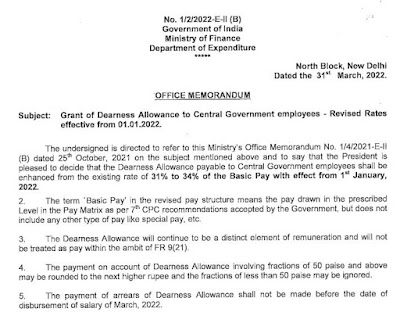
DA Jan 2022 - Grant of Dearness Allowance to Central Government employees - Revised Rates effective from 01.01.2022

 3% DA Hike - Revised Rates effective from 01.01.2022: DoE OM dated 31.03.2022 No. 1/2/2022-E-II (B) Government of India Ministry of Finance...