Saturday, 3 September 2016

2nd September 2016 General Strike Reflection of Workers’ Anger: Confederation Of Central Government Employees

2nd September 2016 General Strike
Reflection of Workers’ Anger
Hemalata

The country wide general strike on 2nd September this year was even bigger and more widespread than that held on the same day last year, as initial reports from all over the country suggest. The country wide general strike this year too was held on the same 12 point charter of demands. The central trade unions claimed a participation of 15 crore workers in the strike last year. The impact of the strike this year was so huge that even before the trade unions made any claims, the electronic media reported that 18 crore workers participated in the strike.

This gives big rebuff to the claims made by the government that it was working for the benefit of the workers and for providing them social security benefits. It is also significant that the BMS, which withdrew from the strike in the last minute in 2015, did not join the strike call this year at all. Besides, the BJP led government used everything within its capacity to create confusion among the workers and sabotage the strike. The BMS became a willing ally of the government in these efforts, declaring that it was ‘withdrawing’ from a strike that it has never called, but also claiming ‘historic victory’ for the workers. All these were nothing but manoeuvres by the BJP and the BMS, both members of the same parivar headed by the RSS to deceive the workers in their efforts to serve their corporate masters. The corporate media, particularly the electronic media, as usual, aired these false claims and added their might to the misinformation campaign.

But the working class of the country refused to be deceived. As the reports show, despite the call of the BMS leadership to organise ‘victory rallies and meetings’, BMS members were not willing to oppose the strike. In fact, in several places they joined the strike. Workers who were not organised into any unions, who joined the strike last year, as in Pune industrial area, joined the strike this time too. In several places the strike spread to newer areas encompassing newer sections of workers. In many states, not only the states that are traditional strongholds of trade unions, but in many others, the strike turned into a bandh. This was mainly due to the massive participation of the road transport workers as a result of which life in these states came to a standstill. In many districts of Assam, Bihar, Haryana, Jharkhand, Karnataka, Madhya Pradesh, Odisha, Punjab wore a bandh like look. Despite the attempts by the TMC government in West Bengal to suppress the strike by issuing warnings and threats to the workers, state transport buses in the state plied empty and a bandh like situation prevailed in almost all the districts. In Kerala and Tripura, as always, strike turned into a bandh.

The anger of the workers against the policies of the government was visible in many ways. Around 70000 anganwadi employees and ASHAs, most of them who were not members of any union joined the strike in Gujarat. Thousands of them participated in the demonstrations held at the district headquarters in many districts. All the workers in the minor ports of Bhavnagar in Gujarat, Gangavaram and Kakinada in Andhra Pradesh joined the strike. These workers are not members of any of the central trade unions that called the strike. Similarly in many industrial clusters across the country, thousands of workers, who are not members of any union, joined the strike.

While there were a few areas like the port sector where the strike was not as good as the last time, and a few districts where the strike in the road transport sector was not as effective as last year, overall the strike was observed in many more industrial clusters and sectors and many newer sections of workers joined it.
It was not only the misinformation and misleading campaign of the government with its huge advertisements in the media aided and abetted by the BMS that the workers confronted. In several states they were subjected to victimisation, police repression and physical attacks. In Haryana 22 leaders of road transport workers’ union were arrested and the striking workers were lathi charged; police went to the residential areas where contract workers lived and coerced them to join duties. Several coal workers in Jharkhand were suspended for joining the strike. The police conducted a flag march to intimidate workers and also lathi charged workers standing peacefully near a theatre in Noida. In West Bengal CITU leader and former MP Suraj Pathak and many CITU leaders were arrested. TMC goons attacked the workers and their supporters, including women, participating in the rallies. Around 5000 workers were arrested in different parts of Assam.

The extent of the strike and the support it received could be gauged from the reports that were available till the evening of 2nd September though comprehensive reports from all the states and sectors are yet to come. In several states local state level unions joined the strike. In Telangana, the TRS affiliated union joined the strike; the TNTUC belonging to the ruling TDP in Andhra Pradesh supported the strike in Telangana. Even in Vijayawada in Andhra Pradesh, though TNTUC opposed the strike, workers belonging to it joined the strike. In Odisha the chief minister himself expressed his support to the strike when the trade union leaders met him. The Left parties openly supported the strike. Even while the BMS was not part of the strike and BMS leadership directed its members to observe ‘victory rallies’, local units of the BMS were not in a position to oppose the strike; in several states BMS members joined the strike.

Overwhelming majority of bank and insurance employees all over the country joined the strike. State government employees in most of the states joined the strike. Particularly noteworthy is the participation of state government employees in the north eastern states including Arunachal Pradesh, Manipur, Mizoram, Nagaland, Meghalaya etc who participated in the strike for the first time. Participation of central government employees – of the income tax employees, postal employees in particular was massive. Defence employees in several defence production units joined the strike. BSNL employees all over the country joined the strike. The strike was near total in the coal sector. Overwhelming majority of contract workers in the public sector participated in the strike. Strike among medical and sales representatives was total in almost all the states.

Scheme workers including anganwadi employees, ASHAs, midday meal workers participated in the strike all over the country. Teaching and non teaching staff of National Child Labour Project joined the strike in Bihar, Maharashtra etc. Traditional sector workers like the plantation workers, cashew, coir, and fisheries workers participated in the strike in their lakhs. Unorganised workers in beedi, construction, head load workers, auto and rickshaw drivers, street vendors, domestic workers in several states joined the strike and also participated in the demonstrations, rasta roko and rail roko. Municipal and conservancy workers, panchayat workers, village chowkidars etc also joined the strike.

In Andhra Pradesh, strike was total in Vizag steel and DCI; around 70% of workers of permanent workers in the Vizag Shipyard participated in the strike. The TTD in the holy town of Tirupati was totally paralysed. Autos all over the state went on strike. Almost all the industrial clusters including the Renigunta industrial area were closed down. In several major cities truck owners associations participated in the strike. This along with the strike of the head load workers throughout the state brought all commercial transactions in the state to a standstill.

In Assam strike took the form of complete bandh in almost all districts seriously affecting public and private transport. No oil refinery in the state functioned. ONGC remained paralysed. More than 15 lakhs tea garden workers joined the strike. All public and private educational institutions remained closed. Railway transport was disrupted due to the rail roko by the unorganised workers, peasants, agricultural workers etc.

In Bihar too the strike was turned into bandh in many districts. Road transport including bus and tempo services was off the road. Workers in several industrial clusters went on strike.

Workers in almost all the major industrial areas in NCR Delh joined the strike. Massive joint demonstrations were held in several centres. The central demonstration was addressed by the national trade union leaders.
In Gujarat, an estimated 4 lakhs workers in 22 districts joined the strike and organised demonstrations in many districts.

Strike was highly successful in Haryana including in the Gurgaon, Manesar industrial areas. Workers in the Manesar plant of Maruti Suzuki, Honda, Hero Honda and other industrial units joined the strike and held demonstrations.

Demonstrations were held in Jammu region in support of the strike while Kashmir region continues to be under curfew. Thousands of workers from different sectors participated in the demonstrations
In Jharkhand strike was observed in industrial areas including in Jamshedpur that never participated in any strike till now. It was reported to be more massive than the strike in 2015.

An estimated 50 lakhs workers participated in the strike in Karnataka. Strike was total in the road transport sector and in all the major industries in Bengaluru and Mysore. 19 lakhs workers in the industrial clusters of Bengaluru joined the strike. Strike was total in both the units of Mico, L&T, Chenna metals, Toyota, ITC, Vikrant Tyres etc. In BEL in Bengaluru, the union affiliated to INTUC did not join the strike; despite this 80% of workers, 800 out of the total 1073 workers, more than the membership of the CITU affiliated union, joined the strike

The strike in transport sector in several cities and towns in Madhya Pradesh was total. Hamalis of agricultural mandis also participated affecting commercial transactions.
Strike was total in many private industrial areas in Maharashtra including the Pune, Aurangabad, Nagpur, Nasik, Mumbai, Solapur etc. Major industries like Ceat Ltd, Thysun Crupp, Sansonite India, Crompton Grieves, beer manufacturing units, pharma industries, liquor and textile industries were closed. Strike was total among beedi and power loom workers in Solapur.

Strike created a bandh like situation in Odisha. It was total among iron ore, manganese and coal mines workers and near total among the contract workers. Road transport including autos was totally paralysed.
Strike evoked massive response in Punjab with workers. Road transport was paralysed and industrial clusters remaining closed. Unorganised workers participated in the demonstrations in thousands.

The garment industry in Tiruppur in Tamil Nadu witnessed total strike. Strike was also effective in the Coimbatore industrial area. It was total in Ashok Leyland, Ennore Foundries, Simpson Group of companies and all three factories of TI Group in Chennai. Workers in BHEL Trichy and Ranipet, ordinance factory in Nilgiris, defence production units in Avadi and Aravangadu were totally in strike. In Aravangadu, BMS members also joined the strike. Contract workers in Manali industrial belt MFL, ATC Tyres in Tirunelveli and TCL Lancer, in L&T, in Tyre machinery making Honey Well company went on strike.

There was bandh like situation in the state due to the total participation of road transport workers in the strike in Telangana. There was total strike in most of the public sector undertakings in the state. Strike was also total in most of the industrial clusters in and around Hyderabad. On the whole the strike was reported to be even more successful than last year

Strike was total in Udhampur industrial area of Uttarakhand and partial in that in Haridwar. It was also total in public road transport in the state but partial in private road transport.

In West Bengal, bandh like situation prevailed in many districts despite the threats and intimidation of the TMC government and its goons. Government ran buses without passengers in the morning but was compelled to withdraw later. Jute mills were closed. Commercial activities were nominal. Educational institutions in several districts were closed. Most of the tea gardens remained closed.

This strike, the seventeenth joint country wide general strike after the advent of neoliberal policies in the country, was preceded by joint campaign that was better organised and taken up to the block and in some states lower level to reach the workers. In addition, CITU prepared campaign material to make the workers aware of the issues and their relationship to the government policies. Booklets exposing government claims were also published which were translated into local languages. During the strike the lower level committees were regularly up dated with information exposing government claims. This has helped in preventing the workers from succumbing to the confusion sought to be created by the government and the BMS.

This country wide general strike will definitely be a mile stone in the working class struggles of the country.

Source: confederation

Confederation of Central Government employees: PRESS STATEMENT Dated 2nd September 2016

Confederation of Central Government employees: PRESS STATEMENT Dated 2nd September 2016

PRESS STATEMENT
Dated 2nd September 2016

The initial report received at the Confederation Central Head Quarters indicate the participation of about ten lakhs Central Government employees in today’s nationwide general strike action of the Indian Working Class. Earlier, endorsing the call of the Central Trade Unions, the Confederation of Central Government employees and workers had called upon the Central Government employees to take part in the one-day strike to compel the Government to withdraw the anti-people and anti-labour neo-liberal policies pursued by the Central Government.

Offices of the Postal, Income Tax, Ground Water Board, Survey of India, Geological Survey of India, Printing and Stationery department, Botanical Survey of India, Indian Bureau of Mines, RMS offices, census department, Indian Space Research organization, Central Government Health Scheme, Atomic Energy, Medical Stores depots, Film Institute of India, AGMARK, Indian Council for Medical Research, Film division and various other autonomous scientific and research institutions etc. remained closed and the work completely paralysed.

The strike also affected the functioning of various offices of Indian Audit & Accounts department, Civil Accounts, Central Excise and Customs, CPWD etc. Total civilian employees of various Defence organisations and Defence Accounts Departments participated in the strike. The Strike was total in Kerala, West Bengal, Tamilnadu, Andhra, Telangana, Jharkhand, Chattisgarh, Odisha, Assam, North Eastern states, Karnataka, Maharashtra, Punjab, Madhya Pradesh and 70 to 80% in other states.

The Central Government employees were particularly unhappy over the totally negative attitude of the NDA Government towards their demands while implementing 7th Central Pay Commission recommendations. Ban on creation of new posts, non-filling up of about six lakhs vacant posts, introduction of New Contributory Pension Scheme, non-regularisation of Gramin Dak Sevaks and casual, contract workers, ceiling on compassionate appointments, rejection of the demand for increase in the minimum wage and fitment formula, reduction in the percentage of House Rent Allowance, abolition of 52 allowances etc. are some of the retrograde measures taken by the Central Government.

The Confederation National Secretariat Congratulates the Central Government employees, who undertook intensive campaign to make the strike a grand success. The Confederation salutes all its members for their whole hearted participation in the strike and making it an unprecedented success.
M. Krishnan
Secretary General
Confederation

HRD Ministry may relax norms for opening new KVs

HRD Ministry may relax norms for opening new KVs

New Delhi: With land scarcity becoming an issue, the Union HRD ministry is considering relaxing the norms for opening new Kendriya Vidyalaya schools.

According to sources, as per the present norms for starting a new Kendriya Vidyalaya school, 10 acres of land is needed in rural areas while 8 acre land is required if the school is to come up in an urban area.
For Metros, 4 acres of land is required.

“There are sometimes issues related to availability of the land. So it is being considered that the present norms may be relaxed,” a source said.

Officials said that the issue has been discussed at the highest level in the HRD ministry including minister Prakash Javadekar and a decision in this regard may be taken in the coming days.

There are over a thousand Kendriya Vidyalayas in the country which are run by the HRD ministry. Often these schools are opened up by the ministry at requests of the state governments.

PTI

Pensioners to supervise government jobs recruitment exams

Pensioners to supervise government jobs recruitment exams

New Delhi: In a first, the Centre has decided to rope in pensioners to supervise government jobs recruitment exams conducted by Staff Selection Commission(SSC)

The SSC, which conducts examinations to select hundreds of candidates for various mid-level central government jobs, has written to Personnel Ministry in this regard.

The retired central government employees will be engaged as Inspecting Officers and members of the flying squad for conducting and supervising of examinations at various places, according to a note by the ministry.

The SSC has also sought a list of pensioners from the ministry to choose appropriate candidates, it said.

The Commission is one of the largest recruiting agencies in the country mandated to conduct eight exams.
There are about 58 lakh central government pensioners.

The Personnel Ministry already maintains a repository of pensioners in an online initiative called Sankalp, which provides a platform for the pensioners to access opportunities available for useful interventions in the society.

It also facilitates the organisations working in these areas to select appropriate skill and expertise from the available pool of volunteers.

There are 1,815 pensioners registered with the Sankalp. The ministry wants all pensioners to get themselves registered on this platform.

PTI

Brief of the second meeting of the Committee on Allowances held today under the chairmanship of Secretary, Finance(Expenditure), Government of India

Brief of the second meeting of the Committee on Allowances held today under the chairmanship of Secretary, Finance(Expenditure), Government of India
National Council (Staff Side)
Joint Consultative Machinery
for Central Government Employees
Shiva Gopal Mishra
Secretary

No.NC/JCM/2016
Dated: September 1, 2016
All Constituents of
National Council(JCM)

Dear Comrades!

Sub: Brief of the second meeting of the Committee on Allowances held today under the chairmanship of Secretary, Finance(Expenditure), Government of India

To obtain the views of the National Council(Staff Side)(JCM) on the recommendations of 7th CPC relating to Allowances, the second meeting of the Committee on Allowances held today under the chairmanship of Secretary, Finance(Expenditure), Government of India, with the National Council(Staff Side) JCM.
From the Official Side, Secretary(Defence), Home, DoP&T, Postal, Chairman Railway Board, J.S.(Estt.), J.S.(Pers.) and J.S.(IC), and from Staff Side(JCM), all the Standing Committee Members were present in the meeting.

At the outset, Secretary(Staff Side)(JCM) as well as Leader(Staff Side)(JCM) and other Standing Committee Member of the NC/JCM(Staff Side) expressed their anguish for non-formation of High Level Committee as was agreed to by the Group of Ministers(Government of India) for settling the issue of Minimum Wage and Multiplying Factor.

The Secretary, Finance(Expenditure) told that, the committee constituted under the chairmanship of Addl. Secretary(Exp.) with J.S.(Pers.), JS(Estt.) and JS(Imp.) as Members has been made only for this purpose. Let us believe that, after the meeting, report of the said committee would be sent to the Government of India for its acceptance.

The Secretary, Finance(Expenditure) asked the Staff Side(JCM) to give their viewpoint in a Note on the Common Demands to implement these, and the Departmental grievances to their respective departments, and after that, a meeting will again be called.

Staff Side(JCM) strongly demanded that, date of effect of Allowance should be 01.01.2016. The Staff Side(JCM) explained its position as well about its demand that, House Rent Allowance should be 10%, 20% and 30% and Transport Allowance must be rationalized and exempted from the Income Tax, Children Education Allowance should be Rs.3,000 and Hostel Subsidy should be Rs.10,000 and these should also be exempted from the Income Tax.

Staff Side demanded that, Post Graduate and Professional Courses should also be covered in Children Education Allowance. The issue of Special Duty Allowance was also raised for N.E. Region by the Standing Committee Members of JCM(Staff Side). Fixed Medical Allowance should be Rs.2,000 with Dearness Allowance Indexation, Over Time Allowance must be given, Small Family Allowance should be continued and Dress Allowance needs to be reviewed. Various Departmental Allowances, which have been abolished, should be allowed to continue, like Breakdown Allowance in the Railways and Fixed Conveyance Allowance to Postal Department employees. All the Standing Committee Members raised various issues related to Allowances.

This is for your information.
Comradely yours
sd/-
(Shiva Gopal Mishra)
Secretary Staff Side
Source : ncjcmstaffside

Friday, 2 September 2016

Implementation of Government's decision on the recommendation of the Seventh Central Pay Commission- Revision of provisions regulating pension / gratuity / commutation of pension / family pension / disability pension / exgratia lump-sum-compensation, etc-reg.

No.14021/4/2016-AIS(II)
Government of India
Ministry of Personnel, P.G. and Pension
Department of Personnel & Training
New Delhi, the 1st September, 2016.
To,
The Chief Secretaries of
All States/Union Territories.

Sub: Implementation of Government's decision on the recommendation of the Seventh Central Pay Commission- Revision of provisions regulating pension / gratuity / commutation of pension / family pension / disability pension / exgratia lump-sum-compensation, etc-reg.

Sir,
I am directed to say that in pursuance of Government's decision on the recommendations of the Seventh Central Pay Commission, the Department of Pension & Pensioners' Welfare by its OM No. 38/37/2016- P&PW (A)(i),(ii) and Resolution dated 4th August 2016 (copies enclosed) has issued the necessary detailed order for implementation of Government's decision on the recommendation of the Seventh Central Pay Commission- Revision of provisions regulating pension/gratuity/commutation of pension/family pension/disability pension/ex-gratia lump-sum-compensation etc. under the CCS (Pension) Rules, 1972 and Commutation of Pension under CCS (Commutation of Pension) Rules 1981, CCS (
Extraordinary Pension) Rules 1939 etc.

2. The applicability of the provisions of aforesaid Office Memorandums of the Department of Pension & Pensioners Welfare to the members of All India Services has been considered. It has been decided that the provisions contained in the aforesaid

Office Memorandum issued by the Department of Pension & Pensioners shall be equally applicable Mutatis-Mutandis to members of All India Service governed by the ATS (DCRB) Rules, 1958.

Encl : as above.
Yours faithfully,
(Kavitha Padmanaban)
Deputy Secretary(Services)

amount of additional pension will be Shown distinctly in the pension payment order, For example, in case where a pensioner is more than BO years of age and his pension is Rs.10,000 pm, the pension will be shown as (i) Basic pension=Rs.10,000 and
(ii)Additional pension Rs.2,000 pm. The pension on his attaining the age of 85 years will be shown as
(i).Basic Pension =-Rs.10,000 and (ii) additional pension = Rs.3,000 pm.
Retirement/Death Gratuity

6.1 The rates for payment of death gratuity shall be revised as under:
 
Length of Qualifying service
Rate of Death Gratuity
Less than one year
2 times of monthly emoluments
One year or more but less than 5 years
6 times of monthly emoluments
5 years or more but less than 11 years
12 times of monthly emoluments
11 years or more but less than 20 years
20 times of monthly emoluments
20 years or more
Half month’s emoluments for every completed six monthly period of qualifying service subject to a maximum of 33 times of emoluments


  Accordingly. Rule 50(1)(b) of MS (Pension) Rules, '1972 shall stand modified to this extent.
6.2 The-maximum limit of Retirement gratuity and death gratuity shall be Rs, .20 The ceiling on gratuity will increase by 25% whenever the dearness allowance rises by 50% of the basic pay. Accordingly, first proviso under Rule 50(1)(b) of CCS (Pension)
Rules, 1972 shall stand modified to this extent.
 Click to view the circular

Official Calculator for 7th CPC Revised Pension and Arrears for Pre-2016 Pensioners and Family Pensioners

Official Calculator for 7th CPC Revised Pension and Arrears for Pre-2016 Pensioners and Family Pensioners
 

 7th CPC Revised Pension and Arrears Calculator for Pre-2016 Pensioners and Family Pensioners by Pensioners Portal

Pensioner’s Portal has provided the Revised Pension Calculator for Pre- 2016 Pensioners and Family Pensioners. Now, Pensioners and Family Pensioners may get their Pension with Arrears under 7th Central Pay Commission. The Revised Pension/Family Pension Calculator for Pre-2016 Pensioners updated Under Pensioner’s Portal, Government of India. The Easy way to find and get their Pension under Seventh Pay Commission.

Click here to Official Calculator for 7th CPC Revised Pension and Arrears for Pre-2016 Pensioners and Family Pensioners

7th Pay Commission: Central government employees to abstain from work today demanding hike in pay

7th Pay Commission: Central government employees to abstain from work today demanding hike in pay

New Delhi: Central government employees will abstain from work on Friday to press for review of the hike in minimum pay and raising fitment factor 3.68 times from 2.57 times approved by the government based on the pay commission recommendations.

The National Joint Council of Action (NJCA) representing 33 lakh central employees has decided to join the general strike on Friday in order to get their demand of hike in minimum pay, as the government’s recent talks on Tuesday and Thursday with them got no result.

The Centre has fixed a minimum wage of Rs 18,000 in the pay hike approved by the Cabinet on June 29. However, the central government employees are protesting the decision calling it a meagre rise in view of the price rise.

“Government has initiated talks with NJCA. We welcome it. But the decision was not made of hike in minimum pay,” Convener of NJCA Shiv Gopal Mishra said.

On August 30 and September 1, the representatives of NJCA including Mishra were called for a meeting with secretaries of national anomaly committee and allowances committee respectively.

““I don’t think there will be result, and if there is any result, that will be sufficient for the central government employees. They have delayed the issue of minimum wage and fitment formula,” Mishra said.

Under the fitment formula, the government multiplied the minimum wage of Rs 7,000 fixed in the last pay commission with 2.57 and arrived at a minimum pay of Rs 18,000 per month.

The employees are demanding for the fitment formula of 3.68, which will result in minimum monthly pay about to Rs 26,000.

The National Joint Council of Action (NJCA) is an umbrella organisation of various Central Government employees’ unions, including Railways, post and telegraph and Income Tax.

However, the promise was already made by Finance Minister Arun Jaitley to consider to hike the minimum pay of central government employees beyond Rs 18,000.

TST

New Delhi: The Central Trade Unions (CTU) have called for a strike across the country on Friday to express their disagreement with the Central Government’s “unilateral labour reforms and anti-worker policies”.

New Delhi: The Central Trade Unions (CTU) have called for a strike across the country on Friday to express their disagreement with the Central Government’s “unilateral labour reforms and anti-worker policies”.

The unions have claimed that this year’s strike will be bigger as the number of striking workers is expected to swell as much as 18 crore, larger than last year when around 14 crore workers participated.
Gurudas Dasgupta General Secreatary of All India Trade Union Congress (AITUC) said, “Most important is control of inflation, particularly the food inflation, social security for the unorganised labour, minimum wage for all unorganised should be Rs. 18,000, road is an investment for profit making public sector, low margin of banks etc are the main demand on which we are going on strike.”

Essential services such as banking, public transport and telecom will be affected by the strike.
The CTUs will strike work protesting against what they call the government’s apathy towards their 12-point charter of demands including a monthly minimum wage of Rs. 18,000, controlling price rise and assured minimum monthly pension of Rs. 3,000.

However, Indian Railways and other central government employees will not participate in strike as government has already constituted a committee to look into their demand of raising monthly minimum wage from Rs 18,000 to about Rs. 26,000 under the 7th Pay Commission.

Resonating similar sentiments, Roman Pandey of Indian National Trade Union Congress told ANI that they are against the handing over of defence and railway industry to the private players.

“We want that ILO conventional 87, 98 needs to be ratified because this gives protection of job security and social security to working people and they have the right to join union of their choice, they can go for collective bargaining. These global rights are being denied by the government. wherever the assured in Geneva in ILO that we are going to ratify, we are fighting for that,” he added.

The Bhartiya Majdoor Sangh (BMS) has decided not to participate in strike.

“We gave the notice to the government, but when the government took the step forward then we decided to withdraw from the strike. The effect of strike is not visible, as the entire rail system is working. They have tried a lot to mislead the people but that phase is over, now no one from Bhartiya Mazdoor Sangh will be part of this strike,” BMS organising secretary Pawan Kumar told ANI.

Last year also on September 2, the union has opted out of the strike at the last moment.

Thursday, 1 September 2016

Central Trade Unions reiterate countrywide General Strike on 2nd September 2016 – Press Statement

Released in the Press Conference of CTUOs held on 31st August 2016 at Press Club, New Delhi
Press Communique
31st August 2016

Central Trade Unions Reiterate countrywide General Strike on 2nd Sept, 2016 Group of Ministers (GOM) Announcement an eyewash

The Central Trade Unions reiterate the call for countrywide general strike on 2nd September 2016 against the anti-worker and anti-people policies of the Govt. in view of utterly unresponsive and undemocratic attitude of the Govt. The CTUs view the announcements made by Committee of Ministers as an eyewash and decide to go ahead with the Strike. Meagre raise in minimum wage to Rs.9100/- per month in central sphere is not binding on the States.

The CTUOs expressed dismay over utterly negative attitude of the Govt. towards basic demands of the workers on minimum wages as per consensus formulation of the Indian Labour Conference, on universal social security including pension for all workers including those in unorganised sector, against mass scale contractorisation of permanent and perennial work, against onslaught on basic rights of the workers through so called labour-law-reforms through various state governments and also by the centre in the background of large scale violation of labour laws being promoted by both the central govt and also many state govts, desperate move for privatisation/disinvestment of strategic and sensitive public sector units, and promoting limitless FDI in sensitive sectors like Defence, Railways, Banks, Insurance, Retail and Pharmaceuticals etc. which is also against the interest of the national economy.

The CTUOs made it clear that the desperate bid of the Govt for changing the labour laws both through central and many state govts is basically designed to throw even the overwhelming majority of the organised sector workers out of the coverage and purview of all basic labour laws which would render all other rights and benefits of the working people virtually meaningless.

The CTUOs also noted with dismay that the Govt while making public statement on being positive on the demands of the workers, has actually been actively pushing through executive measures, one after another, just in the opposite direction, against the interest of the working people in the grab of ensuring so called “else of doing business”. All these proactive initiatives militate against the basic interests and rights of the working people. Even the non-striking Central Trade Union also officially recorded its opposition.

The CTUOs expressed satisfaction over the increasing response by the workers throughout the country to the call for united action. The strike is going to be complete in industrial sectors such as transport, financial, power, coal, textile, automobile, port and dock, steel, oil, defence production, scheme, education etc.
sectors and Central and State Govts. employees. In some states it is going to be bandh like situation.

It is unfortunate that during the past one year, the Group of Ministers appointed for discussion with the CTUOs on 12 point charter has not convened even a single meeting but has been only talking to BMS which has not joined the strike call. The CTUOs denounce such undemocratic bias of the Govt.

The CTUOs condemn the move of the central govt to divide the workers in the face of ongoing strike campaign and create confusion through making misleading statements on its so called positive attitude on workers’ demands both directly and through their various agencies and allies.

While expressing confidence that such dubious action to divide the workers will not succeed, the CTUOs appeal to the working people of the country irrespective of affiliations to further widen their unity and unitedly combat the anti-worker, anti-people policies of the Govt through making the call for countrywide general strike on 2nd September 2016 a total success.

AITIC
HMS
OIFU
AIUTUC
SEWA
AICCTU
UTUC
LPF
And independent federations of Workers/Employees.

Source http://confederationhq.blogspot.in

Flash News

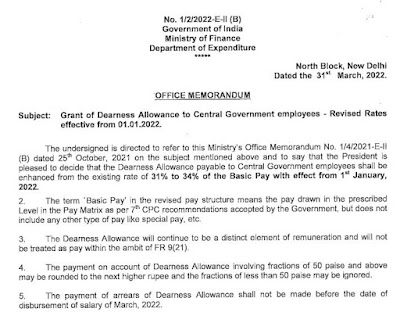
DA Jan 2022 - Grant of Dearness Allowance to Central Government employees - Revised Rates effective from 01.01.2022

 3% DA Hike - Revised Rates effective from 01.01.2022: DoE OM dated 31.03.2022 No. 1/2/2022-E-II (B) Government of India Ministry of Finance...