Thursday, 31 March 2016

Expected DA July 2016 – AICPIN For February 2016

Expected DA July 2016 – AICPIN For February 2016

Expected-DA-july-2016-AICPIN-CG-Employees

No.5/1/2016- CPI
GOVERNMENT OF INDIA
MINISTRY OF LABOUR & EMPLOYMENT
LABOUR BUREAU
CLEREMONT, SHIMLA-171004
DATED: 31st March,2016
Press Release

Consumer Price Index for Industrial Workers (CPI-IW) – February, 2016

The All-India CPI-IW for February, 2016 decreased by 2 points and pegged at 267 (two hundred and sixty seven). On 1-month percentage change, it decreased by (-) 0.74 per cent between January, 2016 and February, 2016 when compared with the decrease of (-) 0.39 per cent between the same two months a year ago.

The maximum downward pressure to the change in current index came from Food group contributing, (-) 2.21 percentage points to the total change. At item level, Rice, Arhar Dal. Masur Dal, Moong Dal, Urd Dal, Groundnut Oil, Mustard Oil, Poultry (Chicken), Eggs (Hen), Garlic, Onion, Vegetable and Fruit items, Flower/Flower Garlands, etc. are responsible for the decrease in index. However, this decrease was checked by Wheat and Wheat Atta, Fish Fresh, Goat Meat, Milk, Tea (Readymade), Sugar, Cigarette, Tailoring Charges, etc., putting upward pressure on the index.

The year-on-year inflation measured by monthly CPI-IW stood at 5.53 per cent tbr February, 2016 as compared to 5.91 per cent for the previous month and 6.30 per cent during the corresponding month of the previous year. Similarly, the Food inflation stood at 6.18 per cent against 7.61 per cent of the previous month and 7.42 per cent during the corresponding month of the previous year.

At centre level, Giridih reported the maximum decrease of 8 points followed by Madurai, Tiruchirapally, Munger-Jamalpur and Bengaluru (7 points each) and Sholapur. Mundakkayam and Belgaum (6 points each). Among others. 5 points decrease was observed in 3 centres, 4 points in 8 centres, 3 points in another 8 centres. 2 points in 14 centres and 1 point in 10 centres. On the contrary, Quilon recorded a maximum increase of 5 points followed by Mysore and Rajkot (3 points each) and Kodarma (2 points). Among others, 1 point increase was observed in 9 centres. Rest or the 14 centres’ indices remained stationary.
The indices of 34 centres are above All-India Index and other 44 centres’ indices are below national average.

The next issue of CPI-IW for the month of March, 2016 will be released on Friday, 29th April, 2016. The same will also be available on the office website www.labourbureaunew.gov.in.
(SHYAM SINGH NEGI)
DEPUTY DIRECTOR GENERAL
PIB

Click to view Press Release in English
Click to view Dettailed Report of AICPIN

Validity period of OBC Certificate in respect of ‘creamy layer’ status of the candidates

 F. No. 36036/2/2013- Estt.(Res-I)
Government of India
Ministry of Personnel, Public Grievances & Pensions
Department of Personnel & Training
Establishment Reservation — I Section
North Block, New Delhi
Dated 31st March 2016
OFFICE MEMORANDUM

Subject: Validity period of OBC Certificate in respect of ‘creamy layer’ status of the candidates
***
This Department has received various references on the issue of problems being faced by the candidates on the requirement to obtain multiple non-creamy layer OBC certificates for appearing in various examinations. With a view to address this issue, the following revised procedure is proposed:-

(a) Every candidate seeking reservation in central government posts and services as OBC candidate is required to submit a certificate confirming his/her status as OBC and also produce Non-creamy layer status issued by an authority mentioned in DOPT Office Memorandum No.36012/22/93-Est(SCT) dated 15.11.1993.

(b) The Non-creamy Layer Certificate would be applicable to OBC candidates who are covered under Income/Wealth Test criterion. The income limit is decided on the basis of income earned during three previous financial years preceding the year of appointment. To illustrate, the validity of non-creamy layer certificate issued during any month of the financial year 2016-17 covering 3 preceding financial years viz. 2013-14, 2014-15 and 2015-16 be accepted by the concerned authorities for any appointments or recruitments which would be valid during the period April 2016 to March 2017. The appointing authorities would accept production of self-attested photo copy of the Non-creamy layer certificate, subject to verification of the original Non-creamy layer certificate, as is the practice being followed for verification of other original documents.

2. On this issue, the National Commission of Backward Classes has suggested a new format for issue of Non-creamy layer certificate, which is enclosed.

3. It is requested that comments on the suggestions made in para 1 of this OM and any other suggestion(s) to streamline the system of issue of Non creamy layer certificate (NCL) may please be furnished.

4. It is also requested that comments on the Non-creamy layer certificate format proposed by NCBC, may also be furnished.

Encl: as above
(Raju Saraswat)
Under Secretary
Tele: 2309 2110
1. M/o Social Justice and Empowerment,
[Kind Attn: Shri B. L. Meena, Joint Secretary]
Shastri Bhawan, New Delhi

2. Department of Higher Education,
[Kind attn: Shri S. S. Sandhu, Joint Secretary]
Shastri Bhawan, New Delhi

3. The Secretary,
Union Public Service Commission,
Dholpur House, Shahjahan Road, New Delhi — 110069

4. The Secretary Staff Selection Commission,
Block No. 12, CGO Complex, Lodhi Road, New Delhi — 110 003

Copy with a request for seeking comments on the suggestions made in para 1 of this OM also forwarded to The Member Secretary, National Commission for Backward Classes, Trikoot – 1, Bhikaji Cama Place, New Delhi -110 066.

Copy also to Director, NIC, DOPT — with a request to place this draft OM on the website of this Department for a period of 30 days from its issue, for obtaining views of concerned stakeholders.

APPLICATION FORM FOR NON – CREAMY LAYER CERTIFICATE

Central Civil Services (Leave Travel Concession) Rules, 1988 — Fulfillment of procedural requirements

No. 31011/3/2015-Estt (A.IV)
Government of India
Ministry of Personnel, Public Grievances and Pensions
Department of Personnel and Training
Establishment A-IV Desk
North Block, New Delhi-110 001
Dated: March 29 , 2016
OFFICE MEMORANDUM

Subject:- Central Civil Services (Leave Travel Concession) Rules, 1988 — Fulfillment of procedural requirements-reg.

The undersigned is directed to enclose a copy of draft O.M. on the subject noted above for comments within 15 days to the undersigned (email address: jha.sn@nic.in).
(Surya Narayan Jha)
Under Secretary to the Government of India
To
The Secretaries
All Ministries / Departments of Government of India
(As per the standard list)

Subject:- Central Civil Services (Leave Travel Concession) Rules, 1988 — Fulfillment procedural requirements. 

The undersigned is directed to refer to para 8 and 9 of the Guidelines enclosed in this Department’s O.M. of even number dated 18.2.2016 on the above noted subject and to say that the issues have been revisited in consultation with the Department of Expenditure. It has been decided that the cases where a Government servant travels on LTC upto the nearest airport/railway station/ bus terminal by authorised mode of transport and undertakes rest of the journey to the declared place of visit by private transport/own arrangement, may be dealt with as follows:-

(i) When public transport is available between the nearest airport/railway station/ bus terminal and the declared place of visit:-
The Government servant may also be reimbursed the fare incurred for completion of journey to the declared place of visit by own arrangement. This will be restricted to the fare admissible for journey by otherwise entitled mode of public transport from the nearest airport/railway station/ bus terminal to the declared place of visit. The Government servant shall be required to submit an undertaking that he has actually visited the declared place of visit.
(ii) Where no public transport is available between the nearest airport/railway station/bus terminal and the declared place of visit:-
(a) In case he does not wish to claim reimbursement for the part of the journey which he has undertaken by his own arrangement, he may be reimbursed for the part of the journey which he has undertaken by public transport. The Government servant shall be required to submit an undertaking that he has actually visited the declared place of visit.
(b) Where the Government servant claims assistance for the entire journey, the part of the journey where he has used his own arrangement would also be reimbursed as per his entitlement for journey on transfer. The Government servant shall be required to submit an undertaking that he has actually visited the declared place of visit.
2. In case of (b) above, the Government servant shall be required to submit a certificate that the mode of transport used by him operates from point to point on regular basis with the approval of the State Government/Transport authorities, and is authorised to ply as public carrier.

3. Above certificate need not be insisted upon in case information to the effect that (i) no public transport is available in a particular area, (ii) list of transport operators who operate on regular basis from point to point on regular basis with the specific approval of the State Government/Transport authorities, is available on the website of a State/Central Government or a State or Central PSU or in a current publication brought out by these authorities.
(Surya Narayan Jha)
Under Secretary to the Government of India
To
The Secretaries
All Ministries/Departments of Government of India
(As per the standard list)

Circular

Election Commission Provides Complaint Redressal Mechanism- Call Centre & Web-Based Management During Ongoing Elections


ECI Provides Complaint Redressal Mechanism- Call Centre & Web-Based Management During Ongoing Elections

In view of the ongoing elections, the Election Commission of India (ECI) has issued instruction to provide a Complaint Redressal Mechanism in all the five election going states. The main objective of this IT platform is to provide the following:
i. Manage the complaints being received through call centres/telephone/online/fax/ post /paper complaints/in person in an integrated way and a time bound manner.
ii. Inform the complainants about the status of receipt and disposal of complaints.
State wise steps being undertaken by the Commission are as follows:

In Assam :- The complaints are received through (i) toll free number 1950, (ii) online application ‘SAMADHAN’ available at district websites with URL http://election.cloudapp.net/assam-samadhan and at CEO website www.ceoassam.nic.in (iii) Android based mobile application available in Google Play Store as SAMADHAN [ASSAM]. Individual can lodge complaints in physical copies in person/post/fax etc. and can still get SMS or view status of complaints if s/he wishes to.

In Kerala:- e- Pariharam has been lodged in Kerala to facilitate lodging complaints online. Complainants can also visit Akshaya Centres (CSC) and use helpline numbers. Complainants will receive SMS alerts while lodging as well as at the time of disposal of complaints. Photos/videos can be uploaded as part of complaints. The URL of website is: http://e-pariharam.kerala.gov.in

In Tamil Nadu:- In Tamil Nadu, apart from paper, phone, e-mails, online modes of complaint receipt, the complaints are also being received through Facebook, twitter etc. The option for lodging online complaint is available on website of CEO, Tamil Nadu: http://www.elections.tn.gov.in/

In West Bengal:- In West Bengal the IT platform is available at the URL: http://election.cloudapp.net/wb-samadhan . The App is also available in the form of mobile App at Google Play Store: SAMADHAN [WEST BENGAL]. The disposal period of complaints received has been prescribed as 24 hrs in general, and ½ hour on poll day.

In Puducherry:- CEO, Puducherry has established 24×7 helpline call centre with 5 dedicated trunk lines under supervision of an officer of Tehsildar level. Complaints are also being received through SMS, Whatsapp (8903331950), e-mail etc. The online complaints registering mechanism is also available for the use of public.

Through these Complaint Redressal Mechanisms, the Election Commission of India ensures that complaints at all level are properly addressed and timely redressed and the entire election process is made smooth, hassle free, transparent and effective.

PIB

Madhya Pradesh Government Nods to Hike MLAs’ Salary, Allowance

Madhya Pradesh Government Nods to Hike MLAs’ Salary, Allowance

MLAs in Madhya Pradesh are set to become richer with the BJP-led state government giving a nod to hike their salary and allowance.

The decision was taken today at the state cabinet meeting chaired by Chief Minister Shivraj Singh Chouhan.
The government gave a go-ahead for the rise in the salary and perks of members of the MP Assembly after a gap of six years.

The Bill to this effect is expected to be tabled tomorrow during the ongoing budget session of the House for clearance, which is going to be a mere formality, as the MLAs from all parties want the hike, a senior state minister said.

With the development, the salaries and allowances of MLAs will go up to Rs 1.10 lakh from the present Rs 71,000.

Besides, Chief Minister and the Speaker’s salary will increase to Rs 2 lakh from Rs 1.43 lakh and to Rs 1.85 lakh from Rs 1.20 lakh respectively.

Likewise, ministers’ pay and perk will increase to Rs 1.70 lakh from the current Rs 1.20 lakh.
The ministers of state will get Rs 1.50 lakh from the present Rs 1.03 lakh.

An opposition Congress MLA preferring anonymity said they too needed the hike “desperately” because of soaring inflation.

PTI

Wednesday, 30 March 2016

7th CPC Dearness Allowance : A decade-long journey begins!

7th CPC DA : A decade-long journey begins!

“The Dearness Allowance calculations as per the recommendations of the 6th Central Pay Commission come to an end; the method prescribed by the 7th Central Pay Commission comes into effect from Jan 2016 onward…!”

The 7th Central Pay Commission was appointed in order to evaluate the methods of calculating the salaries, incentives, benefits, pensions, retirement benefits, and Dearness Allowance of the Central Government employees and serving and retired personnel of the Indian defence forces, and suggest changes, if and when required. Four months have passed since the Central Pay Commission submitted its final report to the Centre.

The government at the centre has the discretion to accept, reject, or modify the recommendations made by the Central Pay Commission. It has constituted a high-level committee to look into the various suggestions in the report. The final decision on the implementation of the recommendations will be made based on the feedback from this empowered committee.

Meanwhile, the Central Government employees federations met with the high-level empowered committee to discuss various issues, including Minimum Wages and Fitment Factor, and to suggest required amendments in the report.

There is likely to be a delay in the publication of the notification containing the accepted recommendations by the 7th Pay Commission. Since the election Model Code of Conduct will be in place until the last week of May 2016, the Government acceptance notification is expected to be published in the first week of June. In that case, there are chances that the revised salaries will be issued from the month of June. Also, the arrears for the past five months are also likely to be released then.

Dearness Allowance is one of the much-anticipated topics among Central Government employees. In its report, the 7th Central Pay Commission had given a short explanation about Dearness Allowance.

The 6th Central Pay Commission suggested elaborate changes in the method of calculating Dearness Allowance. This time however, the 7th Central Pay Commission did not suggest any elaborate changes. It has suggested that the same process be continued.

We have presented an easy-to-use calculator here for you to calculate the likely Dearness Allowance hike. (Click to Calculate Expected DA)

We have presented a ready reckoner of the procedures that were followed when the 5th Central Pay Commission drew to a close and the 6th Central Pay Commission came into effect, which are very likely to be followed this time too.

The AICPIN points of only the month of January are available as of now. The AICPIN points for February will be released tomorrow.

You can come up with approximate AICPIN points for the remaining four months to calculate the approximate Dearness Allowance.

As of January 1, 2016, according to the Centre, the Dearness Allowance stood at 125 percent. An order of the Ministry of Finance to this effect will be released soon. In the event that the 7th Central Pay Commission recommendations come into effect from January 1, 2016 onwards, the salaries of the Central Government employees will be revised by adding 125 percent to their basic pay. The new Dearness Allowance hike will be issued from 01.07.2016 onwards.

For example, if the basic pay of an employee, as on 01.01.2016, is Rs.12,000 (Grade Pay 2800 + 9200), his salary revisions and Dearness Allowance hikes as per the 6th and 7th Central Pay Commission recommendations, are given below.

Employee’s Pay as on 1.1.2016 as per the recommendations of 6th CPC
Basic Pay + 125% DA: 12000 + 15000 = 27000
Employee’s Pay as on 1.1.2016 as per the recommendations of 7th CPC
Basic Pay + No DA: 31000 + 0 = 31000

(No Dearness Allowance for the period between Jan to Jun 2016 and the first instalment of additional DA will be given only on 1.7.2016)

Source: 7thpaycommissionnews.in


Organizational Restructuring of EPFO Approved to Address Career Progression of Over 20000 Officials

Organizational Restructuring of EPFO Approved to Address Career Progression of Over 20000 Officials

Inoperative EPF Accounts that Stopped Earning Interest in 2011, Now to Earn Interest W.E.F. 01.04.2016
Software Module for Disbursal of Salaries to EPFO Launched

EPFO’s highest decision making body, the Central Board of Trustees methere last evening . This was its 212th meeting.The Union Minister for Labour and Employment (Independent Charge) and Chairman CBT, Mr BandaruDattatreya after the conclusion of the meeting said that the Board has taken two important decisions.

The first is in relation to Organisational Restructuring of EPFO. While approving the report in principle, the Board also constituted a Committee to look into the anomalies/gaps pointed out by the Board members. The committee chaired by the Central Provident Fund Commissioner has been asked to submit this report to the Board in a month’s time.

The Second major decision was to allow crediting of interest on inoperative accounts. Accounts of members who do not receive contributions for a continuous period of three years are treated as “Inoperative accounts”. Interest on these accounts was stopped in 2011. The Board decided to resume crediting interest on such accounts w.e.f. 01.04.2016

This is in view of recent amendment to paragraph 69(1) (a) that has been amended to provide for withdrawal of full amount on retirement from service after attaining the age of 58 years.Thus, the employer’s share of contribution in the provident fund account of a member would be withheld by EPFO up to the age of retirement. Hence the decision has been taken, to credit interest as per paragraph 60 of the employees ‘Provident Funds Scheme, 1952. Such an account would not be classified as an “Inoperative Account” for the purpose of paragraph 72(6) of EPFO Scheme, 1952.

The Union minister on the occasion also launched a Software module for disbursal of Salaries to EPFO. The Organisation is bringing IT (Information Technology) enabled systems to manage its Human Resources.

Better Human Resources management would bring further improvement in the service delivery by the offices.
The software will achieve the following objectives: –
– Uniformity in preparation of salary across all offices of Organization.
– Provision of Upload facility for existing data to enable speedy & correct data capture.
– No need to enter data for subsequent months. Only changes are required to be entered.
– Automated TAX calculation.
– Automated Staff Provident Fund and Loan Accounting.
– Provision to make calculation of arrears when required.
PIB

7th Pay Commission pay structures likely to be revised

7th Pay Commission pay structures likely to be revised

7th-CPC-Latest-News-7CPC

Cabinet Secretary P K Sinha who is heading the high-powered secretaries committee to examine the report of the 7th Pay Commission is likely to revise pay structures of central government employees before handing over it to Finance Minister Arun Jaitley in June.

The Finance Ministry sources said: “the proposal will be placed before the cabinet for nod after the Finance Minister’s review.

“We don’t think secretaries committee will be able to hand over proposal to Finance Minister before June, considering time taking process of Implementation Cell in the Finance Ministry which works as the Secretariat of the secretaries committee to review demands submitted by the central government employees unions. However, the new pay structure will be effective from January 1,” sources further said.

The Pay Commission headed by Justice A K Mathur presented its report to Finance Minister Arun Jaitley in November.

The Commission had proposed minimum pay to Rs 18,000 per month but the secretaries committee is likely to propose to make it Rs 20,ooo, they added.

However, central government employees unions demanded minimum pay Rs 26,000. “we think it should not be touched to Rs 26,ooo,” they confirmed.
Once the minimum pay is hiked, salaries of 48 lakh central government employees will rise than the seventh Pay Commission recommendations.

They said everyone’s salary should be ‘automatically’ increased when the minimum pay is increased.
They said it was ‘natural’ for the secretaries committee to recommend to hike maximum basic pay proposed by the pay panel. “It also happened before.”

The government formed the 13 members of Empowered Committee of Secretaries headed by Sinha on January 13 to review the report of the Justice A K Mathur-led Pay Commission.

The secretaries of Home, Defence, department of personnel and training, pension and PW, revenue, expenditure, posts, health, and science and technology. Chairman of Railway Board, Deputy CAG and Secretary (Security) in the Cabinet Secretariat are also members of Empowered Committee of Secretaries headed by Sinha.

The Seventh Pay Commission led by Justice A K Mathur was set up by the UPA government in February 2014.

After getting the report, the Finance Minister Arun Jaitley said, the impact of the Seventh Pay Commission recommendations would be an increase of 0.65 percentage on expenditure on salaries to GDP compared to 0.77 per cent in 6th Pay Commission.

However, he said, government had requisite fund to implement it.
TST

7th Pay Commission Latest News – Don’t think 7th CPC Suggestions will Remain – Parrikar

7th Pay Commission Latest News – Don’t think 7th CPC Suggestions will Remain – Parrikar

“The seventh Pay Commission is in the form of recommendations. I do not think they (recommendations) will remain. I do not consider them as finalities. I have flagged them and will flag them properly at the right level,” said the defence minister.

7thcpc-OROP-Parrikar


7th Pay Commission Latest News – Don’t think 7th CPC Suggestions will Remain – “I will not claim that I have turned it around completely but at least something has been done so that deliveries can start. Ground has been prepared. Delivery is now the key word,” said Parrikar.


Defence Minister Manohar Parrikar on Tuesday said the recommendation of 7th Pay Commission was not final and he would take up concerns raised by the Armed Forces at the right level.

In an exclusive interview with the India Today, Parrikar said he has prepared ground for smoothening the defence procurement which needed to be backed by deliveries now.

On the concerns raised by the Armed Forces over the raw deal given to them in the 7th Pay Commission, Parrikar said it was not the final word. “The seventh Pay Commission is in the form of recommendations. I do not think they (recommendations) will remain. I do not consider them as finalities. I have flagged them and will flag them properly at the right level,” said the defence minister.

Parrikar, who inaugurated arms show DefExpo in Goa on Monday where a strong pitch is being made to further expand the growing defence sector, said negative environment surrounding the military acquisitions has changed.

“I will not claim that I have turned it around completely but at least something has been done so that deliveries can start. Ground has been prepared. Delivery is now the key word,” said Parrikar adding that there was an environment of mistrust, suspicion which can be frustrating in dealing with forces.

He said the industry cannot be held responsible for responding slowly to the changing atmosphere. “They have experienced a congested atmosphere and the breeze has only now begun flowing in. However, it cannot happen overnight. Confidence building measures are in place. Industry has begun responding,” he said outlining how smaller changes have been made.

“Offsets have taken off, exports are improving, procurement from local level has gone up. At the capital procurement level, it has not taken off or turned into a big deal because it takes longer. Industry has definitely responded.” Talking about the defence reforms like the appointment of a Chief of Defence Staff, Parrikar said there are no hurdles in bringing defence reforms. “There has to be a rational decision. Drafts are being prepared and shared. Very soon it will be brought to the Cabinet,” he said.

Asked about delay in development of critical equipment like Intermediate Jet Trainers (IJT) for the IAF or submarines for the navy, Parrikar said the air force does not think the IJT is a requirement as it is training on simulators, Basic Trainer Aircraft and Advanced Jet Trainer. “Instead of three, it is a two-level, re-caliberated approach. The proposal for six under-construction Scorpene submarines is moving smoothly. Next project P75, I will tag along with our policy document on Strategic Partnership,” Parrikar said.

“When it will come about? Very soon, but I am not willing to issue a timeline. As far as Arihant, the issue should not be discussed. We are equally concerned and are moving in the right direction,” he said. The three services raised a number of issues, but when the pay commission sought the defence ministry’s comments and recommendation, the ministry negated most of the demands of the services, the officer said.

Source: India Today

Tuesday, 29 March 2016

Now, cancelling train tickets will be just a phone call away

Now, cancelling train tickets will be just a phone call away

Indian Railway is set to launch a facility next month for the hassled passengers who find it hard to reach its counters within the stipulated time to cancel their confirmed tickets and claim refund.

Come April and cancelling a confirmed train ticket would only be a phone call away.

Indian Railway is set to launch a facility next month for the hassled passengers who find it hard to reach its counters within the stipulated time to cancel their confirmed tickets and claim refund.

“One has to dial 139 giving details of the confirmed ticket for cancelling it and the sender will get a one-time password (OTP). Passenger has to reach the counter the same day and reveal the OTP to claim refund,” said a senior Railway Ministry official.

After the change in refund rules, a lot of passengers are now finding it difficult to reach counters to cancel the reserved tickets within the stipulated time and as a result they are losing money.

According to the new refund rules, railways has doubled the ticket cancellation charge with the aim of helping genuine passengers get confirmed tickets.

“The refund rules were revised to discourage touts and ticketing agents who engage in black marketing of tickets,” said the official, adding “however, it has also resulted in inconvenience in some genuine cases. So we are now providing the 139 facility for cancellation.” Coming to the aid of harried passengers, railways will launch the cancellation facility through 139 service so that one does not have to rush to the counter to cancel confirmed tickets. The tickets which are booked online can be cancelled on the ticketing websites. The 139 facility is for those who bought tickets from counters. The software is ready and the facility is likely to be formally launched in the second week of April.

PTI

Flash News

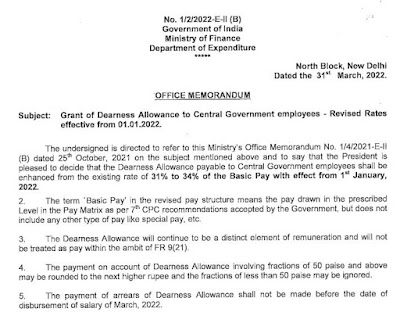
DA Jan 2022 - Grant of Dearness Allowance to Central Government employees - Revised Rates effective from 01.01.2022

 3% DA Hike - Revised Rates effective from 01.01.2022: DoE OM dated 31.03.2022 No. 1/2/2022-E-II (B) Government of India Ministry of Finance...