Wednesday, 1 February 2017

Shares of Railway PSEs - IRCTC, IRFC and IRCON to be listed


Shares of Railway PSEs - IRCTC, IRFC and IRCON to be listed

Consolidation, mergers and acquisitions of CPSEs to be encouraged, an integrated public sector oil major soon

Pradhan Mantri Mudra Yojana budget target doubled to Rs. 2.44 lakh crores

Rs. 10,000 crores earmarked for recapitalisation of Banks, Need based additional allocation assured
While presenting the General Budget 2017-18 in Lok Sabha here today, the Union Finance Minister Shri Arun Jaitley has said that the shares of Railway Public Sector Enterprises (PSEs) like IRCTC, IRFC and IRCON will be listed in stock exchanges. The Government will encourage strengthening the CPSEs through consolidation, mergers and acquisitions and soon create an integrated public sector ‘oil major’, he added.
Stating that the Pradhan Mantri Mudra Yojana (PMMY) has proved an overwhelming success in extending funds for the deprived sections, Shri Jaitley doubled the budget target under the scheme to Rs. 2.44 lakh crores.

Easing the stressed legacy accounts of banks, Shri Jaitley earmarked Rs. 10,000 crores for recapitalisation of Banks in 2017-18 and assured need based additional allocation.

Stating that the disinvestment policy announced in the last budget will continue, Shri Jaitley further said that the Government will put in place a revised mechanism and procedure to ensure time bound listing of identified CPSEs on stock exchanges. This will foster greater public accountability and unlock the true value of these companies, he added.

Shri Jaitley said the CPSEs will be integrated across the value chain of an industry through consolidation, mergers and acquisitions. By these methods it will give them capacity to bear higher risks, avail economies of scale, take higher investment decisions and create more value for the stakeholders, he added. Possibilities of such restructuring are visible in the oil and gas sector. The Government proposes to create an integrated public sector ‘oil major’ which will be able to match the performance of international and domestic private sector oil and gas companies.

The Finance Minister said that the Exchange Trade Fund (ETF), comprising shares of ten CPSEs, has received overwhelming response in the recent Further Fund Offering (FFO). The Government will continue to use ETF as a vehicle for further disinvestment of shares. Accordingly, a new ETF with diversified CPSE stocks and other Government holdings will be launched in 2017-18, he added.

Shri Jaitley said that the focus on resolution of stressed legacy accounts of Banks will continue and the legal framework has been strengthened to facilitate resolution, through the enactment of the Insolvency and Bankruptcy Code and the amendments to the SARFAESI and Debt Recovery Tribunal Acts. In line with the ‘Indradhanush’ roadmap, an amount of Rs. 10,000 crore is provided for recapitalisation of Banks in 2017-18 and additional allocation will be provided, as may be required, he added.

Shri Jaitley said that the Pradhan Mantri Mudra Yojana has contributed significantly to funding the unfunded and the underfunded. He further said that the last year target of Rs.1.22 lakh crores was exceeded and for 2017-18, he proposes to double the lending target of 2015-16 and set it at Rs. 2.44 lakh crores. Priority will be given to Dalits, Tribals, Backward Classes, Minorities and Women, he added.

Shri Jaitley said that the Stand Up India scheme was launched by the Government in April 2016 to support Dalit, Tribal and Women entrepreneurs to set up green field enterprises and become job creators. Over 16,000 new enterprises have come up through this scheme in activities, as diverse as food processing, garments, diagnostic centres, etc, he added.

PIB

No Cash Transaction above Rs 3 lakh - Finance Minister


No Cash Transaction above Rs 3 lakh - FM

Press Information Bureau
Government of India
Ministry of Finance
01-February-2017 13:57 IST

Budget gives a major push to Digital Economy; proposes No Cash Transaction above Rs 3 lakh
Government to launch schemes to promote BHIM app, Aadhar Enabled Payment System
Mission to be set-up to achieve a target of 2500 Cr digital transactions in 2017- 18
Series of measures proposed to strengthen and regulate digital economy

In a bid to give a push to Digital Economy and weed-out corruption and black money, the Union Minister for Finance and Corporate Affairs, Shri Arun Jaitley in his Budget Speech today said that the Government has decided that no transaction above Rs 3 lakh will be permitted in cash. Accepting a suggestion by Special Investigation Team on Black Money to ban cash transactions above Rs 3 lakhs, the Finance Minister has proposed an amendment to the Income-tax Act in the Finance Bill.

Presenting the General Budget 2017-18 in the Parliament, the Finance Minister said that the Government will launch two new Schemes to promote the usage of BHIM App i.e, Referral Bonus Scheme for individuals and a Cashback Scheme for merchants. BHIM App was launched to promote digital transactions and will unleash the power of mobile phones for digital payments and financial inclusion, The Finance Minister Shri Jaitley informed the House that 125 lakh people have adopted the BHIM app so far.
The Finance Minister Shri Jaitley also announced that Aadhar Pay, a merchant version of Aadhar Enabled Payment System, will be launched shortly. This will be specifically beneficial for those who do not have debit cards, mobile wallets and mobile phones. A Mission will be set-up with a target of 2,500 crore digital transactions for 2017-18 through UPI, USSD, Aadhar Pay, IMPS and debit cards. Banks have targeted to introduce additional 10 lakh new PoS terminals by March 2017. They will be encouraged to introduce 20 lakh Aadhar based PoS by September 2017.

Highlighting the Government's strategy to clean the system through digital economy, Shri Jaitley said that it has a transformative impact in terms of greater formalisation of the economy and mainstreaming of financial savings into the banking system. This, in turn, is expected to energise private investment in the country through lower cost of credit. India is now on the cusp of a massive digital revolution, he added. The Finance Minister said that a shift to digital payments has huge benefits for the common man. The earlier initiative of the Government to promote financial inclusion and the JAM trinity were important precursors to the current push for digital transactions, the Finance Minister added.

In a bid to incentivize the digital transactions, the Finance Minister Shri Jaitley proposed that the presumptive income tax for small and medium tax payers whose turn-over is up to Rs 2 crore will be reduced from the present 8% of their turnover which is counted as presumptive income to 6% in respect of turnover which is received by non-cash means. This benefit will be applicable for transactions undertaken in the current year also, he added.

The Finance Minister also proposed to limit the cash expenditure allowable as deduction, both for revenue as well as capital expenditure, up to Rs 10,000. Similarly, the limit of cash donation which can be received by a Charitable Trust is being reduced from Rs 10,000/- to Rs 2000/-.

To promote cashless transactions, the Finance Minister in the Budget has proposed to exempt BCD, Excise/CV duty and SAD on miniaturised POS card reader for m-POS, micro ATM standards version 1.5.1, Finger Print Readers/Scanners and Iris Scanners. He also proposed to exempt parts and components for manufacture of such devices, so as to encourage domestic manufacturing of these devices.

To strengthen and regulate the digital economy, the Finance Minister has proposed to create a Payments Regulatory Board in the Reserve Bank of India(RBI) by replacing the existing Board for Regulation and Supervision of Payment and Settlement Systems. The Committee on Digital Payments constituted by the Department of Economic Affairs has recommended structural reforms in the payment eco system, including amendments to the Payment and Settlement Systems Act, 2007. The Government will undertake a comprehensive review of this Act and bring about appropriate amendments, Finance Minister added.

To strengthen the digital payment infrastructure and grievance handling mechanisms, the Finance Minister said in his Budget Speech that the focus would be on rural and semi urban areas through Post Offices, Fair Price Shops and Banking Correspondents. He added that steps would be taken to promote and possibly mandate petrol pumps, fertilizer depots, municipalities, Block offices, road transport offices, universities, colleges, hospitals and other institutions to have facilities for digital payments, including BHIM App. A proposal to mandate all the Government receipts through digital means, beyond a prescribed limit, is under consideration. The Government will strengthen the Financial Inclusion Fund to augment resources for taking up these initiatives, the Finance Minister added.

In his Budget Speech, the Finance Minister informed that increased digital transactions will enable small and micro enterprises to access formal credit. He said that the Government will encourage
SIDBI to refinance credit institutions which provide unsecured loans, at reasonable interest rates, to borrowers based on their transaction history.

The Finance Minister assured the House that the Government will consider and work with various stakeholders for early implementation of the interim recommendations of the Committee of Chief Ministers on digital transactions.

Shri Jaitley said that the Government is considering the option of amending the Negotiable Instruments Act to ensure that the payees of dishonoured cheques are able to realise the payments.

Highlights of Union Budget 2017-18


Highlights of Union Budget 2017-18

1. All taxpayers above 5 lakh rupees to get benefit of 12,500 rupees across the board: FM
2. 10% Surcharge on individuals with income between 50 lakh to 1 Crore: FM
3. Surcharge of 10% for individuals earning between Rs 50 lakh- 1 crore; Surcharge for incomes > Rs 1 crore at 15% to continue: FM
4. A single one-page form for filing IT returns for taxable income up to 5 lakh rupees: FM
5. Tax on income from 2.5 lakh to 5 lakh reduced from 10 per cent to 5 per cent: FM
6. Time period of revising tax return to be reduced to 12 months: FM
7. Amendment to RBI Act proposed to enable electoral bonds: FM
8. Political parties will be entitled to receive donations in cheque or digital payment, every political party to file IT returns: FM
9. Long-term capital gains tax on immovable property to apply after 2 years, instead of 3 years now: FM
10. Maximum amount of cash donation a political party can receive to be 2000 rupees from any one source: FM
11. Computer emergency response team to be established Cyber security: FM
12. Rate of growth in advance tax in personal income tax in last 3 quarters of this financial year is as high as 34.8%: FM
13. Basic customs duty on LNG to be reduced from 5% to 2.5%: FM
14. Tax rate for companies with an annual turnover up to 50 crores to be reduced to 25%, to strengthen MSME sector: FM
15. To make MSMEs more viable, income tax for smaller companies to be reduced: FM
16. Profit linked deduction available to Startups for 3 years out of 5 years will be available for 3 years out of 7 years
17. Capital gains tax to be exempted,for persons holding land from which land was pooled for creation of state capital of Telangana: FM
18. Thrust in budget are affordable housing, promote digital economy, bringing transparency in political funding: FM
19. We are committed to make our taxation rate reasonable,our tax admin more fair & expand the tax base of the country: FM
20. Only 1.72 lakh people show income above Rs 50 lakh: FM
21. 1.5 crore people show income between Rs 2.5-5 lakh; 52 lakh people between between Rs 5-10 lakh; 24 lakh above Rs 10 lakh: FM
22. 5 special tourism zones,anchored on SPV, to be set up; Incredible India II campaign to be launched across the world: FM
23. Revenue Deficit target at 1.9% of GDP: FM
24. Govt to commemorate Champaran Satyagraha centenary: FM
25. Fiscal deficit pegged at 3.2 percent of GDP: FM
26. Aadhar-enabled payment system AadharPay to be launched: FM
27. Defence allocation of Rs 2.74 lakh crore: FM
28. Pradhan Mantri Kaushal Kendras to be extended to more than 600 districts across the country: FM
29. Total allocation for infrastructure in Budget for Better India stands at a record level Rs 3,96,135 crore in 2017-18: FM
30. State run companies like IRCON and IRCTC to be listed in markets: FM

Source: http://www.newsonair.com/

Income tax reduced by 5% for Income upto Rs.5 lakh: Budget 2017


Income tax reduced by 5% for Income upto Rs. 5 lakh: Budget 2017

Finance Minister announced in the budget speech for 2017-18 today in Lok Sabha, there were legitimate expectations of the salary class after demonetization to reduce the tax burden. He proposed reducing the present rate of income tax from 10 to 5 percent for the first slab of income from 2.5 lakhs to 5 lakh rupees

NEW INCOME TAX RATES 2017-18 (ASSESSMENT YEAR 2018-19)

Total IncomeNormal Rates of Income Tax
Up to Rs.2,50,000 to Rs.5,00,0005%
  • All taxpayers above 5 lakh rupees to get benefit of 12,500 rupees across the board
  • 10% Surcharge on individuals with income between 50 lakh to 1 Crore
  • Surcharge of 10% for individuals earning between Rs 50 lakh- 1 crore; Surcharge for incomes > Rs 1 crore at 15% to continue
  • A single one-page form for filing IT returns for taxable income up to 5 lakh rupees
  • Tax on income from 2.5 lakh to 5 lakh reduced from 10 per cent to 5 per cent
  • Time period of revising tax return to be reduced to 12 months

7th Pay Commission: Higher Allowances Likely After Union Budget 2017


7th Pay Commission: Higher Allowances Likely After Union Budget 2017

Global brokerage Morgan Stanley said that higher pay commission-related payouts could put pressure on government finances.

Some analysts are hopeful that the government will implement Seventh Pay Commission-related allowance hikes after the Budget 2017, which is scheduled for February 1. The Centre implemented the Seventh Pay Commission (CPC) pay hikes in September 16 and is expected to implement the allowance hikes in March after the state elections, domestic brokerage Religare said in a report. This will boost the income of one crore central government employees and pensioners, the brokerage added.

Another brokerage HSBC Securities says that "about 70 per cent of the Seventh Pay Commission recommendations (i.e. pay and pension) have already been accounted for in the FY17 Budget. The remaining item - the housing allowance - is likely to get implemented in FY18."

"At worst, if the government is under pressure, this allowance can be pushed to the next year, as was done in the previous pay commissions. The housing allowance does not attract arrears," HSBC Securities said.

Religare, however, said that implementation of the housing allowance portion of the Seventh Pay Commission as well as GST or Goods and Services Tax is expected to push up average inflation. Another global brokerage Morgan Stanley said that higher pay commission-related payouts could put pressure on government finances. "Trailing higher wage spending and further drain are expected as the government is likely to pay the higher allowances due as part of the Seventh Pay Commission wage hikes," it said in a report.

The Union Cabinet had in June accepted the recommendation of Justice A K Mathur headed Seventh Pay Commission in respect of the hike in basic pay and pension but its suggestions relating to allowances were referred to a committee. The 7th Pay Commission examined a total of 196 existing allowances and, by way of rationalisation, recommended abolition of 51 allowances and subsuming of 37 allowances.

Source: NDTV

AICPIN for the month of December 2016


AICPIN for the month of December 2016

No. 5/1/2014- CPI
GOVERNMENT OF INDIA
MINISTRY OF LABOUR & EMPLOYMENT
LABOUR BUREAU


CLEREMONT, SHIMLA-171004
DATED: 31st January, 2017
 Press Release

Consumer Price Index for Industrial Workers (CPI-IW)-December, 2016

The All-India CPI-IW for December, 2016 by 2 points and stood 275 (two hundred and seventy five). On 1-month percentage change, it decreased by (-) 0.72 per cent November and December, 2016 when compared with the decease of (-) 0.37 per cent between the same two months a year ago.

The maximum downward pressure to the change in current index came from Food group conuibuting (-) 2.74 percentage points to the total change. At item level, Arhar Dal, Gram Dal, Masur Dal, Urd Dal, Groundnut Oil, Muslard Oil, Chillies Green, Ginzer, Brinjal, Cabbage, Carrot, Cauliflower, French Beans, Gourd, Green Coriander Leaves, Methi, Palak, Peas, Potato, Radish, Tomato, Banana, Lemon, etc. are responsible for the decrease in index. However, this decrease checked by Rice, Wheal, Wheat Alta, Coconut OiL Fish Fresh, Goat Meat, Milk Snack Saltish, Cooking Gas, ESI Premium Contribution, Petrol, Flowe/Flower Garlands, Toilet Soap, etc., putting upward on the index.

The year-on-year inflation measured by monthly CPI-IW stood at 2.23 per cent for December, 2016 as compared to 2.59 per cent for the pervious month and 6.32 per cent during the corresponding month of the previous year. Similarly, the Food inflation stood at 0.67 per cent against 1.66 per cent of the previous month and 7.94 per cent during the corresponding month or the previous year.

At centre level, Rourkela reported the maximum decrease or 10 points followed by Vadodara (9 points), Nagpur and Lucknow (8 points each) and Amritsar, Varanasi and Monger Jamalpur (6 points each). Among others, 5 points decrease was observed in 7 centres, 4 points in 12 centres, 3 points in 9 centres, 2 points in 15 centres and 1 point in 10 centres. On the contrary, Quilon recorded maximum increase of 6 points followed by Ernakulam and Mundakkayam (3 points each). Among others, 2 points increase was observed in 4 centres and 1 point in 4 centres. Rest or the 7 centres indices remained stationary.

The indices or centres are above All-India Index and other 43 centres indices are below national average. The index or Vishakhapathnam centre remained at par with All-India Index. The next or CPI-IW fer the month of January, 2017 will be released on Tuesday, 28th February, 2017. The same will also be available on the office website www.labourbureaunew.gov.in

sd/-
(SHYAM SINGH NEGI)
DEPUTY DIRECTOR GENERAL
Authority: www.labourbureaunew.gov.in

Tuesday, 31 January 2017

7th Pay Commission implementation to State Government Employees - Minister's reply in the Parliament


7th Pay Commission implementation to State Government Employees - Minister's reply in the Parliament

7th Pay Commission implementation - State Government employees are not covered within the terms of reference of the 7th central Pay Commission - Minister's reply in the Parliament

Smt.Nirmala Sitharaman in a written reply to a Member states that State Government employees are not covered within the terms of reference of the 7th central Pay Commission

While answering to a question in Parliament on 12th August 2014 regarding the employees working in State Government, Ministry of State for Finance Smt.Nirmala Sitharaman said that the State Government employees are not covered within the terms of reference of the 7th central Pay Commission.

She replied in written form to a question asked by a member that service conditions of State Government employees fall within the exclusive domain of respective State Governments. Therefore, State Government employees are not covered within the terms of reference of the 7th central Pay Commission.

Thus, the recommendations of Commission will not directly apply to State Government employees. Accordingly, it is not possible for the Central Government to indicate the financial burden on State Governments, if they decide to adopt the recommendation of the 7th Central Pay Commission in respect of their employees with or without modification.

She also added, the Central Government had sought the views of the State Governments and till the date of the constitution of the 7th Central Pay Commission on 28.2.2014, only 14 States had responded. These State Governments generally mentioned, inter-alia, that adoption of the recommendations of a Central Pay Commission by them in case of State Government employees adds to substantial financial burden
Since the decision to adopt the recommendations of the 7th Central Pay Commission in case of the State Government employees will exclusively concern respective State Government, the question of any assistance by the Central Government will not arise. However, the Terms of Reference of the 7th Central Pay Commission provide, inter-alia, that while making its recommendations, the Commission will also keep in view the likely impact of the recommendations on the finances of the State Governments, which usually adopt the recommendations with some modifications.

Income Tax Department (ITD) launches Operation Clean Money


Income Tax Department (ITD) launches Operation Clean Money

Income Tax Department (ITD) has initiated Operation Clean Money, today. Initial phase of the operation involves e-verification of large cash deposits made during 9th November to 30th December 2016. Data analytics has been used for comparing the demonetisation data with information in ITD databases. In the first batch, around 18 lakh persons have been identified in whose case, cash transactions do not appear to be in line with the tax payer's profile.

ITD has enabled online verification of these transactions to reduce compliance cost for the taxpayers while optimising its resources. The information in respect of these cases is being made available in the e-filing window of the PAN holder (after log in) at the portal https://incometaxindiaefiling.gov.in. The PAN holder can view the information using the link “Cash Transactions 2016” under "Compliance" section of the portal. The taxpayer will be able to submit online explanation without any need to visit Income Tax office. 

Email and SMS will also be sent to the taxpayers for submitting online response on the e-filing portal. Taxpayers who are not yet registered on the e-filing portal (at https://incometaxindiaefiling.gov.in) should register by clicking on the ‘Register Yourself’ link. Registered taxpayers should verify and update their email address and mobile number on the e-filing portal to receive electronic communication.

A detailed user guide and quick reference guide is available on the portal to assist the taxpayer in submitting online response. In case of any difficulty in submitting on line response, help desk at 1800 4250 0025 may be contacted. 

Data analytics will be used to select cases for verification, based on approved risk criteria.  If the case is selected for verification, request for additional information and its response will also be communicated electronically. The information on the online portal will be dynamic getting updated on receipt of new information, response and data analytics.

The response of taxpayer will be assessed against available information. In case explanation of source of cash is found justified, the verification will be closed without any need to visit Income Tax Office. The verification will also be closed if the cash deposit is declared under Pradhan Mantri Garib Kalyan Yojna (PMGKY).

The taxpayers covered in this phase should submit their response on the portal within 10 days in order to avoid any notice from the ITD and enforcement actions under the Income-tax Act as also other applicable laws.

PIB

IRS officers meet Dr Jitendra Singh, seek DoPT intervention

IRS officers meet Dr Jitendra Singh, seek DoPT intervention

A delegation of the Indian Revenue Service (IRS) officers met the Union Minister of State (Independent Charge) for Development of North Eastern Region (DoNER), MoS PMO, Personnel, Public Grievances, Pensions, Atomic Energy and Space, Dr Jitendra Singh here today and sought intervention by Department of Personnel & Training (DoPT) for the clearance of backlog in promotions.

In a memorandum submitted by the members of delegation, it was pointed out that around 450 posts of Joint Commissioner / JAG level are lying vacant, but there are no officers eligible to be promoted because Recruitment Rules prescribe minimum residency of 5 years at Deputy Secretary level as eligibility criteria. Officers up to 2007 batch have already been promoted and therefore, they requested for relaxation of 9 months for gaining eligibility for the officers of 2017 batch who have been left out. The members of delegation sought Dr Jitendra Singh’s intervention so that the DoPT could take a holistic view of circumstances and grant relaxation for promotion to JAG / JC-IT.

Prominent IRS officers who led the delegation included Shri Rajesh Menon from Mumbai, Shri Anantharaman Aiyer from Delhi, Shri C.K. Singh and Shri B.K. Singh.

India Post Payments Bank will be a game changer for financial inclusion - Manoj Sinha


Press Information Bureau,
Government of India
Ministry of Communications & Information Technology
30-January, 2017 18:27 IST

India Post Payments Bank will be a game changer for financial inclusion - Manoj Sinha
IPPB branches launched in Ranchi & Raipur

IPPB-India-Post-Payments-Bank

Finance Minister, Shri Arun Jaitley and Minister of Communications Shri Manoj Sinha launched the operations of the India Post Payments Bank (IPPB) here today as two pilot branches at Raipur and Ranchi through video conferencing from Delhi.

Speaking on the occasion, Shri Jaitley said that about 650 IPPB branches will be opened by September this year and that will have a multiplier impact as far as banking in India is concerned. He said with IPPB, banking at the doorstep will no longer remain a mere slogan, but will become a reality due to huge postal network in the country. He said that financial Inclusion is critical for the socio-economic development of the country, but there are significant gaps in this area and a large proportion of country’s population remain unbanked or underbanked. IPPB will effectively leverage the ubiquitous post office network with its pan-India physical presence, long experience in cash handling and savings mobilization, backed by the ongoing project of IT-enablement, to bridge this gap in Financial Inclusion.

In his address, Minister of Communications Shri Manoj Sinha has commended the hard work done by the Department of Posts in setting up the India Post Payments Bank and hoped that both organizations will work in tandem to take the benefits of government schemes and financial services that are not easily available in rural areas to customers across the country and to the marginalized population in urban and rural areas alike. He said, the objective of IPPB will be public service rather than promoting commercial interests.

Secretary, Department of Posts, Shri B.V.Sudhakar said that the IPPB is widely expected to be a game changer for financial inclusion in the country as the USP of this initiative is doorstep banking, particularly in the rural areas.

As mandated by the RBI, the India Post Payments Bank (IPPB) would focus on providing basic financial services such as all kinds of payments; including social security payments, utility bill payments, person to person remittances (both domestic and cross-border), current and savings accounts up to a balance of Rs 1 lac, distribution of insurance, mutual funds, pension products and acting as business correspondent to other banks for credit products especially in rural areas and among the underserved segments of the society.

Set up us a 100% Government of India owned Public Limited Company under the Department of Posts, it will open around 650 branches in district HQ locations. All 1.55 lacs post offices including the 1.39 lac of the rural post offices will be mapped to the IPPB branch at the district headquarter and function as access points for IPPB. IPPB will usher in state of the art internet and mobile banking platforms, digital wallets and use innovative and emerging technologies to catalyse the shift from a cash dominant to a less cash economy.

While many other banks and financial institutions are working on the same theme, the USP of IPPB will be its ability to ease access and handhold the adoption of new age banking and payments instruments among citizen of all walks of life through the delivery by postmen and Grameen Dak sevaks, savings agents and other franchisees who will take banking to door steps. IPPB thus aspires to the most accessible, affordable and trusted bank for the common man with the motto - "No customer is too small, no transaction too insignificant, and no deposit too little".

Given 'in principle' approval by the RBI along with 10 other aspirants on 19th Aug 2015, IPPB received the cabinet’s approval on 1st June, 2016 and was incorporated as on 17th Sept, 2106. Today it became the second payments bank to launch its operations. Having got its final banking license from the RBI on the 20th Jan 2017 it has commenced operations in record time of 10 days in partnership with the Punjab National Bank, after obtaining all necessary approvals and registrations from the RBI, NPCI etc.

A commemorative stamp and a logo of the new bank were also launched on the occasion.

Flash News

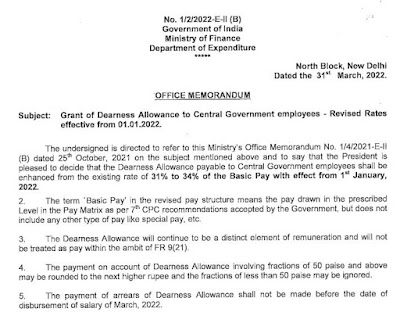
DA Jan 2022 - Grant of Dearness Allowance to Central Government employees - Revised Rates effective from 01.01.2022

 3% DA Hike - Revised Rates effective from 01.01.2022: DoE OM dated 31.03.2022 No. 1/2/2022-E-II (B) Government of India Ministry of Finance...