Wednesday, 7 December 2016

29th meeting of Standing Committee of Voluntary Agencies (SCOVA) under the chairmanship of Hon'ble MOS (PP)


29th meeting of Standing Committee of Voluntary Agencies (SCOVA) under the chairmanship of Hon'ble MOS (PP)

 F.No. 42/16/2016-P&PW(G)
Government of India
Ministry of Personnel, P.G and Pensions
Department of Pension & Pensioners Welfare

3rd Floor, Lok Nayak Bhawan
Khan Market, New Delhi-110003
Date: 30th Nov, 2016
To
All the Pensioners Associations included in the SCOVA vide Resolution dated 25.08.2015

Subject: 29th meeting of Standing Committee of Voluntary Agencies (SCOVA) under the chairmanship of Hon'ble MOS (PP)-reg

The 29th meeting of Standing Committee of Voluntary Agencies(SCOVA) of the Department of Pension & Pensioners Welfare is scheduled to he held shortly. The date, time and venue of the meeting will be intimated shortly. The meeting will be chaired by the Hon’ble Minister of State in the Ministry of Personnel, Public Grievances & Pensions.

2. It is therefore requested to provide the following requisite information through hard copy as well as e-mail:
(a) Suggest fresh items/issues, if any, for inclusion in the agenda to be discussed for the proposed meeting,. Kindly do not send those agenda items which have already been discussed in the previous SCOVA meetings and on which final decision/action has already been taken. Your response in this regard may please he sent to this Department latest by 5th December, 2016 to enable us to finalise the agenda items. Minutes of the previous SCOVA meetings are available on the website of this Department i.e www.pensionersportal.gov.in
(b) Because of the consideration of space. only one representative of your organisation may attend the above said meeting. Confirmation of participation and the name of the participant may kindly be intimated in advance to the undersigned by fax/e-mail.
3. Outstation members will be paid TA/DA and local members will be paid conveyance charges in accordance with the rules/instructions.

4. This Department looks forward to your participation in the meeting.
(Charanjit Taneja)
Under Secretary to the Government of India

Download DP&PW SCOVA meeting resolution F.No. 42/16/2016-P&PW(G) dated 30.11.2016

Tuesday, 6 December 2016

Revision of provisional pension sanctioned under Rule of the CCS (Pension) Rules, 1972

Revision of provisional pension sanctioned under Rule of the CCS (Pension) Rules, 1972


Government Of India
Ministry of Personnel. PG & Pensions
Department ef Pension & Pensioners’ Welfare


3rd Floor. Lok Nayak Bhawan
Khan Market,


New Delhi, the 30th November. 2016


 Office Memorandum

Sub:- Revision of provisional pension sanctioned under Rule of the CCS (Pension) Rules, 1972

The undersigned is directed to say that in pursuance of Government’s decision on the recommendations Of Seventh pay Commission, orders for revision Of pension Of pensioners w.e.f.1.1 .2016 have been issued on 4.8.2016.

2. The following categories of pensioners arc drawing provisional pension under Rule-69 of the CCS (Pension) Rules based 0n their pre-revised pay/pension:-

(i) Retired before 1.1 .2016 and sancüoned provisional pension under Rule-69 of CCS (Pension) Rules on account of departmental/judicial proceedings or suspension.

ii) Suspended before 1.1.20t6 ard sanctioned provisional pension under Rule.69 of the CCS (Pension) Rules on retirement on or after 1.1.2016.

3. The provisional pension sanctioned in the above cases may be revised in the normal course in accordance With the instructions contained in this Department’s NO.38/37/2016- dated 4.8.2016 issued for revision of pension of pre-2016 pensioners.

4. This issues with the approval of Department of Expenditure, Ministry of’ Finance ID No. J(21)/EV/2016 Dated 24.1 1.2016.

Hindi version will follow.

(Harjit Singh)
Director

Authority: http://www.pensionersportal.gov.in/

7th Pay Commission Pension revision – Interpretation of Proposed Option 3

7th Pay Commission Pension revision – Interpretation of Proposed Option 3

7th Pay Commission Pension revision – Interpretation of Proposed Option 3 by RSCWS for revised Pension as per 7th CPC recommendations as an alternate to Option 1 recommended by 7th Pay Commission

INTERPRETATION OF PROPOSED OPTION 3 FOR REVISED PENSION HOW FAR IS IT AN ALTERNATIVE TO OPTION 1 RECOMMENDED BY 7Tth CPC? By N. P. MOHAN, President, RSCWS

 The most significant recommendation of 7th CPC is to bring parity between past pensioners with those retiring after 1-1-2016 (Para 10.1.67). A long standing demand of the pensioners, who have been the victim of Modified Parity in the last two decades from 1-1-1996 (5th CPC), has been addressed by the Commission The parity is sought to be achieved by the recommendation of Option 1 for revised pension which provides for consideration of increments earned in the last Level by a pensioner while in service. Recognizing the delay in checking record for ascertaining the increments for implementation of this option, revised pension in the interim phase was recommended to be fixed by multiplying the pension fixed after 6th CPC by MF of 2.57 (Option 2). This option has already been implemented.

While accepting the above recommendations, Govt. had constituted a 5 member Committee under the chairmanship of Secretary (Pension) to examine the feasibility of implementation of Option 1. The Committee in its meeting with JCM on 6th October has suggested an alternative option (Option 3) to overcome the difficulty of tracing record in some cases. It has been indicated in Para 5 of the minutes of the meeting “that the Committee has found that the alternative method of arriving at notional pay in Seventh CPC by applying formula for pay revision for serving employees in each Pay Commission and giving 50% of this as pension to be beneficial to all pensioners in comparison to the fitment method.”

Dispensation of revised pension under alternative Option 3 will depend on the decision of the Govt on the recommendations of this Committee. The impact of Option 3 as understood from the proposal of the Committee mentioned in above is reflected in the 3 tables indicating the revised pension.


EXAMPLE OF REVISED PENSION UNDER OPTIONS 1 & 2 of 7th CPC & OPTION 3 BASED ON NOTIONAL PAY IN SUCCESSIVE PAY COMMISSIONS

  (As proposed in Para 5 of the minutes of the meeting of Feasibility Committee held with JCM on 6-10-2016)

FOR PENSIONERS RETIRING IN 5TH CPC REGIME (1.1.1996 TO 31-12-2005) FROM SCALE S 13 (7450-11500)-LEVEL 7 Average Pay on retirement Pension after 5th CPC (Higher of Mod. Parity or with factor of 2.26) – whichever is higher Notional pay-6th CPC (As per Fitment table-6th CPC) Notional pay-7th CPC with MF OF 2.57-3rd option (col.2xMF) Pay in the next cell of 7th CPC Pay Matrix- 3rd Option Pay based on option 1 with no. 0f increments (7th CPC pay matrix- (7th CPC pay matrix- Level 7)Revised Pension as per Option 3 (col.4/2) Revised Pension as per Option 1 (col.5/2) Revised Interim Pension as per Option 2 of 7th CPC (Col.2×2.57)

1
2
3 18460
4
5
6 44900
7
8
9
7450 9230 47442 47600 23800 22450 23721
7675 9230 18880 48522 49000 46200 24500 23100 23721
7900 9230 19300 49601 50500 47600 25250 23800 23721
8125 9230 19720 50680 52000 49000 26000 24500 23721
8350 9436 20144 51770 52000 50500 26000 25250 24249
8575 9690 20550 52814 53600 52000 26800 26000 24903
8800 9944 20970 53893 55200 53600 27600 26800 25556
9025 10198 21390 54972 55200 55200 27600 27600 26210
9250 10453 21810 56052 56900 56900 28450 28450 26863
9475 10707 22230 57131 58600 58600 29300 29300 27516
9700 10961 22650 58211 58600 60400 29300 30200 28170
9925 11215 23070 59290 60400 62200 30200 31100 28823
10150 11470 23480 60344 60400 64100 30200 32050 29477
10375 11724 23900 61423 62200 66000 31100 33000 30130
10600 11978 24320 62502 64100 68000 32050 34000 30783
10825 12232 24740 63582 64100 70000 32050 35000 31437
11050 12487 25160 64661 66000 72100 33000 36050 32090
11275 12741 25580 65741 66000 74300 33000 37150 32744
11500 12995 25990 66794 68000 76500 34000 38250 33397

NOTES:- 1. This table is illustrative under option 3 which is as per understanding of the proposal indicated by the Feasibility Committee based on Notional pay fixation in successive Pay Commissions.

 2. Actual fixation of revised pension will depend on Govt’s decision in the matter. 3. The figures of revised pension under Option 1 (Col. 8) are for each stage of increment. Compiled by: N. P. Mohan, President, RSCWS
Source : RSCWS

GUIDELINES OF THE MINISTRY OF DEFENCE FOR PENALTIES IN BUSINESS DEALINGS WITH ENTITIES

GUIDELINES OF THE MINISTRY OF DEFENCE FOR PENALTIES IN BUSINESS DEALINGS WITH ENTITIES

(A) Introduction
A.1 It is imperative that the highest standards of propriety be maintained throughout the process of procurement of defence equipment.

A.2 The procurement process needs to proceed without loss of credibility and therefore, there is a need to put in place appropriate measures to deal with acts of impropriety.

A.3 The following paragraphs lay down the policy and guidelines for Levy of Financial Penalties and/ or Suspension/Banning of business dealings with entities seeking to enter into contract with/having entered into a contract for the procurement of goods and services by the Ministry of Defence.

A.4 In applying the measures provided for under the guidelines, the concerned authorities shall be guided by the need to ensure probity, transparency, propriety and compliance in the defence procurement process. Equally, the concerned authorities shall also ensure fairness, impartiality, rigour and correctness in dealing with entities, keeping in view the overall security interests of the country.

(B) General
B.1 Ministry of Defence will include Department of Defence, Department of Defence Production, Departement of Defence Research & Development, HQ, IDS, Armed Forces Headquarters and their attached/subordinate offices.

B.2 “Entities” will include companies, trusts, societies, as well as individuals and their associations with whom the Ministry of Defence has entered into, or intends to enter into, or could enter into contracts or agreements.

B.3 All firms/companies which come within the sphere of effective influence of the entities shall be treated as its allies firms. In determining this, the following factors may be taken into consideration:-
(i) Whether the management is common or the majority interest in the management is held by the partners or directors of the entities.
(ii) Majority shares are owned by the entity, their directors/shareholders and by virtue of this it has controlling voice.

B.4 Effect of actions, viz., levy of financial penalties and/or suspension/banning of business dealings with an entity in accordance with these guidelines may, with the approval of the competent authority also apply when an entity participates in the procurement process as member of consortium.

B.5 The competent authority for the purpose of these guidelines will be Raksha Mantri.

B.6 The Competent Authority may constitute Committees as necessary, to examine and make recommendations on any matter provided for under the guidelines.

(C) Causes for Suspension and Banning of Business Dealings with Entities
C.1 The competent authority may levy financial penalties and/or suspend/ban business dealings with an entity for one or more of the grounds listed below:-
a) Violation of Pre-Contract Integrity Pact (PCIP) (where such PCIPs are entered into between the Ministry of Defence and an entity).

b) Resort to corrupt practices, unfair means and illegal activities during any stage of bid/contract to secure a contract, even in cases where PCIP is not mandated.

c) Violation of Standard Clause in the contract of agents/agency commissions.

d) If national security considerations so warrant.

e) Non-performance or under performance under the terms and conditions of contract(s) or agreement(s) not covered in grounds listed in (a) to (c) above in accordance with provisions in contract or agreement.

f) Any other ground for which the competent authority may determine that suspension or banning of business dealings with an entity shall be in the public interest.

(D) Suspension
D.1 Suspension of business dealing with an entity may be ordered by the competent authority pending a full proceeding into allegations or facts related to any grounds enumerated in paragraph C.1 (a) to (f) above.

D.2 The competent authority may suspend business dealings with an entity when it refers any complaint against the entity to CBI or any investigating agency or when intimation is received regarding initiation of criminal investigation or enquiry against any entity.

D.3 An order of suspension of business dealings with an entity will be issued for such period as the competent authority may deem fit. The period of suspension shall not ordinarily exceed one year. A review of the Order of suspension of business dealings with an entity shalll be undertaken within six months of the issue of such an Order and before expiry of the period specified therein. The suspension of an entity may be extended beyond the period of one year, on the order of the Competent Authority for subsequent periods of six months each. The total period of suspension of business dealings with an entity shall not exceed the maximum period of banning of business dealings with an entity for the same cause of action.

(E) Effect of Suspension of Business Dealings with an Entity
E.1 An order of suspension of business dealings with an entity shall result in immediate ineligibility of the entity from participating in future bids. No RFP will be issued to such an entity.

E.2 Any on-going procurement process, where L1 determination has not yet been done, will be progressed after excluding the bid involving an entity with which business dealings are suspended. In case there are only two bidders, one being the entity with which business dealings are suspended, the procurement will be progressed as per extant provisions of DPP after excluding such an entity.
E.3 Any on-going procurement process where the lowest bid involves the entity with which business dealings are suspended by order of competent authority, will be held in abeyance till decision of revocation of such order or banning of business dealings with the entity or till expiry of the validity of the existing bid, whichever is earlier. Extension of the validity of the bid involving such entity will not be permitted. On expiry of the bid validity, the procurement process will be terminated and fresh procurement process, if required, may be initiated. In cases of operational urgency, the procurement process may be foreclosed prior to the expiry of the bid validity and a fresh process initiated, excluding the entity with which business dealings are suspended.
E.4 Order of suspension of business dealings with an entity may be extended to its allied firms by specific order of the competent authority.

(F) Banning of Business Dealings with an Entity/Debarment of an Entity
F.1 Banning of business dealings with an entity may be ordered by the competent authority on acceptance of misconduct related to any of the grounds enumerated in paragraph C.1 (a) to (f) above by the entity or establishment of such misconduct by a competent court/ tribunal/ authority
F.2 Banning of business dealings with an entity may be ordered by the competent authority on receipt of information regarding filing of charge-sheet in the court of law by CBI or any other investigating agency.
F.3 The order of banning of business dealings with an entity will be issued for such specified period as the competent authority may deem fit. For the grounds listed in paragraph C.1 (a) to (d) above, the period of banning of business dealings with an entity shall not be less than five years. For the grounds listed in paragraph C.1 (e) and (f) above, banning of business dealings may be resorted to if, in the view of the competent authority, the grounds for action are such that continuation of business dealings with the entity would be detrimental to public interest. In such cases, the period of banning of business dealings with an entity shall not ordinarily exceed three years. The period of Banning of business dealings with an entity in both the categories will be inclusive of period of suspension of business dealings with an entity, if any, for the same cause of action. In exceptional cases and those involving national security considerations the competent authority may order a longer period of banning of business dealings with an Entity, as deemed appropirate.

(G) Effect of Banning of Business Dealings with an Entity/Debarment of an Entity
G.1 An order of banning of business dealings with an entity shall result in immediate ineligibility of the entity, from participating in future bids of a specified period with effect from the date of such order. No RFP will be issued to such an entity.
G.2 Any on-going procurement process where L1 determination has not yet been done will be progressed after excluding the bid involving entity with which the business dealings are banned. In case there are only two bidders, one being the entity with which business dealings are banned, the procurement will be progressed as per extant provisions of DPP after excluding such an entity.
G.3 Any on-going procurement process where the lowest bidder involves an entity with which business dealings are banned, will be terminated and fresh procurement process, if required, may be initiated.

G.4 Orders of banning of business dealings with an entity may be extended to its allied firms by specific order of the competent authority.
(H) Employees / Agents of an Entity

H.1 Any employee or agent of an entity, who is convicted for any act of impropriety, will not be allowed to engage in any bid process in any capacity with the Ministry of Defence, any time in the future.

H.2 Any employee or agent of an entity with which business dealings are suspended or banned and who is involved in a case of alleged impropriety for which investigation or judicial proceedings is in progress, will not be allowed to engage in any bid process in any capacity with the Ministry of Defence even after the expiry of the period of suspension / banning of business dealings with the entity.

(I) Miscellaneous
I.1 The entity with which business dealings are suspended or banned, may with the approval of competent authority, participate in the future RFPs for spares, upgrades, maintenance etc for the equipment/weapon systems supplied earlier by it, if the equipment which is the object of the Contract is a proprietary item and there are no available alternate sources of supply.

I.2 In cases wherein Transfer of Technology (ToT)/Licensed production has been taken in the past for manufacturing of equipment/weapon systems in India from the entity with which business dealings are suspended or banned, may with the approval of the competent authority, participate in the future RFPs related to components/ rotables/ additional items of such equipment/ weapon systems for which the TOT/Licensed production has been taken.

I.3 Any contract(s) related to the procurement process(es) in connection with which business dealings with an entity have been suspended will be held in abeyance. Any contract(s) related to the procurement process(es) in connection with which business dealings with an entity have been banned, shall be cancelled. However, other contracts involving such entity shall continue unless a decision to the contrary is taken by the competent authority, on a case by case basis.

I.4 If it becomes necessary on grounds of national security and operational preparedness / export obligations, to deal with an entity with which business dealings have been suspended or banned, in a procurement process and which is the only source that can supply/manufacture an equipment/weapon systems, the Competent Authority will be approached for approval of issuance of RFP or conclusion of contract with such an entity. Certificates (as provided in Annexure-I) signed by the Vice Chief of the service concerned / CISC / Additional Secretary (Defence Production) will be placed before the Competent Authority. SHQ / Department of Defence Production may propose special conditions to conclude a contract with such an entity.

I.5 The entity with which business dealings have been suspended or banned will not be permitted to transact contracts or agreements under a different name or division either through a transfer of assests of such an entity to another legal entity or otherwise.

I.6 An updated list of entities with which business dealings have been suspended or banned by the competent authotity and/or against which financial penalties have been imposed shall be maintained on the official website of the Ministry of Defence.

(J) Application
J.1 These guidelines shall come into force with immediate effect.

Annexure-I

(Refers to Para-1.4 of draft Guidelines)

CERTIFICATE***
1) The
…………………………………………………………………………………. [equipment/weapon system] is inescapably required for national security and operational preparedness / export obligations and no other alternative/combination of equipment/weapon system can fulfil the requirement.

2) The …………………………………………………………………………………………….. [equipment/weapon system] is not availbale from any other source.

3) It is absolutely necessary to deal with …………………………………………………………………………… [name of the entity] with which business dealings have been suspended or banned for meeting the instant requirement.

**Certificates as above, signed separately by the Vice Chief of the Service concerned / CISC, are to be placed before the Competent Authority.
**Certificate for inescapable requirement on account of export obligations, signed by AS (DP) is to be placed before the Competent Authority.

Authority: www.mod.nic.in

Pensionary benefits of medically decategorised running staff opt for voluntary Retirement

Pensionary benefits of medically decategorised running staff opt for voluntary Retirement

Railway Board Circular on Pensionary benefits of medically decategorised running staff opt for voluntary Retirement Ministry of Railways has issued a Circular on Pensionary benefits of medically decategorised running staff opt for voluntary Retirement

GOVERNMENT OF INDIA MINISTRY OF RAILWAYS (RAILWAY BOARD)

RBE No. 137/2016
No. E(P&A)II-2004/RS-05
New Delhi, dated 29 .11.2016.
The General Managers(P)/CAOs, All Indian Railways & Prod. Units etc.

Sub: Pensionary benefits of medically decategorised running staff who opt for voluntary retirement. Ref: Board’s letter no. E(NG)I-2009/RE-3/9 dated 05-10-2011.

Vide DC/JCM item no. 25/2004, PNM/NFIR Item No. 8/2015 and PNM/AIRF Item No. 46/2012, recognised staff Federations have demanded that 55% of Pay Element be reckoned for computing retirement benefit for those running staff who have been medically decategorised and decide to take Voluntary Retirement instead of opting for redeployment in an alternative stationary post.

2. The issue has been examined in Board’s office, and it is observed that the issue is governed under the provisions contained in Board’s letter referred to above. To address the specific aspect brought out by Federations, it has been decided that whenever a medically decategorised running staff governed by RS(PR)1993. who has rendered the prescribed qualifying service opts for Voluntary Retirement either on his own or within a period of one month from the date of offer of the first alternative post, his pension may be computed with addition of 55% Pay Element. This 55% benefit will be reckoned after deducting the 30% Pay Element fixation benefit if granted already as per Board’s letter dated 05-10-2011 referred to above.

3. In case such staff does not give option of Voluntary Retirement within the outer limit period of one month specified herein above. it will be deemed that the staff has accepted the alternative appointment offered and in this case, retirement benefits will be governed by extant instruction on the issue whenever he superannuates or opts for Voluntary Retirement thereafter.

4. The period of one month to opt for Voluntary Retirement for those medically decategorised running staff, who have already been offered the alternative posts, will start from the date of issue of this letter.

5. The above clarification shall take effect from the date of issue of this letter.

6. This issues with the concurrence of the Finance Directorate of the Ministry of Railways.

7. Please acknowledge receipt.

(S. Balachandra Iyer)
Director/Pay Commission,
Railway Board.

Download RBE No. 137/2016 No. E(P&A)II-2004/RS-05, dated 29.11.2016.

Tamil Nadu Govt declares holiday for its offices today

Tamil Nadu Govt declares holiday for its offices today

Chennai: Tamil Nadu government has announced today as a holiday for its offices under the Negotiable Instruments Act, as a mark of respect to late Chief Minister J Jayalalithaa. A Government Order (GO) said the notified public holiday will apply to all state government offices, undertakings, corporations and boards.

“Under the Explanation to Section 25 of the Negotiable Instruments Act, 1881 read with Notification of the Government of India, Ministry of Home Affairs No.20-25-26, Public-1, dated 8th June 1957 the Government of Tamil Nadu hereby declares that Tuesday, the 6th of December, 2016 as a public holiday as a mark of respect to the late Selvi J Jayalalithaa, Hon’ble Chief Minister of Tamil Nadu,” it said.

The day will be also treated as a paid holiday for all industrial employees on regular work charge and industrial establishments and the labour hired on daily wages, it said. The government also issued another order declaring three days holidays for “all educational institutions” starting today. The holidays were being declared “as a mark of respect” to the late leader, the GO said.

 PTI

Monday, 5 December 2016

7th Pay Commission: Finmin gets 2 months more to issue higher allowances notification

7th Pay Commission: Finmin gets 2 months more to issue higher allowances notification

New Delhi: The Finance Ministry has got 2 months extension to issue the higher allowances notification under 7th Pay Commission recommendations, a Finance Ministry official said on Monday on condition of anonymity.

"The October-November month is the scheduled for issuing notification for the Finance Ministry, but the time was extended by 2 months because the cash crunch on account of demonetisation, which is taking time to get normality.

Therefor,unless the banks can begin to function with a modicum of efficiency, the government will not issue notification on higher allowances to save demonetisation chaos," the official said.

He further said “the issue of increased financial activities after demonetisation compels the government to keep in abeyance to issue higher allowances notification for getting normalized the position and it is likely to issue from January next, after the the cash crunch will ease.

However the government wants to issue the higher allowances notification speedily in a time bound manner."

The committee on allowances head Finance Secretary Ashok Lavasa said in October, "We are ready to submit our report, when the Finance Minister Arun Jaitley calls up."

The government constituted the committee on allowances in June headed by Finance Secretary Ashok Lavasa to examine the 7th Pay Commission recommendations on allowances, other than dearness allowance.

"The committee has been asked to submit its report within four months and it was ready to submit its report in advance but the government intends to accept the report after December 30, deadline for depositing demonetised notes," the official said.

Existing allowances are now being paid to the central government employees according to the 6th Pay Commission recommendations until issuing of higher allowances notification.

Government asks staff to become ambassadors for digital push

Government asks staff to become ambassadors for digital push

New Delhi: Government has asked its employees to maximise use of debit cards for personal transactions and become 'ambassadors' for promoting digital payments.

The Finance Ministry has asked all ministries/departments to encourage their employees to make use of debit cards for personal transactions instead of cash, an official statement said.

It said that given the progress made in banking technology, it is assumed that each employee would be in possession of a debit/ATM card linked to his/her bank account.

"Ensuring and encouraging government employees to maximise the usage of debit cards for personal related transactions instead of cash would go a long way, with the employees serving as ‘ambassadors’ for the digital push, and also motivate, encourage the general public in taking up the cause," the ministry added.

Government and PSUs have been disbursing salaries to majority of their employees through electronic mode into their bank accounts.

The ministry said that in the recent years, advancements in banking technology, progress in mobile banking and innovative technologies to facilitate digital payments have enabled large number of small denomination transactions to be handled smoothly in electronic mode.

Following the announcement of demonetisation of 500 and 1000 rupee notes on November 8, the government has been taking a slew of measures to promote digital transaction.

While the Finance Ministry has asked public and private sector banks to waive off transaction costs for all payments made through debit cards, the Road Transport Ministry has asked vehicle manufacturers to provide a digital tag on all new cars for e-payments at toll plazas and check posts.
The Finance Ministry has also asked government departments to liaise with their accredited banks and set up special camps to ensure that all its employees are in possession of debit cards.

It also asked other ministries/departments to issue similar advisories to their attached offices, PSUs and autonomous bodies.

PTI

High Court asks RBI to consider issue of salary payment to teachers

High Court asks RBI to consider issue of salary payment to teachers

Mumbai: The Bombay High Court today asked the RBI to consider the issue of payment of salaries to aided school teachers since it is disbursed through district cooperative banks which have been prohibited from depositing and exchanging old currency notes.

The Mumbai, Solapur, Nashik and Pune District Central Cooperative Banks had approached the high court challenging the RBI circular of November 14, restricting them from exchanging or depositing old currency notes of Rs 500 and Rs 1,000, which were declared as illegal tender under the government’s demonetisation move on November 8.

Solapur co-operative bank counsel V M Thorat today informed the court that the bank receives around Rs 95 crore from the state government for salaries of teachers in aided schools, but due to the circular the bank is not able to disburse the amount.

A division bench of Justices A S Oka and Anuja Prabhudessai asked the Reserve Bank to consider the issue.

"RBI needs to consider this issue. We cannot take this matter up on merits as the Supreme Court is already seized of the main contentions raised in the petitions, but this particular issue about teachers’ salaries can be looked into," Justice Oka said.

"It is common knowledge that teachers of aided schools get their salaries from cooperative banks. We want to know how teachers will get their salaries now," the court said.

Thorat informed the bench today that the banks have filed application in the apex court seeking clarification on whether the high court can hear the matter.

"The application along with the transfer petition filed by the Union government seeking for all petitions filed on the demonetisation issue to be heard by SC itself is posted for hearing on December 9," the counsel said.

The high court then adjourned the cooperative banks petitions to December 14.

PTI

7th CPC - Govt will consider the report of Committee, says in Parliament

7th CPC - Govt will consider the report of Committee, says in Parliament

Pay hike after implementation of 7th CPC

GOVERNMENT OF INDIA
MINISTRY OF FINANCE
RAJYA SABHA

UNSTARRED QUESTION NO-1526

ANSWERED ON-29.11.2016

Pay hike after implementation of Seventh Central Pay Commission

1526 . Dr. Sanjay Sinh

(a) the salient features of the Seventh Central Pay Commission;

(b) the percentage of increase in the salaries of employees after the implementation of the recommendations of Seventh Central Pay Commission;

(c) the percentage of increase in the salaries of employees after the fourth, fifth and sixth Central Pay Commission;

(d) whether the extent of pay hike this time is very less as compared to the previous pay hikes; and

(e) whether Government would reconsider it in view of the resentment among employees and pay anomalies?

ANSWER

MINISTER OF STATE IN THE MINISTRY OF FINANCE
(SHRI ARJUN RAM MEGHWAL)

(a): The Seventh Central Pay Commission (7th CPC) has recommended the minimum pay of Rs. 18,000 per month and uniform fitment factor of 2.57 for all employees. The system of Pay Band and Grade Pay has been replaced with separate Pay Matrices for Civil, Defence and Military Nursing Services personnel. The Commission has recommended abolishing 52 allowances and subsuming of another 36 allowances either in an existing allowance or in newly proposed allowances. Allowances relating to Risk and Hardship will be governed by a Risk and Hardship Matrix. The Commission has also recommended revised pension formulation for all personnel who have retired before 01.01.2016 to bring about complete parity of past pensioners with current retirees.

(b) to (e): Salary of all employees will increase by at least 14.29 per cent after the implementation of Seventh Central Pay Commission (7th CPC) recommendations. The 7th CPC has mentioned that increases given in Minimum Pay were 27.6%, 31.0% and 54.0% by Fourth, Fifth and Sixth Central Pay Commissions, respectively. The anomalies arising out of implementation of the recommendations of the 7th CPC will be examined by the Anomalies Committee which has already been constituted. Based on the report of the Committee, the matter will be considered by the Government and appropriate decision will be taken.

Source: http://rajyasabha.nic.in/

Flash News

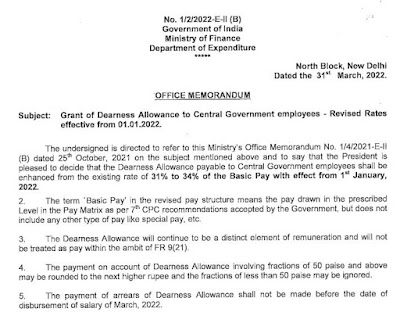
DA Jan 2022 - Grant of Dearness Allowance to Central Government employees - Revised Rates effective from 01.01.2022

 3% DA Hike - Revised Rates effective from 01.01.2022: DoE OM dated 31.03.2022 No. 1/2/2022-E-II (B) Government of India Ministry of Finance...