Saturday, 11 July 2015

Government mulls giving Rs 10 lakh extra to employees for taking VRS

Government mulls giving Rs 10 lakh extra to employees for taking VRS

New Delhi: Government is considering giving financial incentives Rs 10 lakh to those central government employees willing to go to voluntary retirement.

The Transport Minister Nitin Gadkari said on Thursday that he has asked his Ministry to come out with a proposal to give Rs 10 lakh extra to such employees for taking VRS.

Gadkari asked bureaucrats and engineers to take voluntary retirement, who often raise needless objections or delay work.

“There is a tendency to stop or delay work, which goes against everyone and hampers development. It’s better that government personnel take VRS…Let them go rather than troubling us,” Gadkari said while addressing a conference on highway construction equipment.

Large number of engineers and other officials from Transport Ministry, NHAI and other affiliated agencies were present in the meeting.

This is not the first time when Gadkari has cracked the whip on a public platform. Soon after taking charge of the Ministry, he had asked officials and engineers to stop the practice of making contractors visit them again and again.

He had said he would prefer such officials go out of the system. Gadkari had also warned that strict action would be taken against all those who keep files with them for several days.
TST

Proposal for the Cadre review of Medical Laboratory Staff in 4 Central Government Hospitals

Proposal for the Cadre review of Medical Laboratory Staff in 4 Central Government Hospitals has been approved by Finance Ministry:-
F.No. 2(12)/E.III Desk/2013
Department of Expenditure
E.III Desk

Subject: Proposal for the Cadre review of Medical Laboratory Staff in 4 Central Government Hospitals.

Reference Ministry of Health and Family Welfare’s Note No. Z-28020/11/2008-PMS (Part) dated 30.01.2015 on the above mentioned subject.
 
2.  The proposal has been examined in this Department and the following Cadre Structure for the Laboratory Staff in 4 Central Government Hospitals is concurred to with the approval of Hon’ble Finance Minister -

Sl. No. Existing Name of Post & Pay Scales In four central hospitals
(Sufdarjung Hospital & VMCC + RML Hospital + LHMC & SSK Hospital + Kalawati Saran Hospital)
Existing Strength of all four Hospitals Name of Post & Pay Scales Proposed by AM Strength proposed by AM Revised Strength approved by Hon’ble FM
1. Laboratory Assistant PB-1, GP (2000, 2400, 2800) 108 Junior Medical Lab Technologist PB-1 GP-2800 108
108
2. Lab Technician/ Blood Bank Technician PB-1, GP 2800 233 Medical Lab Technologist # PB-2 GP 4200 233 Post of Lab Technician/ Blood Bank Technician & Technical Assistant/ Sr. Laboratory Technician/ Museum  Curator/ Senior Blood Bank Technician have been merged with a revised designation as Medical Lab Technologist 324 (merged in GP 4200/-)
3 Technical Assistant/ Sr. Laboratory Technician/ Museum Curator/ Senior Blood Bank Technician PB-1 GP 2800 77 Senior Medical Technologist (MLT) # PB-2 GP-4600 Group-B 91
4 Senior Technical Assistant (Lab)/ Technical Supervisor (Lab) PB-2, GP-4200 Group B 18 Technical Officer (MLT) PB-2, GP-4800 Group-B 42 32## Revised designation of Technical Officer (MLT) in the GP of 4600
5 Junior Technical Officer/ Technical Supervisor (Lab) PB-2, GP-4600 Group-B 8 Senior Technical Officer # (MLT) PB-3 GP 5400 18 18
Revised designation of Senior Technical Officer (MLT) in the GP of 4800/-
6 Chief Technical Officer (MLT) ** (New grade) 4 Chief Technical Officer (MLT) PB-3 GP 6600 Group-A (Gazetted) 4 (one post for each hospital) 4 (one post for each hospital in GP of 5400/- in PB3 (Gazetted)

Lab Attendants* PB-1 GP 1800 130 Proposed to be abolished

Total
578

496 (-82)
486 (-82)

* These will be gradually phased out on functional grounds
** New grade of Chief Technical Officer (MLT) for promotional avenues for Senior Technical Officer (STO) and managing the Technical supervision of four central hospitals.
#  Upgradation has been proposed to establish parity in pay scales for suitable placement as per their upgraded professional qualification.
## There is a reduction of 10 posts of Technical Office in the four central hospitals in the proportion i.e. SJH (-3) + RMLH (-4) + LHMC (-3).
 
3.  RRs for all these posts may be revised on priority basis as per the proposed qualifications etc. in consultation with DoP&T.
 
4. The Designations and the Grade Pays of all the posts may be revised as approved.
 
5.  As decided in the meeting held on 24.05.2015, the proposal of MoH&FW all exising Medical Laboratory staff at level 1 & 2 may be considered for promotion based on length of service based on DoP&T Guidelines.
 
6.  Ministry is advised to form a common cadre of all the Laboratory staff working in the four Government Hospitals with a new nomenclature, and service rules.

(Ravi Katyal)
Deputy Secretary (E.III Desk)
Joint Secretary (HR), MoH&FW, Nirman Bhawan, New Delhi
——————————————————————————–
MoF, DoE, I.D. No. 2(12)/E.III Desk/2013 dated 06th July, 2015
Copy to:
(i)  Kaptan Singh Sehrawat, General Secretary, Joint Forum of Medical Technologists of India and Others in respect of OA No. 2521/2012, CP No. 545/2014 before CAT, Principal Bench, New Delhi
(ii)  The Principal Registrar (CP), Central Administrative Tribunal, Copurnicas Marg, New Delhi-110001.

Training programme for Managerial Category and Cook Category Canteen employees of Non-Statutory Departmental Canteens

Mandatory Training programme for Canteen Staff in the Institute of Hotel Management/FCIs located across the country:-

No.25/1/2013-Dir. (C)
Government of India
Ministry of Personnel, Public Grievances and Pensions
Department of Personnel & Training
********

Lok Nayak Bhawan, New Delhi
Dated: 10th July, 2015
Office Memorandum

Subject:- Training programme for Managerial Category and Cook Category Canteen employees of Non-Statutory Departmental Canteens- Nominations from Ministries/Department’s – regarding.
The undersigned is directed to say that, with a view to impart professional skill to the employees working in Departmental Canteens functioning from Central Government Offices, it has been decided in consultation with the Ministry of Tourism to hold training programme for Managerial category and Cook category working in the Departmental Canteens. These training programme are mandatory and will be organized in the Institute of Hotel Management/FCIs located across the country.
 
2. The duration of the training programme would be 6 days. The scheduled dates of training programmes would be intimated in due course. TA/DA for trainees as admissible will be borne by the respective Ministry/Department.

3. The Ministries/Department’s are requested to forward nomination of one or two Canteen employees for each batch in the enclosed proforma (I &II) to the Department of personnel & Training by 14th August, 2015.

(Pratima Tyagi)
Director (Canteen)

Source: www.persmin.nic.in

NFIR: List of Holiday Homes on Indian Railways

List of Holiday Homes on Indian Railways

GOVERNMENT OF INDIA
MINISTRY OF RAILWAYS
(RAILWAY BOARD)
No. E(W)2012/WE-2/3
New Delhi, dated 03-07-2015.
General Managers
All Indian Railways & PUs
(as per mailing list enclosed)

Sub:- List of Holiday Homes on Indian Railways
Ref: E(W)WE2/3 dated 06.06.2012

With reference to above, the holiday home facility is available as per details as follows:-

Railway Location No. of Suites (Group wise) Competent authority/official with Telephone no.


A B C D
WCR Maihar (Dist.Satna) 02 02 DRM(P), JBP Division, WCR (Phone – 55726, Fax -2620489)
This may be circulated amongst all officers and staff of your Railway/Unit

Source: NFIR

Friday, 10 July 2015

5 Major issues of the Central Government Employees which are projected for a serving employee to the 7th Pay Commission

5 Major issues of the Central Government Employees which are projected for a serving employee to the 7CPC

Major issues of the Central Government Employees

Five major issues of the Central Government employees which are projected for a serving employee to the 7th CPC.
1) Inadequate pay compared to talent.
2) Lack of promotions and better increment rate.
3) Equal pay for equal work.
4) Non-filling up of vacant posts and increased work load.
5) Allowances to be paid as per market rate.
1) Inadequate pay compared to talent:
The person joining a Government Service is not just for the employment is for a whole career, if a person joins a Government Service he will quit/ retire from the job only after putting 30 years service or more. In case of the person joining a private company he will jump from one company to another at least five times in thirty years.

The talented persons from all over the country are moving to IT, BT and private sectors, rather than Central Government sector. Because of the lower salary / pay structure in Central Government sector compared to IT and BT sectors and complex nature of rules and regulations in Central Government sector and also the skill and merit of the worker/ employee is not into account in Central Government sector.

Today, the weakest link in respect of any government policy is at the delivery stage. This phenomenon is not endemic to India. Internationally also, there is an increasing emphasis on strengthening the delivery lines and decentralization with greater role being assigned at delivery points, which actually determines the benefit that the common citizen is going to derive out of any policy initiative of the government.

More the talented persons are there in Government services, more the delivery of the government schemes will be there, thus the Government machinery will be more effective and common man will benefit a lot.
Main consideration in the private and public sector being ‘profit’, and in Central Government it is “service” even through Railways, Income Tax & Central Excise are revenue earning departments, hence an equal comparison with the Government is not going to be ever possible. Performance for the Government is usually not measured in terms of profit, but in terms of achieving societal goals.

The time scale gap between one posts to another should be uniform rate from starting to end, starting from Rs 26,000 to Rs 2, 60,000.

The minimum wage should be calculated using Dr Aykroyd formula and following 15th ILC norms and four units should be taken into account not three units as followed by the 6th CPC.

The pay should fixed taking in following factors.

a) The educational qualifications.
b) The level of responsibility.
c) The skill of the work.

The earlier pay commissions were only taking into account only educational qualifications into account.
Only around 8 to 9 % of the total Govt revenue collection is spent on wages of Central Government employees, compared to 20% to 25% of the revenue spent on wages in private sector.
The cost of living (prices of essential items and other items) has gone by over 250% during last 10 years, compared to 113% DA. The prices are continuously rising.

The Government is a model employer, hence the wages should be provided with the needs and to attract the talented and skilled persons.

2) Lack of promotions and better increment rate.
Today there are persons who have not even got two promotions in his entire career, The MACP scheme is not that much effective, lack of promotions in Central Government sector compared to IT and BT sectors.
One should get five promotions in promotional hierarchy during his service to motivate him to work more. As the Government employee put more and more service, he will be more trained to perform his duties in a better befitting manner. Thus the Government is more beneficial as good quality of work can be expected of him.

The family responsibility will increase with age. There should be adequate financial protection for him, the better rate of increment should motivate him to work more from the present 3% to 5%. On promotion one should get a minimum salary increase of Rs 3000/- per month as he will perform higher duties.

3) Equal Pay for Equal work.
For the same post which include similar duties and responsibility. There are different pay scales/ Grade Pay existing for same nature of duties and similar recruit qualifications. This anomaly should be rectified.
Grant of Grade Pay Rs.4800 to all Supervisors cadre. The gazetted Group “B” post should start from Rs 5400/- GP.

4) Non-filling up of vacant posts and increased work load
In 1990 the Population of the country is 85 crores and the Central Government Employees strength is 40 lakhs in the year 2014 population of the country is 125 crores, whereas the Central Government Employees strength is just 31 lakhs.

Non-filling up of vacant posts has resulted in increased work load on the existing employees. The strength of Central government employees should increase considerably.

5) Allowances to be paid as per market rate:
The house rent allowance should be from Rs 7000/- per month to Rs 55,000/- per month. All allowances such as Tour DA, OTA, Night Duty, CEA (tuition fees) , Cashier Allowances, etc should be increased by three times.

The all allowances should also be paid net of taxes which has been examined by 5th CPC in para no 167.
The staff side (JCM) has represented well the above important issues of the Central Government Employees before the 7th CPC, we sincerely hope the 7th CPC will address and resolve the above issues.
Let us wait patiently for the 7th CPC to submit its report and then we can deliberate on the report and do the needful action
.
Source: www.karnatakacoc.blogspot.in

Yearly Increment for Central Government Employees from July 2015, Will the 7th CPC continue the same formula?

Yearly Increment for Central Government Employees from July 2015, Will the 7th CPC continue the same formula?

“Will the 7th CPC continue the same formulae adopted by the 6th CPC, or it brings any changes in to it…!”
As we are in the last six months for the implementation of 7th Central Pay Commission, let us look at the calculation of yearly increment implemented in the 6th CPC.

The 6th Central Pay Commission which came in to effect from January 2006 and fully implemented with allowances like HRA, CCA, etc., from August 2008, presented a totally different look when compared to previous pay commissions. There were different types of decisions, ideas, information and recommendations in it.

The main change was that, it brought a new type of Pay Scales namely Pay in the Pay Band and Grade Pay. In order to maintain records and for easy calculation, the 6th CPC had fixed a common date for the yearly increment irrespective of their appointment date. In the previous pay commissions, the increment was given to an employee on his/her appointment month. For example, if an employee was appointed in the month of January, his/her increment month will be in the same month every year. But the 6th CPC recommended a common date and the month of July every year was fixed as the increment month for all Central Government Employees. This decision was widely appreciated by everyone. A point in the 6th CPC says that, ‘If an employee has completed six months or more in the revised pay structure as per 6th CPC, as on 1st July, he/she will be given one increment…’

In the 5th CPC, an employee’s pay is fixed in the Scale of Pay. If that individual’s scale of pay is – 3050-75-3950-80-4590, he/she gets yearly increment of Rs.75/- up to Rs.3950/- and Rs. 80/- from Rs.4590/-… If the employee reaches maximum of his pay scale, there is no further increment and get stagnated there. There were such instances of employees with no increment for three to four years.
Whereas in the 6th CPC, to remove stagnation, the commission introduced the running pay bands for all posts. If an employee reaches maximum of his pay band, after one year he will be placed in the next pay band providing him one increment. Thus, he/she moves up to the next pay band. It was a good recommendation as far as employees are concerned.

The 6th CPC also recommended that the yearly increment should not be fixed as in 5th CPC, but 3% of the employee’s basic pay should be calculated and added to the basic pay. The increment so calculated, should be rounded off to the next multiple of 10, ignoring the paise, and added to the pay band. For example, if the amount of increment comes to Rs. 1500.80, then the amount will be rounded off to Rs. 1500/- and if the amount comes to Rs. 1501.00, then it will be rounded off to Rs.1510/-.

As of now, no one can predict what will be the recommendations in the 7th CPC…The Commission in its website, said that it had stopped all type of interactions, meetings etc. and it is ready to submit its report to the Central Government in September 2015…

Will the 7th CPC continue the same formulae adopted by the 6th CPC, or it brings any changes in to it…!
Let’s all hope for the best……!

Source: www.govtstaffnewsportal.in

Thursday, 9 July 2015

Good news soon on One Rank One Pension (OROP): Parrikar

Good news soon on One Rank One Pension (OROP): Parrikar

Lucknow: Defence Minister Manohar Parrikar today said there will be “good news” soon on the issue of One Rank One Pension, a long-standing demand of ex-servicemen who have been holding protests across the nation.

“It’s an inter-departmental issue. As far as the Defence Ministry is concerned, our work is almost over. This is taking time but I can say that there will be a good news soon,” he said.

Ex-servicemen have been protesting since last month to press for the implementation of One Rank, One Pension. Prime Minister Narendra Modi had said that his government is committed to the long-awaited One Rank, One Pension (OROP) policy for ex-servicemen.

Currently, the pension of retired personnel is based on the pay commission recommendations in force at the time of their retirement.

One Rank One Pension scheme is aimed at ensuring that all retired soldiers, who have the same rank and the length of service receive the same amount of pension, irrespective of their date of retirement.

Currently, all those soldiers who retired before 2006 receive less pension than their counterparts and even their juniors.

PTI

Clarification on definition of Hometown LTC: Orders issued on 6.7.2015

Clarification on definition of Hometown LTC: Orders issued on 6.7.2015


PC of A (Fys) clarified that “areas falling within Urban Agglomeration of a city but within different districts may be termed as same station for the purposes of LTC Rules”.

OFFICE OF THE PRINCIPAL CONTROLLER OF ACCOUNTS (FYS)
10-AI S.K. BOSE ROAD, KOLKATA – 700 001.
No.T/1/72/Circular-28
Date: 06.07.2015
To
1. The Secretary, OFB, 10-A, S.K. Bose Rd., Kol – 700 001
2. All Sr. General Managers / All General Managers Ordnance / Equipments Factories
3. All Group Controllers & Br. SAO/AOs.

Sub: Clarification on definition of Hometown LTC

Attention is invited to HQr office CGDA, New Delhi letter No. AN/XIV/14162/TA/DA/LTC/Vol-II dated 04/03/2014 in regard to above mentioned subject wherein it is clarified that “areas falling within Urban Agglomeration of a city but within different districts may be termed as same station for the purposes of LTC Rules”.

It is, therefore, once again impressed upon all concerned to comply the aforesaid guidelines while availing home town conversion in LTC.

Kindly ensure maximum/wide publicity of the above points within your jurisdiction for effecting compliances.
This has approval of J. C. A. (Fys.).
sd/-
(VIDHU AGGARWAL)
Asstt. Cont. of Accounts (Fys.)
Authority : www.pcafys.gov.in (Click to view the order)

Aadhaar Camp for Pensioners at New Delhi from July 13th to 17th, 2015

Aadhaar Camp for Pensioners at New Delhi from 13th to 17th July, 2015

Aadhaar Seeding cum Registration Camps from 13th to 17th July, 2015
Press Information Bureau
Government of India
Ministry of Personnel, Public Grievances & Pensions
06-July-2015 18:34 IST
Aadhaar Seeding cum Registration Camps from 13th to 17th July, 2015

The Department of Pension and Pensioner’s Welfare will hold five Aadhaar Seeding and Regularisation for pensioners in Delhi NCR in collaboration with Punjab National Bank from 13th to 17th July, 2015. These camps will be held at Rajendra Place, Civil Lines, Scope Tower – Lakshmi Nagar in Delhi and Noida Sector 1 and Neelam Chowk, Faridabad respectively.

Pensioners residing in the Delhi NCR may visit an Aadhaar Camp on any one of the days with original PPO, Aadhaar Card, and bank pass book along with photocopies of these documents.

Pensioners who do not have Aadhaar number yet may in addition carry a photo id like Voters Card. Jeevan Pramaan is in addition to the other existing facilities for submission of Life Certificate. All the Nationalised banks, as also UIDAI will participate in these camps which are proposed to be held later in other parts of the country.

Camp Timings: 9am to 5pm

Pensioners-issues

For implementation of Jeevan Pramaan- an Aadhaar based life certification system – all pensioners are requested to furnish their Aadhaar Numbers to their bank, if not already done. The pensioners who do not have “Aadhaar” are requested to obtain Aadhaar number.

PIB

Feedback by Re-employed pensioners – Problems being faced relating to the stoppage of Dearness Relief

Feedback by Re-employed pensioners – Problems being faced relating to the stoppage of Dearness Relief

Feedback may be given by re-employed pensioners on visiting banks regarding problems being faced relating to the stoppage of Dearness Relief on pension on re-employment and for restoration of the same when the re-employment ceases.

Feedback in the following format may be furnished by 17.07.2015.

Re-employed Pensioners

Source: www.pensionersportal.gov.in

Flash News

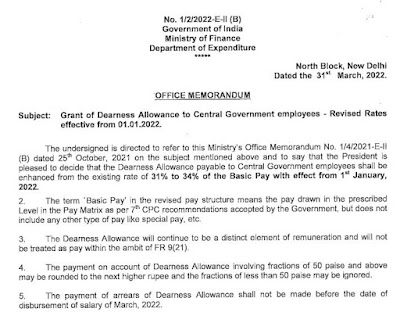
DA Jan 2022 - Grant of Dearness Allowance to Central Government employees - Revised Rates effective from 01.01.2022

 3% DA Hike - Revised Rates effective from 01.01.2022: DoE OM dated 31.03.2022 No. 1/2/2022-E-II (B) Government of India Ministry of Finance...