Wednesday, 15 October 2014

Will the 7th CPC fulfil the demands of LDCs and UDCs?

Will the 7th CPC fulfil the demands of LDCs and UDCs?

For a number of years now, especially after the 6th CPC, the problems faced by LDCs and UDCs have started gaining prominence. The unity and sense of purpose among them makes them look all set for the kind of victory that Pharmacists had. Common sense of purpose, unity and dedication sure make success possible!

In order to decrease the number of grades, the 6th Pay Commission combined all the different grades between Grade Pay 1300 to Grade Pay 1800 into a single grade – Grade Pay 1800, thereby wiping out the entire Group ‘D’. As a result, everybody became Group ‘C’ employees. Even those who lacked the minimum education levels, illiterates and everybody else were lumped into Group ‘C’. Their Grade Pay was also raised to Rs. 1800. But, at the same time, employees working as LDCs, who have a minimum educational qualification of Class XII and also possess some technical education, were not given any upgrading. Instead, they now had to share their grade with lesser-qualified former Grade ‘D’ employees.

The next huge trouble originated from the MACP. Those who didn’t get any promotion for years are given career upgradations through MACP. LDCs who didn’t get any promotions for more than 10 years were given their next grade pay, from Rs. 1900, their pay rose to Rs. 2000. The increase of mere Rs. 100 turned out to be a huge disappointment to many. Similarly, those with Grade Pay 2400 were hoping for a jump to Grade Pay 4200, but were instead forced to upgrade with only Grade Pay 2800 as per MACP rules. That anger kept seething too, because the different is 1400.

The most important demand of the LDCs and UDCs is to upgrade the current Pay Scale-Grade Pay.
Grades are decided based on the educational qualification of the employees. An LDC possesses a minimum educational qualification of Class XII and also has some technical qualifications. The basic salary of an LDC is just Rs. 1900 + 5830 = Rs. 7730.00. They want it revised to Rs. 2400 + 7510 = Rs. 9910.

The big question is – will the 7th CPC grant this demand?

Source: 90Paisa
#7CPC, #7th CPC, #7th CPC Pay Scale, #LDC, #LDC UDC Issues, #Grade Pay Upgradation for LDC & UDC, #LDC Grade Pay Issues, #LDC UDC Grade Pay Issue, #TKR Pillai

Latest list of CGHS Hospitals & Revised Package Rates effective from 1.10.2014

Latest list of CGHS Hospitals & Revised Package Rates effective from 1.10.2014

Ministry of Health and Family Welfare published the detailed list of new Hospitals, Eye, Dental and Diagnostic Centres under Central Government Health Scheme. The fresh empanelment of private Health Care Orgnizations (HCOs) and revision of package rates applicable under CGHS Delhi and NCR.

The Directorate of General of Central Government Health Scheme issued an office memorandum, which states the revised rates and terms & conditions will come into effect from 1st October 2014. The new empanelment shall be for a period of two years from 1.10.2014.

In Delhi 54 Hospitals, 72 Exclusive Eye Centres, 50 Diagnostic Centres, 32 Exclusive Dental Clinics.
In Faridabad 5 Hospitals, 1 Exclusive Eye Centres, 1 Diagnostic Centres.

In Gurgaon 9 Hospitals, 5 Exclusive Eye Centres, 3 Diagnostic Centres, 6 Exclusive Dental Clinics.
In Ghaziabad 9 Hospitals, 2 Exclusive Eye Centres, 3 Exclusive Dental Clinics.
In Noida 10 Hospitals, 3 Exclusive Eye Centres, 2 Exclusive Dental Clinics.

Click here to view the complete list of Health Care Organizations (HCOs) Empanelled under CGHS, Delhi & NCR with effect from 1.10.2014 and revised package rates for treatment procedure / investigation list as per office memorandum No.S.11045/36/2012-CGHS (HEC) dated the 1st October 2014.

#CGHS, #CGHS Dispensaries, #CGHS Hospitals, #cghs Package Rates, #elhi CGHS Hospitals

Bank employees may come under 7th Pay Commission

Bank staff may come under govt pay panel: Hindustan Times
Even after several rounds of talks between bank employee unions and the Indian Banks Association (IBA), there seems to be no consensus on the quantum of salary hike for over 800,000 employees at different public sector lenders.
While the IBA has indicated that the maximum hike that can be offered to employees is about 11%, unions are demanding a 25% raise.
With the stalemate still continuing, sources said a proposal could also be considered to bring them under the purview of the Seventh Pay Commission, which has already been constituted. A large section of bank employees are, however, unwilling to do the same.
“There needs to be an end to the stalemate and this is an option that has also come up,” an official source who refused to be identified said.
IBA chairman, TM Bhasin, however, told HT that there was no proposal to bring bank employees under the purview of the pay commission. “IBA has no such consideration and no proposal has come to the IBA,” he said.
“There have been some reports of bringing the bank employees under the purview of the pay commission but we are completely opposed to such a move,” said CH Venkatachalam, general secretary, All India Bank Employees Association.
The salary revision of bank employees is due since November 2012.
Unions meanwhile have threatened to go on a strike on November 12. There could even be an indefinite strike thereafter if the issue is not addressed, union representatives said.
A senior bank executive said the issue of wage settlement would have to be sorted at the earliest and the finance ministry could intervene to ensure that the deadlock comes to an end.
“At a time, when the Pradhan Mantri Jan Dhan Yojana is underway and targets have to be met, there is little scope to lose time,” he said.
#7th CPC News, #7th Pay Commission News, #Bank Employees News, #Bank Staff News, #Wage Revision, #7th Central Pay Commission, #Bipartite Wage Revision, #Wage Revision, 7th CPC

Due to General Assembly Elections in Maharashtra, Declaration of Public Holiday on 15.10.2014 – Orders issued

Due to General Assembly Elections in Maharashtra, Declaration of Public Holiday on 15.10.2014 – Orders issued

Maharashtra Government and Indian Bank Association has issued orders on declaration of Public Holiday under Negotiable Instruments Act, 1881 on 15.10.2014 on account of polling for the General Assembly Elections in the State of Maharashtra.

MAHARASHTRA GOVERNMENT ORDER

GENERAL ADMINISTRATION DEPARTMENT
Madam Cama Road, Hutatma Rajguru Chowk, Mantralaya,
Mumbai 400 032, dated the 7th October 2014.

NOTIFICATION

NEGOTIABLE INSTRUMENTS ACT, 1881.
No. PHD. 1114/C.R.343/2014/XXIX.— In exercise of the powers entrusted to the Government of Maharashtra by the Government of India, Ministry of Home Affairs vide its Notification No.39/1/68/Judi-III, dated the 8th May 1968 under section 25 of the Negotiable Instruments Act, 1881 (XXVI of 1881), the Government of Mnharashtra hereby declares as a Public Holiday in the State, on the day of Polling i.e. Wednesday, 15th October 2014 for the General Assembly Elections.

The Departments of Mantralaya are requested to bring these instructions to the notice of the Corporations / Undertakings and Semi-Government bodies under their administrative control and advise them to extend the facility to the employees.

By order and in the name of the Governor of Maharashtra,
P. P. GOSAVI,
Deputy Secretary to Government.


INDIAN BANK ASSOCIATION PUBLISHED ORDERS REGARDING ELECTION HOLIDAYS ON 15TH OCTOBER 2014…
Indian Banks’ Association
HR & INDUSTRIAL RELATIONS
No.CIR/HR&IR/H6/2014-15/727
October 9, 2014
All Members of the Association
(Designated Officers)

Dear Sirs,

Public holiday under Negotiable Instruments Act, 1881 on Wednesday, 15th October 2014 on account of General Assembly Elections in the State of Maharashtra. We enclose a copy of notification No.PHD.1114/C.R/343/2014/XXIX dated 7th October 2014 issued by the Government of Maharashtra declaring Wednesday, 15th October 2014 as Public holiday under the Negotiale Instruments Act, 1881(XXVI of 1881), on account of polling for the General Assembly Elections in the State of Maharashtra.

This is for information of member banks.
Yours faithfully,
sd/-
K S Chauhan
Sr. Vice Presidenl-HR&IR
#Election Holidays, #Public Holidays, #State Government Employees, #Election Duty

Ministry of Finance and issued orders regarding revision of rates of incentives to Public Sector Bank officers posted to North Eastern Region

Ministry of Finance and issued orders regarding revision of rates of incentives to Public Sector Bank officers posted to North Eastern Region as follows…

F.No.4/4/2/2001-IR
Government of India
Ministry of Finance
Department of Financial Services
Jeevan Deep, IIIrd Floor,
Parliament Street, New Delhi
Dated the September 26, 2014
To
The Chairman, SBI/IDBI and CMDs of all PSBs.

Subject: Incentives to officers posted to North Eastern Region – revision thereof

Sir,
I am directed to refer to this Department’s letter of even number dated 11.1.2002 on the subject cited above and to say that proposal of revision/reconsideration of the ceiling of ad hoc and temporary incentives to officers posted North Eastern Region has been examined in this Department and it has been decided to advise the Public Sector Banks as follows

i) The incentive shall be 20% of basic pay with minimum Rs. 3000/- pm and maximum Rs. 7500/- pm.
ii) Officers belonging to a State in North Eastern Region but posted in other States of North Eastern Region shall also be eligible.

2. Other terms and conditions as provided earlier and covered in letter dated 11.1.2002 shall remain the same. The above revision in the incentives is applicable with immediate effect. Banks are requested to take appropriation action accordingly.

3. This issues with the approval of Secretary (FS).
Yours faithfully,
sd/-
(Manish Kumar)
Under Secretary to the Government of India

#Bank Employees News, #Indian Banks Association, #North Eastern Region, Special Incentive

Monday, 13 October 2014

National Council JCM Staff Side Meeting Will Be Held Tomorrow

National Council JCM Staff Side Meeting Will Be Held Tomorrow

Much Anticipated National Council JCM Staff Side Meeting Tomorrow

The National Council JCM Staff Side meeting is going to take place tomorrow in New Delhi. The meeting, to be attended by the representatives of all federations, will be chaired by the Staff Side Secretary, Shiva Gopal Mishra.

Important agendas of the meeting include demanding a change in the attitude of the Central Government towards the Central Government employees, merger of DA, granting interim relief and to hold discussions over the date of effect of the recommendations of the 7th CPC.

In the past, interim relief was granted before the recommendations of the new Pay Commissions were implemented. In the Fifth Pay Commission, it was recommended that whenever the DA crosses 50%, it should be added to the basic pay. The recommendation was accepted and in the year 2004, a 50% DA hike was added to the basic pay of all Central Government employees. Therefore, interim relief was not granted during the 6th Pay Commission.

There were also a number of confusions in the tenure of the Pay Commission, which had to be constituted once every ten years. One Pay Commission was almost lost, as a result. To make up for these errors, a demand has been presented to implement the recommendations of the 7th Pay Commission from January 1, 2014 onwards.

Members of the National Council JCM Staff Side, including Mr, C. Srikumar, Mr. S.N. pathak, Mr. J.R. Bhonsale, Mr Raj Gopal and the association president, Mr. M Raghaviah, attended the meeting that was held on September 14, 2014 at AIRF office, under the leadership of Staff Side Secretary, Shiva Gopal Mishra, and presented their views. It was decided at the meeting that further debates will be conducted on important issues and decisions will be made on 12.10.2014.

Tomorrow’s meeting attains prominence due to the fact that representatives of all the employee associations are going to participate and debate over some of the most eagerly awaited issues.

Source: CGEN.in

Delink the Aadhar Card from the process of implementation of Biometric attendance system – NFCAA

Protest against Aadhar Card based Biometric Attendance System for the Central Govt Employees

Resolutions Adopted by the 6th Federal Council Meeting of NATIONAL FEDERATION OF CIVIL ACCOUNTS ASSOCIATIONS Held at Cochin on 17th and 18th September 2014
RESOLUTION – I
(IN PROTEST AGAINST BIOMETRIC ATTENDANCE SYSTEM)

The 6th Federal Council meeting of the National Federation of Civil Accounts Associations held at Cochin on 18th and 19th September 2014 discussed the decision of Govt. of India to introduce the Aadhar Card based biometric attendance system for the Central Govt. Employees.
The meeting observed that introduction of Aadhar based attendance and punctuality in the offices-
 
(a) Every employee is expected to be on seat and to start work at the prescribed opening of office hour. Ten minutes grace time may be allowed in respect of arrival time to cover up any unforeseen contingencies.

(b) (i) Every employee should note down the time of arrival and departure under his /her initial in ink in the Attendance Register(S 37)
 
(ii) The Register should be initialed at the bottom by the Section Officer.
(iii) The Register should be sent to the Branch Officer 10 minutes after the prescribed arrival time.
(c) (i) The Section Officer will see that the entries are made correctly.
(ii) The section Officer will draw the attention of the Branch Officer to the names of the person(s) who frequently or habitually late.
(iii) The section officer shall denote prescribed abbreviations for non- attendance by any official

- This system of recording attendance and watching the punctuality of individual government servants and the portrait of his/her attendance and non- attendance is in vogue from a date prior to independence and its efficacy was never questioned by the Administrative Reforms Committees of any of the six Central Pay Commissions. The administrations of Government departments have been most effectively maintaining the punctuality and discipline in the offices for the last seven decades by using the omnibus register for maintaining the attendance and punctuality.

The meeting felt that giving publicity of the decision of enforcing attendance in a disproportionate manner is retrograde and derogatory to the dignity of the employees and officers of Central Government establishments. The electronic and print media are using this internal administrative decision of the Central Government as an instrument to malign the officers and employees of Central Government which is untenable.

The meeting also noted that the Aadhar Card based biometric attendance system is nothing but pointing of fingers towards the integrity of the employees & officers of central Government establishments. Before taking such decisions, the Government did not bring the fact of deteriorations in the position of attendance and punctuality if any, in the National Council JCM justifying the requirement to replacing the manual system by machine. As per the Government of India, Department of Personnel and Training OM. No. 3/42/87-JCA dated 28th January 1988 read with clause 8(Jurisdiction and functions) of JCM the Staff side is to be consulted before introduction of any new Technology.

The meeting therefore, urges upon the Govt. of India to delink the Aadhar Card from the process of implementation of Biometric attendance system and before implementing the new scheme of biometric attendance system in the Central Government Offices, take the following actions-

1. Discuss the issue of introduction of Biometric attendance system/Adhar Card based Biometric Attendance system in the National Council(JCM) and Departmental Council (JCM)
And
 
2. Upgrade infrastructure and communication system in all cities of the country or introduce pickup point system for the employees & officers so that they could report for duty in time.
The meeting also urges upon the Government of India not to consider introduction of aadhar card based attendance. The National Federation of Civil Accounts Association stands for strict implementation of punctuality, discipline and work culture in all central Govt. offices and extend its full support and co-operation to maintain punctuality and discipline in the offices.
The meeting Resolves to forwarded the Resolution to the Cabinet Secretary, Controller General of Accounts, the Secretary, staff side National Council (JCM) and the Secretary General, Confederation of Central Government Employees & workers.
(T.R. Janardanan)
President

Rs. 10 Lakh Compensation if Government Employee Dies During Election Duty

Rs. 10 Lakh Compensation if Government Employee Dies During Election Duty

The Tamil Nadu Election Commission’s Chief Commissioner, Praveen Kumar says that the Election Commission has announced a compensation of Rs. 10 lakhs for employees who die while on election duties.
Normally during state elections, more than 3 lakh state and Central Government employees, including teachers, local police personnel, police personnel from the neighboring states, paramilitary forces and private videographers, participate.

If death occurs in poll-related violence or if the employee dies of cardiac arrest while on election duty, his/her family was, until now, given a compensation of Rs. 5 lakhs. This has been increased to Rs. 10 lakhs from 2014 onwards. Under this scheme, personnel who had died on duty during the May elections will be paid a compensation of Rs. 10 lakhs, says Praveen Kumar.

If the death is unfortunately caused due to any violent acts of extremist or unsocial elements like, road mines, bomb blasts, armed attacks, etc., the amount of compensation would be Rs.20 lakhs. In the case of permanent disability, like loss of limb, eye sight, etc., a minimum ex-gratia payment of Rs.5 lacs would be given to the official (which would be doubled in the case of such mishaps being caused by extremist or unsocial elements as aforesaid).

Friday, 10 October 2014

Is Interim Relief Likely for Central Government Employees?

Is Interim Relief Likely for Central Government Employees?

Is it really possible for Central Government employees to get an interim relief this time? Let us look at it in detail.

‘Interim Relief’ may be defined as the temporary relief given to employees before the new Pay Commission’s recommendations are implemented. ‘Interim relief will be treated sui generis’, most of the Finance Ministry orders included the sentence when sanctioning interim relief.

If one looks at the interim relief granted in 1983 and 1993, it can also be inferred that interim relief is granted in order to correct the errors in salary revision once every ten years. One gets the feeling as if an entire Pay Commission was lost simply for the sake of a small hike.

During the previous Pay Commission, particularly in 5th CPC, since 50% DA Merger was granted, there was no interim relief.

Here are some of the reasons why interim relief is normally granted :
* It has been granted a number of times before, in the past.
* DA Merger hasn’t been sanctioned this time
* Prices have touched the skies
* Some errors in the formulation of once-in-a-decade Pay Commission…etc.,

Reasons cited for the Government’s refusal to sanction DA Merger/interim relief:
* 7th Pay Commission was constituted at the right time.
* There was no recommendation for DA Merger in the 6th Pay Commission
* There was a recommendation against DA merger in the 6th Pay Commission (the Commission is, therefore, not recommending merger of dearness allowance with basic pay at any stage).
* In the event that the Price Index is taken as 115.76 instead of 306.33 for the DA calculations.

All the Central Government Employees Unions and Federations are functioning with the intention of getting the DA merged with the basic pay. If that doesn’t happen, these federations are hoping that interim relief will be offered through the 7th Pay Commission’s interim report.

This is very much possible if Modi Government is willing to accept the demand.

#7CPC, #7th Central Pay Commission, #7th CPC News, #DA Merge with Basic Pay, #DA Merger, #50% Da Merger, #7th CPC Interim Report, #Interim Relief, #Interim Report

Thursday, 9 October 2014

Expected DA phrase losing interest amidst Central Government Employees..!

“Expected DA” phrase losing interest amidst Central Government employees..!

Nowadays, the attractive and magical word of “Expected DA” is losing interest amidst Central Government employees..!

We are proud to claim that we were the first to introduce the phrase, “Expected DA”.

Central Govt employees are getting additional Dearness Allowance twice in a year according to the fluctuation of Consumer Price Index. Generally all employees, including state and central government employees are showing interest to know the hike of additional Dearness allowance in advance.

In 2009, when, for the first time we wrote an article under the title “Expected DA (Dearness Allowance) from Jan 2009 for Central Government Employees“, we did feel a bit uneasy. We were wondering if the readers would comprehend the title properly. Even the familiar publications like “Swamy’s News” didn’t have such phrases that time.

The phrase “Expected DA”, received tremendous response from the Central Government employees and earned a place for itself in their hearts. It wouldn’t be an exaggeration for us to claim that after the magical ‘Central Government Employees News’, this was the most exciting phrase that we had come up with.

As far as we know, “Swamy’s News” was the only publication that had successfully predicted the Dearness Allowance accurately for a number of years. It is not an ordinary feat for a private publication to be treated on par with a Government Order. This is the reason why, despite the onslaught of the internet, the publication is still gaining tremendous growth.

In January 2009, we announced a 6% expected additional DA. Since then, with Dearness Allowance rising continuously, the curiosity and eagerness to hear the forecast continued to grow. With two 10% hikes in 2010, the response to our forecasts was nothing short of mind-boggling.

Normally, Government employees are more than eager to receive positive news about salary hike, like increment, DA, Arrears, Bonus etc.,. Yet, strangely, there is a slight dip in the kind of interest that the phrase “Expected DA” triggers nowadays.

In 2009 Our Forecasts in additional Dearness Allowance…

Source: 90PAISA
[http://90paisa.blogspot.in/2014/10/expected-da-phrase-losing-interest.html]

#Expected DA, #Expected DA Jan 2015,# Expected DA to CG Staff, #Central Government Employees News

Flash News

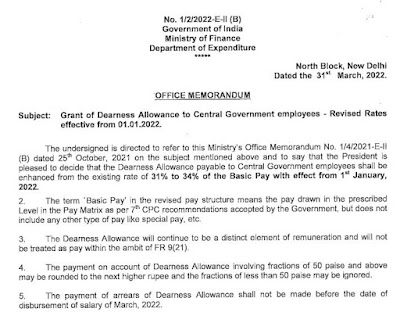
DA Jan 2022 - Grant of Dearness Allowance to Central Government employees - Revised Rates effective from 01.01.2022

 3% DA Hike - Revised Rates effective from 01.01.2022: DoE OM dated 31.03.2022 No. 1/2/2022-E-II (B) Government of India Ministry of Finance...