Showing posts with label Digital India. Show all posts

Thursday, 25 August 2016

100 government websites differently-abled friendly soon

100 government websites differently-abled friendly soon

New Delhi: Work is on to make 100 government websites differently-abled friendly and 16 such websites are ready, Union Minister for Electronics & Information Technology Ravi Shankar Prasad said today.
Optical fibre measuring 1.39 lakh kms to connect village panchayats with internet has been laid since last two years as against 398 km from 2011-14 during the UPA.

He claimed nearly 104 crore people, comparable to the size of population of Italy and France, are in the ambit of the Aadhar and mobile connections in India since last two years.

“What is Digital India? We are seeking to bridge the divide between Digital Haves and Digital Have-nots,” he said while listing the achievements of Modi government since last two years.

“Of 125 crore people 104 have Aadhar card. They are digitally verifiable. With one click, you can view your face, your iris and finger-tip. It has happened in a completely secure condition and we have are the first ones to have done this,” Prasad claimed.

He was speaking at the launch of Sugamya Pustakalaya- an online library for persons with visual disabilities.
The online library was launched by Prasad, Union HRD Minister Prakash Javadekar, Union Minister for Social Justice and Empowerment Thaawarchand Gehlot, and his two deputies Krishan Pal Gurjar and Ramdas Athawal.

Books are available in accessible formats for people with visual impairment and other print disabilities.
People can access over two lakhs books in diverse languages, integrating libraries across India and the globe, including the largest international library ‘Bookshare’.

“We have linked ‘divyangjans’ with the common service centres in our country. National Informatics Centre (NIC) is in the process of making 100 Government websites ‘divyang’ friendly of which 16 have already been made ‘divyang’ friendly,” Prasad said, as he urged NGOs and citizens to use ‘My Gov’ to provide valuable inputs on central schemes.

Prasad said in order to help children suffering from autism, an e-learning tool has also been developed by the National Institute of Mentally Handicapped and all the scholarships will be under one banner.

Javadekar said there are 23 lakh people special ability under the Sarva Shiksha Abhiyan.

As the HRD Minister, Javadekar said, he receives invitations for convocations, but he has accepted the first invitation from the University meant for differently abled in Thiruvanathapuram.

Gurjar said people with special abilities don’t need sympathy of the people but deserve their love, affection and support.

PTI

Sunday, 5 June 2016

Centre to government officials: Don’t use smartphones, foil hackers

Centre to government officials: Don’t use smartphones, foil hackers

Concern over hacking and data thefts and vulnerabilities in communication systems has prompted the centre to instruct officials in all central ministries and departments to use smartphones only as a last resort and in emergency situations to discuss sensitive official work.

Odd as the “restrictions” on use of smartphones may sound in a wireless world, a recent two-day session on cyber security in government offices saw ministry of home affairs (MHA) and central paramilitary brass being asked to stick to face-to-face meetings, RAX (a closed communication network connecting government offices) and landlines.

The officers were sensitised that smartphone is a far less secure device when it comes to dealing with official work due to the risk of embedded malware or spyware that may be downloaded along with certain applications and that these instruments are best avoided when discussing classified information.
The instructions have been reiterated not only for establishment pertaining to the MHA but also defence, external affairs and other sensitive ministries.

“Though it is largely home and defence ministries that routinely handle matters that can directly impinge on national security, the norms for avoiding use of smartphones to process and relay sensitive information will apply to all government departments,” said an officer.

Hacking is a major threat to cyber systems and networks used in government offices not only in India but across the world. There have been several cases of Chinese and Pakistani hackers breaking into government of India websites, besides gaining access to official data.

Internationally, many hacking attacks are known to originate from China, Russia, the US, Iran, Israel and even North Korea.

India has faced a consistently high level of cyber threat from Chinese hackers, many being students of technical institutes working with official blessings, whose targets range from government offices, commercial enterprises to admission lists in Army public schools.

he threat of hacking and data-theft is seen as even more serious now, given the Modi regime’s push for ‘Digital India’ that requires most government services and transactions to go online.

As per latest instructions on “prudent use of smartphones” shared with sensitive government departments, employees have been told not to connect their smartphones to office computers, including for charging. Also, there is a thinking that voice-calls meant for official work should be made using only landline phones.

Input with TNN

Thursday, 12 May 2016

Digital India to offer passport, pension, driving license online

Digital India to offer passport, pension, driving license online

Government is implementing the Digital India programme to transform the country into a digitally empowered and knowledge economy so that various services like passport, pension and driving licenses could be delivered online, Lok Sabha was informed today.

Telecom and IT Minister Ravi Shankar Prasad said one of the primary focus areas of Digital India is Pillar 5: eKranti – electronic delivery of services.

“e-Kranti aims to ensure a government wide transformation by delivering all services electronically to the citizens through integrated and interoperable systems via multiple modes while ensuring efficiency, transparency and reliability of such services at affordable costs,” he said during Question Hour.

In e-Kranti, 44 Mission Mode Projects (MMP) – 13 central, 17 state and 14 integrated MMPs – are being implemented. Under the 25 operational MMPs 222 services are being provided. More than 192 e-transactions have been reported since January 1, 2016.

“Under e-Kranti, the government of India has made concerted effort to make offline government services to be also delivered through online mode, ensuring that all citizens would have access to them, thereby improving the quality of basic governance on an unprecedented scale,” he said.

Prasad said services being provided online include income tax, passport, immigration, core banking, pension grievance redressal, courts, police, RTI, utility payments, licenses, social welfare schemes, agriculture, municipality, land record, vehicle registration, driving license, public distribution system etc.

The Minister said so far more than 100 crore Aadhaar enrollments have been processed and that resulted in extensive use of Direct Benefit Transfer (DBT) scheme for subsidies and saving of Rs 21,000 crore.

Prasad said around 1.99 lakh common service centres have been made operational and 1,40,751 KMs OFC pipe laid and over 1,12 lakh KMs optical fibre laid for connectivity to 50,465 gram panchayats to deliver services to citizens in rural areas.

Rural tele-density has crossed 50.09 per cent. Guidelines for spectrum sharing and trading and liberalisation of spectrum have been issued. More than 2 crore passport applications have been processed, he said.

PTI

Thursday, 18 February 2016

Online Subscriber Registration and contribution under NPS using eNPS platform

Online Subscriber Registration and contribution under NPS using eNPS platform

In light of Prime Minister’s “Digital India” campaign on promoting e-governance for providing last mile connectivity through extensive use of ICT (Information and Communications Technology) platforms, Pension Fund Regulatory and Development Authority (PFRDA) has been pursuing the development and operationalization of online transaction facilities for the prospective as well as existing subscribers of NPS.

PFRDA introduced eNPS online portal whereby PAN (Permanent Account Number) and savings bank account of new subscribers to NPS who are already customers of the banks are accepted as KYC with active participation of the banks acting as POPs for opening of accounts under NPS.

PFRDA has received feedback from prospective subscribers and other stakeholders that those who voluntarily seek to use Aadhaar as their document of identity for availing of the eNPS online platform to join NPS should not be deprived of this eNPS facility.

As the identity and address for such account holders is established through e-KYC facility with the express consent of the subscriber through One Time Password (OTP) and as Aadhaar is a unique number, its use as a KYC document rules out the possibility of opening duplicate retirement (PRAN) accounts. PFRDA has accordingly revisited the issue and believes that enabling eAadhaar in addition to PAN and bank account based KYC for the eNPS platform can reduce the cost and time of operation and ensure wider coverage to the citizens of India under the old age income security schemes and thus help in fulfilling the mandate given to it under the provisions of the PFRDA Act, 2013.

PFRDA has accordingly modified the eNPS functionality to accept PAN and bank account or eAadhaar as the KYC document for online registration of subscribers under NPS. With the operationalization of this modified eNPS platform, the subscriber will now have the following options for opening of account:
• Opening of account through any of the Points-of- Presence- Service Provider (POP-SP).

• Opening of account online using PAN and net banking of the selected bank. In this case KYC verification is done by the Bank. The PRAN gets activated only after KYC verification by bank.

• Opening of account online using Aadhaar No. and OTP received from UIDAI. In this case, the subscriber can instantly get their PRAN generated and can contribute.

The eNPS platform using Aadhaar based KYC verification is one of the options for any prospective subscriber to join NPS and it is optional and purely voluntary on the part of the prospective subscriber.

To register under NPS through eNPS using Aadhaar, the prospective subscriber needs to have Aadhaar Number/Card with access to the mobile number registered with Aadhaar.

With the use of this Aadhaar based KYC verification, the subscriber would be able to open his NPS account online. The Prospective subscriber will require to follow the undernoted process for opening of NPS account:

• The prospective subscriber will go to eNPS platform hosted on NPS Trust website www.npstrust.org.in and enter Aadhaar and validate the same using OTP (Sent on the mobile number registered with Aadhaar).

• Then he will be required to fill up the mandatory details like choice of Pension Fund, Investment Scheme, nominations etc.

• Address and Date of Birth details will be auto-populated from details available with Aadhaar.

• He will be required to provide a mobile number and email ID (Mandatory requirement).

• He will be required to Scan and upload the signature. Subscriber may also upload a scanned photograph, in case he/she wishes to replace the photo obtained from Aadhaar, if the Aadhaar photo is blurred or hazy.

• He will be required to make online payment (Minimum amount of Rs 500/-).

• After completion of this process, the PRAN will be generated instantly.
Subscriber will be required to print the form, paste photograph, affix signature and submit the physical form to CRA within a specified period of time while continuing contributing online.

A prospective subscriber can visit NPS Trust website www.npstrust.org.in and select NPS Online menu to register and contribute to NPS.

The complete information about eNPS is available on PFRDA website www.pfrda.org.in and also on NPS Trust website www.npstrust.org.in .

Through this facility, it is expected that the subscriber will have multiple advantages like seamless onboarding experience where he need not visit a Point of Presence and can register from anywhere through an internet connection, contribution with minimum cost of transaction and reduction in errors resulting from various manual activities.

PIB

Flash News

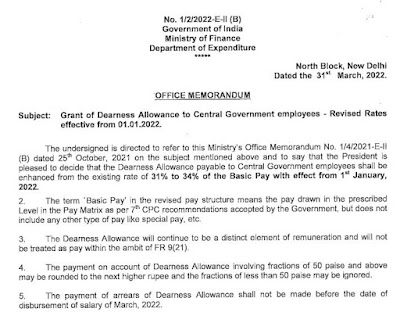
DA Jan 2022 - Grant of Dearness Allowance to Central Government employees - Revised Rates effective from 01.01.2022

 3% DA Hike - Revised Rates effective from 01.01.2022: DoE OM dated 31.03.2022 No. 1/2/2022-E-II (B) Government of India Ministry of Finance...