Saturday, 23 April 2016

7th Pay Commission – How Govt will Save Rs 11,000 Crore in Allowances

7th Pay Commission – How Govt will Save Rs 11,000 Crore in Allowances

7th-Pay-Commission-allowance-7CPC

7th Pay Commission – How Govt will Save Rs 11,000 Crore – Allowances currently are roughly half of the Centre’s salary bill.

The Centre is likely to implement the 7th Pay Commission award from September-October, the beginning of the festive season, to give a consumption boost to the economy. However, in order to restrict the budgetary outgo, it would pay the revised allowances only prospectively, unlike the pay component that will be paid along with arrears from January 2016.

Allowances currently are roughly half of the Centre’s salary bill; as per the pay panel award, the steepest increase — 63% — was in allowances, while the overall rise in pay, allowances and pensions recommended was 23.55%.

If the revised allowances take effect only from September this year, the savings to the govt would be to the tune of Rs.11,000 crore, official sources said. Additionally, if the railway ministry decided to toe the Centre’s line, the national transporter will save around Rs.3,800 crore. The Budget in February had provided Rs.53,500 crore towards the pay panel-induced overall rise in pay, allowances and pension (PAP) and also to finance the one-rank-one-pension scheme for the armed forces. The 7th Pay commission had estimated the additional outgo in FY17 due to its award at Rs.73,650 crore.

The Centre’s additional bill on allowances in FY 17 due to the pay panel would have been about Rs.22,000 crore, but since it would release allowances only from September (and not with retrospective effect from January as envisaged by the commission), the actual outgo would be nearly half that.

Some analysts reckon that the consumption stimulus to the economy from the increased pay to government staff this time around could be somewhat muted.

Compared with the Sixth Pay Commission award — which led to an overall salary increase of 40% and was released first with arrears of 30 months paid over two years — the disbursement now includes only six months’ arrears in pay, they noted. “If the pay commission’s award is implemented across the board (including state governments as well as public institutions/enterprises), it would bring in an additional 0.9% of GDP growth in FY17,” said NR Bhanumurthy, professor at the National Institute of Public Finance and Policy. Even if states lag in implementing the pay revisions, Bhanumurthy said, GDP growth still could be at least 8% in the current fiscal, up from likely 7.6% last year.

Contrary to some reports that government employees could be asked to put part of the increased salary in bank capitalisation bonds to be issued by the Centre to infuse capital in the banks, officials said there was no such move. The government would like the employees to spend additional money in their hands to perk up the economy, sources added.

The seventh pay panel had projected the railways budget would bear the additional Rs.28,450 crore in FY17 due to its award. However, officials reckon that the actual requirement could be lower by about R3,800 crore for the railways due to prospective implementation of allowances.

Source: Financial Express

Steps to be followed, if OROP Arrears not paid so far


Steps to be followed, if OROP Arrears not paid so far

May be due to the non-availability of the following particulars with your bank, they have not paid. Therefore, please arrange to send the attested proof of the following particulars:-

1. Rank
2. Qualifying service.
3. Group
4. Date of Birth.

Please take a Xerox copies of the proof, get attested by your Bank’s Manager and send it to the CPPC of your bank by Registered Post immediately.

It is better if you can send the OROP arrears calculation sheet also along with the documents. For OROP calculation sheet, please click here.

Click FAQ on the Home page read the procedure for payment.

Addresses of some important banks and email addresses.

1. State Bank of India, CPPC, 112/4 Kaliamman Koil Street, Virugambakkam, Chennai 92. Email: cppc.zoche@sbi.co.in
2. Canara Bank, CPPC, Besavangudi, Bangalore 4. Email: cppc@canarabank.com
3. Indian Bank, CPPC, 66 Rajaji Salai, Chennai 1. Email: cppc@indianbank.co.in
4. Indian Overseas Bank, CPPC, Annasalai, Chennai 2. Email: cppc@iobnet.co.in
5. Central Bank of India CPPc, 2nd Floor, MMO Building, MG Road, Fort, Mumbai 400001. Email: cppc@centralbank.co.in
6. Corporation Bank, CPPC, Pandeshwar, Mangladevi Temple Road, Mangalore 575001.email: hogovt@corpbank.co.in :
7. Bank of India CPPC 87A 1st Floor,Gandhibaug, Nagpur 440002. Email; cppc.nagpur1@bankofindia.co.in
8. Union Bank of india, CPPC, 12th Floor, 239 Vidhan Bhavan Marg, Nariman Point, Mumbai 400021. Email: govtbusinesss@unionbankofindia.com.
9. Bank of Baroda CPPC 13th Floor, 16 Parliament St. New delhi 1. Email: cppc.ho@bankofbaroda.co.in
10. Syndicate bank CPPC, 2nd Floor, Manipal Udupi, Karnataka 574104. Email: syndcppc@syndicatebank.co.in

Source: http://indianexserviceman.blogspot.in/

PARTIAL WITHDRAWAL FROM NPS - ORDERS ISSUED BY PFRDA

PARTIAL WITHDRAWAL FROM NPS - ORDERS ISSUED BY PFRDA

Guidelines issued from PFRDA on processing partial withdrawal requests under National Pension System (NPS).

As per the guidelines, a subscriber can partially withdraw his/her accumulated pension wealth, not exceeding twenty-five per cent of the contributions made by the subscriber and excluding contributions made by the employer, if any, at any time before exit from NPS.

The aforesaid guidelines issued by PFRDA provide terms & conditions, purpose, frequency and limits for partial withdrawal under NPS.

Click Here to view Order (NSDL Circular Dt: 31.3.2016)

Click here to view Application Form

7th Pay Commission award after five-state polls: Finmin

7th Pay Commission award after five-state polls: Finmin

New Delhi: Official sources in Finance Ministry told us on condition of anonymity that the central government will announce 7th Pay Commission award to increase pay and facilities of the central government employees after the completion of five states assemblies’ poll process as the model code of conduct is currently in place and the employees will get it ahead of the festive season.

The announcement is to come in June-July after eight to nine months of receiving of Seventh Pay Commission report.

Sources, however, said the government had no plans to give allowances in arrears for the central government employees.

“There’s no arrears of allowances will be given to employees,” they confirmed.

When asked whether complications would arise in implementing the 7th Pay Commission’s recommendations when its implement, they said, “Secretaries group’ll not leave such vacuum.”

Sources said the Secretaries group was aimed at narrowing the gap between the salaries of officers and low paid government employees.

The group observed it was essential that the salary of top government officials should not be far to that of their low paid subordinate employees. “This will help reduce corruption by the government officials and make government jobs more attractive.”

The Seventh Pay Commission was formed on February 4, 2014 during the last UPA government.

Under Seventh Pay Commission recommendations, the take-home salary of the top boss in government service was fixed at Rs 2,50,000 while the the basic pay of the lowest-ranked employee was fixed at Rs 18,000.

Traditionally, pay commissions have been set up after every 10 years to revise the pay scales of central government employees. States also accept these recommendations for their employees after certain modifications.

Justice A K Mathur, Chairman, 7th Pay Commission presented its report to Finance Minister Arun Jaitley in November with the recommendations for 14.27 per cent increase in basic pay, the overall increase in salary, allowances and pensions is 23.55%. The increase in allowances will be higher by 63% while pensions will rise 24%.

A 13 members secretary-level Empowered Committee or Secretaries group headed by cabinet Secretary P K Sinha was formed in January to review the recommendations of 7th Pay Commission before cabinet nod.

TST

Friday, 22 April 2016

New EPF withdrawal norms put on hold for 3 months

New EPF withdrawal norms put on hold for 3 months

EPF withdrawal norms put on hold till July 31st 2016 – Earlier, with the consent of Trade Unions and with the intention of promoting a decent accumulation of provident fund in members account Partial withdrawal was proposed to be disallowed

The Govt puts on hold new Provident Fund withdrawal norms till July 31. New PF withdrawal norms proposes to bar withdrawal of employer’s contribution to the provident fund corpus until the employee attains the age of 58 years.

On the issue of new Provident Fund withdrawal norms, the government today decided to keep the implementation of new norms in abeyance for three more months till July 31st.

The announcement comes in the midst of protest by labour unions in several parts of the country against the new norms.

People have also launched online campaign against the decision, which was to be implemented from February 10 but was later put on hold till April 30.

In February, the ministry had issued a notification restricting 100 per cent withdrawal of provident fund by members after unemployment of more than two months.

Source: DDI News


    Press Information Bureau
    Government of India
    Ministry of Labour & Employment
    21-April-2016 17:51 IST

                Government had issued a notification dated 10th February 2016 regarding rules for withdrawal from EPF Funds by the members. Under the revised rules, the employee was permitted to withdraw the employees’ share from the fund (which is 12% of the wages).

    However, it was prescribed that the employers’ share of contribution towards the Provident Fund (which is 3.67% of wage) would be allowed to be withdrawn only at the age of retirement (58 years).

    The objective was to provide a minimum social security to the workers at the time of retirement. It was noticed that over 80% of the claims settled by EPFO belonged to pre-mature withdrawal of funds, treating the EPF accounts as savings accounts, and not a Social Security instrument.

    In order to address the issues the amendment stated above was carried out with the consent of Trade Unions and with the intention of promoting a decent accumulation of provident fund for the members at the end of their working lifetimes.

    However, considering the representations received from various quarters and after consultations with the various stakeholders, Minister of State (IC) Labour and Employment, Sh Bandaru Dattatreya announced that the government has decided to withdraw the said 10th February 2016 Notification with immediate effect.

    Accordingly, the workers are now allowed to withdraw the entire amount from the provident fund as per existing provisions of the EPF Scheme 1952 including the employers’ share of 3.67%.

Source: Press Information Bureau

Successful Strike on 11th July 2016 will fetch decent 7th Pay Commission Pay and Allowances

Successful Strike on 11th July 2016 will fetch decent 7th Pay Commission Pay and Allowances
7th-pay-commission-allowance-strike-july

Confederation of Central Government Employees and Workers, Karnataka Branch observes in the background of Govt’s decision to withhold Provident Fund withdrawal Policy on the response of Flash Strike by Garment Factory Workers in Bangalore

Comrades,

The flash strike against the recent PF Rules, 2016 of the Central Government (i.e., Centre’s new rule on Provident Fund withdrawal) by large section of Garment Factory Workers and other Industrial Workers of Karnataka State on 18th and 19th April 2016 received immense response and there was a massive protest which resulted in road blocks for hours together, thereby the entire traffic of Bengaluru City was paralyzed. The traffic was also severely affected on Mysore, Tumkur and Hosur roads.

The COC Karnataka extended moral support and sympathy for this Labour Movement. The February 10th notification was under attack from trade unions from the beginning. The notification was published in the gazette on February 26 and created technical problems.

The violence in Bengaluru prompted the Labour Ministry, Govt. of India to cancel the February 10 notification which put restrictions on 100% withdrawal from the PF account.

Within few hours of protest in Bengaluru and other parts of Karnataka state , the Hon’ble Minsiter for Labour, Shri.Bandaru Dattatreya acted upon and withdrawn the notification issued on February 10th and informed that the old system will continue. This is a victory for the workers of the country.

This clearly shows that the Government of India does not want to antagonize the workers. If the Central Government employees also participate in trade union action against the retrograde recommendations of the VII CPC similar to the Garment Workers of Karnataka, we too can get similar results and hope for a better wage revision and a decent wage hike.

This Labour movement of the Garment Workers of Karnataka state is an eye-opener for all other working class in the entire country, Comrades if one state and one particular working class movement can bring changes to the policy of the Central Government, if the entire the entire country the Central Government employees agitate against the retrograde recommendations of the 7th CPC (where only 14 % wage hike was provided against the staff side demand of 80% wage hike and also reducing the number of allowances and reduction in HRA rates) then the Central Government shall provide the decent wage hike by settling the issue of wage hike with the staff side NJCA like the PF issue being settled.

Comrades it is high time to prepare for 11th July strike of Central Government employees under the banner of NJCA. We shall get good results and Central Government shall grant better wage hike than the 7th CPC recommendations. Better we prepare for 11th July strike better wage hike we get.

Comradely yours

(P.S.Prasad)
General Secretary

Source: Confederation, Karnataka Branch

Pay fixation of Officials where Posts have been upgraded

Pay fixation of Officials where Posts have been upgraded

CPWD circular on Pay fixation of officials in terms of Illustration 4A of CCS(RP)Rules, 2008 in cases where posts have been upgraded

Central Public Works Department has issued a Circular clarifying pay fixation calculations in respect Office Superintendents.


    MOST IMMEDIATE

    No. 2/22/2015-EC-IV(SC)
    Government of India
    Directorate General
    Central Public Works Department

    Nirman Bhawan, New Delhi
    Dated : 13th April, 2016

    To

All Concerned Controlling Offices through website of CPWD.

Sub: Reg. – Pay fixation of officials in terms of Illustration 4A of CCS(RP)Rules, 2008 in cases where posts have been upgraded.

Sir,

    I am directed to refer to the above captioned subject and to say that it has been observed that, in some offices of CPWD, the pay fixation of Office Superintendents (erstwhile Head Clerk) on their promotion from the grade of UDC, during the period of 01.01.2006 to 31.08.2008, were made in the upgraded Pay Scale of Rs. 6500-10500 by multiplying Rs. 6500×1.86, instead of multiplying 1.86 with their existing pay at the time of their promotion as OS.

    2. It is, therefore, requested to all concerned Controlling Offices to rectify such pay fixation, if made, in respect of any officials. All Controlling Officers are directed to strictly follow Illustration 4A of CCS (RP) Rules, 2008 (copy enclosed) for pay fixation in case of upgradation of pay scale in respect of officials working under their jurisdiction. It is also directed that no recovery of over payments shall be made, if, such direction has been made by any Tribunal/Courts.

    3. This issues with the approval of Director (Admn.)-II.

    Yours faithfully,
    (Mahesh Chandra)
    Dy. Director (Admn.)-III

Download CPWD No. 2/22/2015-EC-IV(SC) dated 13.04.2016

Payment of Dearness Allowance to Gramin Dak Sevaks (GDS) at revised rates w.e.f.01.01.2016

Payment of Dearness Allowance to Gramin Dak Sevaks (GDS) at revised rates w.e.f.01.01.2016

Gramin-Dak-Sevaks-dearness-allowance-GDS

No.14-01/2011-PAP
Government Of India
Ministry Of Communication & IT
Department Of Posts
(Establishment Division)/P.A.P.Section
Dak Bhawan, Sansad Marg, New Delhi – 110 001


Dated 19th April 2016


To,
All Chief Postmaster General
All G.Ms. (PAF)/Directors of Accounts (Posts).

Subject: Payment of Dearness Allowance to Gramin Dak Sevaks (GDS) at revised rates w.e.f.01.01.2016 onwards -reg.

Consequent upon grant of another installment of Dearness Allowance, with effect from 1st January, 2016 to the Central Government Employees vide Government of India, Ministry Of Finance, Department of Expenditure’s O.M.No.1/1/2016-E-II (B) dated 07.04.2016,duly endorsed vide this Department letter No.8-1/2012-PAP dated 07.04.2016, the Gramin Dak Sevaks (GDS) have also become entitled to the payment of Dearness Allowances on basic TRCA at the revised rate with effect from 01.01.2016.It has, therefore, been decided that the Dearness Allowance Payable to the Gramin Dak Sevaks shall be enhanced from the existing rate of 119% to 125% on basic time related continuity allowance, with effect from the 1st January 2016.

2. The additional installment of dearness allowance payable under this order shall be paid in cash to all Gramin Dak Sevaks.

3. The expenditure on this account shall be debited to the Head “Salaries” under the relevant head of account and should be met from the sanctioned grant.

4. This issues with the concurrence of integrated Finance wing vide their Diary No.06/FA/2016/CS dated 19/04/2016.

(K.V.Vijayakumar)
Assistant Director General (Estt.)

Tamilnadu Government increased the Dearness Allowance to Pensioners and Family Pensioners from 1st January 2016

Tamilnadu Government increased the Dearness Allowance to Pensioners  and  Family  Pensioners from 1st January 2016 

  FINANCE [Pension] DEPARTMENT
    G.O.No.118, Dated 20th April 2016.
    (Thunmugi, Chithirai-07, Thiruvalluvar Aandu-2047)


    ABSTRACT

    PENSION  –  Dearness  Allowance  to  the  Pensioners  and  Family  Pensioners  – Revised rate admissible from 1st  January, 2016 – Orders – Issued.

    Read :

    1. G.O.Ms.No.264, Finance (Pension) Department, dated: 16-10-2015.

    2. G.O.Ms.No.117, Finance (Allowances) Department, dated:20-04-2016.

    3. Government  of  India,  Ministry  of  Personnel,  Public  Grievances  & Pensions,   Department   of   Pension   &   Pensioners’   Welfare,   New Delhi’s   Office   Memorandum    F.No.42/06/2016-P&PW(G),    dated: 11-04-2016.

    ORDER :

    In   the   Government   Order   first   read   above,   orders   were   issued sanctioning the revised rate of Dearness Allowance to the State Government Pensioners / Family Pensioners as detailed below:-
    Date from  which payable     Revised  rate  of  Dearness
    Allowance    (per  month )
    1st  July, 2015.     119 %  of  Pension  /  Family  Pension

    2. The  Government  of  India,  in  its  Office  Memorandum  third  read above  has  enhanced  the  Dearness  Allowance  payable  to  its  Pensioners  / Family Pensioners from the existing rate of 119% to125% with effect from 1st January, 2016.

    3. Following   the   orders   issued   by   the   Government   of   India,   the Government  has  now  decided  to  sanction  one  additional  instalment  of Dearness Allowance at the rate of 6% to the Pensioners / Family Pensioners of   the   State   with  effect  from  1-1-2016.     Accordingly,   the   Government sanction the revised rate of Dearness Allowance to the State Government Pensioners / Family Pensioners as indicated below:-

    Date from  which payable     Revised  rate  of  Dearness
    Allowance    (per  month )
    1 s t   J a n u a r y ,  2 0 1 6     125% of Pension / Family Pension

    4. The   Government   also   direct   that   the   increase   in   Dearness Allowance  shall be paid in cash to the Pensioners  / Family Pensioners with effect from 1-1-2016.

    5. While  arriving  at  the  revised  Dearness  Allowance,  fraction  of  a rupee  shall  be  rounded  off  to  the  next  higher  rupee  if  such fraction  is  50 paise and above and shall be ignored if it is less than 50 paise.  It will be the responsibility  of  the  Pension  Disbursing Authority  including  Public  Sector Banks to calculate the quantum of Dearness Allowance payable in each individual case.

    6. Pending formal authorisation  by the Principal  Accountant  General, the  revised  Dearness  Allowance  shall  be  paid  straightaway  by the Pension Pay   Officer,   Chennai-6,   Treasury   Officers   and   Public   Sector   Banks concerned.

    7. This order will apply to the following categories of pensioners:-

    (i) Government  Pensioners,  Teacher  Pensioners  of aided  and  local body  educational  institutions  and  other  pensioners  of  local bodies.

    (ii) The  State  Government  employees  who  had  drawn  lumpsum payment on absorption in Public Sector Undertaking / Autonomous Body / Local Body / Co-operative institution and have become entitled to restoration of 1/3rd commuted portion of pension as well as revision of the restored amount.

    (iii) Present  and  future  family  pensioners;  In the  case  of divisible family pensioners, Dearness Allowance shall be divided proportionately.

    (iv) Former   Travancore-Cochin   State   pensioners   drawing   their pension  on  1st   November,  1956  in  the  Treasuries  situated  in the areas transferred to Tamil Nadu State on that date, i.e. Kanniyakumari District and Shencottah taluk of Tirunelveli District.

    (v) Pensioners who are in receipt of special pensions under Extra- ordinary Pension Rules, Tamil Nadu and Compassionate Allowance.

    8. The expenditure  on Dearness  Allowance  payable  to the Pensioners and Family  Pensioners shall  be  debited to the  following Heads of Account respectively:

    “2071.   Pension   and   Other   Retirement   Benefits   –   01.   Civil   –  101. Superannuation  and Retirement  Allowances  – I. Non-Plan  – AC. Dearness Allowance to Pensioners – 03. Dearness Allowance (D.P.Code 2071 01 101 AC 0306)”

    “2071.   Pension   and   Other   Retirement   Benefits   –   01.   Civil   –  105. Family Pensions – I. Non-plan – AC. Dearness Allowance to Family Pensioners of Tamil Nadu Government – 03. Dearness Allowance (D.P. Code 2071 01 105 AC 0308) “.

    9. Orders regarding sanction of Dearness Allowance to the widows and children of the deceased Contributory Provident Fund / Non Pensionable Establishment  beneficiaries  of  State  Government  and the  former  District Board who are drawing ex-gratia will be issued separately.

    10. The   increased   expenditure   due   to   the   sanction   of   Dearness Allowance in this order is allocable among the successor States as per the provisions laid down under the State Reorganization Act, 1956.

    (BY ORDER OF THE GOVERNOR)
    T.UDHAYACHANDRAN
    SECRETARY TO GOVERNMENT  [EXPENDITURE]

Download TN Govt G.O.No.118 dated 20.04.2016.

Grant of Hospital Patient Care Allowance (HPCA) & Patient Care Allowance (PCA) to Group ‘C’ & ‘D’

Grant of Hospital Patient Care Allowance (HPCA) & Patient Care Allowance (PCA) to Group ‘C’ & ‘D’
GOVERNMENT OF INDIA
MINISTRY OF RAILWAYS
RAILWAY BOARD


RBE No.36/2016.
No.E(P&A)II-98/HW-6 Vol.III
 New Delhi, dated : 18.04.2016.


The General Managers/CAOs,
All Indian Railways &
Production Units etc.

Sub: Grant of Hospital Patient Care Allowance (HPCA) & Patient Care Allowance (PCA) to Group ‘C’ & ‘D’ (non-ministerial) Railway employees working in Railway Hospitals & Health Units/Clinics.

Ref: PNM/AIRF Item No. 7/2010, PNM/NFIR Item No.12/2015.

Hospital Patient Care Allowance/Patient Care Allowance was introducedon the Railways in terms of Railway Board’s letter no. E(P&A)II-98/HW-6 dt. 09.01.2008. As per paragraph 2 (a) (ii), of the letter dt. 9-1-2008 Pharmacists were also made eligiblle for grant of HPCA/PCA subject to fulfilment of the conditions of admissibility except exclusive store Pharmacists who were not involved in dispensing of medicines. Both the recognised Federations, namely AIRF and NFIR have raised the issue in the forum of PNM stating that there is no particular designation of Store Pharmacists in the Indian Railways. The matter has been considered in consultation with the Health Directorate of Railway Board and it has decided to remove the exception made for exclusive Store Pharmacists in paragraph2(a)(ii) in Railway Board’s letter no. E(P&A)II-98/HW-6 dt. 09.01.2008. Pharmacists will be entiled for payment of Hospital Patient Care Allowance / Patient Care Allowance. This would have effect from 01.01.2008 as mentioned in Railway Board’s letter no.E(P&A)II-98/HW-6 dt,09.01.2008.

3. Other terms and conditions would remain the same as per Board’s letter no. E(P&A)II-98/HW-6 dt. 09.01.2008 and Board’s letter No. E(P&A)II-2013/AL-3 dt.20.02.2013

4. This issues with the concurrence of Finance Directorate of the Ministry of Railways.

5. Please acknowledge receipt.

(Salim Md.Ahmed)
Dy.Director/E(P&A)II
Railway Board.

Flash News

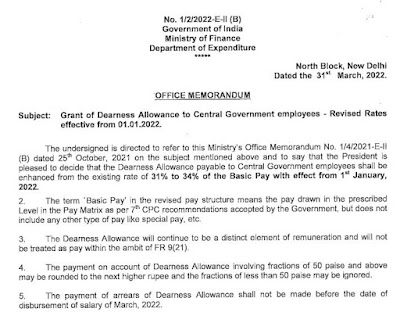
DA Jan 2022 - Grant of Dearness Allowance to Central Government employees - Revised Rates effective from 01.01.2022

 3% DA Hike - Revised Rates effective from 01.01.2022: DoE OM dated 31.03.2022 No. 1/2/2022-E-II (B) Government of India Ministry of Finance...