Showing posts with label Right to Information. Show all posts

Monday, 22 July 2019

Lok Sabha passes the Right to Information (Amendment) Bill, 2019

Ministry of Personnel, Public Grievances & Pensions
Lok Sabha passes the Right to Information (Amendment) Bill, 2019

Government is fully committed to transparency and accountability; No question of decreasing autonomy of Information Commissions: Dr. Jitendra Singh
22 JUL 2019
Lok Sabha passed the Right to Information (Amendment) Bill, 2019 today. In this amendment, it is proposed to amend the Right to Information Act, 2005 so as to provide that the term of office of, and the salaries, allowances and other terms and conditions of service of, the Chief Information Commissioner and Information Commissioners and the State Chief Information Commissioner and the State Information Commissioners, shall be such as may be prescribed by the Central Government.
Participating in the debate on the Bill, Union Minister of Statefor Personnel, Public Grievances and Pensions, Dr. Jitendra Singh said that this Government is fully committed to transparency and accountability. Following this principle, the Government has encouraged suo motu dissemination of maximum information by Government Departments in order to reduce number of RTIs.

In addition to this, the Minister said that the Government is focussing on grievance redressal through citizen involvement. This has strengthened the underlying principle of RTI and has consistently reduced the pendency of RTI applications in the last 5 years, the Minister informed the House.
Assuring the members that the Government is not misusing its powers to frame rules regarding State Information Commissions, Shri Singh said that according to the original RTI act of 2005, the power of framing rules in respect of Information Commissions does not fall under the purview of either the Union or the State or the Concurrent lists. Hence, framing rules, even for the State Information Commissions, falls under the Residuary powers of the Union Government, the Minister said.

Replying on the issue of comparison of service conditions of Information Commissions and Election Commissions, Shri Singh said that the Central Information Commission and State Information Commissions are statutory bodies established under the provisions of the Right to Information Act, 2005. Therefore, the mandate of Election Commission of India and Central and State Information Commissions are different. Hence, their status and service conditions need to be rationalised accordingly.Further, the Minister said that there has been no change in the section of the original act dealing with the appointment of Information Commissioners. Thus, the question of decreasing autonomy of the Information Commissions does not arise, the Minister added.

PIB

Sunday, 25 November 2018

Most of central government department websites lack transparency: CIC audit


Most of central government department websites lack transparency: CIC audit

Most of the central government department websites lack in suo-motu disclosure of public information under a mandatory provision of the Right to Information (RTI) Act, according to an official report released Tuesday.

It said the ultimate objective of transparency by them can be performed only by the government who control all supply side of information.

Transparency watchdog Central Information Commission (CIC) has undertaken an evaluation to ascertain the quality of suo-motu disclosures under Section 4 of the RTI Act made by various public authorities.

The evaluation was conducted by a committee comprising A N Tiwari, former Chief Information Commissioner, and M M Ansari, former Information Commissioner.

The committee evolved an evaluation format and requested all public authorities to fill it up.
Out of 2,092 public authorities registered with the commission, feedback was received from 838.
"It has been found that out of 838 public authorities, 158 public authorities got grade A, 157 public authorities got grade B, 118 public authorities got grade C, 133 public authorities got grade D and 272 public authorities got grade E," the report said.

The departments getting 90-100 per cent score in the evaluation got grade A, those getting 80-89 per cent were put in grade B, 70-79 per cent in grade C, 60-69 in grade D and below 60 per cent in grade E.

"We have been at pains to point out in our report that while the audit of the websites of the public authorities is a necessary step in the direction of ushering in greater transparency in the functioning of the state instrumentalities, the ultimate objective still remains the embrace of transparency by them as central to governance," the report said.

This task can be performed only by the government who control all supply side of information, it said.

"It is our hope that the initiative taken by the Central Information Commission to evaluate disclosure standards on websites of public authorities shall usher in the change which the RTI Act enjoins. We repeat that institutional transparency is the final frontier of the Right to Information movement," the report said.

Mentioning its major findings, the CIC report said missing information largely relates to "policy on transfer and posting of senior officers deployed at important and sensitive places; details of domestic and foreign visits undertaken by the senior officials and sources and methods of funding political parties or identification of donors", among others.

The report has been accepted by the Central Information Commission, subject to any observations that may now be received by the commission from the public authorities.

PTI

Flash News

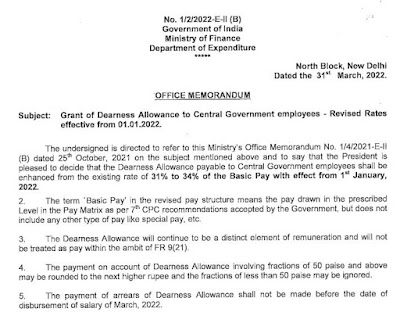
DA Jan 2022 - Grant of Dearness Allowance to Central Government employees - Revised Rates effective from 01.01.2022

 3% DA Hike - Revised Rates effective from 01.01.2022: DoE OM dated 31.03.2022 No. 1/2/2022-E-II (B) Government of India Ministry of Finance...