Monday, 1 August 2016

Ceiling for Pensionable Salary

Ceiling for Pensionable Salary

As per Para 12(1) of the Employees’ Pension Scheme (EPS), 1995, a member shall be entitled to:

(a) Superannuation pension if he has rendered eligible service of 10 years or more and retired on attaining the age of 58 years.

(b) Early pension, if he has rendered eligible service of 10 years or more and retired or otherwise ceases to be in the employment before attaining the age of 58 years.

In such cases, the amount of pension shall be reduced at the rate of 4 per cent for every year the age falls short of 58 years.

This information was given by Shri Bandaru Dattatreya, the Minister of State (IC) for Labour and Employment, in reply to a question in Lok Sabha today.

PIB

7th CPC DA calculation should give same benefit of Sixth CPC

7th CPC DA calculation should give same benefit of Sixth CPC

An interesting point is raised by Mr. Alpesh on 7th CPC DA calculation as it is not giving the DA benefit we supposed to get from sixth CPC

A Comparison of current DA vs 7th Pay Commission DA

As per this current DA calculator

6th pay DA would be 7% and

7th pay DA is 2% from July onwards.

Now if we see this figures logically there is great disappointment. We actually can’t get 7th pay DA hike at least same as currently available system of 6th pay DA hike.
7th pay commission has raised basic pay with Multiplication factor 2.57.
Then logically DA revision pattern would also be such as which at least should maintain equivalency of 2.57 factor.

For example…

If one’s Basic pay in 6th CPC is Rs. 20000, So with fitment factor of 2.57 his Basic Pay in 7th pay will be 51400.

So as per DA calculator, 7% DA rise on 6th CPC Basic Pay will be Rs.1400.

2% DA rise on 7th CPC Basic Pay will be 1028.

So current applicable DA system is clearly failing to maintain the parity between 6th pay and 7th pay consideration.
In order to achieve this balance either DA Calculation system or 7th pay fitment factor should be amended.
Suppose if we think fitment factor should be amended to maintain the parity in DA Rates between Sixth and 7th CPC, then the should be such basic to be fixed so as give its 2% value as Rs. 1400.

Thus, the 7th CPC Basic Pay to be revised as Rs. 70000 instead of Rs. 51400.

And to arrive 70000 as basic Pay, the fitment factor should be revised to 3.5…!!!
If this issue is not considered timely then employee will suffer for upcoming 10 years.

Pradhan Mantri Rojgar Protsahan Yojana

Pradhan Mantri Rojgar Protsahan Yojana

A new scheme “Pradhan Mantri Rojgar Protsahan Yojana”(PMRPY) has been announced in the Budget for 2016-17 with the objective of promoting employment generation and an allocation of Rs. 1000 crores has been made. The scheme is being implemented by the Ministry of Labour and Employment in 2016-17. Under the scheme employers would be provided an incentive for enhancing employment by reimbursement of the 8.33% EPS contribution made by the employer in respect of new employment.

The PMRPY scheme is targeted for workers earning wages upto Rs. 15,000/- per month. Publicity and awareness campaign is an integral component of the PMRPY scheme for encouraging employers including Micro, Small and Medium Enterprises (MSMEs) to avail benefits.

This information was given by Shri Bandaru Dattatreya, the Minister of State (IC) for Labour and Employment, in reply to a question in Lok Sabha today.


PIB

7th pay commission arrears not to push up car, house sales

7th pay commission arrears not to push up car, house sales

New Delhi: Car and house sales are not expected to go up after giving the seven months’ arrears of the 7th Pay Commission recommendations to central government employees on August 31.

As per the notification and resolution, central government employees will receive an average 14.27 per cent hike in basic pay effective from January 1, 2016.

The previous 6th Pay Commission had recommended a 20 per cent hike which the government doubled while implementing it in 2008.

The hype around the 7th Pay Commission recommendations is completely unnecessary, as the real impact is going to be much lesser both in absolute and relative terms compared with the previous 6th Pay Commission. As such, the employees can’t spend more to buy a car or a house.

7th pay commission arrears, its nothing more than peanut for lower and middle level employees. A middle level employee will take home the 7th pay commission arrears that may range from Rs 40,000 to Rs 80,000 on August 31.

How can he purchase a car? With the take arrears salary of Rs 40,000, getting a car loan of Rs 4 lakh is a big deal for an employee. The employee has to bring in margin money to the tune of 15 per cent to 30 per cent of the loan amount, depending on banks.

So, an employee, who is to get arrears Rs 40,000, he will have to pay Rs 80,000, the margin amount for a car loan, which is 20 per cent of a car of Rs 4 lakh. It seems impossible for him to pay the margin money upfront.

Over 80 percent central government employees are working in middle and lower level rungs.

So, bankers say that the 7th pay commission arrears effect on retail lending will be a little.

The last such comprehensive hike in salaries did lead to a sharp increase in consumer spending. House, car and two-wheeler sales, for instance, recorded a sharp surge shortly after the sixth pay panel payouts.

The sixth pay commission report was submitted in 2008, with the higher salaries coming into effect retrospectively from January 1, 2006.

It entitled government employees to huge arrears, a part of which was spent on margin money for buying cars and houses.

The Finance ministry Office Memorandum No.1-5/2016-IC said on Friday, “The 7th Pay Commission arrears shall be paid in cash in one installment along with the payment of salary for the month of August 2016.”

Accordingly, The government’s overall arrears payout will be lower because of only seven months arrears this time, compared to the previous pay commission, which came in late.

It may be recalled that a month ago, Finance Minister Arun Jaitley had “congratulated” central government employees after the Union Cabinet accorded its approval to the 7th pay commission recommendations.

TST

Delegation of powers to Financial Advisers of administrative Ministry/ Department to accord exemption for air travel in airlines other than Mr India in individual cases of autonomous bodies

Delegation of powers to Financial Advisers of administrative Ministry/ Department to accord exemption for air travel in airlines other than Mr India in individual cases of autonomous bodies— reg.

No. 19024/1/2009E.IV
Government of India
Ministry of Finance
Department of Expenditure
***
New Delhi, dated the 26th July, 2016
Office Memorandum

Sub:-Delegation of powers to Financial Advisers of administrative Ministry/ Department to accord exemption for air travel in airlines other than Mr India in individual cases of autonomous bodies— reg.

Reference is invited to Para ‘2’ of Department of Expenditure’s 0.M. of even number dated 07.06.2016, which provides that powers, which were vested with Ministry of Civil Aviation to accord exemption for Air travel, both domestic and international, by Airlines other than Air India because of operational or other reasons or on account of non-availability, have been delegated to the Financial Advisors (FA) of the administrative Ministries/Departments and that in respect of the individual cases of Autonomous bodies, the FAs of the concerned Ministry/Department will accord exemption for Air travel by Airlines other than Air India.

2. Several references are being received in this Department seeking further delegation of powers to FAs of Autonomous bodies/statutory organisations, to accord approval to travel in any Airlines other than Air India, in individual cases covering that Autonomous body/statutory organisation.

3. It is hereby clarified that the powers to accord exemption for air travel by airlines other than Air India, including individual cases of Autonomous bodies, are vested only in the Financial Advisers of the Ministries/Departments, exercising administrative control over the Autonomous body/statutory organisation and that these powers cannot be further delegated to FAs of the Autonomous body/statutory organisation under the administrative control of the Ministry/Department concerned.

(Nirmala Dev)
Deputy Secretary to the Government of India

Payment of Overtime, Piece Work Earning & Incentive Bonus on Implementation of instructions of 7th CPC recommendations:BPMS

Payment of Overtime, Piece Work Earning & Incentive Bonus on Implementation of instructions of 7th CPC recommendations:BPMS

BHARTIYA PRATIRAKSHA MAZDOOR SANGH
Ref: BPMS /OFB / OTA / 43 A (7/2/R)
Dated: 30.07.2016
To,
The DGOF & Chairman,
Ordnance Factory Board,
10-A, S. K. Bose Road,
Kolkata – 700001

Kind Attention: (Shri S K Singh, Director/IR, OFB)

Subject: Payment of Overtime, Piece Work Earning & Incentive Bonus on Implementation of instructions of 7th CPC recommendations regarding.

Respected Sir,
With due regards, I would like to invite your kind attention to the Section 59 of Factories Act, 1948, which states that a worker shall be entitled to wages at the rate of twice of his ordinary rate of wages, in respect of Overtime work and as per Sub Section (2) of Section 59 the ‘ordinary rate of wages’ means the basic wages plus such allowances, including the cash equivalent of the advantage accruing through the concessional rate to workers of food grains and other articles, as the worker is for the time being entitled to but does not include a bonus and wages for overtime work.

Now, Govt of India, Min of Finance (Department of Expenditure) has passed & adopted the Resolution (No. 1-2/2016-IC, Dated 25.07.2016) regarding 07th CPC recommendations on revised pay structure with effect from 01.01.2016.

Hence, all the industrial & non-industrial employees of Ordnance & Ordnance Equipment Factories, who are deputed on overtime, have become eligible for payment of overtime allowance on the revised pay under the CCS (Revised Pay) Rules, 2016 in compliance of statutory order of Section 59 of the Factories Act, 1948.
It is worth to mention here that regarding fixation of pay and payment of arrears, instructions have been issued vide Implementation Cell, 7th CPC O.M. No. 1-5/2016-IC, Dated 29.07.2016.

Therefore, you are requested to issue necessary directives for the payment of overtime allowance on the revised pay of 7th CPC and also to co-relate the piece work & incentive accordingly.

Thanking you
Sincerely Yours
(M P SINGH)
General Secretary
Source: http://bpms.org.in/documents/overtime-revision-mqvg.pdf

Banks to launch new loan schemes to grab pay commission arrears

Banks to launch new loan schemes to grab pay commission arrears

Banks-to-launch-schemes-to-grab-arrears

New Delhi: State Bank of India, the country’s largest lender, and its rivals are set to launch programmes aimed at encouraging central government employees in line for fatter 7th pay commission arrears to borrow and spend on consumer goods, cars and homes.

The government announced its employees would get the higher salaries from August along with arrears of the first seven months under the Finance ministry Office Memorandum No.1-5/2016-IC issued on Friday. The pay commission award is due from January 1.

Punjab National is also firming up plans to tap salary increases to the tune of a total Rs 70,000 crore through this financial year thanks to the award of the Seventh Central Pay Commission.

State-owned SBI will raise the age bar on loan repayments by five years in the two schemes it’s planning. It will also offer lower interest rates and the flexibility of paying higher installments in the first few years.

“We will launch SBI Privilege to suit the needs of the borrowers who will be benefiting from the pay commission,” SBI managing director Rajnish Kumar told The Economic Times. “This new scheme will allow home loan borrowers to service loans till the age of 75 from the existing age of 70 years besides a five basis point reduction in interest rates if they repay through check-off facility (or payments deducted directly from the salary).” A basis point is 0.01 percentage point.

Another progamme, SBI Shaurya, is aimed at defence personnel, who are also in line for pay and pension increases.

“We expect that the major demand will be from personal loans and car loans,” a Bank of Baroda executive told The Economic Times. “We will be soon be coming out with interesting offers on these two product lines.”

After the sixth pay commission award in 2008, the sales of two wheelers and passenger cars rose 25%. Analysts expect a similar bump, though not as sharp, this time around.

The increase in salary this time is an average 15% compared with 40% last time. Plus, last time the arrears were for two years, resulting in a bigger surge.

Inputs with ET

Sunday, 31 July 2016

Gujarat government to implement 7th Pay Commission from tomorrow

Gujarat government to implement 7th Pay Commission from tomorrow

Ahmedabad: In a major bonanza for over 8.77 lakh Gujarat government employees and pensioners ahead of next year’s assembly polls, Chief Minister Anandiben Patel today announced the implementation of 7th Pay Commission from tomorrow.

Over 4.65 lakh Gujarat government employees and more than 4.12 lakh pensioners would benefit from this decision, a release from the Chief Minister’s Office (CMO) said.

However, the state government employees will not get pay hike benefits from January 1 this year as accepted by the Centre, instead it will be effective from August 1.

“Chief Minister Anandiben Patel has accepted the recommendations of 7th Pay Commission and announced to implement it in the state from August 1,” it said.

The Centre had on July 25 notified the implementation of 7th Pay Commission for Central Government employees from January 1.

As per the release, the new hike will benefit employees and pensioners of state government, panchayats and granted institutions in Gujarat.

“Employees of class-4 to class-1 will now get a hike of 14.60 per cent to 25 per cent in their salaries,” it added.

As the Centre is now expected to start deliberations to decide the hike in allowances, the state government will take appropriate decision about allowances as per the announcement by the Centre, added the release.

Earlier, Gujarat government spokesperson and state Finance Minister Saurabh Patel had said that the government may have to bear an extra-burden of Rs 6,000 crore annually if it decides to implement the pay hike suggested by the 7th Pay Commission.

The elections in Gujarat are scheduled to be held in the later part of 2017.

PTI

Railway employees to have new uniforms designed by Ritu Beri

Railway employees to have new uniforms designed by Ritu Beri

New Delhi: Five lakh railway employees comprising front office staff, TTEs, guards, drivers and catering personnel will soon don new uniforms created by fashion designer Ritu Beri woven around the theme of Indian culture.

Beri submitted four different sets of uniform, each with a distinct texture, to the Railway Ministry five days back and the public transporter will soon launch an online initiative on Twitter, Facebook and the ministry’s website seeking the views of people to help it select the attire.

In the first phase, the new uniform will be issued to five lakh of 13 lakh employees of the Indian Railway.

Beri said the look of the uniform will be an ode to India and her exoticism.

“The focus is to reflect modern India while respecting our deep-rooted tradition and culture, thus reflecting the glory of India. The uniforms will be Indo-western in cut and silhouette with comfort being the most important factor,” she said.

The idea behind introducing the new uniform is to instill a sense of pride and belonging among the staff rendering their services to around two crore passengers every day, a senior official involved in the project said.

He said, in the first phase, front office staff, guards, drivers and catering personnel, onboard staff, station masters, loco pilots, train ticket examiners and gangmen will be given the uniform at an estimated cost about Rs 50 crore. The new uniform will also be given to the technical staff in workshops and production units.

Currently, railway staff including TTEs, station masters and guards wear uniforms which were designed long ago.

Beri’s new collection includes sarees and T-shirts.

The new dress is expected to be ready for use by the year-end, the official said, adding a common uniform can be worn for ceremonial occasions like celebration of Railway Day, sporting events and prize distribution ceremonies.

One of the designs Beri has submitted is based on tribal art, while the other is inspired by rustic coins and currency of the ‘golden period’ of the country. The third is based on the legacy of nawabs, while fourth is inspired by pop art. The fourth option, classified as vibrant soul of India, reflects elements of culture, business, music and entertainment.

“The work on the uniform designs is in progress. For now,

we have made the first presentation. We have worked very hard for two months and researched on various possibilities. We will work with Khadi, our national fabric, which also works well given our climate conditions.

“The idea is to create uniforms that are attractive, impactful and comfortable at the same time. I wish to retain our traditional look but give it a modern twist in keeping with today’s times,” Beri told

PTI

GST, 7th Pay commission to help increase demand in remaining year: GCPL

GST, 7th Pay commission to help increase demand in remaining year: GCPL

New Delhi: After witnessing a sluggish first half, FMCG firm Godrej Consumer Products Ltd (GCPL) expects demand to be better in the remaining period of the year with implementation of 7th Pay Commission and passing of GST likely to increase consumption.

“Overall, we should see a boost to consumption in India, following the implementation of the 7th Pay Commission and the passing of GST. We are hopeful that the second half of the year will be better than the first,” GCPL Managing Director Vivek Gambhir told PTI.

He further said: “We are hopeful to see an uptake in demand with an improved monsoon”.

The company, which last week reported a consolidated net sales of Rs 2,120.22 crore in the Q1 of financial year 2016-17 and a net profit of Rs 244.27 crore, is extending its offering in the personal care and household insecticides category.

“We already have natural platforms in both hair and soap, we are now we are building the natural Household Insecticides category as well. Neem has strong Indian roots and it is known to be effective and safe to use,” he said.

Besides, GCPL would “remain focused on driving our innovation momentum and continue to invest heavily behind our new product launches,” he added.

The company which has recently launched Cinthol deostick for men and women has plans to extend the brand into a male grooming brand.

“While these are early days, the response has been very encouraging. We will continue to invest behind this and extend Cinthol into a male grooming platform,” Gambhir said.

During this quarter, 50.09 per cent of GCPL sales were contributed from the international markets and rest 49.90 was from the domestic market.

GCPL’s revenue form its Indonesian business was Rs 376.20 crore and the company expects it to be better in the coming quarters.

“Our Indonesia business has delivered good sales growth despite the macroeconomic slowdown in the country. Given the changes the government is introducing we hope to see better growth going ahead,” he said.

PTI

Flash News

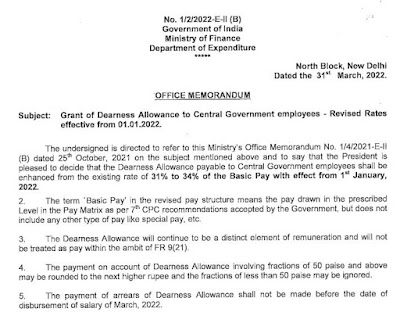
DA Jan 2022 - Grant of Dearness Allowance to Central Government employees - Revised Rates effective from 01.01.2022

 3% DA Hike - Revised Rates effective from 01.01.2022: DoE OM dated 31.03.2022 No. 1/2/2022-E-II (B) Government of India Ministry of Finance...